 Скачать презентацию ANNOUNCING Karmayog Corporate Social Responsibility Ratings 2007 of
5ad47f78b17fe4dc54bdb85a22ce28a8.ppt
- Количество слайдов: 38



ANNOUNCING Karmayog Corporate Social Responsibility Ratings 2007 of the largest 500 Indian Companies www. karmayog. org/csr
Summary of Presentation 1 Easy everyday examples of social responsibility 2 What is Corporate Social Responsibility? 3 Results of the Karmayog CSR Rating 4 How we assigned the CSR Rating 5 Inferences from the CSR rating exercise 6 Our Recommendations for companies 7 Importance of the CSR Ratings for different stakeholders
Easy everyday examples of Social Responsibility
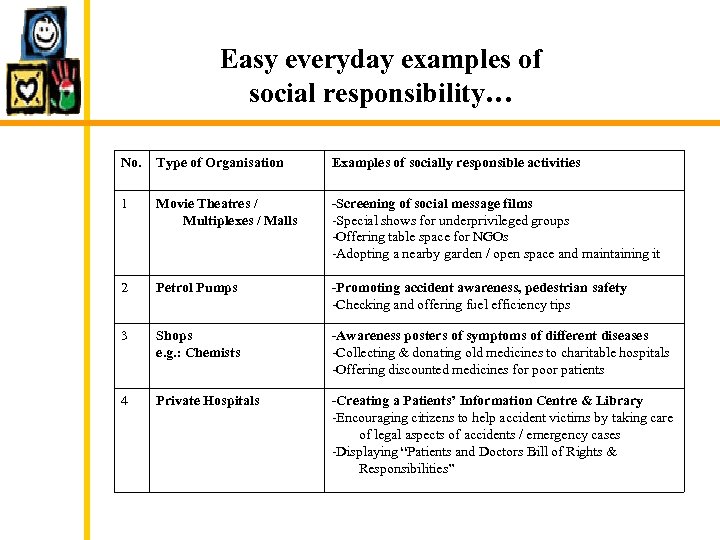
Easy everyday examples of social responsibility… No. Type of Organisation Examples of socially responsible activities 1 Movie Theatres / Multiplexes / Malls -Screening of social message films -Special shows for underprivileged groups -Offering table space for NGOs -Adopting a nearby garden / open space and maintaining it 2 Petrol Pumps -Promoting accident awareness, pedestrian safety -Checking and offering fuel efficiency tips 3 Shops e. g. : Chemists -Awareness posters of symptoms of different diseases -Collecting & donating old medicines to charitable hospitals -Offering discounted medicines for poor patients 4 Private Hospitals -Creating a Patients’ Information Centre & Library -Encouraging citizens to help accident victims by taking care of legal aspects of accidents / emergency cases -Displaying “Patients and Doctors Bill of Rights & Responsibilities”
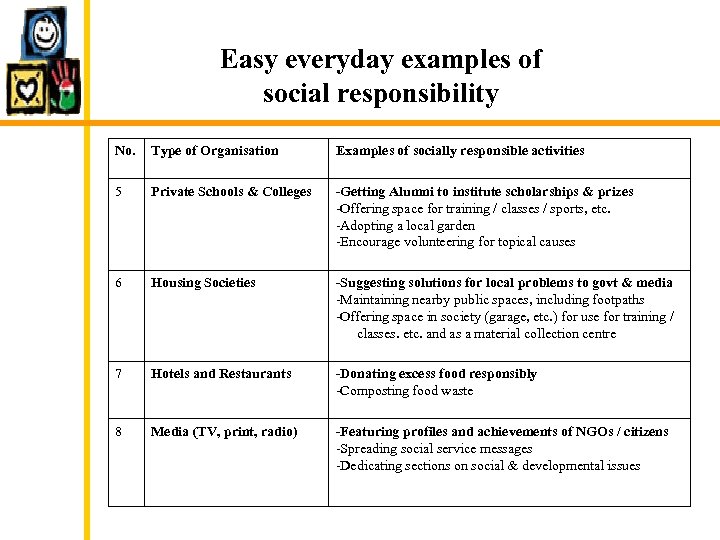
Easy everyday examples of social responsibility No. Type of Organisation Examples of socially responsible activities 5 Private Schools & Colleges -Getting Alumni to institute scholarships & prizes -Offering space for training / classes / sports, etc. -Adopting a local garden -Encourage volunteering for topical causes 6 Housing Societies -Suggesting solutions for local problems to govt & media -Maintaining nearby public spaces, including footpaths -Offering space in society (garage, etc. ) for use for training / classes. etc. and as a material collection centre 7 Hotels and Restaurants -Donating excess food responsibly -Composting food waste 8 Media (TV, print, radio) -Featuring profiles and achievements of NGOs / citizens -Spreading social service messages -Dedicating sections on social & developmental issues
So what is Corporate Social Responsibility?
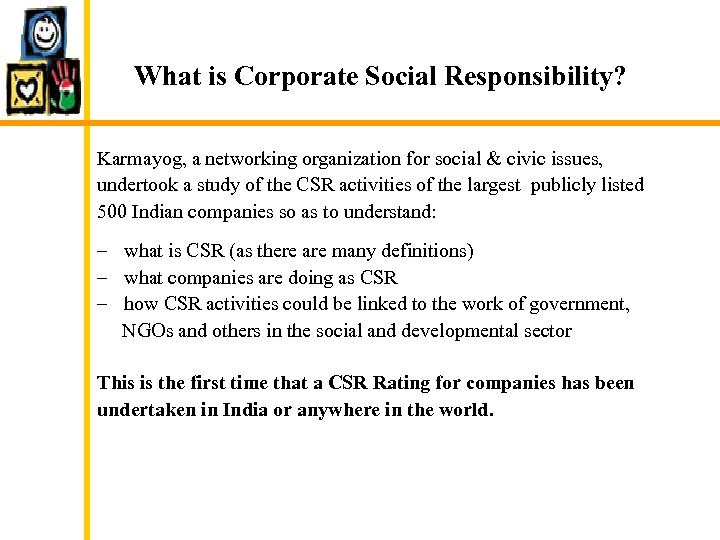
What is Corporate Social Responsibility? Karmayog, a networking organization for social & civic issues, undertook a study of the CSR activities of the largest publicly listed 500 Indian companies so as to understand: – what is CSR (as there are many definitions) – what companies are doing as CSR – how CSR activities could be linked to the work of government, NGOs and others in the social and developmental sector This is the first time that a CSR Rating for companies has been undertaken in India or anywhere in the world.
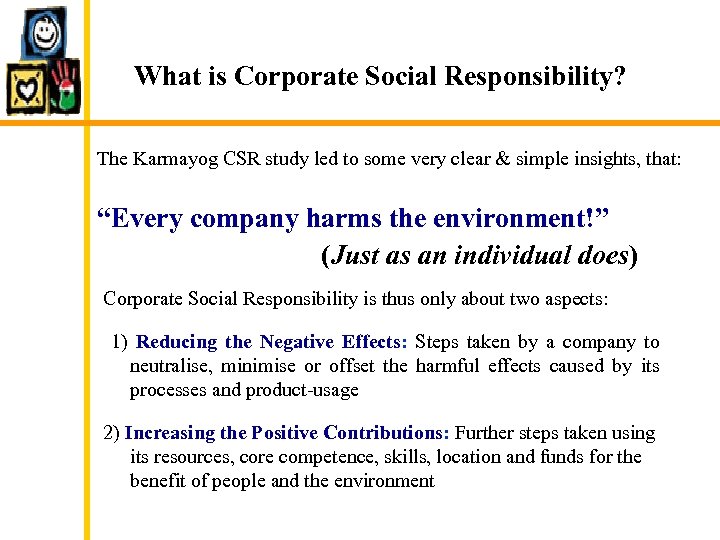
What is Corporate Social Responsibility? The Karmayog CSR study led to some very clear & simple insights, that: “Every company harms the environment!” (Just as an individual does) Corporate Social Responsibility is thus only about two aspects: 1) Reducing the Negative Effects: Steps taken by a company to neutralise, minimise or offset the harmful effects caused by its processes and product-usage 2) Increasing the Positive Contributions: Further steps taken using its resources, core competence, skills, location and funds for the benefit of people and the environment
Results of the Karmayog CSR Rating 2007
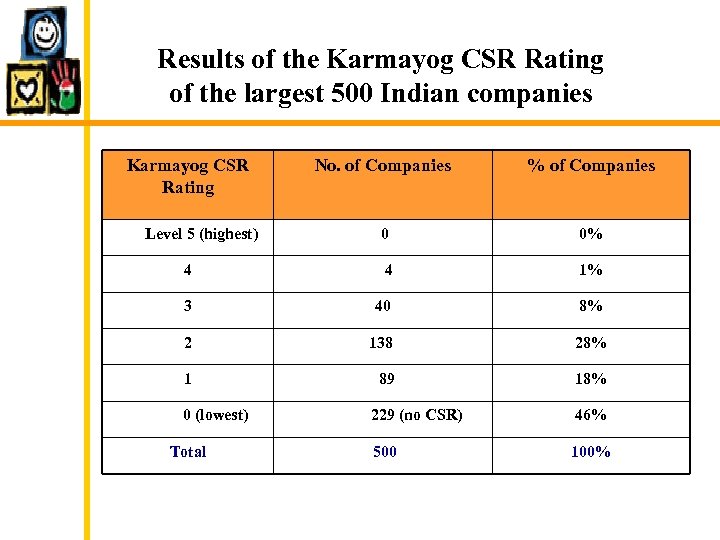
Results of the Karmayog CSR Rating of the largest 500 Indian companies Karmayog CSR Rating No. of Companies % of Companies 0 0% 4 4 1% 3 40 8% 2 138 28% 1 89 18% Level 5 (highest) 0 (lowest) Total 229 (no CSR) 46% 500 100%
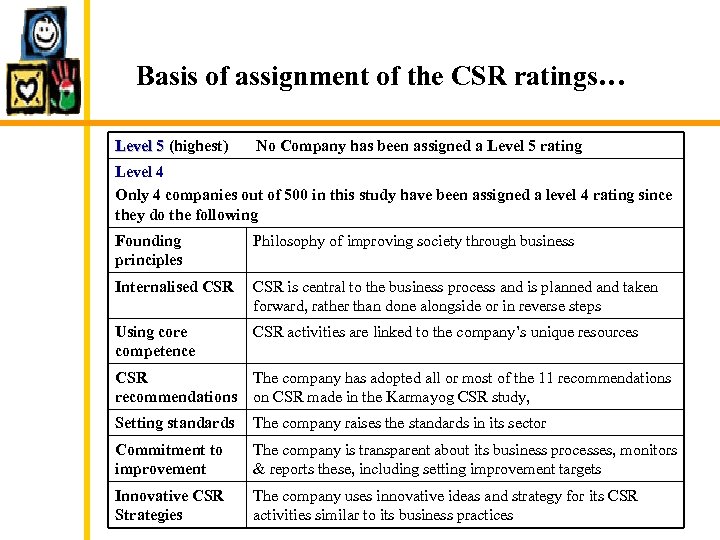
Basis of assignment of the CSR ratings… Level 5 (highest) No Company has been assigned a Level 5 rating Level 4 Only 4 companies out of 500 in this study have been assigned a level 4 rating since they do the following Founding principles Philosophy of improving society through business Internalised CSR is central to the business process and is planned and taken forward, rather than done alongside or in reverse steps Using core competence CSR activities are linked to the company’s unique resources CSR recommendations The company has adopted all or most of the 11 recommendations on CSR made in the Karmayog CSR study, Setting standards The company raises the standards in its sector Commitment to improvement The company is transparent about its business processes, monitors & reports these, including setting improvement targets Innovative CSR Strategies The company uses innovative ideas and strategy for its CSR activities similar to its business practices
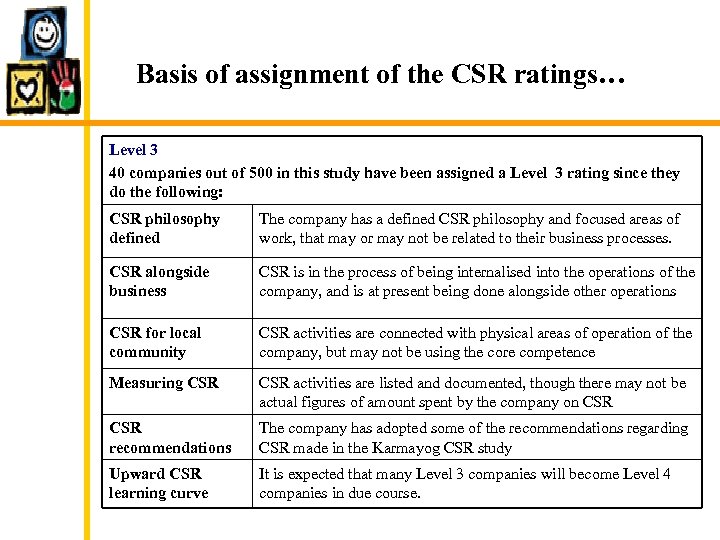
Basis of assignment of the CSR ratings… Level 3 40 companies out of 500 in this study have been assigned a Level 3 rating since they do the following: CSR philosophy defined The company has a defined CSR philosophy and focused areas of work, that may or may not be related to their business processes. CSR alongside business CSR is in the process of being internalised into the operations of the company, and is at present being done alongside other operations CSR for local community CSR activities are connected with physical areas of operation of the company, but may not be using the core competence Measuring CSR activities are listed and documented, though there may not be actual figures of amount spent by the company on CSR recommendations The company has adopted some of the recommendations regarding CSR made in the Karmayog CSR study Upward CSR learning curve It is expected that many Level 3 companies will become Level 4 companies in due course.
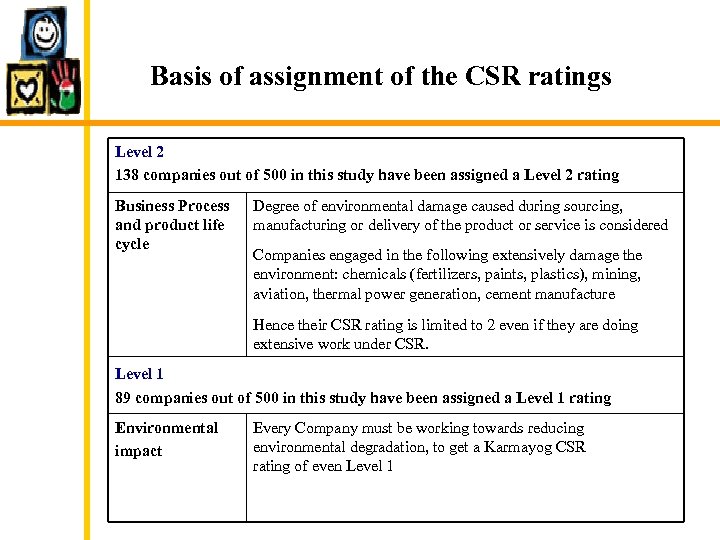
Basis of assignment of the CSR ratings Level 2 138 companies out of 500 in this study have been assigned a Level 2 rating Business Process and product life cycle Degree of environmental damage caused during sourcing, manufacturing or delivery of the product or service is considered Companies engaged in the following extensively damage the environment: chemicals (fertilizers, paints, plastics), mining, aviation, thermal power generation, cement manufacture Hence their CSR rating is limited to 2 even if they are doing extensive work under CSR. Level 1 89 companies out of 500 in this study have been assigned a Level 1 rating Environmental impact Every Company must be working towards reducing environmental degradation, to get a Karmayog CSR rating of even Level 1
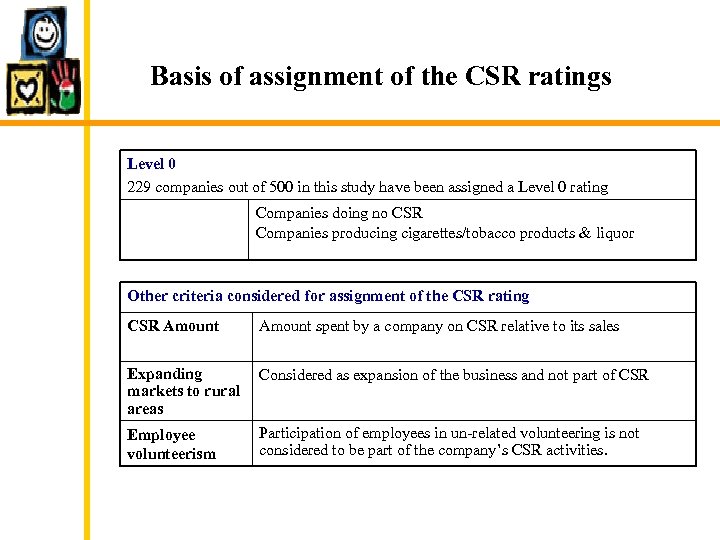
Basis of assignment of the CSR ratings Level 0 229 companies out of 500 in this study have been assigned a Level 0 rating Companies doing no CSR Companies producing cigarettes/tobacco products & liquor Other criteria considered for assignment of the CSR rating CSR Amount spent by a company on CSR relative to its sales Expanding markets to rural areas Considered as expansion of the business and not part of CSR Employee volunteerism Participation of employees in un-related volunteering is not considered to be part of the company’s CSR activities.
Inferences from the Karmayog CSR rating exercise
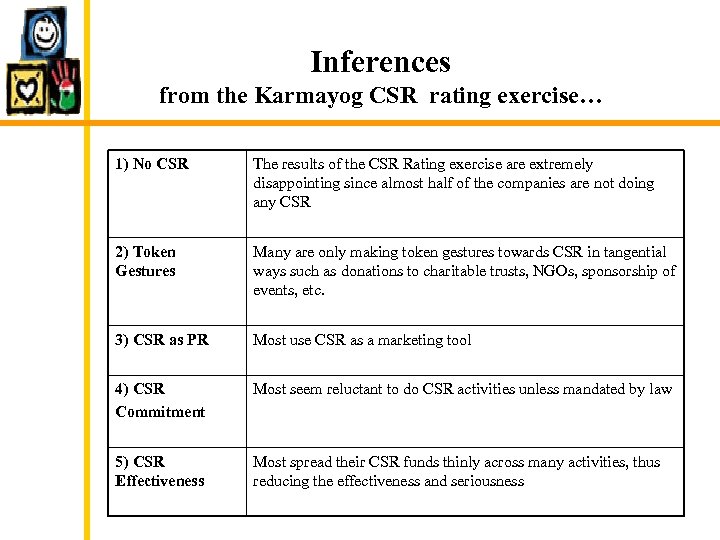
Inferences from the Karmayog CSR rating exercise… 1) No CSR The results of the CSR Rating exercise are extremely disappointing since almost half of the companies are not doing any CSR 2) Token Gestures Many are only making token gestures towards CSR in tangential ways such as donations to charitable trusts, NGOs, sponsorship of events, etc. 3) CSR as PR Most use CSR as a marketing tool 4) CSR Commitment Most seem reluctant to do CSR activities unless mandated by law 5) CSR Effectiveness Most spread their CSR funds thinly across many activities, thus reducing the effectiveness and seriousness
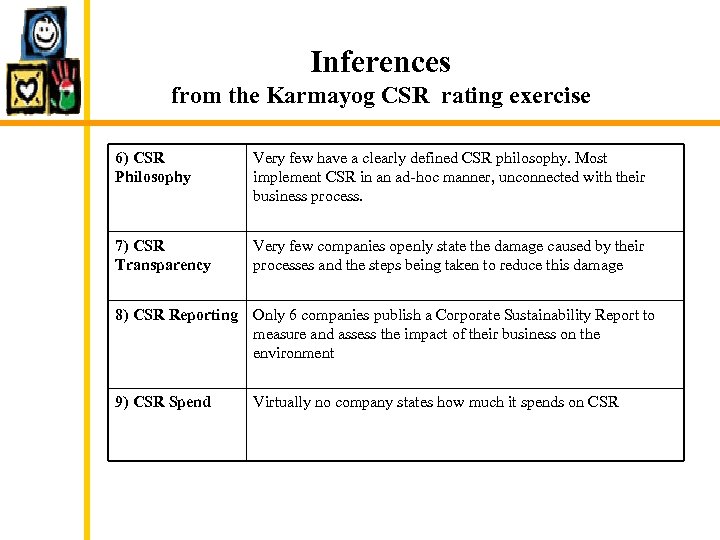
Inferences from the Karmayog CSR rating exercise 6) CSR Philosophy Very few have a clearly defined CSR philosophy. Most implement CSR in an ad-hoc manner, unconnected with their business process. 7) CSR Transparency Very few companies openly state the damage caused by their processes and the steps being taken to reduce this damage 8) CSR Reporting Only 6 companies publish a Corporate Sustainability Report to measure and assess the impact of their business on the environment 9) CSR Spend Virtually no company states how much it spends on CSR
Industry Sector–wise analysis of the CSR activities of the largest 500 Indian companies
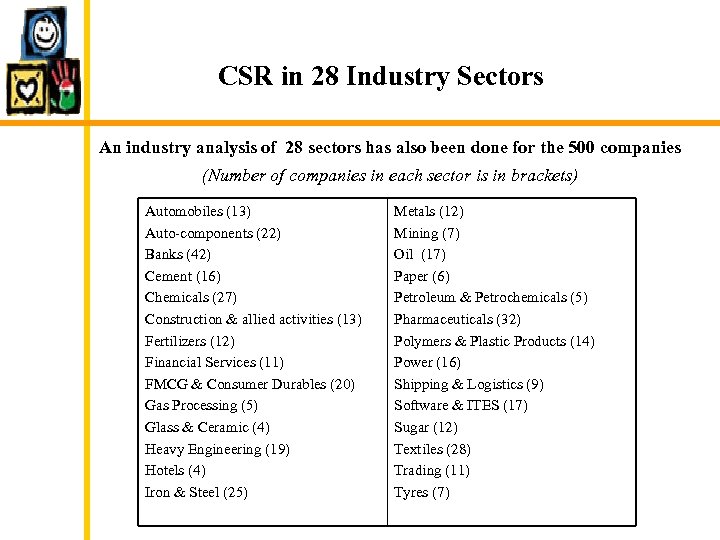
CSR in 28 Industry Sectors An industry analysis of 28 sectors has also been done for the 500 companies (Number of companies in each sector is in brackets) Automobiles (13) Auto-components (22) Banks (42) Cement (16) Chemicals (27) Construction & allied activities (13) Fertilizers (12) Financial Services (11) FMCG & Consumer Durables (20) Gas Processing (5) Glass & Ceramic (4) Heavy Engineering (19) Hotels (4) Iron & Steel (25) Metals (12) Mining (7) Oil (17) Paper (6) Petroleum & Petrochemicals (5) Pharmaceuticals (32) Polymers & Plastic Products (14) Power (16) Shipping & Logistics (9) Software & ITES (17) Sugar (12) Textiles (28) Trading (11) Tyres (7)
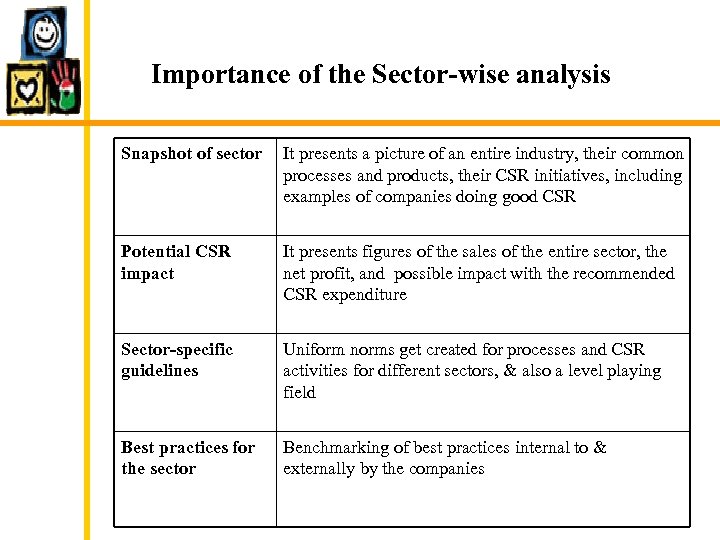
Importance of the Sector-wise analysis Snapshot of sector It presents a picture of an entire industry, their common processes and products, their CSR initiatives, including examples of companies doing good CSR Potential CSR impact It presents figures of the sales of the entire sector, the net profit, and possible impact with the recommended CSR expenditure Sector-specific guidelines Uniform norms get created for processes and CSR activities for different sectors, & also a level playing field Best practices for the sector Benchmarking of best practices internal to & externally by the companies
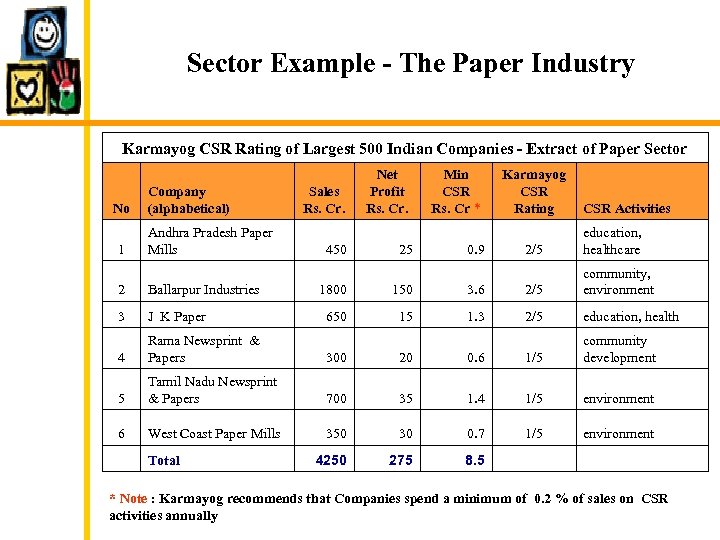
Sector Example - The Paper Industry Karmayog CSR Rating of Largest 500 Indian Companies - Extract of Paper Sector No 1 Company (alphabetical) Andhra Pradesh Paper Mills Sales Rs. Cr. 450 Net Profit Rs. Cr. 25 CSR Activities 2/5 0. 9 education, healthcare 1800 150 3. 6 2/5 650 15 1. 3 2/5 education, health 0. 6 1/5 community development 35 1. 4 1/5 environment 350 30 0. 7 1/5 environment 4250 275 8. 5 Ballarpur Industries 3 J K Paper 4 Rama Newsprint & Papers 300 20 5 Tamil Nadu Newsprint & Papers 700 6 West Coast Paper Mills Total Karmayog CSR Rating community, environment 2 Min CSR Rs. Cr * * Note : Karmayog recommends that Companies spend a minimum of 0. 2 % of sales on CSR activities annually
Compulsory CSR: our 4 Recommendations
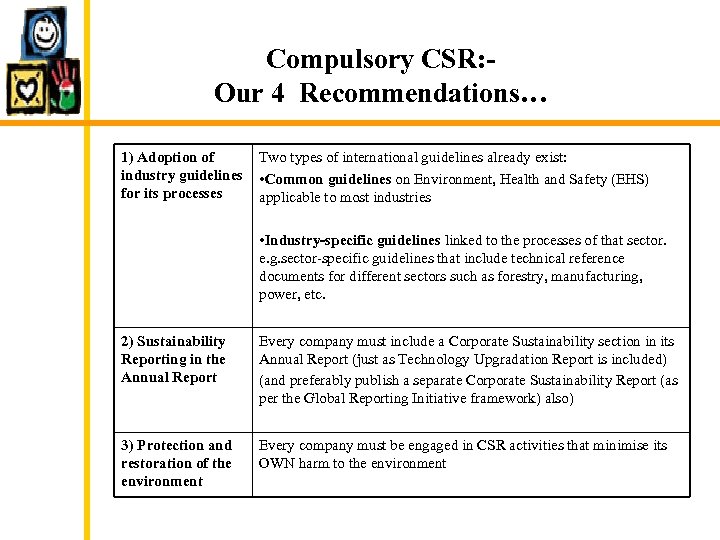
Compulsory CSR: Our 4 Recommendations… 1) Adoption of industry guidelines for its processes Two types of international guidelines already exist: • Common guidelines on Environment, Health and Safety (EHS) applicable to most industries • Industry-specific guidelines linked to the processes of that sector. e. g. sector-specific guidelines that include technical reference documents for different sectors such as forestry, manufacturing, power, etc. 2) Sustainability Reporting in the Annual Report Every company must include a Corporate Sustainability section in its Annual Report (just as Technology Upgradation Report is included) (and preferably publish a separate Corporate Sustainability Report (as per the Global Reporting Initiative framework) also) 3) Protection and restoration of the environment Every company must be engaged in CSR activities that minimise its OWN harm to the environment
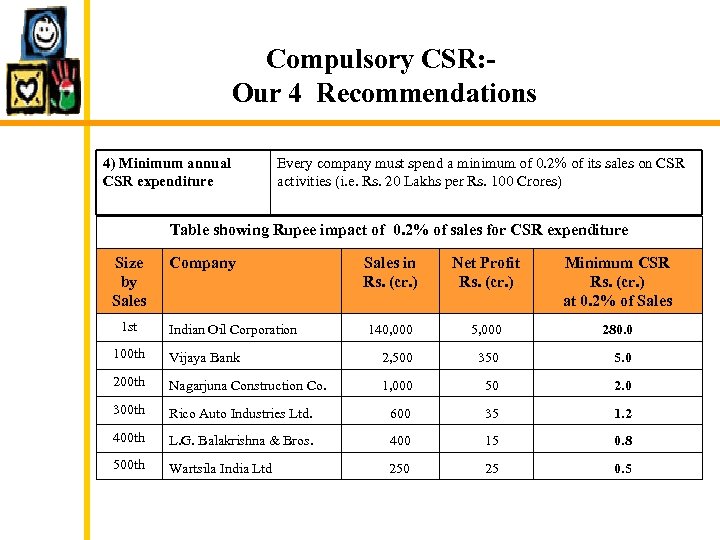
Compulsory CSR: Our 4 Recommendations 4) Minimum annual CSR expenditure Every company must spend a minimum of 0. 2% of its sales on CSR activities (i. e. Rs. 20 Lakhs per Rs. 100 Crores) Table showing Rupee impact of 0. 2% of sales for CSR expenditure Size by Sales in Rs. (cr. ) Net Profit Rs. (cr. ) Minimum CSR Rs. (cr. ) at 0. 2% of Sales Indian Oil Corporation 140, 000 5, 000 280. 0 100 th Vijaya Bank 2, 500 350 5. 0 200 th Nagarjuna Construction Co. 1, 000 50 2. 0 300 th Rico Auto Industries Ltd. 600 35 1. 2 400 th L. G. Balakrishna & Bros. 400 15 0. 8 500 th Wartsila India Ltd 250 25 0. 5 1 st Company
Voluntary CSR: Our 7 Recommendations
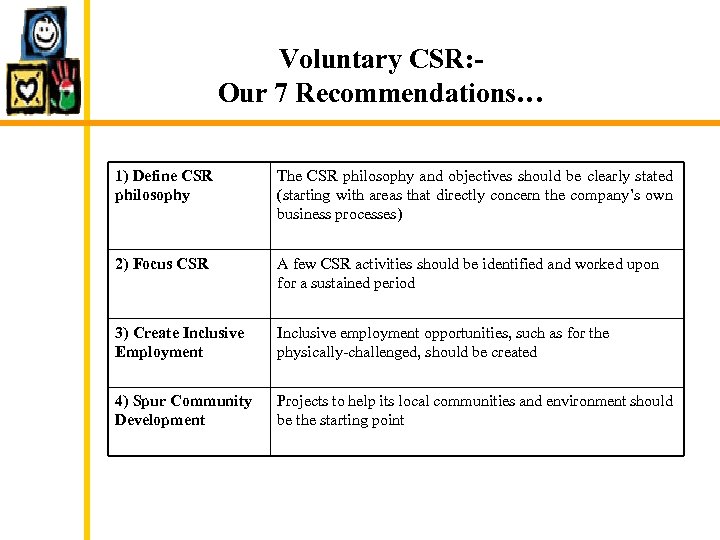
Voluntary CSR: Our 7 Recommendations… 1) Define CSR philosophy The CSR philosophy and objectives should be clearly stated (starting with areas that directly concern the company’s own business processes) 2) Focus CSR A few CSR activities should be identified and worked upon for a sustained period 3) Create Inclusive Employment Inclusive employment opportunities, such as for the physically-challenged, should be created 4) Spur Community Development Projects to help its local communities and environment should be the starting point
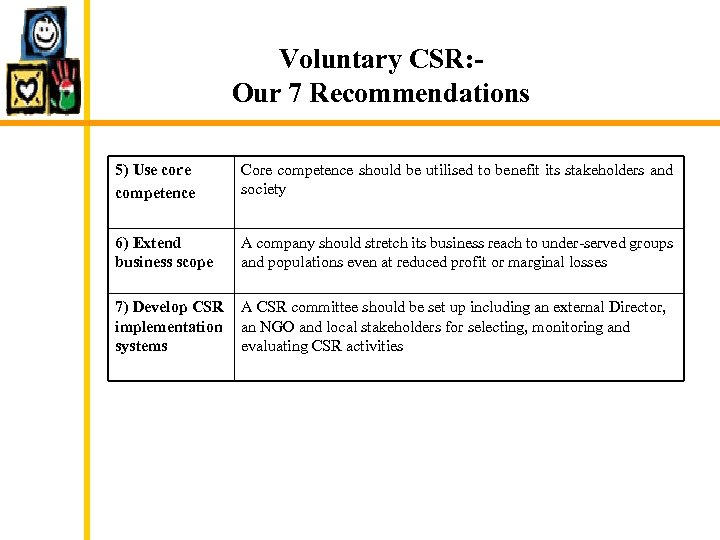
Voluntary CSR: Our 7 Recommendations 5) Use core competence Core competence should be utilised to benefit its stakeholders and society 6) Extend business scope A company should stretch its business reach to under-served groups and populations even at reduced profit or marginal losses 7) Develop CSR implementation systems A CSR committee should be set up including an external Director, an NGO and local stakeholders for selecting, monitoring and evaluating CSR activities
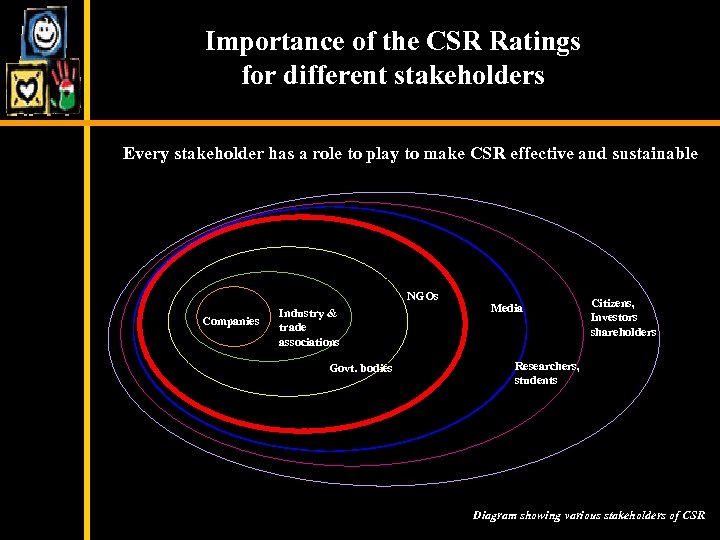
Importance of the CSR Ratings for different stakeholders Every stakeholder has a role to play to make CSR effective and sustainable NGOs Companies Industry & trade associations Govt. bodies Media Citizens, Investors shareholders Researchers, students Diagram showing various stakeholders of CSR
Importance of the CSR Ratings for the Board of Directors • To sensitise directors & employees about the value of CSR • To implement international CSR guidelines and norms • To identify possible CSR activities • To learn from others’ CSR initiatives
Importance of the CSR Ratings for Government bodies • To develop industry-wise guidelines for CSR • To introduce laws to get companies to work effectively towards reducing environmental damage, and restoring the damage done by them (e. g. polluter-pays’ principle) • To introduce incentives to reward companies engaged in effective CSR • To enable companies to partner with government in implementing social welfare and developmental schemes (e. g. adoption of ITI’s)
Importance of the CSR Ratings for Industry & Trade Associations • To get a snapshot of the state of CSR & set benchmarks for companies to follow • To understand the huge scale and magnitude of the benefits that are possible if an entire sector spends even the recommended minimum amount on CSR • To work with Government and NGOs and international organisations to upgrade and improve CSR activities and to set milestones for companies • To prepare case studies, highlight best practices & give awards • To provide consultation on CSR
Importance of the CSR Ratings for NGOs • To know about the areas of CSR work undertaken by companies, thus enabling partnerships with them • To be able to identify companies which are not doing CSR or doing so in a token manner, so as to approach these companies to initiate meaningful projects • To assist companies to formulate CSR objectives, implement CSR activities, and monitor and evaluate their CSR activities
Importance of the CSR Ratings for Media • To stop eulogising corporate leaders whose companies are damaging the environment & harming lives • To present a clear view of CSR that is separate from philanthropy, charity, marketing, advertising, or expanding business scope, and to sensitise the public about this • To highlight companies practising good CSR, and to negate those companies which are actually engaged in marketing or advertising of their products or services under the guise of CSR • To encourage and enable business publications to have a regular feature or column dedicated to CSR initiatives along with feedback from NGOs and other stakeholders
Importance of the CSR Ratings for Researchers & Students For researchers • To study CSR practices & results • To influence the shaping of CSR policy and regulations For students and colleges / institutions • To be sensitised about the role and responsibility of companies • To understand the impact and consequences of everyday processes and actions • To develop a holistic view of life and living
Importance of the CSR Ratings for Citizens, Investors, Shareholders • To understand that as consumers and stakeholders of companies, we can and must influence companies to change harmful polices and adopt proper CSR practices (due to the huge impact and power that companies have on people and the environment) • To ensure that through our purchase choices, we get desirable values for society to be reflected in how companies do business
Closing Statement… • Enlightened businesses worldwide, small and large, have begun to realise that responsible practices enhance profitability & ensure long-term survival. Companies not doing CSR will not survive – it’s only a question of when. • For those companies which disrespect the environment or living beings, we, as responsible citizens, need to individually and collectively, reward or penalise them through our voices and our wallets
Closing Statement Jubilant Organosys, a pharmaceutical company, while acknowledging the harm caused in manufacturing its chemicals, actively works to minimise the damage. It is one of the 6 Indian companies that publish a Corporate Sustainability Report. “There are stakeholders who can voice their concerns today while we engage them. There is another category of stakeholders like flora, fauna and physical environment, whose voices we cannot hear, but who are affected by anthropogenic impacts of global population. The future generation is another important group of stakeholders that does not exist today but will be impacted by our activities…………. ” Jubilant Organosys Limited, Corporate Sustainability Report, FY 2007
Karmayog Corporate Social Responsibility Ratings 2007 of the largest 500 Indian Companies
Скачать презентацию ANNOUNCING Karmayog Corporate Social Responsibility Ratings 2007 of
5ad47f78b17fe4dc54bdb85a22ce28a8.ppt