


 Скачать презентацию Announcements o Wednesday Evaluations Review n n o
5e707ec286b1a399fc97da702a4e77d0.ppt
- Количество слайдов: 20
 Announcements o Wednesday: Evaluations, Review n n o Bring your notes and questions CLUE that evening Advertisement--Friday: Prof. Emily Bender
 Today o o History of English Types of language change n n n Sound Morphological Semantic Readings: 12. 3, 12. 6, 12. 8
 Historical Linguistics Concerned with o How languages are related to one another o How languages change over time
 A (Brief) History of English o o Old English: Fæder ure þu þe eart on heofonum Si þin nama gehalgod … Middle English: Oure fadir that art in heuenes, halewid be thi name … Early Modern English: Our father which art in heaven, hallowed be thy name… Modern English: Our father, who is in heaven, May your name be kept holy…
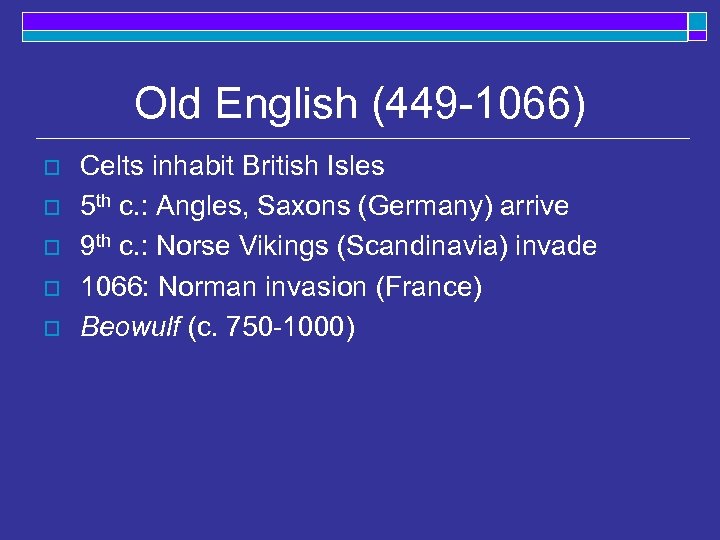 Old English (449 -1066) o o o Celts inhabit British Isles 5 th c. : Angles, Saxons (Germany) arrive 9 th c. : Norse Vikings (Scandinavia) invade 1066: Norman invasion (France) Beowulf (c. 750 -1000)
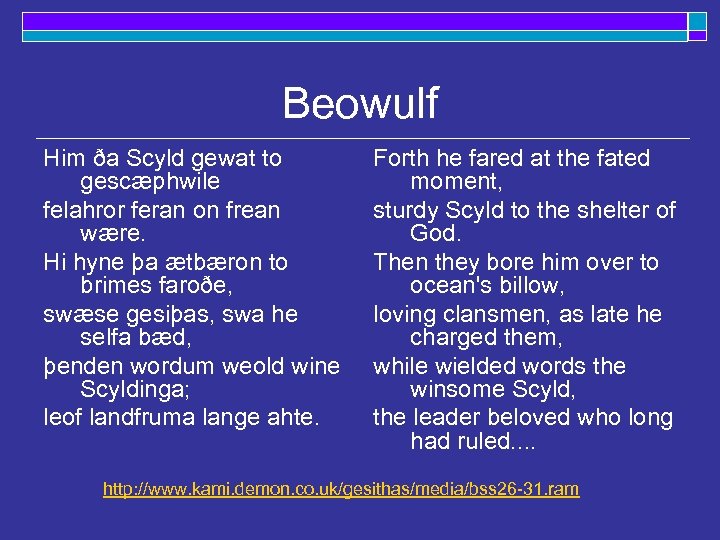 Beowulf Him ða Scyld gewat to gescæphwile felahror feran on frean wære. Hi hyne þa ætbæron to brimes faroðe, swæse gesiþas, swa he selfa bæd, þenden wordum weold wine Scyldinga; leof landfruma lange ahte. Forth he fared at the fated moment, sturdy Scyld to the shelter of God. Then they bore him over to ocean's billow, loving clansmen, as late he charged them, while wielded words the winsome Scyld, the leader beloved who long had ruled. . http: //www. kami. demon. co. uk/gesithas/media/bss 26 -31. ram
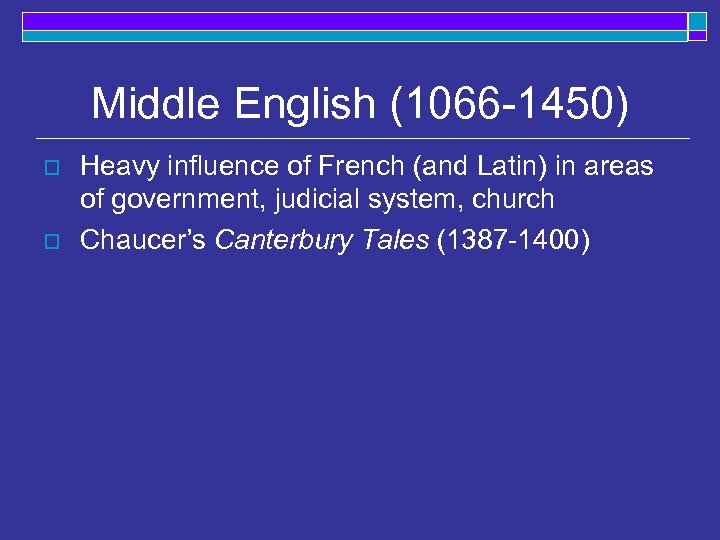 Middle English (1066 -1450) o o Heavy influence of French (and Latin) in areas of government, judicial system, church Chaucer’s Canterbury Tales (1387 -1400)
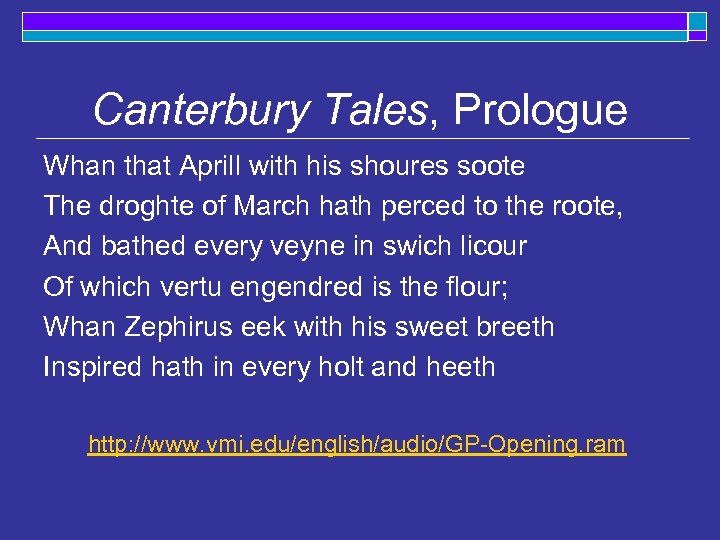 Canterbury Tales, Prologue Whan that Aprill with his shoures soote The droghte of March hath perced to the roote, And bathed every veyne in swich licour Of which vertu engendred is the flour; Whan Zephirus eek with his sweet breeth Inspired hath in every holt and heeth http: //www. vmi. edu/english/audio/GP-Opening. ram
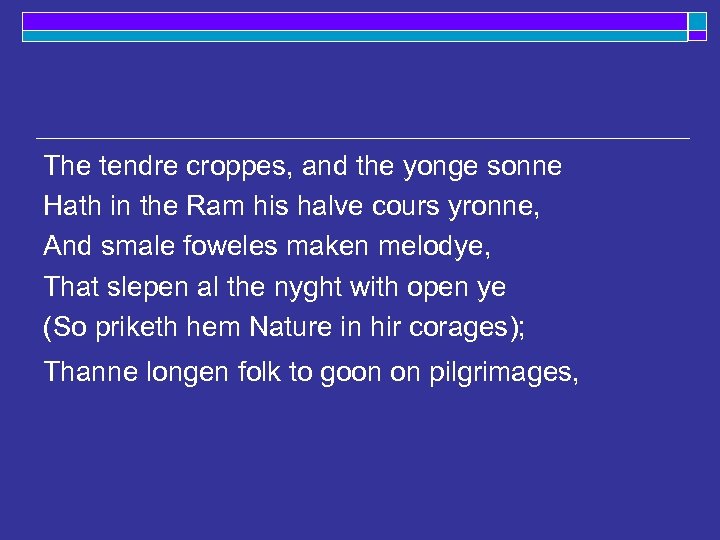 The tendre croppes, and the yonge sonne Hath in the Ram his halve cours yronne, And smale foweles maken melodye, That slepen al the nyght with open ye (So priketh hem Nature in hir corages); Thanne longen folk to goon on pilgrimages,
 (Early) Modern English (1450 -1700) o o o End of 15 th c. : First steps of English standardization w/ William Caxton’s printing press Works of Shakespeare (1564 -1616) The King James Bible (1611)
 Language change o Sound change n n o o Phonetic Phonological Morphological change Lexical/semantic change
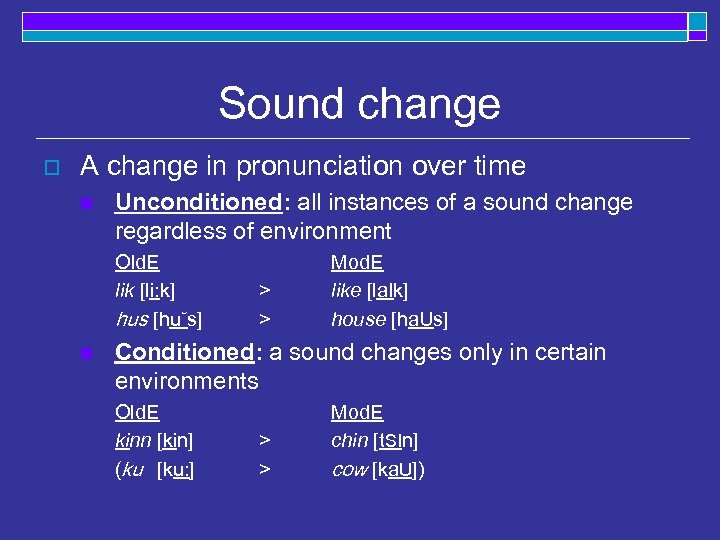 Sound change o A change in pronunciation over time n Unconditioned: all instances of a sound change regardless of environment Old. E lik [li: k] hus [hu˘s] n > > Mod. E like [la. Ik] house [ha. Us] Conditioned: a sound changes only in certain environments Old. E kinn [kin] (ku [ku: ] > > Mod. E chin [t. SIn] cow [ka. U])
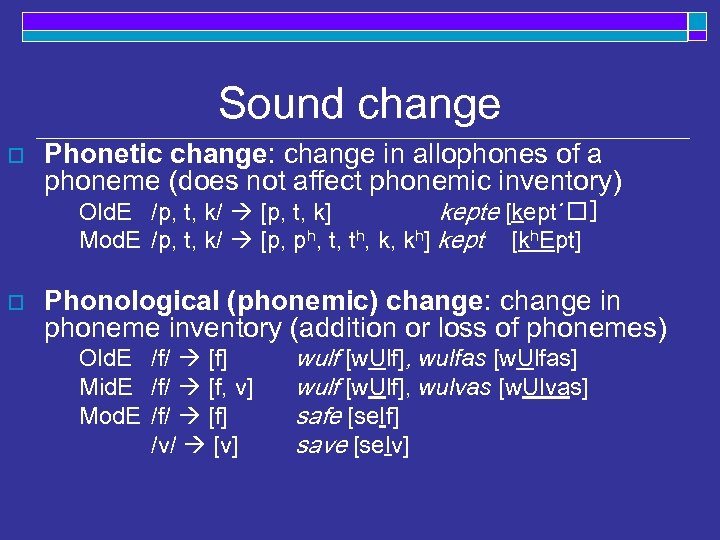 Sound change o Phonetic change: change in allophones of a phoneme (does not affect phonemic inventory) Old. E /p, t, k/ [p, t, k] kepte [kept´ ] Mod. E /p, t, k/ [p, ph, t, th, k, kh] kept [kh. Ept] o Phonological (phonemic) change: change in phoneme inventory (addition or loss of phonemes) Old. E /f/ [f] Mid. E /f/ [f, v] Mod. E /f/ [f] /v/ [v] wulf [w. Ulf], wulfas [w. Ulfas] wulf [w. Ulf], wulvas [w. Ulvas] safe [se. If] save [se. Iv]
 Great Vowel Shift o o o 15 th century Unconditioned sound change between Mid. E and Mod. E Responsible for many of the spelling peculiarities of English
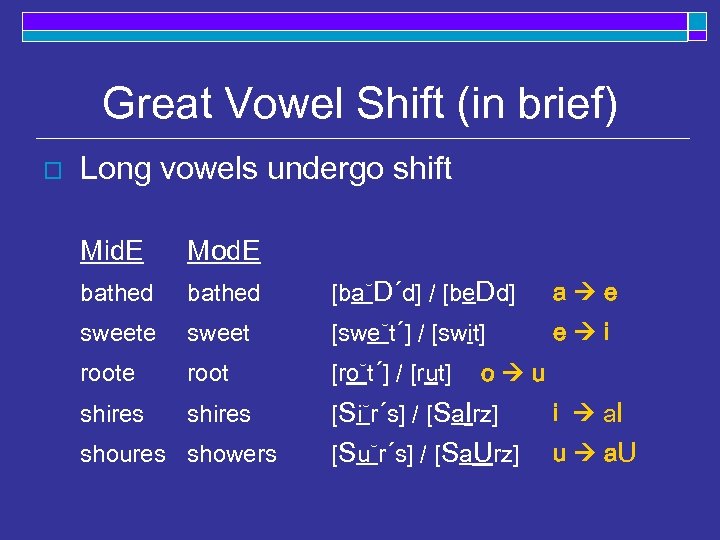 Great Vowel Shift (in brief) o Long vowels undergo shift Mid. E Mod. E bathed [ba˘D´d] / [be. Dd] a e sweet [swe˘t´] / [swit] e i roote root [ro˘t´] / [rut] shires [Si˘r´s] / [Sa. Irz] i a. I [Su˘r´s] / [Sa. Urz] u a. U shoures showers o u
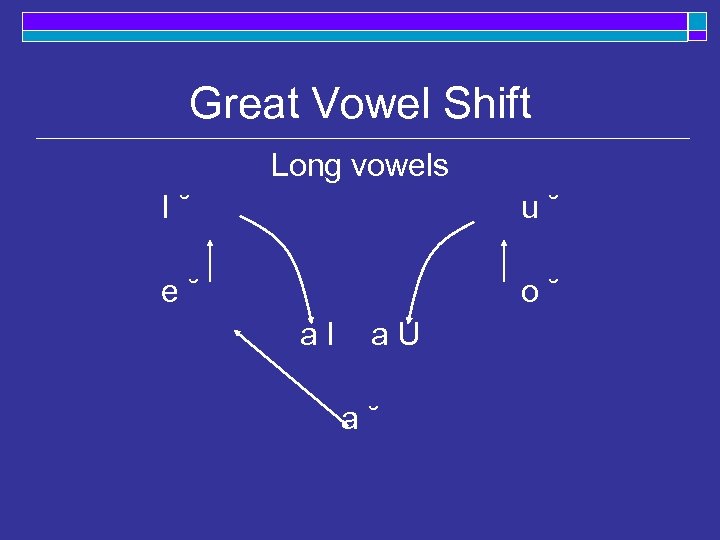 Great Vowel Shift Long vowels I˘ u˘ e˘ o˘ a. I a. U a˘
![Morphological change o Change in the morphology over time Mid. E clomb [klom] o](https://present5.com/presentation/5e707ec286b1a399fc97da702a4e77d0/image-17.jpg "Morphological change o Change in the morphology over time Mid. E clomb [klom] o") Morphological change o Change in the morphology over time Mid. E clomb [klom] o > Mod. E climbed [kla. Imd] (Proportional) Analogy: a form changes to be more like another, usually to make a pattern more regular timed rhymed climb ? ?
Morphological change o Change in the morphology over time Mid. E clomb [klom] o > Mod. E climbed [kla. Imd] (Proportional) Analogy: a form changes to be more like another, usually to make a pattern more regular timed rhymed climb ? ?
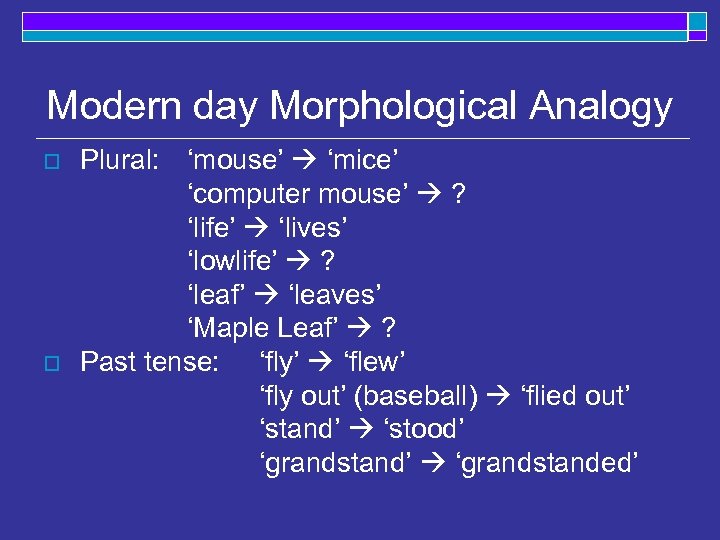 Modern day Morphological Analogy o o Plural: ‘mouse’ ‘mice’ ‘computer mouse’ ? ‘life’ ‘lives’ ‘lowlife’ ? ‘leaf’ ‘leaves’ ‘Maple Leaf’ ? Past tense: ‘fly’ ‘flew’ ‘fly out’ (baseball) ‘flied out’ ‘stand’ ‘stood’ ‘grandstand’ ‘grandstanded’
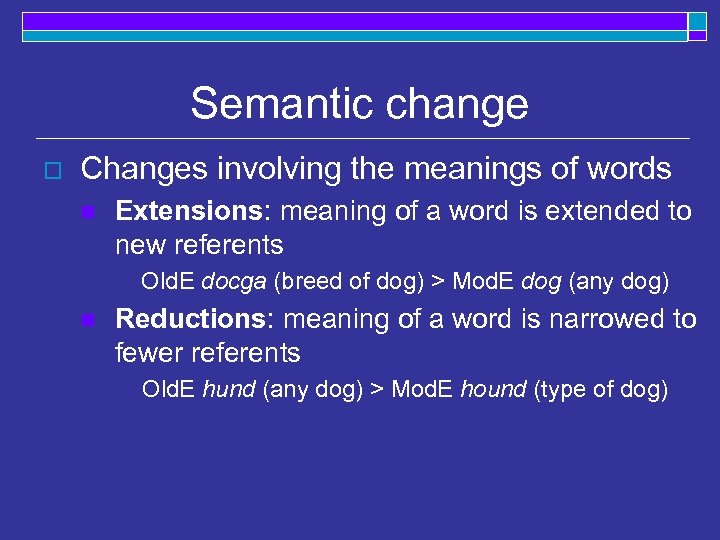 Semantic change o Changes involving the meanings of words n Extensions: meaning of a word is extended to new referents Old. E docga (breed of dog) > Mod. E dog (any dog) n Reductions: meaning of a word is narrowed to fewer referents Old. E hund (any dog) > Mod. E hound (type of dog)
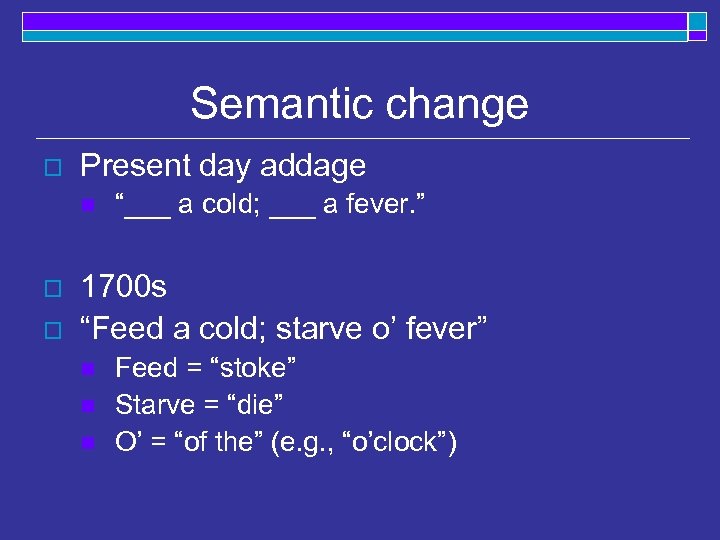 Semantic change o Present day addage n o o “___ a cold; ___ a fever. ” 1700 s “Feed a cold; starve o’ fever” n n n Feed = “stoke” Starve = “die” O’ = “of the” (e. g. , “o’clock”)