


 Скачать презентацию Announcements o Revised Final Exam date o THURSDAY
b263413a140e40965b161c340af64d19.ppt
- Количество слайдов: 15
 Announcements o Revised Final Exam date: o THURSDAY 03/15/2007 08: 30 -10: 20 BAG 131
 Today o o What is morphology? Types of morphemes Readings: 5. 1, 5. 3, 5. 4
 Morphology o The study of words and the rules for word formation in a language
 What is a word? o o o A meaningful unit of language that can stand on its own Stored in mental lexicon w/ information about its ‘part of speech’ (noun, verb, adj. , etc. ) Composed of one or more morphemes
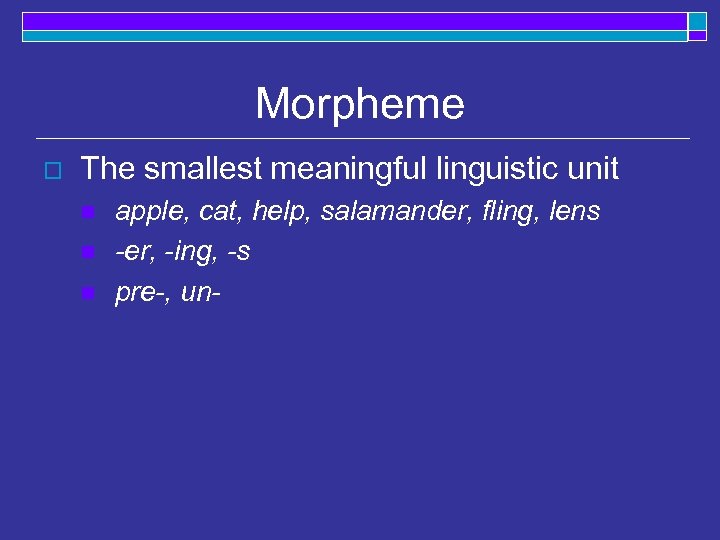 Morpheme o The smallest meaningful linguistic unit n n n apple, cat, help, salamander, fling, lens -er, -ing, -s pre-, un-
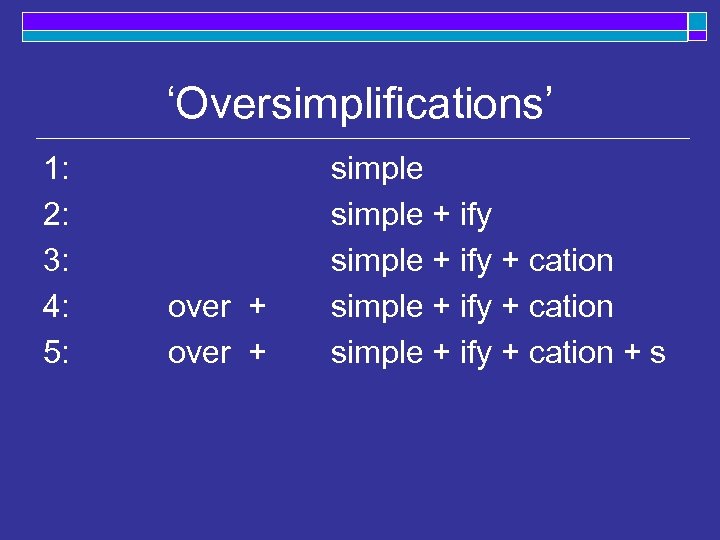 ‘Oversimplifications’ 1: 2: 3: 4: 5: over + simple + ify + cation simple + ify + cation + s
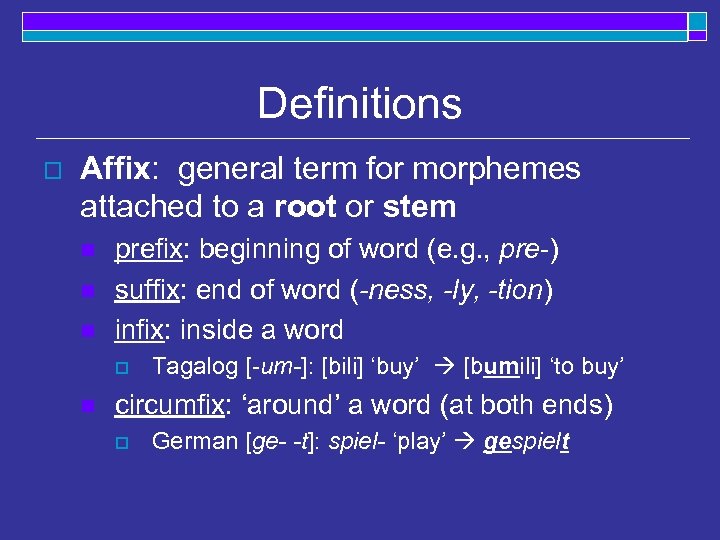 Definitions o Affix: general term for morphemes attached to a root or stem n n n prefix: beginning of word (e. g. , pre-) suffix: end of word (-ness, -ly, -tion) infix: inside a word o n Tagalog [-um-]: [bili] ‘buy’ [bumili] ‘to buy’ circumfix: ‘around’ a word (at both ends) o German [ge- -t]: spiel- ‘play’ gespielt
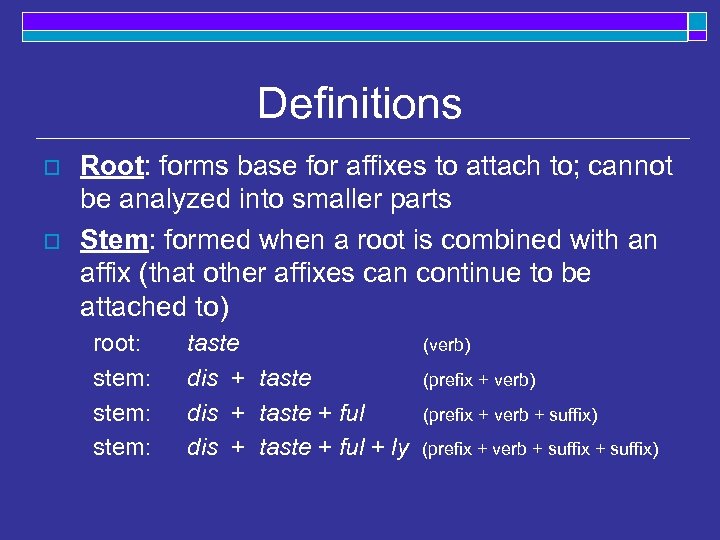 Definitions o o Root: forms base for affixes to attach to; cannot be analyzed into smaller parts Stem: formed when a root is combined with an affix (that other affixes can continue to be attached to) root: stem: taste dis + taste + ful + ly (verb) (prefix + verb + suffix)
 Types of morphemes o o o Bound vs. Free Derivational vs. Inflectional Content vs. Function
 Free vs. Bound morphemes o Free morphemes: n can occur as an independent word all by themselves o Simple words: cat, eat, green, pumpkin, the, is
 Free vs. Bound morphemes o Bound morphemes: n Cannot stand alone, but must be attached to other morphemes o o Affixes: un-, pre-, dis-, -ly, -ness, -tion Bound roots: -ceive (conceive, receive, deceive, perceive) -sist (consist, resist, desist, persist)
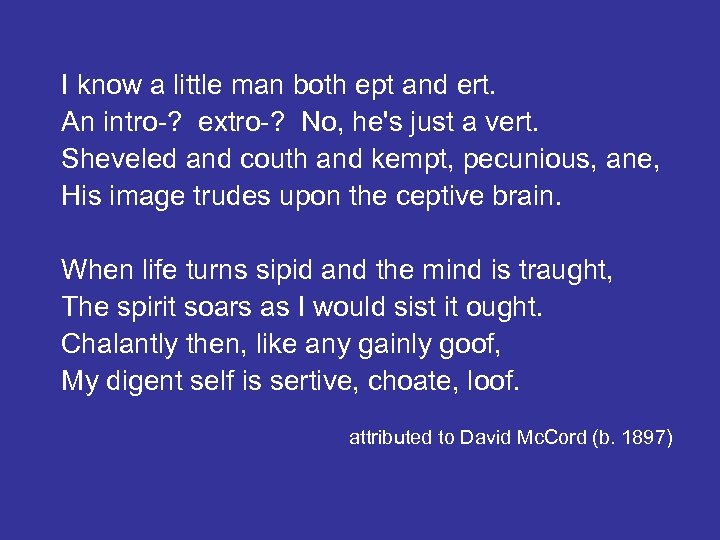 I know a little man both ept and ert. An intro-? extro-? No, he's just a vert. Sheveled and couth and kempt, pecunious, ane, His image trudes upon the ceptive brain. When life turns sipid and the mind is traught, The spirit soars as I would sist it ought. Chalantly then, like any gainly goof, My digent self is sertive, choate, loof. attributed to David Mc. Cord (b. 1897)
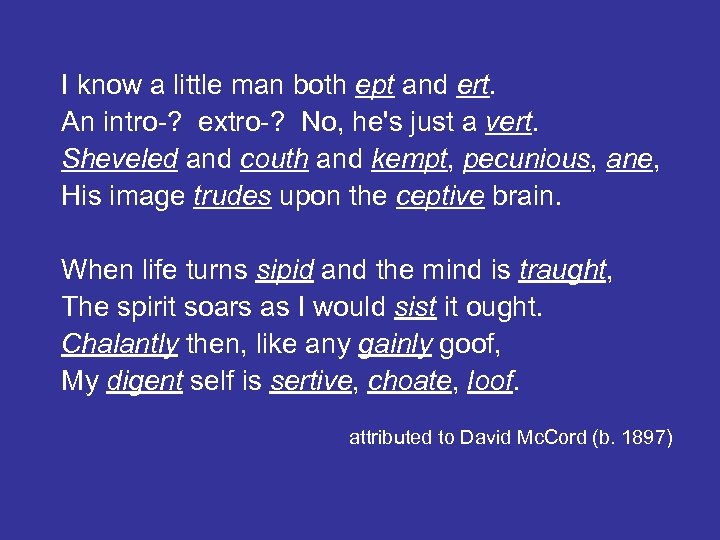 I know a little man both ept and ert. An intro-? extro-? No, he's just a vert. Sheveled and couth and kempt, pecunious, ane, His image trudes upon the ceptive brain. When life turns sipid and the mind is traught, The spirit soars as I would sist it ought. Chalantly then, like any gainly goof, My digent self is sertive, choate, loof. attributed to David Mc. Cord (b. 1897)
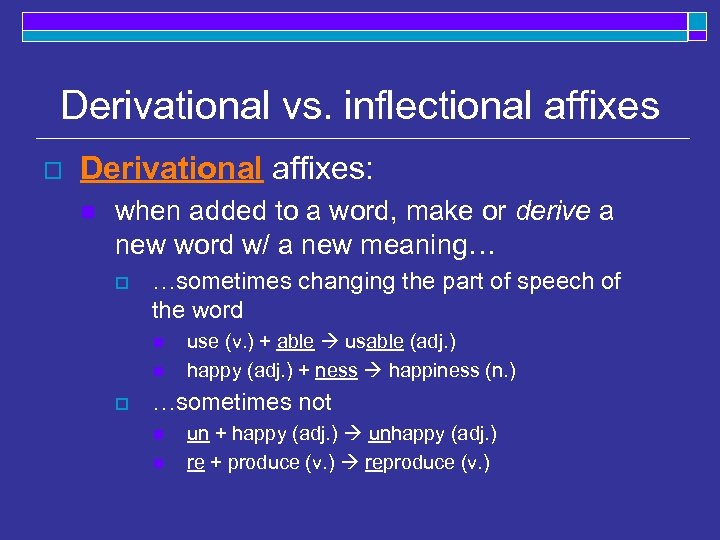 Derivational vs. inflectional affixes o Derivational affixes: n when added to a word, make or derive a new word w/ a new meaning… o …sometimes changing the part of speech of the word n n o use (v. ) + able usable (adj. ) happy (adj. ) + ness happiness (n. ) …sometimes not n n un + happy (adj. ) unhappy (adj. ) re + produce (v. ) reproduce (v. )
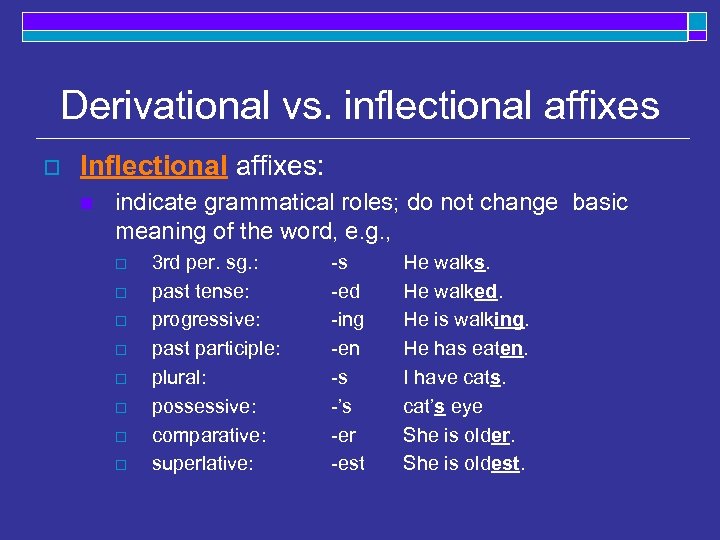 Derivational vs. inflectional affixes o Inflectional affixes: n indicate grammatical roles; do not change basic meaning of the word, e. g. , o o o o 3 rd per. sg. : past tense: progressive: past participle: plural: possessive: comparative: superlative: -s -ed -ing -en -s -’s -er -est He walks. He walked. He is walking. He has eaten. I have cats. cat’s eye She is older. She is oldest.