


 Скачать презентацию Announcements Nov 8 2004 Agriculture III
d6cc4b8d25b1092f515f07fde05bb337.ppt
- Количество слайдов: 30
 Announcements – Nov. 8, 2004
 Agriculture III Lecture Objectives: 1. What alternatives to fertilizers & pesticides exist? 2. What are GMOs? 3. How do GMOs influence our lives? 4. What are the impacts of agriculture on soil?
 Review o Chemical fertilizers n n o pros: increase yields cons: reliance on oil, only replace nutrients, runoff to aquatic systems Chemical pesticides n n pros: increase yields, human health, decrease labor cons: selects for resistance, toxic effects to non-target organisms, persistence in environment
 Alternative Agriculture o Crop rotation o Sustainable agriculture o Organic agriculture o Integrated pest management
 Crop rotation Plant different, specific crop in a field each year o Pros n n o Reduce build-up of pests specific to one crop Retain or enhance soil nutrients Cons n n Requires more equipment Insects developing 2 -year diapause
 Sustainable agriculture o Seeks ways to raise food without degrading agricultural land harming surrounding ecosystems n o Eliminate soil erosion & loss of productivity Methods: n n Modify traditional practices (e. g. contour farming, conservation tillage) Close evaluation of conditions o apply fertilizer & pesticides only where & when needed
 Organic agriculture No chemical fertilizers or pesticides used o Animal manure as fertilizer o Crop rotation to enhance productivity & reduce pests o Biological predators and human labor to combat pests o Higher up-front costs, but healthier and less damaging to environment
 Integrated Pest Management o Use a variety of methods, not just chemical pesticides, to control pests o Ecology and physiology of crop, pest researched at universities & government organizations n Reproduction disruption
 Reproduction disruption Intervene in reproduction process to reduce insect numbers o Pheromone baiting n n o Often, males find females by following their “smell” Synthesize female pheromones & put in traps in fields Male sterilization n Screwworm fly female mates only once in life Raise large numbers of males, sterilize them & release them in environment to mate with wild females Does not work as well in species where females mate more than once
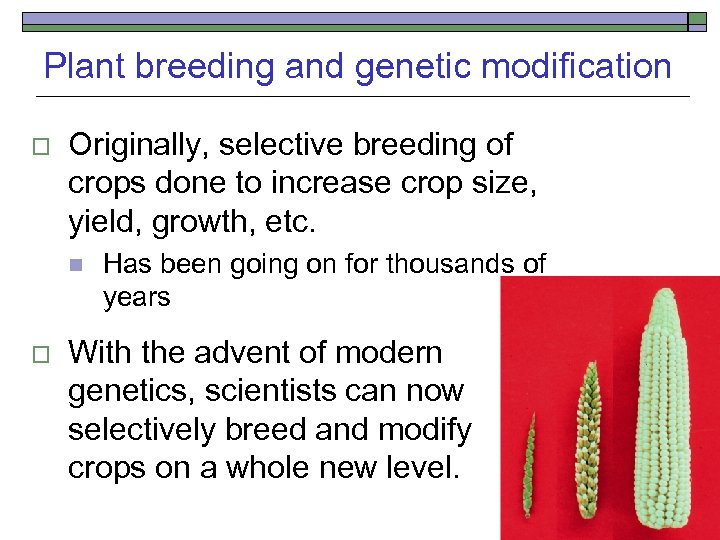 Plant breeding and genetic modification o Originally, selective breeding of crops done to increase crop size, yield, growth, etc. n o Has been going on for thousands of years With the advent of modern genetics, scientists can now selectively breed and modify crops on a whole new level.
 Genetic Engineering o Genetically Modified Organisms (GMO’s) n Contain DNA possessing genes borrowed from unrelated species. o o o Pest-resistance Wider tolerance levels Increased growth Herbicide resistance Dietary supplements or oral vaccines
 Genetic Engineering n 70% of all processed foods in NA contain transgenic products. n 75% of soybeans, 33% of corn, 71% of cotton grown in US is transgenic
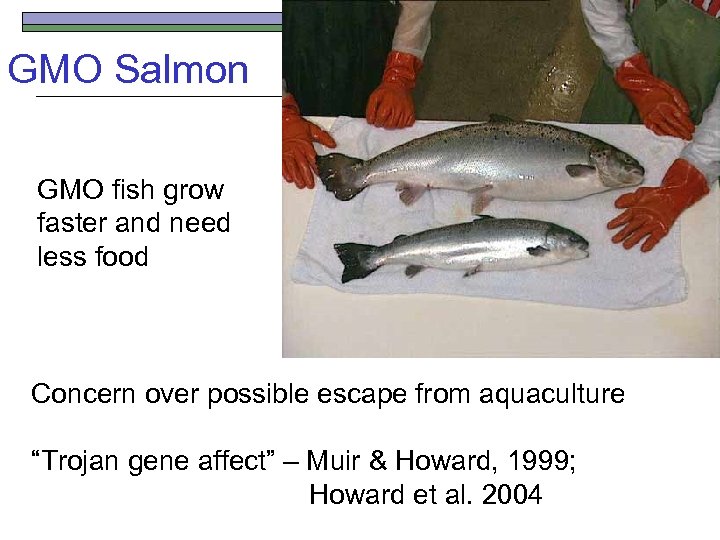 GMO Salmon GMO fish grow faster and need less food Concern over possible escape from aquaculture “Trojan gene affect” – Muir & Howard, 1999; Howard et al. 2004
 Roundup Ready Crops are modified to tolerate herbicides Large quantities of herbicides can be sprayed directly on fields Concerns over spread of resistance and herbicide residue on crops
 Bt Corn Bacillus thuringiensis (Bt) is a bacterium that makes toxins that are lethal to beetles Bt corn allows for reduced use of chemical insecticides Concerns over human health effects • In 2001, Starlink, a Bt variety not yet approved for human consumption was found in a variety of foods • No toxin found, just the genes that code for it • Probably not toxic to humans, but may be an allergen
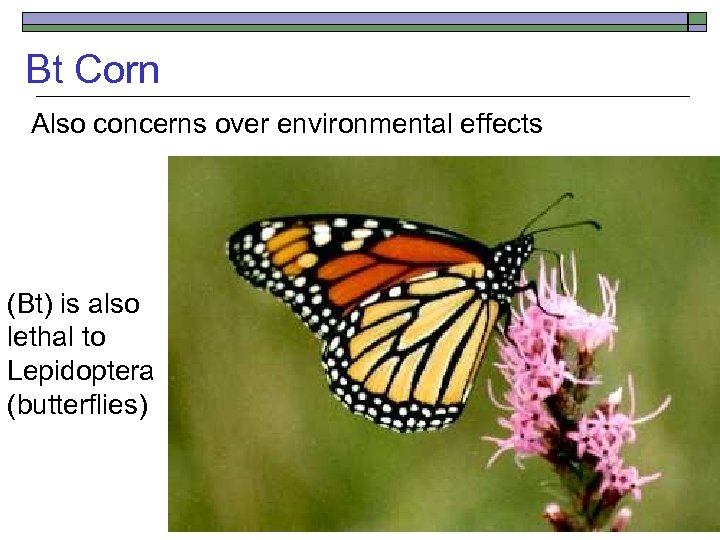 Bt Corn Also concerns over environmental effects (Bt) is also lethal to Lepidoptera (butterflies)
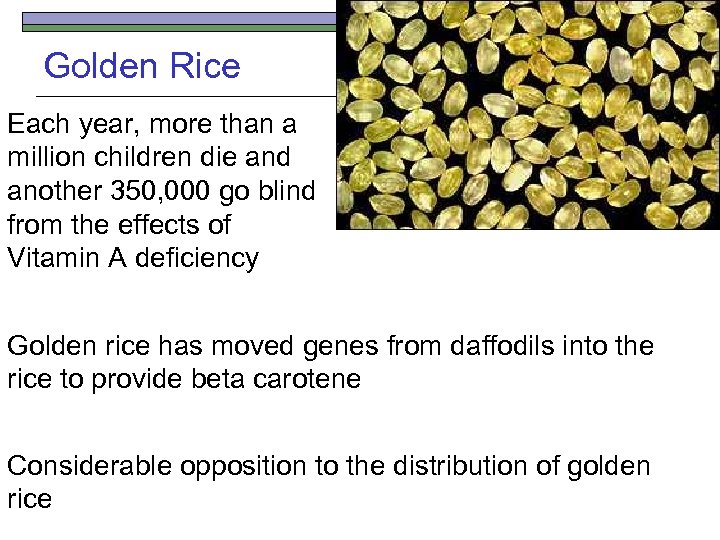 Golden Rice Each year, more than a million children die and another 350, 000 go blind from the effects of Vitamin A deficiency Golden rice has moved genes from daffodils into the rice to provide beta carotene Considerable opposition to the distribution of golden rice
 Debate over GMOs o Supporters argue: n n n o Improved yield with fewer insecticides Reduced hunger Increased health and nutrition Critics argue: n n Increased use of herbicides What we don’t know can hurt us later o o Future environmental problems Future human health problems
 Questions for Discussion 1) Have you ever been concerned about where your food comes from? Are you now? 2) Do you regularly wash fresh produce? 3) What would it take for you to: 1) Go to a farmer’s market regularly? 2) Buy organic produce? 3) Buy organic meat or go vegetarian/flexitarian? 4) How do you feel about eating GM foods?
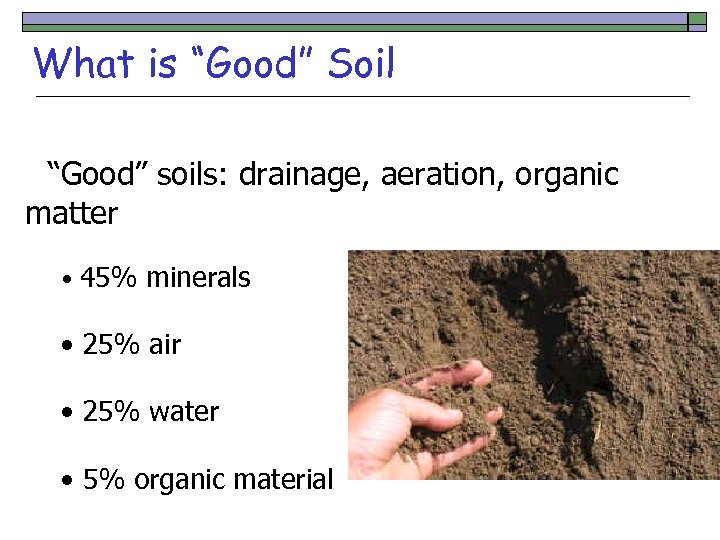 What is “Good” Soil “Good” soils: drainage, aeration, organic matter • 45% minerals • 25% air • 25% water • 5% organic material
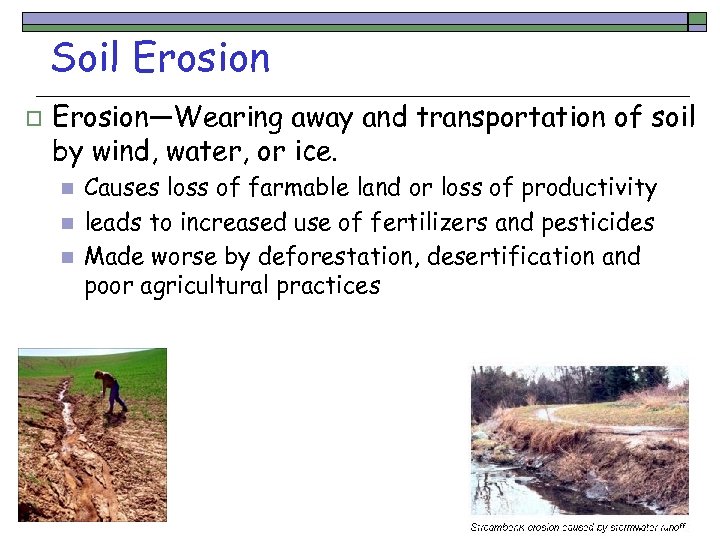 Soil Erosion o Erosion—Wearing away and transportation of soil by wind, water, or ice. n n n Causes loss of farmable land or loss of productivity leads to increased use of fertilizers and pesticides Made worse by deforestation, desertification and poor agricultural practices
 Mechanisms of Erosion o Wind can equal or exceed water as an erosive force, especially in a dry climate and on flat land. n Intensive farming practices: o o o Row crops leave soil exposed Weed free-fields Removal of windbreaks No crop-rotation or resting periods Continued monocultures
 Land Degradation o Estimated nearly 3 million ha of cropland ruined annually via erosion, 4 million ha transformed into deserts, and 8 million ha converted to non-agricultural uses. Worldwide, erosion reduces crop production by equivalent of 1% of world cropland per year. v
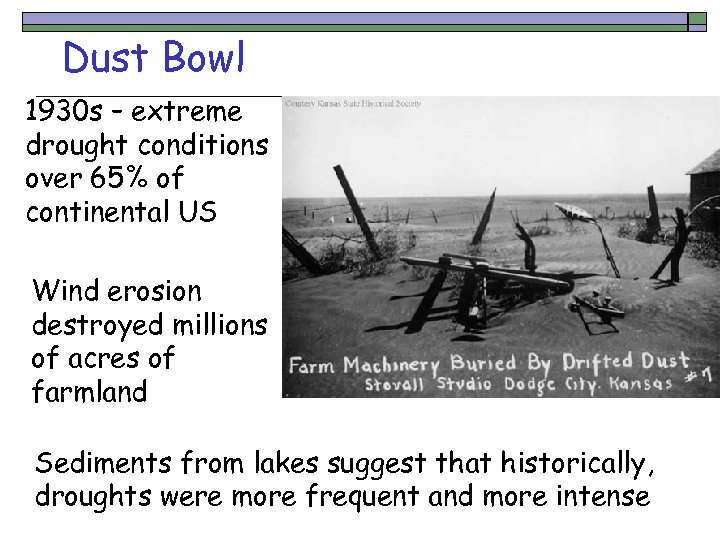 Dust Bowl 1930 s – extreme drought conditions over 65% of continental US Wind erosion destroyed millions of acres of farmland Sediments from lakes suggest that historically, droughts were more frequent and more intense
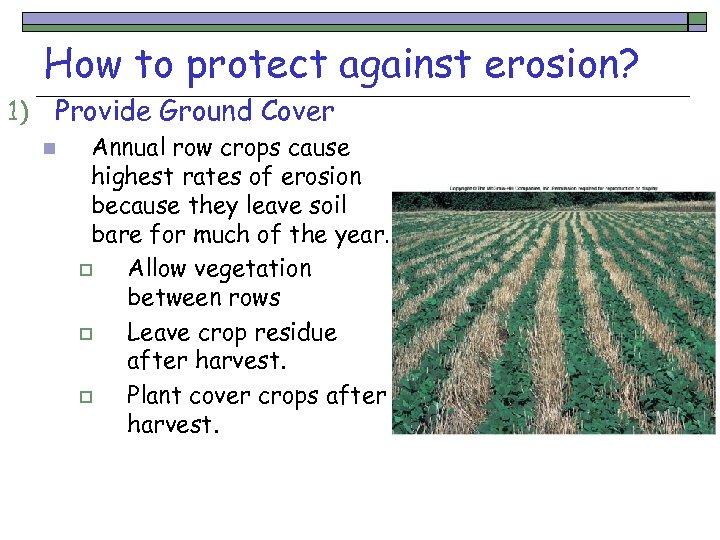 How to protect against erosion? 1) Provide Ground Cover n Annual row crops cause highest rates of erosion because they leave soil bare for much of the year. o Allow vegetation between rows o Leave crop residue after harvest. o Plant cover crops after harvest.
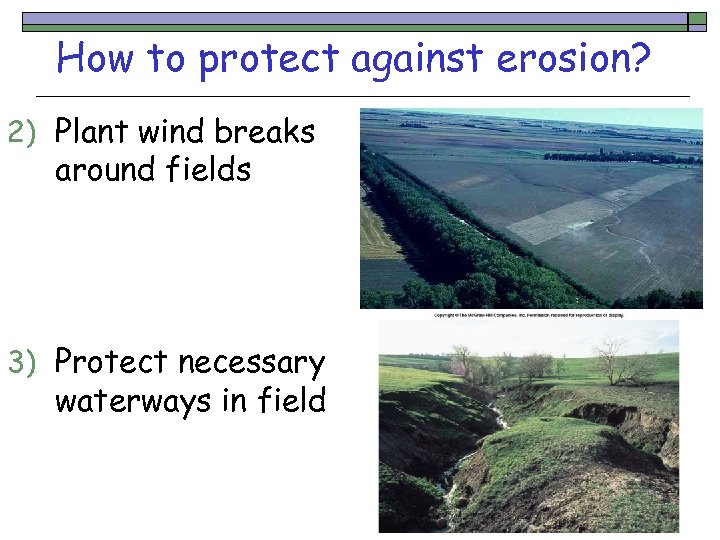 How to protect against erosion? 2) Plant wind breaks around fields 3) Protect necessary waterways in field
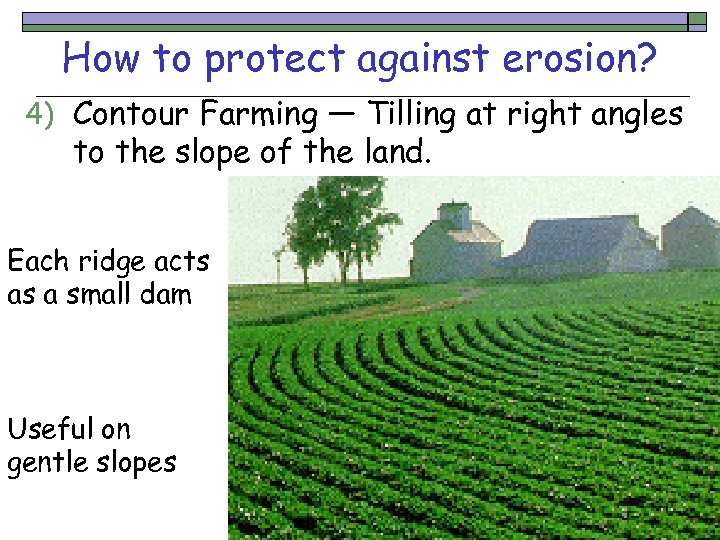 How to protect against erosion? 4) Contour Farming — Tilling at right angles to the slope of the land. Each ridge acts as a small dam Useful on gentle slopes
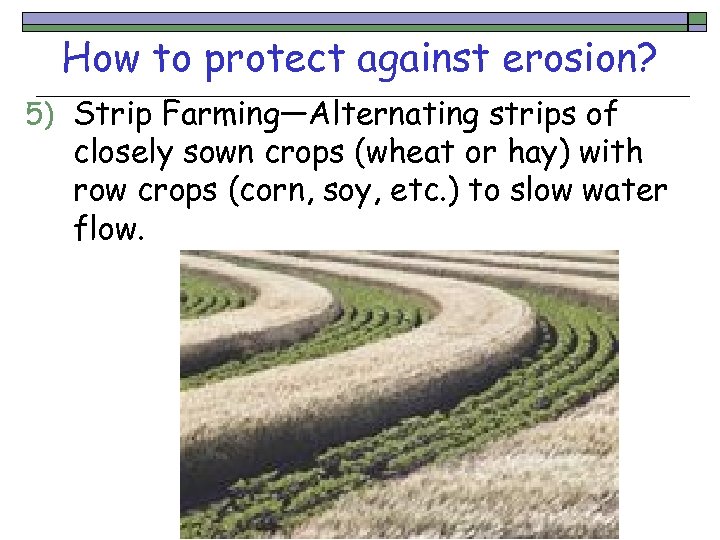 How to protect against erosion? 5) Strip Farming—Alternating strips of closely sown crops (wheat or hay) with row crops (corn, soy, etc. ) to slow water flow.
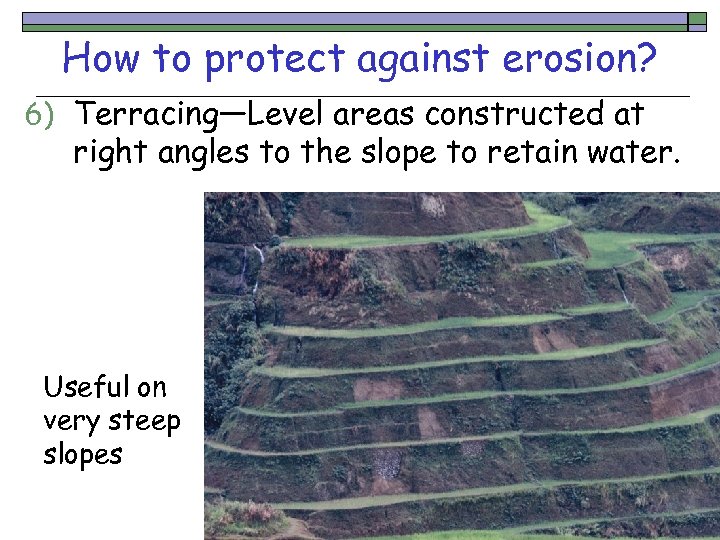 How to protect against erosion? 6) Terracing—Level areas constructed at right angles to the slope to retain water. Useful on very steep slopes
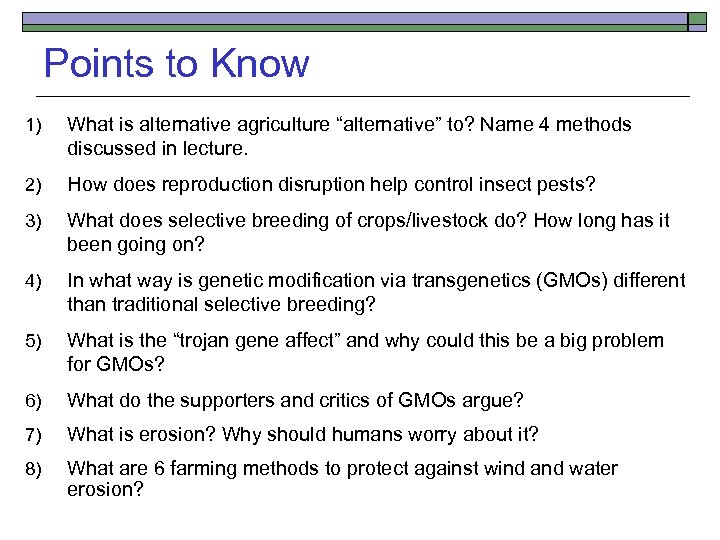 Points to Know 1) What is alternative agriculture “alternative” to? Name 4 methods discussed in lecture. 2) How does reproduction disruption help control insect pests? 3) What does selective breeding of crops/livestock do? How long has it been going on? 4) In what way is genetic modification via transgenetics (GMOs) different than traditional selective breeding? 5) What is the “trojan gene affect” and why could this be a big problem for GMOs? 6) What do the supporters and critics of GMOs argue? 7) What is erosion? Why should humans worry about it? 8) What are 6 farming methods to protect against wind and water erosion?