


 Скачать презентацию Announcements n Questions on exams Please see me
321474b9de654ed650820cb0cdd7459f.ppt
- Количество слайдов: 12
 Announcements n Questions on exams? Please see me. Open Forum Wednesday evening (7: 15 -8: 15 in J 237) if sufficient interest n Rosh Ha. Shanah begins at sundown this evening n n n “May you be written in the book of life” Psalm 89: 14 -15
 Civil/Social Torah
 A Review Question: What were the purposes of civil/social Torah? n n Set up moral guidelines to curb the excesses of the individual’s will Structure societal conduct and provide for the proper administration of justice Indicate that all of life is lived in the presence of God Create the environment for our approach to a holy God
 And the answer is…. n n Set up moral guidelines to curb the excesses of the individual’s will Structure societal conduct and provide for the proper administration of justice Indicate that all of life is lived in the presence of God Create the environment for our approach to a holy God
 Introductory Comments and Questions n n Ancient Near East parallels – with a focus on the Code of Hammurabi (CH) What distinctions do we see between the Torah and the CH? What are the noticeable differences between Israelite society and 21 st century western culture What cross-cultural principles apply? n n Justice must be balanced, properly applied, not perverted Care for the disadvantaged – widows, aliens, orphans Concern for human dignity What are some of the challenging issues?
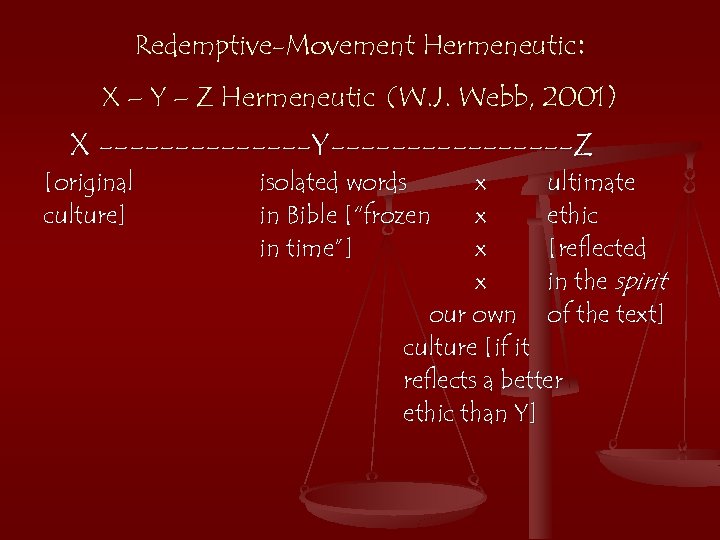 Redemptive-Movement Hermeneutic: X – Y – Z Hermeneutic (W. J. Webb, 2001) X -------Y--------Z [original culture] isolated words in Bible [“frozen in time”] x ultimate x ethic x [reflected x in the spirit our own of the text] culture [if it reflects a better ethic than Y]
 The Justice System in Israel n n Measure-for-measure – to prevent excess and vengeance (Exodus 21: 23 -25; Lev 24: 17 -22; Deut 19: 22) Ministers of justice Judges in every town n The “Supreme Court” – priests ministering before the Lord n
 Factors Affecting the Administration of Justice n n Intentional vs. unintentional action Gender n n n Slave or free n n n Freedom for female slaves would remove them from protection in the household Being sold into slavery often meant marriage into the new household Slaves as “property” for which an owner has paid No other ANE code protects slaves against owners’ maltreatment Israelite or foreigner n n The issue of interest on debts Foreigners were often highly mobile commercial agents
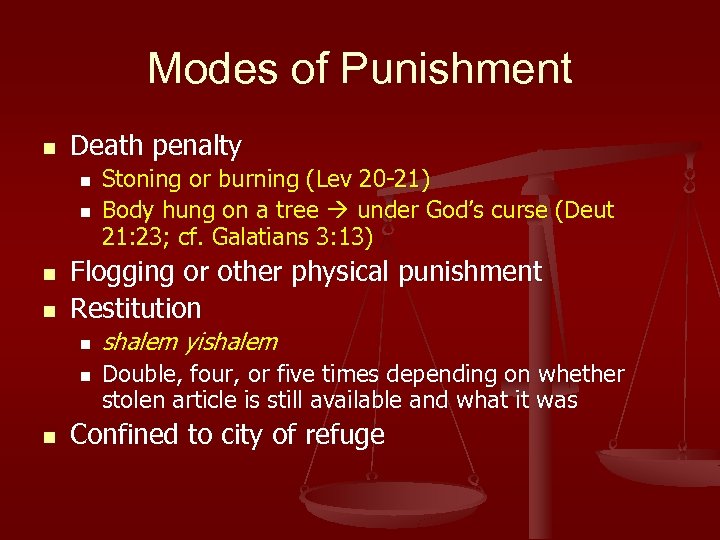 Modes of Punishment n Death penalty n n Flogging or other physical punishment Restitution n Stoning or burning (Lev 20 -21) Body hung on a tree under God’s curse (Deut 21: 23; cf. Galatians 3: 13) shalem yishalem Double, four, or five times depending on whether stolen article is still available and what it was Confined to city of refuge
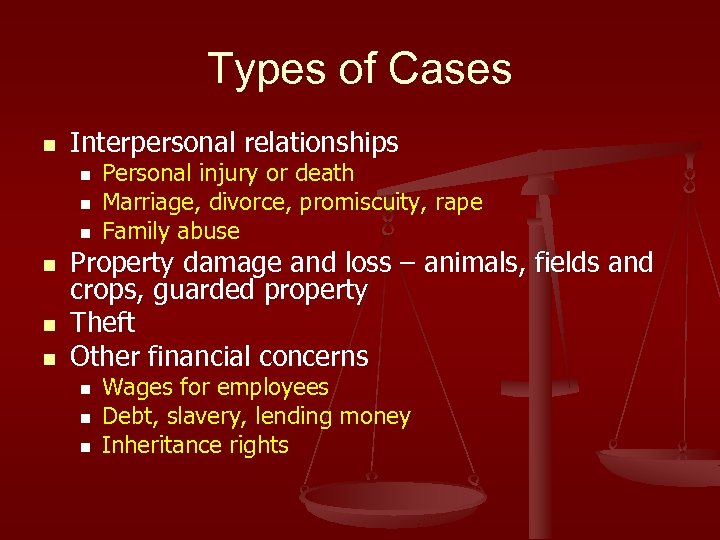 Types of Cases n Interpersonal relationships n n n Personal injury or death Marriage, divorce, promiscuity, rape Family abuse Property damage and loss – animals, fields and crops, guarded property Theft Other financial concerns n n n Wages for employees Debt, slavery, lending money Inheritance rights
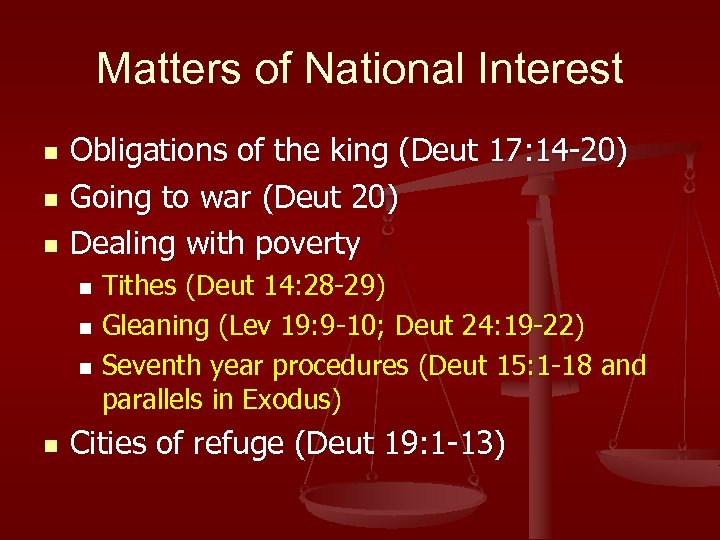 Matters of National Interest n n n Obligations of the king (Deut 17: 14 -20) Going to war (Deut 20) Dealing with poverty Tithes (Deut 14: 28 -29) n Gleaning (Lev 19: 9 -10; Deut 24: 19 -22) n Seventh year procedures (Deut 15: 1 -18 and parallels in Exodus) n n Cities of refuge (Deut 19: 1 -13)
 The “unified torah” n Relationship of moral torah to civil torah n Relationship of civil torah to ritual torah