 Скачать презентацию ANNEXURE D 1 NON-NEGOTIABLES AND THE MTSF
18c446b8e65ca24311e589008337ba87.ppt
- Количество слайдов: 21




ANNEXURE D 1

NON-NEGOTIABLES AND THE MTSF 2014 PRIORITIES Portfolio Committee 1 July 2014 2
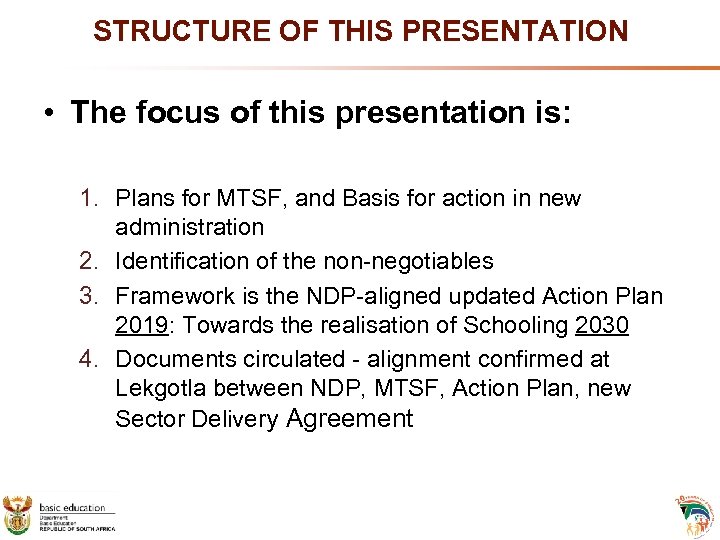
STRUCTURE OF THIS PRESENTATION • The focus of this presentation is: 1. Plans for MTSF, and Basis for action in new administration 2. Identification of the non-negotiables 3. Framework is the NDP-aligned updated Action Plan 2019: Towards the realisation of Schooling 2030 4. Documents circulated - alignment confirmed at Lekgotla between NDP, MTSF, Action Plan, new Sector Delivery Agreement
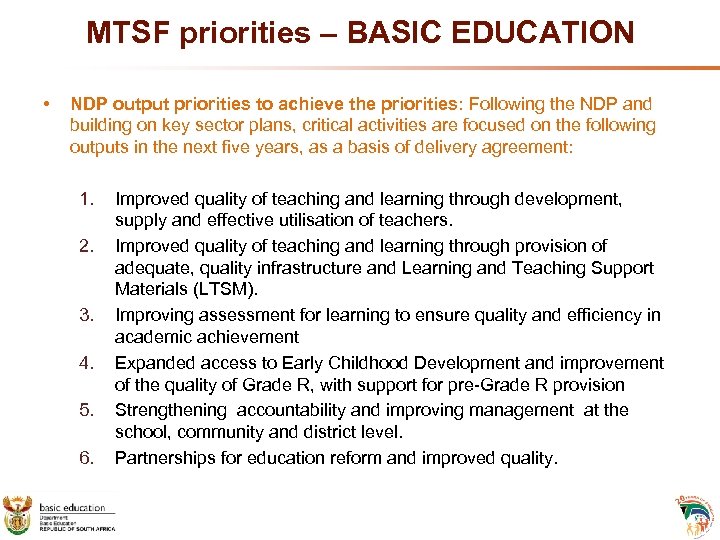
MTSF priorities – BASIC EDUCATION • NDP output priorities to achieve the priorities: Following the NDP and building on key sector plans, critical activities are focused on the following outputs in the next five years, as a basis of delivery agreement: 1. 2. 3. 4. 5. 6. Improved quality of teaching and learning through development, supply and effective utilisation of teachers. Improved quality of teaching and learning through provision of adequate, quality infrastructure and Learning and Teaching Support Materials (LTSM). Improving assessment for learning to ensure quality and efficiency in academic achievement Expanded access to Early Childhood Development and improvement of the quality of Grade R, with support for pre-Grade R provision Strengthening accountability and improving management at the school, community and district level. Partnerships for education reform and improved quality.
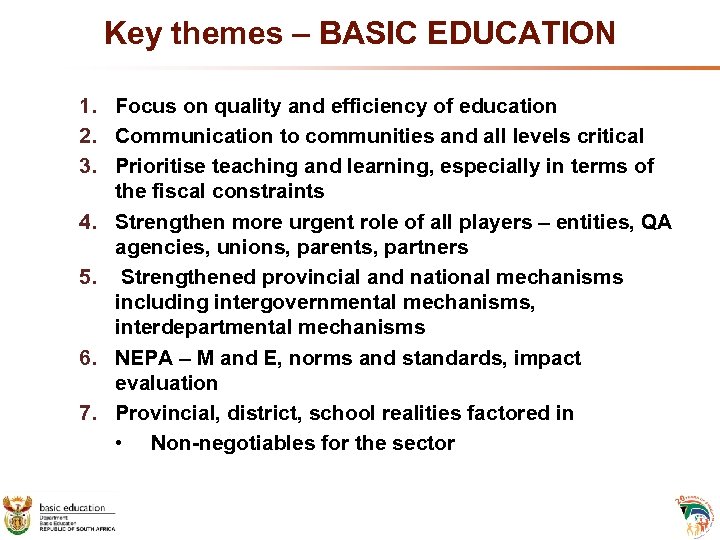
Key themes – BASIC EDUCATION 1. Focus on quality and efficiency of education 2. Communication to communities and all levels critical 3. Prioritise teaching and learning, especially in terms of the fiscal constraints 4. Strengthen more urgent role of all players – entities, QA agencies, unions, parents, partners 5. Strengthened provincial and national mechanisms including intergovernmental mechanisms, interdepartmental mechanisms 6. NEPA – M and E, norms and standards, impact evaluation 7. Provincial, district, school realities factored in • Non-negotiables for the sector
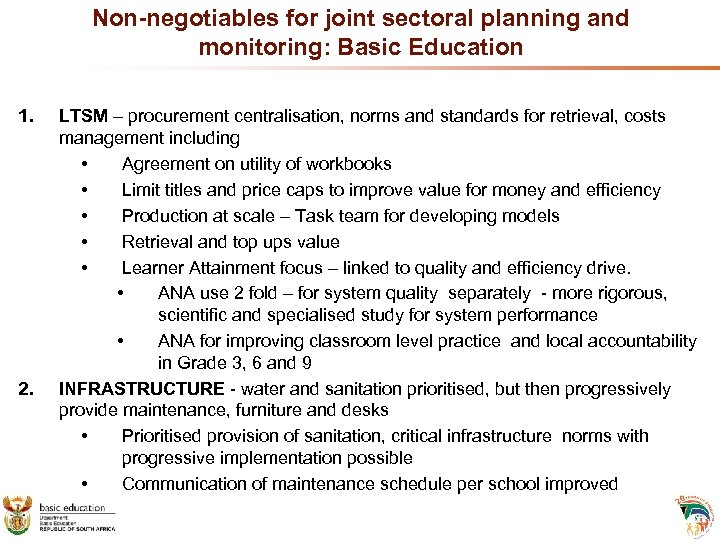
Non-negotiables for joint sectoral planning and monitoring: Basic Education 1. 2. LTSM – procurement centralisation, norms and standards for retrieval, costs management including • Agreement on utility of workbooks • Limit titles and price caps to improve value for money and efficiency • Production at scale – Task team for developing models • Retrieval and top ups value • Learner Attainment focus – linked to quality and efficiency drive. • ANA use 2 fold – for system quality separately - more rigorous, scientific and specialised study for system performance • ANA for improving classroom level practice and local accountability in Grade 3, 6 and 9 INFRASTRUCTURE - water and sanitation prioritised, but then progressively provide maintenance, furniture and desks • Prioritised provision of sanitation, critical infrastructure norms with progressive implementation possible • Communication of maintenance schedule per school improved
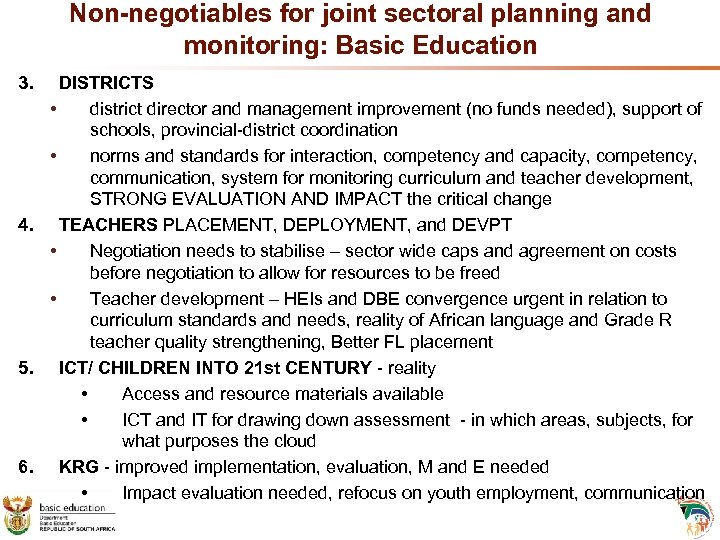
Non-negotiables for joint sectoral planning and monitoring: Basic Education 3. DISTRICTS • district director and management improvement (no funds needed), support of schools, provincial-district coordination • norms and standards for interaction, competency and capacity, competency, communication, system for monitoring curriculum and teacher development, STRONG EVALUATION AND IMPACT the critical change 4. TEACHERS PLACEMENT, DEPLOYMENT, and DEVPT • Negotiation needs to stabilise – sector wide caps and agreement on costs before negotiation to allow for resources to be freed • Teacher development – HEIs and DBE convergence urgent in relation to curriculum standards and needs, reality of African language and Grade R teacher quality strengthening, Better FL placement 5. ICT/ CHILDREN INTO 21 st CENTURY - reality • Access and resource materials available • ICT and IT for drawing down assessment - in which areas, subjects, for what purposes the cloud 6. KRG - improved implementation, evaluation, M and E needed • Impact evaluation needed, refocus on youth employment, communication
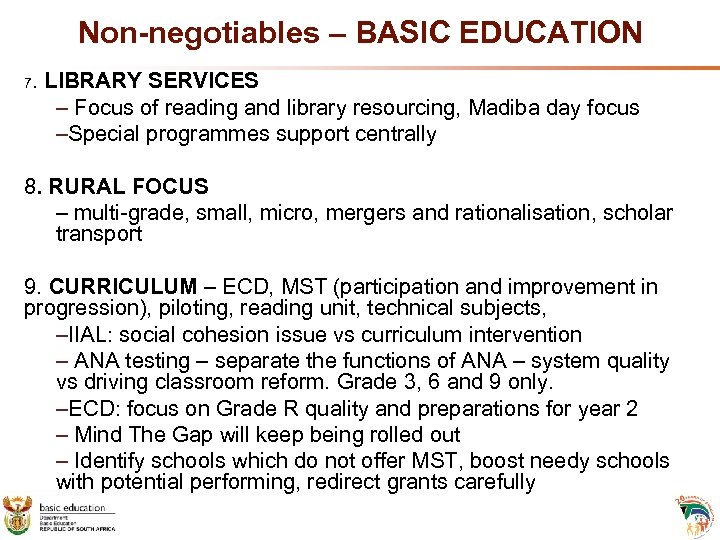
Non-negotiables – BASIC EDUCATION 7. LIBRARY SERVICES – Focus of reading and library resourcing, Madiba day focus –Special programmes support centrally 8. RURAL FOCUS – multi-grade, small, micro, mergers and rationalisation, scholar transport 9. CURRICULUM – ECD, MST (participation and improvement in progression), piloting, reading unit, technical subjects, –IIAL: social cohesion issue vs curriculum intervention – ANA testing – separate the functions of ANA – system quality vs driving classroom reform. Grade 3, 6 and 9 only. –ECD: focus on Grade R quality and preparations for year 2 – Mind The Gap will keep being rolled out – Identify schools which do not offer MST, boost needy schools with potential performing, redirect grants carefully
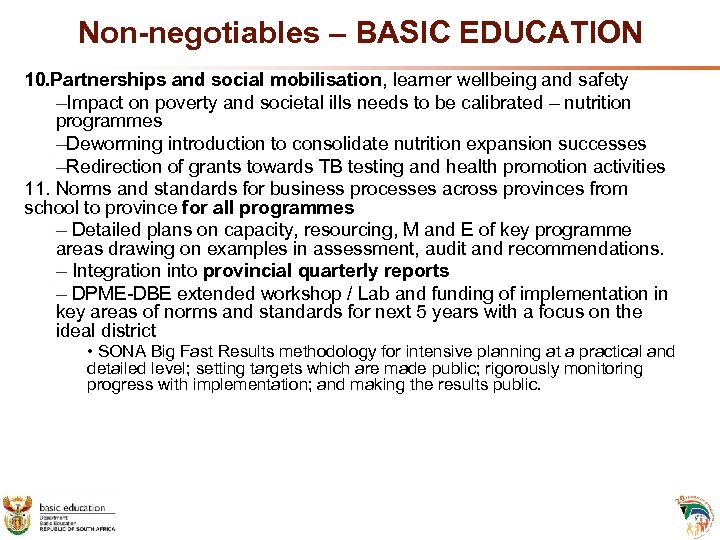
Non-negotiables – BASIC EDUCATION 10. Partnerships and social mobilisation, learner wellbeing and safety –Impact on poverty and societal ills needs to be calibrated – nutrition programmes –Deworming introduction to consolidate nutrition expansion successes –Redirection of grants towards TB testing and health promotion activities 11. Norms and standards for business processes across provinces from school to province for all programmes – Detailed plans on capacity, resourcing, M and E of key programme areas drawing on examples in assessment, audit and recommendations. – Integration into provincial quarterly reports – DPME-DBE extended workshop / Lab and funding of implementation in key areas of norms and standards for next 5 years with a focus on the ideal district • SONA Big Fast Results methodology for intensive planning at a practical and detailed level; setting targets which are made public; rigorously monitoring progress with implementation; and making the results public.
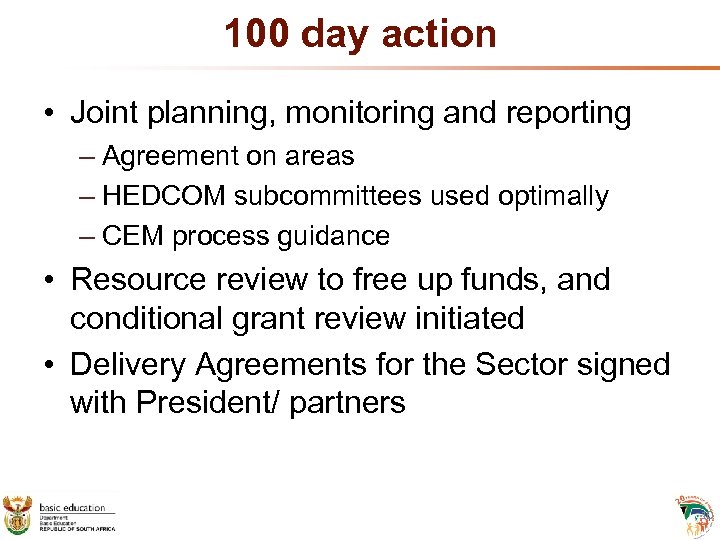
100 day action • Joint planning, monitoring and reporting – Agreement on areas – HEDCOM subcommittees used optimally – CEM process guidance • Resource review to free up funds, and conditional grant review initiated • Delivery Agreements for the Sector signed with President/ partners 10
5 year priorities MTSF 11
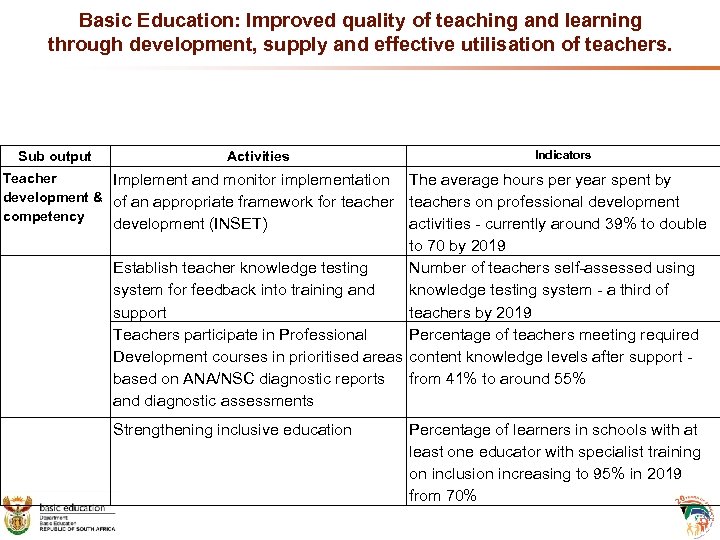
Basic Education: Improved quality of teaching and learning through development, supply and effective utilisation of teachers. Sub output Activities Indicators Teacher Implement and monitor implementation The average hours per year spent by development & of an appropriate framework for teachers on professional development competency development (INSET) activities - currently around 39% to double to 70 by 2019 Establish teacher knowledge testing Number of teachers self-assessed using system for feedback into training and knowledge testing system - a third of support teachers by 2019 Teachers participate in Professional Percentage of teachers meeting required Development courses in prioritised areas content knowledge levels after support - based on ANA/NSC diagnostic reports from 41% to around 55% and diagnostic assessments Strengthening inclusive education Percentage of learners in schools with at least one educator with specialist training on inclusion increasing to 95% in 2019 from 70% 12
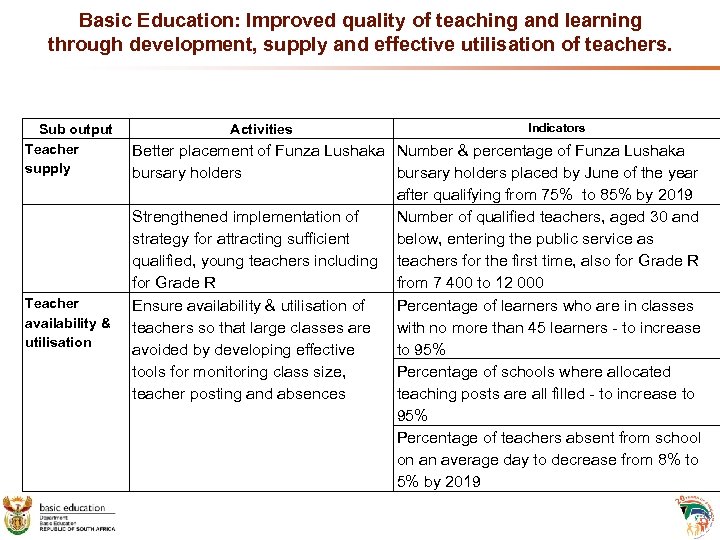
Basic Education: Improved quality of teaching and learning through development, supply and effective utilisation of teachers. Sub output Teacher supply Teacher availability & utilisation Activities Indicators Better placement of Funza Lushaka Number & percentage of Funza Lushaka bursary holders placed by June of the year after qualifying from 75% to 85% by 2019 Strengthened implementation of Number of qualified teachers, aged 30 and strategy for attracting sufficient below, entering the public service as qualified, young teachers including teachers for the first time, also for Grade R from 7 400 to 12 000 Ensure availability & utilisation of Percentage of learners who are in classes teachers so that large classes are with no more than 45 learners - to increase avoided by developing effective to 95% tools for monitoring class size, Percentage of schools where allocated teacher posting and absences teaching posts are all filled - to increase to 95% Percentage of teachers absent from school on an average day to decrease from 8% to 5% by 2019 13
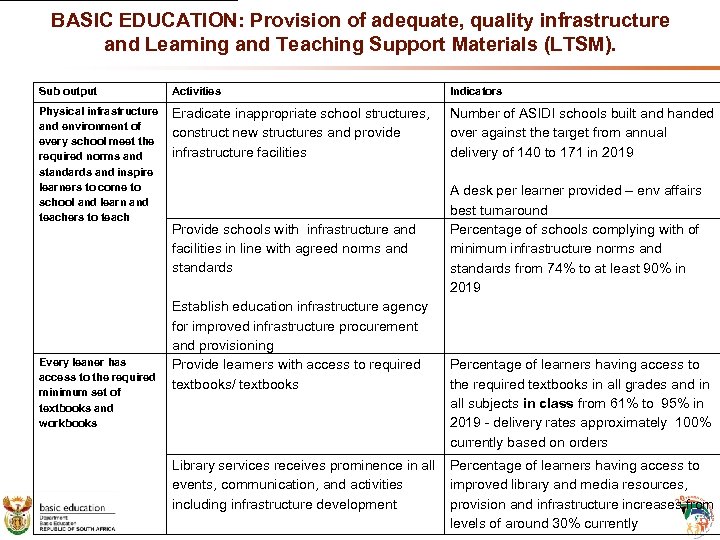
BASIC EDUCATION: Provision of adequate, quality infrastructure and Learning and Teaching Support Materials (LTSM). Sub output Activities Indicators Physical infrastructure and environment of every school meet the required norms and standards and inspire learners to come to school and learn and teachers to teach Eradicate inappropriate school structures, construct new structures and provide infrastructure facilities Number of ASIDI schools built and handed over against the target from annual delivery of 140 to 171 in 2019 Every leaner has access to the required minimum set of textbooks and workbooks Provide schools with infrastructure and facilities in line with agreed norms and standards Establish education infrastructure agency for improved infrastructure procurement and provisioning Provide learners with access to required textbooks/ textbooks A desk per learner provided – env affairs best turnaround Percentage of schools complying with of minimum infrastructure norms and standards from 74% to at least 90% in 2019 Percentage of learners having access to the required textbooks in all grades and in all subjects in class from 61% to 95% in 2019 - delivery rates approximately 100% currently based on orders Library services receives prominence in all Percentage of learners having access to events, communication, and activities improved library and media resources, including infrastructure development provision and infrastructure increases from 14 levels of around 30% currently
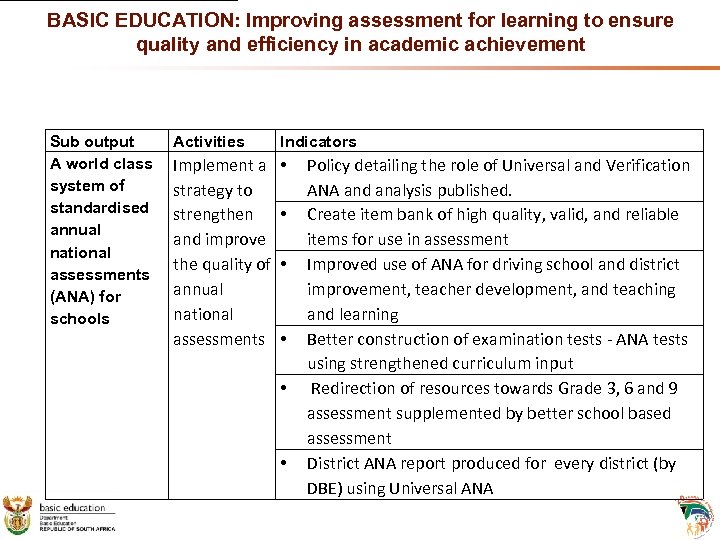
BASIC EDUCATION: Improving assessment for learning to ensure quality and efficiency in academic achievement Sub output A world class system of standardised annual national assessments (ANA) for schools Activities Indicators Implement a • strategy to strengthen • and improve the quality of • annual national assessments • • • Policy detailing the role of Universal and Verification ANA and analysis published. Create item bank of high quality, valid, and reliable items for use in assessment Improved use of ANA for driving school and district improvement, teacher development, and teaching and learning Better construction of examination tests - ANA tests using strengthened curriculum input Redirection of resources towards Grade 3, 6 and 9 assessment supplemented by better school based assessment District ANA report produced for every district (by DBE) using Universal ANA 15
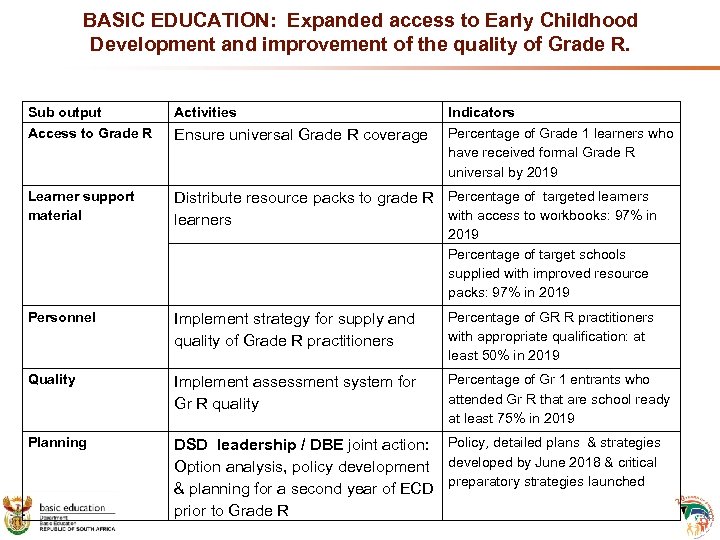
BASIC EDUCATION: Expanded access to Early Childhood Development and improvement of the quality of Grade R. Sub output Access to Grade R Activities Learner support material Distribute resource packs to grade R Percentage of targeted learners with access to workbooks: 97% in learners Ensure universal Grade R coverage Indicators Percentage of Grade 1 learners who have received formal Grade R universal by 2019 Percentage of target schools supplied with improved resource packs: 97% in 2019 Personnel Implement strategy for supply and quality of Grade R practitioners Percentage of GR R practitioners with appropriate qualification: at least 50% in 2019 Quality Implement assessment system for Gr R quality Percentage of Gr 1 entrants who attended Gr R that are school ready at least 75% in 2019 Planning DSD leadership / DBE joint action: Policy, detailed plans & strategies Option analysis, policy development developed by June 2018 & critical & planning for a second year of ECD preparatory strategies launched prior to Grade R 16
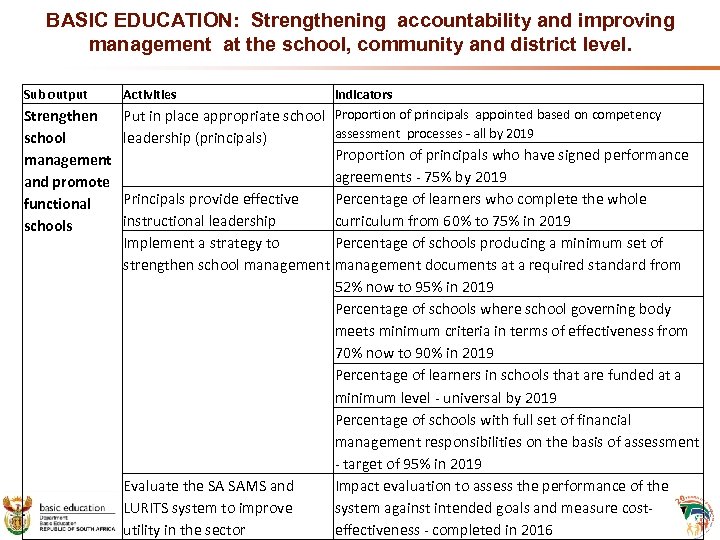
BASIC EDUCATION: Strengthening accountability and improving management at the school, community and district level. Sub output Activities Indicators Put in place appropriate school Proportion of principals appointed based on competency assessment processes - all by 2019 leadership (principals) Strengthen school Proportion of principals who have signed performance management agreements - 75% by 2019 and promote Principals provide effective Percentage of learners who complete the whole functional instructional leadership curriculum from 60% to 75% in 2019 schools Implement a strategy to Percentage of schools producing a minimum set of strengthen school management documents at a required standard from 52% now to 95% in 2019 Percentage of schools where school governing body meets minimum criteria in terms of effectiveness from 70% now to 90% in 2019 Percentage of learners in schools that are funded at a minimum level - universal by 2019 Percentage of schools with full set of financial management responsibilities on the basis of assessment - target of 95% in 2019 Evaluate the SA SAMS and Impact evaluation to assess the performance of the LURITS system to improve system against intended goals and measure cost 17 utility in the sector effectiveness - completed in 2016
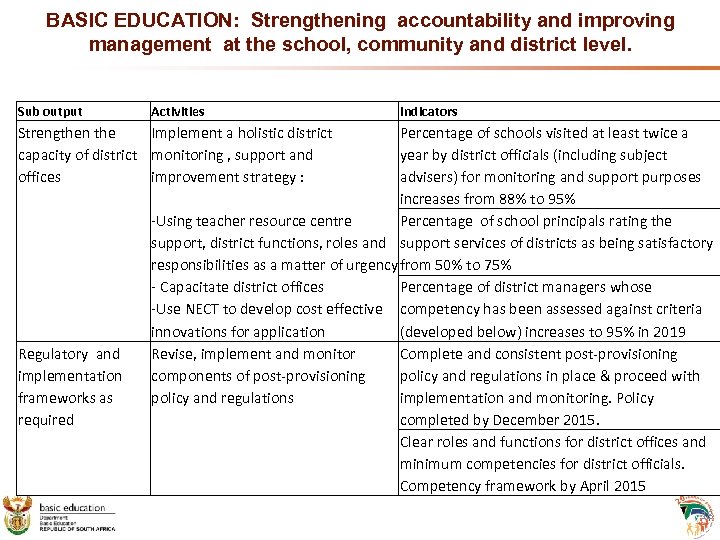
BASIC EDUCATION: Strengthening accountability and improving management at the school, community and district level. Sub output Activities Indicators Strengthen the Implement a holistic district capacity of district monitoring , support and offices improvement strategy : Regulatory and implementation frameworks as required Percentage of schools visited at least twice a year by district officials (including subject advisers) for monitoring and support purposes increases from 88% to 95% Percentage of school principals rating the -Using teacher resource centre support, district functions, roles and support services of districts as being satisfactory responsibilities as a matter of urgency from 50% to 75% Percentage of district managers whose - Capacitate district offices -Use NECT to develop cost effective competency has been assessed against criteria (developed below) increases to 95% in 2019 innovations for application Revise, implement and monitor Complete and consistent post-provisioning components of post-provisioning policy and regulations in place & proceed with policy and regulations implementation and monitoring. Policy completed by December 2015. Clear roles and functions for district offices and minimum competencies for district officials. Competency framework by April 2015 18
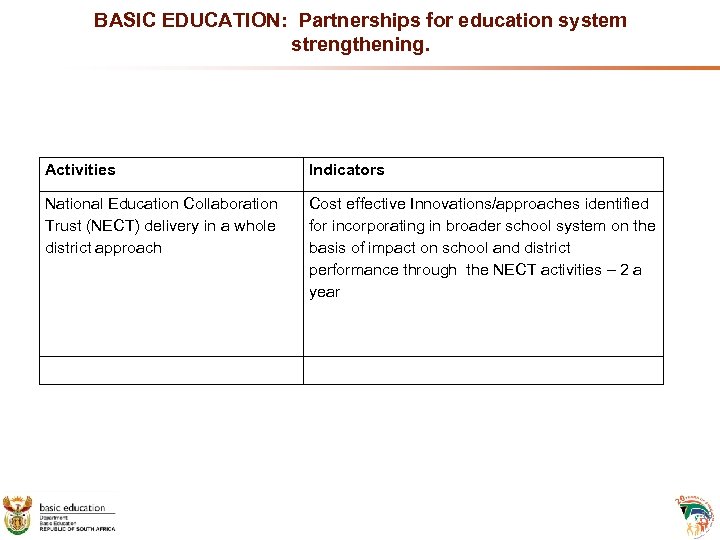
BASIC EDUCATION: Partnerships for education system strengthening. Activities Indicators National Education Collaboration Trust (NECT) delivery in a whole district approach Cost effective Innovations/approaches identified for incorporating in broader school system on the basis of impact on school and district performance through the NECT activities – 2 a year 19
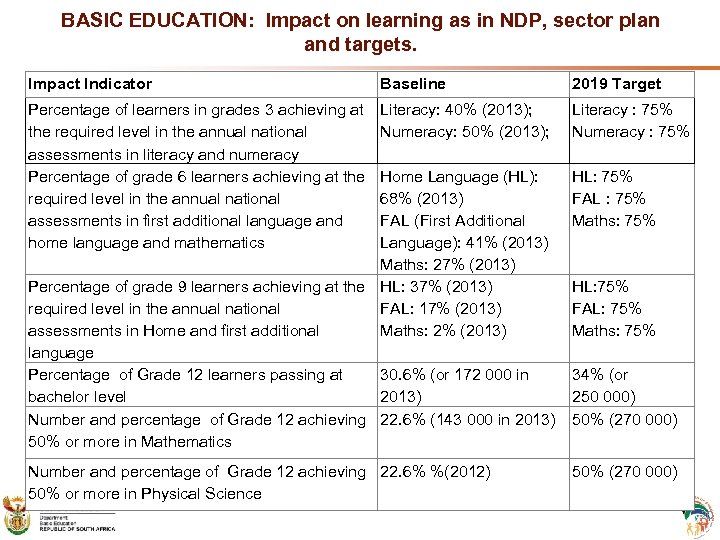
BASIC EDUCATION: Impact on learning as in NDP, sector plan and targets. Impact Indicator Baseline 2019 Target Percentage of learners in grades 3 achieving at the required level in the annual national assessments in literacy and numeracy Percentage of grade 6 learners achieving at the required level in the annual national assessments in first additional language and home language and mathematics Literacy: 40% (2013); Numeracy: 50% (2013); Literacy : 75% Numeracy : 75% Home Language (HL): 68% (2013) FAL (First Additional Language): 41% (2013) Maths: 27% (2013) Percentage of grade 9 learners achieving at the HL: 37% (2013) required level in the annual national FAL: 17% (2013) assessments in Home and first additional Maths: 2% (2013) language Percentage of Grade 12 learners passing at 30. 6% (or 172 000 in bachelor level 2013) Number and percentage of Grade 12 achieving 22. 6% (143 000 in 2013) 50% or more in Mathematics HL: 75% FAL : 75% Maths: 75% Number and percentage of Grade 12 achieving 22. 6% %(2012) 50% or more in Physical Science 50% (270 000) HL: 75% FAL: 75% Maths: 75% 34% (or 250 000) 50% (270 000) 20
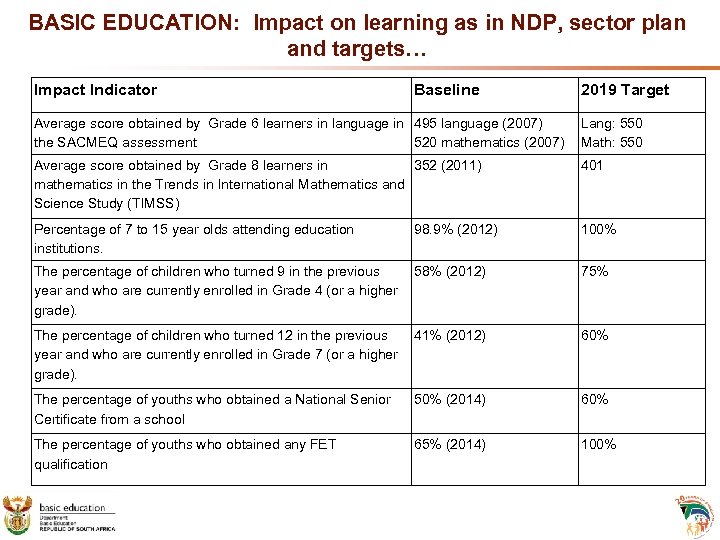
BASIC EDUCATION: Impact on learning as in NDP, sector plan and targets… Impact Indicator Baseline 2019 Target Average score obtained by Grade 6 learners in language in 495 language (2007) the SACMEQ assessment 520 mathematics (2007) Lang: 550 Math: 550 Average score obtained by Grade 8 learners in 352 (2011) mathematics in the Trends in International Mathematics and Science Study (TIMSS) 401 Percentage of 7 to 15 year olds attending education institutions. 100% 98. 9% (2012) The percentage of children who turned 9 in the previous 58% (2012) year and who are currently enrolled in Grade 4 (or a higher grade). 75% The percentage of children who turned 12 in the previous 41% (2012) year and who are currently enrolled in Grade 7 (or a higher grade). 60% The percentage of youths who obtained a National Senior Certificate from a school 50% (2014) 60% The percentage of youths who obtained any FET qualification 65% (2014) 100%
Скачать презентацию ANNEXURE D 1 NON-NEGOTIABLES AND THE MTSF
18c446b8e65ca24311e589008337ba87.ppt