


 Скачать презентацию Anne Frank 1929 -1945 Early life Frank
Anne_Frank - Lena 9B.pptx
- Количество слайдов: 6
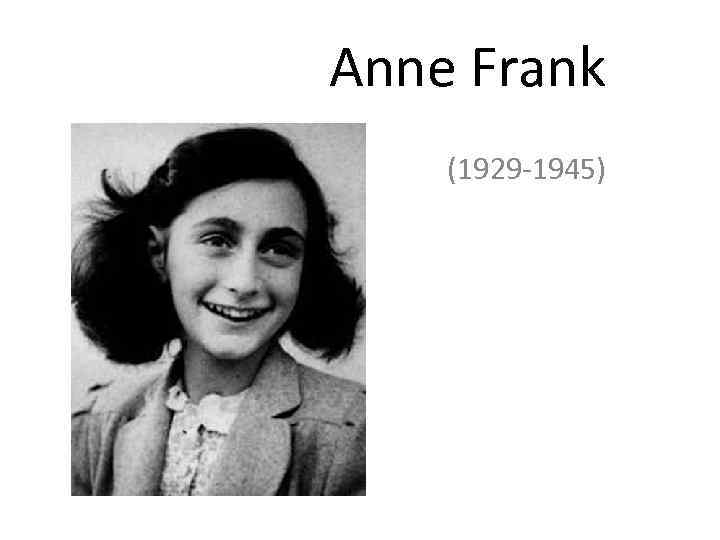 Anne Frank (1929 -1945)
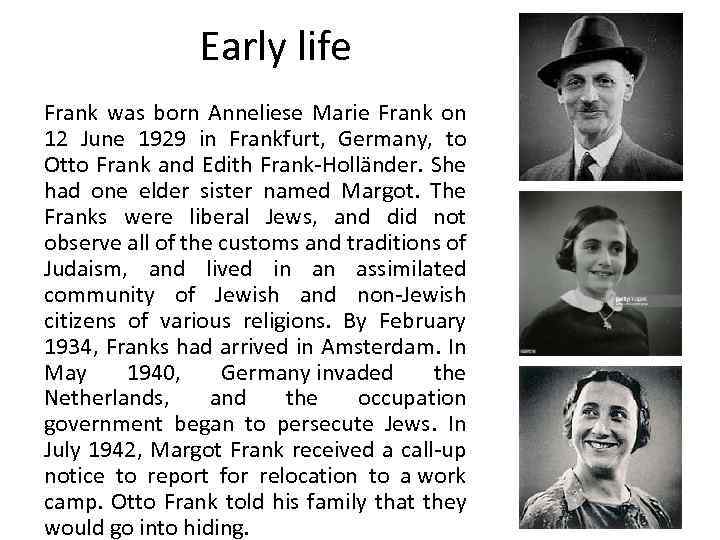 Early life Frank was born Anneliese Marie Frank on 12 June 1929 in Frankfurt, Germany, to Otto Frank and Edith Frank-Holländer. She had one elder sister named Margot. The Franks were liberal Jews, and did not observe all of the customs and traditions of Judaism, and lived in an assimilated community of Jewish and non-Jewish citizens of various religions. By February 1934, Franks had arrived in Amsterdam. In May 1940, Germany invaded the Netherlands, and the occupation government began to persecute Jews. In July 1942, Margot Frank received a call-up notice to report for relocation to a work camp. Otto Frank told his family that they would go into hiding.
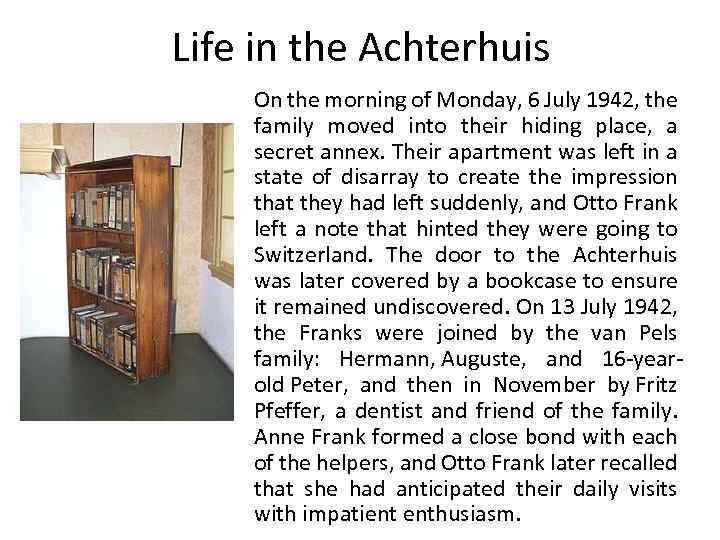 Life in the Achterhuis On the morning of Monday, 6 July 1942, the family moved into their hiding place, a secret annex. Their apartment was left in a state of disarray to create the impression that they had left suddenly, and Otto Frank left a note that hinted they were going to Switzerland. The door to the Achterhuis was later covered by a bookcase to ensure it remained undiscovered. On 13 July 1942, the Franks were joined by the van Pels family: Hermann, Auguste, and 16 -yearold Peter, and then in November by Fritz Pfeffer, a dentist and friend of the family. Anne Frank formed a close bond with each of the helpers, and Otto Frank later recalled that she had anticipated their daily visits with impatient enthusiasm.
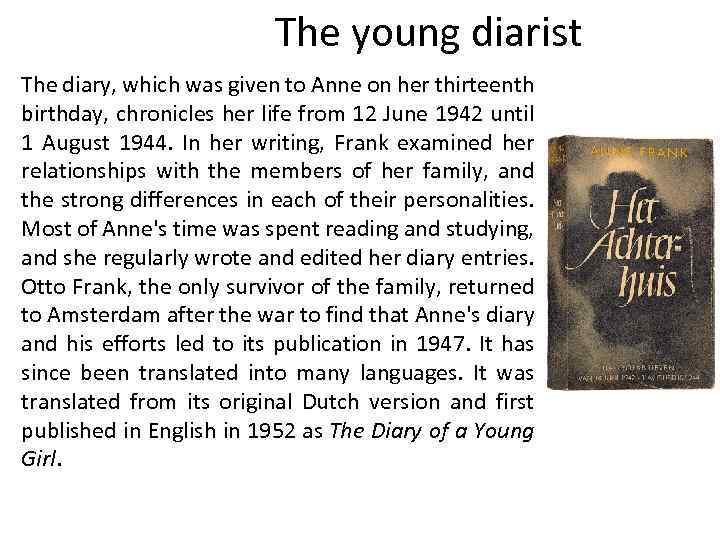 The young diarist The diary, which was given to Anne on her thirteenth birthday, chronicles her life from 12 June 1942 until 1 August 1944. In her writing, Frank examined her relationships with the members of her family, and the strong differences in each of their personalities. Most of Anne's time was spent reading and studying, and she regularly wrote and edited her diary entries. Otto Frank, the only survivor of the family, returned to Amsterdam after the war to find that Anne's diary and his efforts led to its publication in 1947. It has since been translated into many languages. It was translated from its original Dutch version and first published in English in 1952 as The Diary of a Young Girl.
 Deportation and death On the morning of 4 August 1944, following a tip from an informer who has never been identified, the Achterhuis was stormed by a group of German uniformed police. On 3 September 1944, the group was deported on what would be the last transport from Westerbork to the Auschwitz concentration camp. Upon arrival at Auschwitz, the SS forcibly separated the men from the women and children, and Otto Frank was wrenched from his family. In 1945 Anne told her friend she believed her parents were dead, and for that reason she did not wish to live any longer. It is not possible to say what ultimately caused Anne's death. Witnesses later testified Margot fell from her bunk in her weakened state and was killed by the shock. Anne died a few days after Margot.
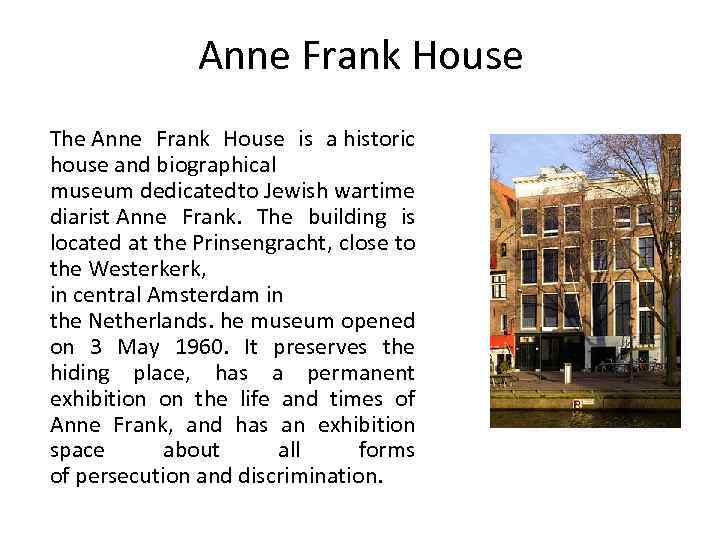 Anne Frank House The Anne Frank House is a historic house and biographical museum dedicated to Jewish wartime diarist Anne Frank. The building is located at the Prinsengracht, close to the Westerkerk, in central Amsterdam in the Netherlands. he museum opened on 3 May 1960. It preserves the hiding place, has a permanent exhibition on the life and times of Anne Frank, and has an exhibition space about all forms of persecution and discrimination.