 Скачать презентацию ANL-FNAL Collaboration on High Intensity Neutrino Source Activities
c36ccc37f02a0fb4a6282e6b3a135a4c.ppt
- Количество слайдов: 20



ANL-FNAL Collaboration on High Intensity Neutrino Source Activities G. Apollinari • Introduction • Collaboration Activities • ‘ 05 -’ 07 Achievements • ’ 07 -’ 10 Plans • Conclusions
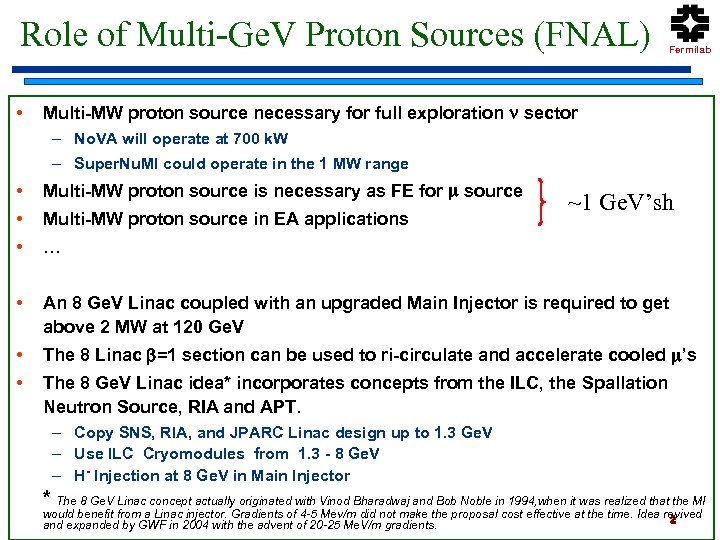
Role of Multi-Ge. V Proton Sources (FNAL) • Fermilab Multi-MW proton source necessary for full exploration n sector – No. VA will operate at 700 k. W – Super. Nu. MI could operate in the 1 MW range • Multi-MW proton source is necessary as FE for m source • Multi-MW proton source in EA applications • … • An 8 Ge. V Linac coupled with an upgraded Main Injector is required to get above 2 MW at 120 Ge. V • The 8 Linac b=1 section can be used to ri-circulate and accelerate cooled m’s • The 8 Ge. V Linac idea* incorporates concepts from the ILC, the Spallation Neutron Source, RIA and APT. ~1 Ge. V’sh – Copy SNS, RIA, and JPARC Linac design up to 1. 3 Ge. V – Use ILC Cryomodules from 1. 3 - 8 Ge. V – H- Injection at 8 Ge. V in Main Injector * The 8 Ge. V Linac concept actually originated with Vinod Bharadwaj and Bob Noble in 1994, when it was realized that the MI would benefit from a Linac injector. Gradients of 4 -5 Mev/m did not make the proposal cost effective at the time. Idea revived 2 and expanded by GWF in 2004 with the advent of 20 -25 Me. V/m gradients.
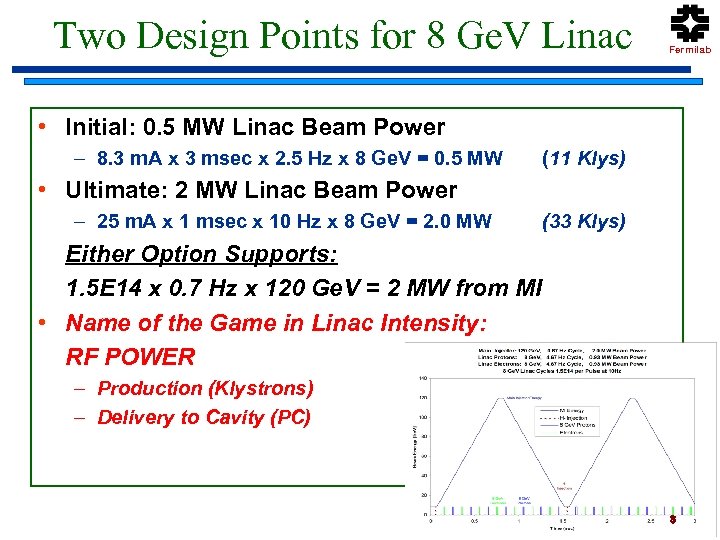
Two Design Points for 8 Ge. V Linac Fermilab • Initial: 0. 5 MW Linac Beam Power – 8. 3 m. A x 3 msec x 2. 5 Hz x 8 Ge. V = 0. 5 MW (11 Klys) • Ultimate: 2 MW Linac Beam Power – 25 m. A x 1 msec x 10 Hz x 8 Ge. V = 2. 0 MW (33 Klys) Either Option Supports: 1. 5 E 14 x 0. 7 Hz x 120 Ge. V = 2 MW from MI • Name of the Game in Linac Intensity: RF POWER – Production (Klystrons) – Delivery to Cavity (PC) 3
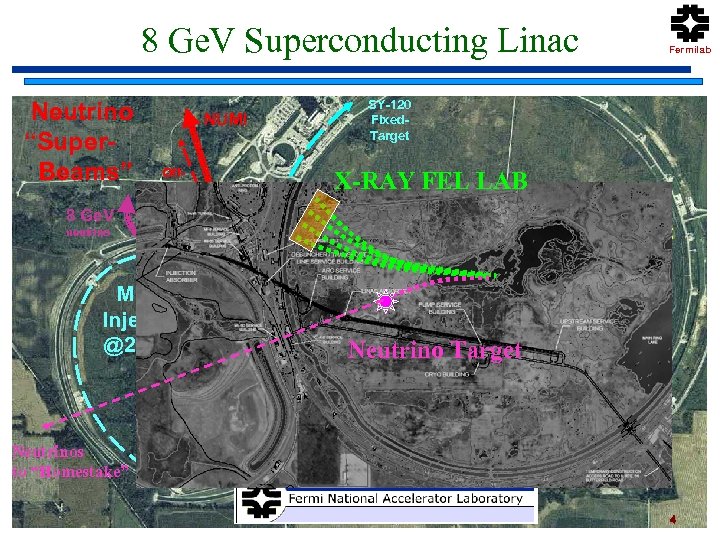
8 Ge. V Superconducting Linac Neutrino “Super. Beams” NUMI Off. Axis 8 Ge. V neutrino Anti. Proton Fermilab SY-120 Fixed. Target X-RAY FEL LAB 8 Ge. V Linac ~ 700 m Active Length Main Injector @2 MW Neutrino Target Neutrinos to “Homestake” 4
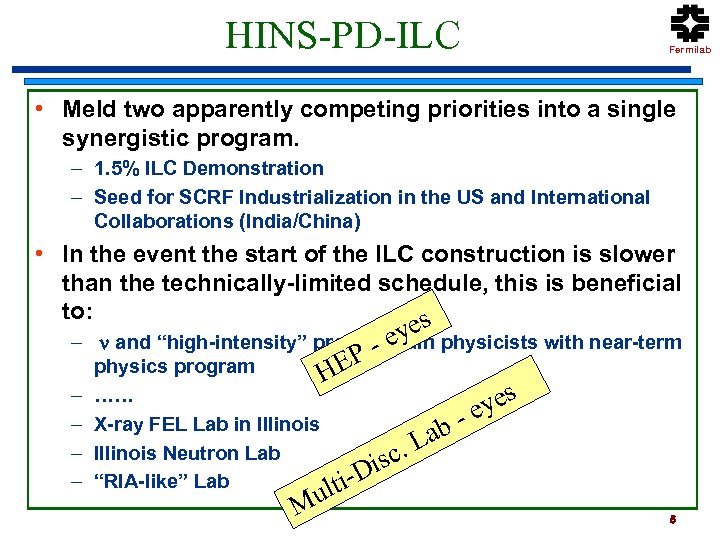
HINS-PD-ILC Fermilab • Meld two apparently competing priorities into a single synergistic program. – 1. 5% ILC Demonstration – Seed for SCRF Industrialization in the US and International Collaborations (India/China) • In the event the start of the ILC construction is slower than the technically-limited schedule, this is beneficial to: s – – – eye physicists with near-term n and “high-intensity” proton-beam Pphysics program HE …… yes -e X-ray FEL Lab in Illinois Lab Illinois Neutron Lab sc. -Di “RIA-like” Lab ulti M 5
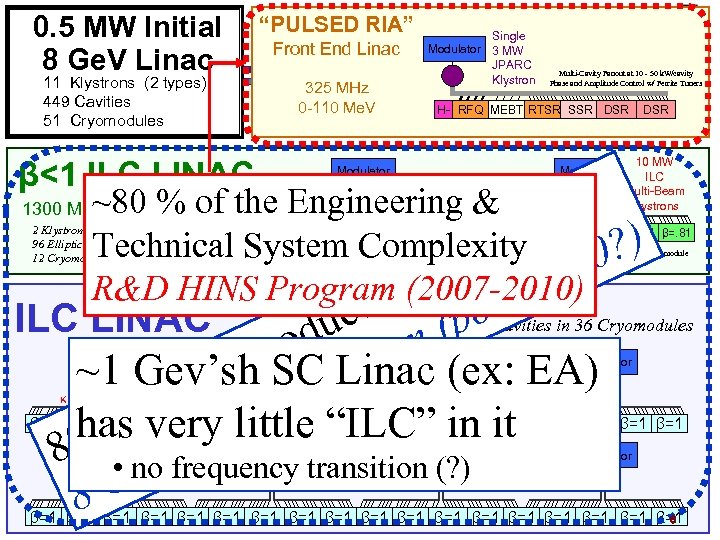
0. 5 MW Initial 8 Ge. V Linac “PULSED RIA” Single Modulator 3 MW JPARC Klystron Front End Linac 11 Klystrons (2 types) 449 Cavities 51 Cryomodules 325 MHz 0 -110 Me. V β<1 ILC LINAC Fermilab Multi-Cavity Fanout at 10 - 50 k. W/cavity Phase and Amplitude Control w/ Ferrite Tuners H- RFQ MEBT RTSR SSR DSR Modulator DSR 10 MW ILC Multi-Beam Klystrons ~80 % Ge. V the Engineering & 0. 1 -1. 2 of Technical System Complexity t ? ) os 010 R&D HINS Program n C 8 Klystrons t-2 o(2007 -2010) i s Elliptical Option 1300 MHz 2 Klystrons 96 Elliptical Cavities 12 Cryomodules 48 Cavites / Klystron β=. 47 β=. 61 β=. 81 or… 325 MHz Spoke Resonators 8 Cavites / Cryomodule ct 288 u m (po. Cavities in 36 Cryomodules od ra r Linac (ex: EA) PSC og ~1 Gev’sh r he P ft c o has verynlittle “ILC” in it % Li a 80 • no frequency transition (? ) e. V 8 G ILC LINAC Modulator 10 MW ILC Klystrons 1300 MHz β=1 Modulator 36 Cavites / Klystron β=1 β=1 β=1 β=1 β=1 Modulator β=1 β=1 β=1 β=1 β=1 6
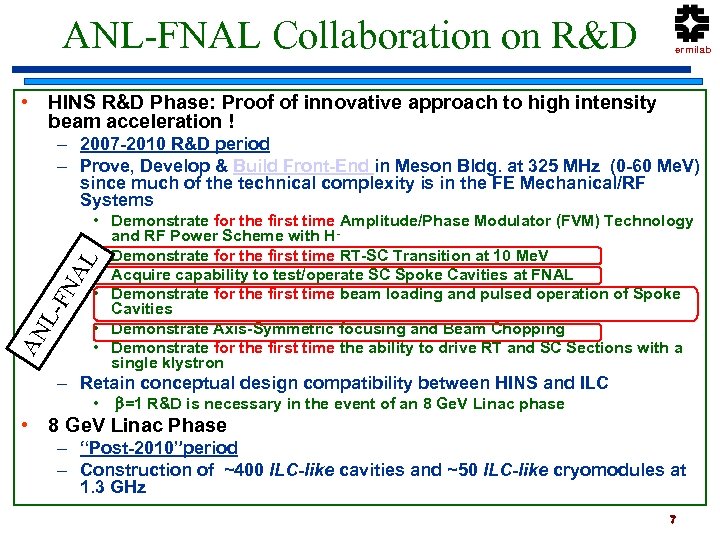
ANL-FNAL Collaboration on R&D HINS R&D Goals Fermilab • HINS R&D Phase: Proof of innovative approach to high intensity beam acceleration ! – 2007 -2010 R&D period – Prove, Develop & Build Front-End in Meson Bldg. at 325 MHz (0 -60 Me. V) since much of the technical complexity is in the FE Mechanical/RF Systems AN LFN AL • Demonstrate for the first time Amplitude/Phase Modulator (FVM) Technology and RF Power Scheme with H • Demonstrate for the first time RT-SC Transition at 10 Me. V • Acquire capability to test/operate SC Spoke Cavities at FNAL • Demonstrate for the first time beam loading and pulsed operation of Spoke Cavities • Demonstrate Axis-Symmetric focusing and Beam Chopping • Demonstrate for the first time the ability to drive RT and SC Sections with a single klystron – Retain conceptual design compatibility between HINS and ILC • b=1 R&D is necessary in the event of an 8 Ge. V Linac phase • 8 Ge. V Linac Phase – “Post-2010”period – Construction of ~400 ILC-like cavities and ~50 ILC-like cryomodules at 1. 3 GHz 7
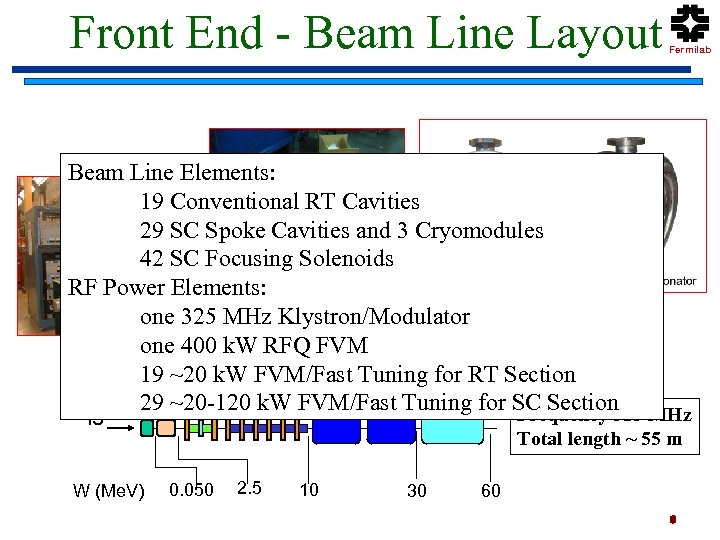
Front End - Beam Line Layout Fermilab Beam Line Elements: 19 Conventional RT Cavities 29 SC Spoke Cavities and 3 Cryomodules 42 SC Focusing Solenoids RF Power Elements: one 325 MHz Klystron/Modulator one 400 k. W RFQ FVM RFQ MEBT RT -CHSR SSR 1 SSR 2 19 ~20 k. W FVM/Fast (b=0. 22) for RT Section Tuning (b=0. 4) 29 ~20 -120 k. W FVM/Fast Tuning for SC Section MHz Frequency 325 IS W (Me. V) Total length ~ 55 m 0. 050 2. 5 10 30 60 8
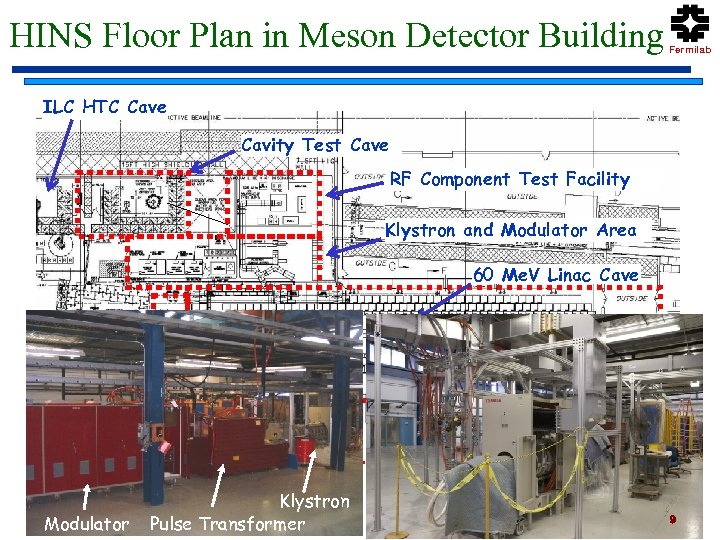
HINS Floor Plan in Meson Detector Building Fermilab ILC HTC Cave Cavity Test Cave RF Component Test Facility Klystron and Modulator Area 60 Me. V Linac Cave Existing CC 2 Cave Ion Source and RFQ Area 150 ft. Modulator Klystron Pulse Transformer 9
’ 05 -’ 07 Achievements Fermilab • Beam Dynamics Simulation – P. Ostroumov’s Group • Basic Design of 8 Ge. V Linac • Merging of HINS with 6 Ge. V ILC Test Linac • Beam Elements Design – P. Ostroumov’s Group • Design of RFQ – K. Shepard’s Group • Design of SSR 1 (Superconducting Single Spoke Resonator) • Industrial Transfer (Roark-Indiana) • Activities covered by bilateral MOUs in FY 06 and FY 07 – FY 06 – FY 07 700 k$ ~400 k$ (4. 9 M$ HINS budget) (2. 2 M$ HINS budget) 10
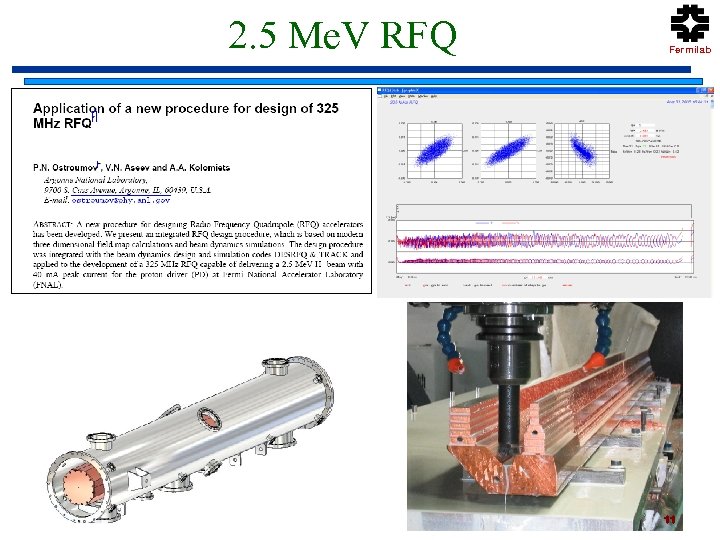
2. 5 Me. V RFQ Fermilab 11
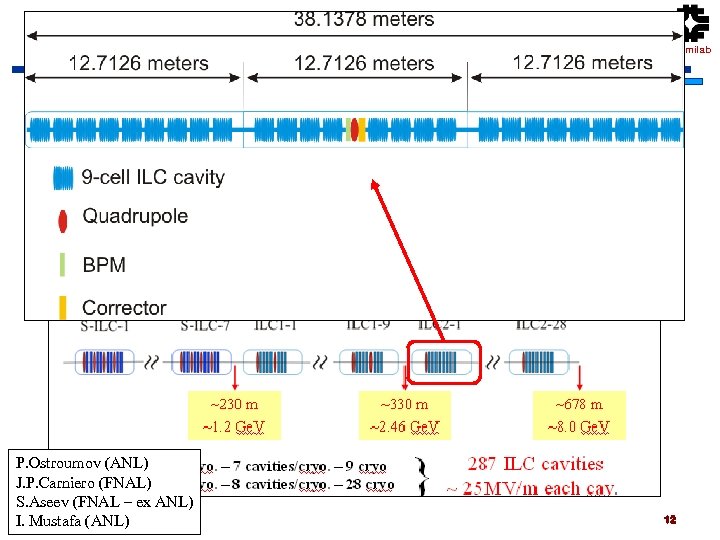
PD-ILC 6 Ge. V Test Linac Fermilab Original Design P. Ostroumov (ANL) J. P. Carniero (FNAL) S. Aseev (FNAL – ex ANL) I. Mustafa (ANL) 12
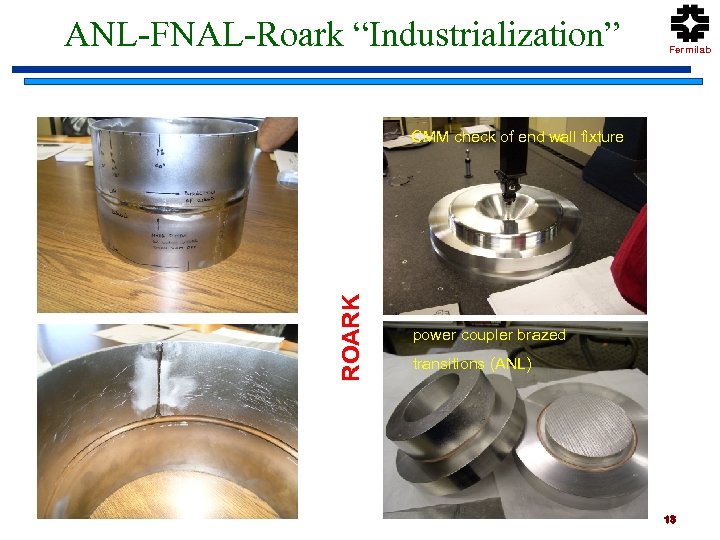
ANL-FNAL-Roark “Industrialization” Fermilab ROARK CMM check of end wall fixture power coupler brazed transitions (ANL) 13
’ 07 -’ 10 Plans for ANL-FNAL Fermilab • Beam Dynamics Simulation – P. Ostroumov’s Group • • Continued support on Beam Simulation Definition or Mechanical and RF Tolerancies Analysis/Optimization of Beam Operations Merging of HINS with 6 Ge. V ILC Test Linac • Beam Elements Operations/Production – P. Ostroumov’s Group • Participation in RFQ Operation – M. Kelly- J. Fuerst Group • Etching of Prototype SSR 1 (4 cavities) • Etching of SSR 1 Production (18+ cavities) in 2008 -’ 09 • Etching of SSR 1 Production (11+ Cavities) in 2009 -’ 10 14
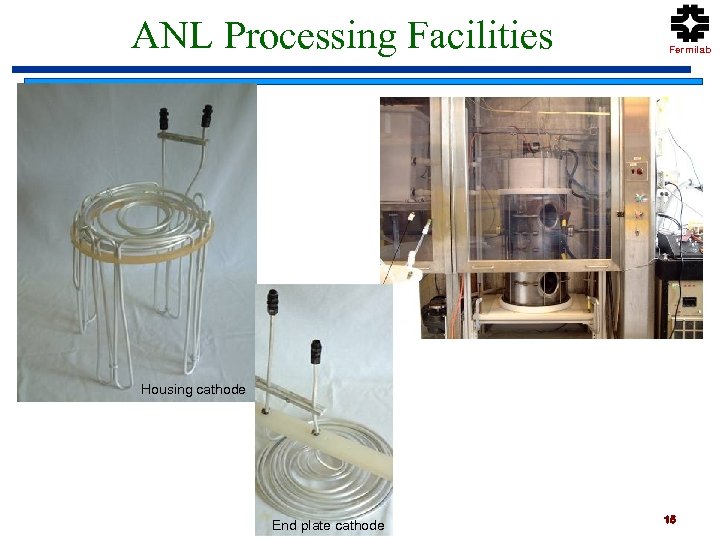
ANL Processing Facilities Fermilab Housing cathode End plate cathode 15
Conclusions Fermilab • Very fruitful ANL-FNAL Collaboration in place on HINS • Strong relationship between FNAL and ANL Scientist on accelerator physics and design of beam elements • Plans to use heavily ANL processing facilities for HINS SSR cavities • Funding support of manpower may become problematic if HINS budget remains constant or decreases 16
Supporting Slides Fermilab 17
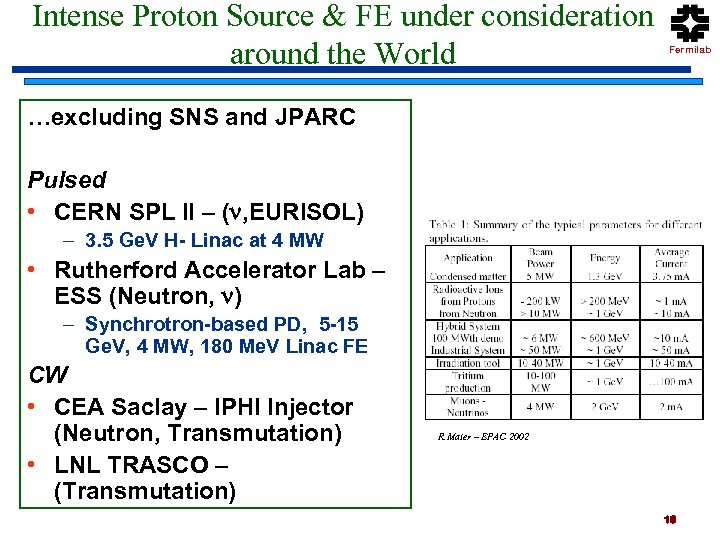
Intense Proton Source & FE under consideration around the World Fermilab …excluding SNS and JPARC Pulsed • CERN SPL II – (n, EURISOL) – 3. 5 Ge. V H- Linac at 4 MW • Rutherford Accelerator Lab – ESS (Neutron, n) – Synchrotron-based PD, 5 -15 Ge. V, 4 MW, 180 Me. V Linac FE CW • CEA Saclay – IPHI Injector (Neutron, Transmutation) • LNL TRASCO – (Transmutation) R. Maier – EPAC 2002 18
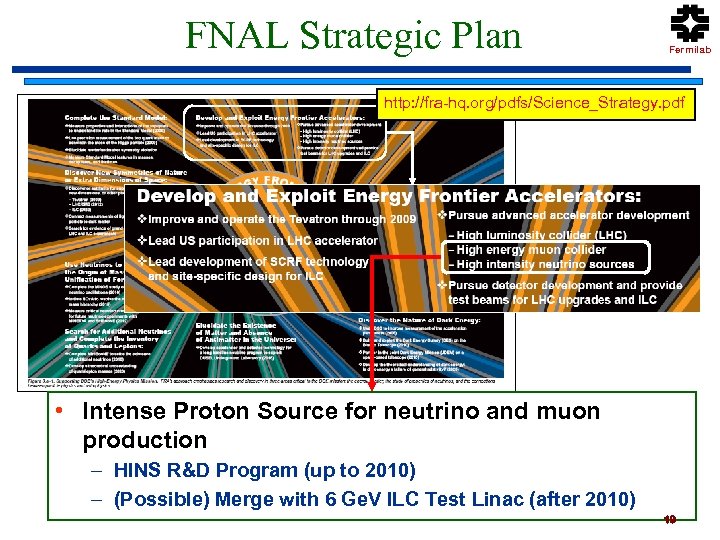
FNAL Strategic Plan Fermilab http: //fra-hq. org/pdfs/Science_Strategy. pdf • Intense Proton Source for neutrino and muon production – HINS R&D Program (up to 2010) – (Possible) Merge with 6 Ge. V ILC Test Linac (after 2010) 19
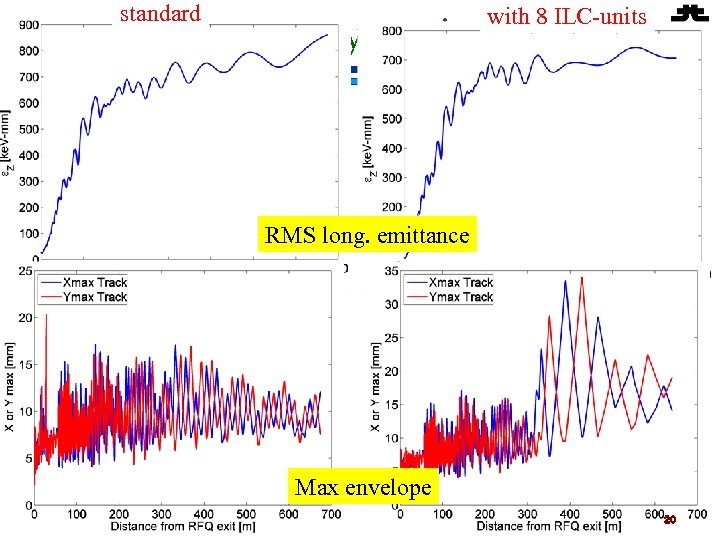
standard with 8 ILC-units Beam Dynamics Fermilab RMS long. emittance Max envelope 20
Скачать презентацию ANL-FNAL Collaboration on High Intensity Neutrino Source Activities
c36ccc37f02a0fb4a6282e6b3a135a4c.ppt