 Скачать презентацию Anita Wolfartsberger WU Vienna University of Economics
dcf079f4e14045fb4fe72b1a666ef68f.ppt
- Количество слайдов: 14



Anita Wolfartsberger WU – Vienna University of Economics & Business e-mail: awolfart@wu. ac. at ELF as an intercultural platform: observations on business meetings Second WU Symposium on International Business Communication LINGUISTIC APPROACHES TO INTERCULTURAL BUSINESS COMMUNICATION WU Vienna University of Economics and Business - June 11/12, 2009
ELF is important for business 4 Non-native speakers nowadays outnumber native speakers of English 8 1, 500 million speakers, 400 million L 1 speakers (Crystal 2003: 67 -69) 4 a shared language lingua franca "[t]he increasingly important role that English is now playing in economic processes, in providing access to the kind of global knowledges available in English and the jobs which involve contact with customers and colleagues for whom English is the only shared language […]". (Graddol 2006: 38) 2
(In)separability of Language and Culture "Culture is notoriously difficult to define" (Spencer-Oatey 2000: 3). 4 Linguistic Relativity/Determinism 8 "Culture is communication. " (Hall 1959: 119) e. g. von Humboldt, Wittgenstein, 'Sapir-Whorf' 4 Opposing position 8 "[…] the correlation of 'a language' with 'a culture' becomes less secure. " (Bowers 1999: 221) 3
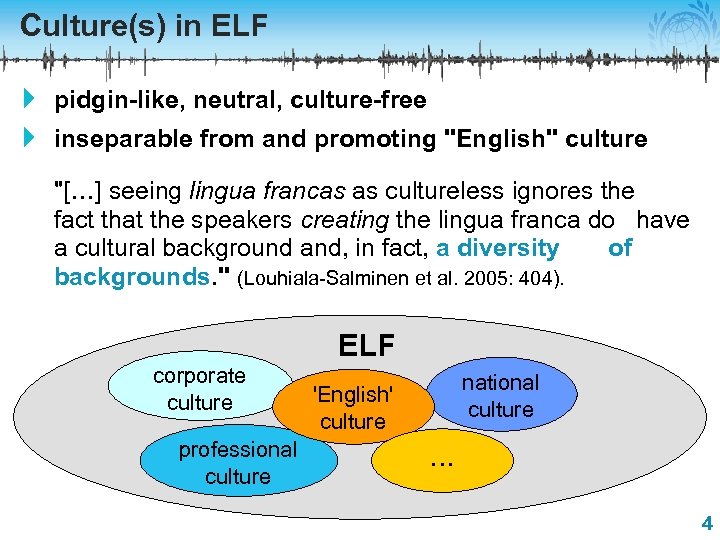
Culture(s) in ELF 4 pidgin-like, neutral, culture-free 4 inseparable from and promoting "English" culture "[…] seeing lingua francas as cultureless ignores the fact that the speakers creating the lingua franca do have a cultural background and, in fact, a diversity of backgrounds. " (Louhiala-Salminen et al. 2005: 404). ELF corporate culture professional culture national culture 'English' culture … 4
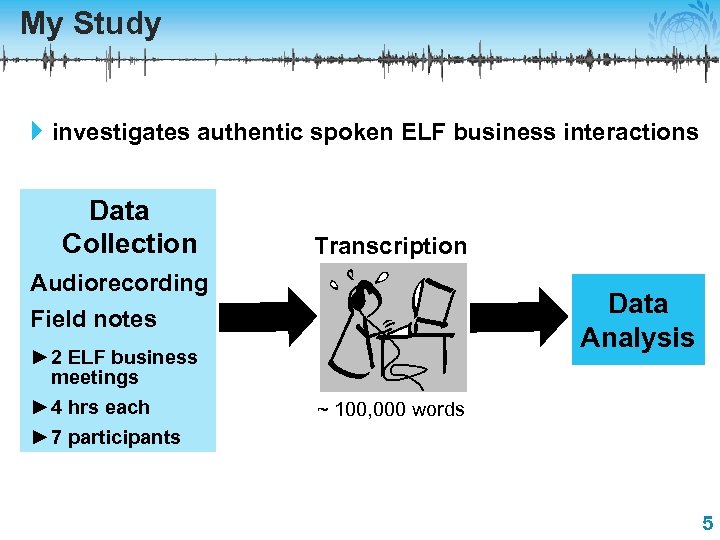
My Study 4 investigates authentic spoken ELF business interactions Data Collection Transcription Audiorecording Field notes ► 2 ELF business meetings ► 4 hrs each ► 7 participants Data Analysis ~ 100, 000 words 5
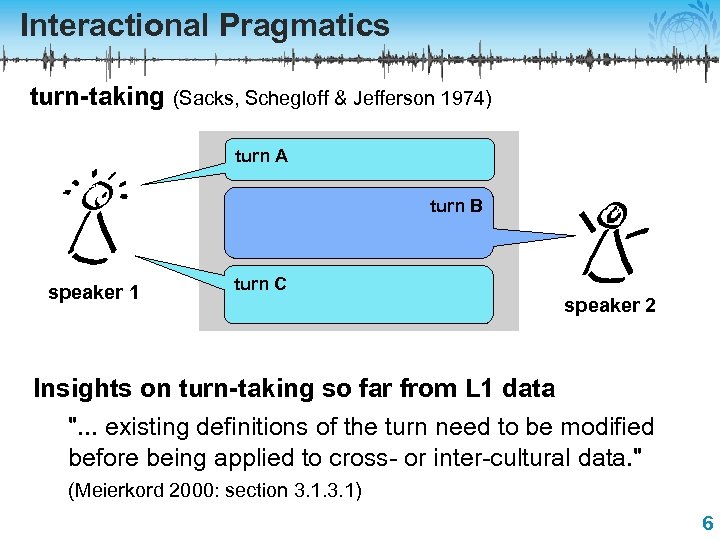
Interactional Pragmatics turn-taking (Sacks, Schegloff & Jefferson 1974) turn A turn B floor speaker 1 turn C speaker 2 Insights on turn-taking so far from L 1 data ". . . existing definitions of the turn need to be modified before being applied to cross- or inter-cultural data. " (Meierkord 2000: section 3. 1) 6
![Speaker interventions 4 Intervention behaviour "[…] any utterance by a member of the group](https://present5.com/presentation/dcf079f4e14045fb4fe72b1a666ef68f/image-7.jpg "Speaker interventions 4 Intervention behaviour \"[…] any utterance by a member of the group")
Speaker interventions 4 Intervention behaviour "[…] any utterance by a member of the group which cuts into the ongoing speech of another, whether or not it causes overlapping speech. " (Watts 1991: 4) Speaker interventions in my data … 4 occur in a variety of forms 4 fulfill different functions (collaborative & competitive) " […] an overlap performed to take the turn is not necessarily uncooperative, but can show involvement and interest in the successful development of the conversation. " (Cogo 2007: 146) 7
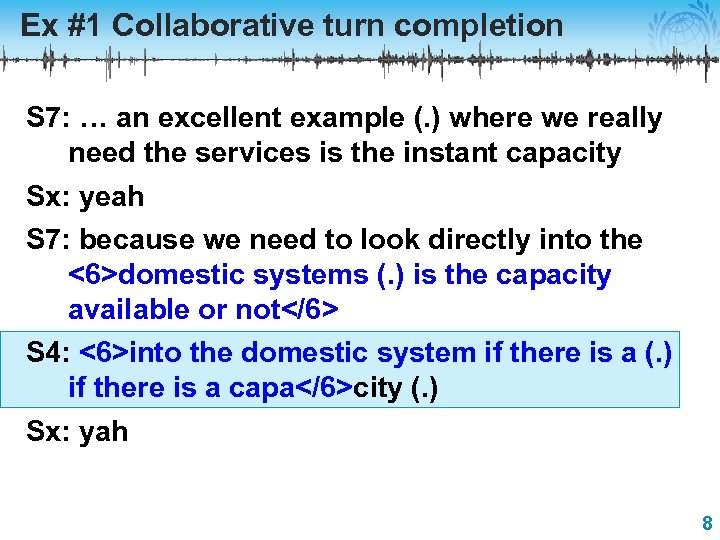
Ex #1 Collaborative turn completion S 7: … an excellent example (. ) where we really need the services is the instant capacity Sx: yeah S 7: because we need to look directly into the <6>domestic systems (. ) is the capacity available or not</6> S 4: <6>into the domestic system if there is a (. ) if there is a capa</6>city (. ) Sx: yah 8
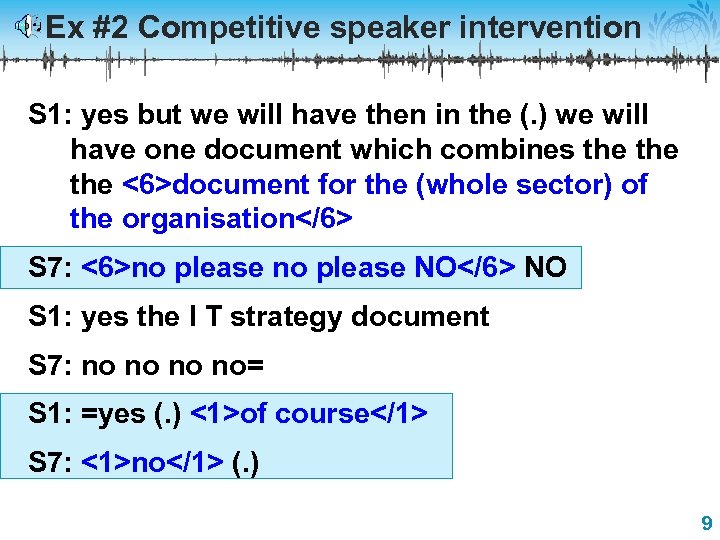
Ex #2 Competitive speaker intervention S 1: yes but we will have then in the (. ) we will have one document which combines the the <6>document for the (whole sector) of the organisation</6> S 7: <6>no please NO</6> NO S 1: yes the I T strategy document S 7: no no= S 1: =yes (. ) <1>of course</1> S 7: <1>no</1> (. ) 9
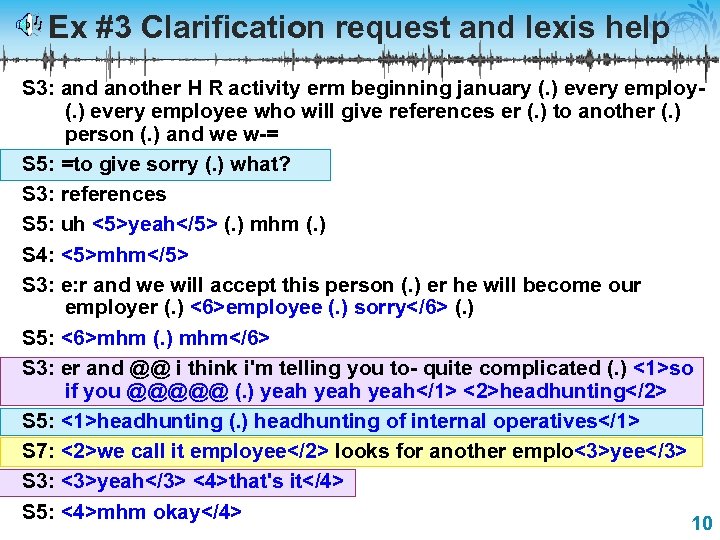
Ex #3 Clarification request and lexis help S 3: and another H R activity erm beginning january (. ) every employee who will give references er (. ) to another (. ) person (. ) and we w-= S 5: =to give sorry (. ) what? S 3: references S 5: uh <5>yeah</5> (. ) mhm (. ) S 4: <5>mhm</5> S 3: e: r and we will accept this person (. ) er he will become our employer (. ) <6>employee (. ) sorry</6> (. ) S 5: <6>mhm (. ) mhm</6> S 3: er and @@ i think i'm telling you to- quite complicated (. ) <1>so if you @@@@@ (. ) yeah</1> <2>headhunting</2> S 5: <1>headhunting (. ) headhunting of internal operatives</1> S 7: <2>we call it employee</2> looks for another emplo<3>yee</3> S 3: <3>yeah</3> <4>that's it</4> S 5: <4>mhm okay</4> 10
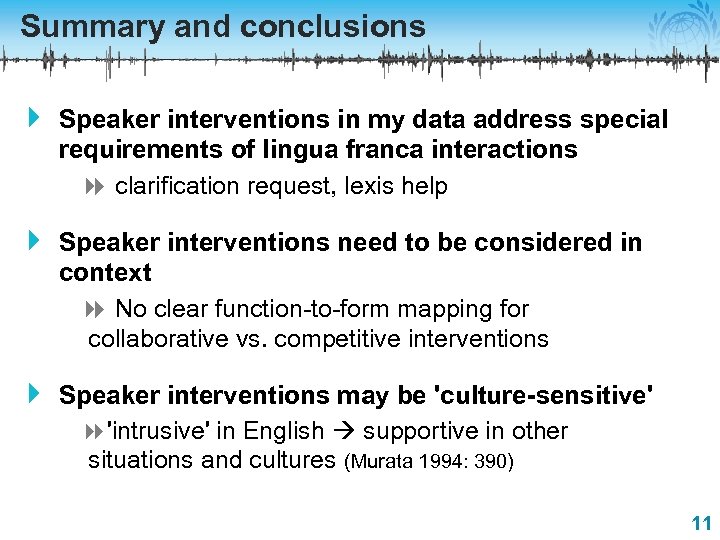
Summary and conclusions 4 Speaker interventions in my data address special requirements of lingua franca interactions 8 clarification request, lexis help 4 Speaker interventions need to be considered in context 8 No clear function-to-form mapping for collaborative vs. competitive interventions 4 Speaker interventions may be 'culture-sensitive' 8'intrusive' in English supportive in other situations and cultures (Murata 1994: 390) 11
Thank you … … for your attention! Questions ? 12
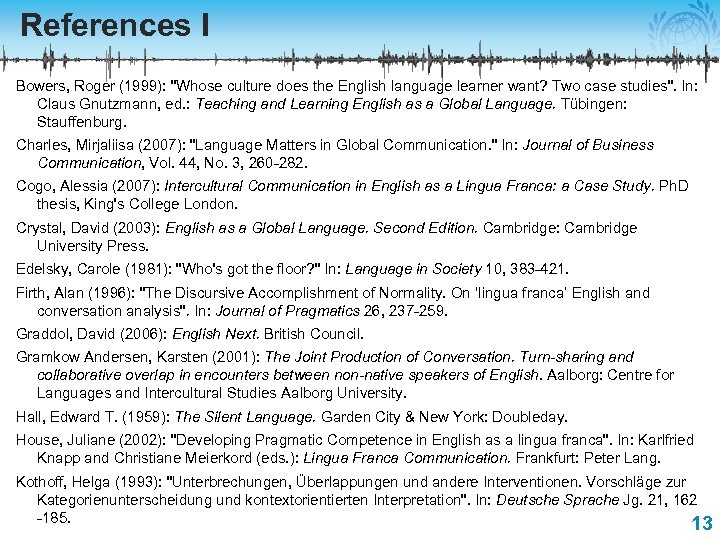
References I Bowers, Roger (1999): "Whose culture does the English language learner want? Two case studies". In: Claus Gnutzmann, ed. : Teaching and Learning English as a Global Language. Tübingen: Stauffenburg. Charles, Mirjaliisa (2007): "Language Matters in Global Communication. " In: Journal of Business Communication, Vol. 44, No. 3, 260 -282. Cogo, Alessia (2007): Intercultural Communication in English as a Lingua Franca: a Case Study. Ph. D thesis, King's College London. Crystal, David (2003): English as a Global Language. Second Edition. Cambridge: Cambridge University Press. Edelsky, Carole (1981): "Who's got the floor? " In: Language in Society 10, 383 -421. Firth, Alan (1996): "The Discursive Accomplishment of Normality. On ‘lingua franca’ English and conversation analysis". In: Journal of Pragmatics 26, 237 -259. Graddol, David (2006): English Next. British Council. Gramkow Andersen, Karsten (2001): The Joint Production of Conversation. Turn-sharing and collaborative overlap in encounters between non-native speakers of English. Aalborg: Centre for Languages and Intercultural Studies Aalborg University. Hall, Edward T. (1959): The Silent Language. Garden City & New York: Doubleday. House, Juliane (2002): "Developing Pragmatic Competence in English as a lingua franca". In: Karlfried Knapp and Christiane Meierkord (eds. ): Lingua Franca Communication. Frankfurt: Peter Lang. Kothoff, Helga (1993): "Unterbrechungen, Überlappungen und andere Interventionen. Vorschläge zur Kategorienunterscheidung und kontextorientierten Interpretation". In: Deutsche Sprache Jg. 21, 162 -185. 13
References II Louhiala-Salminen, Leena, Mirjaliisa Charles and Anne Kankanraanta (2005): "English as a lingua franca in Nordic corporate mergers: Two case companies. " In: English for Specific Purposes 24, 401 -421. Meierkord, Christiane (2000): "Interpreting successful lingua franca interaction. An analysis of nonnative-/non-native small talk conversations in English". In: Linguistik Online 5, 1/00. http: //www. linguistik-online. de/1_00/MEIERKOR. HTM, accessed Sept 30, 2008. Meierkord, Christiane (2002): "'Language stripped bare' or 'linguistic masala'? Culture in lingua franca conversation. " In: Karlfried Knapp and Christiane Meierkord, eds. : Lingua Franca Communication. Frankfurt etc. : Peter Lang. Murata, Kumiko (1994): "Intrusive or co-operative? A cross-cultural study of interruption". In: Journal of Pragmatics 21, 385 -400. Oreström, Bengt (1983): Turn-taking in English Conversation". Lund: CWK Gleerup. Pölzl, Ulrike (2005): Exploring the Third Space: Negotiating Culture in English as a lingua franca. Ph. D thesis, University of Vienna. Sacks, Harvey, Emanuel A. Schegloff and Gail Jefferson (1974): "A simplest systematics for the organization of turn-taking for conversation". In: Language 50/4, 696 -735. Schegloff, Emanuel A. (2000): "Overlapping talk and the organization of turn-taking for conversation". In: Language in Society 29, 1 -63. Seidlhofer, Barbara (2001): “Closing a conceptual gap: the case for a description of English as a lingua franca”. In: International Journal of Applied Linguistics Vol 11, No. 2, 133 -158. Spencer-Oatey, Helen, ed. (2000): Culturally Speaking. London & New York: Continuum. Watts, Richard J. (1991): Power in Family Discourse. Berlin & New York: de Gruyter. 14
Скачать презентацию Anita Wolfartsberger WU Vienna University of Economics
dcf079f4e14045fb4fe72b1a666ef68f.ppt