


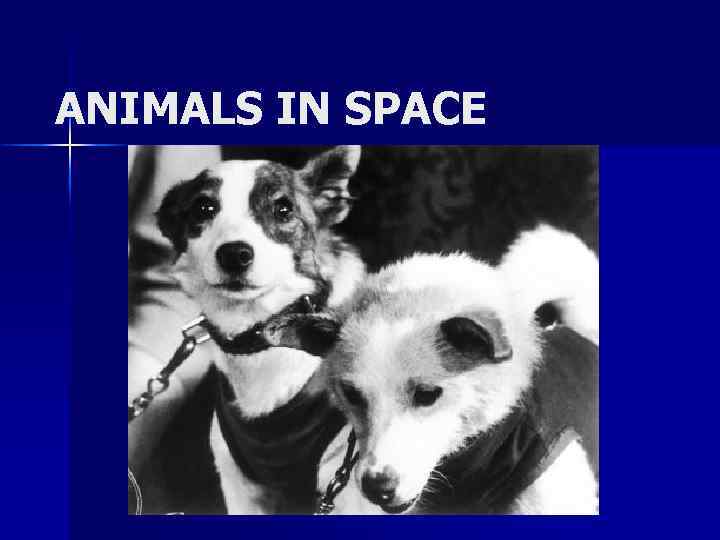
ANIMALS IN SPACE
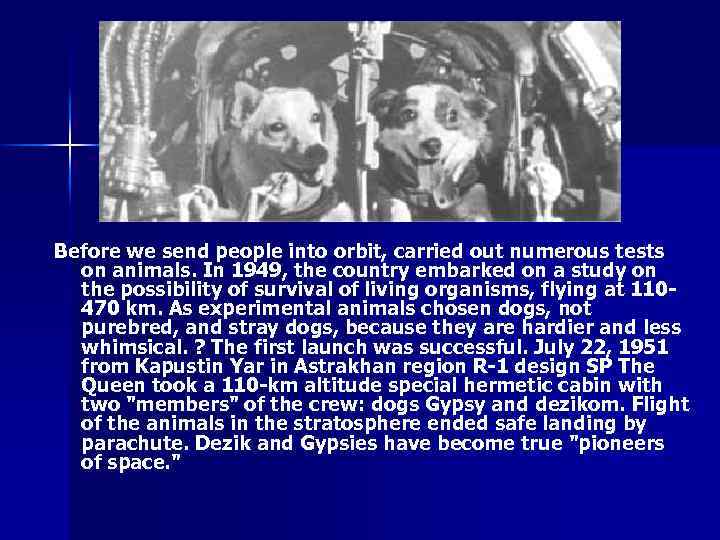
Before we send people into orbit, carried out numerous tests on animals. In 1949, the country embarked on a study on the possibility of survival of living organisms, flying at 110470 km. As experimental animals chosen dogs, not purebred, and stray dogs, because they are hardier and less whimsical. ? The first launch was successful. July 22, 1951 from Kapustin Yar in Astrakhan region R-1 design SP The Queen took a 110 -km altitude special hermetic cabin with two "members" of the crew: dogs Gypsy and dezikom. Flight of the animals in the stratosphere ended safe landing by parachute. Dezik and Gypsies have become true "pioneers of space. "
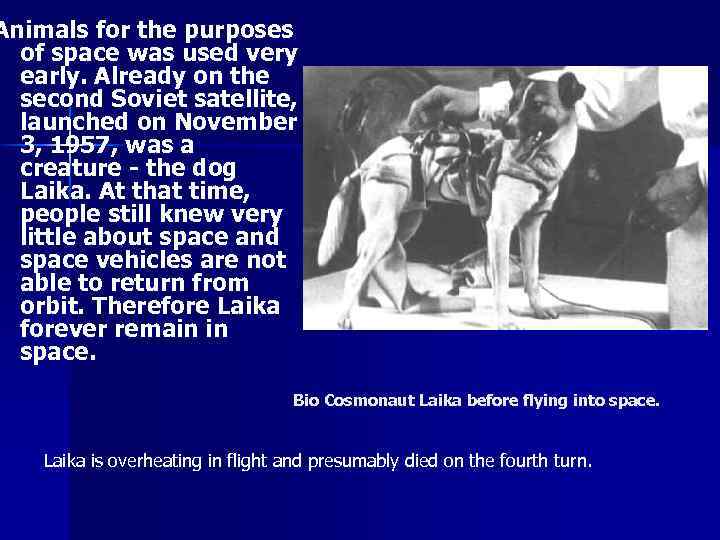
Animals for the purposes of space was used very early. Already on the second Soviet satellite, launched on November 3, 1957, was a creature - the dog Laika. At that time, people still knew very little about space and space vehicles are not able to return from orbit. Therefore Laika forever remain in space. Bio Cosmonaut Laika before flying into space. Laika is overheating in flight and presumably died on the fourth turn.
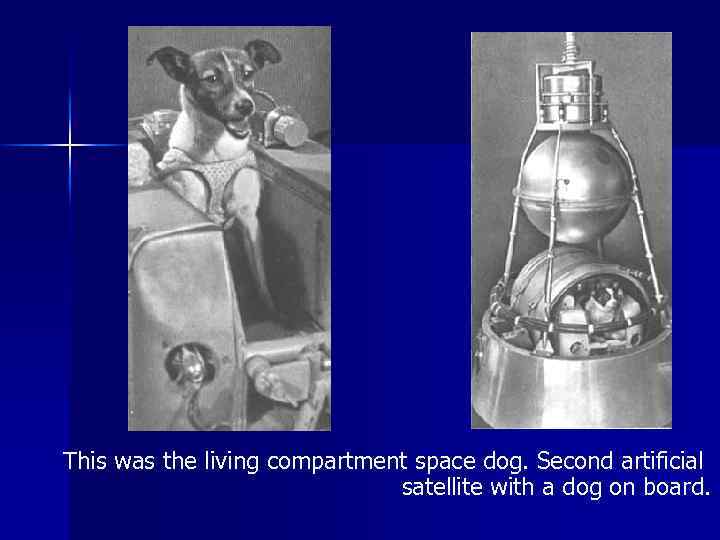
This was the living compartment space dog. Second artificial satellite with a dog on board.
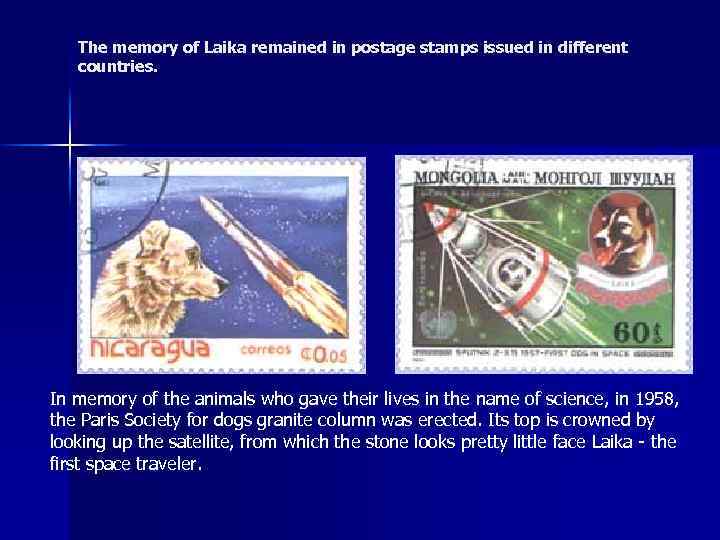
The memory of Laika remained in postage stamps issued in different countries. In memory of the animals who gave their lives in the name of science, in 1958, the Paris Society for dogs granite column was erected. Its top is crowned by looking up the satellite, from which the stone looks pretty little face Laika - the first space traveler.
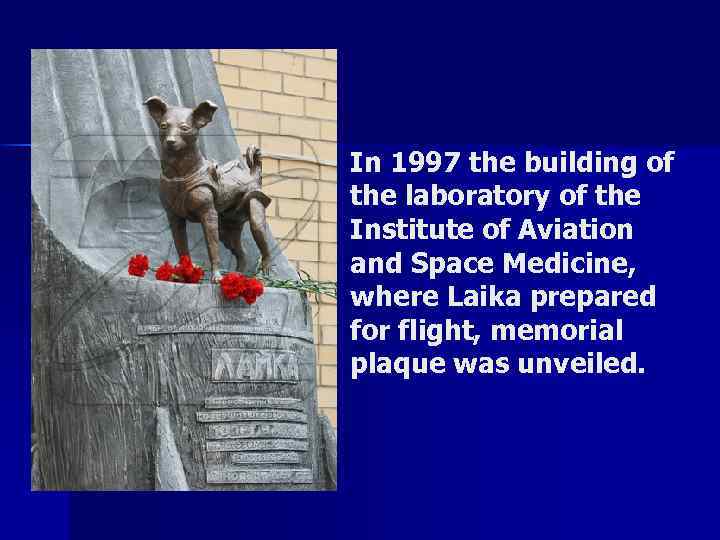
In 1997 the building of the laboratory of the Institute of Aviation and Space Medicine, where Laika prepared for flight, memorial plaque was unveiled.
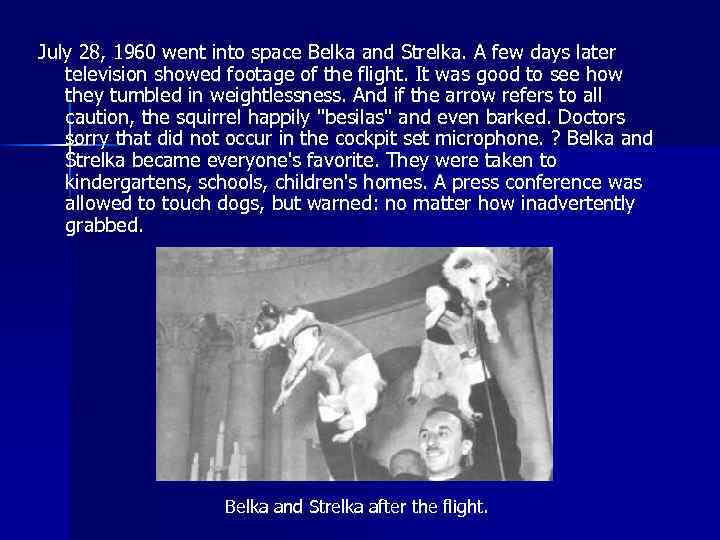
July 28, 1960 went into space Belka and Strelka. A few days later television showed footage of the flight. It was good to see how they tumbled in weightlessness. And if the arrow refers to all caution, the squirrel happily "besilas" and even barked. Doctors sorry that did not occur in the cockpit set microphone. ? Belka and Strelka became everyone's favorite. They were taken to kindergartens, schools, children's homes. A press conference was allowed to touch dogs, but warned: no matter how inadvertently grabbed. Belka and Strelka after the flight.
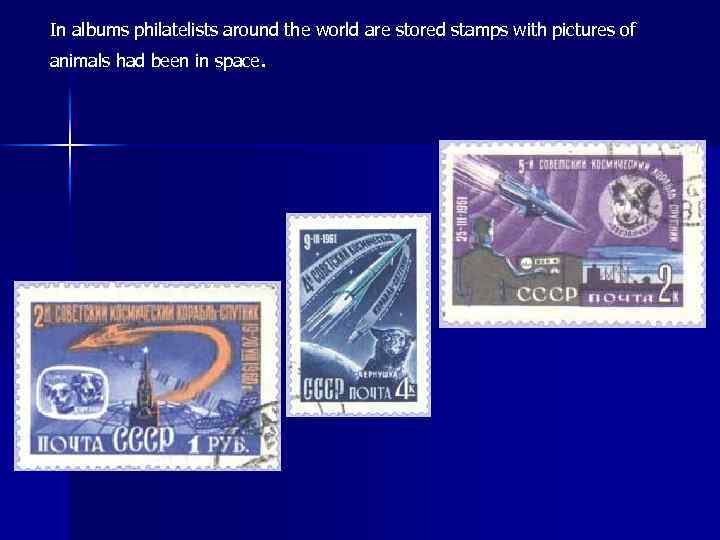
In albums philatelists around the world are stored stamps with pictures of animals had been in space.
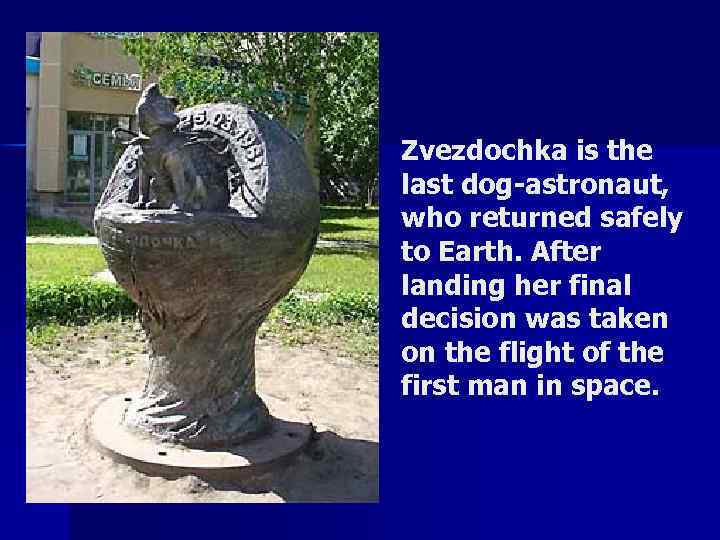
Zvezdochka is the last dog-astronaut, who returned safely to Earth. After landing her final decision was taken on the flight of the first man in space.
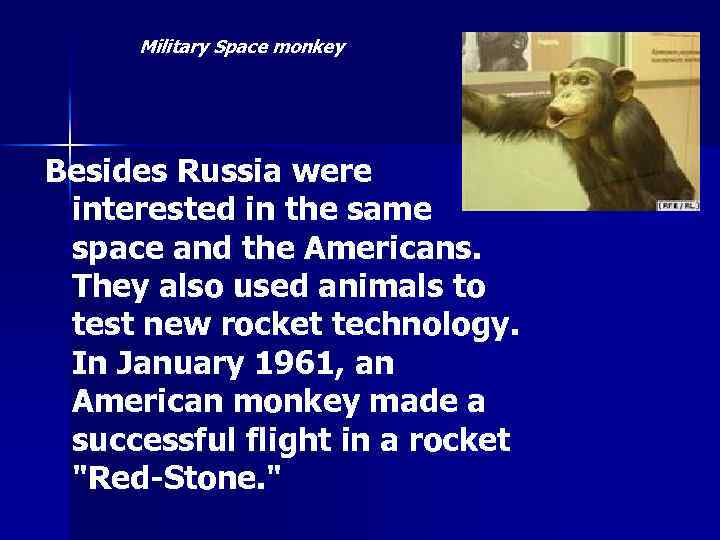
Military Space monkey Besides Russia were interested in the same space and the Americans. They also used animals to test new rocket technology. In January 1961, an American monkey made a successful flight in a rocket "Red-Stone. "
Military and Space Cat Eighteenth October 1963 Felix, black and white cat found on the streets of Paris, was the first cat-astronaut in the history of France. Starting from the research Hammagir landfill in Algeria on a rocket "Veronica AGI № 47", the cat soared to a height which did not dream bats - about 200 miles - and planned out by parachute. True, evil tongues say that the first French astronaut was not a cat, and a cat named Felisetta (Felicity).
For the time of space exploration in low Earth orbit have visited hundreds of biological objects. In addition to the dogs, it's - mice, rats, monkeys, snails, newts, fish, insects and microorganisms. Only 11 satellites, "Bion" made space travel 12 monkeys and 212 rats.
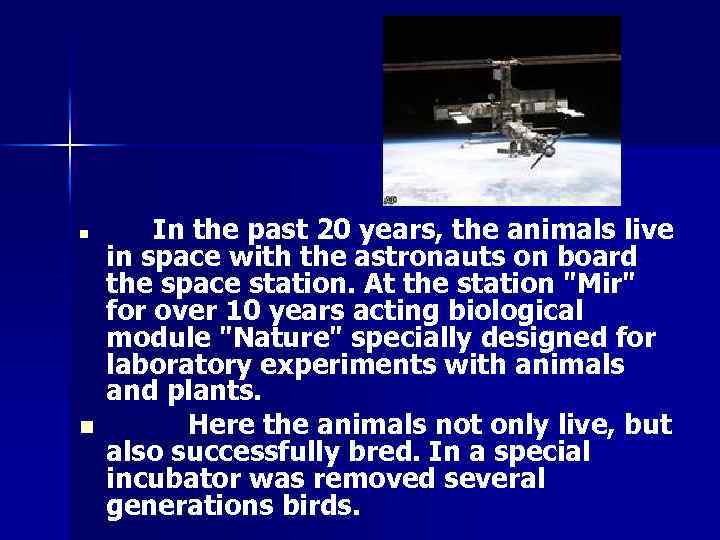
n n In the past 20 years, the animals live in space with the astronauts on board the space station. At the station "Mir" for over 10 years acting biological module "Nature" specially designed for laboratory experiments with animals and plants. Here the animals not only live, but also successfully bred. In a special incubator was removed several generations birds.
Particularly interesting to study the plants grown in space. In zero gravity the fruit on the trees obtained several times larger than the earth. Space plants grown in special orbital greenhouses. They are characterized by high yields and resistance to disease. In addition, the harvest gathered in space for a long time does not go bad, because it is stored in a special vacuum chamber to prevent rotting.
Results of experiments with animals and plants, the ongoing aboard space stations, will be useful for future interplanetary expeditions. On modern spacecraft to Mars, our nearest planet, must fly almost half a year, the same amount back. All this time the astronauts something to eat. Of course, they will have a lot of canned and dried foods, but the human body always need fresh vegetables and fruits. These fruits and vegetables are grown in space greenhouses.
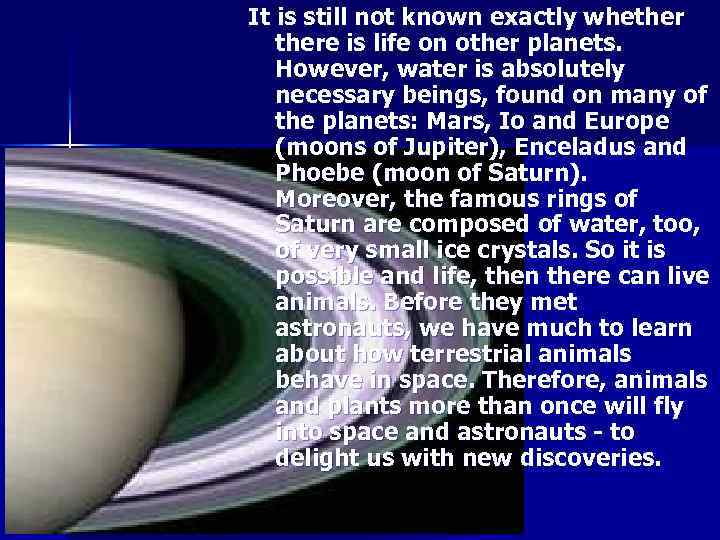
It is still not known exactly whethere is life on other planets. However, water is absolutely necessary beings, found on many of the planets: Mars, Io and Europe (moons of Jupiter), Enceladus and Phoebe (moon of Saturn). Moreover, the famous rings of Saturn are composed of water, too, of very small ice crystals. So it is possible and life, then there can live animals. Before they met astronauts, we have much to learn about how terrestrial animals behave in space. Therefore, animals and plants more than once will fly into space and astronauts - to delight us with new discoveries.
