



 Anglo-Saxons
 Who were they?
 Settlers in Britain The Romans invaded Britain in AD 43. After that, for 400 years southern Britain was part of the Roman world. The last Roman soldiers left Britain in AD 410, and then new people came in ships across the North Sea. Historians call them Anglo-Saxons. The new settlers were a mixture of people from north Germany, Denmark and northern Holland. Most were Saxons, Angles and Jutes. There were some Franks and Frisians too. If we use the modern names for the countries they came from, the Saxons, Franks and Frisians were German-Dutch, the Angles were southern Danish, and Jutes were northern Danish.
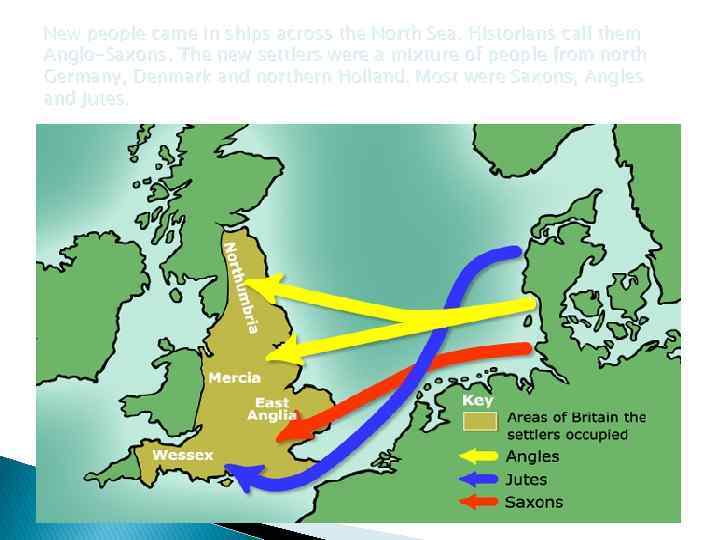 New people came in ships across the North Sea. Historians call them Anglo-Saxons. The new settlers were a mixture of people from north Germany, Denmark and northern Holland. Most were Saxons, Angles and Jutes.
 How the Anglo-Saxons lived In their own lands, most Anglo-Saxons were farmers. They lived in family groups in villages, not cities. Since they lived close to the sea and big rivers, many Anglo-Saxons were sailors too. They built wooden ships with oars and sails, for trade and to settle in new lands. Raiders in ships attacked Roman Britain. Most people in Roman Britain were Christians. Most Anglo-Saxons were not Christians. They worshipped lots of gods and goddesses. Their beliefs were similar to those of the Celts, who lived in Britain before the Romans invaded.
 Where did the Anglo-Saxons settle? When the Anglo-Saxons arrived in Britain, most kept clear of Roman towns. They preferred to live in small villages. However, warrior chiefs knew that a walled city made a good fortress. So some Roman towns, like London, were never completely abandoned. Many Roman buildings did become ruins though, because no one bothered or knew how to repair them. Some Saxons built wooden houses inside the walls of Roman towns. Others cleared spaces in the forest to build villages and make new fields. Some settlements were very small, with just two or three families.
 Hengist and Horsa Without Roman soldiers to defend them, the Britons were in danger from raids, so some British leaders paid Anglo-Saxons to fight for them. A history book called the 'Anglo-Saxon Chronicle' describes how in AD 449 two Jutes named Hengist and Horsa were invited to Britain by a British king called Vortigern. He paid them and their men to fight the Picts. Instead, the Jutes turned on Vortigern and seized his kingdom. Hengist's son Aesc became king of Kent. No one knows if this is a true story, but it may show some of the newcomers settled in Britain.
 How did England get its name? The Roman Britons spoke Latin or local Celtic languages. The newcomers spoke their own languages, which in time became a language now known as Anglo-Saxon or Old English. The Anglo-Saxons themselves called it 'Englisc'. The country taken over by the new settlers became 'England'. Some Britons settled down with the newcomers. Others moved west and north, taking their Latin-Celtic culture with them. Place names give clues to where the new 'English' lived. A place-name ending in ham, for instance, shows it was once a Saxon settlement. Ham in Anglo-Saxon English meant 'village'.
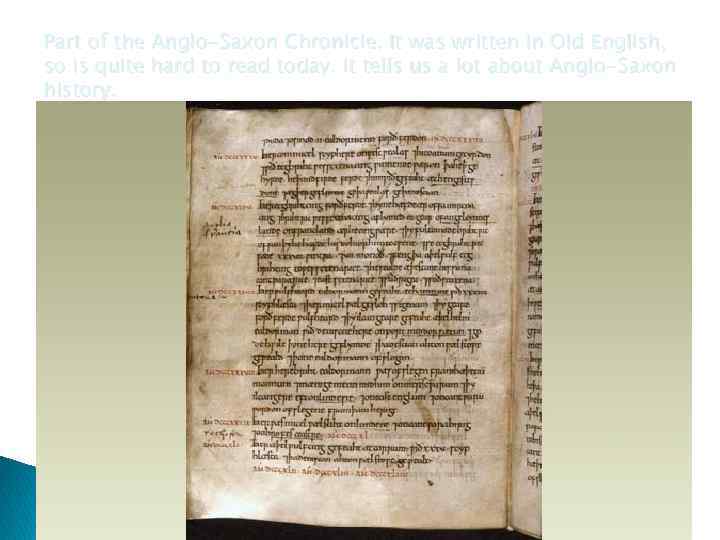 Part of the Anglo-Saxon Chronicle. It was written in Old English, so is quite hard to read today. It tells us a lot about Anglo-Saxon history.
 Anglo-Saxon life
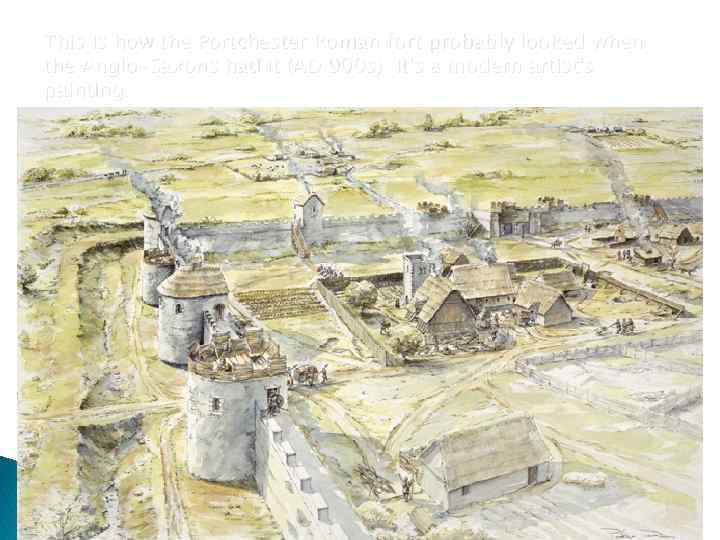 This is how the Portchester Roman fort probably looked when the Anglo-Saxons had it (AD 900 s). It's a modern artist's painting.
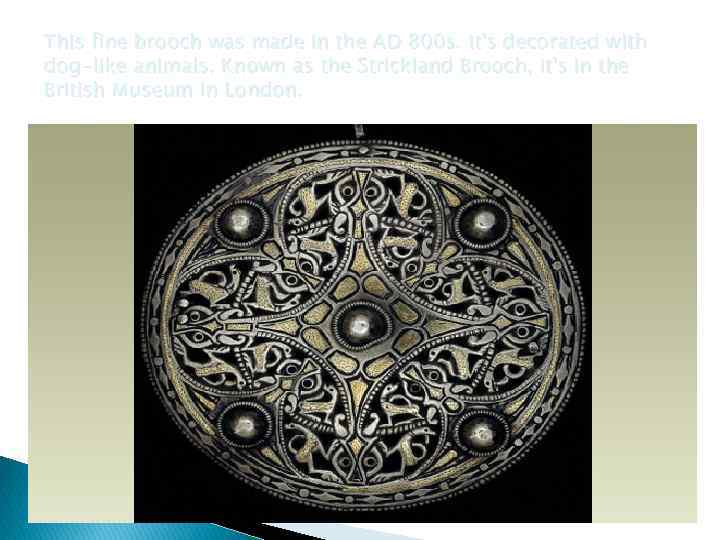 This fine brooch was made in the AD 800 s. It's decorated with dog-like animals. Known as the Strickland Brooch, it's in the British Museum in London.
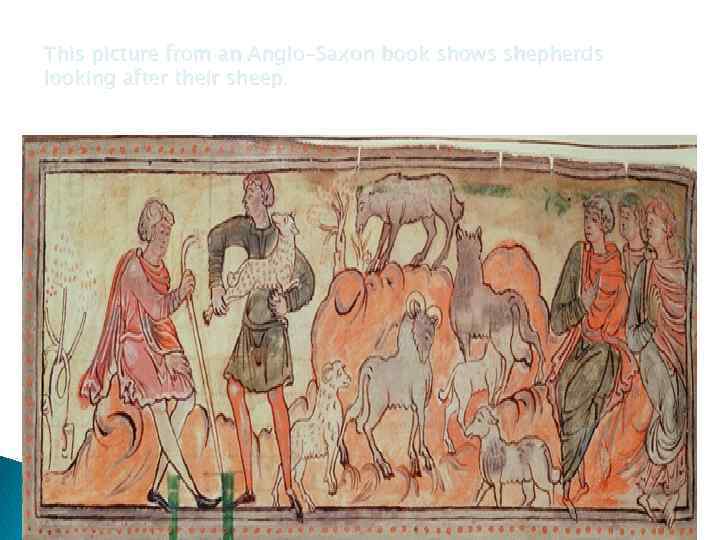 This picture from an Anglo-Saxon book shows shepherds looking after their sheep.
 An Anglo-Saxon home In an Anglo-Saxon family, everyone from babies to old people shared a home. Anglo-Saxon houses were built of wood and had thatched roofs. At West Stow in Suffolk archaeologists found the remains of an early Anglo. Saxon village. They reconstructed it using Anglo-Saxon methods. They found that the village was made up of small groups of houses built around a larger hall. Each family house had one room, with a hearth with a fire for cooking, heating and light. A metal cooking pot hung from a chain above the fire.
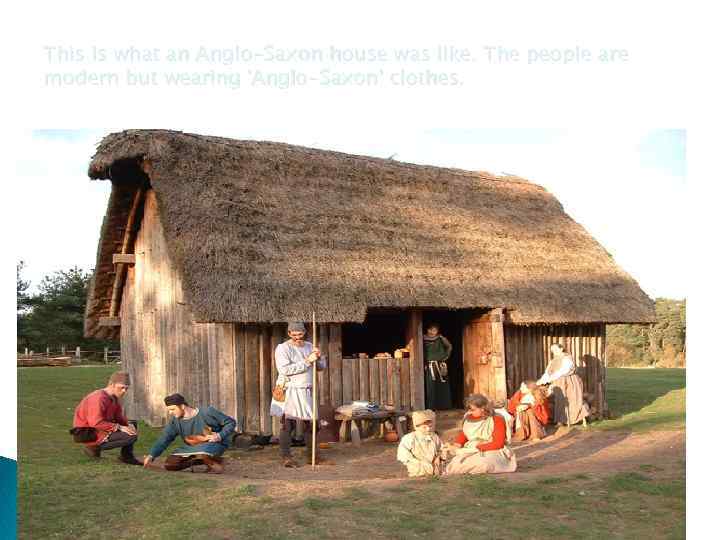 This is what an Anglo-Saxon house was like. The people are modern but wearing 'Anglo-Saxon' clothes.
 Clothing People wore clothes made from woollen cloth or animal skins. Men wore tunics, with tight trousers or leggings, wrapped around with strips of cloth or leather. Women wore long dresses. Women spun the wool from sheep and goats to make thread. They used a loom to weave thread into cloth. Clothing styles varied from region to region. For instance, an Anglian woman fastened her dress with a long brooch. A Saxon woman used a round brooch. Clothing also changed over time.
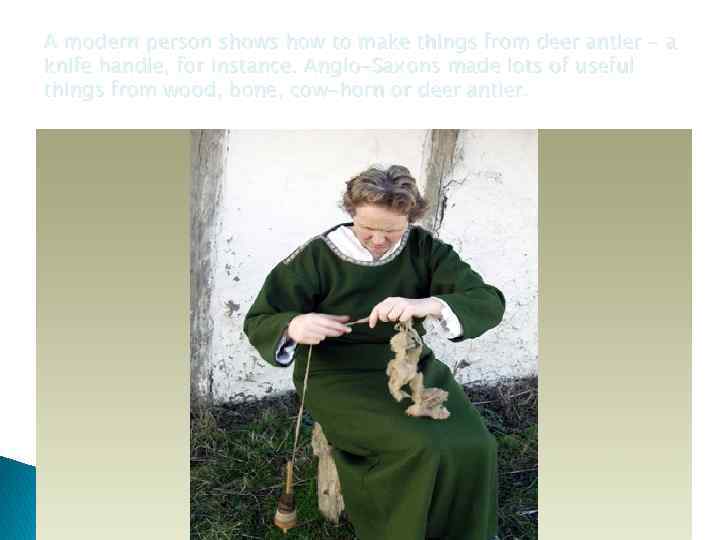 A modern person shows how to make things from deer antler - a knife handle, for instance. Anglo-Saxons made lots of useful things from wood, bone, cow-horn or deer antler.
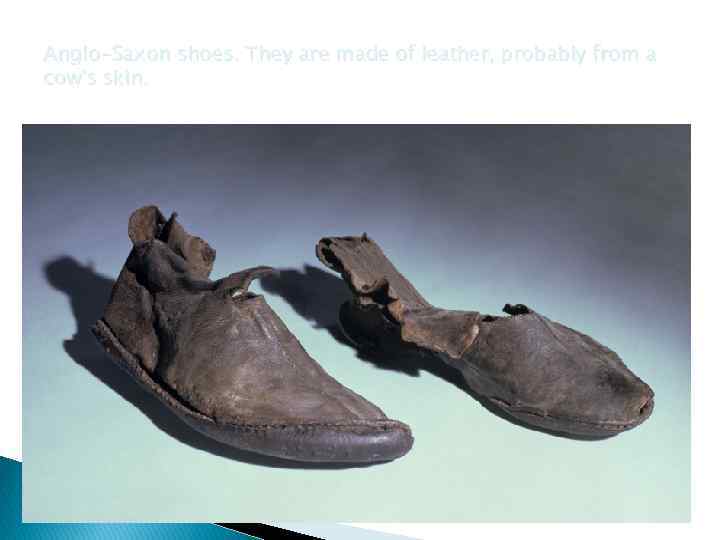 Anglo-Saxon shoes. They are made of leather, probably from a cow's skin.
 What jobs did people do? Men, women and children helped on the farm. Men cut down trees to clear land for ploughing and sowing crops. Farmers used oxen to pull ploughs up and down long strip-fields. Children with dogs herded cattle and sheep. They kept a lookout for wolves - which still lived in Britain at this time. Some people had special skills. The smith made iron tools, knives and swords. Woodworkers made wooden bowls, furniture, carts and wheels. Potters made pottery from clay. The shoemaker made leather shoes. Jewellers made metal brooches, beads and gold ornaments for rich people.
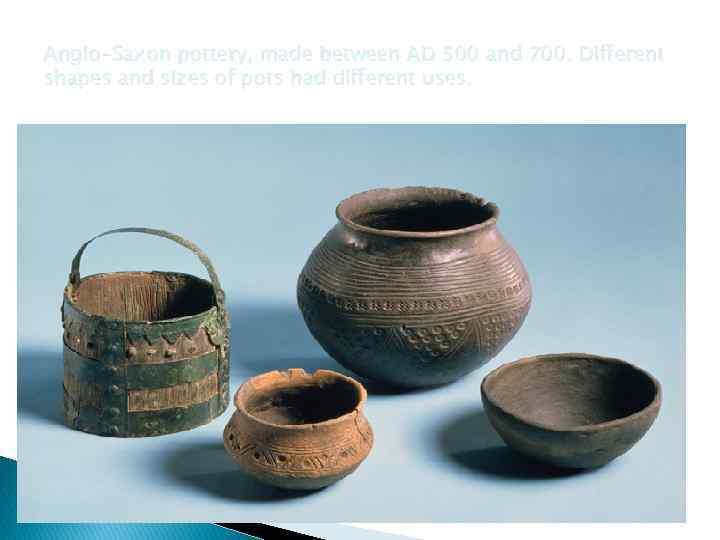 Anglo-Saxon pottery, made between AD 500 and 700. Different shapes and sizes of pots had different uses.
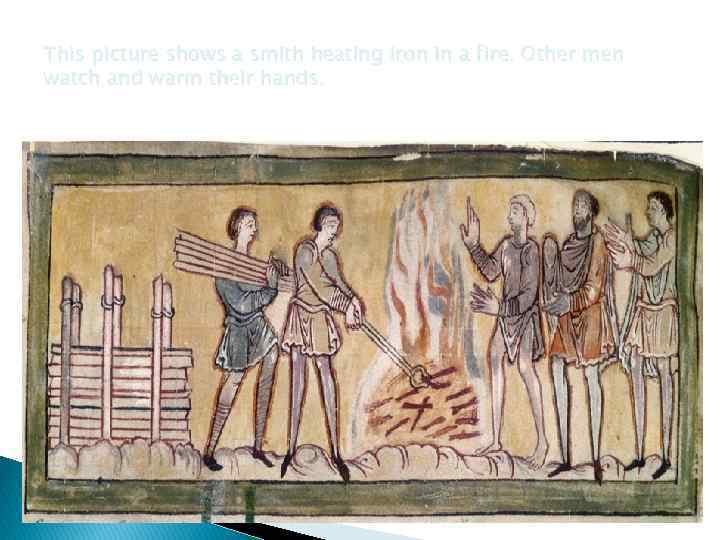 This picture shows a smith heating iron in a fire. Other men watch and warm their hands.
 Stories and pastimes
 Story-telling Anglo-Saxons liked to gather in the lord's great hall, to eat and drink, and to listen to songs and stories. They loved tales about brave warriors and their adventures. A favourite story told how Beowulf, a heroic prince, kills the fierce man-eating monster Grendel, and Grendel's equally horrid mother. The story of Beowulf was first written down in the 8 th-9 th centuries, but long before that the story was told around the fire. The storyteller played music to accompany the songs and poems, on a small harp or on another stringed instrument called a lyre.
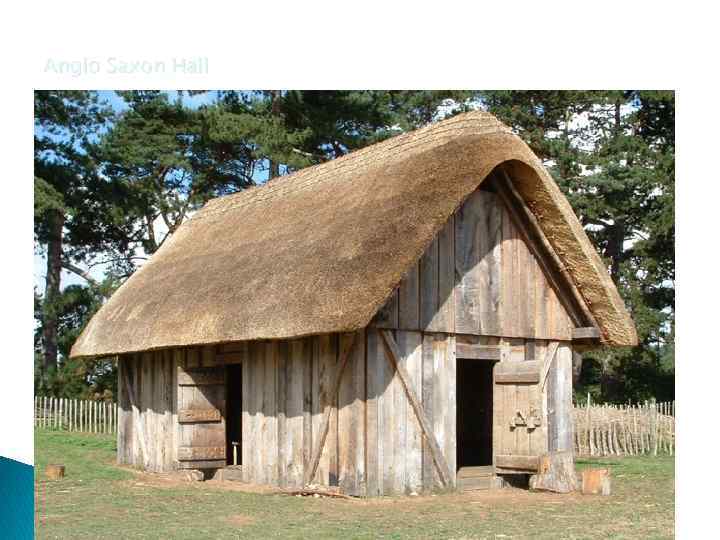 Anglo Saxon Hall
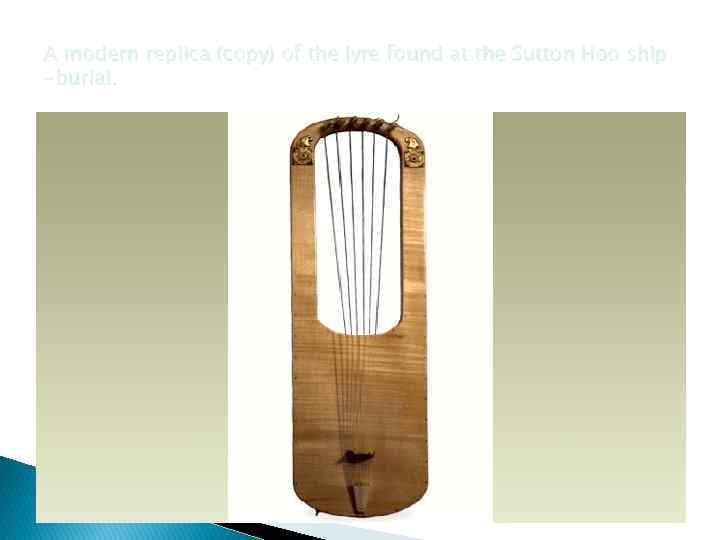 A modern replica (copy) of the lyre found at the Sutton Hoo ship -burial.
 Riddles and runes The Anglo-Saxons liked to play with words. They amused themselves by telling riddles (a puzzle based on playing with words) , some of which were written down. Here's one riddle. I appear on the ground like a blanket, and melt in the midday sun. Early Anglo-Saxons wrote using letters called runes ( the letters of the Anglo-Saxon alphabet). They believed runes had magical powers.
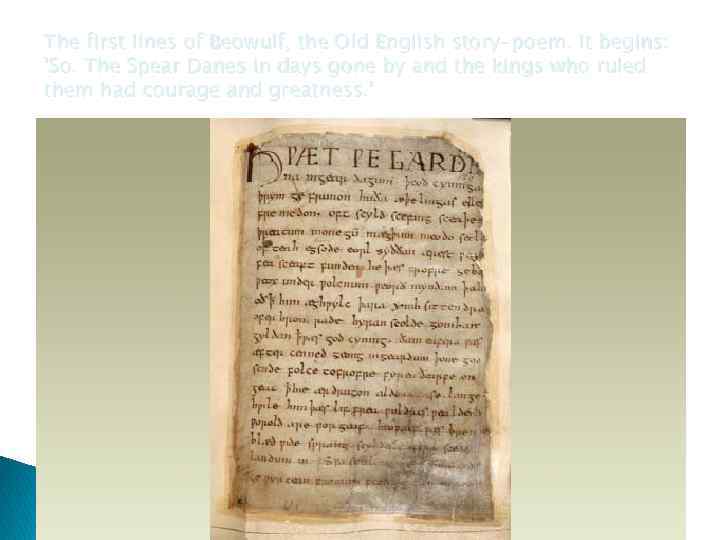 The first lines of Beowulf, the Old English story-poem. It begins: 'So. The Spear Danes in days gone by and the kings who ruled them had courage and greatness. '
 Anglo-Saxon feasts Anglo-Saxon leaders or lords were expected to entertain their followers with feasts. A lord gave his men gifts in return for their loyalty - treasure after a victory in battle, perhaps, or a roasted boar after a successful hunt. The feast was held in the lord's great hall. On dark winter days, people gathered in the hall around a log fire. They listened to stories and poems, and sang. They ate roast meats, bread and fruit. They drank ale ( drink made of barley) or mead, a strong drink made from honey. People often drank too much, so feasts were often noisy and sometimes ended in fights!
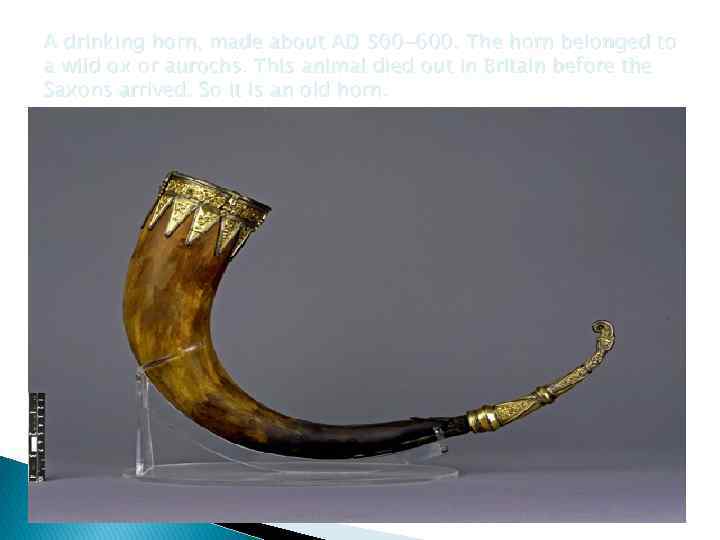 A drinking horn, made about AD 500 -600. The horn belonged to a wild ox or aurochs. This animal died out in Britain before the Saxons arrived. So it is an old horn.
 Games and sports Men enjoyed rough and boisterous pastimes, such as wrestling, weightlifting (using heavy rocks) and horse-racing. These sports kept them fit, for work and war. They also played ball games. One game seems to have been a bit like hockey, and another like baseball or cricket. In swimming races, it was apparently fair to push other swimmers under water! Gambling was very popular. The grave of a prince or king found in Essex in 2003 contained more than 50 bone gaming pieces and two large dice, made from deer antler.
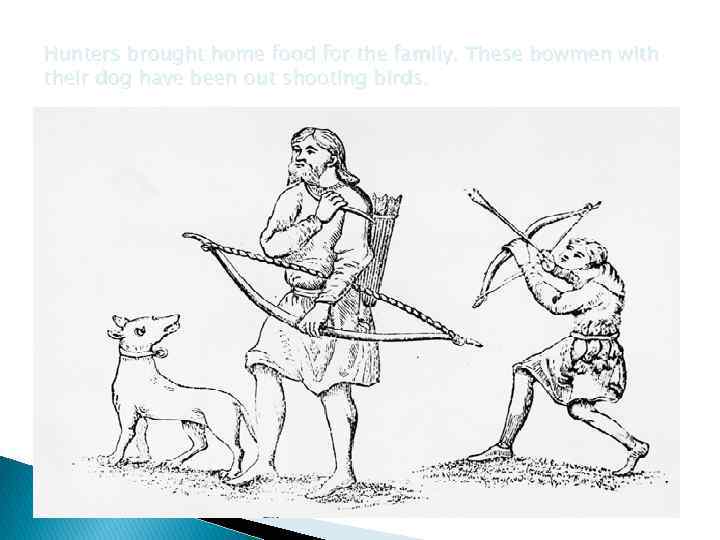 Hunters brought home food for the family. These bowmen with their dog have been out shooting birds.
 Kings and laws
 One king or many? Each group of Anglo-Saxon settlers had a leader or war-chief. A strong leader became 'cyning' - Anglo-Saxon for 'king'. Each king ruled a kingdom and led a small army. There were many quarrels and wars between kings, to see who was the strongest. By around AD 600 there were five important Anglo-Saxon kingdoms. They were Northumbria, Mercia, Wessex, Kent and East Anglia. From time to time, the strongest king would claim to be 'bretwalda' - which meant ruler of all Britain.
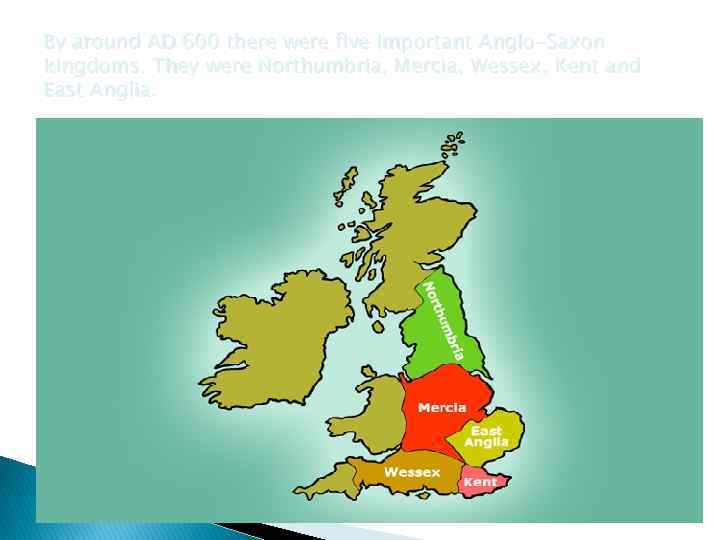 By around AD 600 there were five important Anglo-Saxon kingdoms. They were Northumbria, Mercia, Wessex, Kent and East Anglia.
 A king's burial In 1939, an amazing discovery was made at Sutton Hoo in Suffolk. When they dug into a large earth mound, archaeologists found traces of an Anglo -Saxon ship and many precious objects. This was the grave of a king, probably King Redwald of East Anglia. He died around AD 625. The treasure buried with the king included coins (with dates on), the remains of clothes and armour, a shield, drinking cups, shoes, a lyre, a gold belt buckle, a sword and a helmet. It's clear this was the burial place of a great leader.
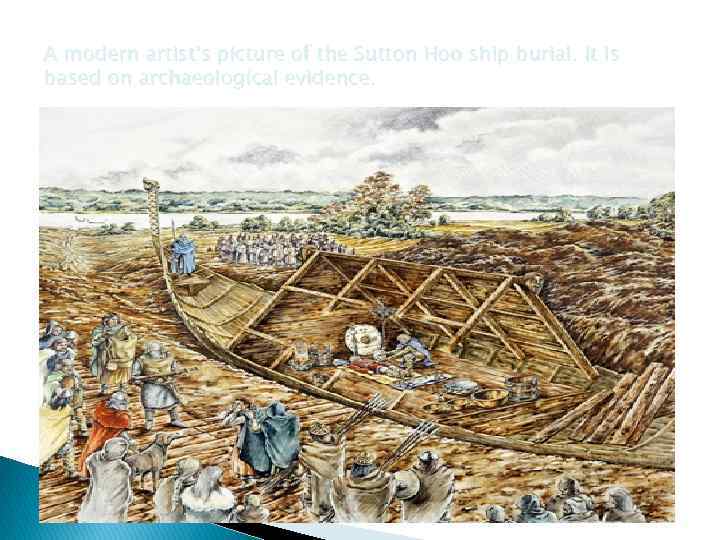 A modern artist's picture of the Sutton Hoo ship burial. It is based on archaeological evidence.
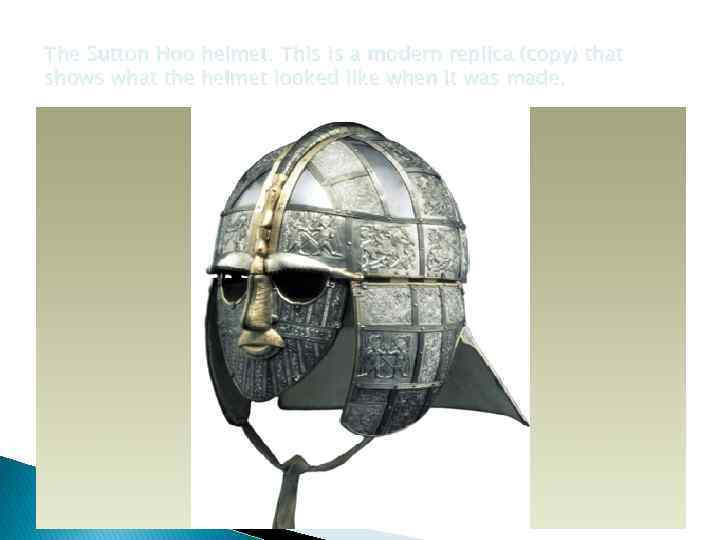 The Sutton Hoo helmet. This is a modern replica (copy) that shows what the helmet looked like when it was made.
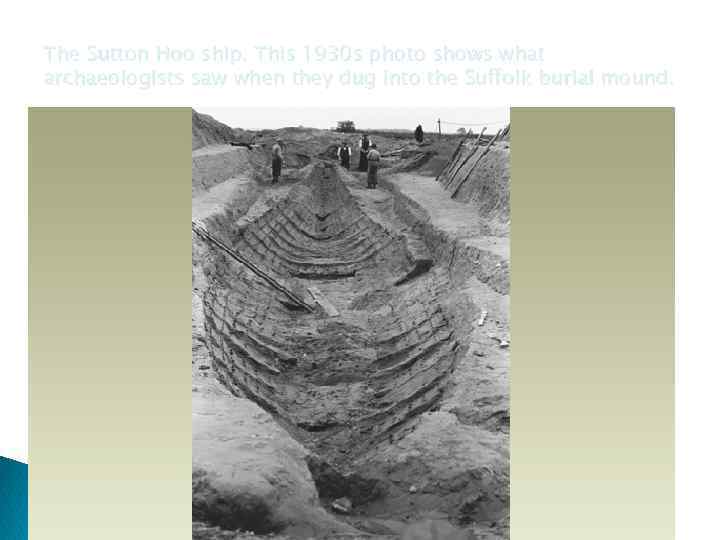 The Sutton Hoo ship. This 1930 s photo shows what archaeologists saw when they dug into the Suffolk burial mound.
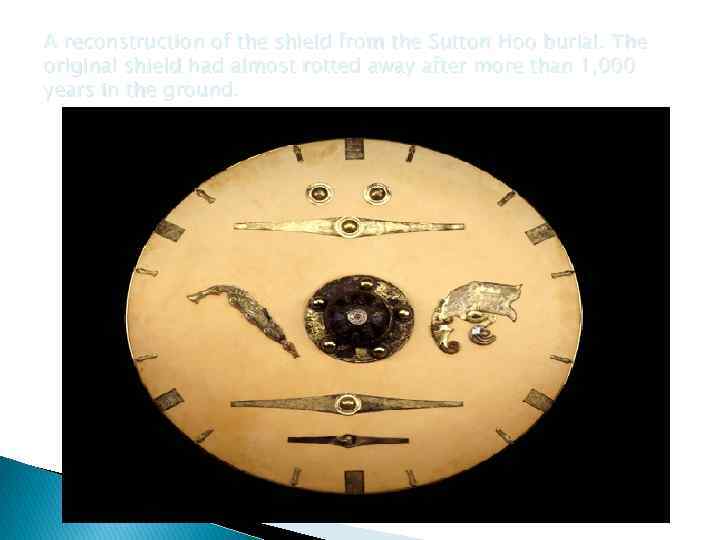 A reconstruction of the shield from the Sutton Hoo burial. The original shield had almost rotted away after more than 1, 000 years in the ground.
 Who was Offa? Offa was King of Mercia from AD 757 to 796. Mercia was the strongest kingdom in Anglo-Saxon England, and Offa was the most powerful English king. His fame spread to Europe. Offa was treated almost as an equal by. Charlemagne, the greatest ruler in Europe at the time. Offa issued England's first penny coins, in silver - known as 'Offa's pennies'. He built an earth wall and ditch for defence along the border with Wales. This bank is called Offa's Dyke. About 80 miles/129 km of it can still be seen.
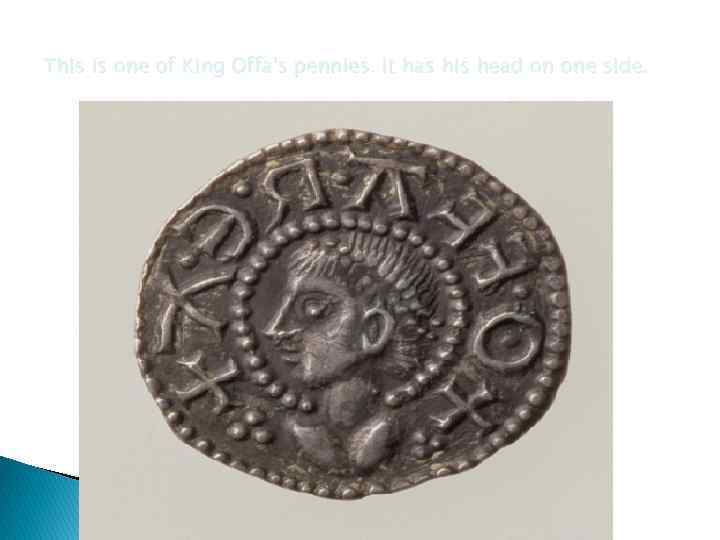 This is one of King Offa's pennies. It has his head on one side.
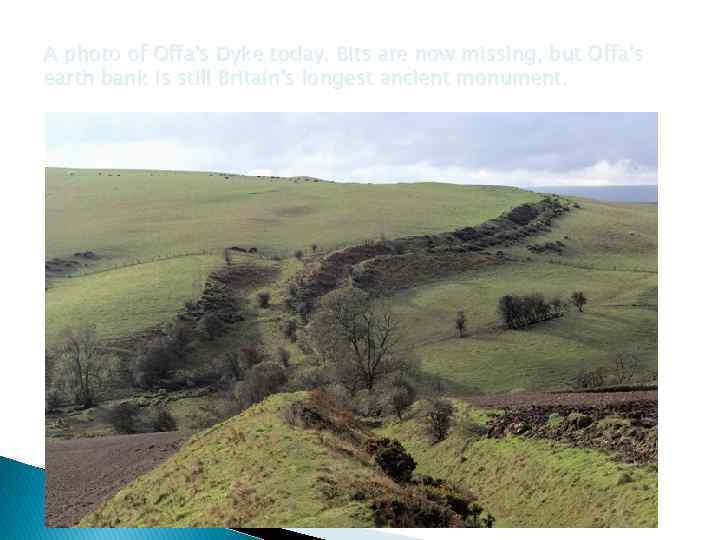 A photo of Offa's Dyke today. Bits are now missing, but Offa's earth bank is still Britain's longest ancient monument.
 Crime and punishment The Anglo-Saxons didn't have prisons. People found guilty of crimes were either executed or punished with fines. If they ran away, they became 'outlaws' (outside the law), and anyone could hunt them down - unless they hid in a church. The fine for breaking into someone's home was 5 shillings (25 p), paid to the home-owner. For minor crimes like stealing, a nose or a hand might be cut off. If a person killed someone, they paid money to the dead person's relatives. This was 'wergild'. The idea was to stop long quarrels or 'blood feuds' between families.
 Free or Slave? Most people in Anglo-Saxon society were either freemen or slaves. A freeman owned land slaves. A slave owned nothing. A slave might be a prisoner captured in war, or someone born into slavery. The richest and most powerful freemen were thanes who helped the king rule the land. While kings and thanes lived in large halls (big wooden houses), free peasants or ceorls (churls) lived in small huts. Poor slaves were glad of a cowshed or barn to sleep in at night. Many slaves were badly treated. They could not leave their owner unless they were sold or set free.
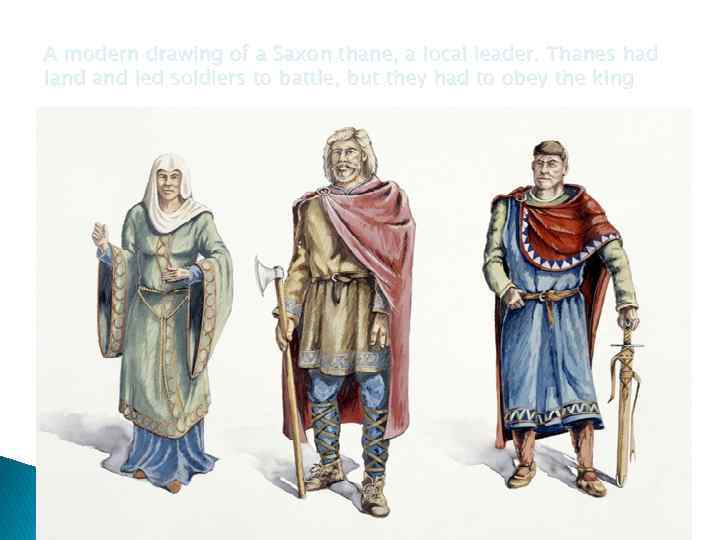 A modern drawing of a Saxon thane, a local leader. Thanes had land led soldiers to battle, but they had to obey the king
 Anglo-Saxons at war
 How Anglo-Saxons fought Anglo-Saxon armies were usually small, with only a few hundred men. The soldiers had spears, axes, swords and bows and arrows. They wore helmets on their heads and carried wooden shields. Everyone fought on foot during a battle. It must have been a bit like a giant rugby scrum, with lots of pushing and yelling, and nasty wounds. The most feared Anglo-Saxon weapon was a battle axe, but the most precious weapon was a sword. It took hours of work by a smith to craft a sword. He softened iron in a red-hot fire, twisted iron rods together and hammered the sword into shape.
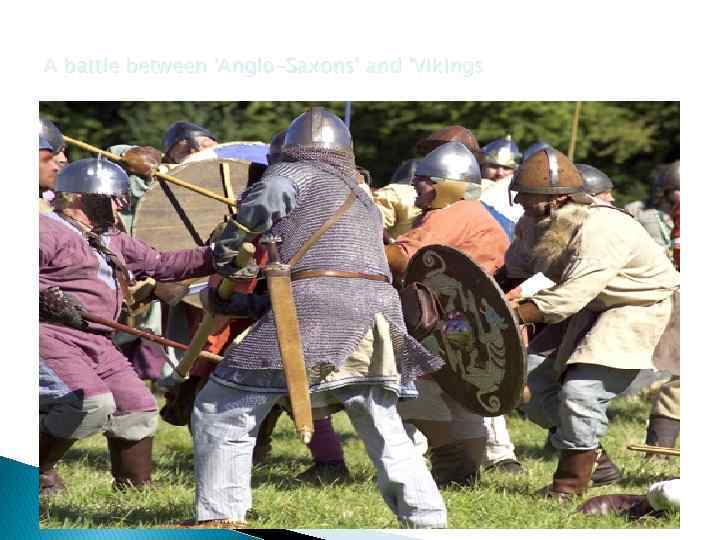 A battle between 'Anglo-Saxons' and 'Vikings
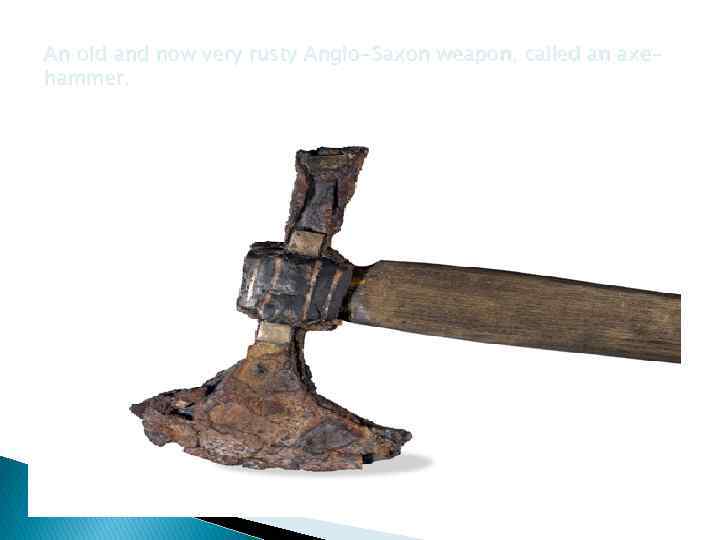 An old and now very rusty Anglo-Saxon weapon, called an axehammer.
 Part-time soldiers Most soldiers had farms, and after a battle went home as soon as they could, to look after their animals and crops. To make sure he had enough soldiers, the king ordered local officials called 'ealdormen' to provide so many men each. The more land you had, the more men you had to provide. These local bands of men made up England's part-time army called the fyrd. If the country was invaded, the king could call up every freeman to join his army.
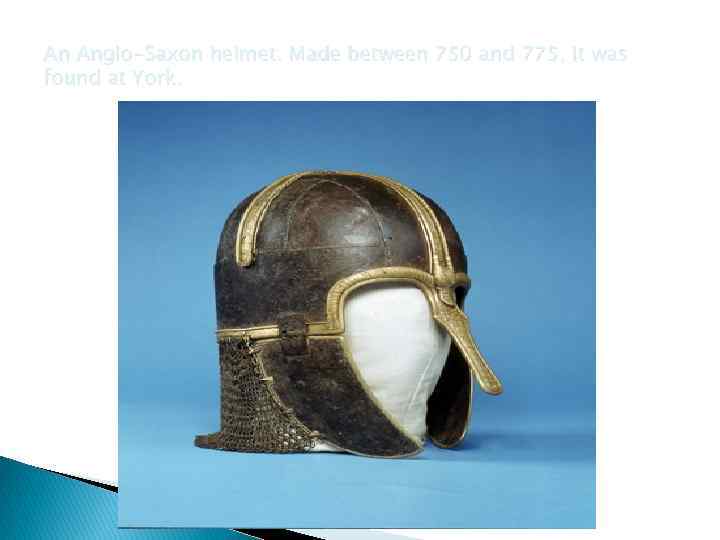 An Anglo-Saxon helmet. Made between 750 and 775, it was found at York.
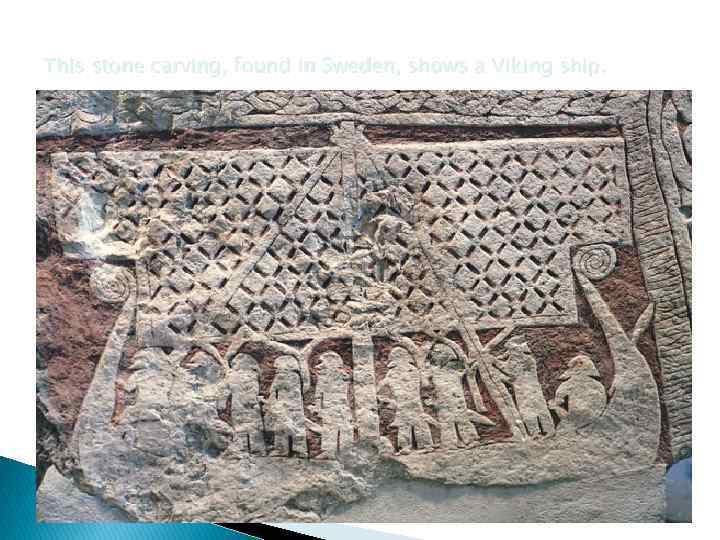 This stone carving, found in Sweden, shows a Viking ship.
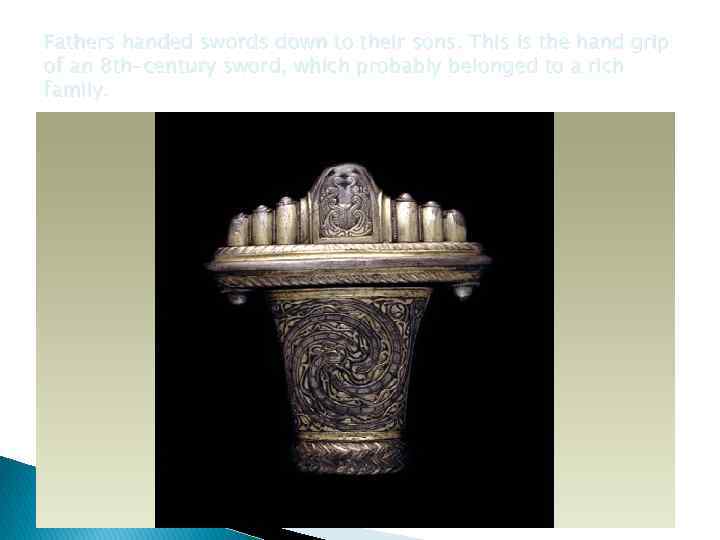 Fathers handed swords down to their sons. This is the hand grip of an 8 th-century sword, which probably belonged to a rich family.
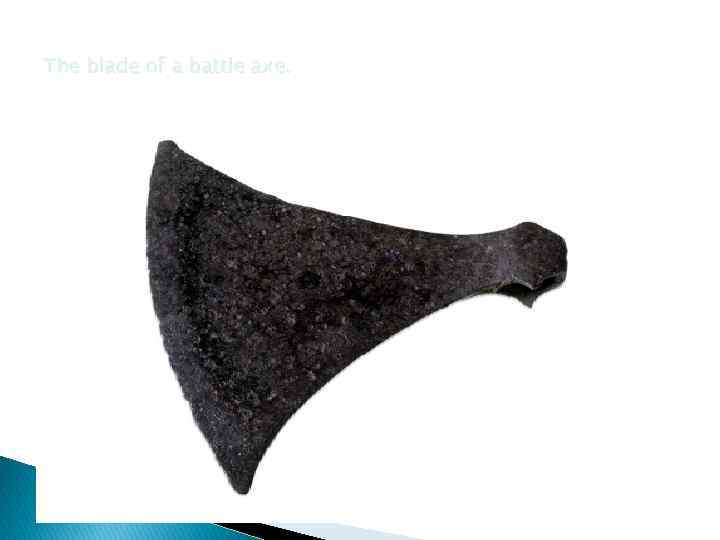 The blade of a battle axe.
 Wars with the Vikings Viking attacks on Anglo-Saxon England started at the end of the AD 700 s. The Vikings came by sea in their longships. They attacked monasteries and churches to steal gold and other treasures. By the 800 s, great armies of Vikings roamed England. In AD 869, they killed King Edmund of East Anglia. After King Alfred of Wessex fought the Vikings, he made peace with them. He built ships and walled towns to defend his kingdom against Viking attacks. However, fighting between the English and the Vikings went on into the AD 1000 s.
 Anglo-Saxon beliefs
 Early Anglo-Saxon beliefs In Roman Britain, many people had been Christians. The early Anglo. Saxons were pagans (a person wh worships many gods). Much like the. Vikings of Scandinavia, they believed in many gods. The king of the Anglo-Saxon gods, for example, was Woden - a German version of the Scandinavian god Odin. From his name comes our day of the week Wednesday or 'Woden's day'. Other gods were Thunor, god of thunder; Frige, goddess of love; and Tiw, god of war. Anglo-Saxons were superstitious. They believed in lucky charms (A magical object or words, to protect a person from harm). They thought 'magic' rhymes, potions, stones or jewels would protect them from evil spirits or sickness.
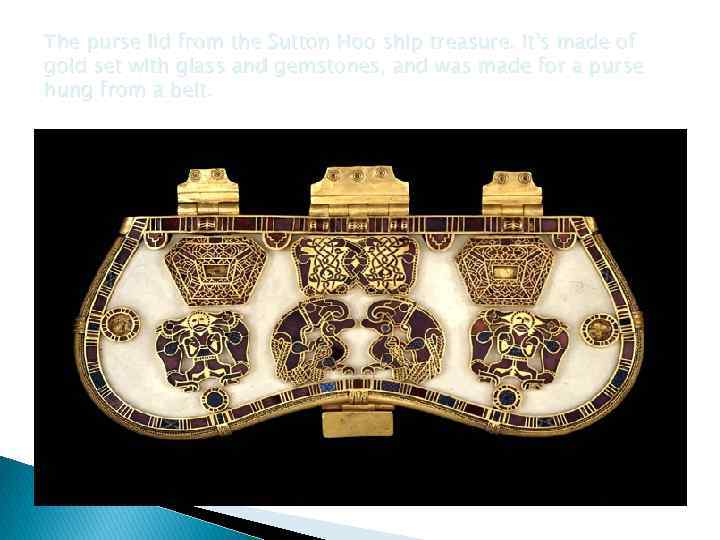 The purse lid from the Sutton Hoo ship treasure. It's made of gold set with glass and gemstones, and was made for a purse hung from a belt.
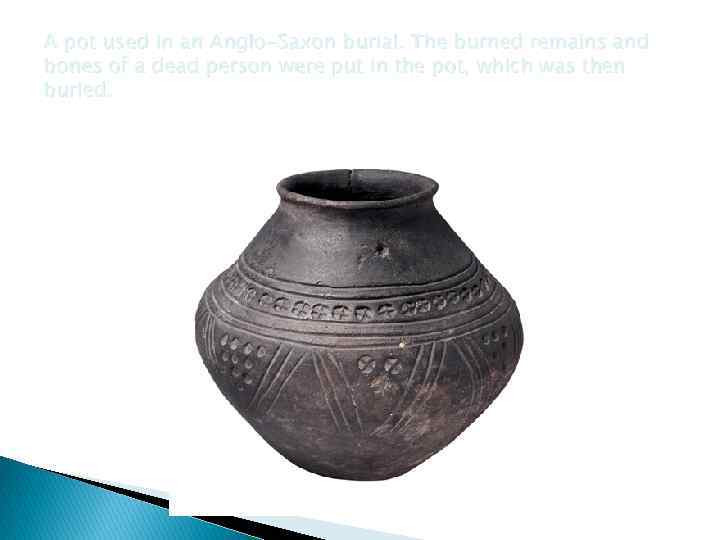 A pot used in an Anglo-Saxon burial. The burned remains and bones of a dead person were put in the pot, which was then buried.
 What do graves tell us? Archaeologists can learn a lot from old burial sites. When Anglo-Saxons died, their bodies were either cremated or buried in a grave. Belongings buried with the dead person, for use in the next life, provide evidence of the jobs people did. Men's graves include knives and spears, which suggests hunting, fighting and farming. Women's graves include tools used for sewing and weaving (making cloth) - showing that women made cloth and clothing. The grave of a king, like the ship-burial at Sutton Hoo (site in Suffolk, England, king's ship burial), was filled with treasures, weapons and armour. One child's grave in Essex had the bones of a dog in it, perhaps a pet.
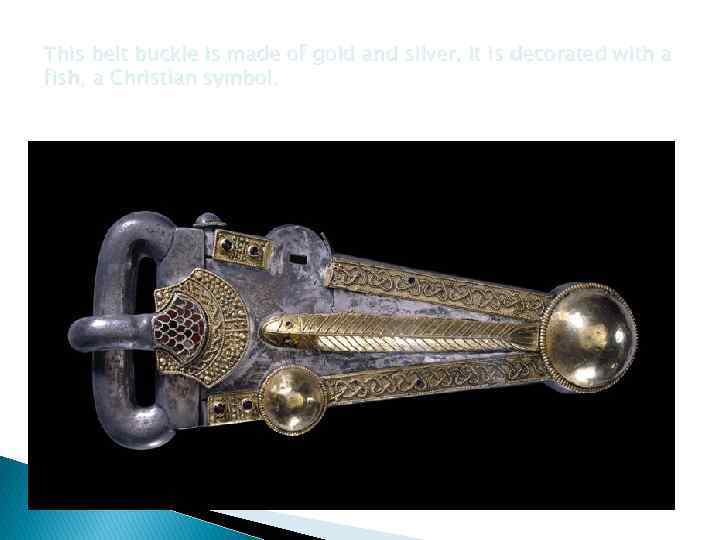 This belt buckle is made of gold and silver. It is decorated with a fish, a Christian symbol.
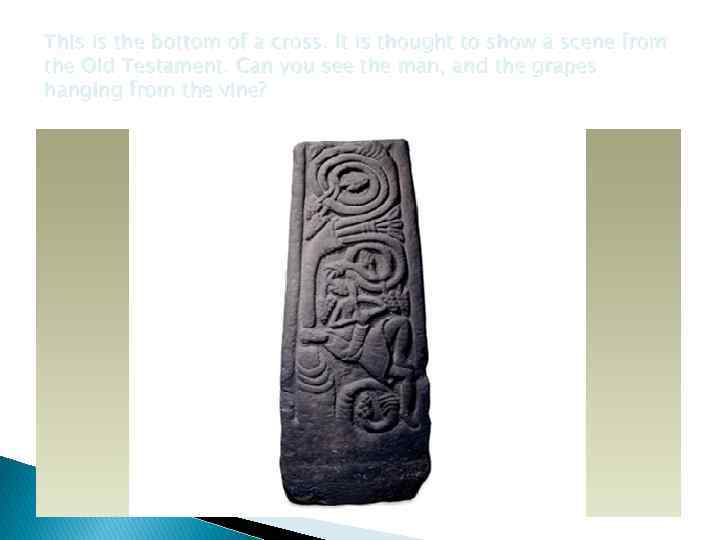 This is the bottom of a cross. It is thought to show a scene from the Old Testament. Can you see the man, and the grapes hanging from the vine?
 Anglo-Saxons become Christians After the Romans left Britain, Christianity continued in places where Anglo -Saxons did not settle, such as Wales and the west. Christian monks, such as St Patrick (who went to Ireland in the 400 s) and St Columba (who went to Scotland from Ireland around 563 AD) taught the 'Celtic' form of the Christian religion. In AD 597 the Pope in Rome decided it was time Anglo-Saxons in southern Britain heard about Christianity. So he sent a monk called Augustine to Kent, to persuade the king to become a Christian. Over the next 100 years, many Anglo-Saxons turned to Christianity. New churches and monasteries were built.
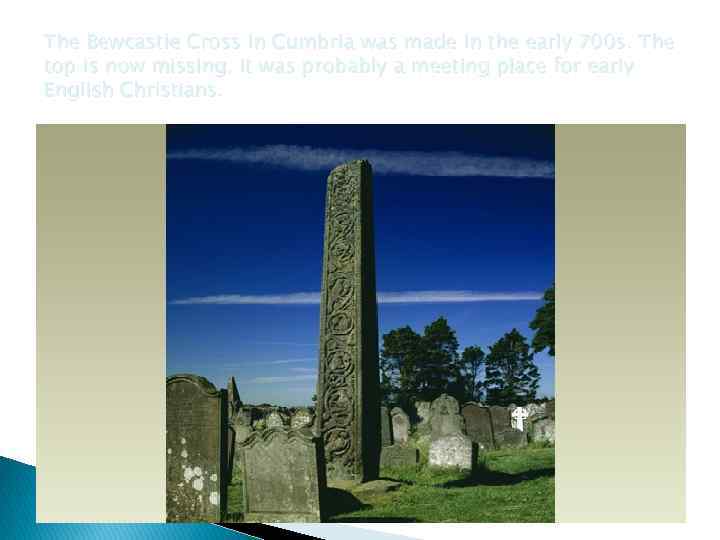 The Bewcastle Cross in Cumbria was made in the early 700 s. The top is now missing. It was probably a meeting place for early English Christians.
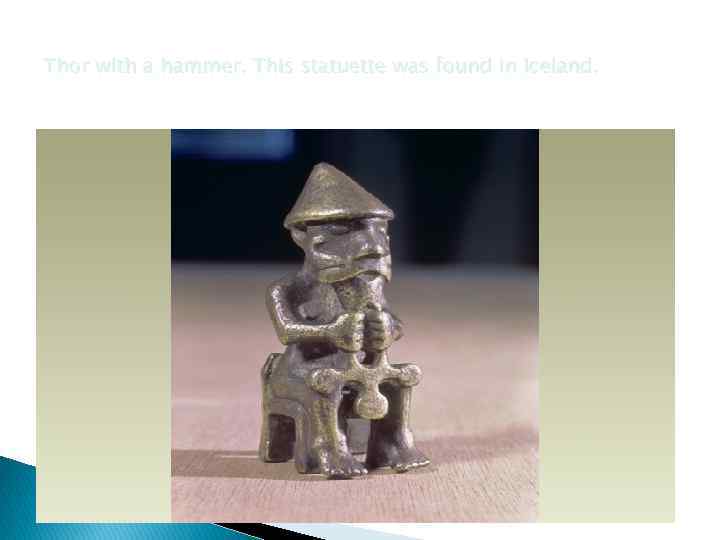 Thor with a hammer. This statuette was found in Iceland.
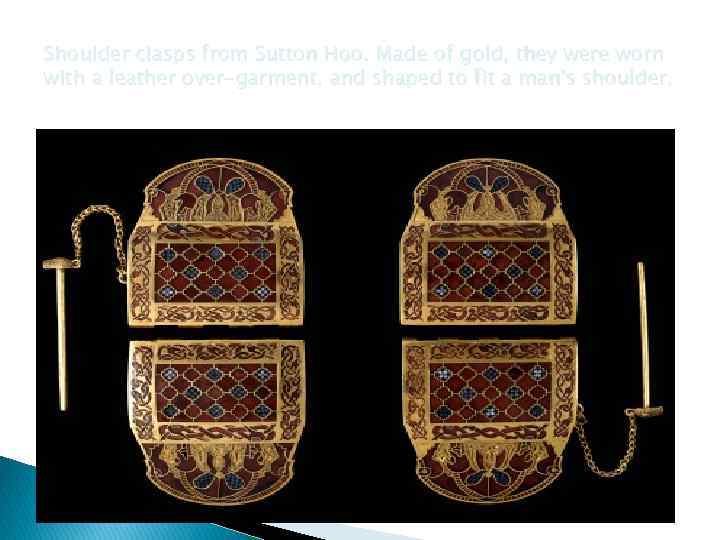 Shoulder clasps from Sutton Hoo. Made of gold, they were worn with a leather over-garment, and shaped to fit a man's shoulder.
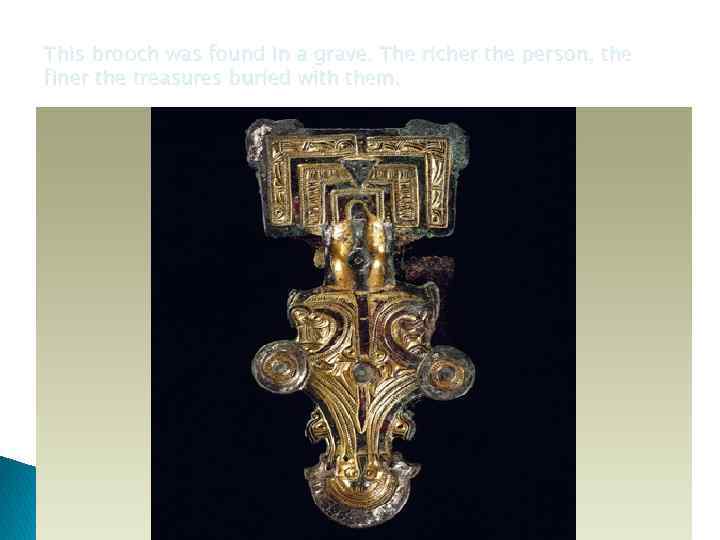 This brooch was found in a grave. The richer the person, the finer the treasures buried with them.
 Bede and the Monasteries were centres of learning, where monks and nuns spent their time in prayer, study and worked in fields and workshops. Monasteries were the only schools in Anglo-Saxon England. In the monasteries, monks copied out books by hand decorated the pages in beautiful colours. Bede (an English monk and historian) lived in the monastery at Jarrow in Northumbria. He went to live with monks in 680 AD when he was just 7 years old. When he grew up, he became a historian. He wrote a book about the history of the Anglo-Saxons, called 'A History of the English Church and People'.
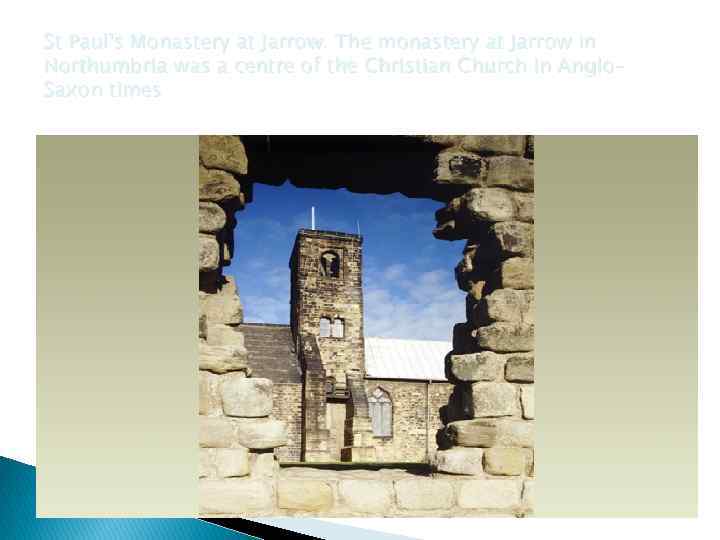 St Paul's Monastery at Jarrow. The monastery at Jarrow in Northumbria was a centre of the Christian Church in Anglo. Saxon times
 Thank you for you attention!