 Скачать презентацию ANGLO-SAXON BACKGROUND 449 -1066 THE BRITONS EXPERIENCE
0a1540955b095c5a039c2ea8596c9053.ppt
- Количество слайдов: 31



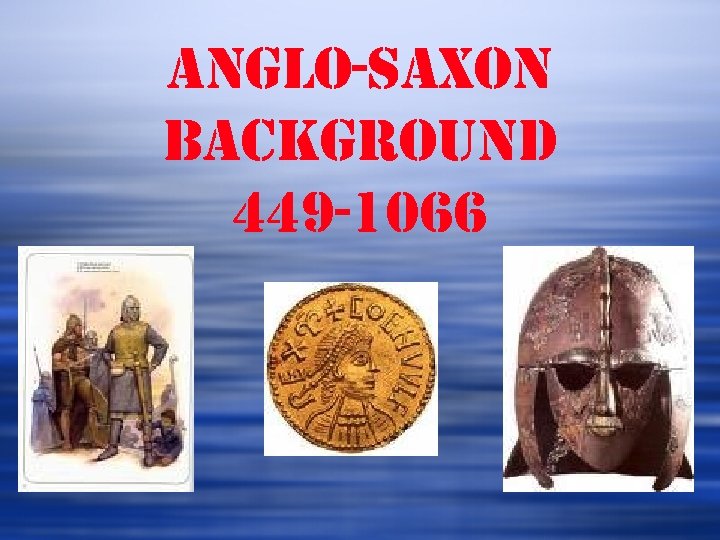
ANGLO-SAXON BACKGROUND 449 -1066
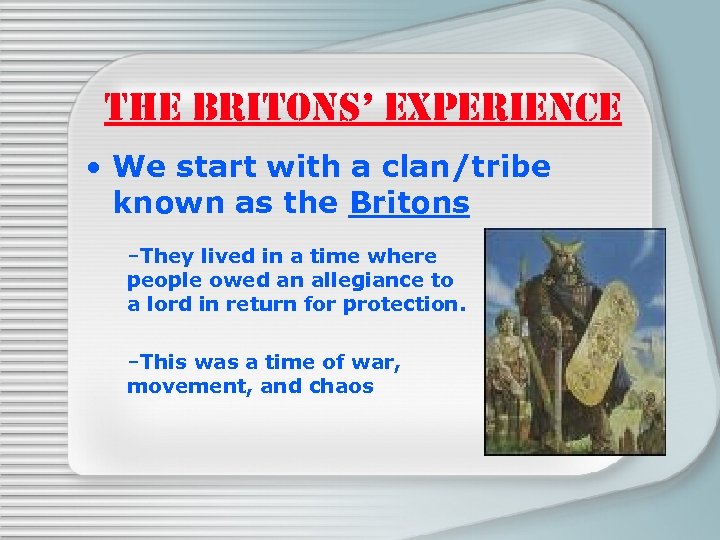
THE BRITONS’ EXPERIENCE • We start with a clan/tribe known as the Britons –They lived in a time where people owed an allegiance to a lord in return for protection. –This was a time of war, movement, and chaos
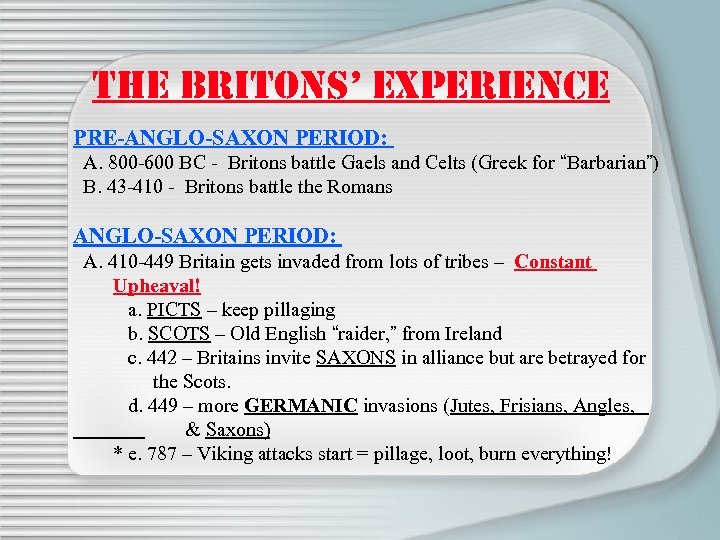
THE BRITONS’ EXPERIENCE PRE-ANGLO-SAXON PERIOD: A. 800 -600 BC - Britons battle Gaels and Celts (Greek for “Barbarian”) B. 43 -410 - Britons battle the Romans ANGLO-SAXON PERIOD: A. 410 -449 Britain gets invaded from lots of tribes – Constant Upheaval! a. PICTS – keep pillaging b. SCOTS – Old English “raider, ” from Ireland c. 442 – Britains invite SAXONS in alliance but are betrayed for the Scots. d. 449 – more GERMANIC invasions (Jutes, Frisians, Angles, & Saxons) * e. 787 – Viking attacks start = pillage, loot, burn everything!
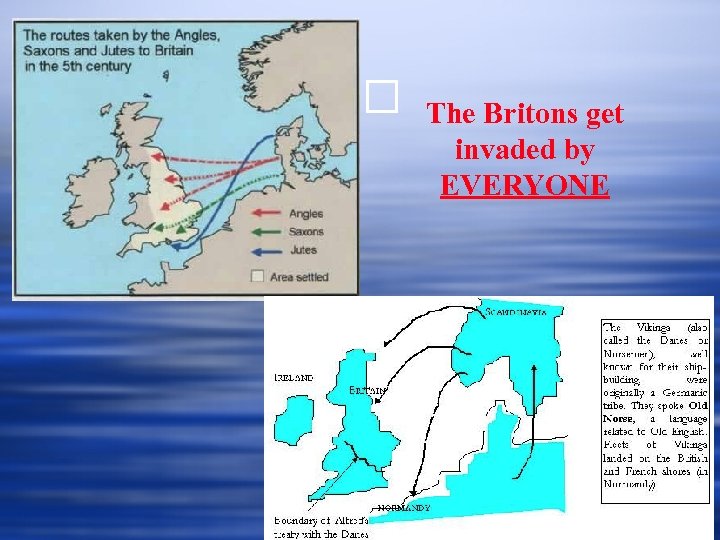
The Britons get invaded by EVERYONE
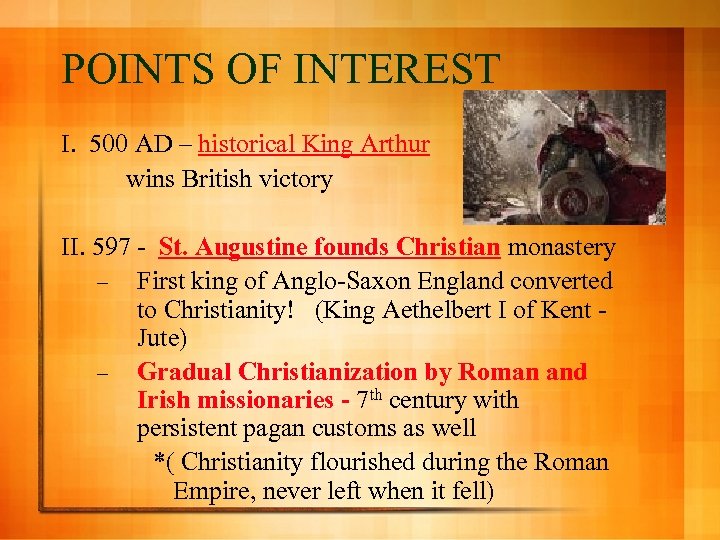
POINTS OF INTEREST I. 500 AD – historical King Arthur wins British victory II. 597 - St. Augustine founds Christian monastery – First king of Anglo-Saxon England converted to Christianity! (King Aethelbert I of Kent Jute) – Gradual Christianization by Roman and Irish missionaries - 7 th century with persistent pagan customs as well *( Christianity flourished during the Roman Empire, never left when it fell)
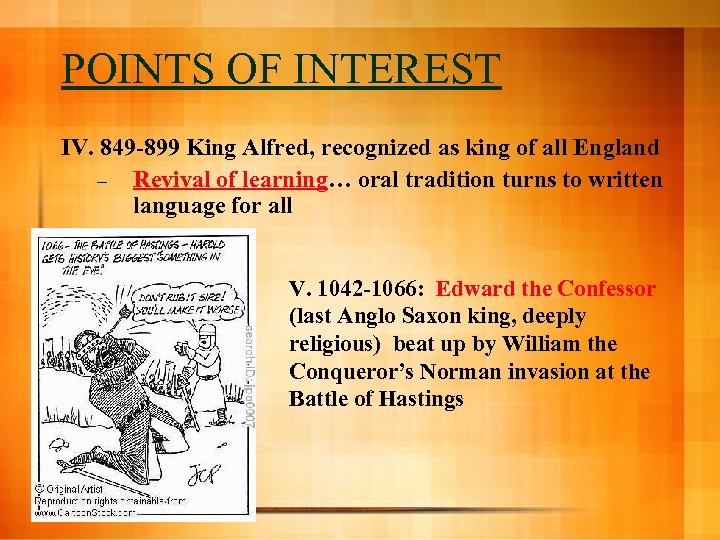
POINTS OF INTEREST IV. 849 -899 King Alfred, recognized as king of all England – Revival of learning… oral tradition turns to written language for all V. 1042 -1066: Edward the Confessor (last Anglo Saxon king, deeply religious) beat up by William the Conqueror’s Norman invasion at the Battle of Hastings
OLD ENGLISH 1) NO WRITING: Writing went out of style with collapse of Roman empire. Only the church had a few documents. *Oral tradition / scops 2) Christian missionaries taught and wrote entirely in Latin, Old English was vulgar 3) Language is predominantly: Anglo-Saxon (German), Some Celtic/Gaelic words, Latin (450 words) Old Norse (50 words)
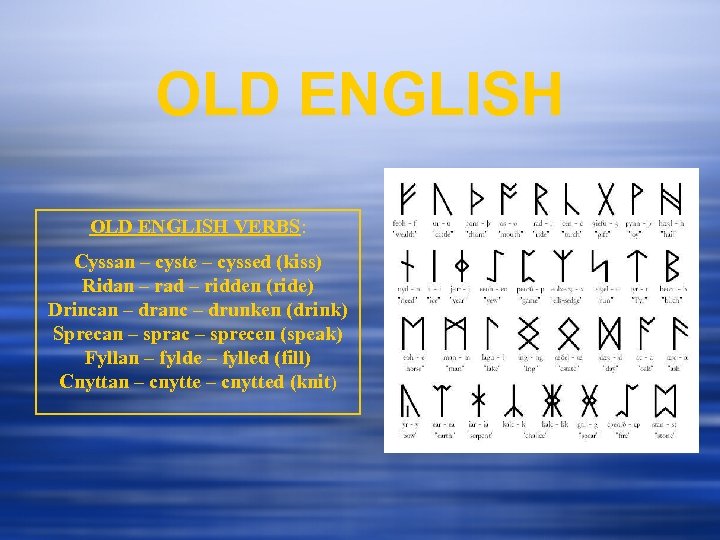
OLD ENGLISH VERBS: Cyssan – cyste – cyssed (kiss) Ridan – rad – ridden (ride) Drincan – dranc – drunken (drink) Sprecan – sprac – sprecen (speak) Fyllan – fylde – fylled (fill) Cnyttan – cnytted (knit)
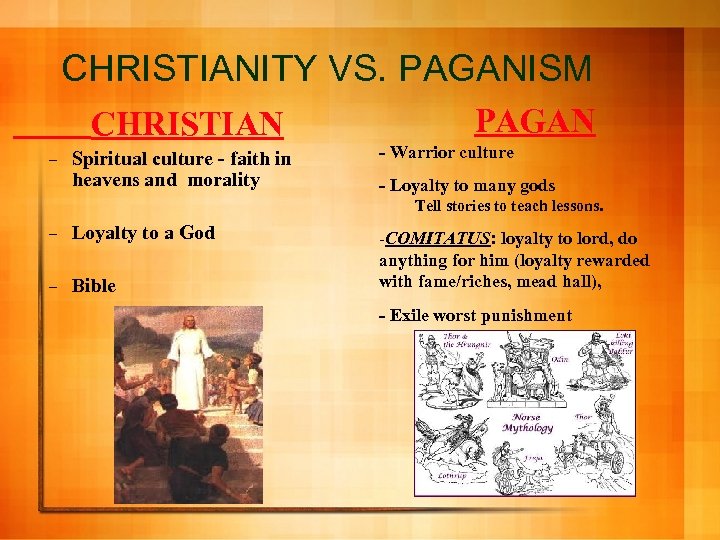
CHRISTIANITY VS. PAGANISM CHRISTIAN – Spiritual culture - faith in heavens and morality PAGAN - Warrior culture - Loyalty to many gods Tell stories to teach lessons. – Loyalty to a God – Bible -COMITATUS: loyalty to lord, do anything for him (loyalty rewarded with fame/riches, mead hall), - Exile worst punishment
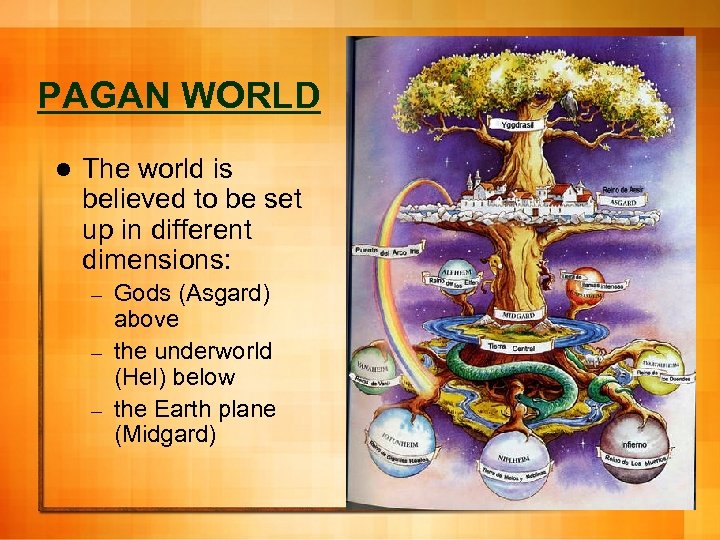
PAGAN WORLD l The world is believed to be set up in different dimensions: Gods (Asgard) above – the underworld (Hel) below – the Earth plane (Midgard) –
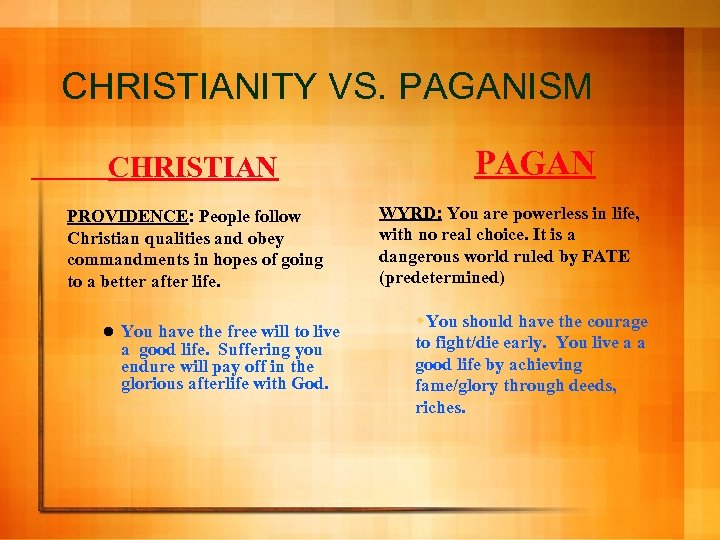
CHRISTIANITY VS. PAGANISM CHRISTIAN PROVIDENCE: People follow Christian qualities and obey commandments in hopes of going to a better after life. l You have the free will to live a good life. Suffering you endure will pay off in the glorious afterlife with God. PAGAN WYRD: You are powerless in life, with no real choice. It is a dangerous world ruled by FATE (predetermined) w. You should have the courage to fight/die early. You live a a good life by achieving fame/glory through deeds, riches.
THINK ABOUT IT… What happens when you die?
THINK ABOUT IT… w How do you PROVE you go to heaven for an afterlife? w How does the church convince so many people of the time to buy into Christianity? Why might it sound appealing?
ANGLO-SAXON RECAP § Warrior Culture: Britons lived in clans that owed allegiance to a lord in return for honor, fame, and gold. (comitatus) § Time of war, chaos, and transition. § Everything is passed on through the oral tradition. § Old English is made up of Anglo-Saxon, Celtic, Latin & Old Norse. § Revival of Education § Pagan culture trying to be turned Christian by missionaries and priests. § Pagan views: many gods, WYRD, warrior culture § Christian views: one god, PROVIDENCE, spiritual culture
ANGLO-SAXON LITERATURE § All passed down through an oral tradition until the mid 10 th century (900 s). It was caused by a church reform where monks were in charge of copying manuscripts. 1) RIDDLES: entertainment/education 2) PROSE: w. Caedmon: “Hymn of Creation, ” oldest vernacular work (Latin) w. Bede: “Ecclesiastical History of the English People” (Latin) w Used historians, other books, travelers, never left more than 75 miles!! w“Anglo-Saxon Chronicles” – begin writing down history in Old English so it was accessible to all
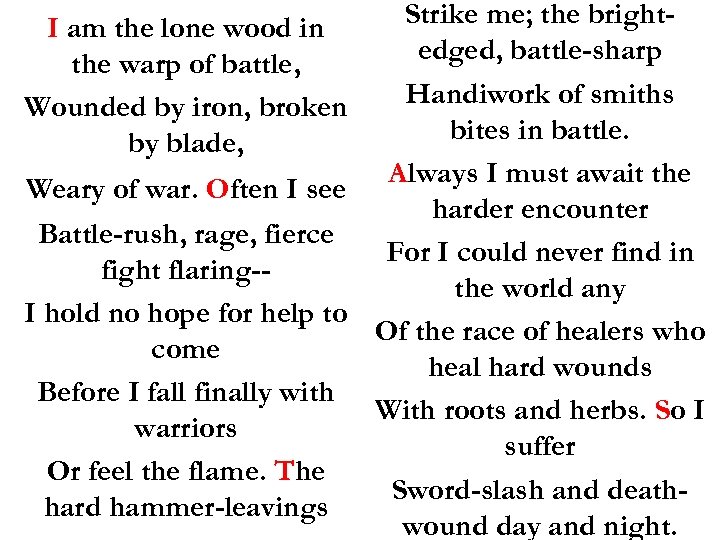
Strike me; the bright. I am the lone wood in edged, battle-sharp the warp of battle, Handiwork of smiths Wounded by iron, broken bites in battle. by blade, Always I must await the Weary of war. Often I see harder encounter Battle-rush, rage, fierce For I could never find in fight flaring-the world any I hold no hope for help to Of the race of healers who come heal hard wounds Before I fall finally with With roots and herbs. So I warriors suffer Or feel the flame. The Sword-slash and deathhard hammer-leavings wound day and night.
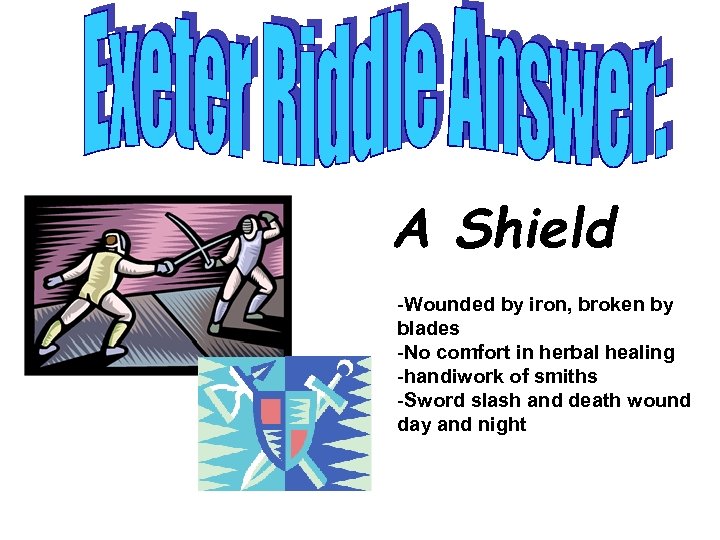
A Shield -Wounded by iron, broken by blades -No comfort in herbal healing -handiwork of smiths -Sword slash and death wound day and night
Wob is my name twisted about-I'm a strange creature shaped for battle. When I bend and the battle-sting snakes Through my belly, I am primed to drive off The death-stroke. When my lord and tormentor Releases my limbs, I am long again, As laced with slaughter, I spit out The death-blend I swallowed before. What whistles from my belly does not easily pass, And the man who seizes this sudden cup Pays with his life for the long, last drink. Unwound I will not obey any man; Bound tight, I serve. Say what I am.
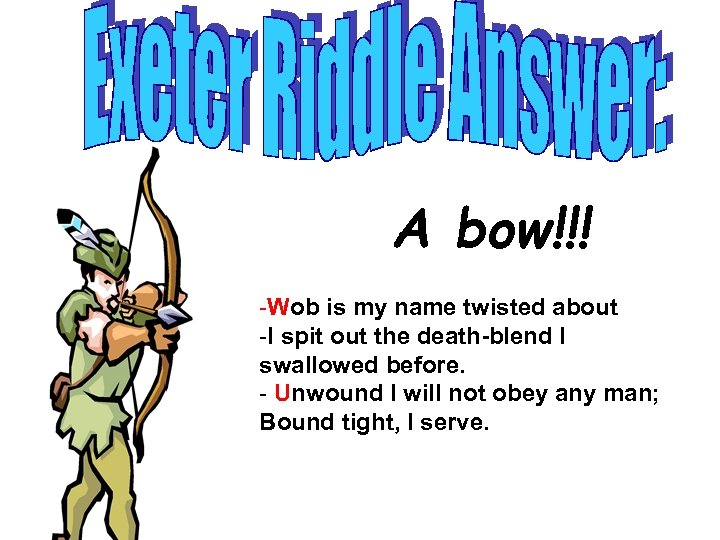
A bow!!! -Wob is my name twisted about -I spit out the death-blend I swallowed before. - Unwound I will not obey any man; Bound tight, I serve.
LITERATURE: POETRY HEROIC: tales of warriors and battles Pagan/Warrior culture… FAME/WYRD Beowulf ELEGAIC: lamenting the death/loss of loved ones, glory, or gold Christian ideas, spirituality Happy past / desolate present “Seafarer” and “Wanderer” *POEMS COME FROM BOOK OF EXETER
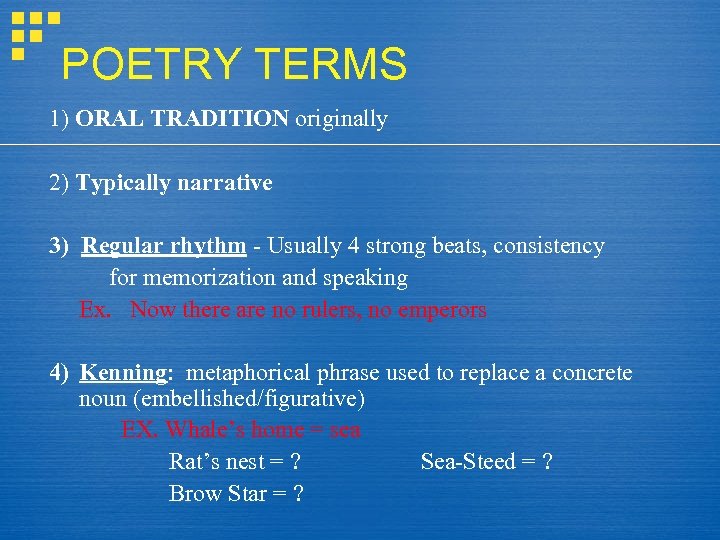
POETRY TERMS 1) ORAL TRADITION originally 2) Typically narrative 3) Regular rhythm - Usually 4 strong beats, consistency for memorization and speaking Ex. Now there are no rulers, no emperors 4) Kenning: metaphorical phrase used to replace a concrete noun (embellished/figurative) EX. Whale’s home = sea Rat’s nest = ? Sea-Steed = ? Brow Star = ?
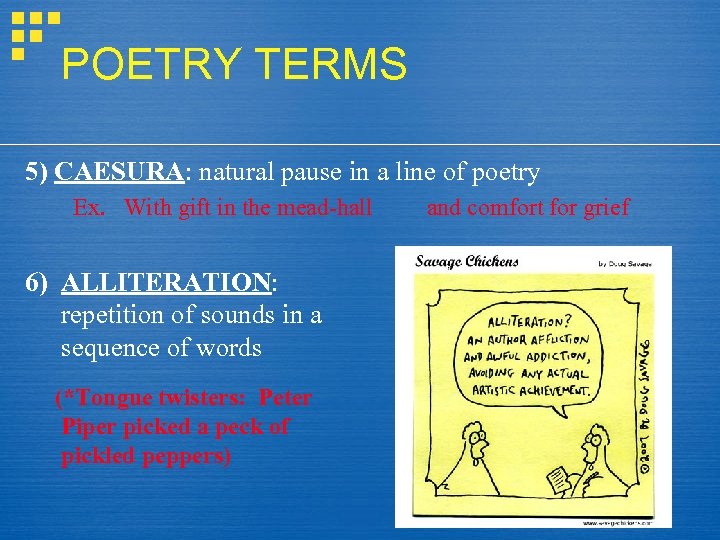
POETRY TERMS 5) CAESURA: natural pause in a line of poetry Ex. With gift in the mead-hall 6) ALLITERATION: repetition of sounds in a sequence of words (*Tongue twisters: Peter Piper picked a peck of pickled peppers) and comfort for grief
POETRY TERMS 7) PARAPHRASE: break down lengthy portions of text to find strictly meaning, put in your own words in a shorter manner Advantage: understand meaning Disadvantage: time consuming
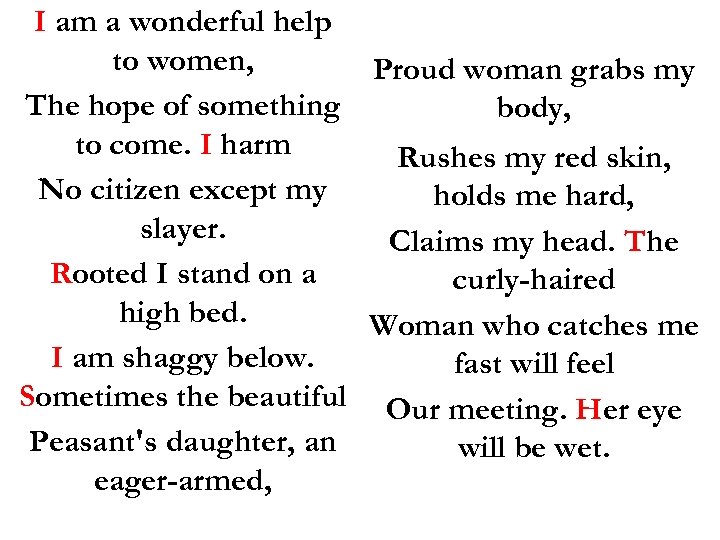
I am a wonderful help to women, Proud woman grabs my The hope of something body, to come. I harm Rushes my red skin, No citizen except my holds me hard, slayer. Claims my head. The Rooted I stand on a curly-haired high bed. Woman who catches me I am shaggy below. fast will feel Sometimes the beautiful Our meeting. Her eye Peasant's daughter, an will be wet. eager-armed,
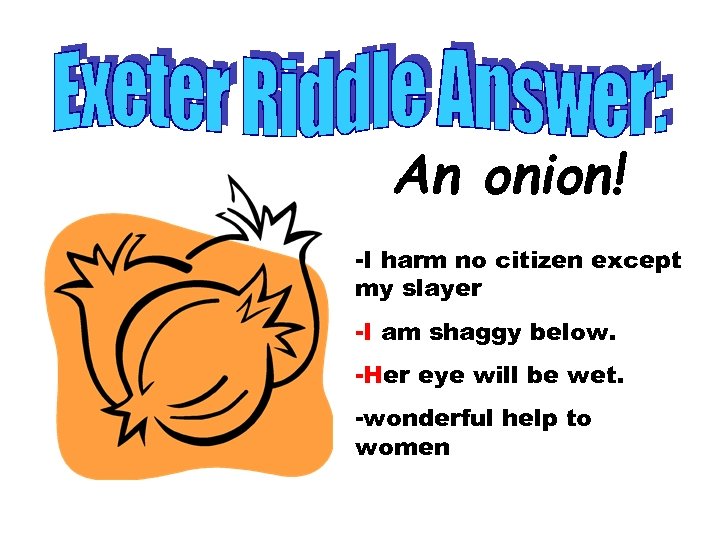
An onion! -I harm no citizen except my slayer -I am shaggy below. -Her eye will be wet. -wonderful help to women
Suckled by the sea, sheltered near shore; Now a man will strip my bonelike skin Cradled in the cold catch of waves, From the sides of my body with a bright blade Footless and fixed-often I offered To the sea-stream a stretch of mouth. And bolt my flesh, relish me raw: A quick cuisine--crack to jaw.
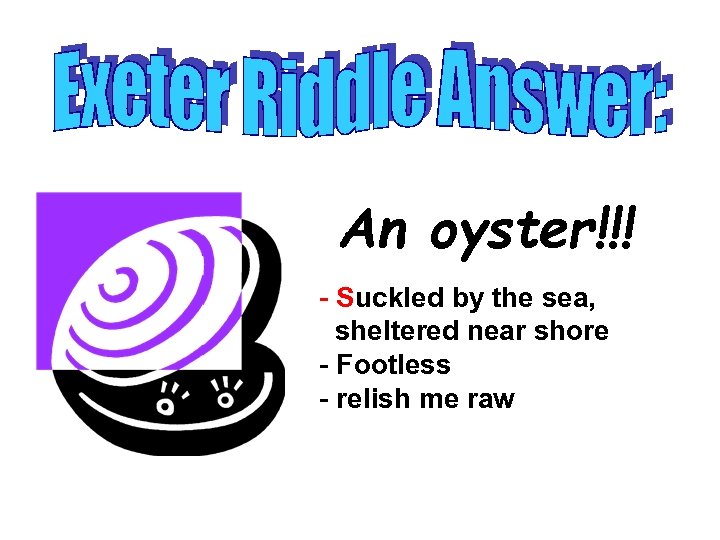
An oyster!!! - Suckled by the sea, sheltered near shore - Footless - relish me raw
HERO § What does our generation/world define a hero as today? What are his/her characteristics? Who are examples of a hero?
HERO § DEFINITION: a man of distinguished courage or ability, admired for his brave deeds and noble qualities. § NEED FOR A HERO: Changes with time depending on the culture/climate We often look at major societal problems to create or embellish who we should look up to

HEROES vs. villains How has the idea of a hero changed over time? Consider who he/she fought and what they stood for? ANCIENT GREEK & ANGLO-SAXON: § Brave warriors fought for their country and lord/king against outside § Gladiator, 300, William Wallace RENAISSANCE: § Knights of the Round Table fought against people who didn’t follow the law and to protect the king or ladies. § Robin Hood fought against the tyrants of the world. WWII:
HEROES vs. villains How has the idea of a hero changed over time? Consider who he/she fought and what they stood for? 1930 s § Creation of Batman, Superman, and early Marvel Comics 1960 s: TODAY:
Скачать презентацию ANGLO-SAXON BACKGROUND 449 -1066 THE BRITONS EXPERIENCE
0a1540955b095c5a039c2ea8596c9053.ppt