 Скачать презентацию Anglo-American Business Law Chapter 2 Contract 夏秀渊
3bb5be917d03a2b09bfb4d8e5913d9f8.ppt
- Количество слайдов: 101



Anglo-American Business Law Chapter 2 Contract 夏秀渊
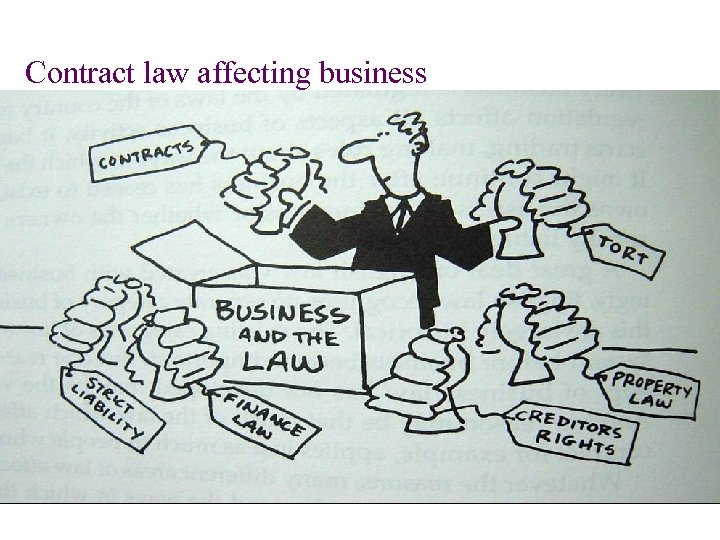
Contract law affecting business

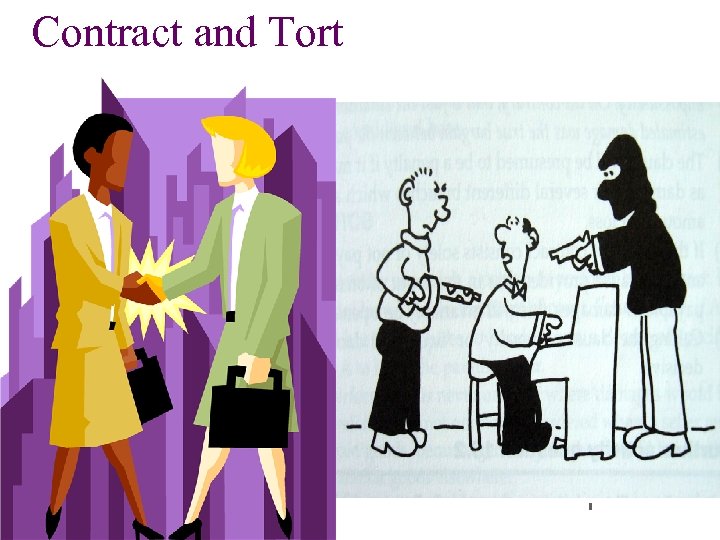
Contract and Tort
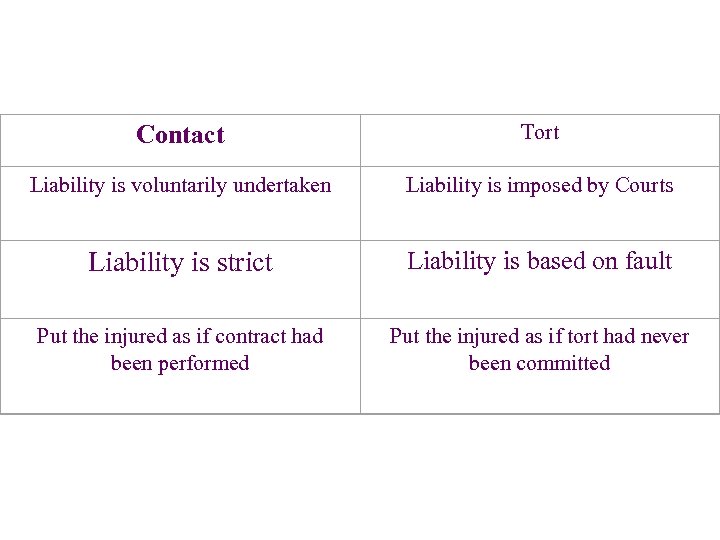
Contact Tort Liability is voluntarily undertaken Liability is imposed by Courts Liability is strict Liability is based on fault Put the injured as if contract had been performed Put the injured as if tort had never been committed
l 1. Formation of contract l 2. Content of contracts l 3. Breach of contract and remedies l 4. The law of torts l 5. Professional negligence l (1) obligations under contracts, both innominate and nominate l (2) in unjust enrichment l (3) management of the property of another (or "negotiorum gestio") l (4) tort
Contracts Law Contents l 1. Formation of contract l 2. Content of contracts l 3. Breach of contract and remedies
Topic list l a) Analyse the nature of a simple contract. l b) Explain the meaning of offer and distinguish from invitations to treat. l c) Explain the meaning and consequence of acceptance. l d) Explain the need for consideration. l e) Analyse the doctrine of privity. l f) Distinguish the presumptions relating to intention to create legal relations.
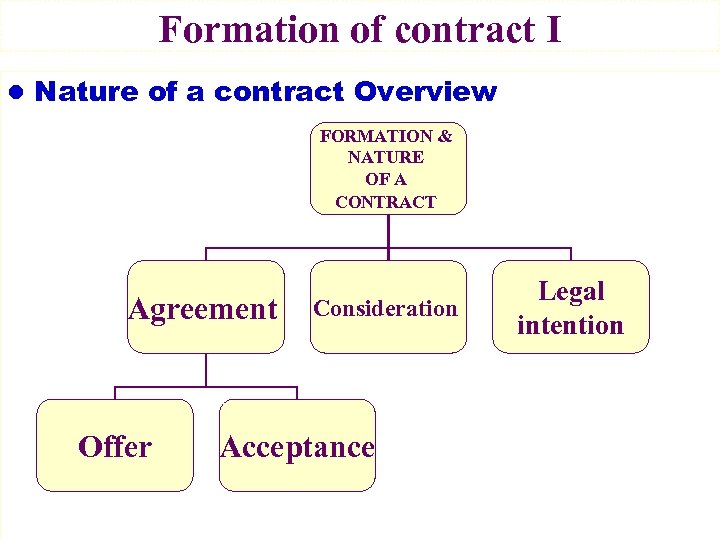
Formation of contract Ⅰ l Nature of a contract Overview FORMATION & NATURE OF A CONTRACT Agreement Offer Consideration Acceptance Legal intention
Topic list l a) Analyse the nature of a simple contract. l b) Explain the meaning of offer and distinguish from invitations to treat. l c) Explain the meaning and consequence of acceptance.
1. Definition l A contract is a legally binding agreement,formed by the mutual consent of 2 parties. l The essential contract elements l (to create a contract) l It is an agreement by offer and acceptance, which is supported by consideration from both parties and made with intention to be legally binding.
An established contract ≠ a valid contract l Why? l A decision of fact or a decision of law. 2. factors affecting the Validity of a contract l Capacity: legal capacity minors and agents l Legality: can be enforced l Genuine consent: not by undue influence l Form: some contracts require particular form l Content: implied terms and express terms must be lawful.
(1)Limited Capacity l Minors l Exceptions: Necessaries are food, clothing, shelter, medicine, and hospital care-whatever a court believes is necessary to maintain a person's status. l A minor may disaffirm a contract for necessaries but will be liable for the reasonable value. l Incompetent Persons Intoxication v Mentally Incompetent Persons l If a person has been adjudged incompetent by a court any contract the enter into is void. v
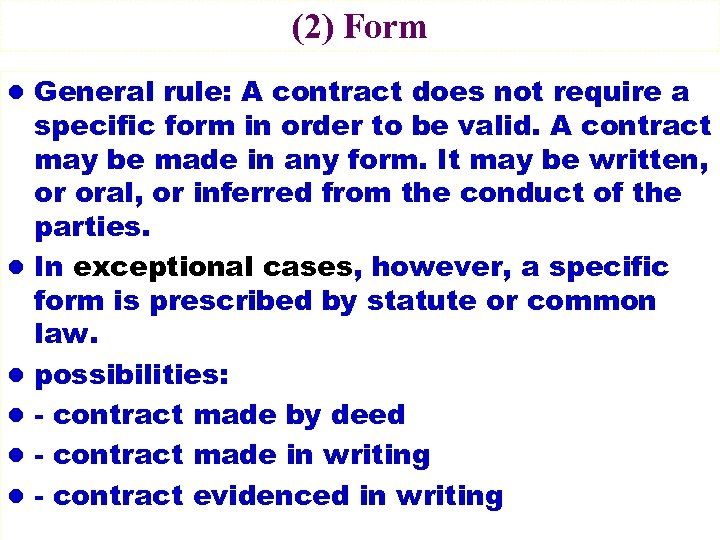
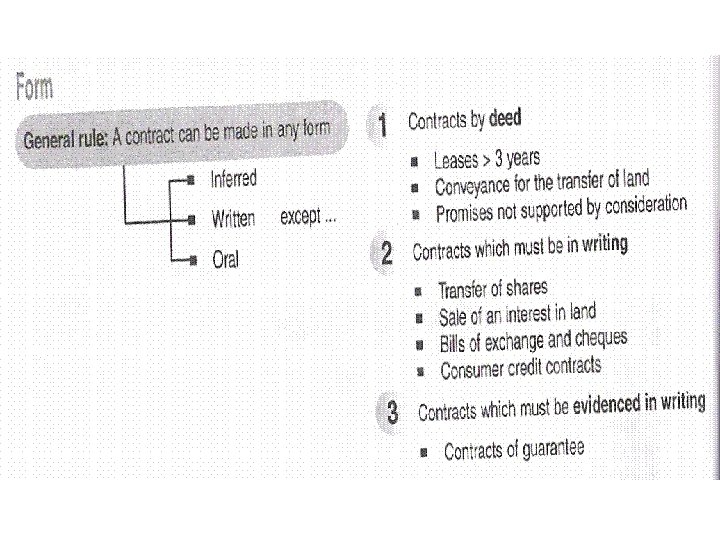
(2) Form l General rule: A contract does not require a l l l specific form in order to be valid. A contract may be made in any form. It may be written, or oral, or inferred from the conduct of the parties. In exceptional cases, however, a specific form is prescribed by statute or common law. possibilities: - contract made by deed - contract made in writing - contract evidenced in writing
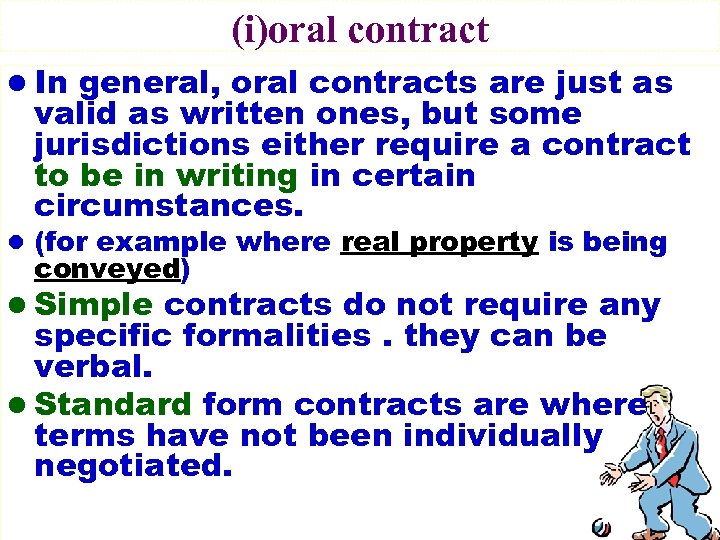
(ⅰ)oral contract l In general, oral contracts are just as valid as written ones, but some jurisdictions either require a contract to be in writing in certain circumstances. l (for example where real property is being conveyed) l Simple contracts do not require any specific formalities. they can be verbal. l Standard form contracts are where terms have not been individually negotiated.
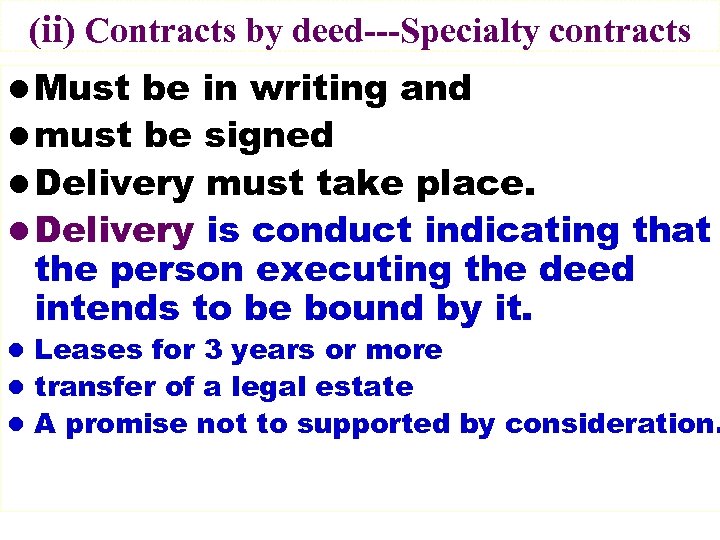
(ⅱ) Contracts by deed---Specialty contracts l Must be in writing and l must be signed l Delivery must take place. l Delivery is conduct indicating that the person executing the deed intends to be bound by it. l Leases for 3 years or more l transfer of a legal estate l A promise not to supported by consideration.
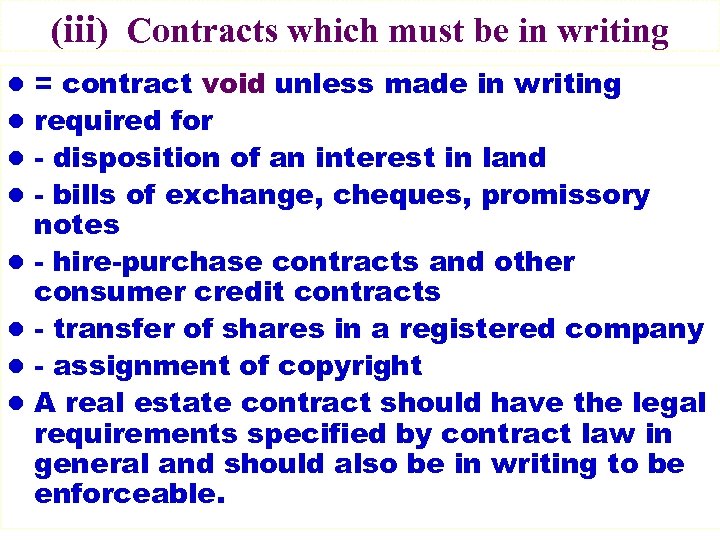
(ⅲ) Contracts which must be in writing l = contract void unless made in writing l required for l - disposition of an interest in land l - bills of exchange, cheques, promissory l l notes - hire-purchase contracts and other consumer credit contracts - transfer of shares in a registered company - assignment of copyright A real estate contract should have the legal requirements specified by contract law in general and should also be in writing to be enforceable.
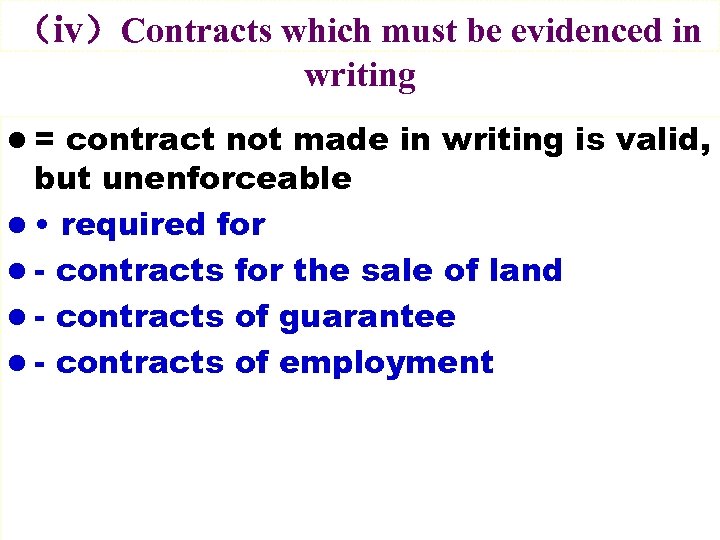
(ⅳ)Contracts which must be evidenced in writing l = contract not made in writing is valid, but unenforceable l • required for l - contracts for the sale of land l - contracts of guarantee l - contracts of employment
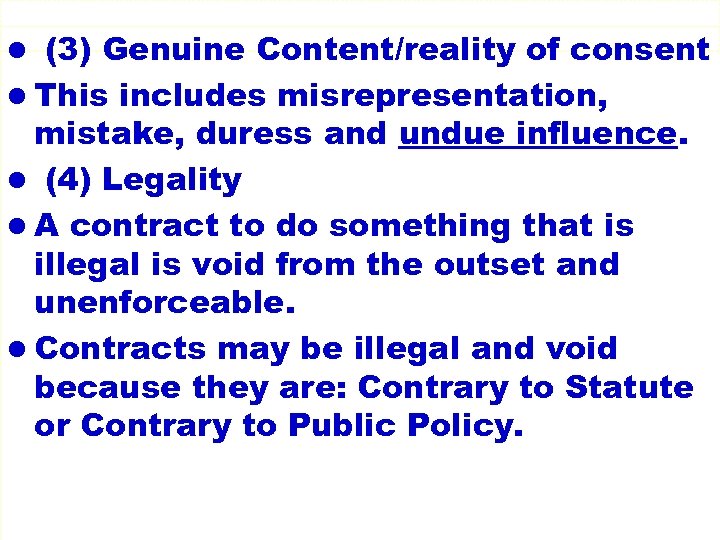
l (3) Genuine Content/reality of consent l This includes misrepresentation, mistake, duress and undue influence. l (4) Legality l A contract to do something that is illegal is void from the outset and unenforceable. l Contracts may be illegal and void because they are: Contrary to Statute or Contrary to Public Policy.
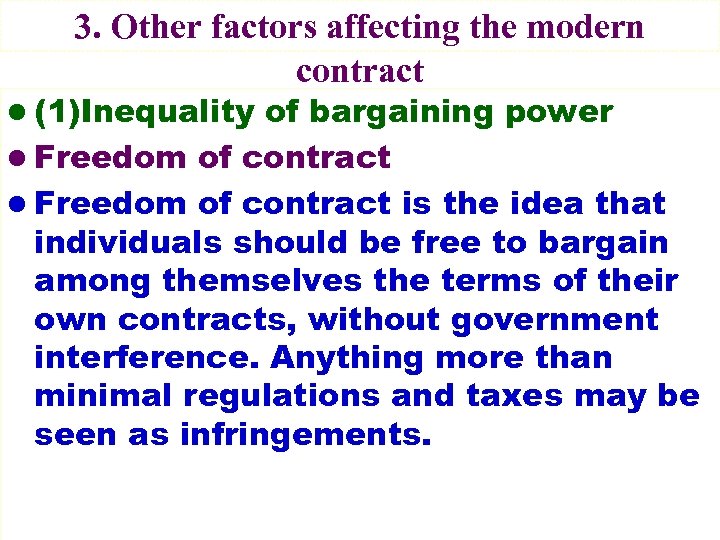
3. Other factors affecting the modern contract l (1)Inequality of bargaining power l Freedom of contract is the idea that individuals should be free to bargain among themselves the terms of their own contracts, without government interference. Anything more than minimal regulations and taxes may be seen as infringements.
(2)The standard form contract l A standard form contract (sometimes referred to as an adhesion contract or boilerplate contract) is a contract between two parties that does not allow for negotiation, i. e. take it or leave it. It is often a contract that is entered into between unequal bargaining partners, such as when an individual is given a contract by the salesperson of a multinational corporation. The consumer is in no position to negotiate the standard terms of such contracts and the company's representative often does not have the authority to do so.
(3)Consumer protection l Consumer protection is a form of government regulation which protects the interests of consumers. l For example, a government may require businesses to disclose detailed information about products—particularly in areas where safety or public health is an issue, such as food. l Consumer protection is linked to the idea of consumer rights (that consumers have various rights as consumers), and to the formation of consumer organizations which help consumers make better choices in the marketplace. l (4)The electronic contract
4. The types of the efficacity of a contract l (1) Valid contract l (2) Effect of failure can be classified into 3: l (a) Void contract means there is no contract. It is not actually a contract. A void contract cannot be enforced by law. Void contracts are different from voidable contracts, which are contracts that may be (but not necessarily will be) nullified.
l (b) Voidable contract means the contract can be avoided by one party. Unlike a void contract, is a valid contract. At most, one party to the contract is bound. The unbound party may repudiate the contract, at which time the contract is void. l (c) Unenforceable contract means the contract is valid but performance by one party cannot be enforced. Unenforceable is usually used in contradistinction to void (or void ab initio) and voidable. If the parties perform the agreement, it will be valid, but the court will not compel them if they do not.
l An example of a transaction which is an unenforceable contract is a contract for prostitution under English law. Prostitution is not actually a crime under English law, but so long as the contract is fully performed, it remains valid. However, if either refuses to complete the bargain (either the prostitute after being paid, or the payor after receiving the service) then the court will not assist the disappointed party. Similarly under English law, a gambling contract is valid, but unenforceable (gambling contracts are sometimes said to be "binding in honour only").
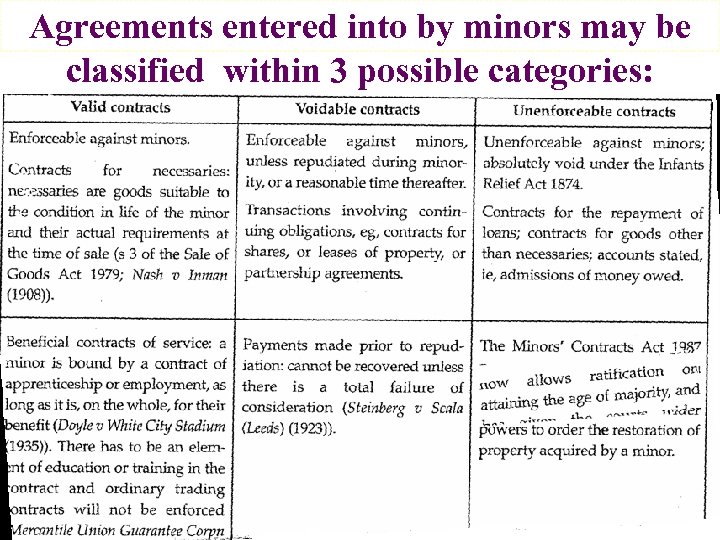
Agreements entered into by minors may be classified within 3 possible categories:
Chapter 5. Essentials of a valid simple contract l Aims to show the essentials of a valid simple contract to the student. l Topic list l Offer and ITT l Acceptance l Consideration l Intention l Privity
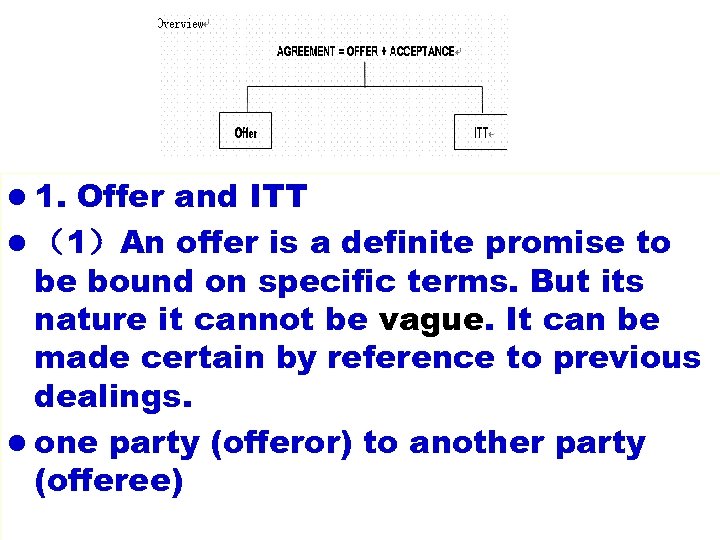
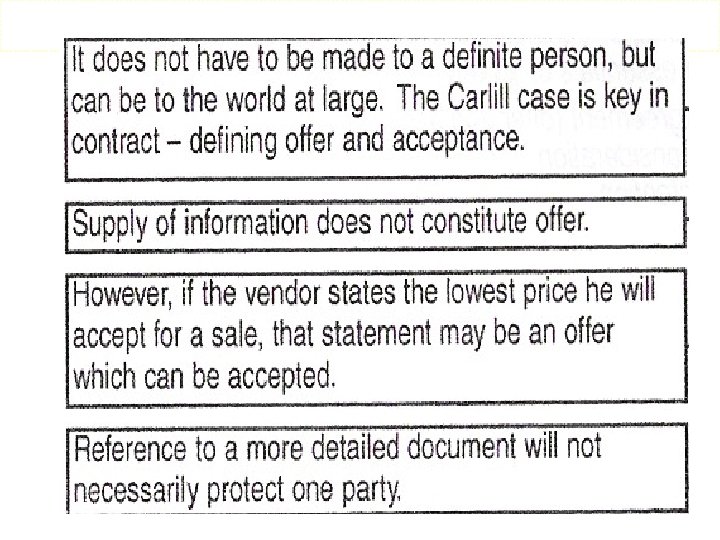
l 1. Offer and ITT l (1)An offer is a definite promise to be bound on specific terms. But its nature it cannot be vague. It can be made certain by reference to previous dealings. l one party (offeror) to another party (offeree)
(2) Characteristics of an offer l (a)Must be certain l (b)Must be differentiated from a mere supply of information l (c)Must be differentiated from an statement of intention l (d) Must be differentiated from an invitation to treat l (e)It does not have to be made to a difinite person, but may be to world at large : Carlill v Carbolic Smokeball Co. 1893.
(a)Must be certain A statement which is vague cannot be an offer but an apparently vague offer can be made certain by reference to previous dealing or customs. Gunthing v Lynn 1831 Facts: the offeror to pay a further sum for a horse if it was ‘lucky’. The offer was too vague so the judge said it was not specific enough to constitute an offer.
l (b)Supply of information l Harvey v Facey (1873) l Fact: the C sent a telegram to the D asking what would be the lowest cash price for the sale of Bumper hall pen. The D replied lowest cash price £ 900. The C replied we agree to buy at £ 900. l The C sued for specific performance of the agreement, and for an injunction to restrain Kingston from taking a conveyance of the property. l Held no agreement between the parties responding to the D request for information. Mere statement of the lowest price at which the vendor would sell contains no implied contract to sell at that price to the persons making the inquiry.
Bigg v Boyd Gibbons 1971 p 97 l the C was selling his house and wrote to the D “as you are aware that I paid £ 25000 for this property and your bid of £ 20000 would appear a little optimistic. For a quick sale I would accept £ 26000”. The D replied I accept your offer and asked the C to contact his solicitor. The C wrote back and said I am putting the matter into my solicitor my wife and I pleased that you are purchasing the property. The D changed his mind. l Held there was an offer and the only thing to do was to draw up a formal contract.
Bowerman and Another v Association of British Travel Agents Ltd 1996 l the C booked a school skiing holiday with a tour operator who was a member of ABTA. The holiday was later cancelled when the tour operator ceased to trade. ABTA refunded all payments made, except for insurance premiums of £ 10. 00 which the claimant sued to recover. l The appeal turned on the construction of a notice which each ABTA tour operator was required to display prominently in its office. l The Court of Appeal held that the notice setting out ABTA’s scheme of financial protection for holiday makers was promissory in nature and intended to be legally binding. l The notice was, in effect, an offer that the customer accepted by choosing to book a holiday with an ABTA member.
(c)Must be differentiated from an statement of intention Harris v Nickerson 1873 l an auctioneer advertised certain goods would be for sale at an auction. The C went to the auction but the goods were withdrawn. He sued the auctioneer for loss of time and money. l Held the advertisement of the auction was merely a deceleration of intent of holding an auction. It was not an offer the advertisement was merely an invitation to treat.
l Comment: Advertisement will take place is not an offer to sell. Potential buyers may not sue the auctioneer if the auction does not take place.
(d)Must be differentiated from an invitation to treat l An invitation to treat is an indication that a person is ready to accept offers with a view to contract. l Cf. Offer l It cannot be accepted to make a valid contract.
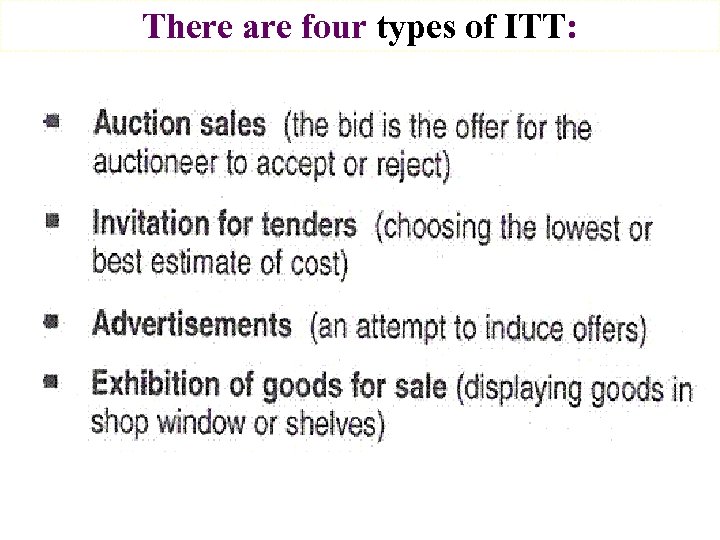
There are four types of ITT:
ⅰ. Auction sales l ① At an auction the bid itself is an offer and then the auctioneer can either accept or reject the offer. Payne and Cave 1789 l Fact: the D made the highest bid for the P's goods at an auction sale, but he withdrew his bid before the fall of the auctioneer's hammer. l Held: the D was not bound to purchase the goods. His bid amounted to an offer which he was entitled to withdraw at any time before the auctioneer signified acceptance by knocking down the hammer.
l ②However, if it is stated by the owner that there is no reserve price or that there is a reserve price beyond which offers will be accepted then the auction is most likely a contractual offer which is accepted by the highest bidder; this was affirmed in the Court of Appeal in Barry v Davies [2000]
ⅱ. Advertisements l ① Generally, advertisements are invitations to treat, so the person advertising is not compelled to sell to every customer. Partridge v Crittenden l Mr. Partridge placed an advertisement for selling a protected species of bird in a magazine. Then RSPCA brought a prosecution of the Birds Act 1953 but the case was quashed as Mr Partridge was not making an offer as it was the advertisement constituted an invitation to treat. l Held: where the appellant advertised to sell wild birds, was not offering to sell them.
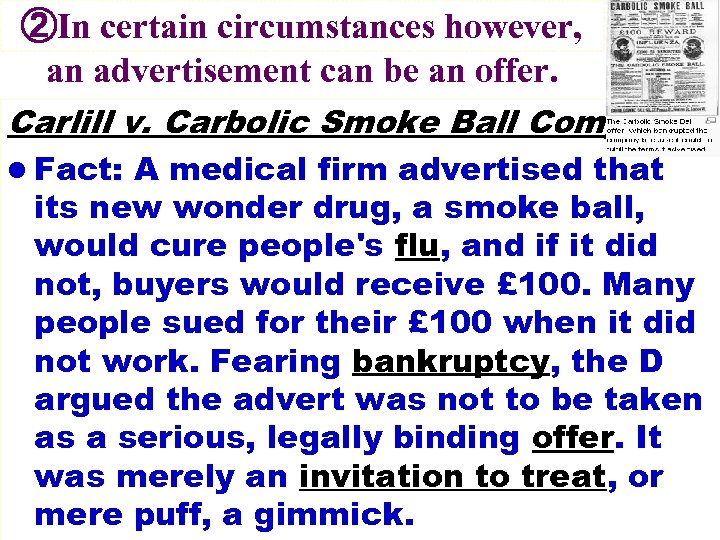
②In certain circumstances however, an advertisement can be an offer. Carlill v. Carbolic Smoke Ball Company l Fact: A medical firm advertised that its new wonder drug, a smoke ball, would cure people's flu, and if it did not, buyers would receive £ 100. Many people sued for their £ 100 when it did not work. Fearing bankruptcy, the D argued the advert was not to be taken as a serious, legally binding offer. It was merely an invitation to treat, or mere puff, a gimmick.
l Held: to a reasonable man Carbolic had made a serious offer. People had given good "consideration" for it by going to the "distinct inconvenience" of using a faulty product. l The D, who advertised were contractually obliged to pay £ 100 to whoever accepted it by performing the requested acts. l Notes: In civil law systems the concept of consideration is not central. In addition, for some contracts formalities must be complied with.
l ⅲ. Exhibition of goods for sale is normally an invitation to treat. l Fisher V Bell l Fact: a shopkeeper was prosecuted for offering for sale an offensive weapon by exhibiting a flick knife in his shop window. Displaying an item with a price in a shop window is an invitation to treat so he was inviting offers from potential buyers which the shopkeeper could either accept or reject the offer.
Pharmaceutical society of GB v Boots (1953) l Fact: The poisoned act prohibited the sale of certain medicines with the supervision of a chemist. The D operated a self service shop. The C would pick up the medicine they required and take it to the cash point. l Held the offer was made when the customer placed the good in the basket and only accepted when they presented the good at the checkout where a qualified pharmacist was supervising.
ⅳ. An invitation for tenders (or bidding in the U. S. ) l A tender is an estimate submitted in response to a prior request. When a person tenders for a contract he is making an offer to the person who has advertised a contract as being available. l ① Generally, it is the clearest example of an invitation to treat.
Spencer v Harding (1870) l Fact: where the Ds offered to sell by tender their stock. l Held: they had not undertaken to sell to the person who made the highest tender, but were inviting offers which they could then accept or reject as they saw appropriate. l ②In certain circumstances though, an invitation for tenders may be an offer.
![Harvela Investments Ltd v Royal Trust of Canada (CI) Ltd [1986] AC 207 l](https://present5.com/presentation/3bb5be917d03a2b09bfb4d8e5913d9f8/image-49.jpg "Harvela Investments Ltd v Royal Trust of Canada (CI) Ltd [1986] AC 207 l")
Harvela Investments Ltd v Royal Trust of Canada (CI) Ltd [1986] AC 207 l Fact: where the Ds had made it clear that they were going to accept the highest tender; l Held: that this was an offer which was accepted by the person who made the highest tender and that the Ds were in breach of contract by not doing so.
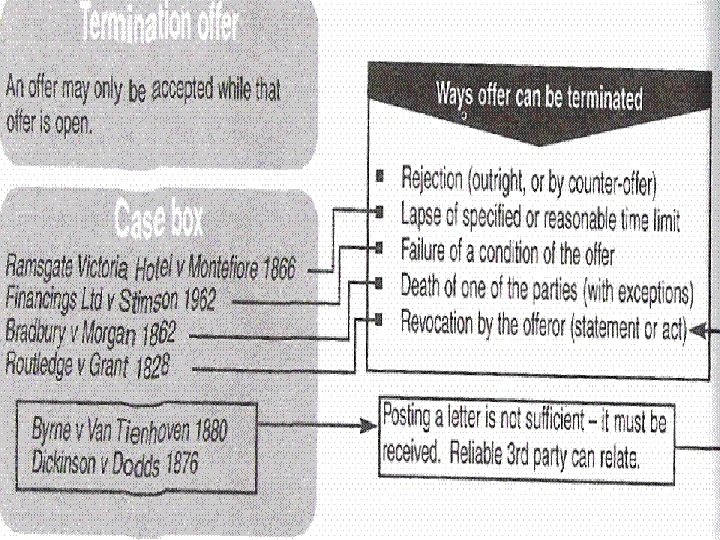
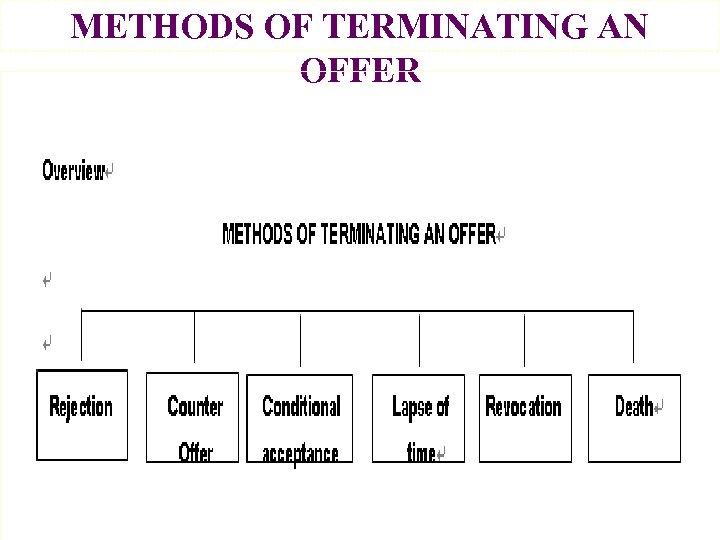
2. Termination of offer l If an offer is accepted, then a contract is formed, but the offer can be brought to an end without involving the creation of a contract, as follows: l (1) rejection by offeree l (2) Counter-offer l (3) lapse of time l (4) revocation by the offeror before acceptance: l (5) death of one of the party l (6)Failure of a condition to which the offer was subject
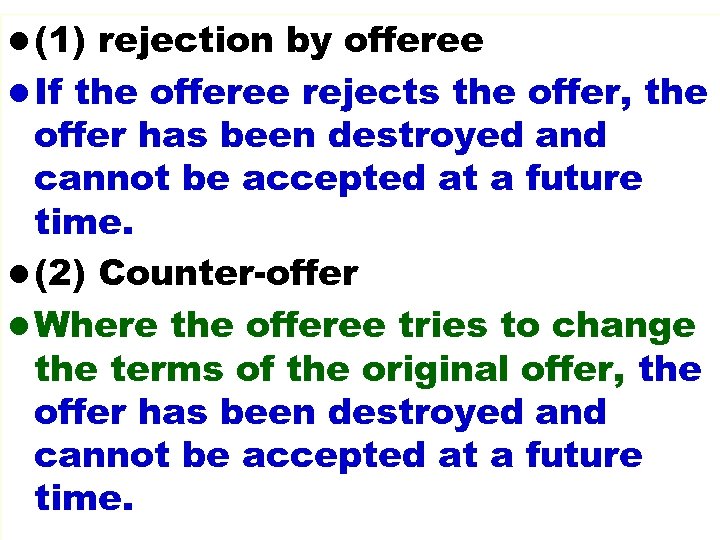
l (1) rejection by offeree l If the offeree rejects the offer, the offer has been destroyed and cannot be accepted at a future time. l (2) Counter-offer l Where the offeree tries to change the terms of the original offer, the offer has been destroyed and cannot be accepted at a future time.
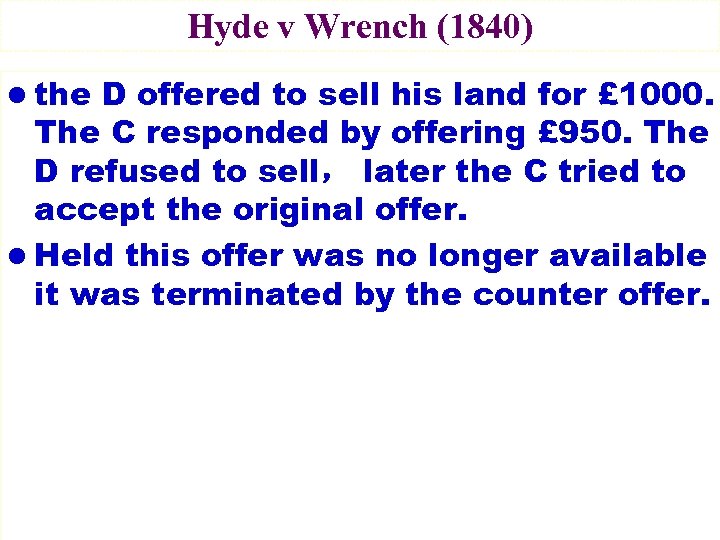
Hyde v Wrench (1840) l the D offered to sell his land for £ 1000. The C responded by offering £ 950. The D refused to sell, later the C tried to accept the original offer. l Held this offer was no longer available it was terminated by the counter offer.
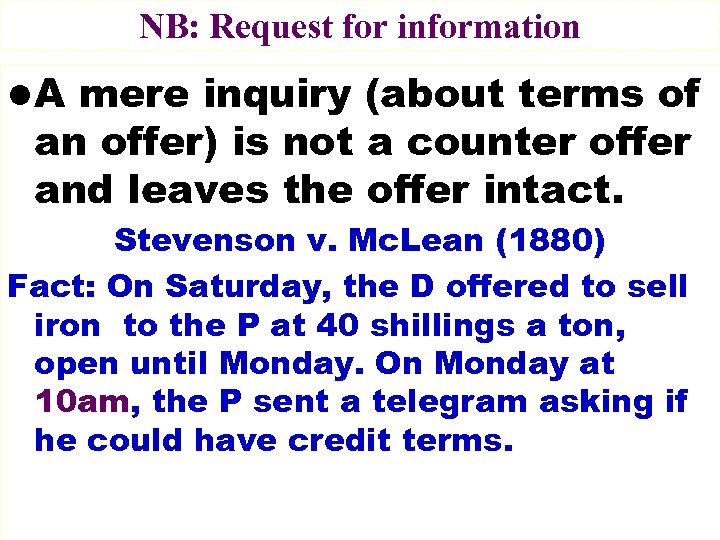
NB: Request for information l A mere inquiry (about terms of an offer) is not a counter offer and leaves the offer intact. Stevenson v. Mc. Lean (1880) Fact: On Saturday, the D offered to sell iron to the P at 40 shillings a ton, open until Monday. On Monday at 10 am, the P sent a telegram asking if he could have credit terms.
l At 1. 34 pm the P sent a telegram accepting the D's offer, but at 1. 25 pm the D had sent a telegram: 'Sold iron to third party' arriving at 1. 46 pm. The P sued the D for breach of contract and the D argued that the P's telegram was a counter-offer so the P's second telegram could not be an acceptance. l Held: the P's first telegram was not a counter-offer but only an enquiry, so a binding contract was made by the P's second telegram.
(3) lapse of time l = non-acceptance within prescribed period or within reasonable time l If the offer is not accepted within the time limit, then it lapses and can no longer be accepted. l Where no time limit has been set, it will still lapse after a reasonable time, depending on the circumstances of the case.
Ramsgate v Montefiore (1866) l On 8 June, the D offered to buy shares in the P’s company. On 23 Nov, the P accepted but the D no longer wanted them and refused to pay. l Held: the six-month delay between the offer in June and the acceptance in November was unreasonable and so the offer had 'lapsed', it could no longer be accepted and the defendant was not liable for the price of the shares.
(4) revocation by the offeror before acceptance l (a) An offer can be withdrawn at any time before acceptance, even if explicitly left open. l (b) If someone undertakes that his offer shall remain open for acceptance for a specified time he may revoke it within that time, unless by a separate contract he has bound himself to keep it open.
l (c) Withdrawal must be communicated to offeree and it will take effect until the revocation is communicated to the offeree. l (d) Posting a letter of revocation is not sufficient act of revocation. l (e) Communication by third person sufficient.
Routledge v Grant 1928 l Fact: The D offered to buy the C’s house for a fix sum, requiring acceptance within 6 weeks. Within the 6 weeks specified, he withdrew his offer. l Held: The D could revoke his offer at any time before acceptance, even though the time limit had not expired.
Byrne v Van Tienhoven (1880) l Fact: The Ds were in Cardiff; The Cs in NY. l 1 Oct. D posted a letter offering goods for sale. l 8 Oct. D revoked the offer; which arrived on 20 Oct. l 11 Oct. P accepted by telegram. l 15 Oct. P posted a letter confirming acceptance. l Held: the D's revocation was not effective until it was received on 20 Oct. l It could not revoke the contract made by the telegram acceptance of the offer on 11 th Oct.
Dickinson v Dodds (1876) l D offered to sell his house to C, the offer being open until 9 am Friday. On Thursday, D sold the house to Allan. C was told of the sale by Berry, the estate agent, and he delivered an acceptance before 9 am Friday. l Held—the offer had been validly revoked. l Communication by third person sufficient.
(5) death of one of the party l The death of offeree before acceptance terminates the offer. l The death of offeror terminates the offer, unless the offeree accepts the offer and the offer is not of a personal contract.
Bradbury v Morgan (1862) l Fact: JM Leigh requested the C to give credit to HJ Leigh, his brother. JM Leigh guaranteed his brother’s account to the extent of £ 100. The C thereafter credited HJ Leigh in the usual way of their business. JM Leigh died but Bradbury, having no notice or knowledge of his death, continued to supply HJ Leigh with goods on credit JM Leigh's executors (Morgan, the D) refused to pay, arguing that they were not liable as the debts were contracted and incurred after the death of JM Leigh and not in his lifetime. l Judgment was given for the Ps, Bradbury.
(6)Failure of a condition to which the offer was subject l An offer subject to condition will lapse if the conditions are mot met. l Financing v Stimson (1962) l the D signed a form by which he offered to take a car on a hire-purchase form. He paid the deposit and was disappointed with the car performance and returned it. The car was stolen from the dealer’s premises. The C was unaware that the car was returned and signed the HP agreement. l Held there was an implied condition that the car would meet the same condition until acceptance had occurred. Before acceptance the condition had not been fulfilled acceptance invalid.
METHODS OF TERMINATING AN OFFER
3. Acceptance l (1) Definition l Acceptance is a positive act by a person to whom an offer has been made. If unconditional, the act creates a binding contract. l (final and unconditional expression of assent to the terms of an offer)
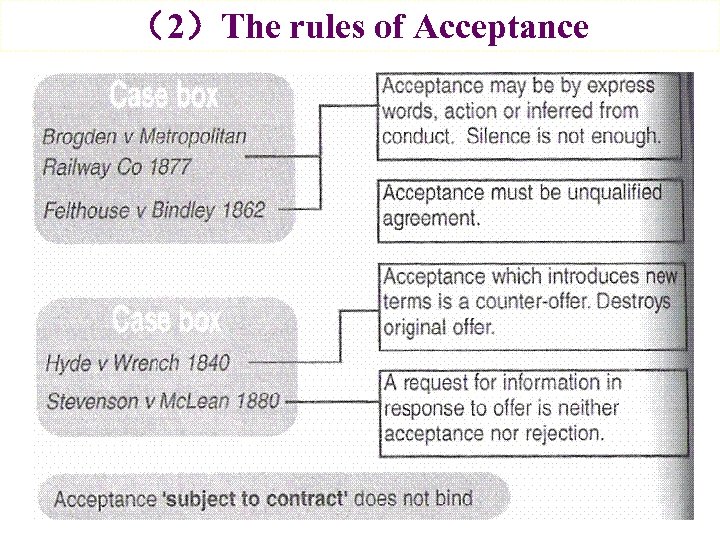
(2)The rules of Acceptance
(a) An unconditional assent to all the terms of the offer: Neale v Merrett l (b) Acceptance may be made by express words, by action or inferred from conduct. Silence is not enough. Brogden v MRC (1877) l Fact: The C supplied coal to the D for many years without an agreement. The D sent a draft agreement to B who filled in the name of an arbitrator, signed it and returned it to the D 's agent who put it in his desk. Coal was ordered and supplied in accordance with the agreement, but they never signed a final version. After a dispute arose the C said there was no binding agreement. l Held: the conduct of the parties had indicated their approval of the agreement.
Felthouse v Bindley 1862 l Facts: The C wanted to buy one of his nephew's horses. He wrote to his nephew who wanted to sell the horse to him, stating that "If I hear no more about him, I consider the horse mine. . . " The nephew intended to accept his uncle’s offer but did not reply. He instructed the D, an auctioneer, not to sell the horse. Owing to a misunderstanding the horse was sold to some else. The uncle sued the auctioneer. l Issue: Had a contract formed between The C and the owner? Did the C own the horse? Could sue the D?
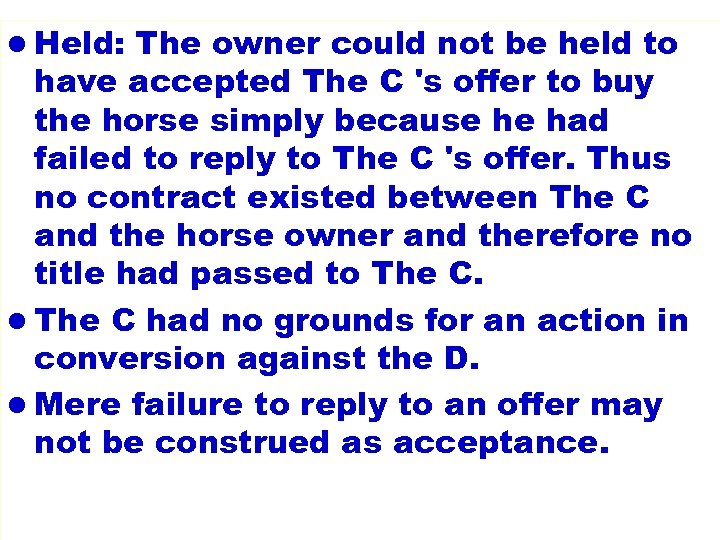
l Held: The owner could not be held to have accepted The C 's offer to buy the horse simply because he had failed to reply to The C 's offer. Thus no contract existed between The C and the horse owner and therefore no title had passed to The C. l The C had no grounds for an action in conversion against the D. l Mere failure to reply to an offer may not be construed as acceptance.
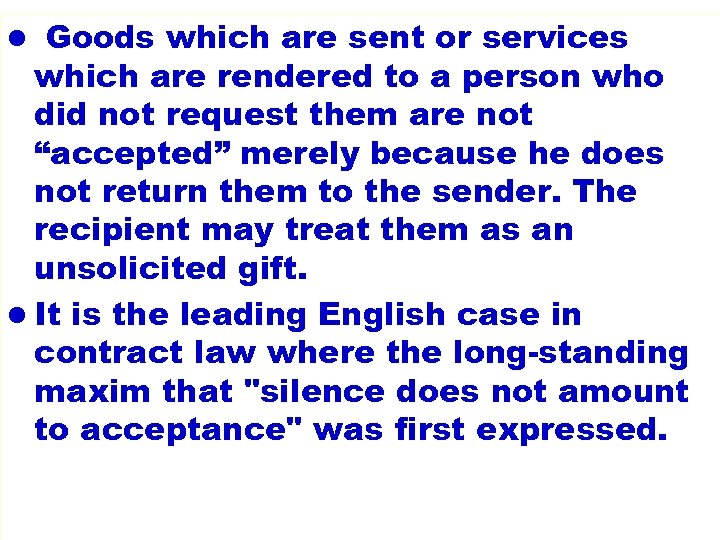
l Goods which are sent or services which are rendered to a person who did not request them are not “accepted” merely because he does not return them to the sender. The recipient may treat them as an unsolicited gift. l It is the leading English case in contract law where the long-standing maxim that "silence does not amount to acceptance" was first expressed.
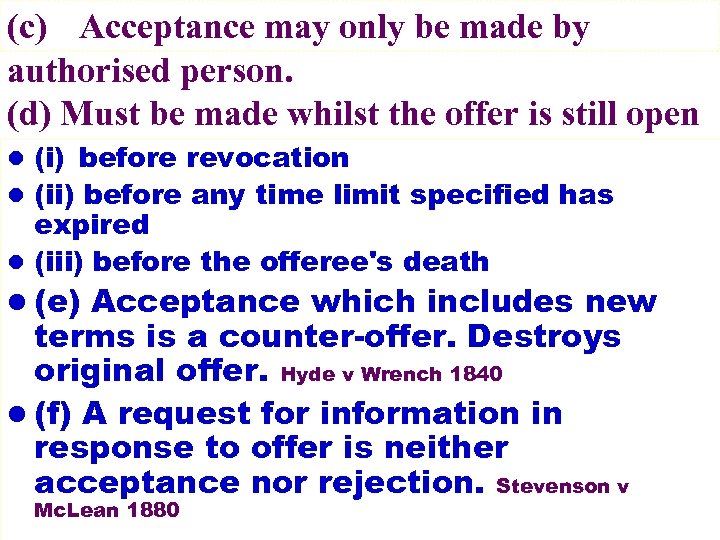
(c) Acceptance may only be made by authorised person. (d) Must be made whilst the offer is still open l (i) before revocation l (ii) before any time limit specified has expired l (iii) before the offeree's death l (e) Acceptance which includes new terms is a counter-offer. Destroys original offer. Hyde v Wrench 1840 l (f) A request for information in response to offer is neither acceptance nor rejection. Stevenson v Mc. Lean 1880
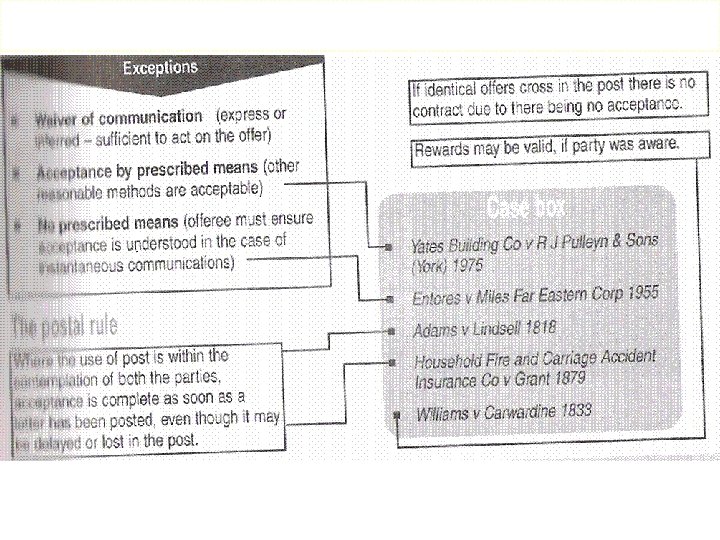
(3) Communication of acceptance l The general rule is that acceptance must be communicated to the offeror, however this rule does not apply in all case. Silence cannot amount to acceptance. l Exception: l (a) Waiver of communication (express or inferred—sufficient to act on the offer) l In Carlill v. Carbolic Smoke Ball Company, it was held that it was sufficient for the C to act on the offer without notifying her acceptance of it. This was an example of unilateral contract.
l (b) Acceptance by prescribed means (other reasonable methods are acceptable) Yates v Pulleyn (1975) l (c) No prescribed means l The offeree can use any method but must ensure that his acceptance is understood if he choose an instantaneous methods of communication. However, if modern instantaneous methods of communication are used e. g. telephone, faxes, email etc, communication must be received. ) Entores v Miles Far East Corporation 1955
l Yates v Pulleyn (1975) l Fact:The D granted the P an option to buy land, exercisable by notice in writing to be sent by “registered or recorded delivery post". The P sent a letter accepting this offer by ordinary post, which was received by the defendant who refused to accept it as valid. l Held:this method of acceptance was valid and was no disadvantage to the offeror, as the method stipulated was only to ensure delivery and that had happened.

Entores v Miles Far East Corporation 1955 l Fact:The P in London made an offer by Telex to the D in Holland. The D's acceptance was received on the P' s Telex machine in London. The P sought for a writ on the D, claiming damages for breach of contract. l The Court of Appeal had to decide where the contract was made. l Held: The acceptance took effect and the contract was made, when the telex message was printed ort on the plaintiff’s terminal in London. A writ could be issued.
l Denning L. J. stated that the rule about instantaneous communications between the parties is different from the rule about the post. l The contract is only complete when the acceptance is received by the offeror: and the contract is made at the place where the acceptance is received. l The contract was made in London where the acceptance was received. Therefore service could be made outside the jurisdiction.
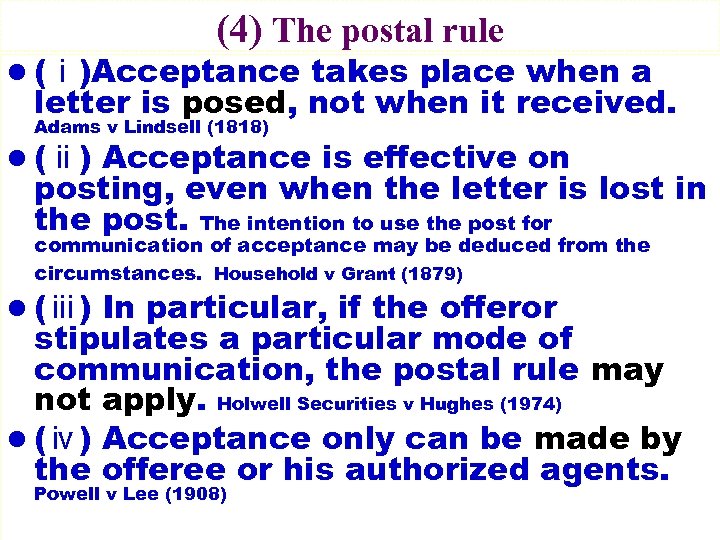
(4) The postal rule l (ⅰ)Acceptance takes place when a letter is posed, not when it received. Adams v Lindsell (1818) l (ⅱ) Acceptance is effective on posting, even when the letter is lost in the post. The intention to use the post for communication of acceptance may be deduced from the circumstances. Household v Grant (1879) l (ⅲ) In particular, if the offeror stipulates a particular mode of communication, the postal rule may not apply. Holwell Securities v Hughes (1974) l (ⅳ) Acceptance only can be made by the offeree or his authorized agents. Powell v Lee (1908)
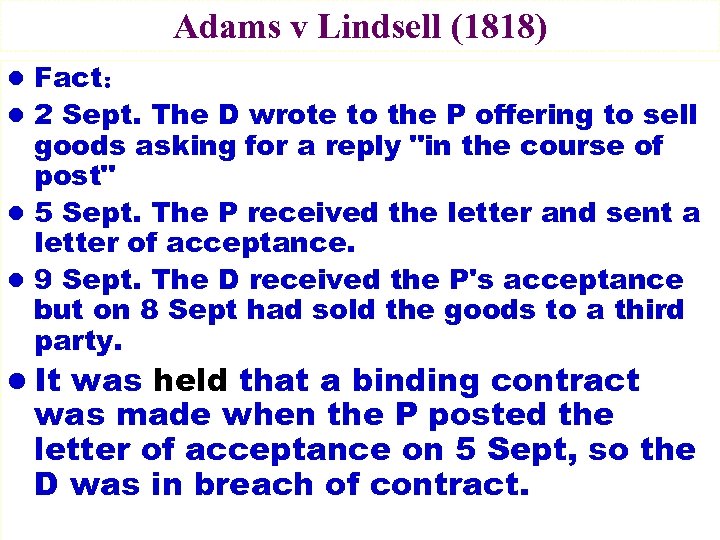
Adams v Lindsell (1818) l Fact: l 2 Sept. The D wrote to the P offering to sell goods asking for a reply "in the course of post" l 5 Sept. The P received the letter and sent a letter of acceptance. l 9 Sept. The D received the P's acceptance but on 8 Sept had sold the goods to a third party. l It was held that a binding contract was made when the P posted the letter of acceptance on 5 Sept, so the D was in breach of contract.
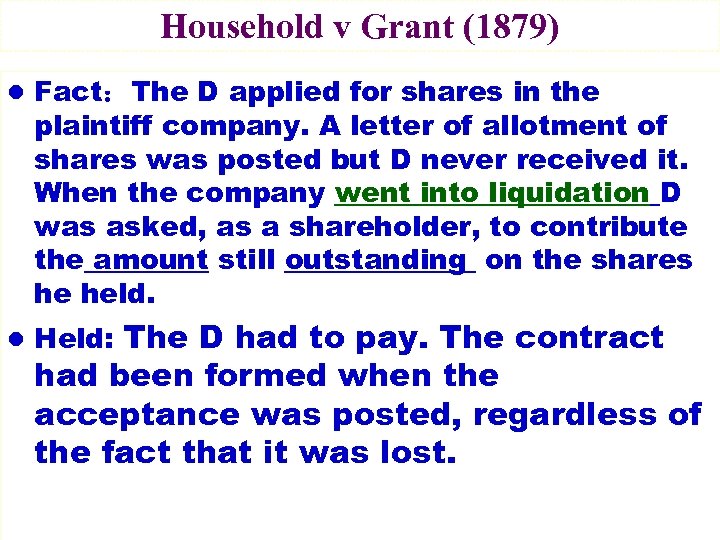
Household v Grant (1879) l Fact:The D applied for shares in the plaintiff company. A letter of allotment of shares was posted but D never received it. When the company went into liquidation D was asked, as a shareholder, to contribute the amount still outstanding on the shares he held. The D had to pay. The contract had been formed when the acceptance was posted, regardless of the fact that it was lost. l Held:
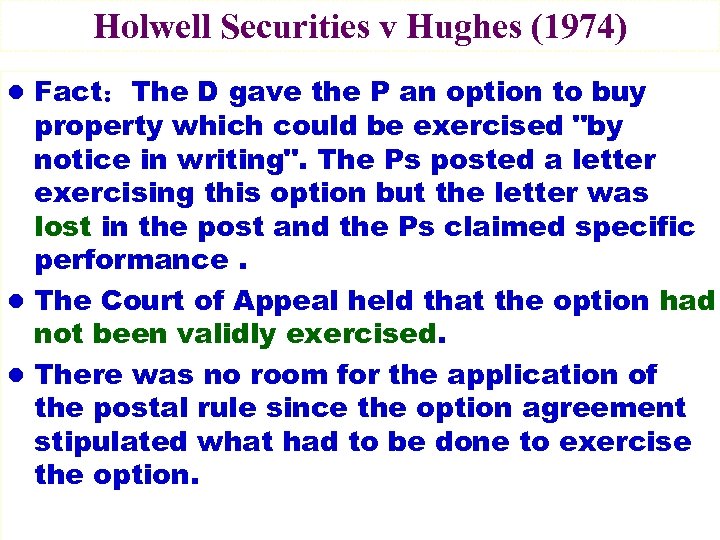
Holwell Securities v Hughes (1974) l Fact:The D gave the P an option to buy property which could be exercised "by notice in writing". The Ps posted a letter exercising this option but the letter was lost in the post and the Ps claimed specific performance. l The Court of Appeal held that the option had not been validly exercised. l There was no room for the application of the postal rule since the option agreement stipulated what had to be done to exercise the option.
Powell v Lee (1908) l Fact:The P applied for a job as headmaster and the school managers decided to appoint him. One of them, acting without authority, told the P he had been accepted. Later the managers decided to appoint someone else. The P brought an action alleging that by breach of a contract to employ him he had suffered damages in loss of salary. l Held: there was no contract as there had been no authorised communication of intention to contract on the part of the body, that is, the managers, alleged to be a party to the contract.
l Conditions: l (i) Letter must be properly addressed and stamped; l (ii) put into the post in the normal way; l (iii) the postal rule will not have been excluded i. e. it must be in contemplation of both parties that acceptance will take place by post. l Effect: l We may have a 'communication' of acceptance without receipt.
(5) cross-offers l Maxim:Cross-offers do not give rise to an agreement or cross-offers do not make a binding contract. (there was no acceptance) l Tinn v Hoffman (1873) l Fact:H wrote to T offering to sell him 800 tons of iron at 69 s per ton. On the same day T wrote to H offering to buy on the same terms. l It was held obiter that these simultaneous cross-offers made in ignorance of each other, would not bind the parties.
(6) Unilateral contract l (a) A unilateral contract differs from a bilateral contract, in which the parties exchange mutual promises. Bilateral contracts are commonly used in business transactions; a sale of goods is a type of bilateral contract. l (b) Reward offers are usually unilateral contracts. The offeror cannot impel anyone to fulfill the reward offer. An offeree can sue for breach of contract, however, if the offeror does not provide the reward after the offeree has fulfilled the contract's requirements. R v Clarke (1927) (Australia) l (c) Remedies may valid, if party was aware. l (d) Acceptance may still be valid even if the offer was not the sole reason for the action: Williams v Carwardine (1833)
R v Clarke (1927) (Australia) l Fact:The Government offered a reward for information leading to the arrest of certain murderers and a pardon to an accomplice who gave the information. Clarke saw the proclamation. He gave information which led to the conviction of the murderers. He admitted that his only object in doing so was to clear himself of a charge of murder and that he had no intention of claiming the reward at that time. He sued the Crown for the reward. l Held: There could not be acceptance without knowledge of the offer. l No one can accept an offer that they do not know about, but the motive for accepting is not important.
l Williams v Carwardine (1833) l Fact:The D offered a reward for information leading to the conviction of a murderer. The P knew of this offer and gave information that it was her husband after he had beaten her, believing she had not long to live and to ease her conscience. l It was held that the P was entitled to the reward as she knew about it and her motive in giving the information was irrelevant.
(7) Agreement without offer and acceptance l (a) Agreement may exist without strict offer and acceptance if the actions of the parties can infer a contract. Clark v Dunraven l Fact:Competitors in a yacht race all agreed to be bound by the rules of a yacht club. The P’s yacht sank as a result of a collision and he sought to sue the other party on the basis of the rules of the yacht club. The D claimed that there was no contractual relationship between them. l Held that there was a contract between all the competitors which they had entered into by participating in the race, thus avoiding the problems of privity.
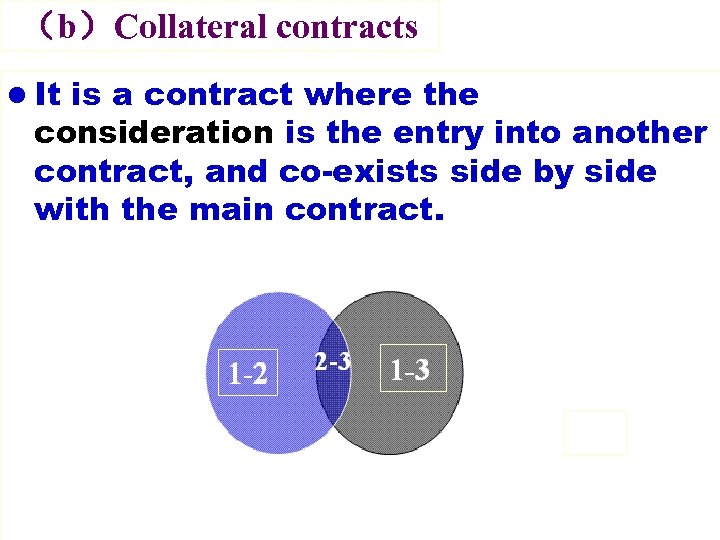
(b)Collateral contracts l It is a contract where the consideration is the entry into another contract, and co-exists side by side with the main contract. B 2 -3 1 -3
Shanklin Pier Ltd v Detel Products 1951 l Fact: The C hired a contractor to paint the pier. The C had specifically requested that the contractor use paints by the D based on representations made by the paint manufacturer that it was suitable and would last seven years. The paint turned out to not be any good and lasted only 3 months. The C sued the paint manufacturer. The D claimed that there was no contractual relationship between them l Held: there was a collateral contract based on the representation of D. l The consideration was found in the P's request to the contractor to use Ds product.
Question l If u buy a computer from a shop, then U were injured for the explode of it. l U can sued for damage from the shop or from the manufacturer? l (10) Efficacy of acceptance l Once the offeree has accepted the terms offered, a contract comes into effect. Both parties are bound: the offeror can no longer withdraw their offer, nor can the offeree withdraw their acceptance.
l Key principles l (1) acceptance must correspond with the l l l terms of the offer. (2)A counter-offer does not constitute acceptance. (3) To accept the offer, the offeree must express his assent to the terms of the offer. This can be signified by words, or in writing, or even by conduct such as a nod or a handshake. (4)Generally, acceptance must communicated to the offeror. Consequently, silence cannot amount to acceptance. (5) In unilateral contracts, acceptance occurred when the offeree began to perform the required act. (6)The postal rule.
Appendix: (1)Acceptance was requested by return of post. (2) Knowledge and motive : No one can accept an offer that they do not know about, but the motive for accepting is not important.
(3) Acceptance “subject to contract” l If an offer is accepted `subject to contract', this is merely an indication that the parties intend to contract formally at some later stage. This is usually used in sales of land property, to allow the parties to signal their strong intention to contract, but not to be formally bound. l An agreement `subject to contract‘ is not binding on anyone, and neither party need proceed to a formal contract. l On the other hand, a contract containing vague terms about provisionality may still be held by courts to be binding, so the precise form of words should be used.
Branca v Cobarro 1947 l Fact: the agreement entered into by the parties contained a clause as follows: ‘This is a provisional agreement until a fully legalized agreement, drawn up by a solicitor and embodying all the conditions herewith stated, is signed. ’ l Held: a binding agreement had come into effect. A "provisional agreement" as "an agreement which is only to last until it is replaced by a formal document containing the same terms and drawn up by the parties.
(4) Letters of intent l A letter of intent or LOI is a document outlining an agreement between two or more parties before the agreement is finalized. l LOIs resemble written contracts, but are usually not binding upon the parties in their entirety. l Many LOIs, however, contain provisions that are binding, such as non-disclosure agreements or covenants to negotiate in good faith. l A LOI may also be interpreted as binding the parties if it too closely resembles a formal contract. l as a memorandum of understanding (MOU)
![British Steel Corporation v. Cleveland Bridge &. Engineering Co Ltd. [1984] l Maxim:When there](https://present5.com/presentation/3bb5be917d03a2b09bfb4d8e5913d9f8/image-99.jpg "British Steel Corporation v. Cleveland Bridge &. Engineering Co Ltd. [1984] l Maxim:When there")
British Steel Corporation v. Cleveland Bridge &. Engineering Co Ltd. [1984] l Maxim:When there was no contract there could be no breach.
(5) Acceptance of a tender l (a) a tender to perform one task is an offer which can be accepted. l (b) a tender to supply or perform a series of thing, is not accepted until an order is placed. l The tenderer can terminate his standing offer.
Great Northern Railways v Witham 1873 l Facts: The C advertised for tenders for the supply of such stores as they might require for one year. D submitted a tender to supply the stores in such quantities. After making some deliveries D refused to fulfill an order which the C had given. l Held: D was in breach of contract in refusing to fulfill the order given but might revoke his tender and need not then fulfill any future orders within the remainder of the 12 month period.
Скачать презентацию Anglo-American Business Law Chapter 2 Contract 夏秀渊
3bb5be917d03a2b09bfb4d8e5913d9f8.ppt