


 Скачать презентацию Andy Warhol Colour Shape Andy Warhol American
ЭНДИ УОРХОЛ2.ppt
- Количество слайдов: 19
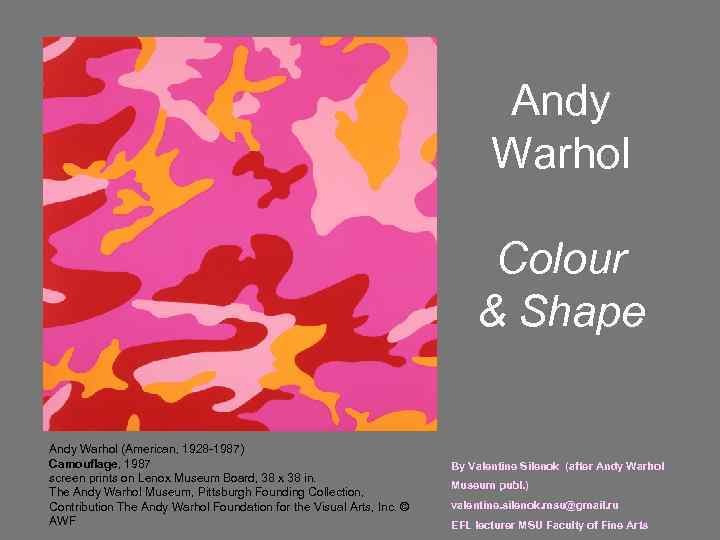 Andy Warhol Colour & Shape Andy Warhol (American, 1928 -1987) Camouflage, 1987 screen prints on Lenox Museum Board, 38 x 38 in. The Andy Warhol Museum, Pittsburgh Founding Collection, Contribution The Andy Warhol Foundation for the Visual Arts, Inc. © AWF By Valentine Silenok (after Andy Warhol Museum publ. ) valentine. silenok. msu@gmail. ru EFL lecturer MSU Faculty of Fine Arts
 Shapes are enclosed objects and can be created by line, colour and value changes that define their edges. Shapes can be: organic (irregular shapes found in nature) also called “natural” geometric (shapes with strong lines and angles such as circles, triangles, and squares).
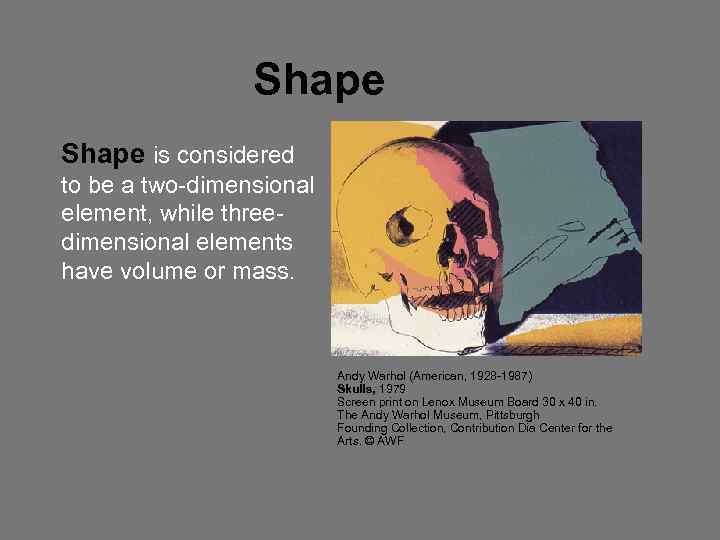 Shape is considered to be a two-dimensional element, while threedimensional elements have volume or mass. Andy Warhol (American, 1928 -1987) Skulls, 1979 Screen print on Lenox Museum Board 30 x 40 in. The Andy Warhol Museum, Pittsburgh Founding Collection, Contribution Dia Center for the Arts. © AWF
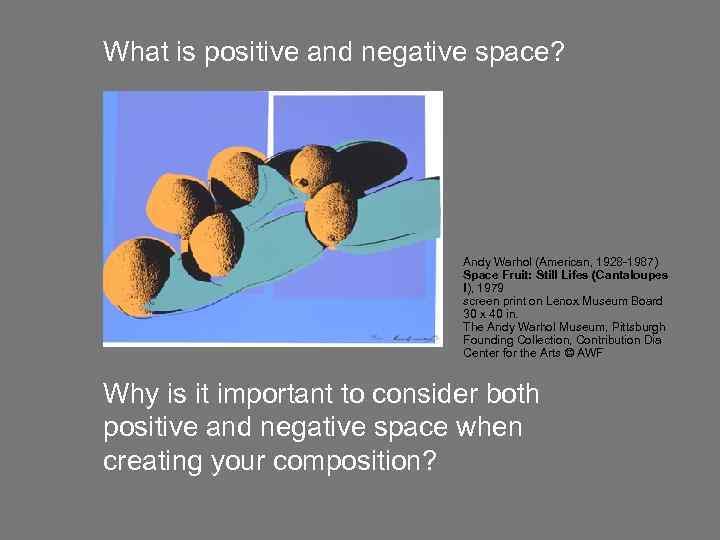 What is positive and negative space? Andy Warhol (American, 1928 -1987) Space Fruit: Still Lifes (Cantaloupes I), 1979 screen print on Lenox Museum Board 30 x 40 in. The Andy Warhol Museum, Pittsburgh Founding Collection, Contribution Dia Center for the Arts © AWF Why is it important to consider both positive and negative space when creating your composition?
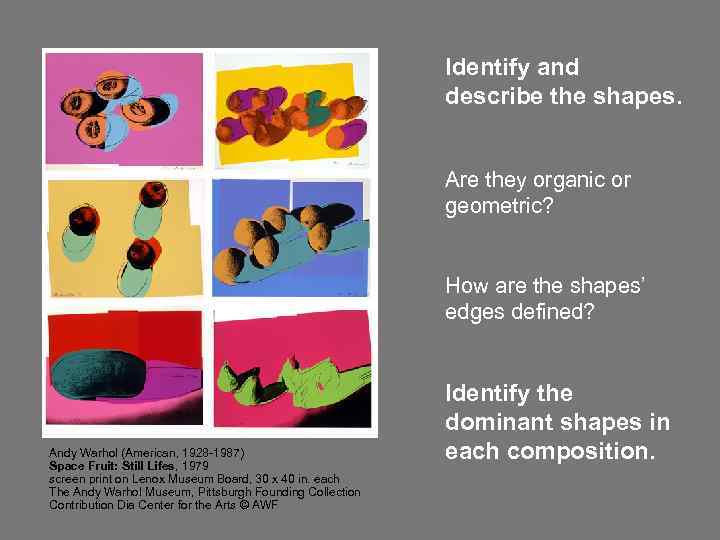 Identify and describe the shapes. Are they organic or geometric? How are the shapes’ edges defined? Andy Warhol (American, 1928 -1987) Space Fruit: Still Lifes, 1979 screen print on Lenox Museum Board, 30 x 40 in. each The Andy Warhol Museum, Pittsburgh Founding Collection Contribution Dia Center for the Arts © AWF Identify the dominant shapes in each composition.
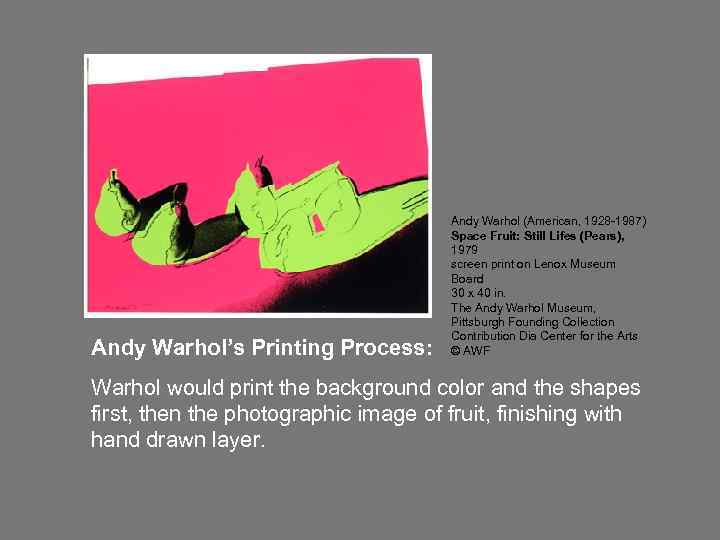 Andy Warhol’s Printing Process: Andy Warhol (American, 1928 -1987) Space Fruit: Still Lifes (Pears), 1979 screen print on Lenox Museum Board 30 x 40 in. The Andy Warhol Museum, Pittsburgh Founding Collection Contribution Dia Center for the Arts © AWF Warhol would print the background color and the shapes first, then the photographic image of fruit, finishing with hand drawn layer.
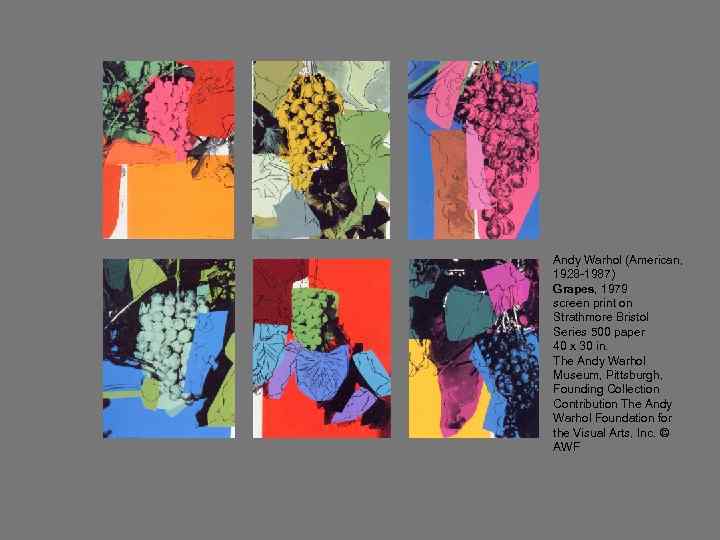 Andy Warhol (American, 1928 -1987) Grapes, 1979 screen print on Strathmore Bristol Series 500 paper 40 x 30 in. The Andy Warhol Museum, Pittsburgh, Founding Collection Contribution The Andy Warhol Foundation for the Visual Arts, Inc. © AWF
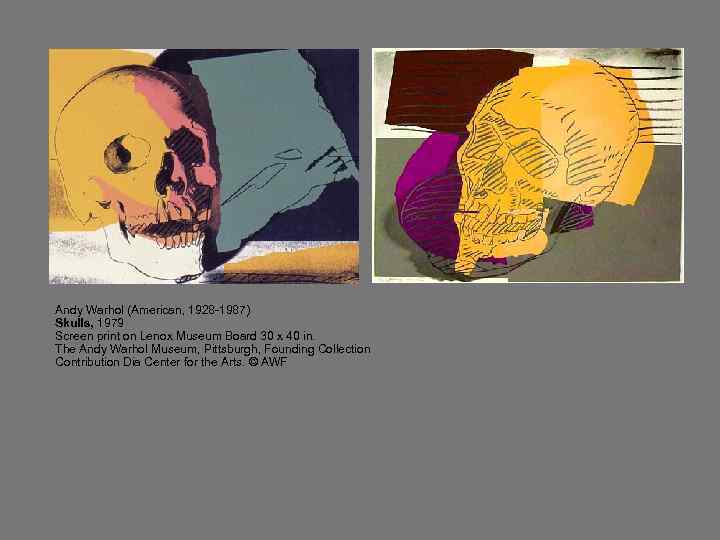 Andy Warhol (American, 1928 -1987) Skulls, 1979 Screen print on Lenox Museum Board 30 x 40 in. The Andy Warhol Museum, Pittsburgh, Founding Collection Contribution Dia Center for the Arts. © AWF
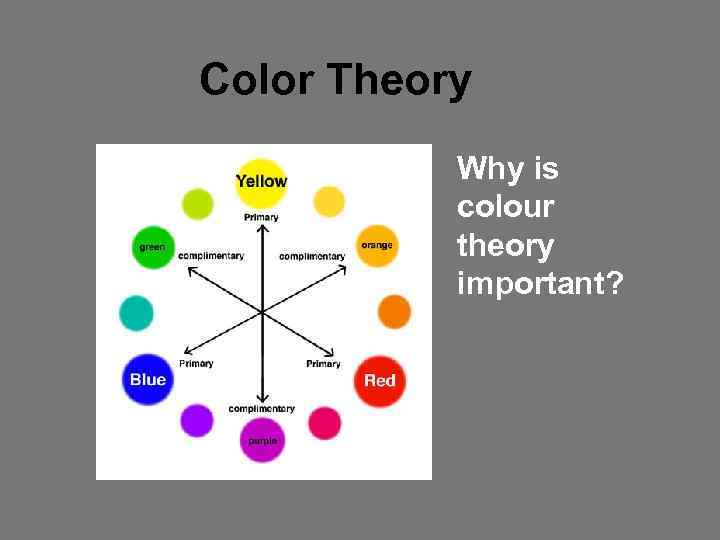 Color Theory Why is colour theory important?
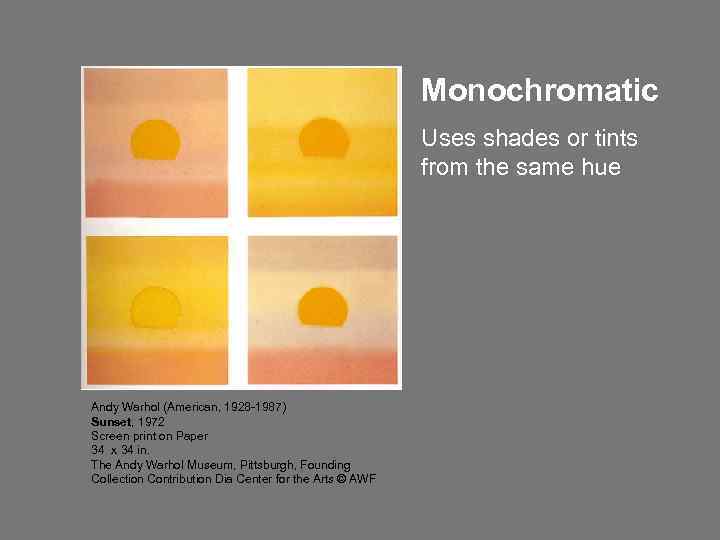 Monochromatic Uses shades or tints from the same hue Andy Warhol (American, 1928 -1987) Sunset, 1972 Screen print on Paper 34 x 34 in. The Andy Warhol Museum, Pittsburgh, Founding Collection Contribution Dia Center for the Arts © AWF
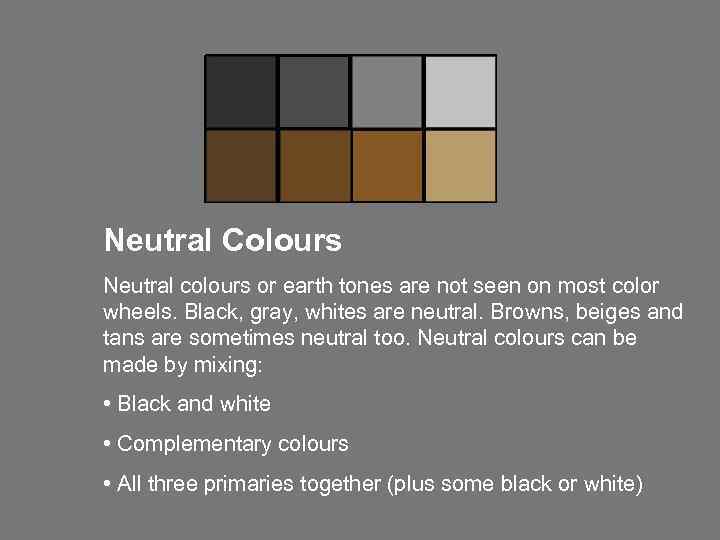 Neutral Colours Neutral colours or earth tones are not seen on most color wheels. Black, gray, whites are neutral. Browns, beiges and tans are sometimes neutral too. Neutral colours can be made by mixing: • Black and white • Complementary colours • All three primaries together (plus some black or white)
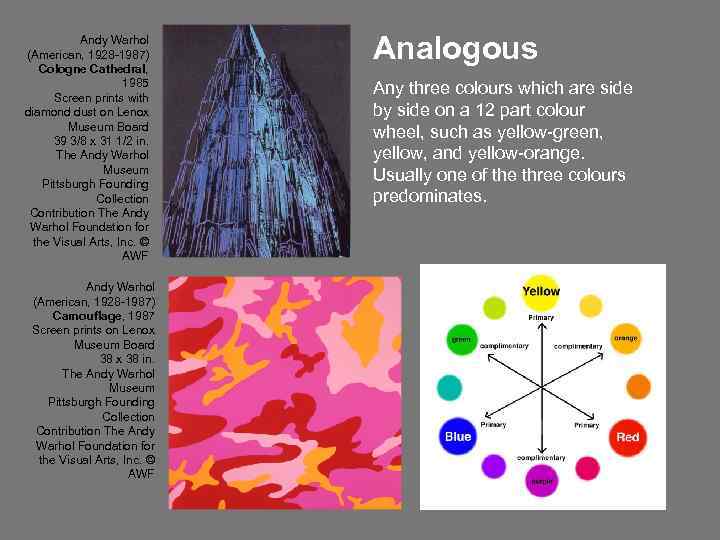 Andy Warhol (American, 1928 -1987) Cologne Cathedral, 1985 Screen prints with diamond dust on Lenox Museum Board 39 3/8 x 31 1/2 in. The Andy Warhol Museum Pittsburgh Founding Collection Contribution The Andy Warhol Foundation for the Visual Arts, Inc. © AWF Andy Warhol (American, 1928 -1987) Camouflage, 1987 Screen prints on Lenox Museum Board 38 x 38 in. The Andy Warhol Museum Pittsburgh Founding Collection Contribution The Andy Warhol Foundation for the Visual Arts, Inc. © AWF Analogous Any three colours which are side by side on a 12 part colour wheel, such as yellow-green, yellow, and yellow-orange. Usually one of the three colours predominates.
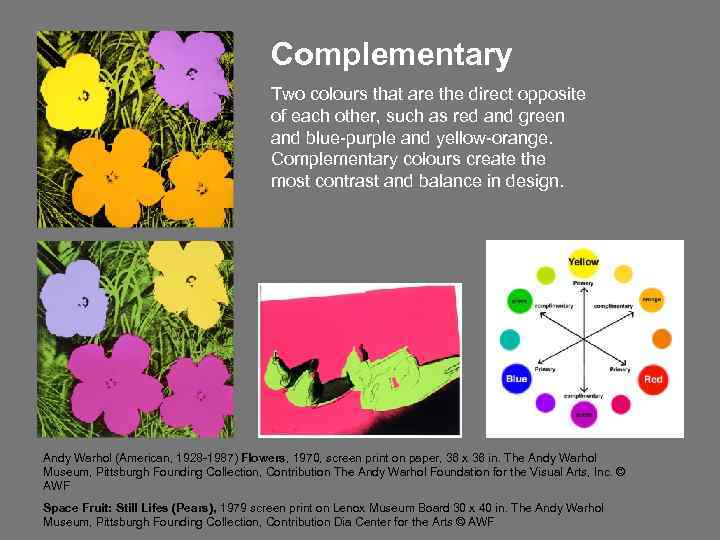 Complementary Two colours that are the direct opposite of each other, such as red and green and blue-purple and yellow-orange. Complementary colours create the most contrast and balance in design. Andy Warhol (American, 1928 -1987) Flowers, 1970, screen print on paper, 36 x 36 in. The Andy Warhol Museum, Pittsburgh Founding Collection, Contribution The Andy Warhol Foundation for the Visual Arts, Inc. © AWF Space Fruit: Still Lifes (Pears), 1979 screen print on Lenox Museum Board 30 x 40 in. The Andy Warhol Museum, Pittsburgh Founding Collection, Contribution Dia Center for the Arts © AWF
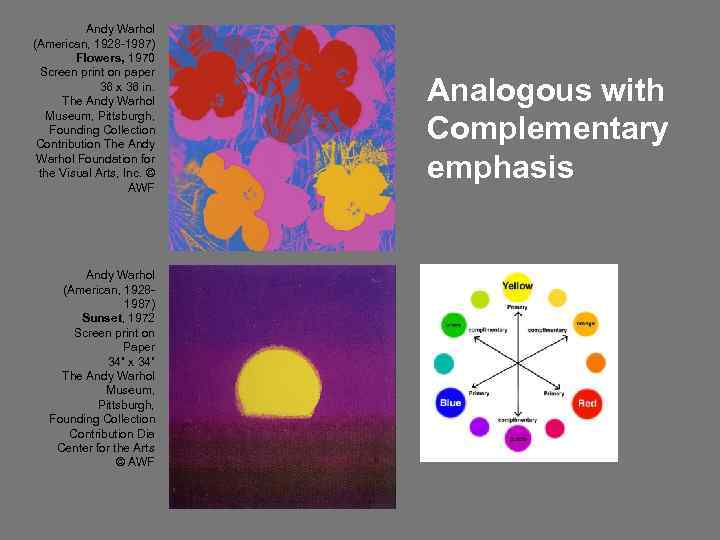 Andy Warhol (American, 1928 -1987) Flowers, 1970 Screen print on paper 36 x 36 in. The Andy Warhol Museum, Pittsburgh, Founding Collection Contribution The Andy Warhol Foundation for the Visual Arts, Inc. © AWF Andy Warhol (American, 19281987) Sunset, 1972 Screen print on Paper 34” x 34” The Andy Warhol Museum, Pittsburgh, Founding Collection Contribution Dia Center for the Arts © AWF Analogous with Complementary emphasis
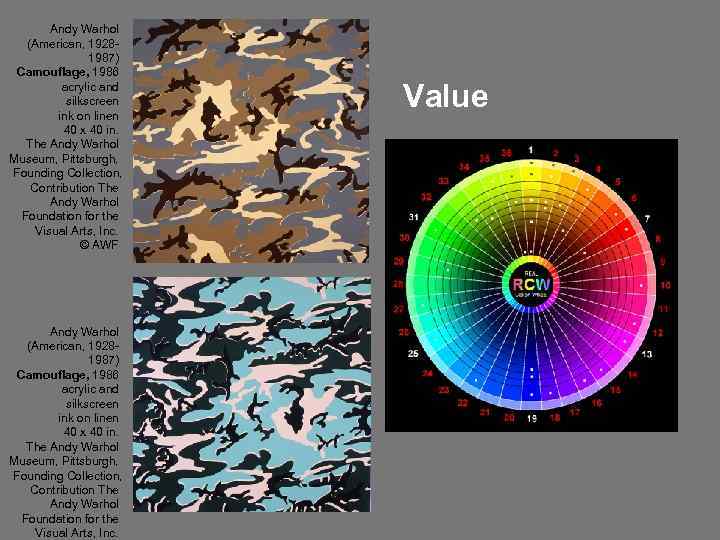 Andy Warhol (American, 19281987) Camouflage, 1986 acrylic and silkscreen ink on linen 40 x 40 in. The Andy Warhol Museum, Pittsburgh, Founding Collection, Contribution The Andy Warhol Foundation for the Visual Arts, Inc. © AWF Andy Warhol (American, 19281987) Camouflage, 1986 acrylic and silkscreen ink on linen 40 x 40 in. The Andy Warhol Museum, Pittsburgh, Founding Collection, Contribution The Andy Warhol Foundation for the Visual Arts, Inc. Value
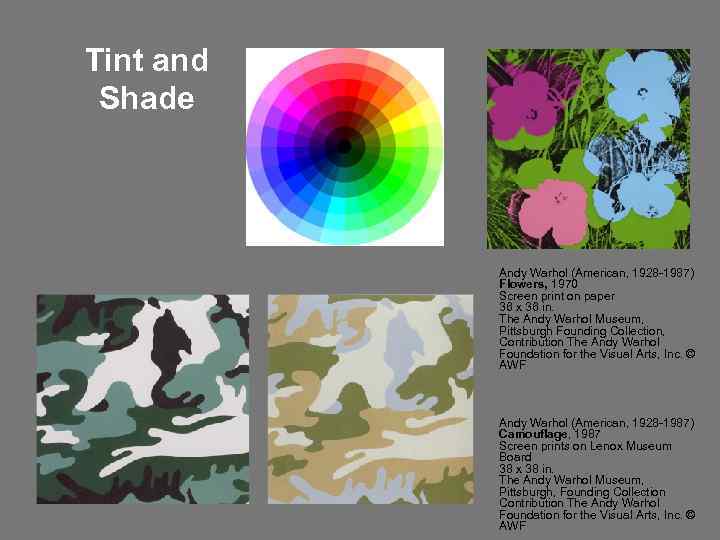 Tint and Shade Andy Warhol (American, 1928 -1987) Flowers, 1970 Screen print on paper 36 x 36 in. The Andy Warhol Museum, Pittsburgh Founding Collection, Contribution The Andy Warhol Foundation for the Visual Arts, Inc. © AWF Andy Warhol (American, 1928 -1987) Camouflage, 1987 Screen prints on Lenox Museum Board 38 x 38 in. The Andy Warhol Museum, Pittsburgh, Founding Collection Contribution The Andy Warhol Foundation for the Visual Arts, Inc. © AWF
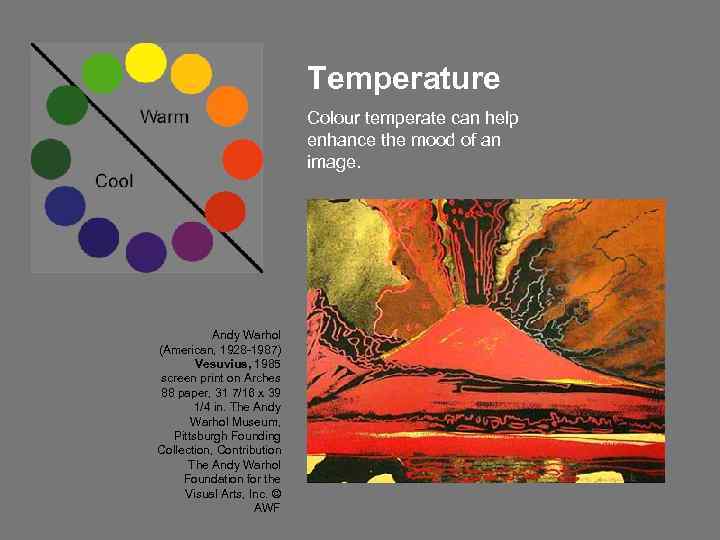 Temperature Colour temperate can help enhance the mood of an image. Andy Warhol (American, 1928 -1987) Vesuvius, 1985 screen print on Arches 88 paper, 31 7/16 x 39 1/4 in. The Andy Warhol Museum, Pittsburgh Founding Collection, Contribution The Andy Warhol Foundation for the Visual Arts, Inc. © AWF
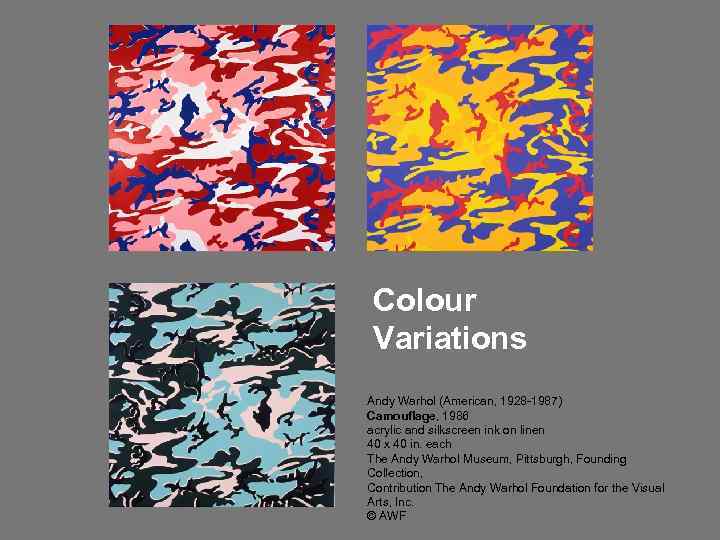 Colour Variations Andy Warhol (American, 1928 -1987) Camouflage, 1986 acrylic and silkscreen ink on linen 40 x 40 in. each The Andy Warhol Museum, Pittsburgh, Founding Collection, Contribution The Andy Warhol Foundation for the Visual Arts, Inc. © AWF
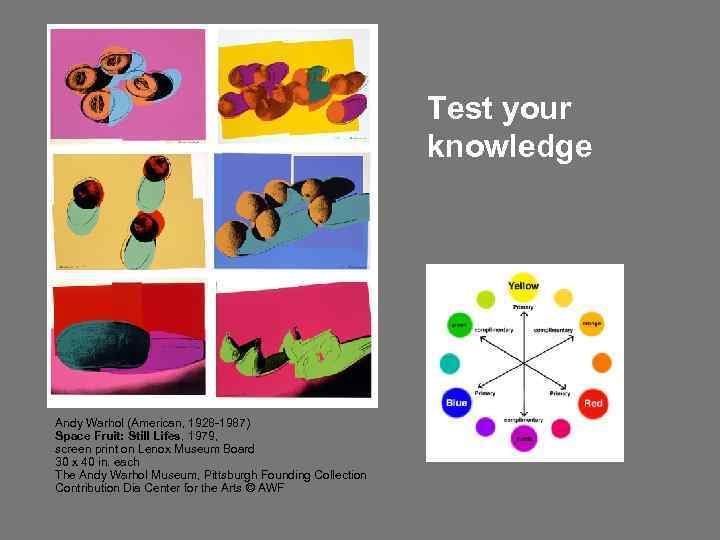 Test your knowledge Andy Warhol (American, 1928 -1987) Space Fruit: Still Lifes, 1979, screen print on Lenox Museum Board 30 x 40 in. each The Andy Warhol Museum, Pittsburgh Founding Collection Contribution Dia Center for the Arts © AWF