


 Скачать презентацию Andrew White Software Developer 18 March 2010
0bcae3ae334e89ee253deaaaee9cfcbe.ppt
- Количество слайдов: 20
 Andrew White – Software Developer 18 March 2010 Integrating WSRR and Data. Power © 2009 IBM Corporation
 Agenda § Introduction § What is WSRR? § WSRR Overview § Integration WSRR and Data. Power 2 © 2009 IBM Corporation
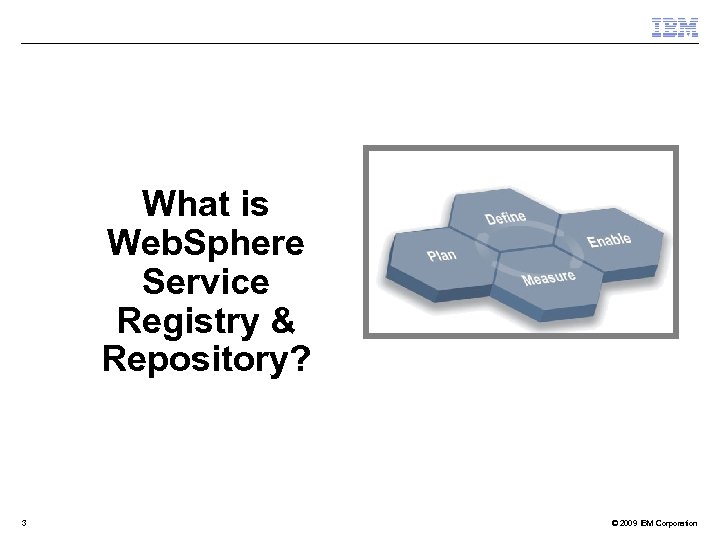 What is Web. Sphere Service Registry & Repository? 3 © 2009 IBM Corporation
 WSRR is… § A Registry – it is designed to represent and govern SOA services § A Repository – conceptually like a database – that stores artifacts that can be queried at both design time and runtime § A J 2 EE Application that runs on Web. Sphere Application Server – Requires a relational backing store. DB/2, Oracle and MS SQL Server are supported – Leverages all security and clustering/HA capabilities of the WAS platform 4 © 2009 IBM Corporation
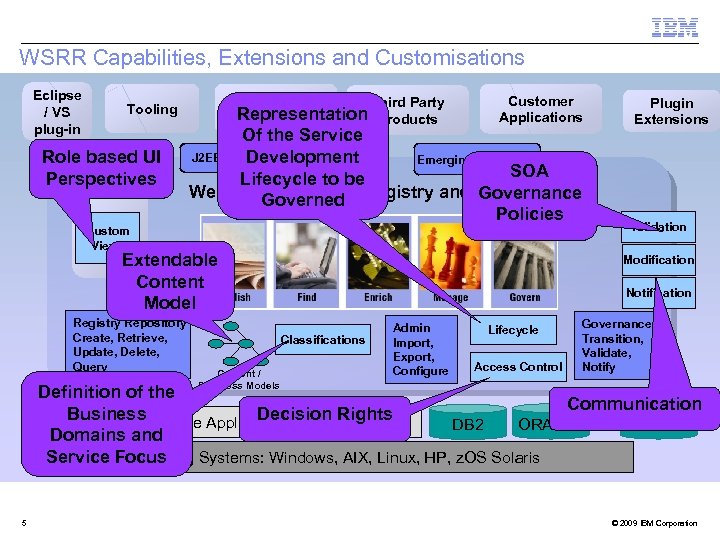 WSRR Capabilities, Extensions and Customisations Eclipse / VS plug-in Tooling REST Role based UI Perspectives Web UI IBM Third Party Customer Representation Products Applications Of the Service Web Service API J 2 EE API Development Emerging Standards SOA Lifecycle to be Web. Sphere Service Registry and Repository Governance Governed Policies Custom Views Extendable Content Model Registry Repository Create, Retrieve, Update, Delete, Query Validation Modification Notification Classifications Content / Business Models Plugin Extensions Admin Import, Export, Configure Lifecycle Access Control Governance Transition, Validate, Notify Definition of the Communication Business Decision Rights Web. Sphere Application Server ORACLE UDDI DB 2 Domains and Service Focus Operating Systems: Windows, AIX, Linux, HP, z. OS Solaris 5 © 2009 IBM Corporation
 WSRR and Web. Sphere Data. Power 6 © 2009 IBM Corporation
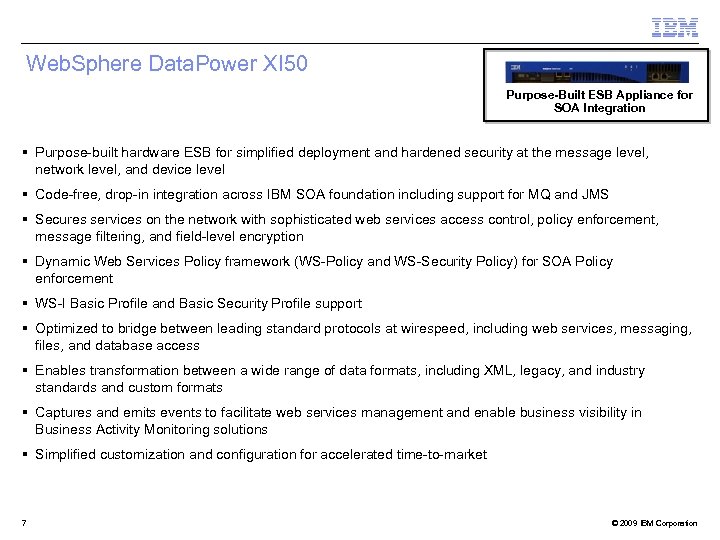 Web. Sphere Data. Power XI 50 Purpose-Built ESB Appliance for SOA Integration § Purpose-built hardware ESB for simplified deployment and hardened security at the message level, network level, and device level § Code-free, drop-in integration across IBM SOA foundation including support for MQ and JMS § Secures services on the network with sophisticated web services access control, policy enforcement, message filtering, and field-level encryption § Dynamic Web Services Policy framework (WS-Policy and WS-Security Policy) for SOA Policy enforcement § WS-I Basic Profile and Basic Security Profile support § Optimized to bridge between leading standard protocols at wirespeed, including web services, messaging, files, and database access § Enables transformation between a wide range of data formats, including XML, legacy, and industry standards and custom formats § Captures and emits events to facilitate web services management and enable business visibility in Business Activity Monitoring solutions § Simplified customization and configuration for accelerated time-to-market 7 © 2009 IBM Corporation
 Why an Appliance for SOA Governance? § Hardened, specialized hardware for helping to integrate, secure & accelerate SOA § Many functions integrated into a single device: – Impact: connectivity will require service level management, routing, policy, transformation § Higher levels of security assurance certifications require hardware: – Example: government FIPS Level 3 HSM, Common Criteria § Higher performance with hardware acceleration: – Impact: ability to perform more security checks without slow downs § Addresses the divergent needs of different groups: – Example: enterprise architects, network operations, security operations, identity management, web services developers § Simplified deployment and ongoing management: – Impact: reduces need for in-house SOA skills & accelerates time to SOA benefits 8 © 2009 IBM Corporation
 Data. Power XI 50 Support for WSRR § Service Discovery – Data. Power WS-Proxy subscribes to service definitions stored in WSRR – Dynamically enforces policies and mediations for these services § Dynamic Endpoint Selection and Routing – Query WSRR for endpoint location(s) and dynamically route service requests § Service Metadata Lookup – Lookup service metadata such as XSLT, XML and XSD for use in service mediation 9 © 2009 IBM Corporation
 Service Discovery Example § Web. Sphere Data. Power XI 50 – WS-Proxy – configuration object for proxying and/or mediating web services – WSRR Server – configuration object for WSRR server information – WSRR Subscription Object – configuration object for subscribing to WSRR – Status Providers – view the current state of the WSRR configuration objects § WSRR – WSDL Documents – Concept – in the Data. Power case, used to logically group service definitions for which Data. Power will provide mediation and policy enforcement 10 © 2009 IBM Corporation
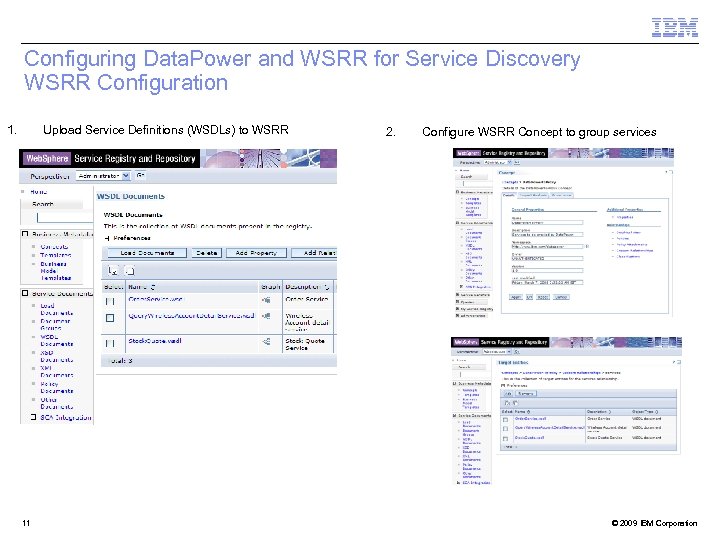 Configuring Data. Power and WSRR for Service Discovery WSRR Configuration 1. Upload Service Definitions (WSDLs) to WSRR 11 2. Configure WSRR Concept to group services © 2009 IBM Corporation
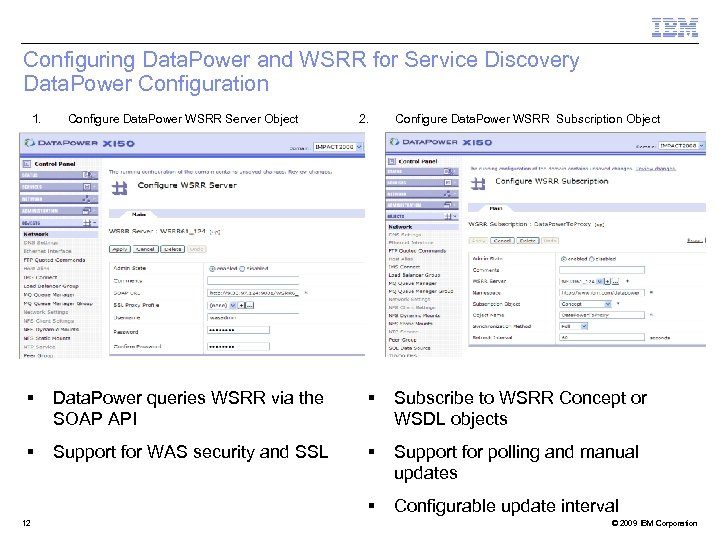 Configuring Data. Power and WSRR for Service Discovery Data. Power Configuration 1. Configure Data. Power WSRR Server Object 2. Configure Data. Power WSRR Subscription Object § Data. Power queries WSRR via the SOAP API § Subscribe to WSRR Concept or WSDL objects § Support for WAS security and SSL § Support for polling and manual updates § Configurable update interval 12 © 2009 IBM Corporation
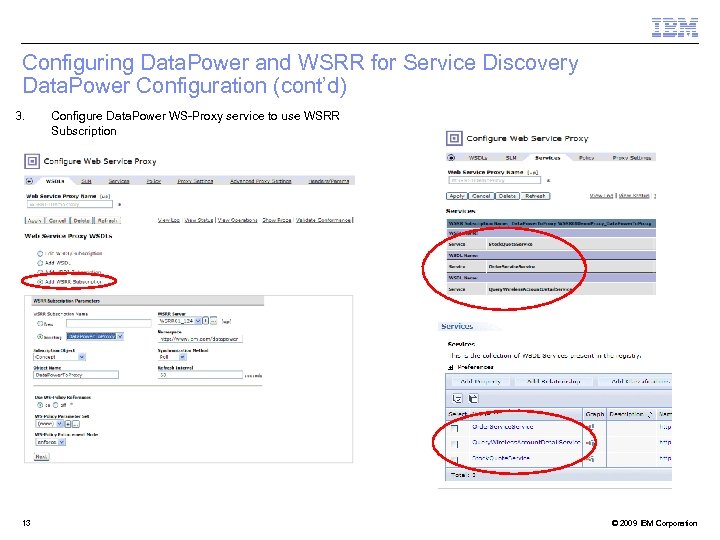 Configuring Data. Power and WSRR for Service Discovery Data. Power Configuration (cont’d) 3. 13 Configure Data. Power WS-Proxy service to use WSRR Subscription © 2009 IBM Corporation
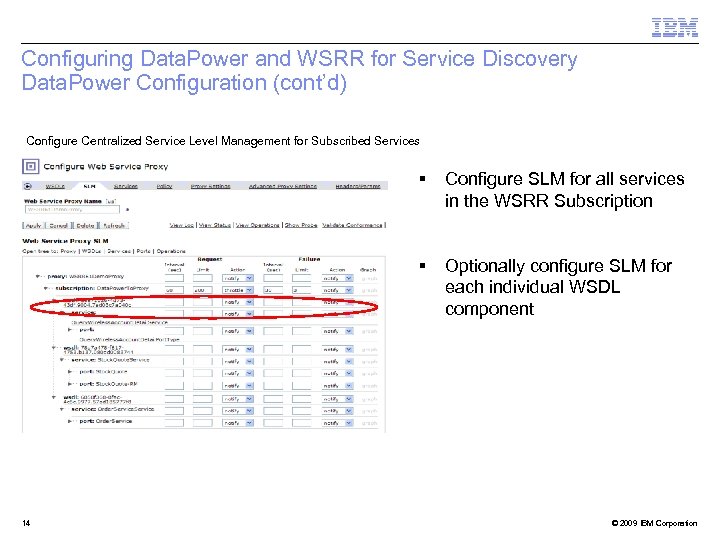 . Configuring Data. Power and WSRR for Service Discovery Data. Power Configuration (cont’d) Configure Centralized Service Level Management for Subscribed Services § § 14 Configure SLM for all services in the WSRR Subscription Optionally configure SLM for each individual WSDL component © 2009 IBM Corporation
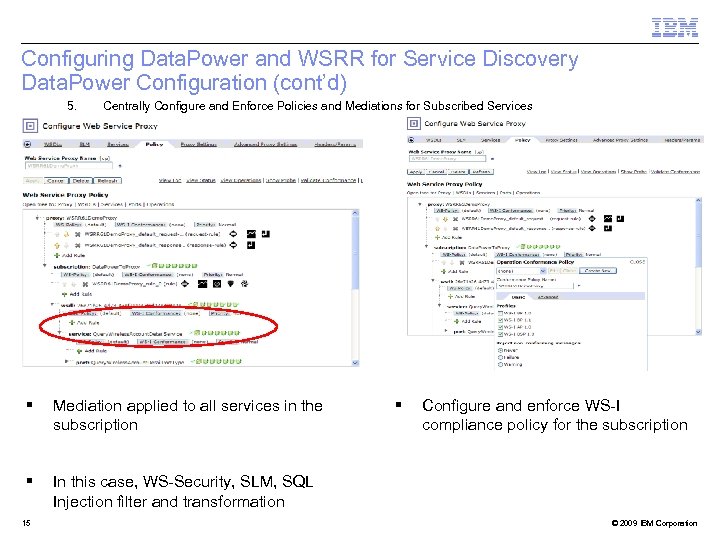 Configuring Data. Power and WSRR for Service Discovery Data. Power Configuration (cont’d) 5. Centrally Configure and Enforce Policies and Mediations for Subscribed Services § Mediation applied to all services in the subscription § In this case, WS-Security, SLM, SQL Injection filter and transformation 15 § Configure and enforce WS-I compliance policy for the subscription © 2009 IBM Corporation
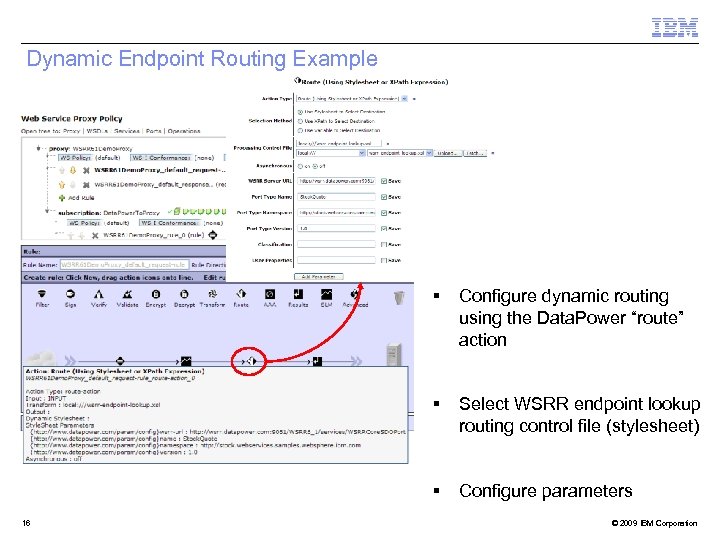 Dynamic Endpoint Routing Example § § Select WSRR endpoint lookup routing control file (stylesheet) § 16 Configure dynamic routing using the Data. Power “route” action Configure parameters © 2009 IBM Corporation
 Comments or Questions? 17 © 2009 IBM Corporation
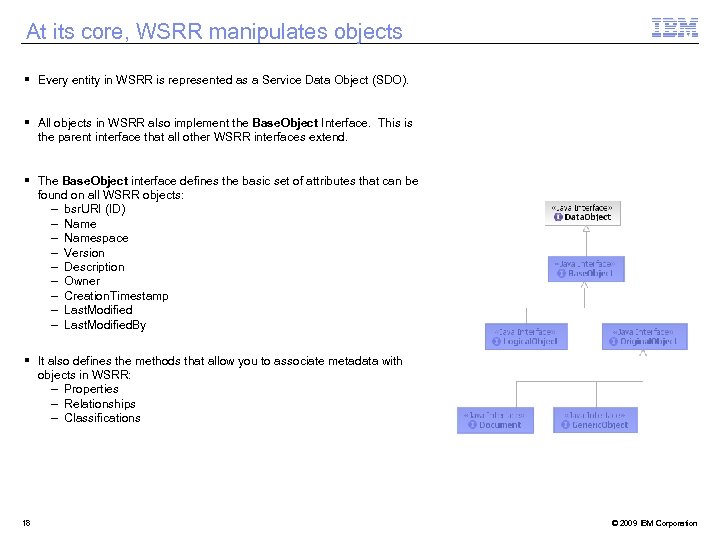 At its core, WSRR manipulates objects § Every entity in WSRR is represented as a Service Data Object (SDO). § All objects in WSRR also implement the Base. Object Interface. This is the parent interface that all other WSRR interfaces extend. § The Base. Object interface defines the basic set of attributes that can be found on all WSRR objects: – bsr. URI (ID) – Namespace – Version – Description – Owner – Creation. Timestamp – Last. Modified. By § It also defines the methods that allow you to associate metadata with objects in WSRR: – Properties – Relationships – Classifications 18 © 2009 IBM Corporation
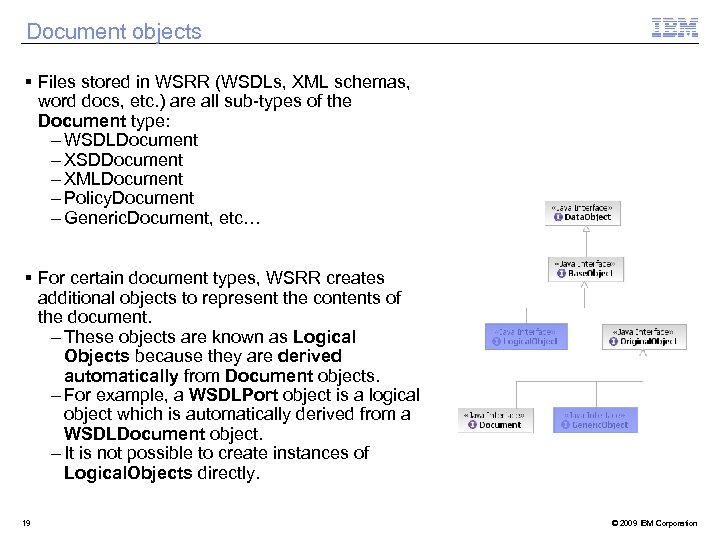 Document objects § Files stored in WSRR (WSDLs, XML schemas, word docs, etc. ) are all sub-types of the Document type: – WSDLDocument – XSDDocument – XMLDocument – Policy. Document – Generic. Document, etc… § For certain document types, WSRR creates additional objects to represent the contents of the document. – These objects are known as Logical Objects because they are derived automatically from Document objects. – For example, a WSDLPort object is a logical object which is automatically derived from a WSDLDocument object. – It is not possible to create instances of Logical. Objects directly. 19 © 2009 IBM Corporation
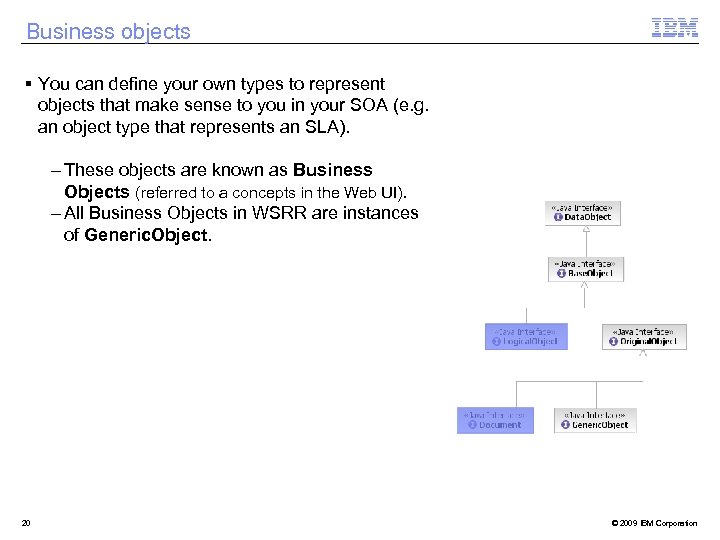 Business objects § You can define your own types to represent objects that make sense to you in your SOA (e. g. an object type that represents an SLA). – These objects are known as Business Objects (referred to a concepts in the Web UI). – All Business Objects in WSRR are instances of Generic. Object. 20 © 2009 IBM Corporation