


 Скачать презентацию Andrew Vine M 0 GJH Amateur radio
26e57091325013df026d374225c77295.ppt
- Количество слайдов: 55
 Andrew Vine, M 0 GJH
 Amateur radio Nature of amateur radio Recall that the amateur licence is for self-training in radio communications and is of a noncommercial nature.
 Licensing Conditions Types of Amateur Licence Foundation Intermediate Advanced
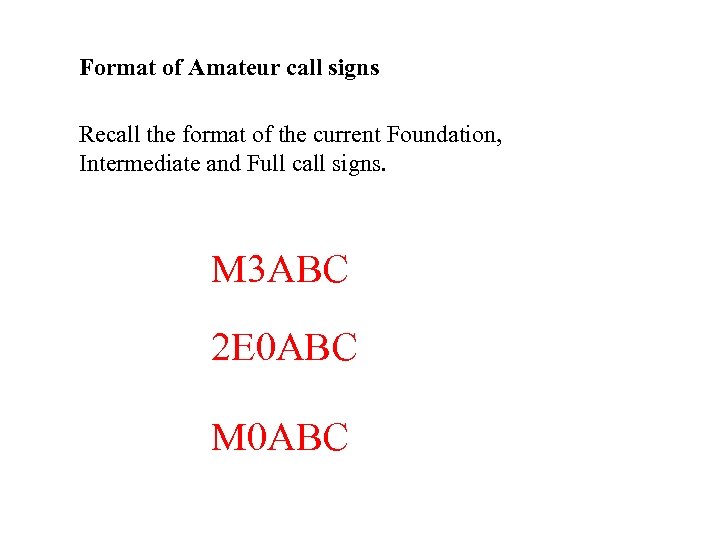 Format of Amateur call signs Recall the format of the current Foundation, Intermediate and Full call signs. M 3 ABC 2 E 0 ABC M 0 ABC
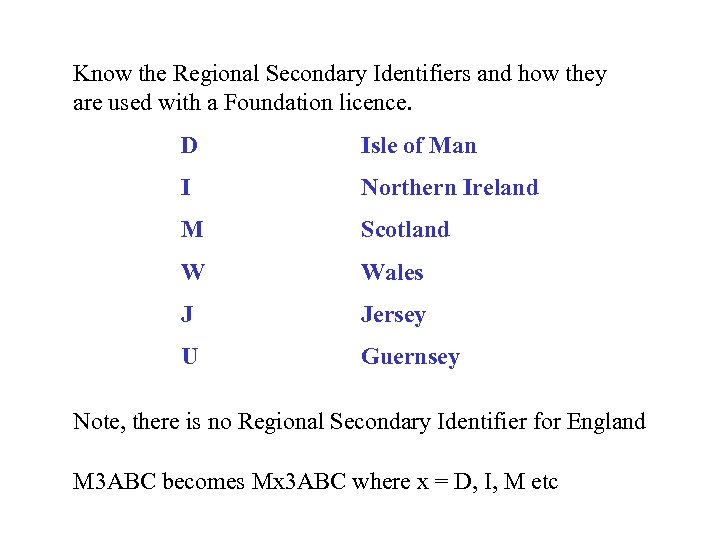 Know the Regional Secondary Identifiers and how they are used with a Foundation licence. D Isle of Man I Northern Ireland M Scotland W Wales J Jersey U Guernsey Note, there is no Regional Secondary Identifier for England M 3 ABC becomes Mx 3 ABC where x = D, I, M etc
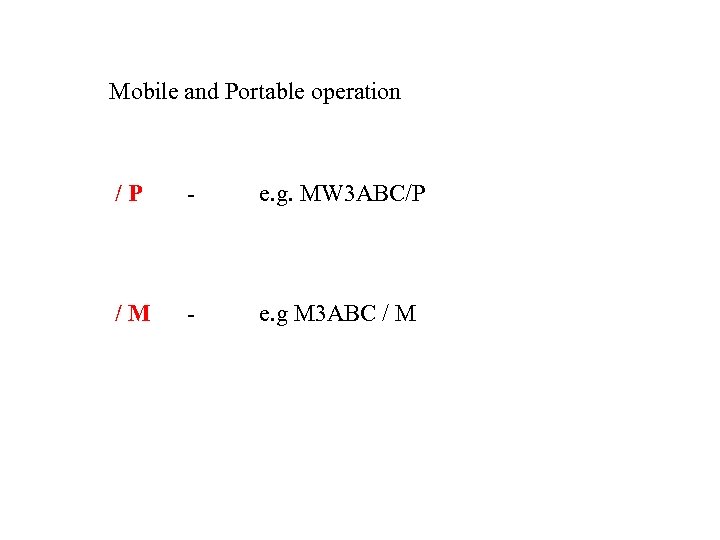 Mobile and Portable operation /P - e. g. MW 3 ABC/P /M - e. g M 3 ABC / M
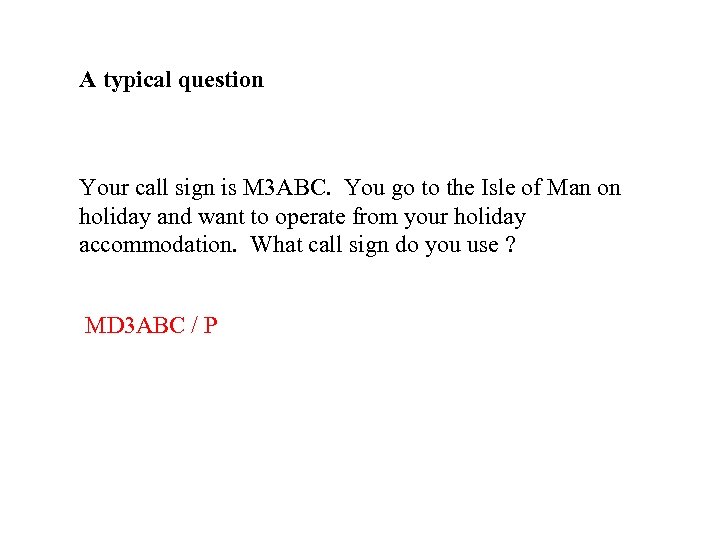 A typical question Your call sign is M 3 ABC. You go to the Isle of Man on holiday and want to operate from your holiday accommodation. What call sign do you use ? MD 3 ABC / P
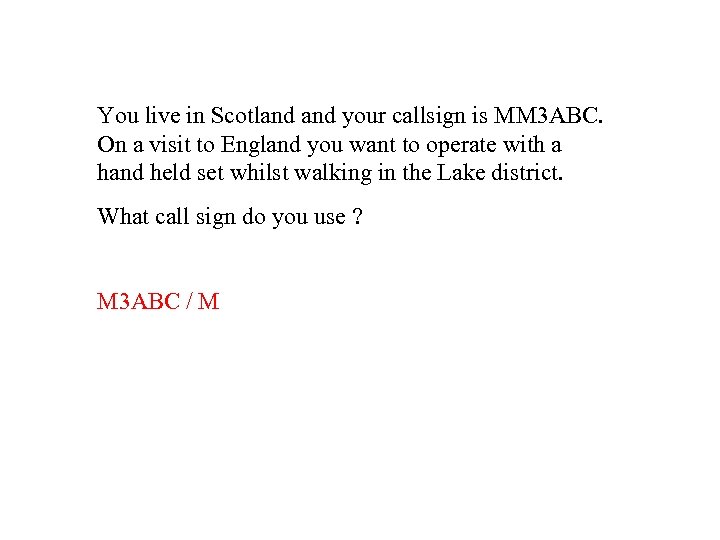 You live in Scotland your callsign is MM 3 ABC. On a visit to England you want to operate with a hand held set whilst walking in the Lake district. What call sign do you use ? M 3 ABC / M
 The CQ Call CQ CQ CQ This is M 3 ABC, M 3 ABC calling CQ CQ CQ This is M 3 ABC calling CQ and standing by
 Recall the requirements for station identification. During initial CQ Calls At beginning and end of each period of communication After 15 minutes Transmission on a new frequency By same type of transmission and on same frequency
 Some do’s and don’ts Only send messages to other amateurs. No secret codes No broadcasting No transmission of music
 Some do’s and don’ts Only the licensee personally may use the station. Must notify Ofcom of change of address. Ofcom is the independent regulator and competition authority for the UK communications industries, with responsibilities across television, radio, telecommunications and wireless communications services Ofcom local office officials have the right to close down or restrict operation.
 The Log Book Date Time (UTC) of : first transmission last transmission Changes to frequency, band, class or power Frequency or Band Mode Power
 The Log Book Initial CQ Calls Call signs of stations worked Location when at a temporary location
 Need to be able to interpret : - The Schedule to the Licence Band Plans Frequency Allocation Table
 Technical Basics Identify the units of, and abbreviations for, Voltage (Potential Difference), Current, Power and Resistance. Volts, Amps, Watts & Ohms Note: Prefixes milli, kilo and Mega may be used.
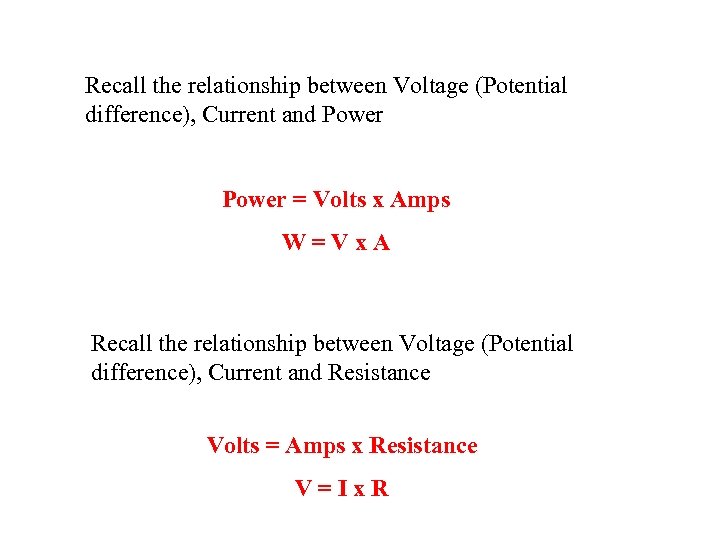 Recall the relationship between Voltage (Potential difference), Current and Power = Volts x Amps W=Vx. A Recall the relationship between Voltage (Potential difference), Current and Resistance Volts = Amps x Resistance V=Ix. R
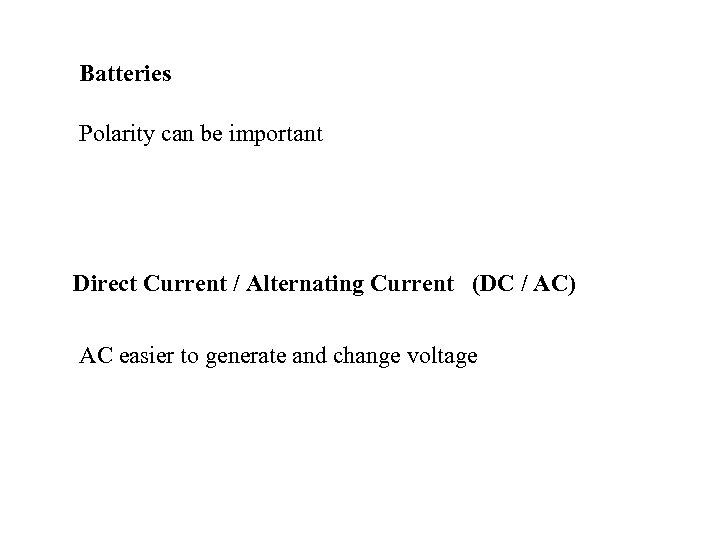 Batteries Polarity can be important Direct Current / Alternating Current (DC / AC) AC easier to generate and change voltage
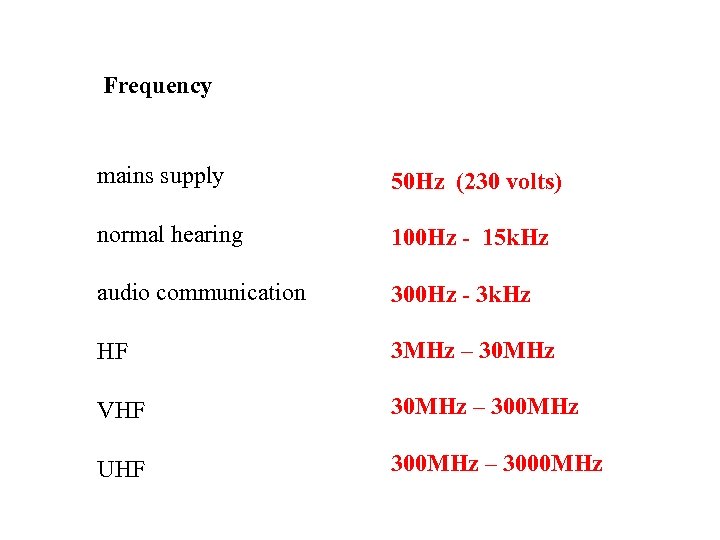 Frequency mains supply 50 Hz (230 volts) normal hearing 100 Hz - 15 k. Hz audio communication 300 Hz - 3 k. Hz HF 3 MHz – 30 MHz VHF 30 MHz – 300 MHz UHF 300 MHz – 3000 MHz
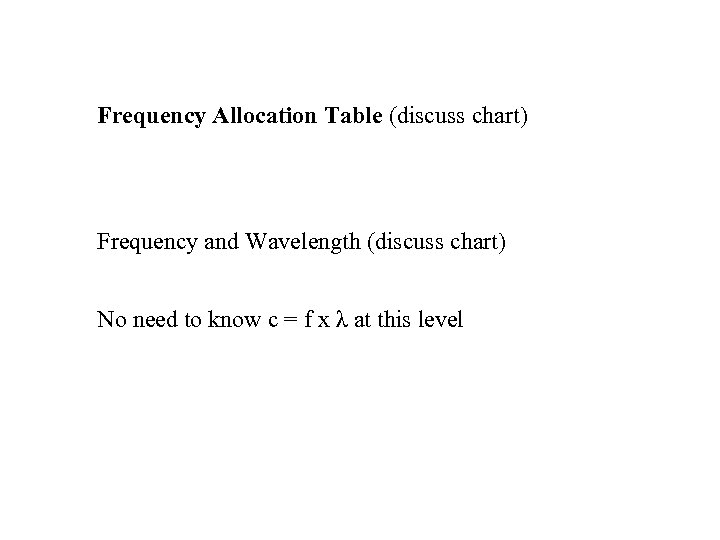 Frequency Allocation Table (discuss chart) Frequency and Wavelength (discuss chart) No need to know c = f x λ at this level
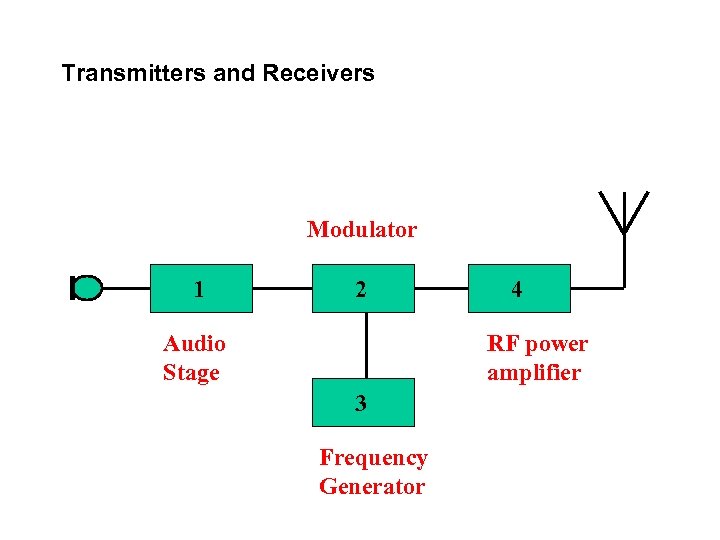 Transmitters and Receivers Modulator 1 2 Audio Stage 4 RF power amplifier 3 Frequency Generator
 Need to remember frequency generation stage(s) (e. g. oscillator(s)) in a transmitter defines the frequency on which the transmitter operates. incorrect setting of these stages can result in operation outside the amateur band interference to other users
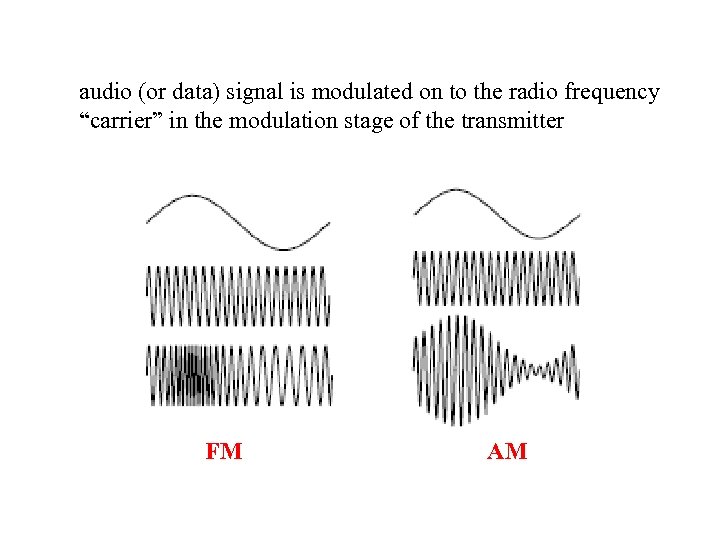 audio (or data) signal is modulated on to the radio frequency “carrier” in the modulation stage of the transmitter FM AM
 Common modulation modes : Voice AM Carrier and two side bands SSB Single side band FM Frequency Modulation Morse code Carrier Data Frequency Shift Keying (FSK) on SSB or FM
 Transmitter considerations the r. f. power amplifier output must be connected to a correctly matched antenna to work properly and that use of the wrong antenna can result in damage to the transmitter excessive amplitude modulation causes distorted output and interference to adjacent channels excessive frequency deviation will cause interference to adjacent channels need to ensure that the microphone gain (where fitted) is correctly adjusted
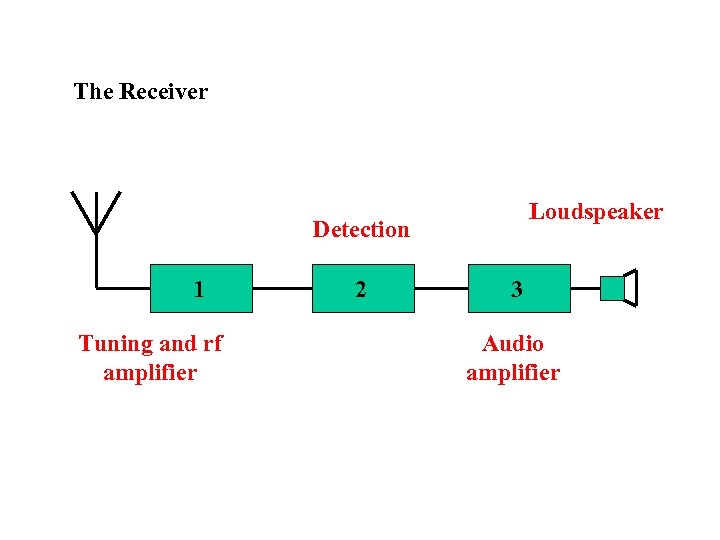 The Receiver Loudspeaker Detection 1 Tuning and rf amplifier 2 3 Audio amplifier
 Feeder requirements Need to use the correct cable for r. f. signals. Coaxial cable is most widely used because of its screening properties plugs and sockets for r. f. should be of the correct type and that the braid of coaxial cable must be correctly connected to minimise r. f. signals getting into or out of the cable.
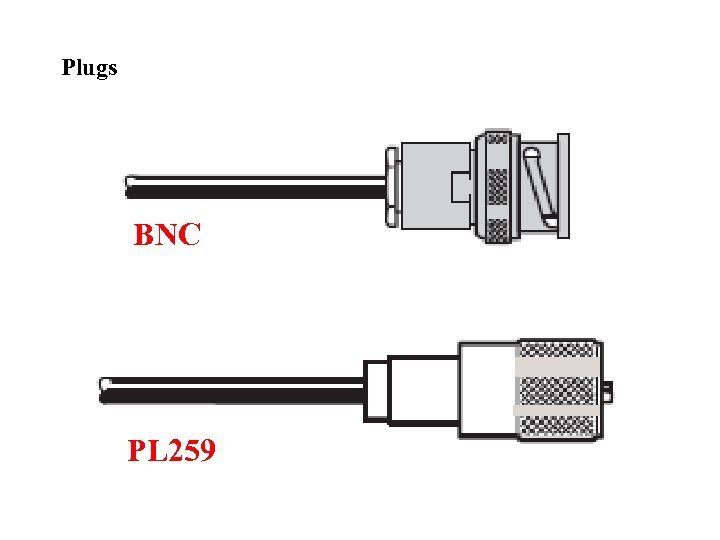 Plugs BNC PL 259
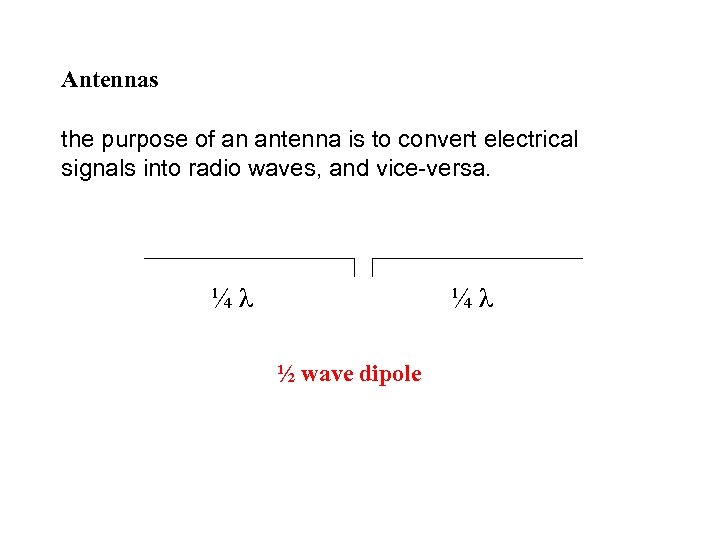 Antennas the purpose of an antenna is to convert electrical signals into radio waves, and vice-versa. ¼ λ ½ wave dipole
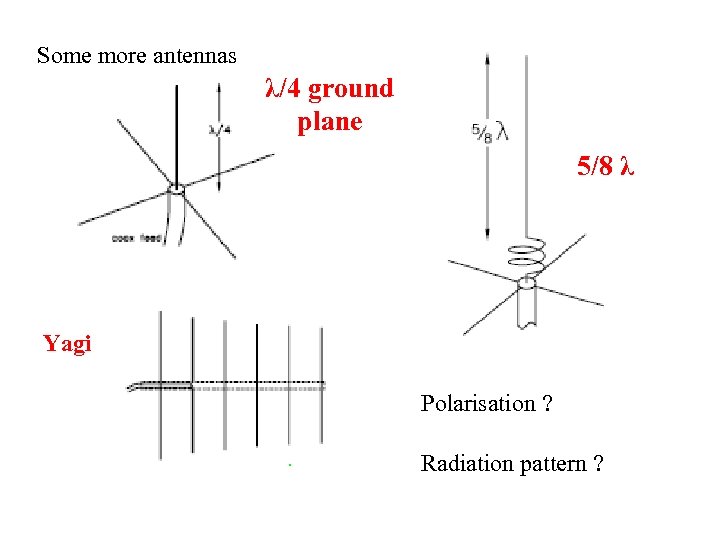 Some more antennas λ/4 ground plane 5/8 λ Yagi Polarisation ? Radiation pattern ?
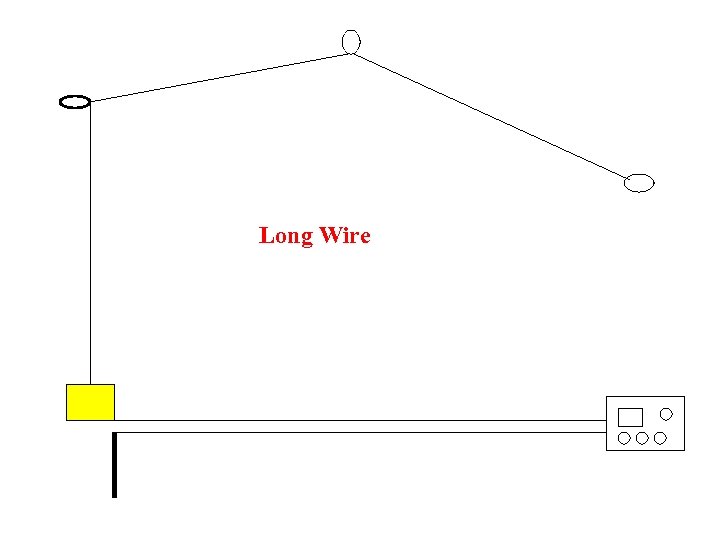 Long Wire
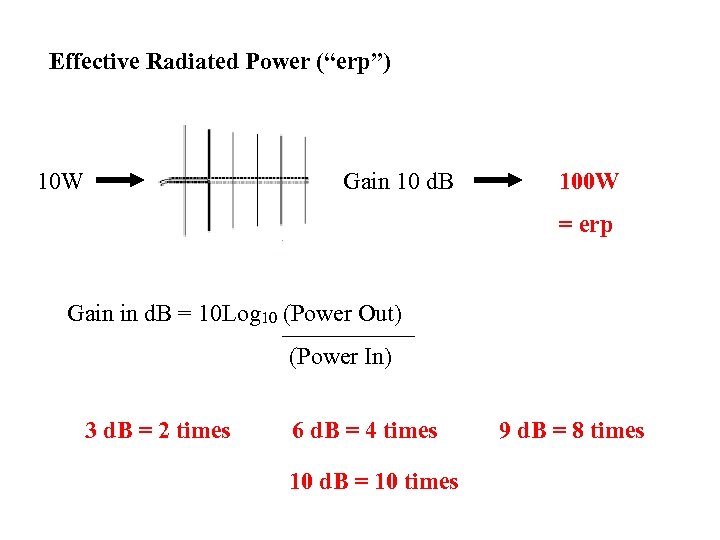 Effective Radiated Power (“erp”) 10 W Gain 10 d. B 100 W = erp Gain in d. B = 10 Log 10 (Power Out) (Power In) 3 d. B = 2 times 6 d. B = 4 times 10 d. B = 10 times 9 d. B = 8 times
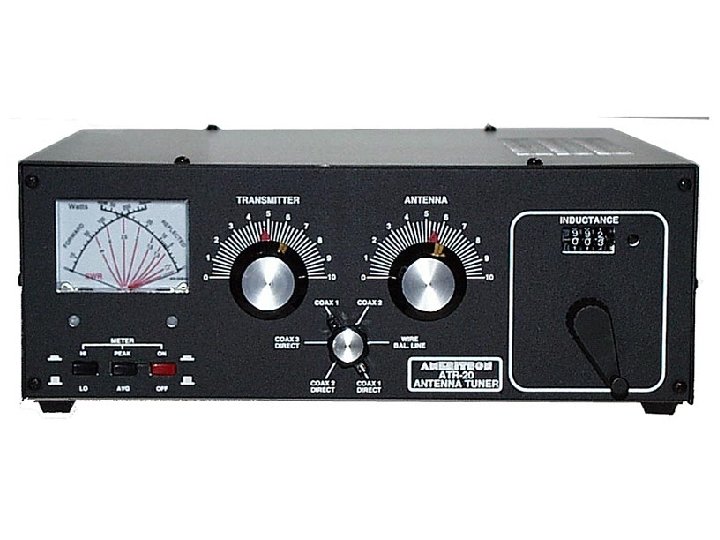
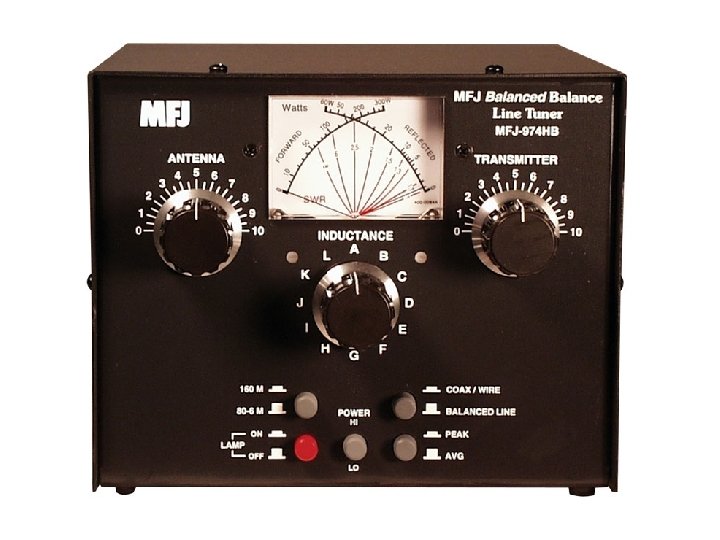
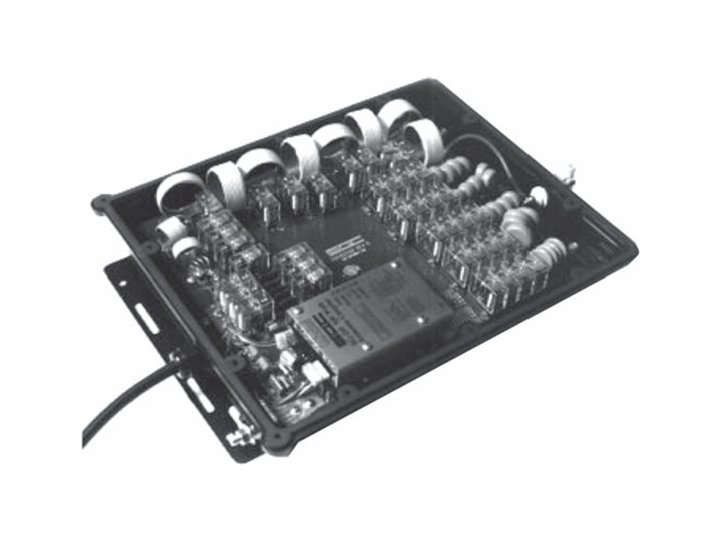
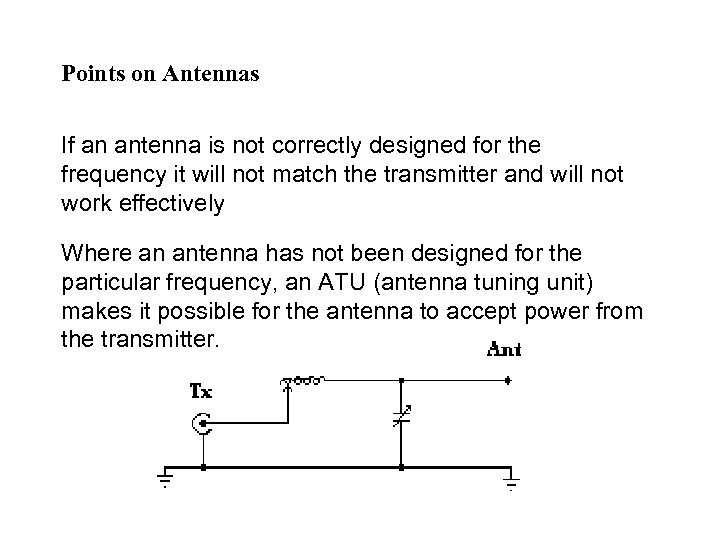 Points on Antennas If an antenna is not correctly designed for the frequency it will not match the transmitter and will not work effectively Where an antenna has not been designed for the particular frequency, an ATU (antenna tuning unit) makes it possible for the antenna to accept power from the transmitter.
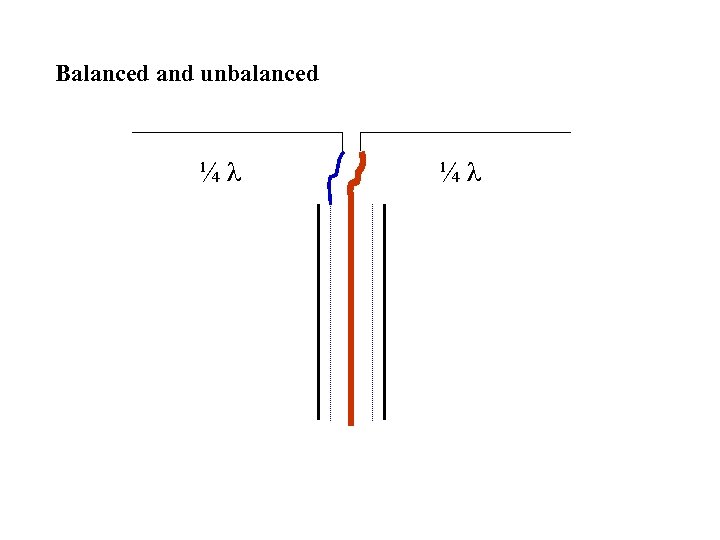 Balanced and unbalanced ¼ λ
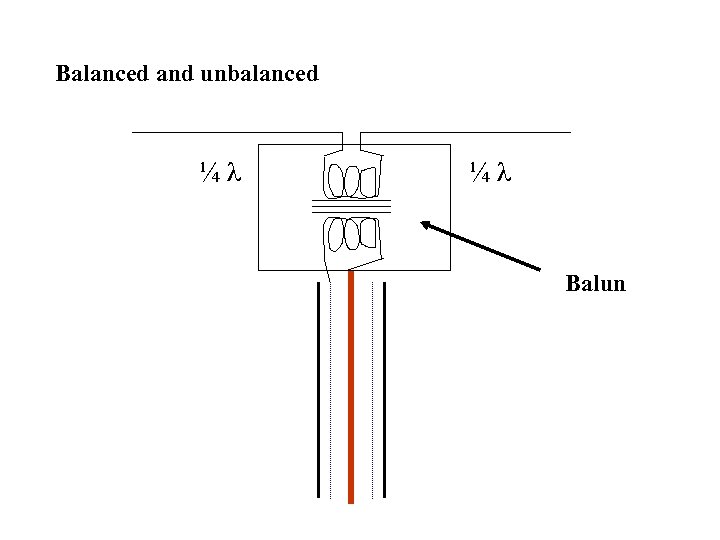 Balanced and unbalanced ¼ λ Balun
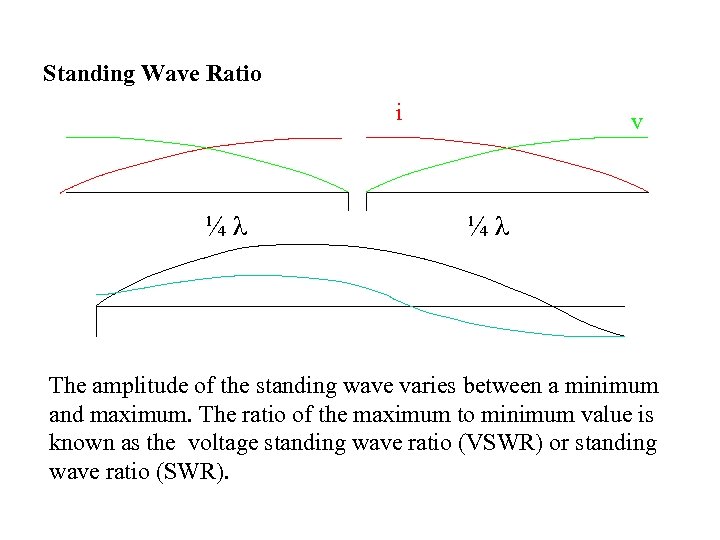 Standing Wave Ratio i ¼ λ v ¼ λ The amplitude of the standing wave varies between a minimum and maximum. The ratio of the maximum to minimum value is known as the voltage standing wave ratio (VSWR) or standing wave ratio (SWR).
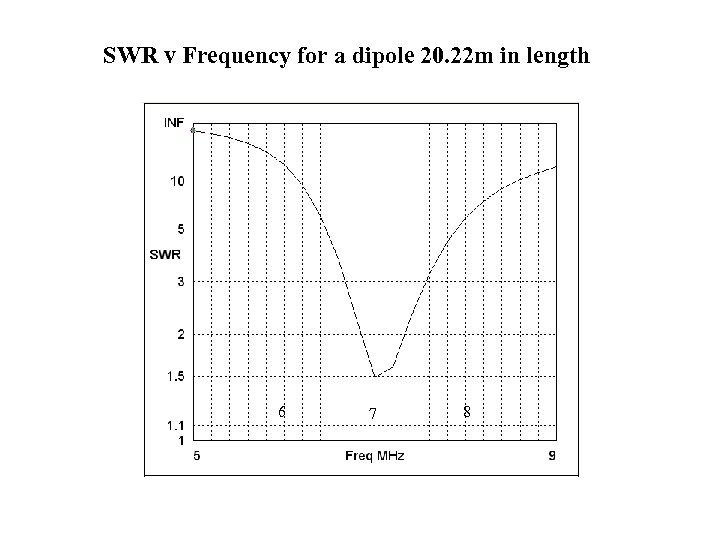 SWR v Frequency for a dipole 20. 22 m in length 6 7 8
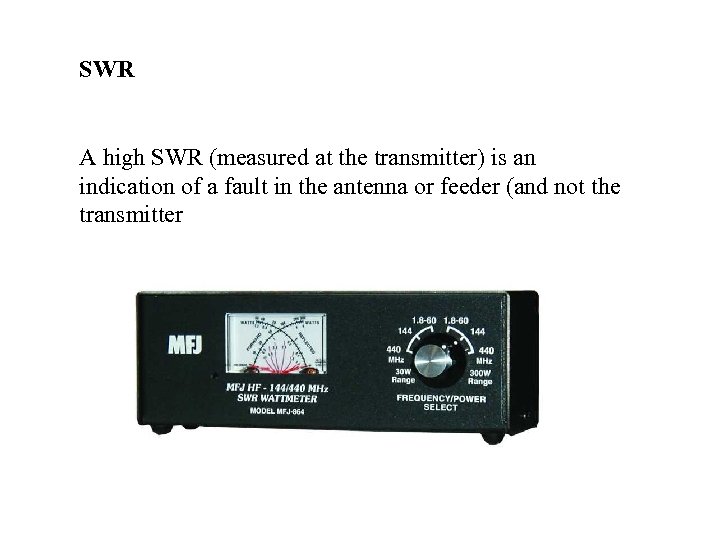 SWR A high SWR (measured at the transmitter) is an indication of a fault in the antenna or feeder (and not the transmitter
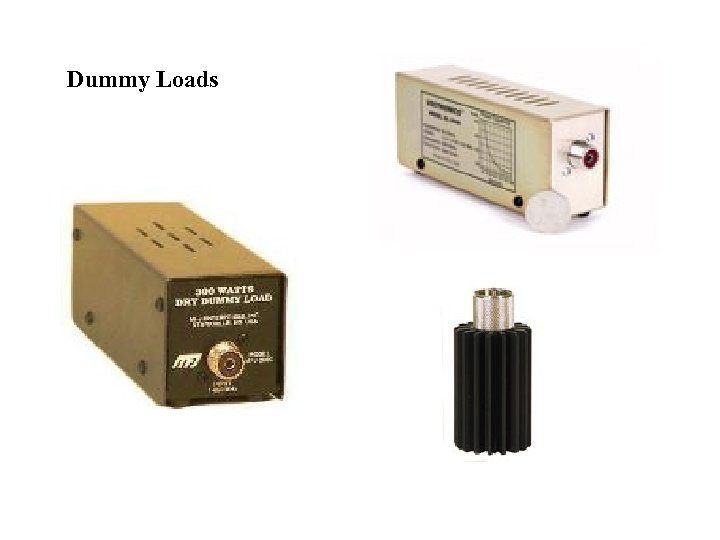 Dummy Loads
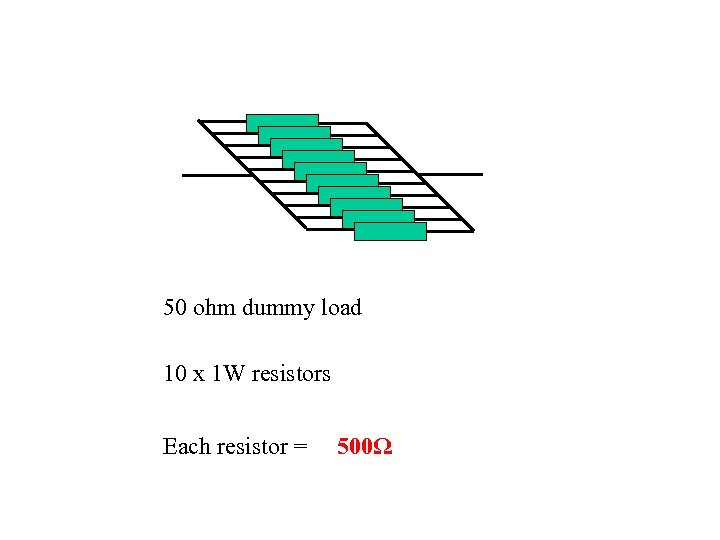 50 ohm dummy load 10 x 1 W resistors Each resistor = 500Ω
 Radio propagation basics radio waves travel in straight lines, unless diffracted or reflected. radio waves get weaker as they spread out (inverse square law) v. h. f. and u. h. f. hills cause “shadows” and waves get weaker when penetrating buildings but glass windows are more transparent to radio waves
 Radio propagation basics range achieved at v. h. f. /u. h. f. is dependent on antenna height, a clear path and transmitter power. Higher antennas are preferable to higher power, as they improve both transmit and receive performance. Outdoor antennas will perform better than indoor antennas. at v. h. f. /u. h. f. , range decreases as frequency increases and that in general, v. h. f. /u. h. f. waves have a range not much beyond “line of sight
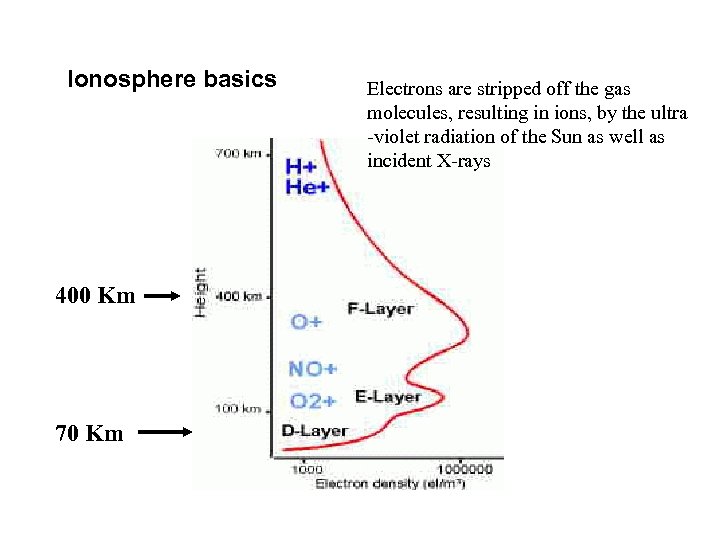 Ionosphere basics 400 Km 70 Km Electrons are stripped off the gas molecules, resulting in ions, by the ultra -violet radiation of the Sun as well as incident X-rays
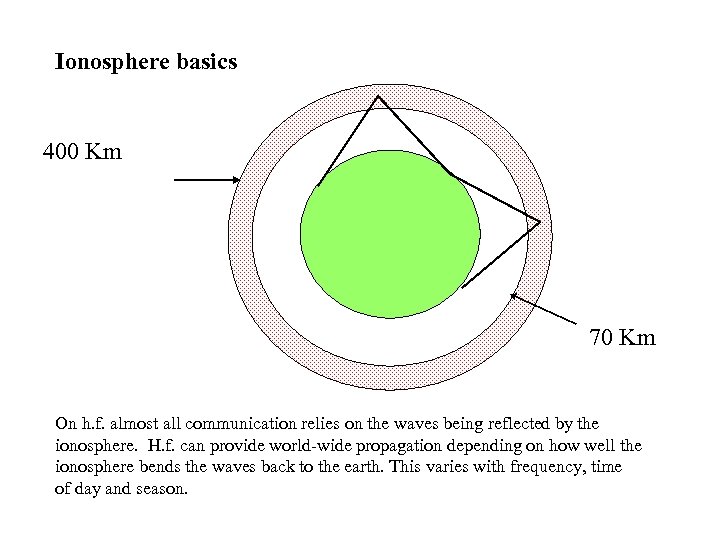 Ionosphere basics 400 Km 70 Km On h. f. almost all communication relies on the waves being reflected by the ionosphere. H. f. can provide world-wide propagation depending on how well the ionosphere bends the waves back to the earth. This varies with frequency, time of day and season.
 EMC Electro magnetic Compatibility the avoidance of interference between various pieces of electronic equipment radio transmitters can cause interference to nearby electronic and radio equipment radio receivers can also suffer from interference from local sources
 EMC interference occurs through local radio transmissions being conveyed to the affected equipment through pick up in house wiring, TV antenna down-leads, telephone wiring etc. , and (particularly at v. h. f. /u. h. f. ) by direct pick-up in the internal circuits of the affected equipment itself.
 Chelmsford Slides
 Operating practices How to make a CQ call - HF 1) Listen 2) Check that the frequency is not being used 3) Call CQ
 Operating practices How to make a CQ call - VHF 1) Find a channel that is not being used 2) Switch to the calling channel 3) Listen and then ask if the frequency is in use 4) Call CQ 5) Having established contact switch to a vacant channel
 Operating practices – need to know Phonetic alphabet What repeaters are about ? Why Band Plans are used ? Connecting anything other than the supplied microphone (e. g. packet radio, TNCs) to the transmitter requires correct operation of the PTT line and correct audio signal levels.
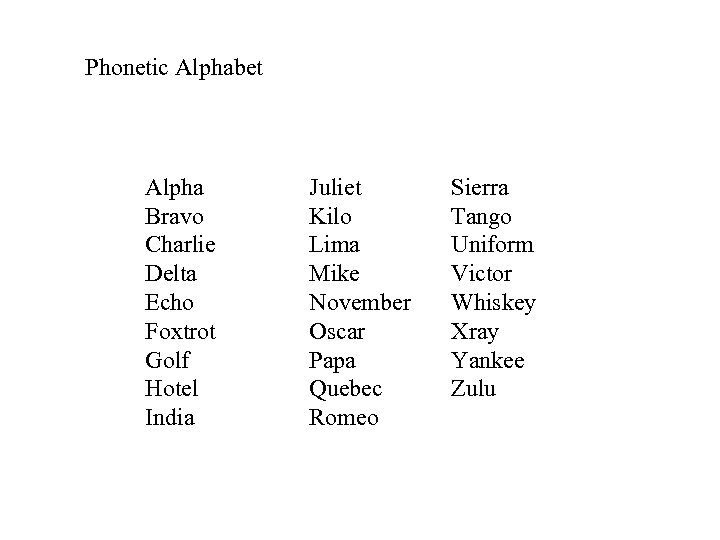 Phonetic Alphabet Alpha Bravo Charlie Delta Echo Foxtrot Golf Hotel India Juliet Kilo Lima Mike November Oscar Papa Quebec Romeo Sierra Tango Uniform Victor Whiskey Xray Yankee Zulu
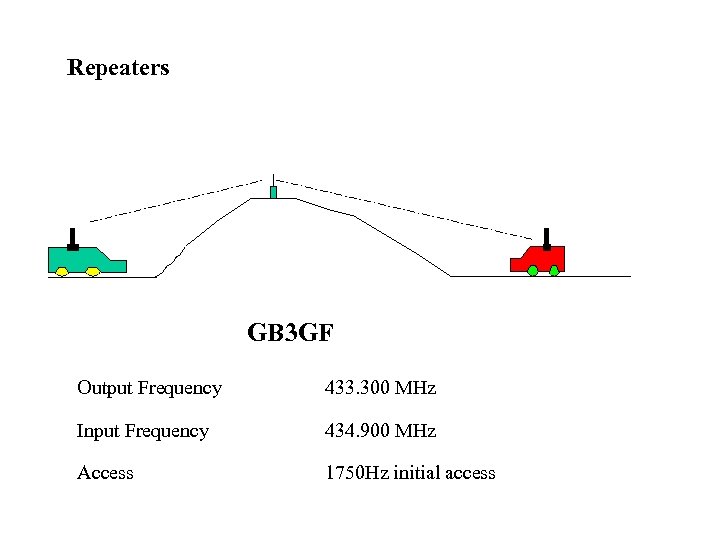 Repeaters GB 3 GF Output Frequency 433. 300 MHz Input Frequency 434. 900 MHz Access 1750 Hz initial access