 Скачать презентацию Andreas S Weigend Ph D 韋思岸教授 E-Business Overview
a7105146fa3c104de9ca3755f3a97785.ppt
- Количество слайдов: 37



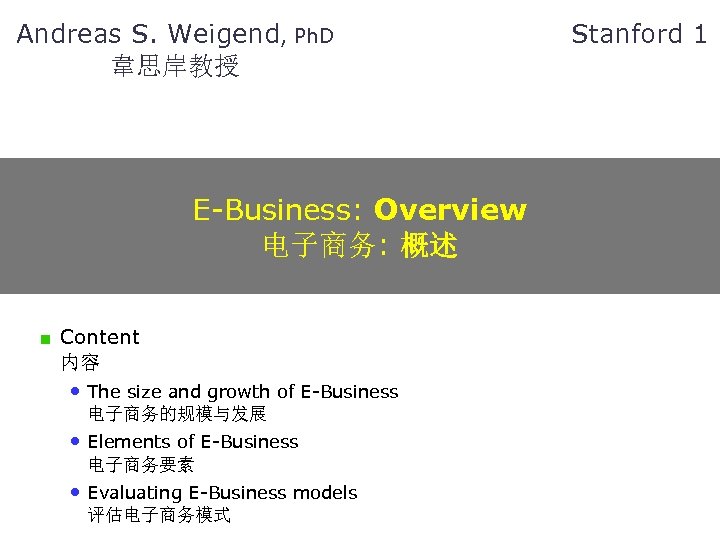
Andreas S. Weigend, Ph. D 韋思岸教授 E-Business: Overview 电子商务: 概述 Content 内容 • The size and growth of E-Business 电子商务的规模与发展 • Elements of E-Business 电子商务要素 • Evaluating E-Business models 评估电子商务模式 Stanford 1
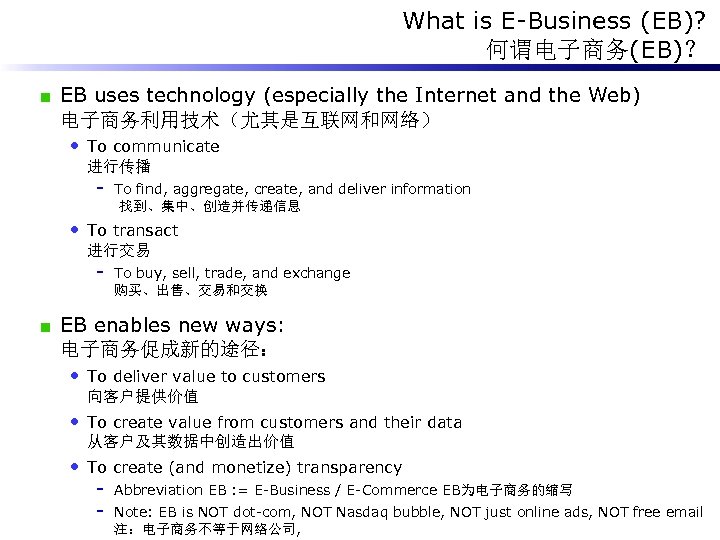
What is E-Business (EB)? 何谓电子商务(EB)? EB uses technology (especially the Internet and the Web) 电子商务利用技术(尤其是互联网和网络) • To communicate 进行传播 - To find, aggregate, create, and deliver information 找到、集中、创造并传递信息 • To transact 进行交易 - To buy, sell, trade, and exchange 购买、出售、交易和交换 EB enables new ways: 电子商务促成新的途径: • To deliver value to customers 向客户提供价值 • To create value from customers and their data 从客户及其数据中创造出价值 • To create (and monetize) transparency - Abbreviation EB : = E-Business / E-Commerce EB为电子商务的缩写 - Note: EB is NOT dot-com, NOT Nasdaq bubble, NOT just online ads, NOT free email 注:电子商务不等于网络公司,
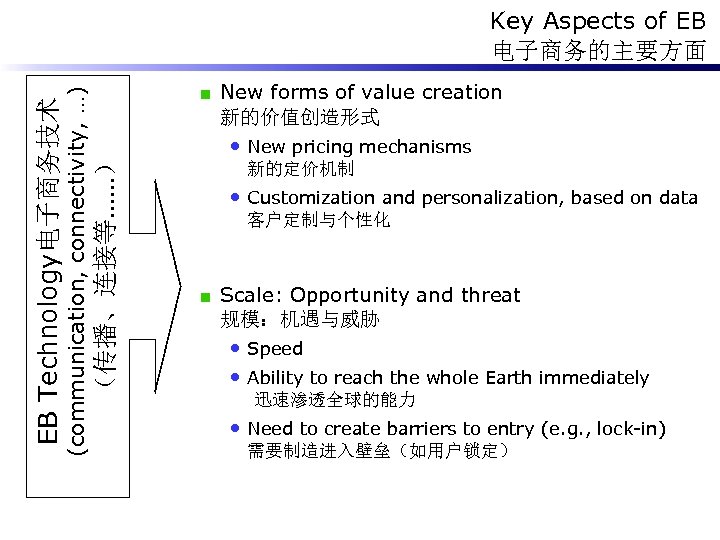
New forms of value creation 新的价值创造形式 (传播、连接等……) EB Technology电子商务技术 (communication, connectivity, …) Key Aspects of EB 电子商务的主要方面 • New pricing mechanisms 新的定价机制 • Customization and personalization, based on data 客户定制与个性化 Scale: Opportunity and threat 规模:机遇与威胁 • Speed • Ability to reach the whole Earth immediately 迅速渗透全球的能力 • Need to create barriers to entry (e. g. , lock-in) 需要制造进入壁垒(如用户锁定)
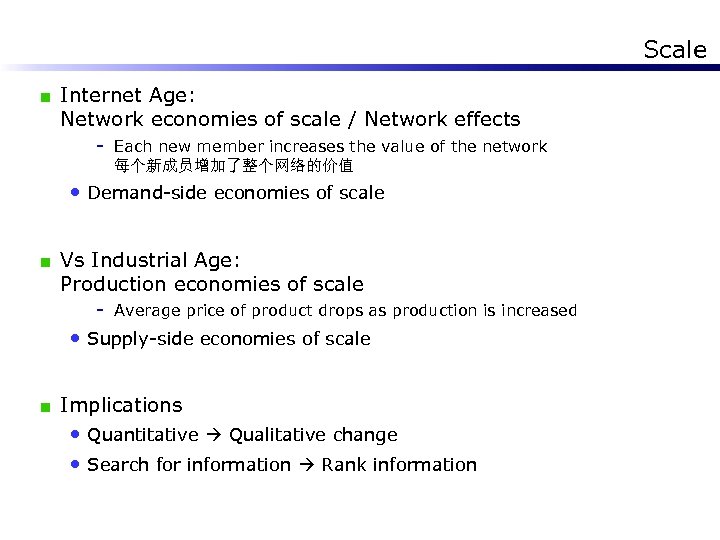
Scale Internet Age: Network economies of scale / Network effects - Each new member increases the value of the network 每个新成员增加了整个网络的价值 • Demand-side economies of scale Vs Industrial Age: Production economies of scale - Average price of product drops as production is increased • Supply-side economies of scale Implications • Quantitative Qualitative change • Search for information Rank information
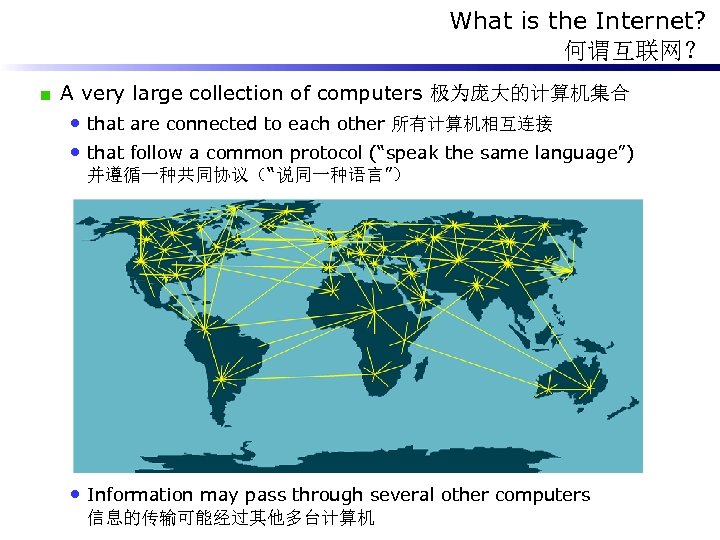
What is the Internet? 何谓互联网? A very large collection of computers 极为庞大的计算机集合 • that are connected to each other 所有计算机相互连接 • that follow a common protocol (“speak the same language”) 并遵循一种共同协议(“说同一种语言”) • Information may pass through several other computers 信息的传输可能经过其他多台计算机
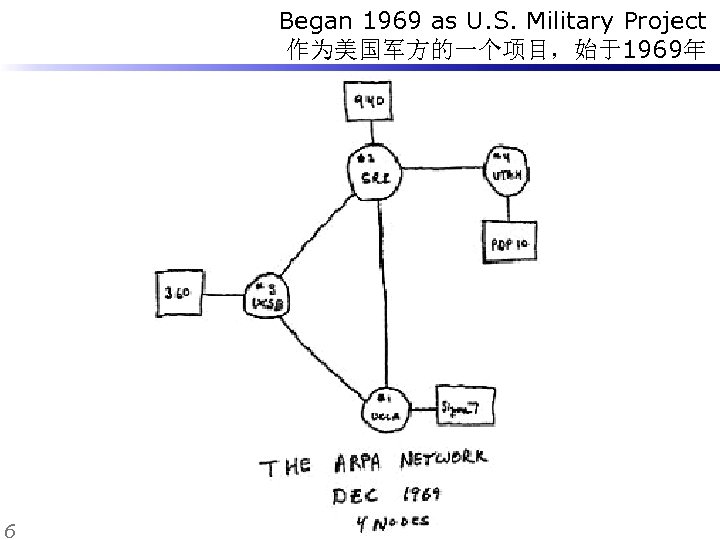
Began 1969 as U. S. Military Project 作为美国军方的一个项目,始于1969年 6
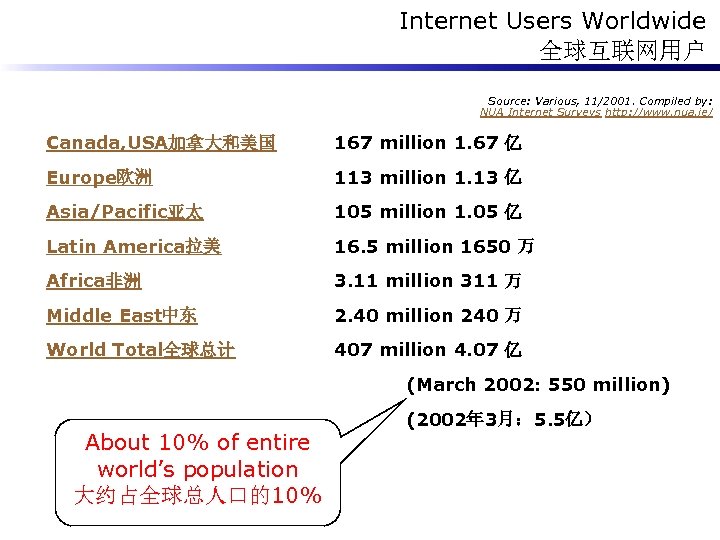
Internet Users Worldwide 全球互联网用户 Source: Various, 11/2001. Compiled by: NUA Internet Surveys http: //www. nua. ie/ Canada, USA加拿大和美国 167 million 1. 67 亿 Europe欧洲 113 million 1. 13 亿 Asia/Pacific亚太 105 million 1. 05 亿 Latin America拉美 16. 5 million 1650 万 Africa非洲 3. 11 million 311 万 Middle East中东 2. 40 million 240 万 World Total全球总计 407 million 4. 07 亿 (March 2002: 550 million) About 10% of entire world’s population 大约占全球总人口的10% (2002年 3月: 5. 5亿)
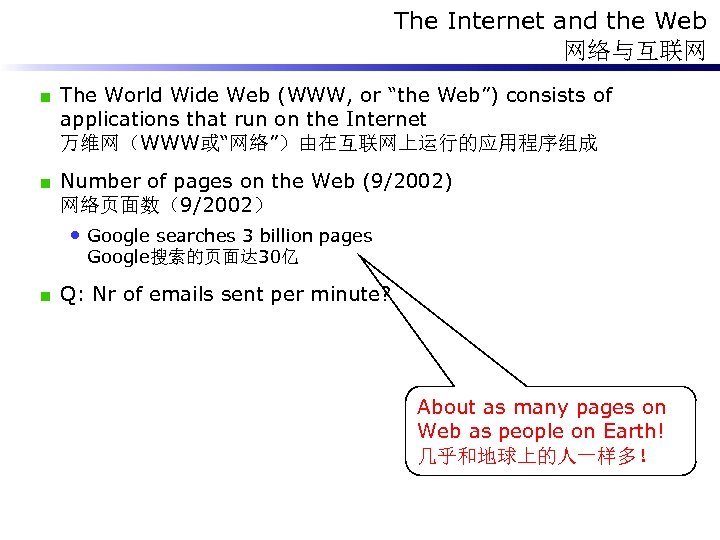
The Internet and the Web 网络与互联网 The World Wide Web (WWW, or “the Web”) consists of applications that run on the Internet 万维网(WWW或“网络”)由在互联网上运行的应用程序组成 Number of pages on the Web (9/2002) 网络页面数(9/2002) • Google searches 3 billion pages Google搜索的页面达 30亿 Q: Nr of emails sent per minute? About as many pages on Web as people on Earth! 几乎和地球上的人一样多!
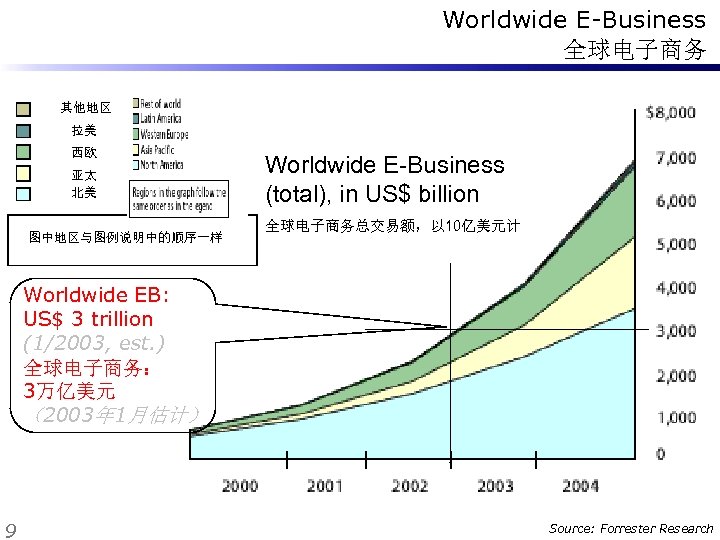
Worldwide E-Business 全球电子商务 其他地区 拉美 西欧 亚太 北美 图中地区与图例说明中的顺序一样 Worldwide E-Business (total), in US$ billion 全球电子商务总交易额,以 10亿美元计 Worldwide EB: US$ 3 trillion (1/2003, est. ) 全球电子商务: 3万亿美元 (2003年 1月估计) 9 Source: Forrester Research
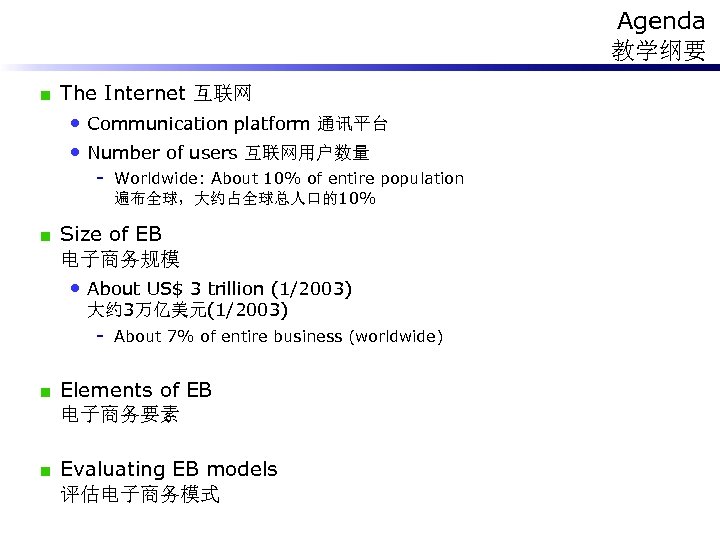
Agenda 教学纲要 The Internet 互联网 • Communication platform 通讯平台 • Number of users 互联网用户数量 - Worldwide: About 10% of entire population 遍布全球,大约占全球总人口的10% Size of EB 电子商务规模 • About US$ 3 trillion (1/2003) 大约 3万亿美元(1/2003) - About 7% of entire business (worldwide) Elements of EB 电子商务要素 Evaluating EB models 评估电子商务模式
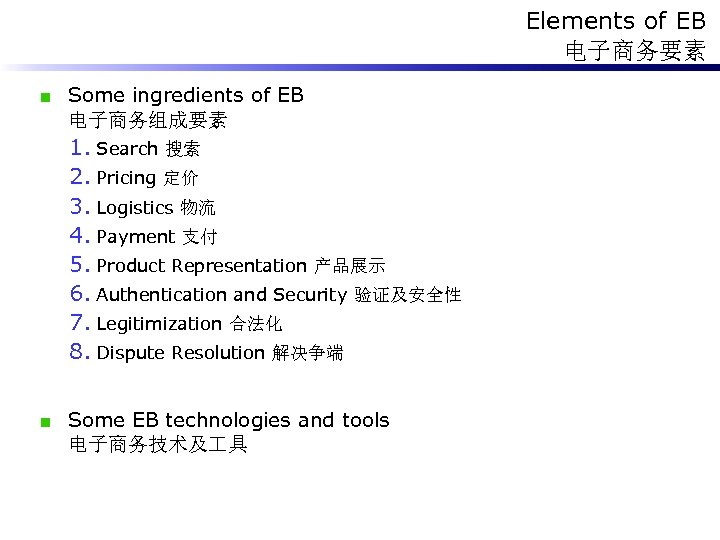
Elements of EB 电子商务要素 Some ingredients of EB 电子商务组成要素 1. Search 搜索 2. Pricing 定价 3. Logistics 物流 4. Payment 支付 5. Product Representation 产品展示 6. Authentication and Security 验证及安全性 7. Legitimization 合法化 8. Dispute Resolution 解决争端 Some EB technologies and tools 电子商务技术及 具
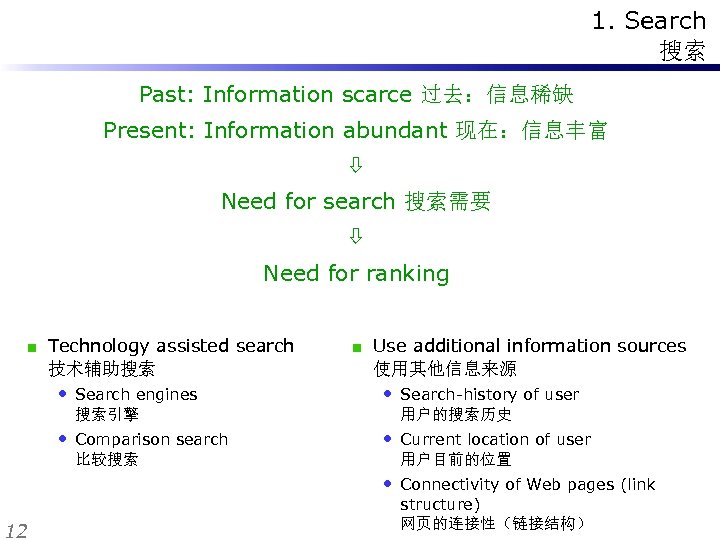
1. Search 搜索 Past: Information scarce 过去:信息稀缺 Present: Information abundant 现在:信息丰富 Need for search 搜索需要 Need for ranking Technology assisted search 技术辅助搜索 • Search engines 搜索引擎 • Comparison search 比较搜索 Use additional information sources 使用其他信息来源 • Search-history of user 用户的搜索历史 • Current location of user 用户目前的位置 • Connectivity of Web pages (link 12 structure) 网页的连接性(链接结构)
2. Pricing 定价 Variety of pricing mechanisms 定价机制种类 Exchanges (similar to financial markets) Auctions 竞拍 Dynamic pricing 动态定价 • Based on inventory • • 视存货情况而定 Based on competition 视竞争情况而定 Based on estimate of customer’s “willingness-to-pay” 视对客户“支付意愿”的估计而定 Buyer-set price 买方定价
3. Logistics 物流 Physical products: 实物产品: Better coordination with suppliers to reduce inventory 加强与供应商之间的协调以削减库存 Outsource inventory 外包库存 (Amazon. com) • Shift inventory risk to supplier 将库存风险转移给供应商 Note: Physical goods always need physical delivery services 注:实物产品总是要依赖实际的递送服务 14 Information products (also called digital goods): 信息产品: Logistics is easy if products in digital form 如果产品以数字形式存在,则 物流简便 • Information products ideally suited for EB 信息产品最适合电子商务 Storage and delivery easy 易于存储和递送 • Physical storage space close to zero 实际存储空间几乎为零
4. Payment 支付 Currently, main payment method in U. S. : Credit and debit cards 目前美国主要的支付方法:贷记卡和借记卡 Direct payment between parties (e. Bay / Pay. Pal) 双方直接支付 Electronic payments (e-Cash) 电子支付 Future possibility: Micro-payments 未来的可能性:微型支付 • E. g. , Net. Bill (purchase a single paragraph) 例如,Net. Bill (购买一个段落)
5. Product Representation 产品展示 • How are product attributes communicated? 如何宣传产品属性? The Web is a rather limited medium 网络是一种相当有局限性的媒介 • Good for information 适用于信息传递 • Limited for multimedia (bandwidth) 不利于多媒体的发展(带宽) • Impossible for touch, smell 不可触摸、嗅闻 Problems with limited representation of product 产品展示受限的影响 • Mistrust 不信任 • Misinformation 信息误传
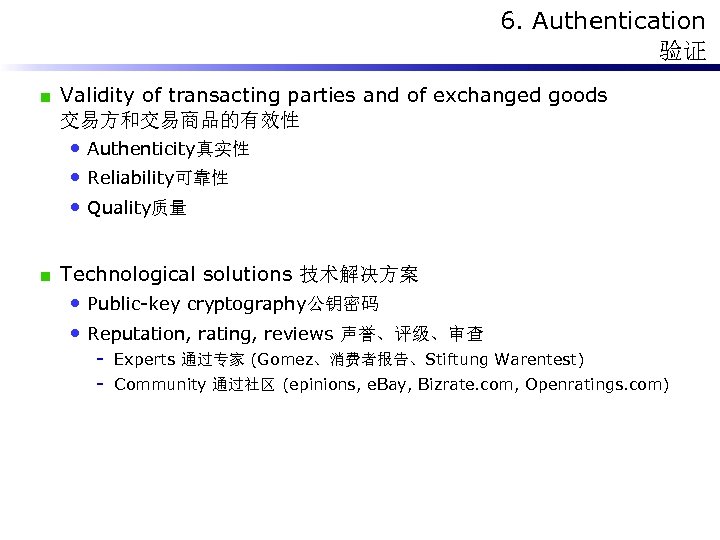
6. Authentication 验证 Validity of transacting parties and of exchanged goods 交易方和交易商品的有效性 • Authenticity真实性 • Reliability可靠性 • Quality质量 Technological solutions 技术解决方案 • Public-key cryptography公钥密码 • Reputation, rating, reviews 声誉、评级、审查 - Experts 通过专家 (Gomez、消费者报告、Stiftung Warentest) - Community 通过社区 (epinions, e. Bay, Bizrate. com, Openratings. com)
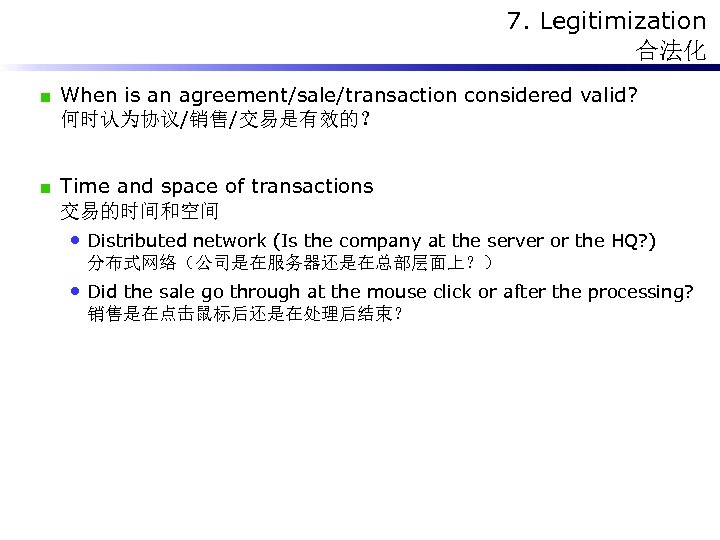
7. Legitimization 合法化 When is an agreement/sale/transaction considered valid? 何时认为协议/销售/交易是有效的? Time and space of transactions 交易的时间和空间 • Distributed network (Is the company at the server or the HQ? ) 分布式网络(公司是在服务器还是在总部层面上?) • Did the sale go through at the mouse click or after the processing? 销售是在点击鼠标后还是在处理后结束?
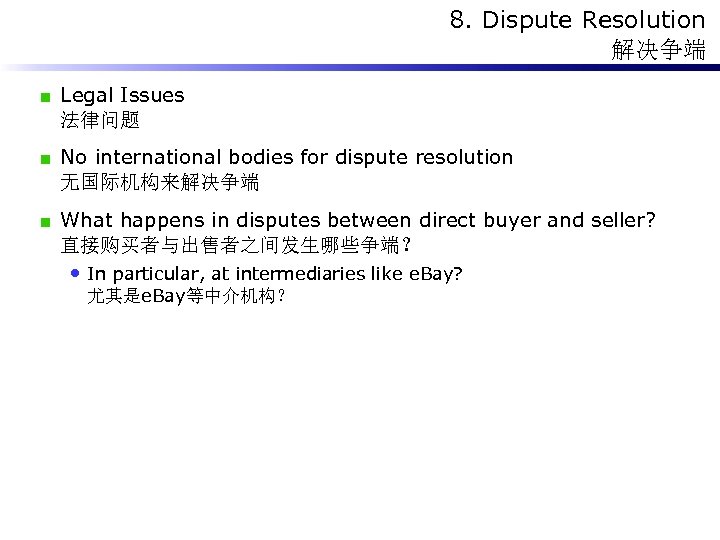
8. Dispute Resolution 解决争端 Legal Issues 法律问题 No international bodies for dispute resolution 无国际机构来解决争端 What happens in disputes between direct buyer and seller? 直接购买者与出售者之间发生哪些争端? • In particular, at intermediaries like e. Bay? 尤其是e. Bay等中介机构?
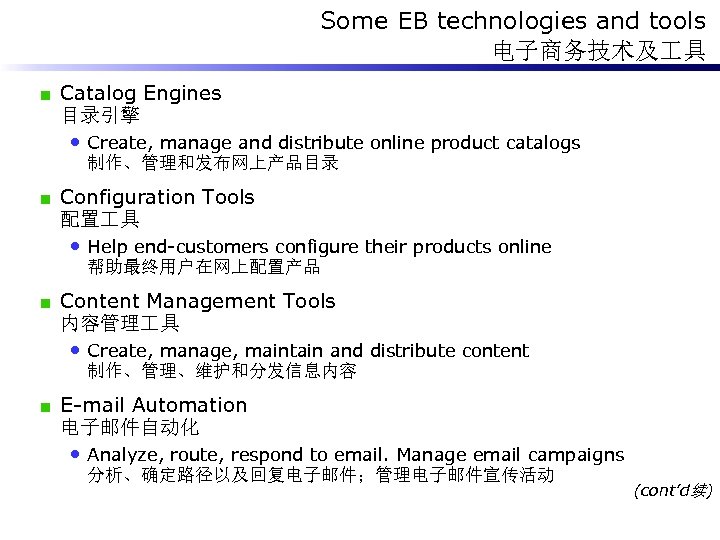
Some EB technologies and tools 电子商务技术及 具 Catalog Engines 目录引擎 • Create, manage and distribute online product catalogs 制作、管理和发布网上产品目录 Configuration Tools 配置 具 • Help end-customers configure their products online 帮助最终用户在网上配置产品 Content Management Tools 内容管理 具 • Create, manage, maintain and distribute content 制作、管理、维护和分发信息内容 E-mail Automation 电子邮件自动化 • Analyze, route, respond to email. Manage email campaigns 分析、确定路径以及回复电子邮件;管理电子邮件宣传活动 (cont’d续)
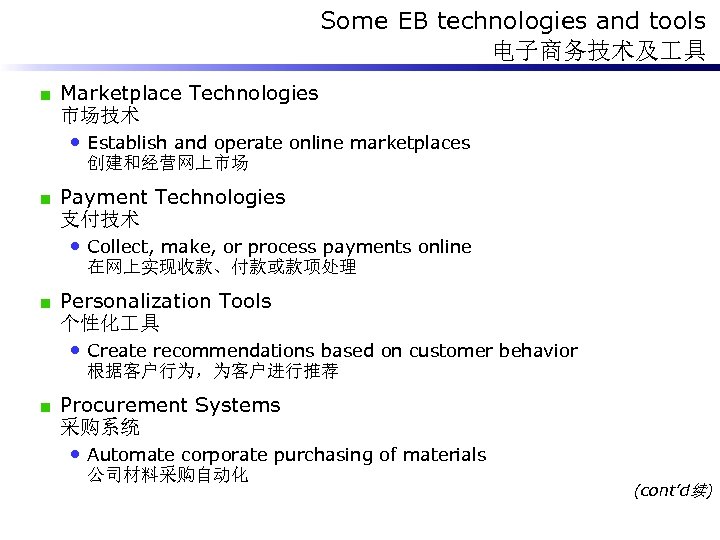
Some EB technologies and tools 电子商务技术及 具 Marketplace Technologies 市场技术 • Establish and operate online marketplaces 创建和经营网上市场 Payment Technologies 支付技术 • Collect, make, or process payments online 在网上实现收款、付款或款项处理 Personalization Tools 个性化 具 • Create recommendations based on customer behavior 根据客户行为,为客户进行推荐 Procurement Systems 采购系统 • Automate corporate purchasing of materials 公司材料采购自动化 (cont’d续)
Some EB technologies and tools 电子商务技术及 具 Search Engines 搜索引擎 Security Technologies 安全技术 Shopping Engines, Shop Bots 购物引擎,购物虫 …
Agenda 教学纲要 The Internet 互联网 Size of E-Business (EB) 电子商务规模 Elements of EB 电子商务要素 Tools for EB 电子商务 具 Evaluating EB models 评估电子商务模式
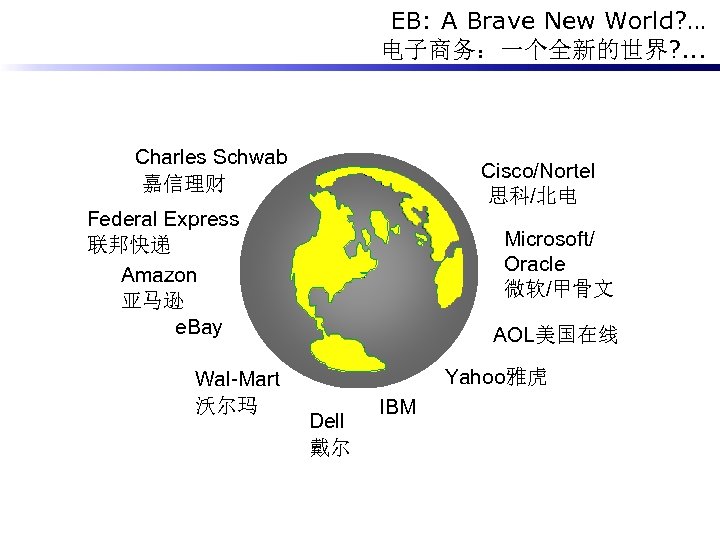
EB: A Brave New World? … 电子商务:一个全新的世界? . . . Charles Schwab 嘉信理财 Cisco/Nortel 思科/北电 Federal Express 联邦快递 Amazon 亚马逊 e. Bay Wal-Mart 沃尔玛 Microsoft/ Oracle 微软/甲骨文 AOL美国在线 Yahoo雅虎 Dell 戴尔 IBM
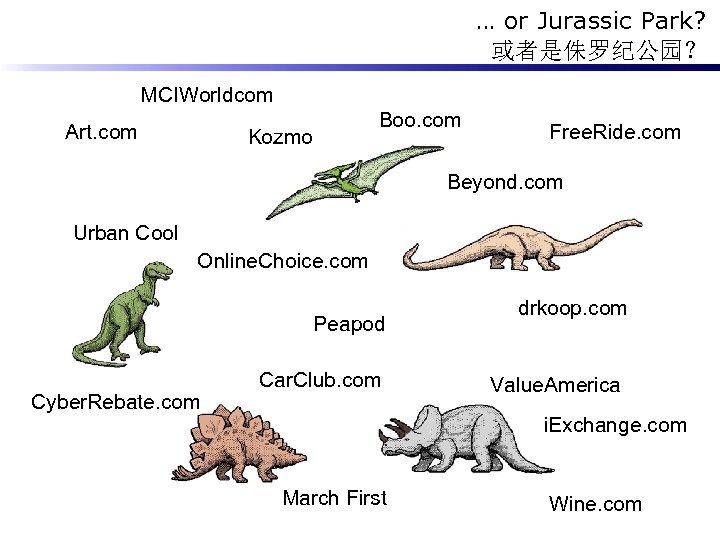
… or Jurassic Park? 或者是侏罗纪公园? MCIWorldcom Art. com Boo. com Kozmo Free. Ride. com Beyond. com Urban Cool Online. Choice. com Peapod Cyber. Rebate. com Car. Club. com drkoop. com Value. America i. Exchange. com March First Wine. com
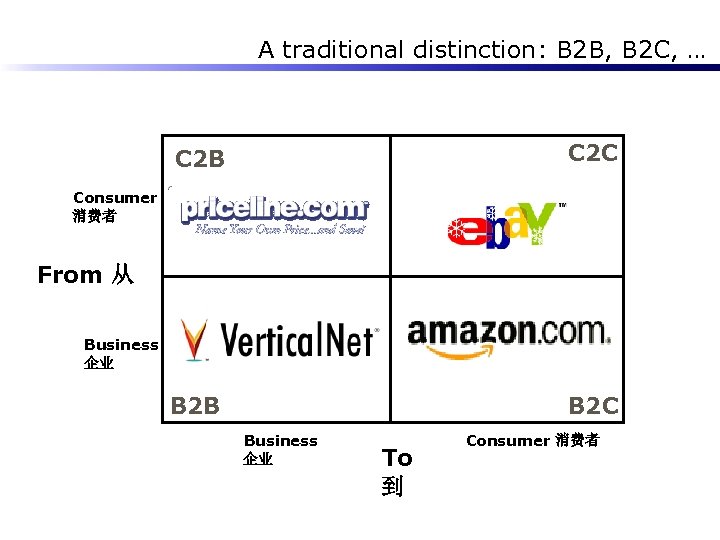
A traditional distinction: B 2 B, B 2 C, … C 2 B C 2 C B 2 B B 2 C Consumer 消费者 From 从 Business 企业 To 到 Consumer 消费者
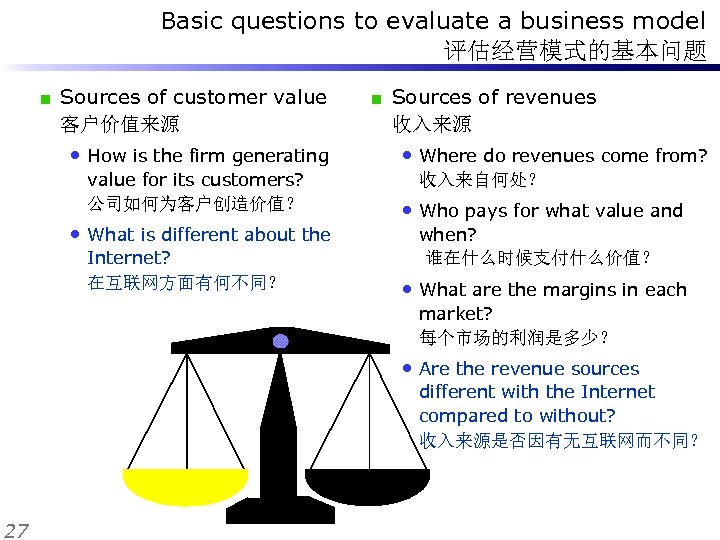
Basic questions to evaluate a business model 评估经营模式的基本问题 Sources of customer value 客户价值来源 • How is the firm generating value for its customers? 公司如何为客户创造价值? • What is different about the Internet? 在互联网方面有何不同? Sources of revenues 收入来源 • Where do revenues come from? 收入来自何处? • Who pays for what value and when? 谁在什么时候支付什么价值? • What are the margins in each market? 每个市场的利润是多少? • Are the revenue sources different with the Internet compared to without? 收入来源是否因有无互联网而不同? 27
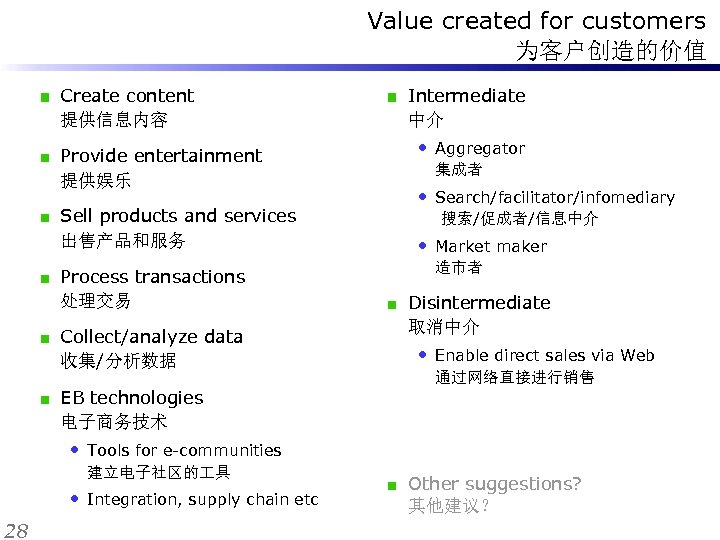
Value created for customers 为客户创造的价值 Create content 提供信息内容 Provide entertainment 提供娱乐 Sell products and services 出售产品和服务 Process transactions 处理交易 Collect/analyze data 收集/分析数据 Intermediate 中介 • Aggregator 集成者 • Search/facilitator/infomediary 搜索/促成者/信息中介 • Market maker 造市者 Disintermediate 取消中介 • Enable direct sales via Web 通过网络直接进行销售 EB technologies 电子商务技术 • Tools for e-communities 建立电子社区的 具 • Integration, supply chain etc 28 Other suggestions? 其他建议?
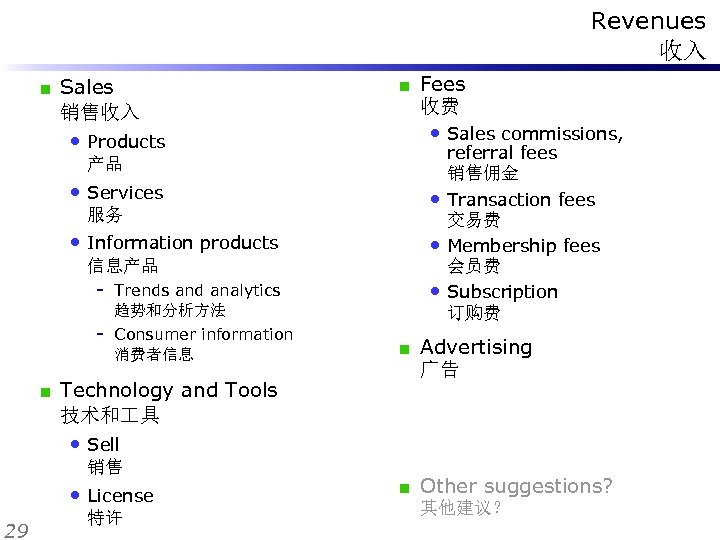
Revenues 收入 Sales 销售收入 • Products Fees 收费 • Sales commissions, 产品 • Services 服务 • Information products 信息产品 - Trends and analytics 趋势和分析方法 - Consumer information 消费者信息 Technology and Tools 技术和 具 • • • referral fees 销售佣金 Transaction fees 交易费 Membership fees 会员费 Subscription 订购费 Advertising 广告 • Sell 销售 • License 29 特许 Other suggestions? 其他建议?
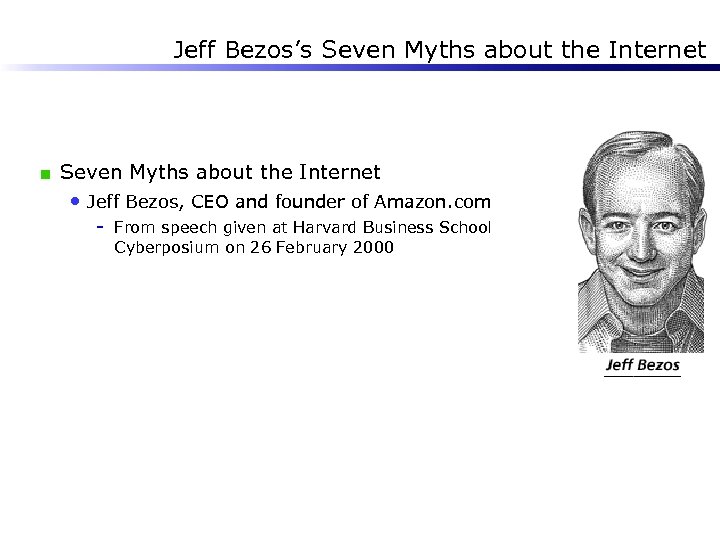
Jeff Bezos’s Seven Myths about the Internet • Jeff Bezos, CEO and founder of Amazon. com - From speech given at Harvard Business School Cyberposium on 26 February 2000
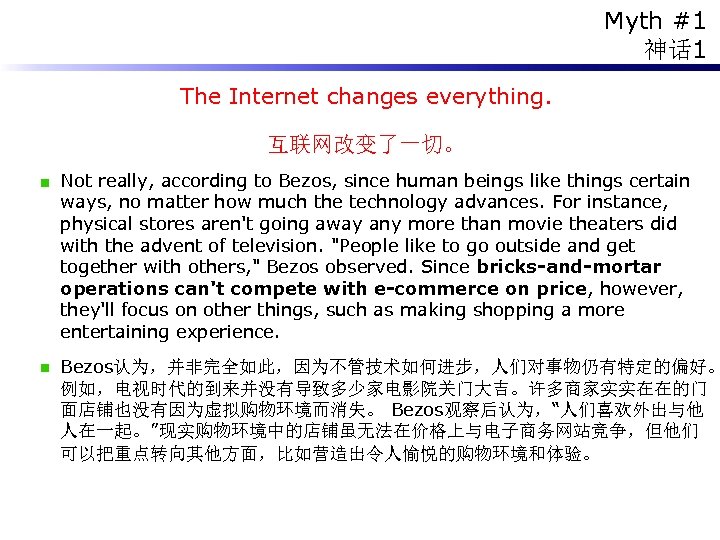
Myth #1 神话 1 The Internet changes everything. 互联网改变了一切。 Not really, according to Bezos, since human beings like things certain ways, no matter how much the technology advances. For instance, physical stores aren't going away any more than movie theaters did with the advent of television. "People like to go outside and get together with others, " Bezos observed. Since bricks-and-mortar operations can't compete with e-commerce on price, however, they'll focus on other things, such as making shopping a more entertaining experience. Bezos认为,并非完全如此,因为不管技术如何进步,人们对事物仍有特定的偏好。 例如,电视时代的到来并没有导致多少家电影院关门大吉。许多商家实实在在的门 面店铺也没有因为虚拟购物环境而消失。 Bezos观察后认为,“人们喜欢外出与他 人在一起。”现实购物环境中的店铺虽无法在价格上与电子商务网站竞争,但他们 可以把重点转向其他方面,比如营造出令人愉悦的购物环境和体验。
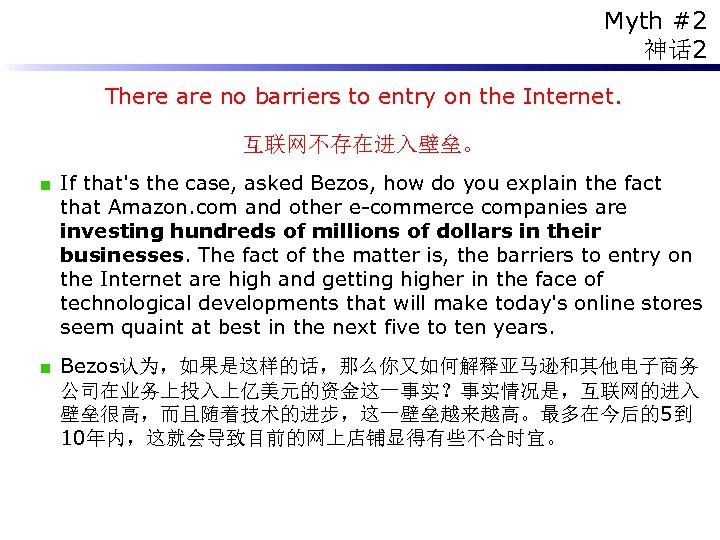
Myth #2 神话 2 There are no barriers to entry on the Internet. 互联网不存在进入壁垒。 If that's the case, asked Bezos, how do you explain the fact that Amazon. com and other e-commerce companies are investing hundreds of millions of dollars in their businesses. The fact of the matter is, the barriers to entry on the Internet are high and getting higher in the face of technological developments that will make today's online stores seem quaint at best in the next five to ten years. Bezos认为,如果是这样的话,那么你又如何解释亚马逊和其他电子商务 公司在业务上投入上亿美元的资金这一事实?事实情况是,互联网的进入 壁垒很高,而且随着技术的进步,这一壁垒越来越高。最多在今后的5到 10年内,这就会导致目前的网上店铺显得有些不合时宜。
Myth #3 神话 3 Intermediaries are dead. 中介消失。 Intermediaries are a fact of life to some degree, Bezos asserted. The litmus test will be who adds value and who doesn't. Those that don't will be "toast. " Bezos认为,从一定程度上来说,中介是客观存在的。问题的关键是看哪 些中介能够增值,哪些不能增值。不能增值的中介将淘汰出局。
Myth #4 神话 4 There are going to be only a few winners in the Internet economy. 互联网经济将只有少数赢家。 Bezos doesn't believe that one for a second. "The world of e-commerce will be as richly varied as the physical world, probably more so, " he said, "because more business models are possible online. " But that doesn't mean that success is in the cards for everyone, he cautioned. "I liken it to the Cambrian era 550 million years ago, which saw the development of multi-celled life. While nature tried every kind of experiment possible, the creation of new species was offset by the extinction of others. ” Bezos对此根本就不相信。“电子商务世界将与现实世界一样极具多样性,而且可 能有过之而无不及,”他说,“因为网络会培育出更多的商业模式。”但这并非意味 着人人都能成功。他提醒说,“这就好比是 5. 5 亿年前的寒武纪时代,当时记录了 多细胞生物的发展历程。但大自然中屡试不爽的规律是,新物种的诞生总是伴随其 他物种的灭绝。”
Myth #5 神话 5 It's easy for bricks-and-mortar retailers to extend their business. 传统的非网络零售商很容易就可以利用互联网拓展他们的业务。 Forget about it, said Bezos. It's an easy trap for people to fall into, he explained, because they reason that a store is a store, whether it's physical or on line. Not so. Take books, for example. Online sellers are essentially in the technology business; off-line operations are in the real estate business. One group deals mainly with variable costs, the other with fixed costs. Below the superficial similarities, the differences run deep. Bezos认为,你可别指望这个。人们很容易陷入这样的误区,因为他们认为不 管是实际存在的,还是网上虚拟的,店铺就是店铺。但事实并非如此。就拿 书籍销售为例。从根本上来说,网上销售商处于技术行业,而非网络销售商 则属于房地产行业。 其中一方主要是处理可变成本,另一方则处理固定成本。 虽然两者表面上类似,但却存在很大的实际差异。
Myth #6 神话 6 Current market leaders can't fail. 目前的市场领先者不会失败。 If they take their eyes off the customer, just watch them, said Bezos. In addition, many business pioneers were good at risk taking until they became successful and had something to lose. Then they fell off the leading edge and never recovered. Bezos认为,如果他们不再关注客户的话,那你就等着看他们的下场。 而且,许多创业者在获取成功、有了可以损失的资本之前都十分善于冒 险。而在此之后,他们就会失去领先优势,再也无法恢复元气。
Myth #7 神话 7 Every company needs an Internet strategy. 每个公司都需要有互联网战略。 Not. "The Internet is an enabling horizontal layer that is causing broad disruptions across a big part of the economy, but it's not for every industry, " Bezos concluded. "Yet you see people making business decisions based on the Internet, even where it doesn't belong. ” 并非如此。 “互联网具有创造性破坏的功效,可以涉及到大部分的经济领 域,但并非涵盖没有行业。” Bezos总结说,“不过,即使在有些互联网没 有覆盖的领域,你也会看到人们基于互联网制定商业决策。”
Скачать презентацию Andreas S Weigend Ph D 韋思岸教授 E-Business Overview
a7105146fa3c104de9ca3755f3a97785.ppt