


 Скачать презентацию Ancient Rome 1 st Yrs What was
bde4e13b78baa6176e1deaa7a21ef57e.ppt
- Количество слайдов: 45
 Ancient Rome 1 st Yrs
 What was the Roman empire? • • • An empire = 1 country controls other lands Existed between 500 BC and 500 AD Lasted almost 1000 years! Rome = most important city in Europe Controlled most of Europe and some of Africa
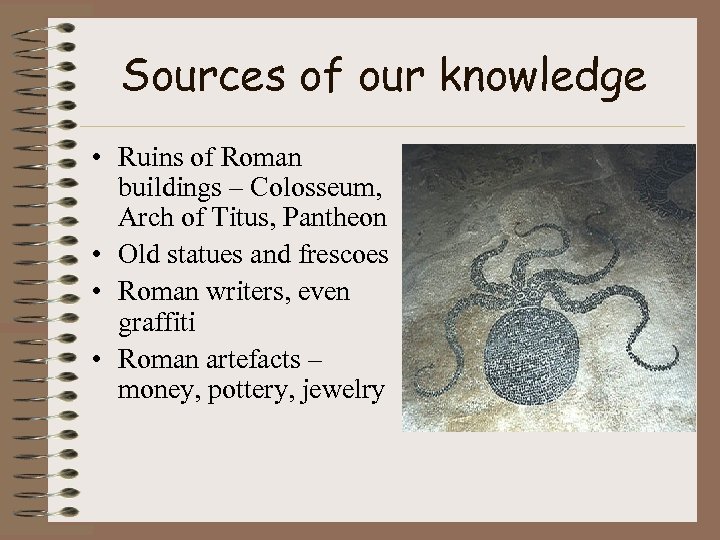 Sources of our knowledge • Ruins of Roman buildings – Colosseum, Arch of Titus, Pantheon • Old statues and frescoes • Roman writers, even graffiti • Roman artefacts – money, pottery, jewelry
 Pompeii • Good source of information about life in Ancient Rome • 79 AD volcano – Mount Vesuvius • Everything preserved • Archaeologists have studied it
 Rome – the city • • • Population – 1 million – centre of empire Appian Way – Road to Rome Tombstones on the way No burials inside city walls – why? Arches around the city – commemorated
 Rome – city (2) • • • Main street – Via Sacra – The Holy Road Went through the centre Used for parades after war victories No carriages allowed during the day Pedestrianised Streets lined with houses Rubbish thrown on street Stepping stones Public toilets
 The forum • • Most famous place in the city Main market held there Shops, businesses, social chats The Senate, the government, beside the forum
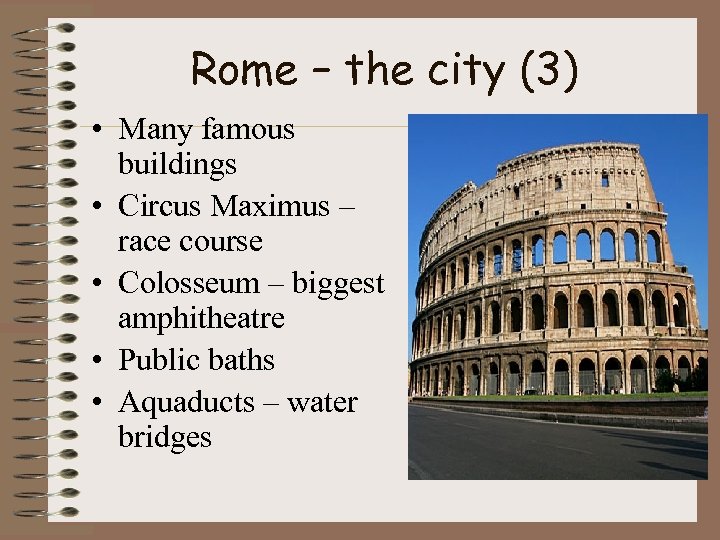 Rome – the city (3) • Many famous buildings • Circus Maximus – race course • Colosseum – biggest amphitheatre • Public baths • Aquaducts – water bridges
 Citizens • • Two types of citizens: Patricians And plebians Women and slaves not citizens
 Citizens • • • 1. Patricians – · Rich Landowners · Didn’t do much work – easy life · Served as Senators or Generals 2. Plebians – · Poor citizens · Shopkeepers, bakers, craftsmen, soldiers · Hard life · Unemployed got grain – called ‘dole’
 Slaves • • · Not citizens – non person · Treated like cattle – bought and sold · 1/3 of the population · Criminals or prisoners of war · Treated harshly · Worked in farms of mines · Well-educated slaves were teachers or doctors · Some were gladiators
 Slaves (2) • • • · Flogged if tried to escape · Regularly beaten · Spartacus – slaves revolt · Defeated · 6000 slaves massacred as warning · Some slaves could earn freedom · Gladiators or chariot racers · Become a freedman Service called ‘manumission’
 Food - plebians • • • Very basic Mainly porridge Bread with olives, water or wine Evening meal – cena Vegetable stew or bean stew Garum – fish sauce covered up smell
 Food – patricians • • • Feasts – reclined on couches 3 courses Vomitorium Variety of dishes – fish, meats, fruit Delicacies – stuffed dormice, fried snails Ate with fingers
 Dress - men • • • Tunics – long white t-shirts Tied at waist Cotton in summer, wool in winter Togas over tunics – long white sheet Wore leather sandals
 Dress - women • • Unmarried girls – long belted tunics Married at 12 Wore long dress called stola Shawl – palla – over head Avoided tans!! Jewelry – necklaces and makeup Red hair – extensions popular
 Houses - plebians • • High rise flats called insulae Wood – fires common Small – whole families in 1 -2 rooms Didn’t cook there 1 st Take-aways! – Thermopolae Higher up – cheaper Water only pumped to bottom floor
 Houses – patricians • • Villas on hills outside capital ‘Domus’ in the town Many rooms Sometimes front rooms used as shops
 Villas • • • Atrium – main hall – columns and statues Shallow pool – impluvium – in it Walled garden and patio – peristylum Mosaics on floors of rooms Frescoes on walls
 Women in Roman empire • • Not citizens Men dominated society Had to obey men – often beaten Girls valued less than boys Newly born girls sometimes left to die Basic education at Ludus (Primary) Didn’t go to grammaticus (secondary) school Boys did
 Women in Roman Empire (2) • • • Girls stayed at home Learned skills of housework – spin, sew Could marry from 12 years Men were older Had a lot of children Average of plebian – 30 years old
 Boys • • • Often taught by slaves in school Reading, writing, arithmetic Learned about Greek and Latin culture Practiced oratory Wrote on boards covered in wax
 Religion • • • Pagans – believed in many gods Each one controlled a different thing Mars – god of war Venus – goddess of love Temples built to honour gods The Pantheon Lares – Household gold Shrine in each house Thought these gods looked over them Spilled wine as offering before meal
 Christianity • • At first Christians were persecuted Slaves – Colosseum – fought with lions Christians buried dead in catacombs Emperor Constantine made Christianity official religion
 Death • • Believed in life after death Hades – underworld Coin on eyes for Charon Funerals – noisy – professional wailers Mourners, torch carriers, musicians Speech praising him in Forum Body brought outside wall – stone coffin or cremated
 How Rome was ruled • • • At first, a republic Citizens had a say Voted for politicians in the senate Senate ruled the republic Women and slaves had no vote
 Empire • • But the republic democracy ended Replaced by an Empire One person ruled the whole empire Called an Emperor e. g. Emperor Augustus, Emperor Nero
 Controlling an Empire • • • Huge armies travelled to different province The empire divided into provinces Built roads everywhere Roman army – very powerful Controlled the empire
 Army • Divided into 30 legions • Controlled different parts of the empire • Soldiers in groups of 100 – century – under the command of a centurion • Soldiers were Roman citizens • Good pay • Could also sell captured slaves • Got conquered land when retired
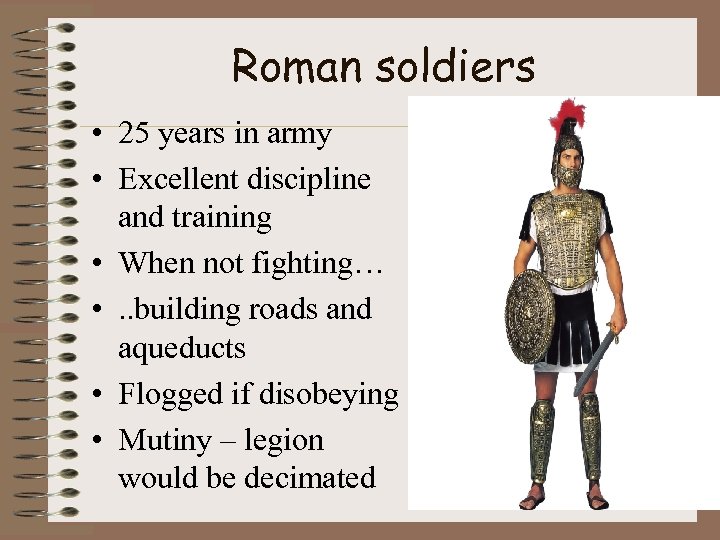 Roman soldiers • 25 years in army • Excellent discipline and training • When not fighting… • . . building roads and aqueducts • Flogged if disobeying • Mutiny – legion would be decimated
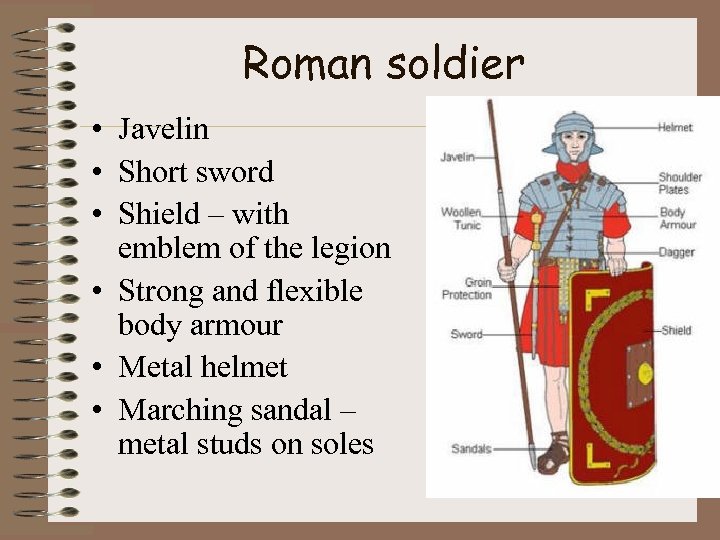 Roman soldier • Javelin • Short sword • Shield – with emblem of the legion • Strong and flexible body armour • Metal helmet • Marching sandal – metal studs on soles
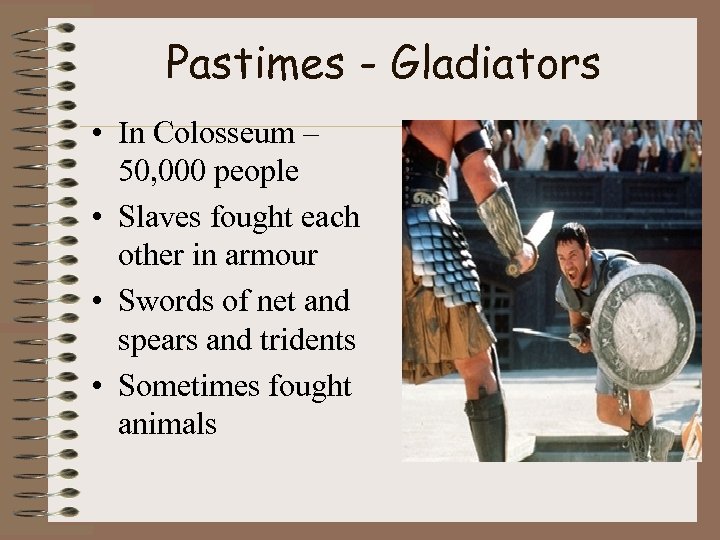 Pastimes - Gladiators • In Colosseum – 50, 000 people • Slaves fought each other in armour • Swords of net and spears and tridents • Sometimes fought animals
 Gladiator contests • • • Fight lasted until one died or wounded Crowd cheered Emperor decided his fate Thumb up or down Successful gladiators could earn their freedom
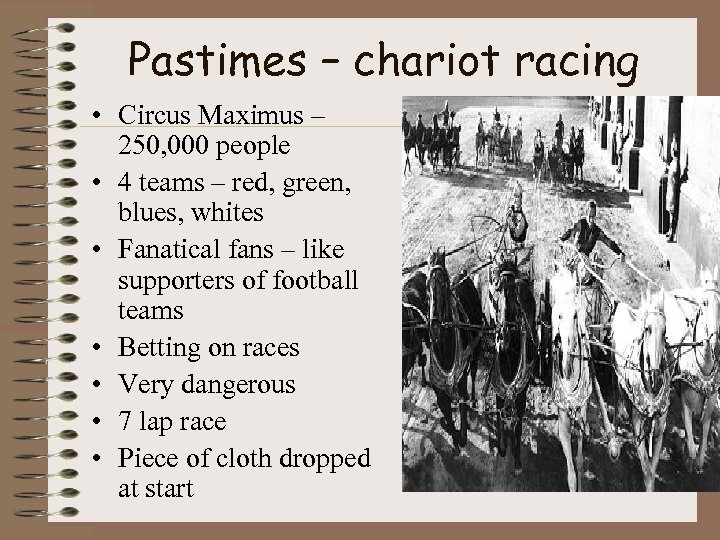 Pastimes – chariot racing • Circus Maximus – 250, 000 people • 4 teams – red, green, blues, whites • Fanatical fans – like supporters of football teams • Betting on races • Very dangerous • 7 lap race • Piece of cloth dropped at start
 Public baths (1) • • • Hundreds in Rome Popular for rich and powerful Men and women separate Children free Bathed, exercised, social chats Even a library and relax for reading
 Baths (2) • Different rooms – • Tepidarium: Warm room • Caldarium: steamy room with tub of hot water • Frigidarium: refreshing, cool pool • Slaves massaged with oil and perfume
 Influence of Ancient Rome • • • 1. Roman Culture Still use roman alphabet and write some letters Latin formed Italian, French, Spanish languages We use Roman calendar – look at months names Copied many of their architecture E. g. GPO – columns and capital
 Influence – 2. inventions • • Still use many Roman ideas The dole Running water pumps Romans invented under-floor heating system – warm air from burning furnace in cellar • Forum – 1 st shopping mall • Insulae – 1 st apartment block
 Influence – 3. Roman Laws • • Well-developed legal system Still forms the basis of law in Europe Introduced a common currency… …so same money used from Scotland to Turkey
 Influence – 4. Roman cities • Many cities were Roman villages • London, Paris
 Revision Qs • 1. Mention 7 details about slaves • 2. Write 8 details about a child’s daily life in Rome.
 Mention 7 details about slaves • • • Criminals or captured in war Not citizens – no rights Flogged and beaten Worked as gladiators In farms or mines Educated slaves – teachers and doctors Spartacus Roman revenge Could be freed by martyr Manumission Wore a cap
 1. Write 8 details about a child’s daily life in Rome. • • • Describe house Food Ludus – day off for market Grammer school What you studied What you wrote on Public baths Circus Maximus Role of father in house
 Recap • • Patricians Plebians Slaves Villas Tunic Fashions Education etc
 Homework • Write about a young person growing up in an ancient civilization outside of Ireland. • Mention Roman past times