

ANCIENT INDIAN AND CHINESE PHILOSOPHY Lecture # 2

 Скачать презентацию ANCIENT INDIAN AND CHINESE PHILOSOPHY Lecture # 2
26742-phil-pp-l-_2._indian_and_chinese_phil.ppt
- Количество слайдов: 36
ANCIENT INDIAN AND CHINESE PHILOSOPHY Lecture # 2
CONTENT OF THE LECTURE: EASTERN (ORIENTAL) PHILOSOPHY ANCIENT INDIAN PHILOSOPHY -HINDUISM - BUDDHISM -JAINISM 3. ANCIENT CHINESE PHILOSOPHY
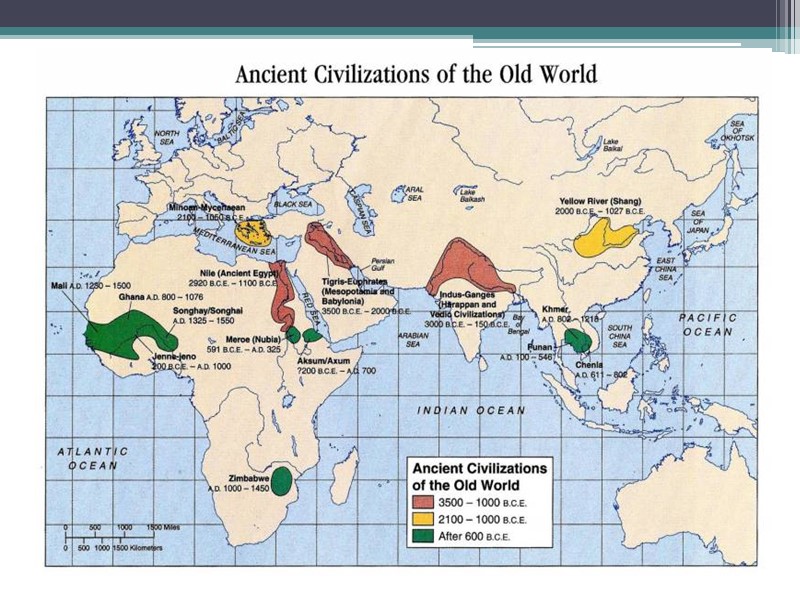
EASTERN (ORIENTAL) PHILOSOPHY In the West, the term Eastern (Oriental) philosophy refers very broadly to the various philosophies of “the East”, namely Asia, including China, India, Japan, Persia and other areas One must take into account that this term ignores that these countries do not belong to a single culture
EASTERN (ORIENTAL) PHILOSOPHY Ancient eastern philosophy developed mainly in India and China The Indian or Hindu schools of philosophy can be considered the oldest schools of philosophy Hindu philosophy is followed by the Buddhist and Jain philosophies
EASTERN (ORIENTAL) PHILOSOPHY Confucianism can be considered as the oldest school of philosophy in China Confucianism developed in China around the same time as Buddhism and Jainism developed in India Another school of philosophy, Taoism, developed in China around 200 BC
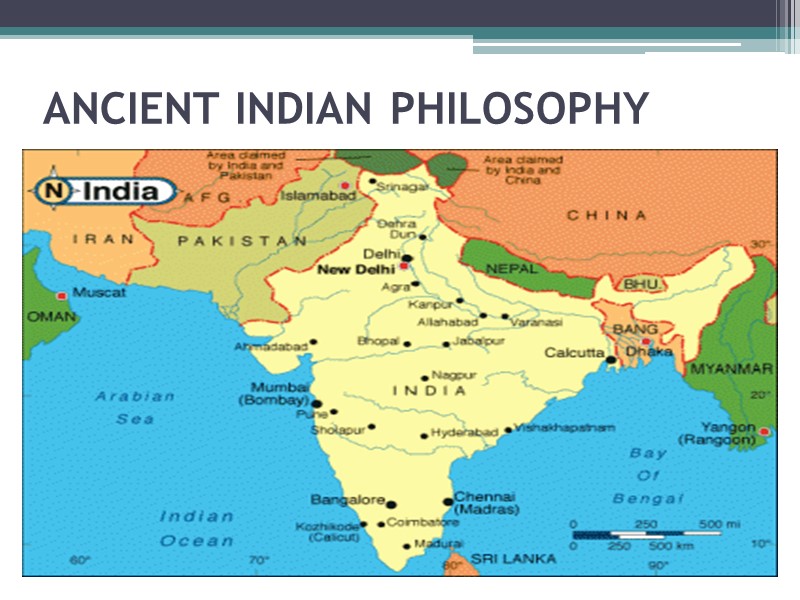
ANCIENT INDIAN PHILOSOPHY
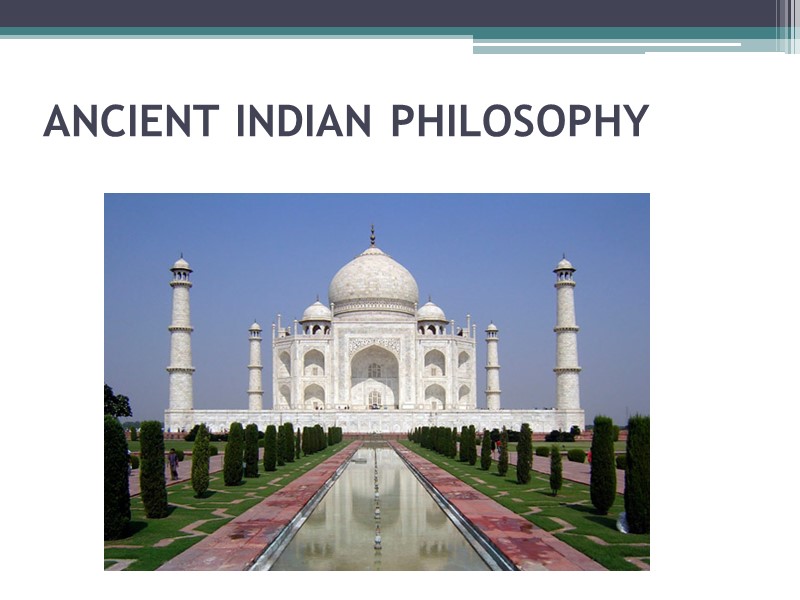
ANCIENT INDIAN PHILOSOPHY
ANCIENT INDIAN PHILOSOPHY
ANCIENT INDIAN PHILOSOPHY
ANCIENT INDIAN PHILOSOPHY
ANCIENT INDIAN PHILOSOPHY
ANCIENT INDIAN PHILOSOPHY The development of ancient Indian philosophy consists of two periods: Vedic and Classical Rig-Veda is a collection of religious hymns, the first known monument of Indian literature The word «veda» means «knowledge» and comes from the root «vid», that reconstructed from Proto-Indo-European root «weid», meaning «see» or «know»
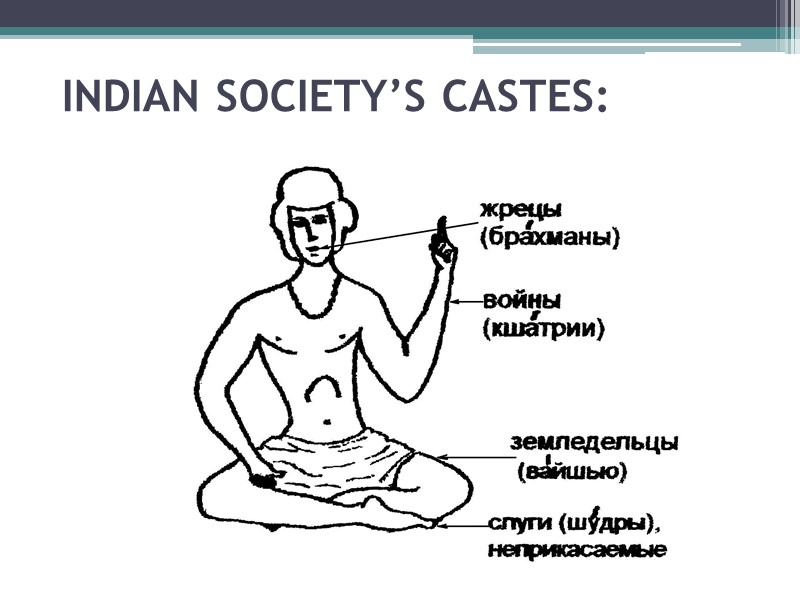
HINDUISM Rig-Veda contains an extreme pluralism: the gods, people, animals, plants, elements, seasons, countries, qualities of body, spiritual abilities, etc. They are animate (жанды/одушевленные) substances, which are connected with each other and can transform into one another. The world and its phenomena are considered as the improvement of the primary entity (түп -тегі/сущность)(Purusha) Purusha is also understood to be the first person, which consists of castes.
INDIAN SOCIETY’S CASTES: Head corresponds to the caste of Brahmins (priests) Hands – to the caste of the Kshatriyas (the military or ruling class) Feet – Vaisya caste (merchants, artisans) Footsteps –Sudras caste (servants) There were also Untouchables, that is, most lower of the castes
INDIAN SOCIETY’S CASTES:
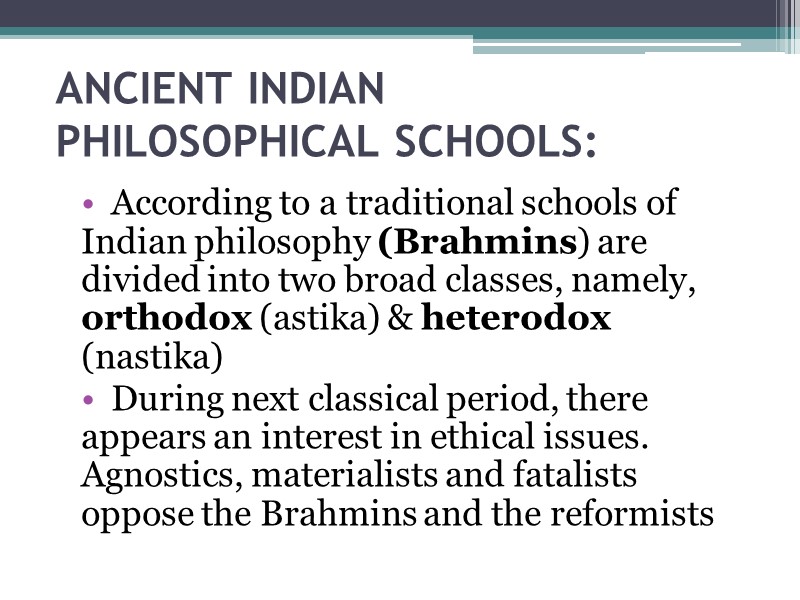
ANCIENT INDIAN PHILOSOPHICAL SCHOOLS: According to a traditional schools of Indian philosophy (Brahmins) are divided into two broad classes, namely, orthodox (astika) & heterodox (nastika) During next classical period, there appears an interest in ethical issues. Agnostics, materialists and fatalists oppose the Brahmins and the reformists
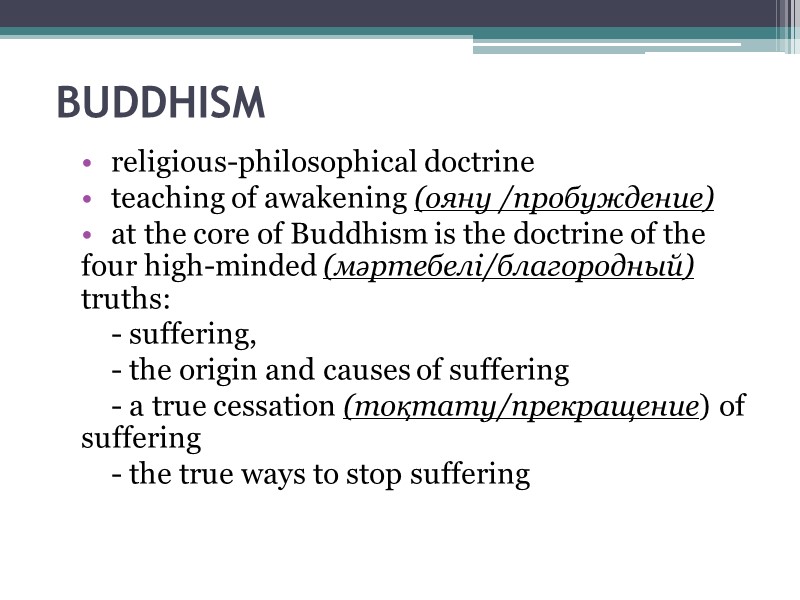
BUDDHISM religious-philosophical doctrine teaching of awakening (ояну /пробуждение) at the core of Buddhism is the doctrine of the four high-minded (мәртебелі/благородный) truths: - suffering, - the origin and causes of suffering - a true cessation (тоқтату/прекращение) of suffering - the true ways to stop suffering
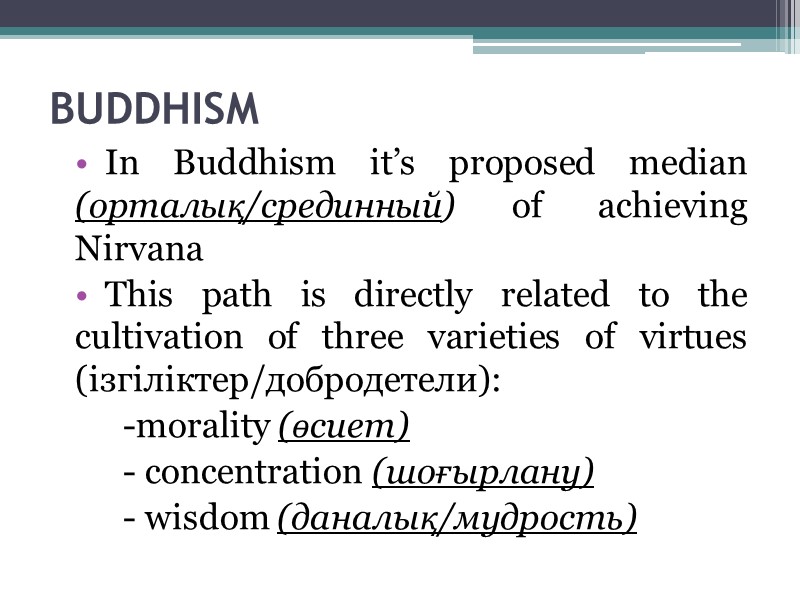
BUDDHISM In Buddhism it’s proposed median (орталық/срединный) of achieving Nirvana This path is directly related to the cultivation of three varieties of virtues (ізгіліктер/добродетели): -morality (өсиет) - concentration (шоғырлану) - wisdom (даналық/мудрость)
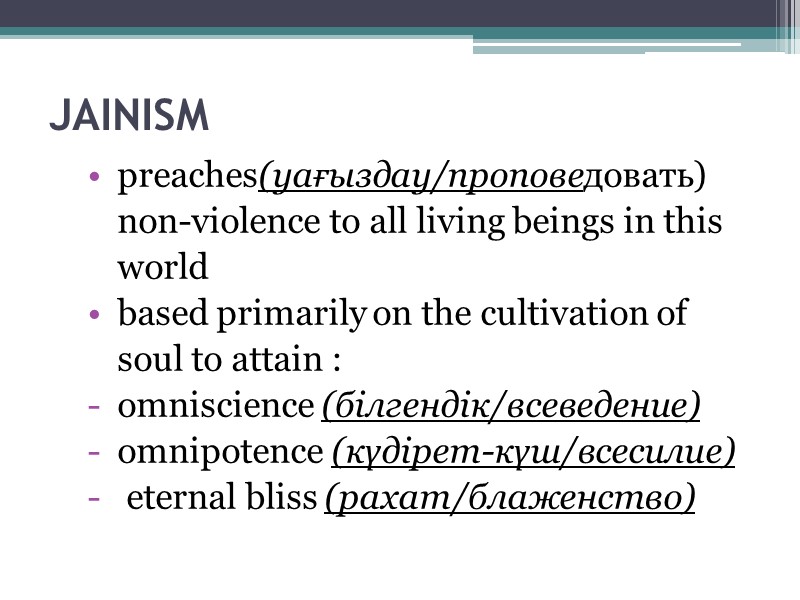
JAINISM preaches(уағыздау/проповедовать) non-violence to all living beings in this world based primarily on the cultivation of soul to attain : omniscience (білгендік/всеведение) omnipotence (күдірет-күш/всесилие) eternal bliss (рахат/блаженство)
ANCIENT CHINESE PHILOSOPHY Considering all things as a unity of opposites (Yang – Yin), Chinese thinkers have explained the endless process of moving through their dialectical interaction In Chinese mythology, it is allocated the highest principle, which rules the world, the existence of things. This principle is sometimes understood as the highest personified ruler (Shang-di)
ANCIENT CHINESE PHILOSOPHY
ANCIENT CHINESE PHILOSOPHY
ANCIENT CHINESE PHILOSOPHY
ANCIENT CHINESE PHILOSOPHY
ANCIENT CHINESE PHILOSOPHICAL SCHOOLS: During this period, freely and creatively there were six major philosophical schools. 1) School of Confucians; 2) School of Yin and yang; 3) School of Moism (Mo-jia); 4) School of Names (Ming-jia); 5) School of Lawyers, legists (Fa-jia); 6) School of Ways and Power (Tao-jia)
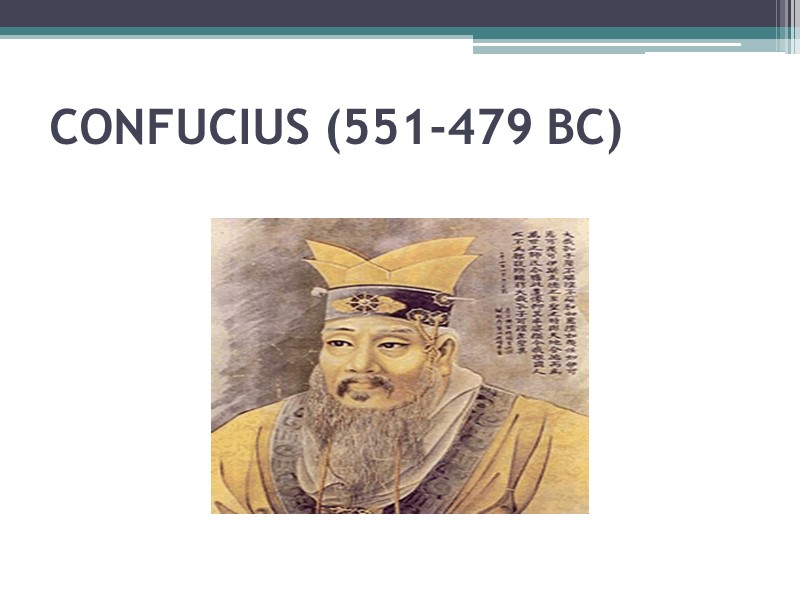
CONFUCIANISM focuses on the ethical rules, social norms and regulation control Confucius (551-479 BCE), his name is latinized version of the name Kung Fu Tzu (teacher Kun) He is one of the first Chinese thinkers, philosophers
CONFUCIUS (551-479 BC)
CONFUCIANISM understood man in connection with his social function, and education is to bring people to the execution (атқару/исполнение) of this function the social order established through the ideal of universality, respect to nature and, especially, relations between people this realization of functions and order based on the order leads to the manifestation of humanity
SCHOOL OF YIN AND YANG the central concept of Inyan Jia - universal dualism forces of Yin-Yang the cyclical nature of interactions generated by these five elements: metal, wood, water, fire and earth this concept considers all of the developed of the world
SCHOOL OF MOISM school was named after the founder Moe Dee (479-391 BC) the main attention was primarily paid to the problems of social ethics, which is connected through a strict organization with the despotic power of the head the whole meaning was to the ideas of universal love and mutual benefit of people
SCHOOL OF NAMES examined the relations of things and the very expression of that relationship examined the judgments and notions
LEGISM formed almost as a teaching that focused primarily on issues of socio-political change in the era of “warring states” (5-4 centuries BC)
TAOISM one of the major directions in China studies nature, space and people in movement learns universe through direct penetration into the conceptual nature of its existence the world is in constant motion and change, evolving, living and acting on impulse (игерусіз/спонтанно)
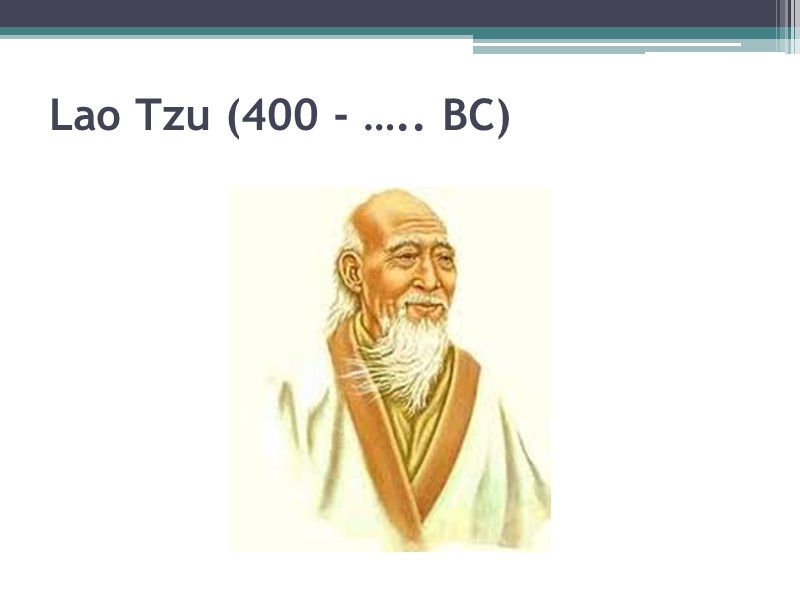
Lao Tzu (400 - ….. BC)
TAOISM the purpose of thinking, in Taoism, is “merger” (қосылуы/слияние) between man and nature, because he is its part Lao Tzu (old teacher) is a senior contemporary of Confucius he wrote the book “Tao Te Ching”, which became the basis for further development of Taoism