


 Скачать презентацию ANCIENT AND CLASSICAL CHINA ANCIENT LEGENDS THE
7f1022941b884dfa74f7608db78c8607.ppt
- Количество слайдов: 30
 ANCIENT AND CLASSICAL CHINA
 ANCIENT LEGENDS: THE THREE WISE SAGE KINGS – King Yao: a virtuous ruler bringing harmony to society – King Shun: regulating the four seasons, weights, measures, and units of time – King Yu: rescued China from raging floods of the Yellow River Legends reflected the values of society; many may prove true!
 APPEARANCE OF HUMANS IN EAST ASIA – Beginnings were over two hundred thousand years ago – Domesticated rice around 7000 B. C. E. in the valley of the Yangzi River – Millet cultivation in the valley of the Yellow River – Wheat and barley became staple foods of north China by 2000 B. C. E.
 EMERGENCE OF CHINESE SOCIETY 2 ND MILLENNIUM BCE u Agricultural villages appeared in the valleys of the two rivers u u u Society was patriarchal Fathers dominated families Elder males ruled village Males performed religious sacrifices Cities, states appeared in north China during 2 nd millennium B. C. E. Three dynastic states in the valley of Yellow River: Xia, Shang, Zhou
 EARLY AGRARIAN SOCIETY – The Yellow River u Water source at high plateau of Tibet u Loess soil carried by the river's water, hence "yellow" u The river was "China's Sorrow" as it flooded uncontrollably u Loess: rich soil, soft, easy to work – Neolithic societies after 5000 B. C. E. u Yangshao society, 5000 -3000 B. C. E. u Excavations at Banpo village: fine pottery, bone tools
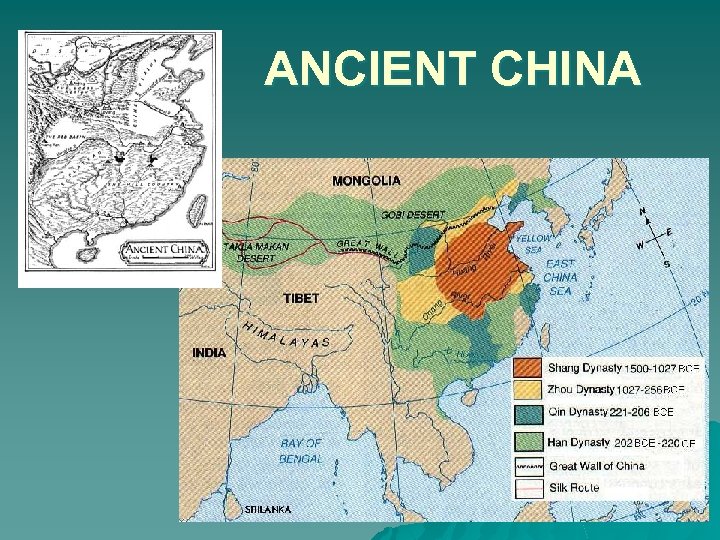 ANCIENT CHINA
 XIA DYNASTY • Archeological discovery of the Xia is still in its preliminary stage • Established about 2200 B. C. E. • Legendary King Yu, the dynasty founder, a hero of flood control • Erlitou: possibly the capital city of the Xia • Chinese scholars believe it existed
 THE SHANG DYNASTY: 1766 -1122 B. C. E. u u u u u Arose in the southern, eastern areas Many records, material remains discovered Bronze metallurgy, monopolized by elite Agricultural surpluses supported large troops Vast network of walled towns Shang-kings were warriors Constant struggle with nobles for power The Shang capital moved six times Lavish tombs of Shang kings – – Contained chariots, weapons, bronze goods Sacrificial human victims, dogs, horses
 MANDATE OF HEAVEN u The right to rule granted by heaven – – – u Zhou justified their overthrow of Shang Ruler called "the son of heaven" Only given to virtuous, strong rulers To lose mandate = someone else should rule Replacement of dynasties = Dynastic Cycle Signs one had lost mandate – – – Corruption, heavy taxes Lazy officials and rulers Revolts, invasions, civil wars, crime Natural disasters Society develops bad morals, habits
 THE ZHOU DYNASTY: 1122 -256 B. C. E. – The rise of the Zhou u The last Shang king was a bad ruler u The Zhou forces toppled the Shang – Political organization u u u Adopted decentralized administration Used princes and relatives to rule regions Consequences – Weak central government with ceremonial functions – Rise of regional powers; often called feudalism – Constant rivalry between warring families, nobles
 FAMILY u u Xia to Zhou ruled through family, kinship Veneration of ancestors u u u Belief in ancestors' presence, continuing influence Burial of material goods with the dead Offering sacrifices at the graves Eldest males presided over rites honoring ancestors Only males could perform religious duties Patriarchal society u During Neolithic times, Chinese society = matrilineal Rise of states, war due to men's contribution s u After Shang, not even queens merited temples u
 THE SOCIAL ORDER u The ruling elites u u u Peasants, the majority of population u u u Royal family and allied noble families at the top Their lavish consumption of bronze products, silk Hereditary aristocrats with extensive landholding Most of the land owned by the king, nobles Called the “mean” people Landless peasants provided labor Lived in small subterranean houses Wood, bone, stone tools before iron spread in the 6 th century B. C. E. Women’s World u u u Wine making, weaving, silkworm raising Managing household, raising children Elite women vs. poor women
 OTHERS u Specialized labor u u u Merchants, trade were important u u Jade from Central Asia, tin from SE Asia A few pieces of pottery from India Merchants ranked socially lower Slaves u u Free artisans, craftsmen in great demand Also served the needs of the ruling elites Mostly war prisoners Performed hard work Became sacrificial victims Suspicious towards Foreigners
 CHINESE POPULAR RELIGION u Customary beliefs and practice – As old as civilization in China – Never encouraged/discouraged by state u Believes gods, spirits (shen) influence family, world – – u Power over world affairs Deceased members of community, family Deified figures of history, literature Spiritual embodiment of nature, geography Maintenance of family shrines, community temples – – – Prayers, supplications Food offerings Shamanism and divination are practiced
 THE FALL OF THE ZHOU u Iron metallurgy. – – u u Iron weapons helped regional authorities to resist the central power Qin mastered iron technology, weapons Nomadic invasion sacked capital Other Troubles – – Territorial princes became more independent Warring States (403 -221 B. C. E. ) Rise of Qin state Last king abdicated his position in 256 B. C. E.
 THOUGHT, LITERATURE u Zhou literature u u u The Book of Change, a manual of diviners The Book of History, the history of the Zhou The Book of Rites – The rules of etiquette and rituals for aristocrats u The Book of Songs – The most notable of the classic works – Verses on themes both light and serious – Reflected social conditions of the early Zhou u Destruction of early literature u u Most Zhou writings have perished 1 st emperor destroyed most writings
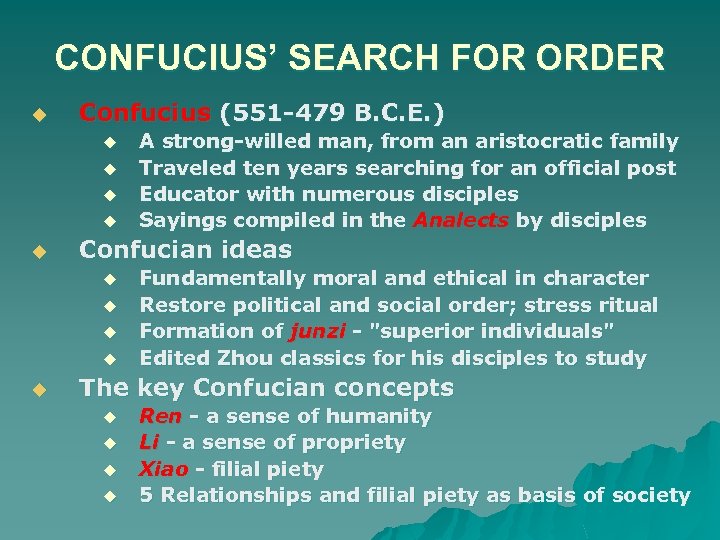 CONFUCIUS’ SEARCH FOR ORDER u Confucius (551 -479 B. C. E. ) u u u Confucian ideas u u u A strong-willed man, from an aristocratic family Traveled ten years searching for an official post Educator with numerous disciples Sayings compiled in the Analects by disciples Fundamentally moral and ethical in character Restore political and social order; stress ritual Formation of junzi - "superior individuals" Edited Zhou classics for his disciples to study The key Confucian concepts u u Ren - a sense of humanity Li - a sense of propriety Xiao - filial piety 5 Relationships and filial piety as basis of society
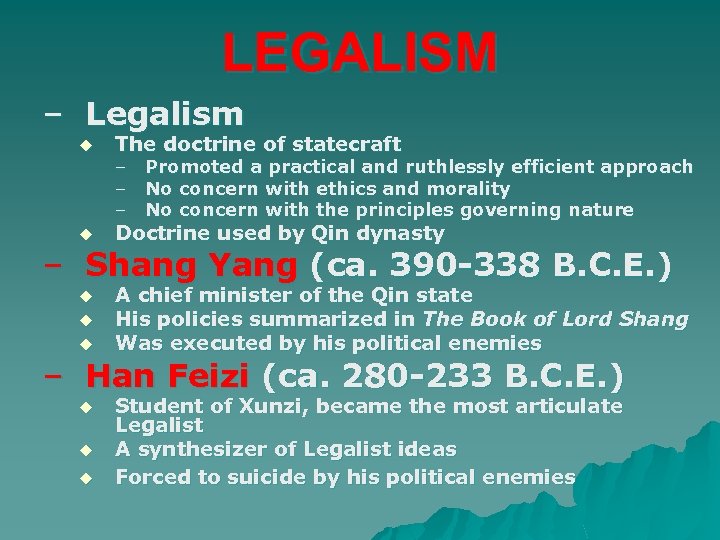 LEGALISM – Legalism u The doctrine of statecraft u Doctrine used by Qin dynasty – Promoted a practical and ruthlessly efficient approach – No concern with ethics and morality – No concern with the principles governing nature – Shang Yang (ca. 390 -338 B. C. E. ) u u u A chief minister of the Qin state His policies summarized in The Book of Lord Shang Was executed by his political enemies – Han Feizi (ca. 280 -233 B. C. E. ) u u u Student of Xunzi, became the most articulate Legalist A synthesizer of Legalist ideas Forced to suicide by his political enemies
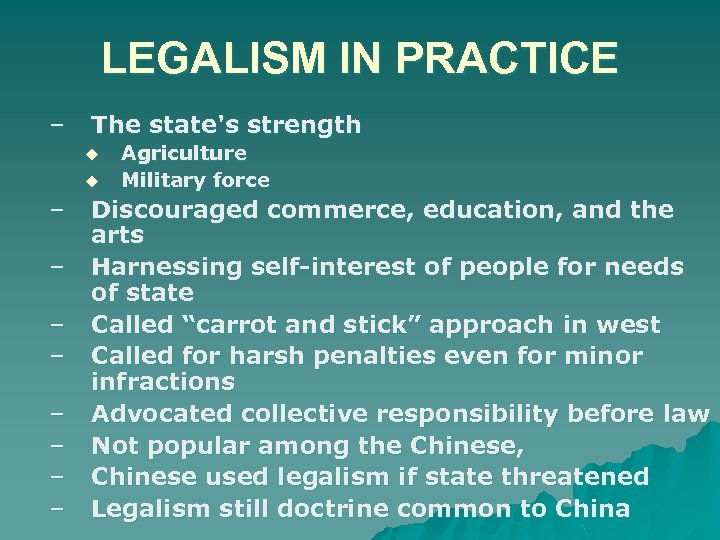 LEGALISM IN PRACTICE – The state's strength u u – – – – Agriculture Military force Discouraged commerce, education, and the arts Harnessing self-interest of people for needs of state Called “carrot and stick” approach in west Called for harsh penalties even for minor infractions Advocated collective responsibility before law Not popular among the Chinese, Chinese used legalism if state threatened Legalism still doctrine common to China
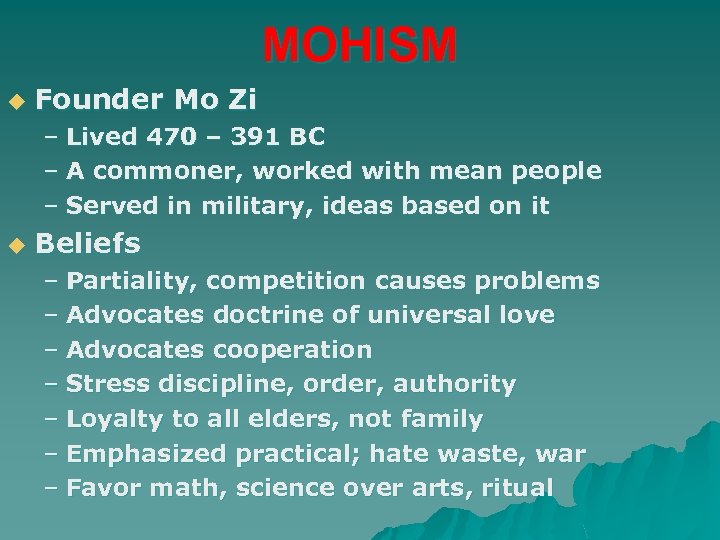 MOHISM u Founder Mo Zi – Lived 470 – 391 BC – A commoner, worked with mean people – Served in military, ideas based on it u Beliefs – Partiality, competition causes problems – Advocates doctrine of universal love – Advocates cooperation – Stress discipline, order, authority – Loyalty to all elders, not family – Emphasized practical; hate waste, war – Favor math, science over arts, ritual
 DAOISM u Prominent critics of Confucianism u u Laozi and Zhuangzi u u Understand natural principles, live in harmony with them Laozi, founder of Daoism; wrote the Daodejing Philosophical Daoism u u u Dao - The way of nature, the way of the cosmos Opposites in balance, complementary Passive, yielding, does nothing , accomplishes everything Tailor behavior to passive, yielding nature Ambition, activism brought the world to chaos
 DAOIST WUWEI – The doctrine of wuwei u u u Disengagement from worldly affairs Called for simple, unpretentious life, living in harmony with nature Advocated small state, self-sufficient community – Political implications u u u Served as a counterbalance to Confucian activism Individuals could live as Confucians by day, Daoists by night Generally Daoism flourishes when society at peace, prosperous
 UNIFICATION OF CHINA u The Qin State and Dynasty – – u Located in west China and adopted Legalist policies Encouraged agriculture, resulted in strong economy Organized a powerful army equipped with iron weapons Conquered other states and unified China in 221 B. C. E. Qin Shi Huang di – – – King of the Qin proclaimed himself First Emperor, 221 B. C. E. Established centralized imperial rule Held sons of nobles as hostages; demolished nobles castles Project of connecting and extending the Great Wall 700, 000 people worked on project; 100, 000 killed
 QIN STATECRAFT u Suppressing the resistance – – – u u u Bitterly opposed, was opposed by Confucian scholars Buried 460 scholars alive because of their criticism against the Qin Burned all books except some with utilitarian value – – – Standardization of laws, currencies, weights, measures Standardized scripts: tried to create uniform language Creates a uniform writing system but not language – – – The tomb was an underground palace Excavation of the tomb since 1974 Terracotta soldiers and army to protect tomb – – – Massive public works generated ill will among people Waves of rebels overwhelmed the Qin court in 207 B. C. E. A short-lived dynasty, left deep marks in Chinese history Policies of centralization Tomb of the First Emperor The collapse of the Qin dynasty
 THE EARLY HAN DYNASTY – – Han was long-lived dynasty Early Han policies u u Sought middle way between Zhou and Qin Royal relatives were not reliable, returned to centralized rule – Martial Emperor (141 -87 B. C. E. ) u u Han Wudi ruled for 54 years Pursued centralization and expansion
 HAN STATECRAFT u – Han centralization Adopted Legalist policies u u – Established Confucian educational system for training bureaucrats u u u – – Built an enormous bureaucracy to rule the empire Continued to build roads and canals Levied taxes on agriculture, trade, and craft industries Imperial monopolies on production of iron and salt Confucianism as the basis of the curriculum in imperial university Thirty thousand students enrolled in the university in Later Han imperial expansion Invaded and colonized northern Vietnam and Korea Extended China into central Asia
 HAN SOCIAL STRUCTURE • • • Large, multigenerational compound families also developed Women's subordination (Ban Zhao Admonitions for Women) Differences apparent between noble, lower class women Scholar bureaucrats: Confucian trained bureaucrats • Scholar Gentry • Merchants held in low social esteem • • • Officials selected through competitive testing Used to run the government in Early Han • • • Confucian bureaucrats intermarried with landed elite New class comes to dominate local, national offices Strongest in late Han
 TRADE AND COMMERCE – – – Iron metallurgy: Farming tools, utensils, and weapons State monopolies on liquor, salt and iron Silk textiles u u – Paper production u – u Invented Began to probably before 100 C. E. replace silk and bamboo as writing materials Population growth u – High quality Chinese silk became a prized commodity Traded as far a field as India, Persia, Mesopotamia, and Rome u Increased from twenty to sixty million from 220 B. C. E. to 9 C. E. Despite light taxation, state revenue was large Silk Road established: horses for silk
 HAN TROUBLES u Expeditions consumed the empire's surplus u u Raised taxes and confiscated land of some wealthy individuals Much of defense consumed on defending against nomads Social tensions, stratification between the poor and rich Problems of land distribution – Early Han supported land redistribution – Lands accumulated in the hands of a few
 LOSS OF THE MANDATE – Collapse of the Han u u u Factions at court paralyzed the central government Han empire dissolved China was divided into regional kingdoms