 Скачать презентацию Anatoly B Chubais CEO RUSNANO Building an Innovation
4779e293fcf2c06d27f9e402676a11d4.ppt
- Количество слайдов: 21



Anatoly B. Chubais CEO RUSNANO Building an Innovation Economy in Russia: an Exercise in Conceptualization January 23, 2010
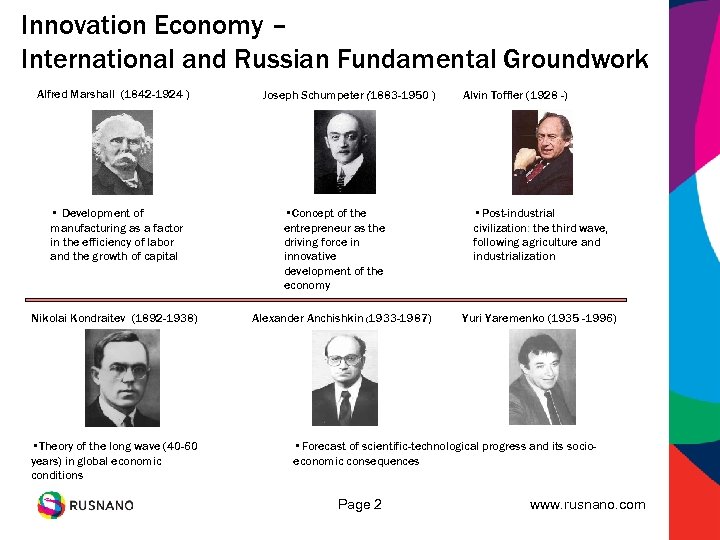
Innovation Economy – International and Russian Fundamental Groundwork Alfred Marshall (1842 -1924 ) • Development of manufacturing as a factor in the efficiency of labor and the growth of capital Nikolai Kondraitev (1892 -1938) • Theory of the long wave (40 -60 years) in global economic conditions Joseph Schumpeter (1883 -1950 ) • Concept of the entrepreneur as the driving force in innovative development of the economy Alexander Anchishkin (1933 -1987) Alvin Toffler (1928 -) • Post-industrial civilization: the third wave, following agriculture and industrialization Yuri Yaremenko (1935 -1996) • Forecast of scientific-technological progress and its socioeconomic consequences Page 2 www. rusnano. com
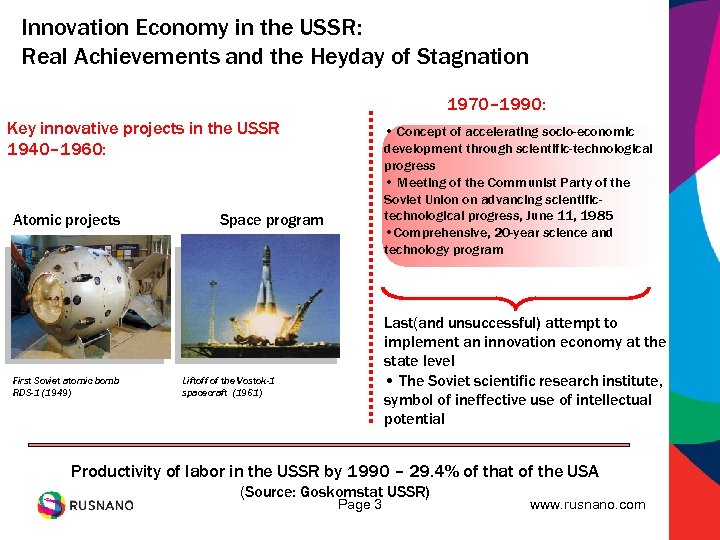
Innovation Economy in the USSR: Real Achievements and the Heyday of Stagnation 1970– 1990: Key innovative projects in the USSR 1940– 1960: Atomic projects First Soviet atomic bomb RDS-1 (1949) • Concept of accelerating socio-economic development through scientific-technological progress • Meeting of the Communist Party of the Soviet Union on advancing scientifictechnological progress, June 11, 1985 • Comprehensive, 20 -year science and technology program Space program Last(and unsuccessful) attempt to implement an innovation economy at the state level • The Soviet scientific research institute, symbol of ineffective use of intellectual potential Liftoff of the Vostok-1 spacecraft (1961) Productivity of labor in the USSR by 1990 – 29. 4% of that of the USA (Source: Goskomstat USSR) Page 3 www. rusnano. com
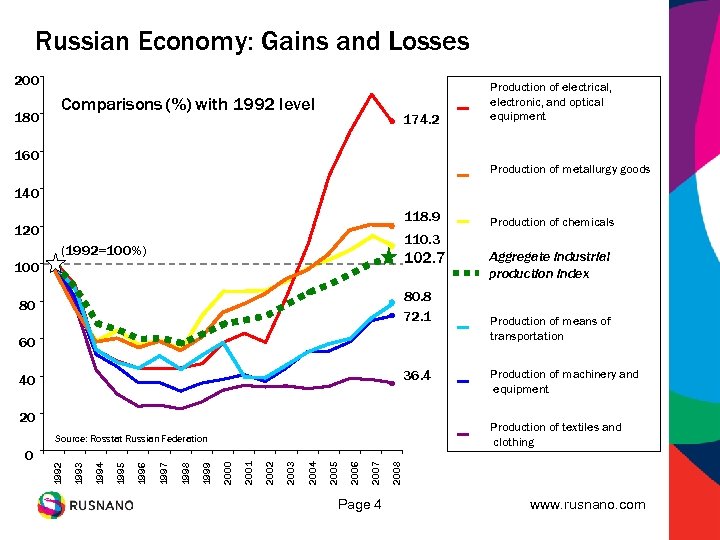
Russian Economy: Gains and Losses 200 180 Comparisons (%) with 1992 level 174. 2 160 Production of electrical, electronic, and optical equipment Production of metallurgy goods 140 118. 9 120 110. 3 (1992=100%) 102. 7 100 80. 8 72. 1 80 60 36. 4 40 20 Production of means of transportation Production of machinery and equipment Page 4 2008 2007 2006 2005 2004 2003 2002 2001 2000 1999 1998 1997 1996 1995 1994 1993 1992 Aggregate industrial production index Production of textiles and clothing Source: Rosstat Russian Federation 0 Production of chemicals www. rusnano. com
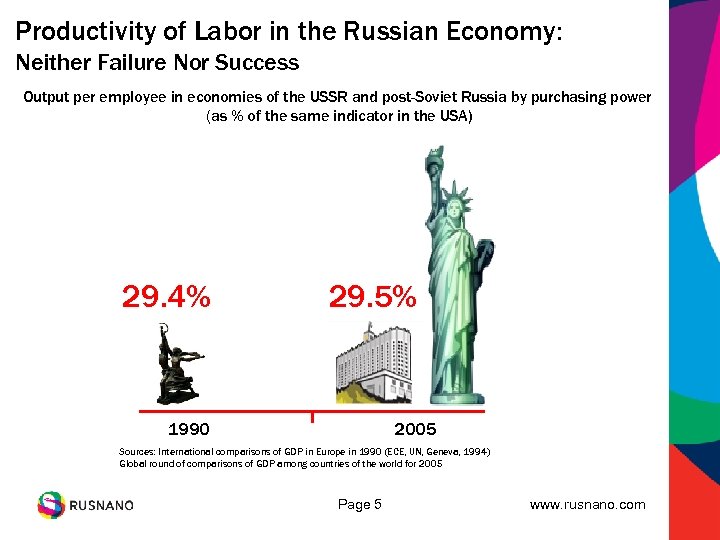
Productivity of Labor in the Russian Economy: Neither Failure Nor Success Output per employee in economies of the USSR and post-Soviet Russia by purchasing power (as % of the same indicator in the USA) 29. 4% 29. 5% 1990 2005 Sources: International comparisons of GDP in Europe in 1990 (ECE, UN, Geneva, 1994) Global round of comparisons of GDP among countries of the world for 2005 Page 5 www. rusnano. com
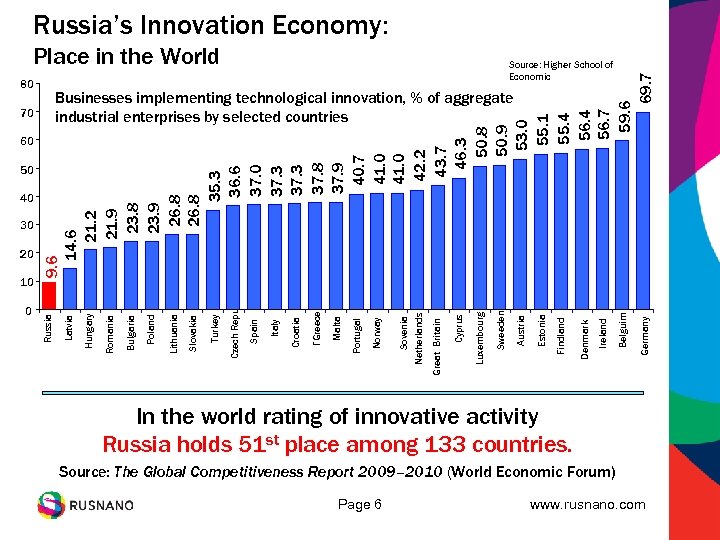
Russia’s Innovation Economy: Place in the World Germany Belguim Ireland Denmark Findland Estonia Austria Sweeden Luxembourg Cyprus Great Britain Sovenia Netherlands Norway Portugal Malta ГGreece Croatia Italy Spain Czech Republic Тurkey Slovakia 0 Lithuania 10 Poland 20 Bulgaria 30 Romania 40 Hungary 50 9. 6 14. 6 21. 2 21. 9 23. 8 23. 9 26. 8 35. 3 36. 6 37. 0 37. 3 37. 8 37. 9 40. 7 41. 0 42. 2 43. 7 46. 3 50. 8 50. 9 53. 0 55. 1 55. 4 56. 7 59. 6 69. 7 60 Latvia 70 Businesses implementing technological innovation, % of aggregate industrial enterprises by selected countries Russia 80 Source: Higher School of Economic In the world rating of innovative activity Russia holds 51 st place among 133 countries. Source: The Global Competitiveness Report 2009– 2010 (World Economic Forum) Page 6 www. rusnano. com
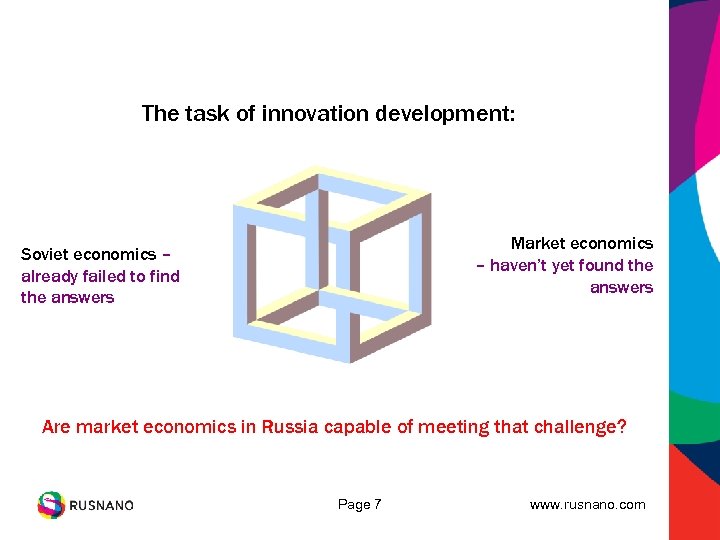
The task of innovation development: Market economics – haven’t yet found the answers Soviet economics – already failed to find the answers Are market economics in Russia capable of meeting that challenge? Page 7 www. rusnano. com
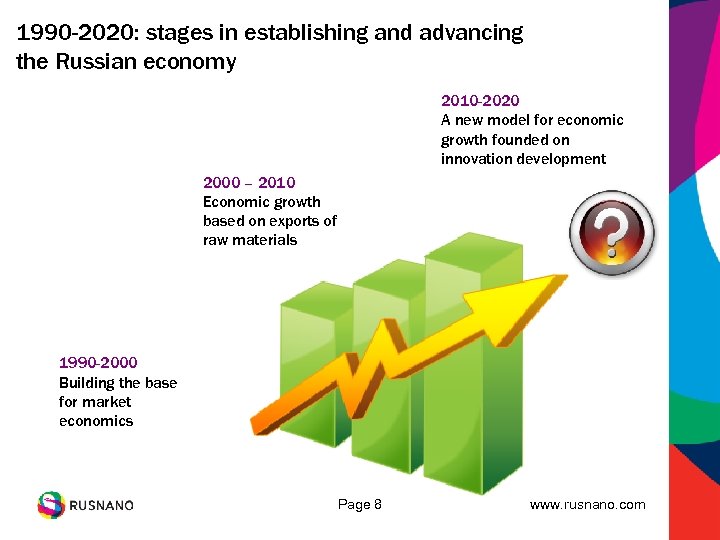
1990 -2020: stages in establishing and advancing the Russian economy 2010 -2020 A new model for economic growth founded on innovation development 2000 – 2010 Economic growth based on exports of raw materials 1990 -2000 Building the base for market economics Page 8 www. rusnano. com
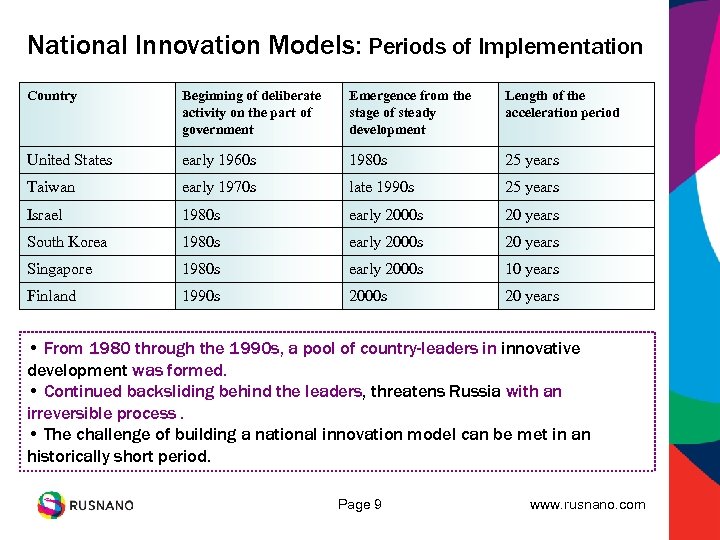
National Innovation Models: Periods of Implementation Country Beginning of deliberate activity on the part of government Emergence from the stage of steady development Length of the acceleration period United States early 1960 s 1980 s 25 years Taiwan early 1970 s late 1990 s 25 years Israel 1980 s early 2000 s 20 years South Korea 1980 s early 2000 s 20 years Singapore 1980 s early 2000 s 10 years Finland 1990 s 2000 s 20 years • From 1980 through the 1990 s, a pool of country-leaders in innovative development was formed. • Continued backsliding behind the leaders, threatens Russia with an irreversible process. • The challenge of building a national innovation model can be met in an historically short period. Page 9 www. rusnano. com
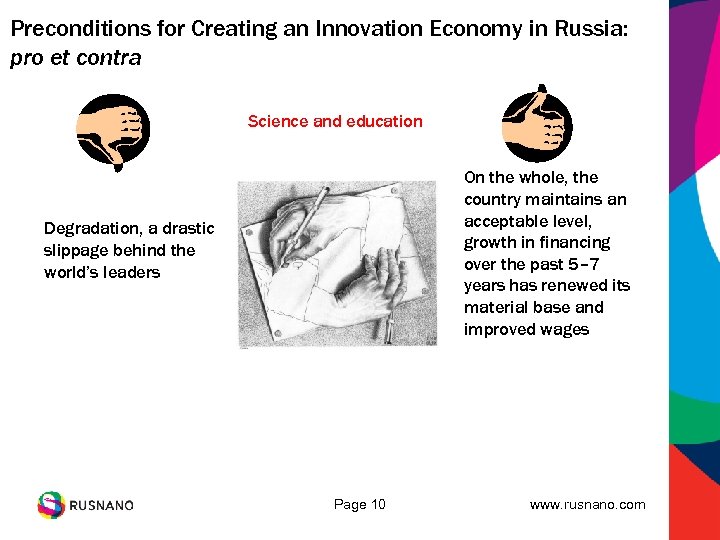
Preconditions for Creating an Innovation Economy in Russia: pro et contra Science and education On the whole, the country maintains an acceptable level, growth in financing over the past 5– 7 years has renewed its material base and improved wages Degradation, a drastic slippage behind the world’s leaders Page 10 www. rusnano. com
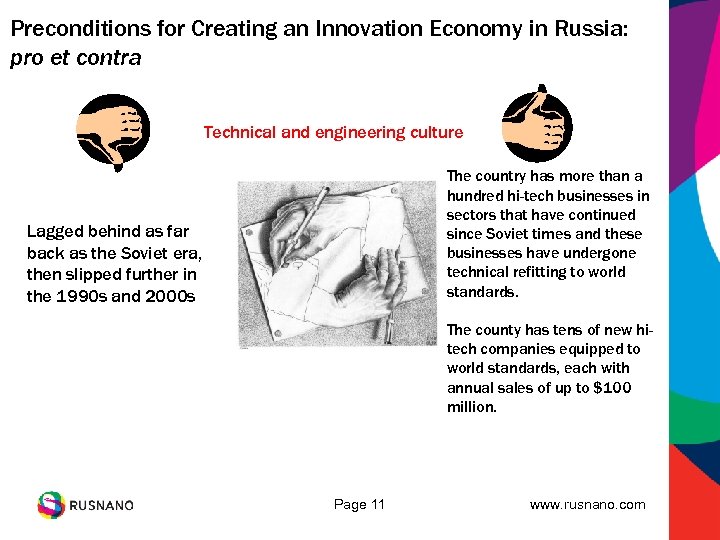
Preconditions for Creating an Innovation Economy in Russia: pro et contra Technical and engineering culture The country has more than a hundred hi-tech businesses in sectors that have continued since Soviet times and these businesses have undergone technical refitting to world standards. Lagged behind as far back as the Soviet era, then slipped further in the 1990 s and 2000 s The county has tens of new hitech companies equipped to world standards, each with annual sales of up to $100 million. Page 11 www. rusnano. com
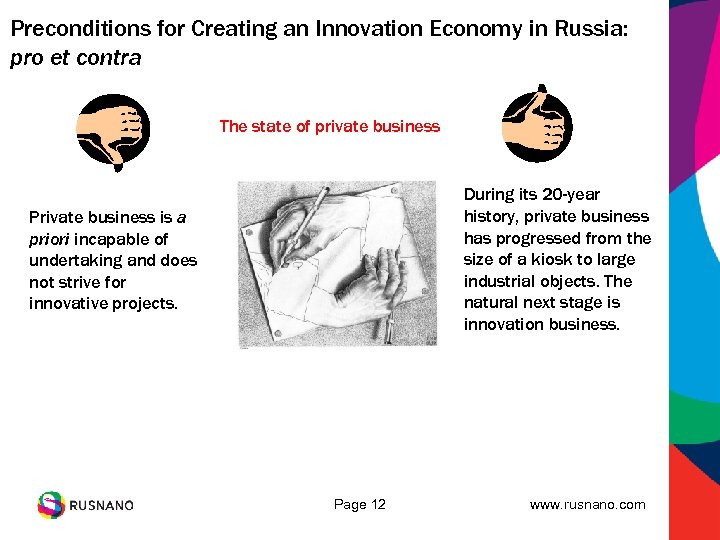
Preconditions for Creating an Innovation Economy in Russia: pro et contra The state of private business During its 20 -year history, private business has progressed from the size of a kiosk to large industrial objects. The natural next stage is innovation business. Private business is a priori incapable of undertaking and does not strive for innovative projects. Page 12 www. rusnano. com
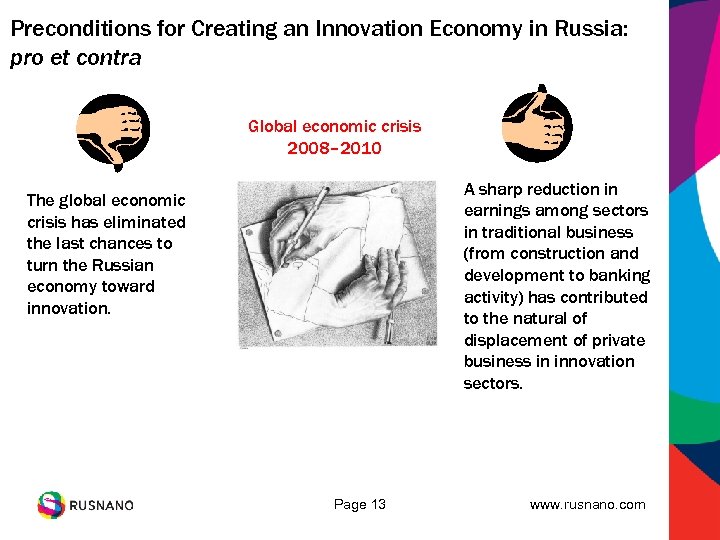
Preconditions for Creating an Innovation Economy in Russia: pro et contra Global economic crisis 2008– 2010 A sharp reduction in earnings among sectors in traditional business (from construction and development to banking activity) has contributed to the natural of displacement of private business in innovation sectors. The global economic crisis has eliminated the last chances to turn the Russian economy toward innovation. Page 13 www. rusnano. com
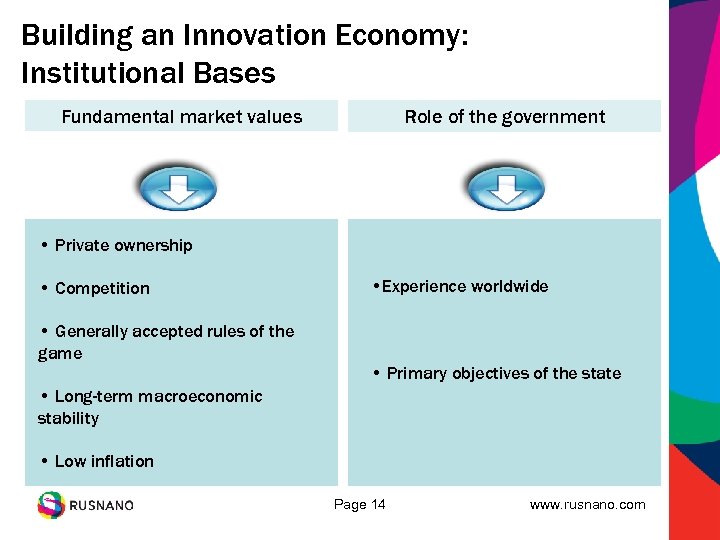
Building an Innovation Economy: Institutional Bases Fundamental market values Role of the government • Private ownership • Competition • Generally accepted rules of the game • Experience worldwide • Primary objectives of the state • Long-term macroeconomic stability • Low inflation Page 14 www. rusnano. com
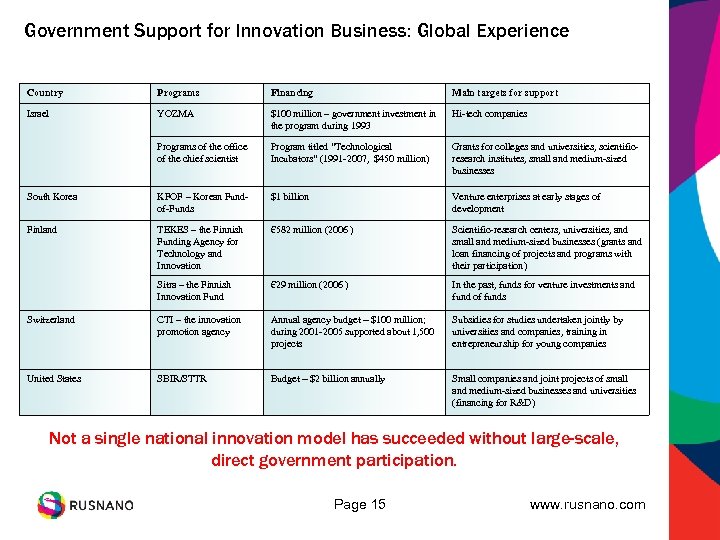
Government Support for Innovation Business: Global Experience Country Programs Financing Main targets for support Israel YOZMA $100 million – government investment in the program during 1993 Hi-tech companies Programs of the office of the chief scientist Program titled “Technological Incubators” (1991 -2007, $450 million) Grants for colleges and universities, scientificresearch institutes, small and medium-sized businesses South Korea KFOF – Korean Fundof-Funds $1 billion Venture enterprises at early stages of development Finland TEKES – the Finnish Funding Agency for Technology and Innovation € 582 million (2006 ) Scientific-research centers, universities, and small and medium-sized businesses (grants and loan financing of projects and programs with their participation) Sitra – the Finnish Innovation Fund € 29 million (2006 ) In the past, funds for venture investments and fund of funds Switzerland CTI – the innovation promotion agency Annual agency budget ~ $100 million; during 2001 -2005 supported about 1, 500 projects Subsidies for studies undertaken jointly by universities and companies, training in entrepreneurship for young companies United States SBIR/STTR Budget ~ $2 billion annually Small companies and joint projects of small and medium-sized businesses and universities (financing for R&D) Not a single national innovation model has succeeded without large-scale, direct government participation. Page 15 www. rusnano. com
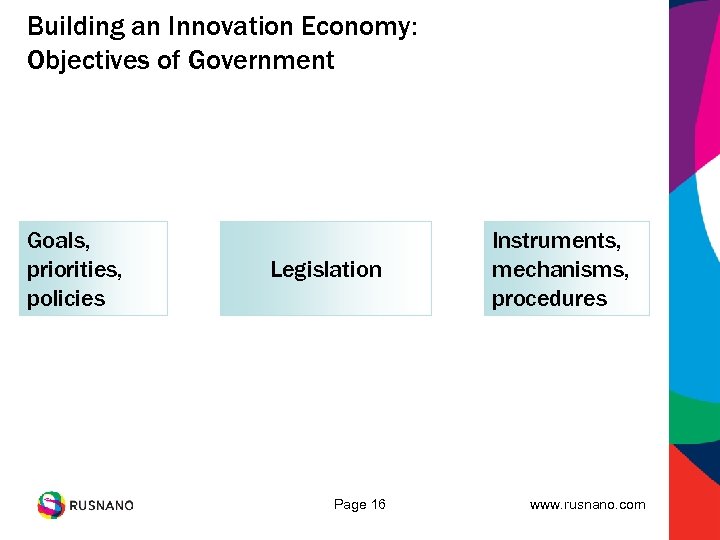
Building an Innovation Economy: Objectives of Government Goals, priorities, policies Legislation Page 16 Instruments, mechanisms, procedures www. rusnano. com
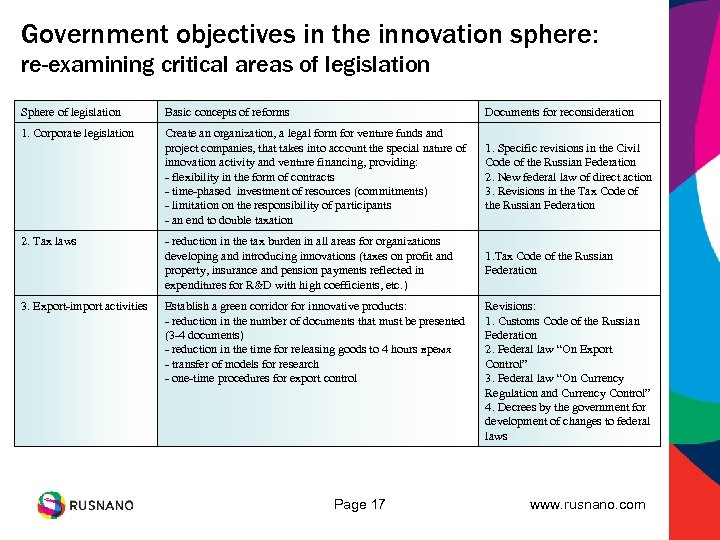
Government objectives in the innovation sphere: re-examining critical areas of legislation Sphere of legislation Basic concepts of reforms Documents for reconsideration 1. Corporate legislation Create an organization, a legal form for venture funds and project companies, that takes into account the special nature of innovation activity and venture financing, providing: - flexibility in the form of contracts - time-phased investment of resources (commitments) - limitation on the responsibility of participants - an end to double taxation 1. Specific revisions in the Civil Code of the Russian Federation 2. New federal law of direct action 3. Revisions in the Tax Code of the Russian Federation - reduction in the tax burden in all areas for organizations developing and introducing innovations (taxes on profit and property, insurance and pension payments reflected in expenditures for R&D with high coefficients, etc. ) 1. Tax Code of the Russian Federation 2. Tax laws 3. Export-import activities Establish a green corridor for innovative products: - reduction in the number of documents that must be presented (3 -4 documents) - reduction in the time for releasing goods to 4 hours время - transfer of models for research - one-time procedures for export control Page 17 Revisions: 1. Customs Code of the Russian Federation 2. Federal law “On Export Control” 3. Federal law “On Currency Regulation and Currency Control” 4. Decrees by the government for development of changes to federal laws www. rusnano. com
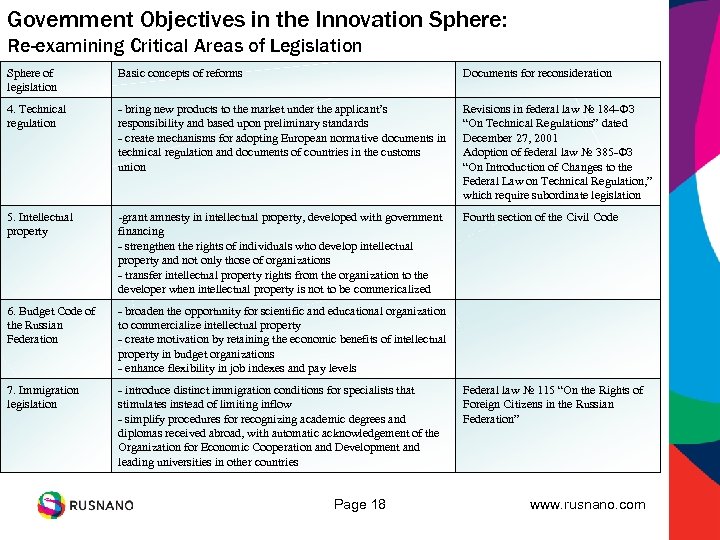
Government Objectives in the Innovation Sphere: Re-examining Critical Areas of Legislation Sphere of legislation Basic concepts of reforms Documents for reconsideration 4. Technical regulation - bring new products to the market under the applicant’s responsibility and based upon preliminary standards - create mechanisms for adopting European normative documents in technical regulation and documents of countries in the customs union Revisions in federal law № 184 -ФЗ “On Technical Regulations” dated December 27, 2001 Adoption of federal law № 385 -ФЗ “On Introduction of Changes to the Federal Law on Technical Regulation, ” which require subordinate legislation 5. Intellectual property -grant amnesty in intellectual property, developed with government financing - strengthen the rights of individuals who develop intellectual property and not only those of organizations - transfer intellectual property rights from the organization to the developer when intellectual property is not to be commericalized Fourth section of the Civil Code 6. Budget Code of the Russian Federation - broaden the opportunity for scientific and educational organization to commercialize intellectual property - create motivation by retaining the economic benefits of intellectual property in budget organizations - enhance flexibility in job indexes and pay levels 7. Immigration legislation - introduce distinct immigration conditions for specialists that stimulates instead of limiting inflow - simplify procedures for recognizing academic degrees and diplomas received abroad, with automatic acknowledgement of the Organization for Economic Cooperation and Development and leading universities in other countries Page 18 Federal law № 115 “On the Rights of Foreign Citizens in the Russian Federation” www. rusnano. com
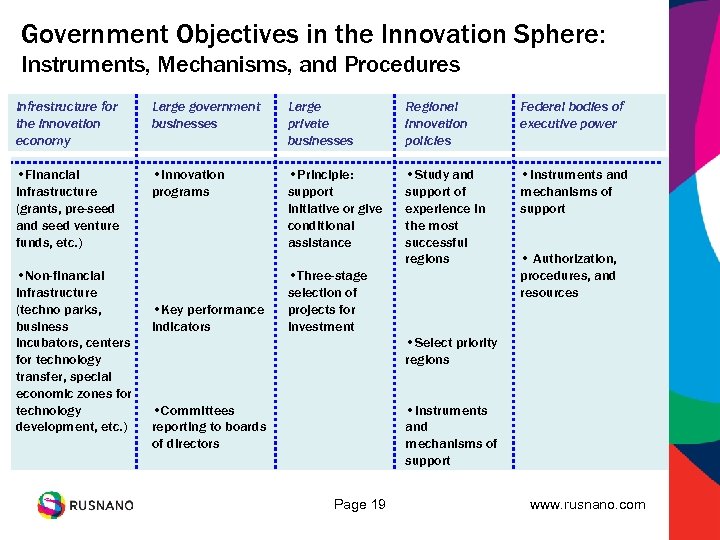
Government Objectives in the Innovation Sphere: Instruments, Mechanisms, and Procedures Infrastructure for the innovation economy Large government businesses Large private businesses Regional innovation policies Federal bodies of executive power • Financial infrastructure (grants, pre-seed and seed venture funds, etc. ) • Innovation programs • Principle: support initiative or give conditional assistance • Study and support of experience in the most successful regions • Instruments and mechanisms of support • Non-financial infrastructure (techno parks, business incubators, centers for technology transfer, special economic zones for technology development, etc. ) • Key performance indicators • Тhree-stage selection of projects for investment • Authorization, procedures, and resources • Select priority regions • Instruments and mechanisms of support • Committees reporting to boards of directors Page 19 www. rusnano. com
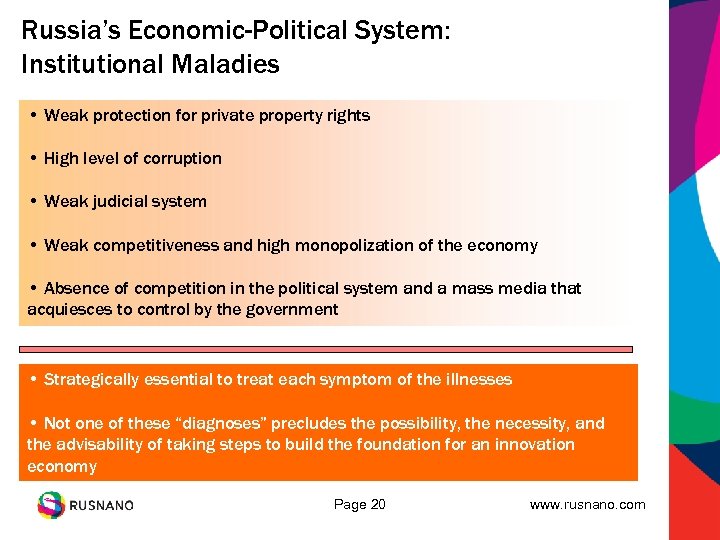
Russia’s Economic-Political System: Institutional Maladies • Weak protection for private property rights • High level of corruption • Weak judicial system • Weak competitiveness and high monopolization of the economy • Absence of competition in the political system and a mass media that acquiesces to control by the government • Strategically essential to treat each symptom of the illnesses • Not one of these “diagnoses” precludes the possibility, the necessity, and the advisability of taking steps to build the foundation for an innovation economy Page 20 www. rusnano. com
Conclusions 1. Innovative development is a charge that has not been fulfilled by either the Soviet or the Russian economy. 2. The historical reserve of time for establishing an innovation economy in Russia is dwindling away; separation from the leaders may become irreversible. 3. In today’s Russia, notwithstanding acute socio-political problems, neither the economic nor the socio-political mechanisms block the start of building an innovation economy. 4. An innovation economy in Russia can be built entirely on fundamental market institutes with simultaneous reconsideration of the role of government. 5. The building of an innovation economy in Russia is a tremendously complex socio-economic reform, requiring long-term political will and powerful intellectual support. But it can be carried out in foreseeable period of 10– 20 years. Page 21 www. rusnano. com
Скачать презентацию Anatoly B Chubais CEO RUSNANO Building an Innovation
4779e293fcf2c06d27f9e402676a11d4.ppt