 Скачать презентацию Analyzing Resources Capabilities OUTLINE The role
99e88d2482c6bc4e0629242ce87c457a.ppt
- Количество слайдов: 37



Analyzing Resources & Capabilities OUTLINE • The role of resources and capabilities in strategy formulation. • The resources of the firm • Organizational capabilities • Appraising the profit potential of resources and capabilities • Putting resource and capability analysis to work —a practical guide • Creating new capabilities.

Shifting the Focus of Strategy Analysis: From the External to the Internal Environment THE FIRM Goals and Values Resources and Capabilities Structure and Systems THE INDUSTRY ENVIRONMENT STRATEGY The Firm-Strategy Interface • Competitors • Customers • Suppliers The Environment-Strategy Interface
Rationale for the Resource-based Approach to Strategy • When the external environment is subject to rapid change, internal resources and capabilities offer a more secure basis for strategy than market focus. • Resources and capabilities are the primary sources of profitability
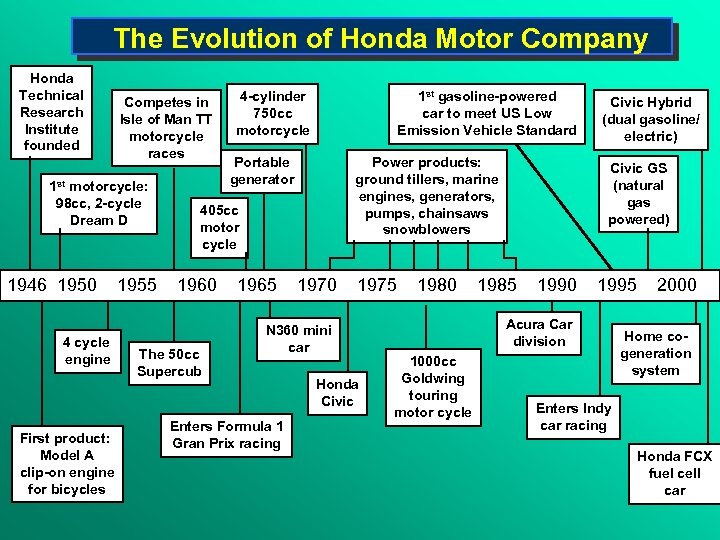
The Evolution of Honda Motor Company Honda Technical Research Institute founded Competes in Isle of Man TT motorcycle races 1 st motorcycle: 98 cc, 2 -cycle Dream D 1946 1950 4 cycle engine First product: Model A clip-on engine for bicycles 1955 4 -cylinder 750 cc motorcycle 1 st gasoline-powered car to meet US Low Emission Vehicle Standard Portable generator Power products: ground tillers, marine engines, generators, pumps, chainsaws snowblowers 405 cc motor cycle 1960 The 50 cc Supercub 1965 1970 1975 N 360 mini car Enters Formula 1 Gran Prix racing Honda Civic 1980 Civic Hybrid (dual gasoline/ electric) Civic GS (natural gas powered) 1985 1990 1995 Acura Car division 1000 cc Goldwing touring motor cycle 2000 Home cogeneration system Enters Indy car racing Honda FCX fuel cell car
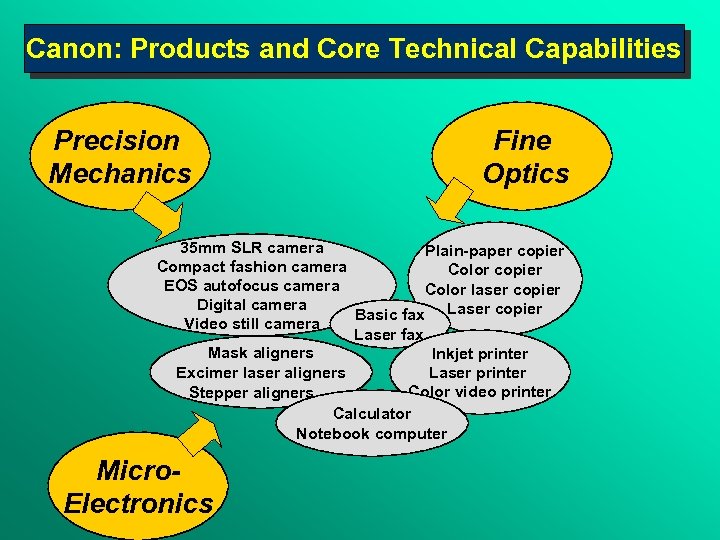
Canon: Products and Core Technical Capabilities Precision Mechanics Fine Optics 35 mm SLR camera Plain-paper copier Compact fashion camera Color copier EOS autofocus camera Color laser copier Digital camera Basic fax Laser copier Video still camera Laser fax Mask aligners Inkjet printer Excimer laser aligners Laser printer Color video printer Stepper aligners Calculator Notebook computer Micro. Electronics
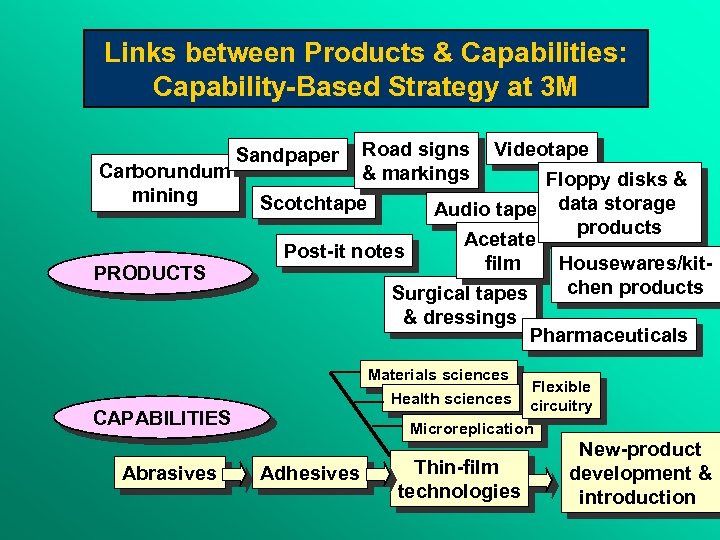
Links between Products & Capabilities: Capability-Based Strategy at 3 M Carborundum mining PRODUCTS Sandpaper Road signs & markings Videotape Floppy disks & Scotchtape Audio tape data storage products Acetate Post-it notes film Housewares/kitchen products Surgical tapes & dressings Materials sciences Health sciences Flexible circuitry Microreplication CAPABILITIES Abrasives Pharmaceuticals Adhesives Thin-film technologies New-product development & introduction
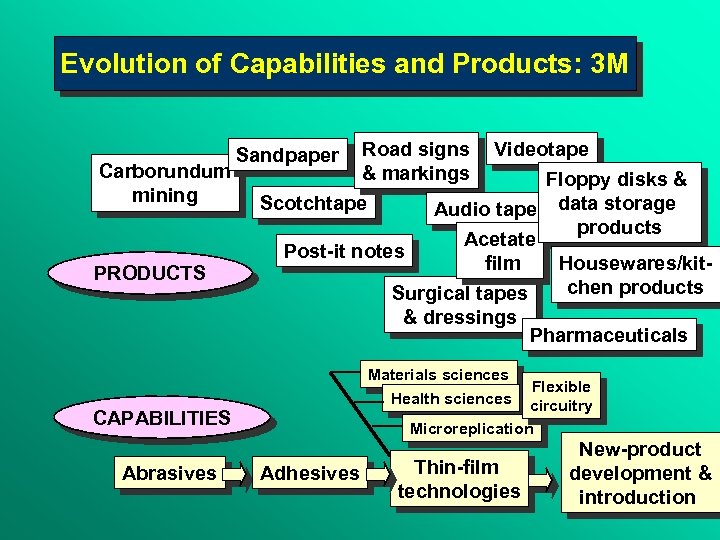
Evolution of Capabilities and Products: 3 M Carborundum mining PRODUCTS Sandpaper Road signs & markings Videotape Floppy disks & Scotchtape Audio tape data storage products Acetate Post-it notes film Housewares/kitchen products Surgical tapes & dressings Materials sciences Health sciences Flexible circuitry Microreplication CAPABILITIES Abrasives Pharmaceuticals Adhesives Thin-film technologies New-product development & introduction
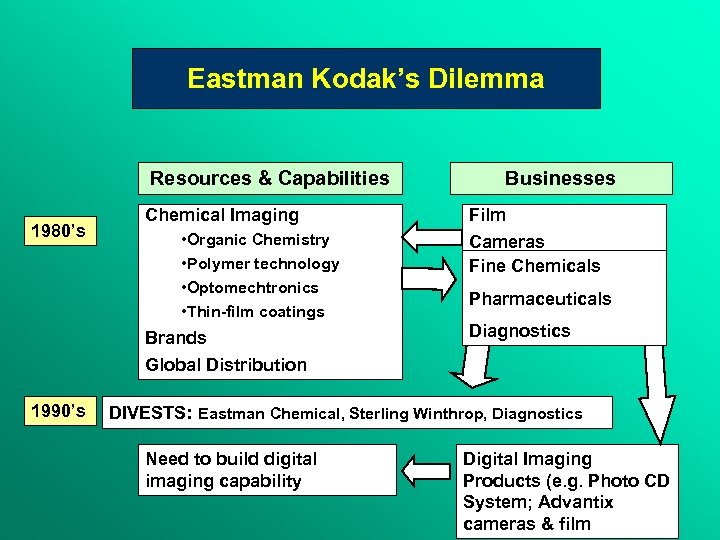
Eastman Kodak’s Dilemma Resources & Capabilities 1980’s Chemical Imaging • Organic Chemistry • Polymer technology • Optomechtronics • Thin-film coatings Brands Businesses Film Cameras Fine Chemicals Pharmaceuticals Diagnostics Global Distribution 1990’s DIVESTS: Eastman Chemical, Sterling Winthrop, Diagnostics Need to build digital imaging capability Digital Imaging Products (e. g. Photo CD System; Advantix cameras & film
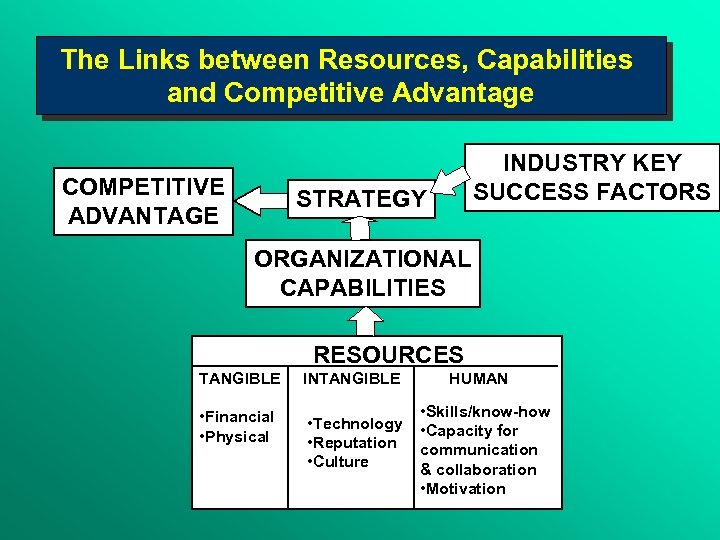
The Links between Resources, Capabilities and Competitive Advantage COMPETITIVE ADVANTAGE STRATEGY INDUSTRY KEY SUCCESS FACTORS ORGANIZATIONAL CAPABILITIES RESOURCES TANGIBLE INTANGIBLE HUMAN • Financial • Physical • Technology • Reputation • Culture • Skills/know-how • Capacity for communication & collaboration • Motivation
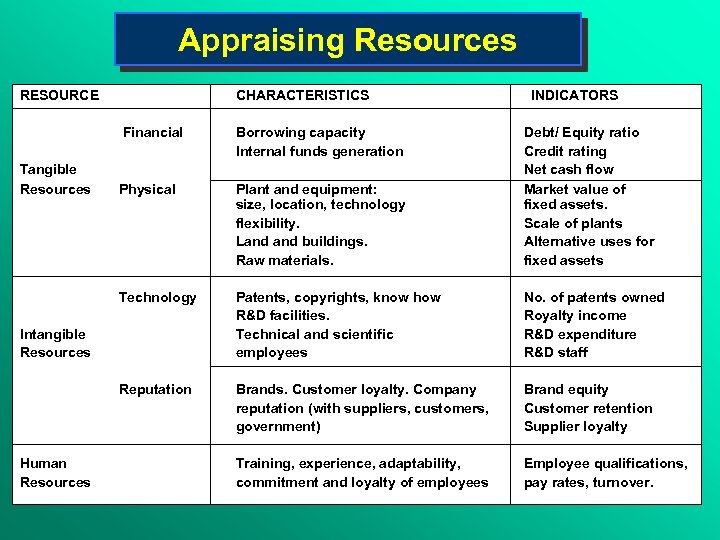
Appraising Resources RESOURCE Financial CHARACTERISTICS Plant and equipment: size, location, technology flexibility. Land buildings. Raw materials. Debt/ Equity ratio Credit rating Net cash flow Market value of fixed assets. Scale of plants Alternative uses for fixed assets Technology Patents, copyrights, know how R&D facilities. Technical and scientific employees No. of patents owned Royalty income R&D expenditure R&D staff Reputation Brands. Customer loyalty. Company reputation (with suppliers, customers, government) Brand equity Customer retention Supplier loyalty Training, experience, adaptability, commitment and loyalty of employees Employee qualifications, pay rates, turnover. Tangible Resources Physical Intangible Resources Human Resources Borrowing capacity Internal funds generation INDICATORS
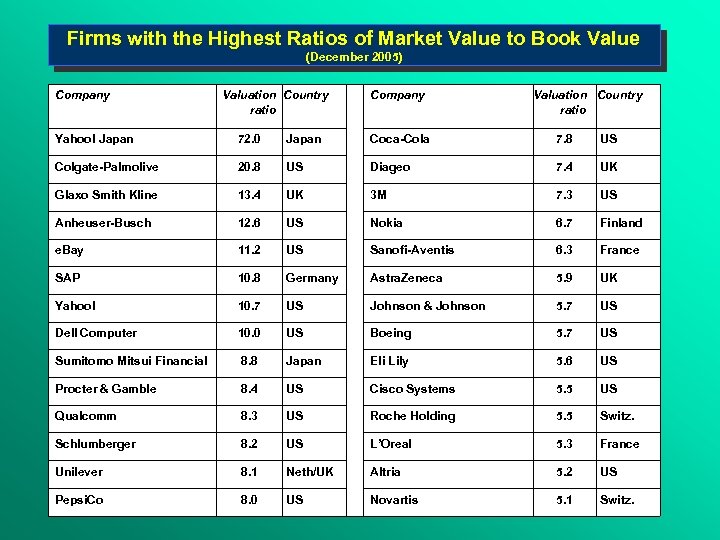
Firms with the Highest Ratios of Market Value to Book Value (December 2005) Company Valuation Country ratio Yahoo! Japan 72. 0 Japan Coca-Cola 7. 8 US Colgate-Palmolive 20. 8 US Diageo 7. 4 UK Glaxo Smith Kline 13. 4 UK 3 M 7. 3 US Anheuser-Busch 12. 6 US Nokia 6. 7 Finland e. Bay 11. 2 US Sanofi-Aventis 6. 3 France SAP 10. 8 Germany Astra. Zeneca 5. 9 UK Yahoo! 10. 7 US Johnson & Johnson 5. 7 US Dell Computer 10. 0 US Boeing 5. 7 US Sumitomo Mitsui Financial 8. 8 Japan Eli Lily 5. 6 US Procter & Gamble 8. 4 US Cisco Systems 5. 5 US Qualcomm 8. 3 US Roche Holding 5. 5 Switz. Schlumberger 8. 2 US L’Oreal 5. 3 France Unilever 8. 1 Neth/UK Altria 5. 2 US Pepsi. Co 8. 0 US Novartis 5. 1 Switz.
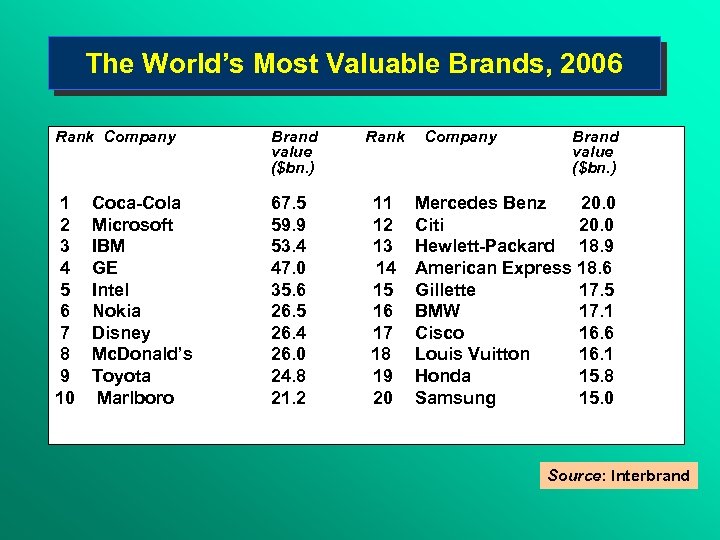
The World’s Most Valuable Brands, 2006 Rank Company Brand value ($bn. ) 1 2 3 4 5 6 7 8 9 10 67. 5 11 Mercedes Benz 20. 0 59. 9 12 Citi 20. 0 53. 4 13 Hewlett-Packard 18. 9 47. 0 14 American Express 18. 6 35. 6 15 Gillette 17. 5 26. 5 16 BMW 17. 1 26. 4 17 Cisco 16. 6 26. 0 18 Louis Vuitton 16. 1 24. 8 19 Honda 15. 8 21. 2 20 Samsung 15. 0 Coca-Cola Microsoft IBM GE Intel Nokia Disney Mc. Donald’s Toyota Marlboro Rank Company Brand value ($bn. ) Source: Interbrand
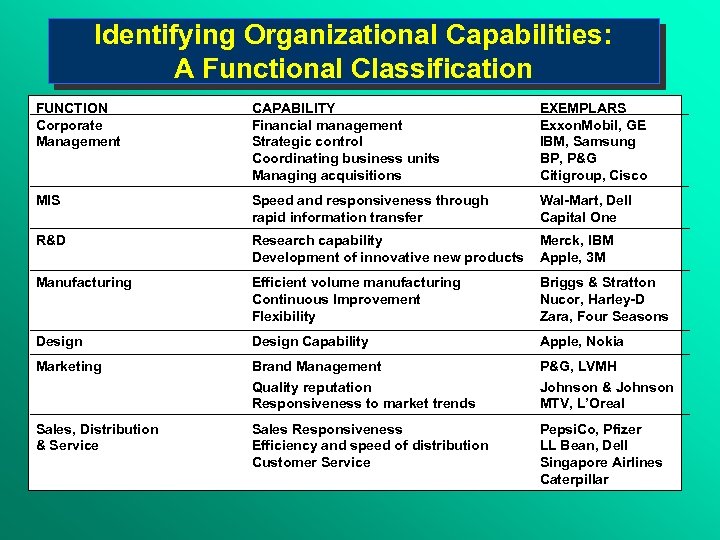
Identifying Organizational Capabilities: A Functional Classification FUNCTION Corporate Management CAPABILITY Financial management Strategic control Coordinating business units Managing acquisitions EXEMPLARS Exxon. Mobil, GE IBM, Samsung BP, P&G Citigroup, Cisco MIS Speed and responsiveness through rapid information transfer Wal-Mart, Dell Capital One R&D Research capability Development of innovative new products Merck, IBM Apple, 3 M Manufacturing Efficient volume manufacturing Continuous Improvement Flexibility Briggs & Stratton Nucor, Harley-D Zara, Four Seasons Design Capability Apple, Nokia Marketing Brand Management Quality reputation Responsiveness to market trends P&G, LVMH Johnson & Johnson MTV, L’Oreal Sales, Distribution & Service Sales Responsiveness Efficiency and speed of distribution Customer Service Pepsi. Co, Pfizer LL Bean, Dell Singapore Airlines Caterpillar
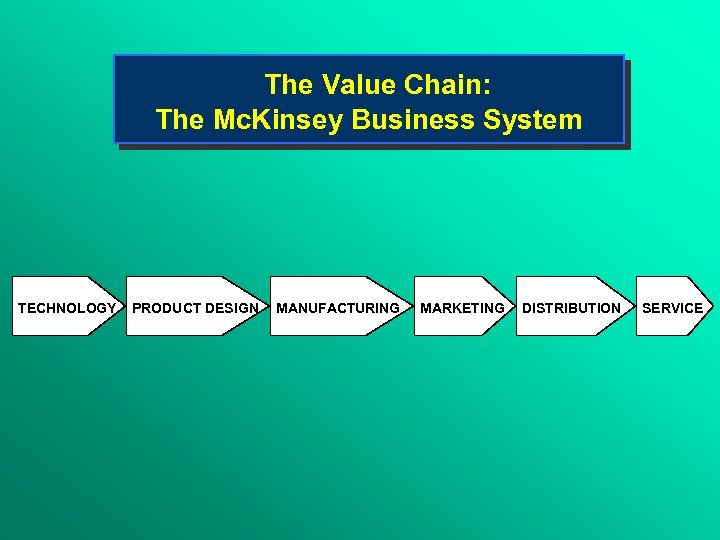
The Value Chain: The Mc. Kinsey Business System TECHNOLOGY PRODUCT DESIGN MANUFACTURING MARKETING DISTRIBUTION SERVICE
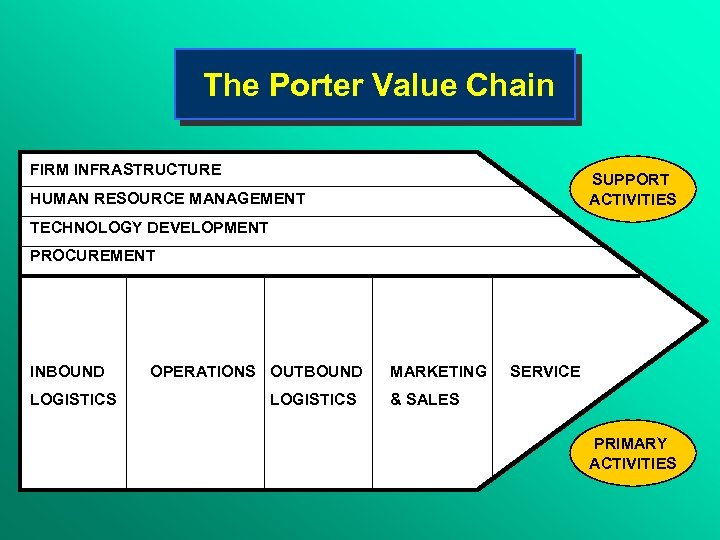
The Porter Value Chain FIRM INFRASTRUCTURE SUPPORT ACTIVITIES HUMAN RESOURCE MANAGEMENT TECHNOLOGY DEVELOPMENT PROCUREMENT INBOUND LOGISTICS OPERATIONS OUTBOUND LOGISTICS MARKETING SERVICE & SALES PRIMARY ACTIVITIES
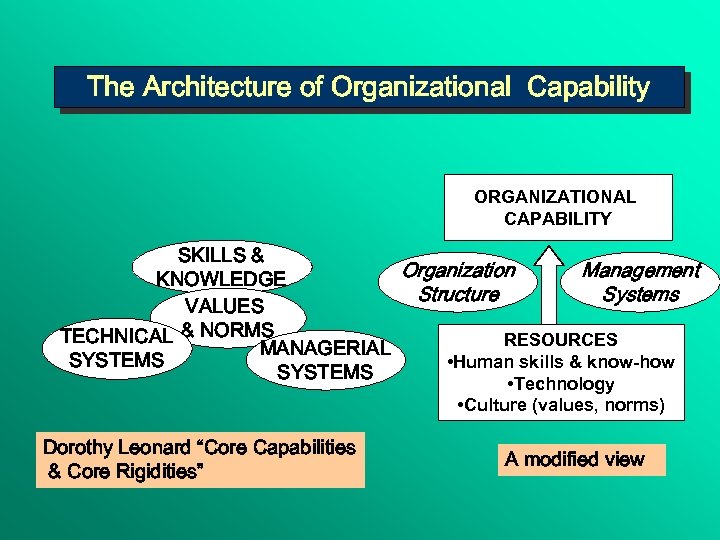
The Architecture of Organizational Capability ORGANIZATIONAL CAPABILITY SKILLS & Organization Management KNOWLEDGE Structure Systems VALUES TECHNICAL & NORMS RESOURCES MANAGERIAL SYSTEMS • Human skills & know-how SYSTEMS • Technology • Culture (values, norms) Dorothy Leonard “Core Capabilities & Core Rigidities” A modified view
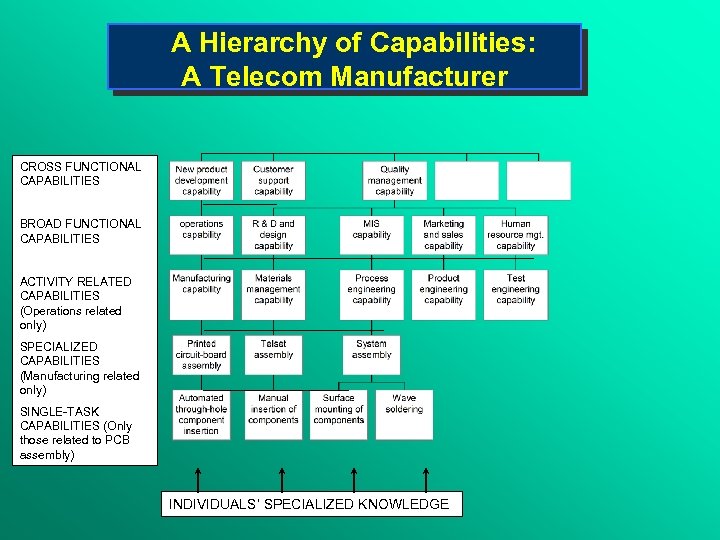
A Hierarchy of Capabilities: A Telecom Manufacturer CROSS FUNCTIONAL CAPABILITIES BROAD FUNCTIONAL CAPABILITIES ACTIVITY RELATED CAPABILITIES (Operations related only) SPECIALIZED CAPABILITIES (Manufacturing related only) SINGLE-TASK CAPABILITIES (Only those related to PCB assembly) INDIVIDUALS’ SPECIALIZED KNOWLEDGE
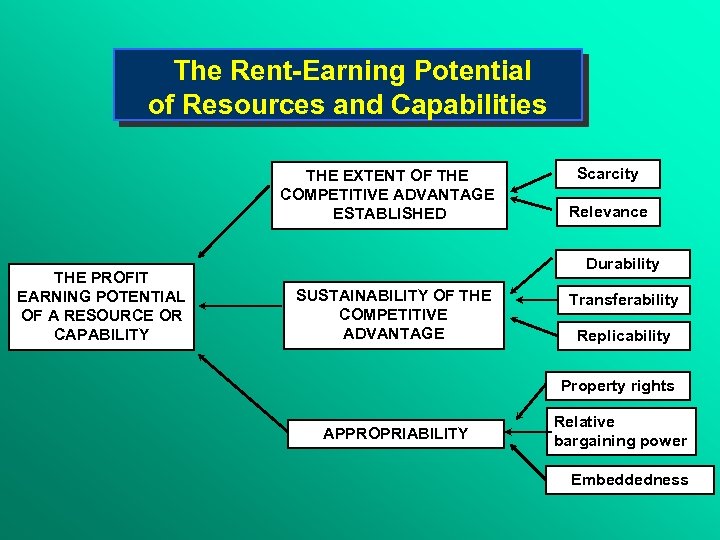
The Rent-Earning Potential of Resources and Capabilities THE EXTENT OF THE COMPETITIVE ADVANTAGE ESTABLISHED THE PROFIT EARNING POTENTIAL OF A RESOURCE OR CAPABILITY Scarcity Relevance Durability SUSTAINABILITY OF THE COMPETITIVE ADVANTAGE Transferability Replicability Property rights APPROPRIABILITY Relative bargaining power Embeddedness
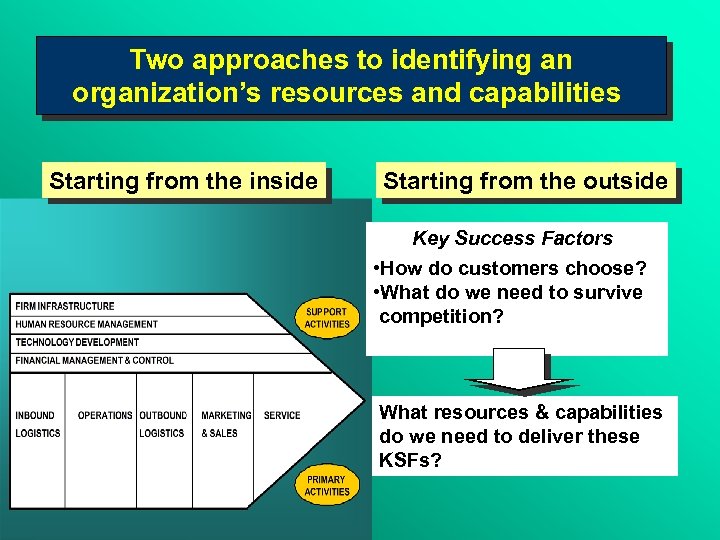
Two approaches to identifying an organization’s resources and capabilities Starting from the inside Starting from the outside Key Success Factors • How do customers choose? • What do we need to survive competition? What resources & capabilities do we need to deliver these KSFs?
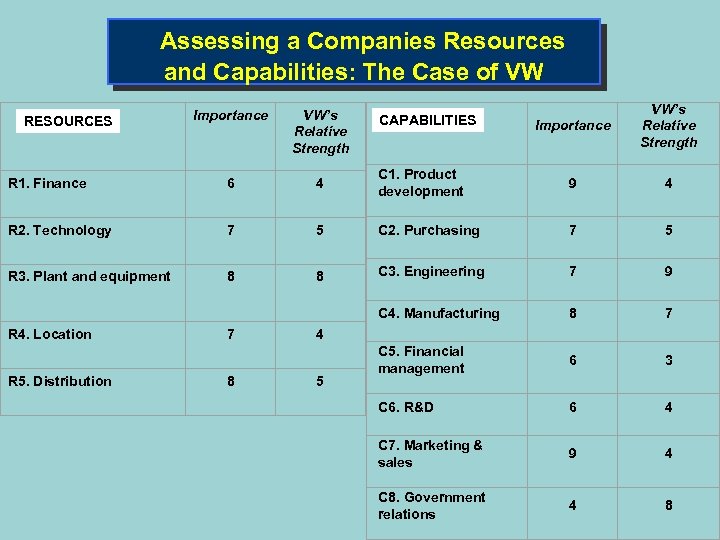
Assessing a Companies Resources and Capabilities: The Case of VW Importance VW’s Relative Strength C 1. Product development 9 4 5 C 2. Purchasing 7 5 8 C 3. Engineering 7 9 C 4. Manufacturing RESOURCES 8 7 C 5. Financial management 6 3 C 6. R&D 6 4 C 7. Marketing & sales 9 4 C 8. Government relations 4 8 Importance VW’s Relative Strength R 1. Finance 6 4 R 2. Technology 7 R 3. Plant and equipment 8 R 4. Location R 5. Distribution 7 8 CAPABILITIES 4 5
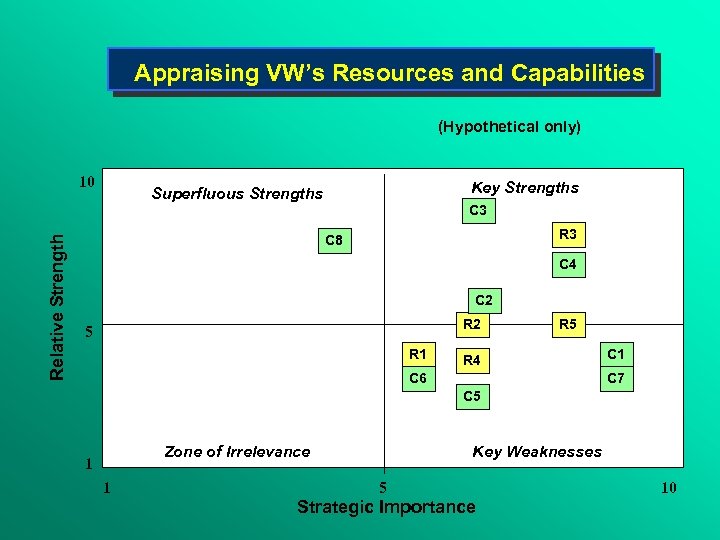
Appraising VW’s Resources and Capabilities (Hypothetical only) 10 Key Strengths Superfluous Strengths Relative Strength C 3 R 3 C 8 C 4 C 2 R 2 5 R 1 R 5 R 4 C 6 C 1 C 7 C 5 Zone of Irrelevance 1 1 Key Weaknesses 5 Strategic Importance 10
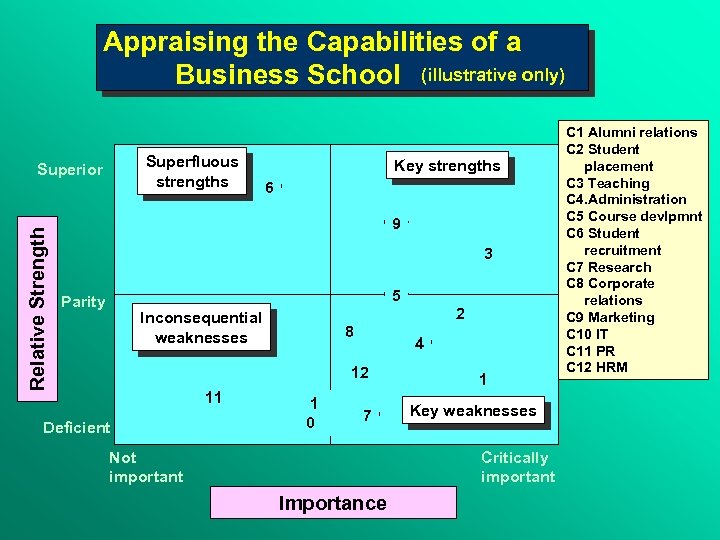
Appraising the Capabilities of a Business School (illustrative only) Superfluous strengths Relative Strength Superior Key strengths 6 9 3 5 Parity 2 Inconsequential weaknesses 8 4 12 11 Deficient 1 0 7 Not important 1 Key weaknesses Critically important Importance C 1 Alumni relations C 2 Student placement C 3 Teaching C 4. Administration C 5 Course devlpmnt C 6 Student recruitment C 7 Research C 8 Corporate relations C 9 Marketing C 10 IT C 11 PR C 12 HRM
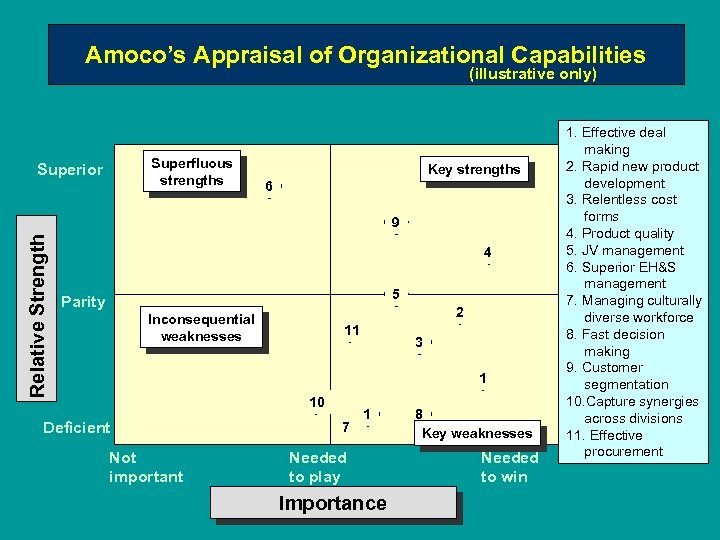
Amoco’s Appraisal of Organizational Capabilities (illustrative only) Superfluous strengths Superior Key strengths 6 Relative Strength 9 4 5 Parity 2 Inconsequential weaknesses 11 3 1 10 Deficient Not important 7 1 Needed to play Importance 8 Key weaknesses Needed to win 1. Effective deal making 2. Rapid new product development 3. Relentless cost forms 4. Product quality 5. JV management 6. Superior EH&S management 7. Managing culturally diverse workforce 8. Fast decision making 9. Customer segmentation 10. Capture synergies across divisions 11. Effective procurement
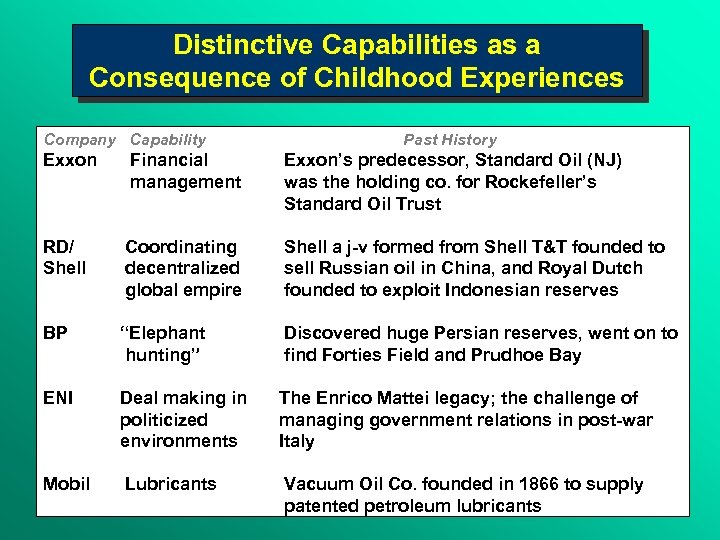
Distinctive Capabilities as a Consequence of Childhood Experiences Company Capability Past History Exxon Financial management Exxon’s predecessor, Standard Oil (NJ) was the holding co. for Rockefeller’s Standard Oil Trust RD/ Shell Coordinating Shell a j-v formed from Shell T&T founded to decentralized sell Russian oil in China, and Royal Dutch global empire founded to exploit Indonesian reserves BP “Elephant hunting” ENI Deal making in The Enrico Mattei legacy; the challenge of politicized managing government relations in post-war environments Italy Mobil Lubricants Discovered huge Persian reserves, went on to find Forties Field and Prudhoe Bay Vacuum Oil Co. founded in 1866 to supply patented petroleum lubricants 2
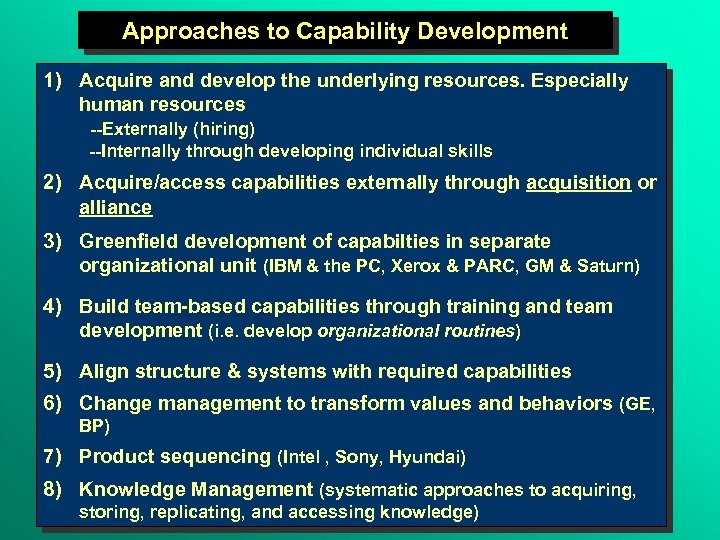
Approaches to Capability Development 1) Acquire and develop the underlying resources. Especially human resources --Externally (hiring) --Internally through developing individual skills 2) Acquire/access capabilities externally through acquisition or alliance 3) Greenfield development of capabilties in separate organizational unit (IBM & the PC, Xerox & PARC, GM & Saturn) 4) Build team-based capabilities through training and team development (i. e. develop organizational routines) 5) Align structure & systems with required capabilities 6) Change management to transform values and behaviors (GE, BP) 7) Product sequencing (Intel , Sony, Hyundai) 8) Knowledge Management (systematic approaches to acquiring, storing, replicating, and accessing knowledge)
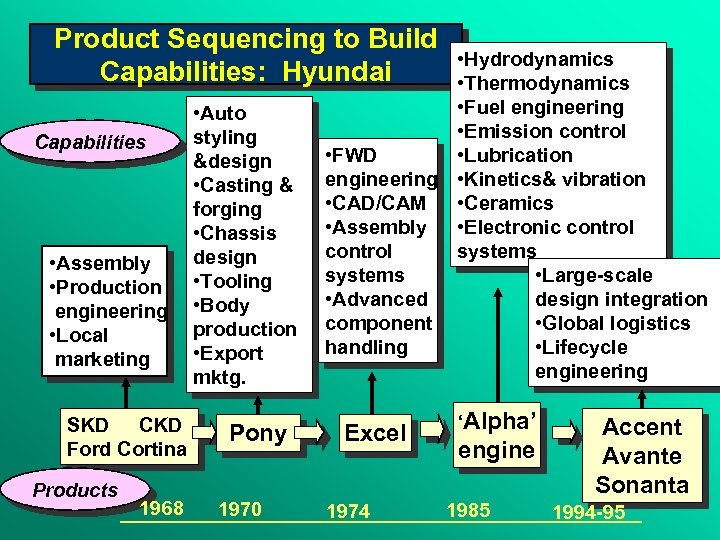
Product Sequencing to Build Capabilities: Hyundai Capabilities • Assembly • Production engineering • Local marketing SKD CKD Ford Cortina Products 1968 • Auto styling &design • Casting & forging • Chassis design • Tooling • Body production • Export mktg. Pony 1970 • Hydrodynamics • Thermodynamics • Fuel engineering • Emission control • Lubrication • FWD engineering • Kinetics& vibration • CAD/CAM • Ceramics • Assembly • Electronic control systems • Large-scale systems design integration • Advanced • Global logistics component • Lifecycle handling engineering Excel 1974 ‘Alpha’ engine 1985 Accent Avante Sonanta 1994 -95
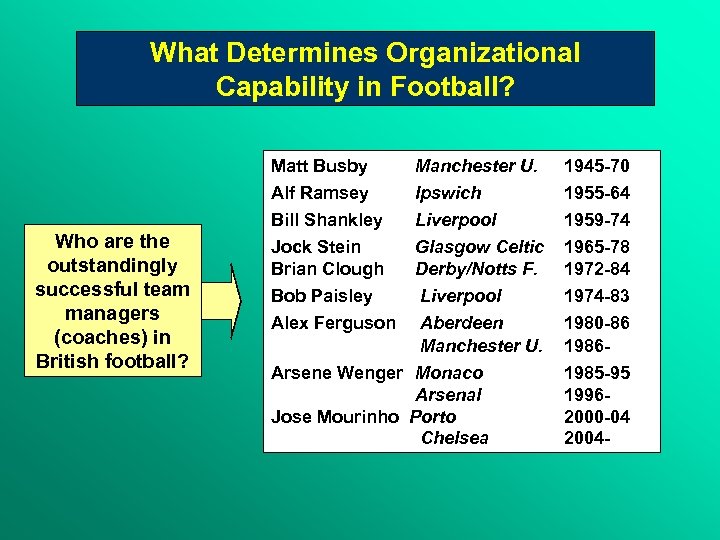
What Determines Organizational Capability in Football? Matt Busby Who are the outstandingly successful team managers (coaches) in British football? Manchester U. 1945 -70 Alf Ramsey Bill Shankley Ipswich Liverpool 1955 -64 1959 -74 Jock Stein Brian Clough Bob Paisley Alex Ferguson Glasgow Celtic Derby/Notts F. Liverpool Aberdeen Manchester U. Arsene Wenger Monaco Arsenal Jose Mourinho Porto Chelsea 1965 -78 1972 -84 1974 -83 1980 -86 1985 -95 1996 2000 -04 2004 -
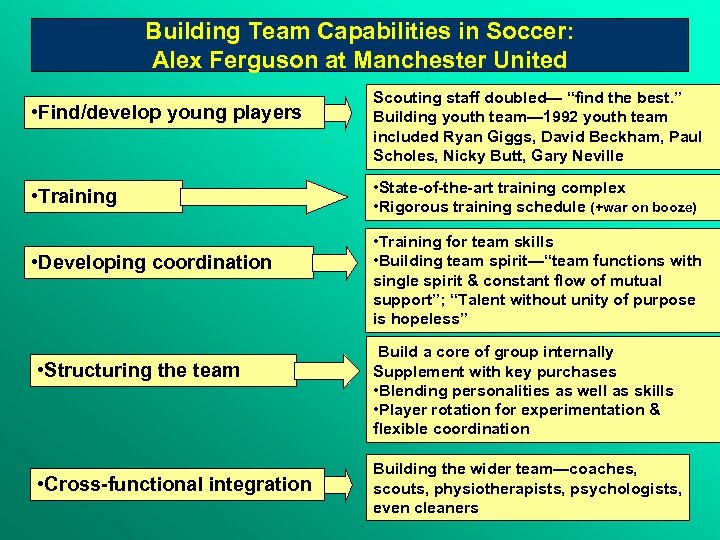
Building Team Capabilities in Soccer: Alex Ferguson at Manchester United • Find/develop young players • Training • Developing coordination • Structuring the team • Cross-functional integration Scouting staff doubled— “find the best. ” Building youth team— 1992 youth team included Ryan Giggs, David Beckham, Paul Scholes, Nicky Butt, Gary Neville • State-of-the-art training complex • Rigorous training schedule (+war on booze) • Training for team skills • Building team spirit—“team functions with single spirit & constant flow of mutual support”; “Talent without unity of purpose is hopeless” Build a core of group internally Supplement with key purchases • Blending personalities as well as skills • Player rotation for experimentation & flexible coordination Building the wider team—coaches, scouts, physiotherapists, psychologists, even cleaners
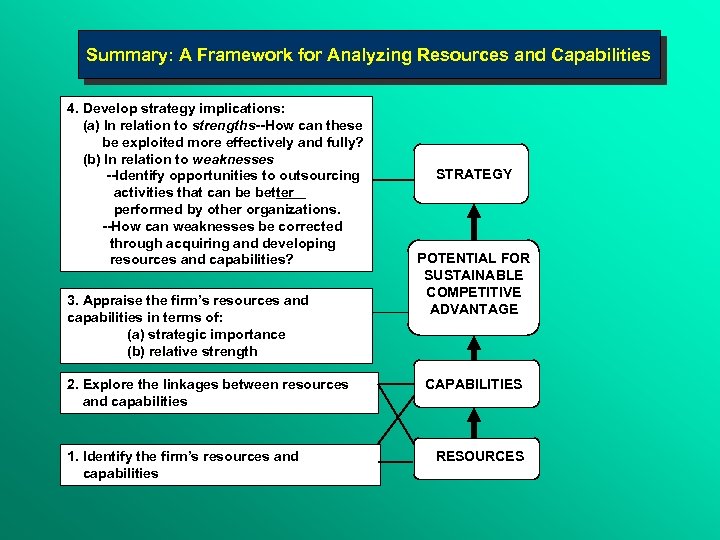
Summary: A Framework for Analyzing Resources and Capabilities 4. Develop strategy implications: (a) In relation to strengths--How can these be exploited more effectively and fully? (b) In relation to weaknesses --Identify opportunities to outsourcing activities that can be better performed by other organizations. --How can weaknesses be corrected through acquiring and developing resources and capabilities? 3. Appraise the firm’s resources and capabilities in terms of: (a) strategic importance (b) relative strength 2. Explore the linkages between resources and capabilities 1. Identify the firm’s resources and capabilities STRATEGY POTENTIAL FOR SUSTAINABLE COMPETITIVE ADVANTAGE CAPABILITIES RESOURCES
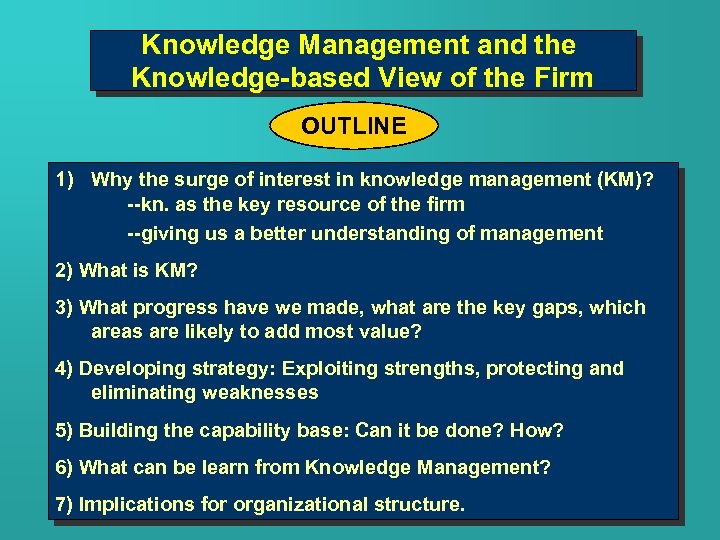
Knowledge Management and the Knowledge-based View of the Firm OUTLINE 1) Why the surge of interest in knowledge management (KM)? --kn. as the key resource of the firm --giving us a better understanding of management 2) What is KM? 3) What progress have we made, what are the key gaps, which areas are likely to add most value? 4) Developing strategy: Exploiting strengths, protecting and eliminating weaknesses 5) Building the capability base: Can it be done? How? 6) What can be learn from Knowledge Management? 7) Implications for organizational structure.
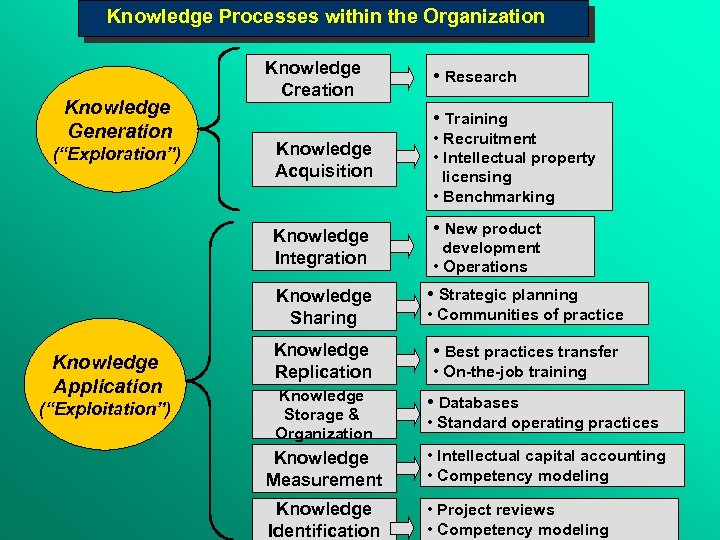
Knowledge Processes within the Organization Knowledge Generation (“Exploration”) Knowledge Creation • Training Knowledge Acquisition Knowledge Integration Knowledge Sharing Knowledge Application (“Exploitation”) • Research Knowledge Replication Knowledge Storage & Organization • Recruitment • Intellectual property licensing • Benchmarking • New product development • Operations • Strategic planning • Communities of practice • Best practices transfer • On-the-job training • Databases • Standard operating practices Knowledge Measurement • Intellectual capital accounting • Competency modeling Knowledge Identification • Project reviews • Competency modeling
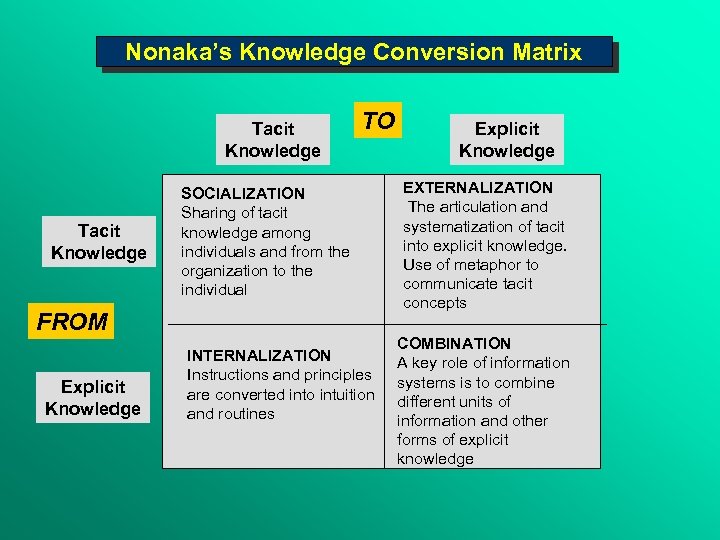
Nonaka’s Knowledge Conversion Matrix Tacit Knowledge TO SOCIALIZATION Sharing of tacit knowledge among individuals and from the organization to the individual FROM Explicit Knowledge INTERNALIZATION Instructions and principles are converted into intuition and routines Explicit Knowledge EXTERNALIZATION The articulation and systematization of tacit into explicit knowledge. Use of metaphor to communicate tacit concepts COMBINATION A key role of information systems is to combine different units of information and other forms of explicit knowledge
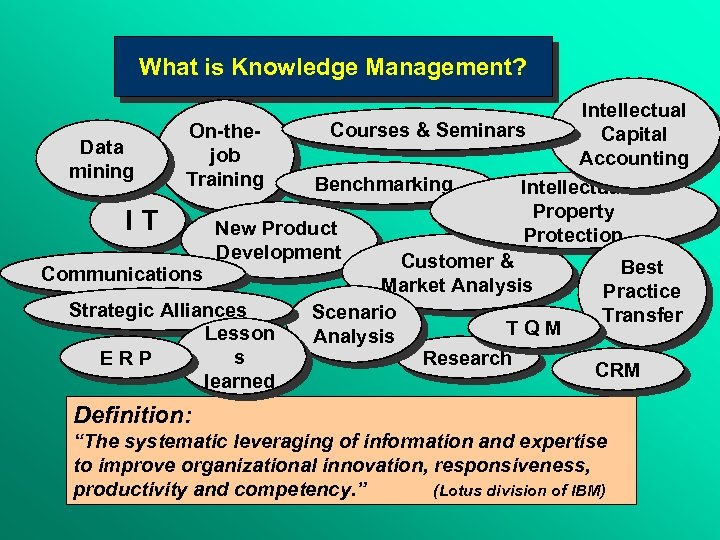
What is Knowledge Management? Intellectual Courses & Seminars On-the. Capital Data job Accounting mining Training Benchmarking Intellectual Property I T New Product Protection Development Customer & Best Communications Market Analysis Practice Strategic Alliances Scenario Transfer T Q M Lesson Analysis s E R P Research CRM learned Definition: “The systematic leveraging of information and expertise to improve organizational innovation, responsiveness, productivity and competency. ” (Lotus division of IBM)
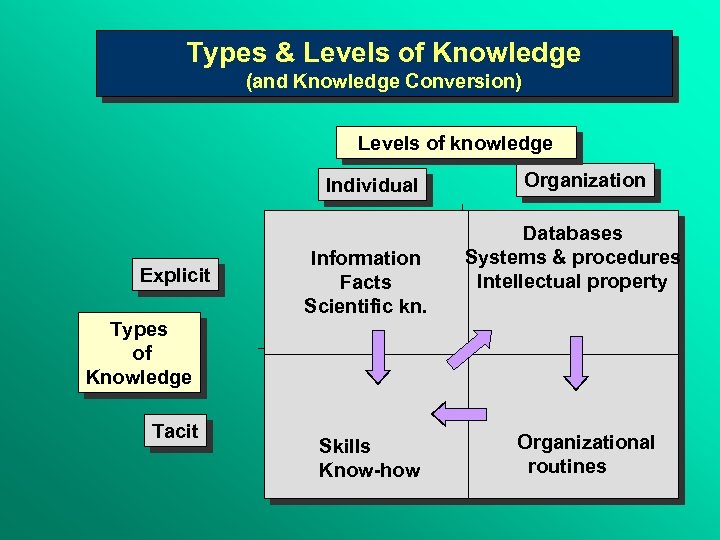
Types & Levels of Knowledge (and Knowledge Conversion) Levels of knowledge Individual Explicit Types of Knowledge Tacit Information Facts Scientific kn. Skills Know-how Organization Databases Systems & procedures Intellectual property Organizational routines
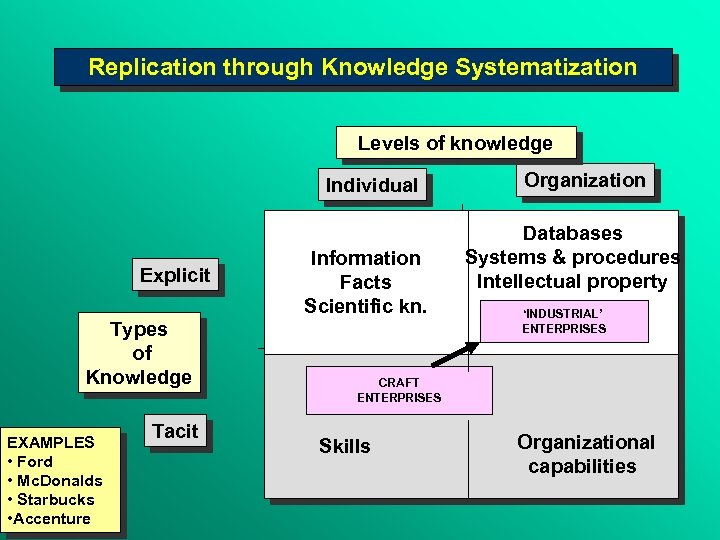
Replication through Knowledge Systematization Levels of knowledge Individual Explicit Types of Knowledge EXAMPLES • Ford • Mc. Donalds • Starbucks • Accenture Tacit Information Facts Scientific kn. Organization Databases Systems & procedures Intellectual property ‘INDUSTRIAL’ ENTERPRISES CRAFT ENTERPRISES Skills Organizational capabilities
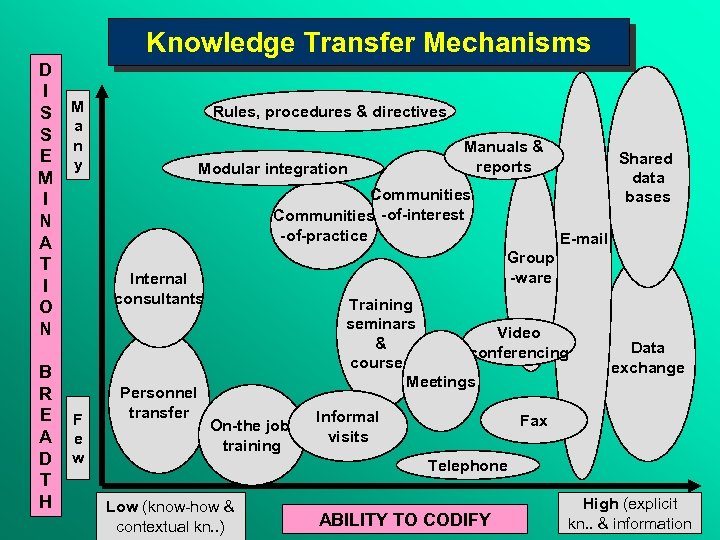
Knowledge Transfer Mechanisms D I S S E M I N A T I O N B R E A D T H M a n y Rules, procedures & directives Modular integration Manuals & reports Communities -of-interest -of-practice F e w E-mail Group -ware Internal consultants Personnel transfer Shared data bases Training seminars Video & conferencing courses Meetings On-the job training Informal visits Data exchange Fax Telephone Low (know-how & contextual kn. . ) ABILITY TO CODIFY High (explicit kn. . & information
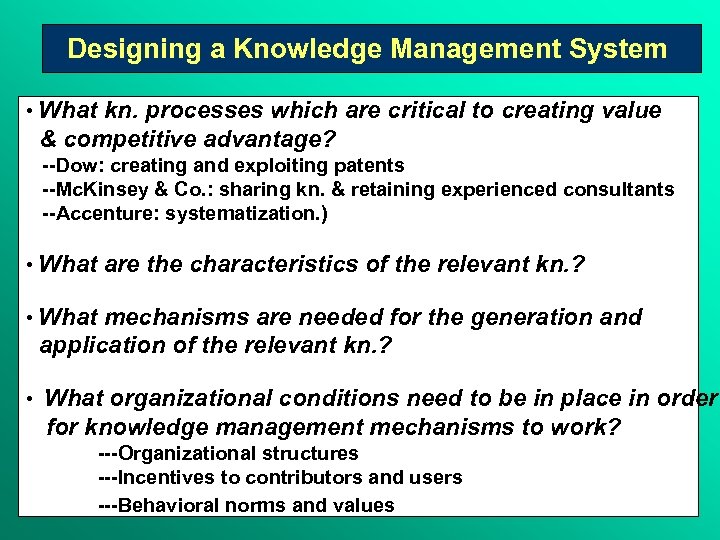
Designing a Knowledge Management System • What kn. processes which are critical to creating value & competitive advantage? --Dow: creating and exploiting patents --Mc. Kinsey & Co. : sharing kn. & retaining experienced consultants --Accenture: systematization. ) • What are the characteristics of the relevant kn. ? • What mechanisms are needed for the generation and application of the relevant kn. ? • What organizational conditions need to be in place in order for knowledge management mechanisms to work? ---Organizational structures ---Incentives to contributors and users ---Behavioral norms and values
Скачать презентацию Analyzing Resources Capabilities OUTLINE The role
99e88d2482c6bc4e0629242ce87c457a.ppt