 Analysis on DPRK Power Industry & Interconnection Options 21. SEP. 2010 KERI (J. Y. YOON jyyoon@keri. re. kr )
 u Introduction u Present Status on DPRK Power Sector u Future Prospects on DPRK Power Sector u History of DPRK Electricity Policy u Interconnection Options u Conclusion 1
 u DPRK suffers from Energy/Electricity shortage …. n Power Capacity/Generation amount of 2009 is worsen than 2008 n Strongly related to DPRK Economy crisis n DPRK practices proper internal & external measures … Construction of generation plants (big or medium hydro plants) Remodeling of power facilities (plants, T/L, D/L. Network …) Enhancement of T&D facilities Reduce power loss Ultra-strong Demand side managements Wants to the co-operational policy with the ROK, RF, China u No exact data & statistics on the DPRK Electricity Sector n Nobody knows the exact data on power plants, power system 2 …
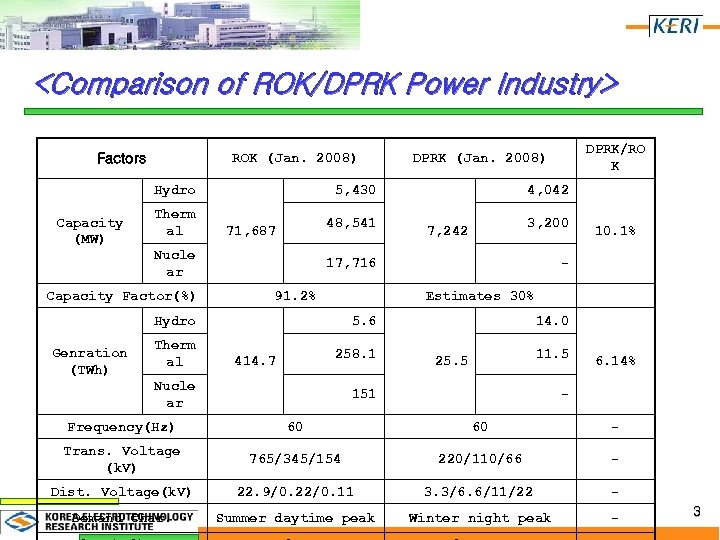 ROK (Jan. 2008) Factors Hydro Capacity (MW) Therm al 5, 430 48, 541 71, 687 Nucle ar Capacity Factor(%) Therm al 3, 200 7, 242 - 5. 6 258. 1 414. 7 10. 1% Estimates 30% Hydro Genration (TWh) 4, 042 17, 716 91. 2% DPRK/RO K DPRK (Jan. 2008) Nucle ar 14. 0 11. 5 25. 5 151 6. 14% - Frequency(Hz) 60 60 - Trans. Voltage (k. V) 765/345/154 220/110/66 - Dist. Voltage(k. V) 22. 9/0. 22/0. 11 3. 3/6. 6/11/22 - Demand Char. Summer daytime peak Winter night peak - 3
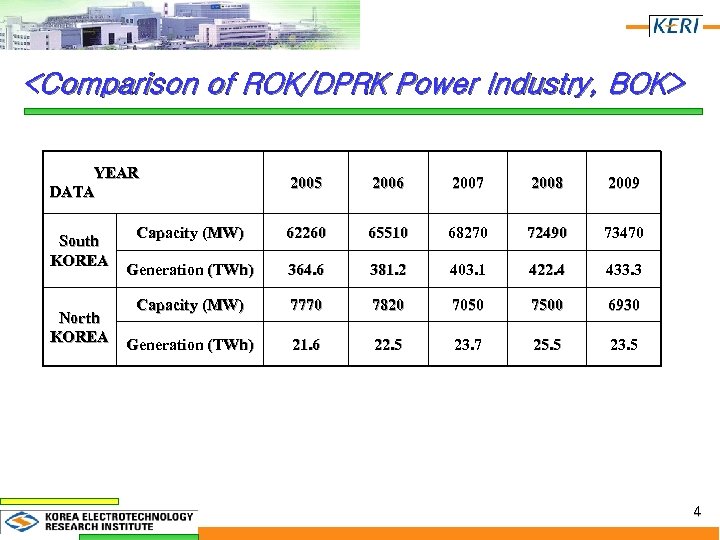 YEAR DATA South KOREA North KOREA 2005 2006 2007 2008 2009 Capacity (MW) 62260 65510 68270 72490 73470 Generation (TWh) 364. 6 381. 2 403. 1 422. 4 433. 3 Capacity (MW) 7770 7820 7050 7500 6930 Generation (TWh) 21. 6 22. 5 23. 7 25. 5 23. 5 4
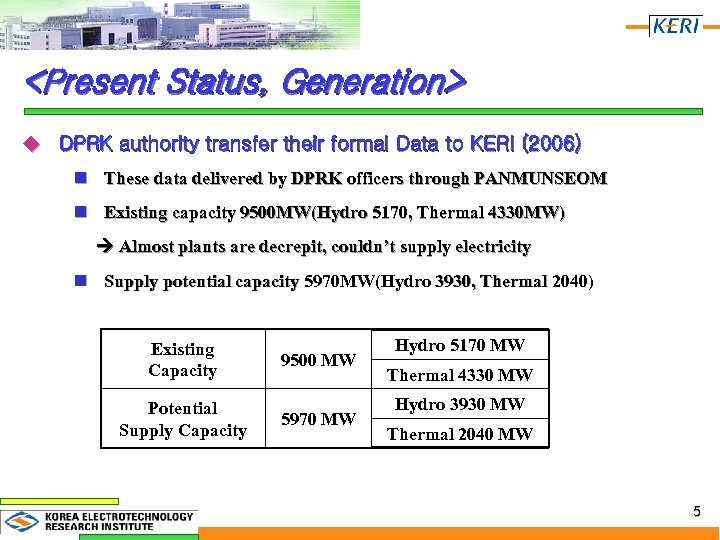 u DPRK authority transfer their formal Data to KERI (2006) n These data delivered by DPRK officers through PANMUNSEOM n Existing capacity 9500 MW(Hydro 5170, Thermal 4330 MW) Almost plants are decrepit, couldn’t supply electricity n Supply potential capacity 5970 MW(Hydro 3930, Thermal 2040) Existing Capacity Potential Supply Capacity 9500 MW 5970 MW Hydro 5170 MW Thermal 4330 MW Hydro 3930 MW Thermal 2040 MW 5
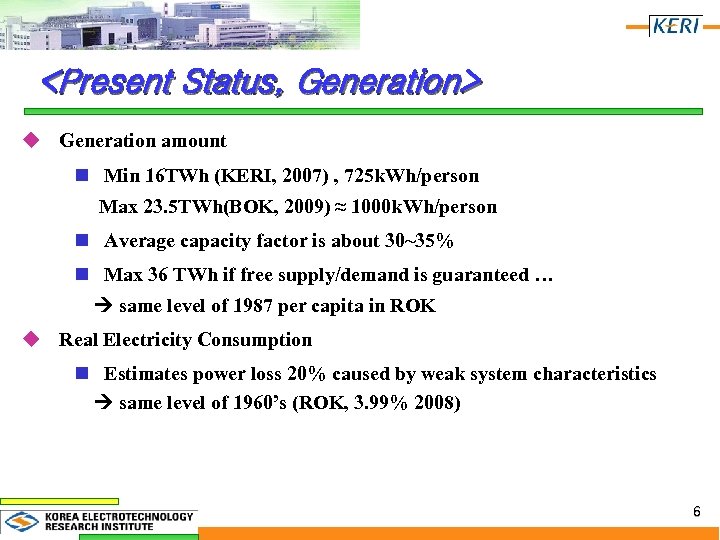 u Generation amount n Min 16 TWh (KERI, 2007) , 725 k. Wh/person Max 23. 5 TWh(BOK, 2009) ≈ 1000 k. Wh/person n Average capacity factor is about 30~35% n Max 36 TWh if free supply/demand is guaranteed … same level of 1987 per capita in ROK u Real Electricity Consumption n Estimates power loss 20% caused by weak system characteristics same level of 1960’s (ROK, 3. 99% 2008) 6
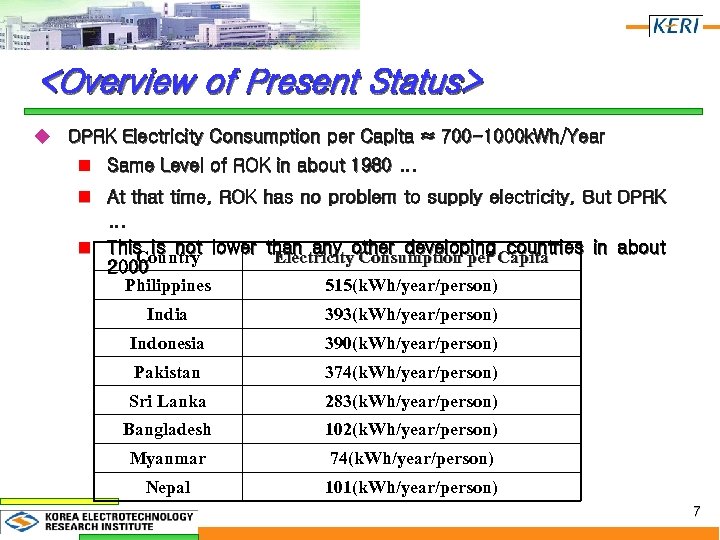 u DPRK Electricity Consumption per Capita ≈ 700 -1000 k. Wh/Year n Same Level of ROK in about 1980 … n At that time, ROK has no problem to supply electricity, But DPRK … n This is not lower than any other developing countries in about Country Electricity Consumption per Capita 2000 Philippines 515(k. Wh/year/person) India 393(k. Wh/year/person) Indonesia 390(k. Wh/year/person) Pakistan 374(k. Wh/year/person) Sri Lanka 283(k. Wh/year/person) Bangladesh 102(k. Wh/year/person) Myanmar 74(k. Wh/year/person) Nepal 101(k. Wh/year/person) 7
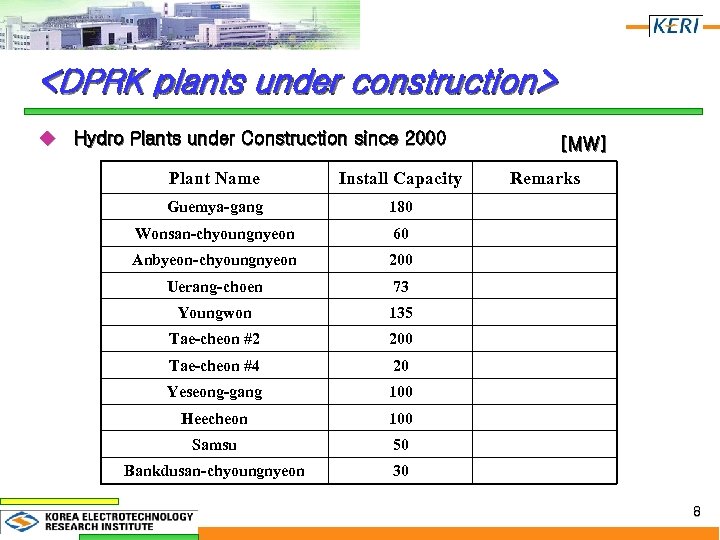 u Hydro Plants under Construction since 2000 Plant Name Install Capacity Guemya-gang 180 Wonsan-chyoungnyeon 60 Anbyeon-chyoungnyeon 200 Uerang-choen 73 Youngwon 135 Tae-cheon #2 200 Tae-cheon #4 20 Yeseong-gang 100 Heecheon 100 Samsu 50 Bankdusan-chyoungnyeon [MW] Remarks 30 8
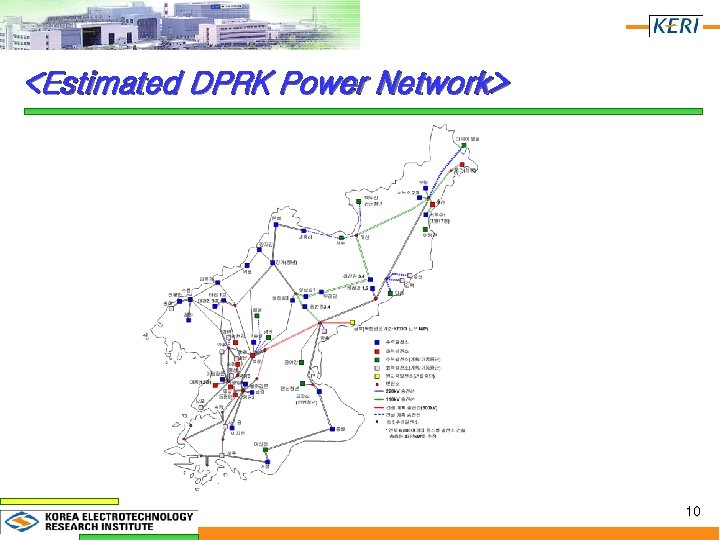
 <표><표> 남북한 전력계통 비교 현황 추정자료 기준) 2004년 북한 전력산업 (2004년 12월 u Transmission System n Composed of 220, 110, 66 k. V system n Frequency 60 Hz, same as The ROK // Russia, China 60 Hz n Divided into East, West, South & Central System n Weak power system n Plan to construct 500 k. V Line to connect east/west system n Power transmission west east in rainy season east west in dry season n Eastern system DUMAN-river Hydro & SEONBON Thermal plants n Western system AMROK-river hydro & Thermal plants nearby PYEONGYANG 9
 10
10
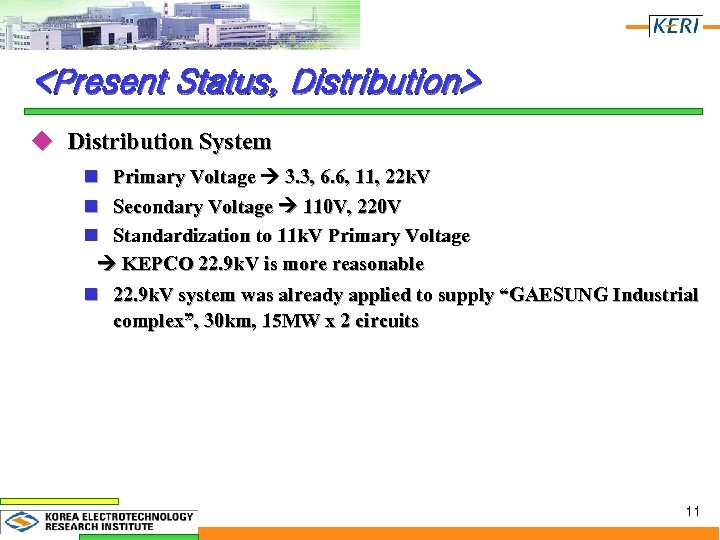 u Distribution System n Primary Voltage 3. 3, 6. 6, 11, 22 k. V n Secondary Voltage 110 V, 220 V n Standardization to 11 k. V Primary Voltage KEPCO 22. 9 k. V is more reasonable n 22. 9 k. V system was already applied to supply “GAESUNG Industrial complex”, 30 km, 15 MW x 2 circuits 11
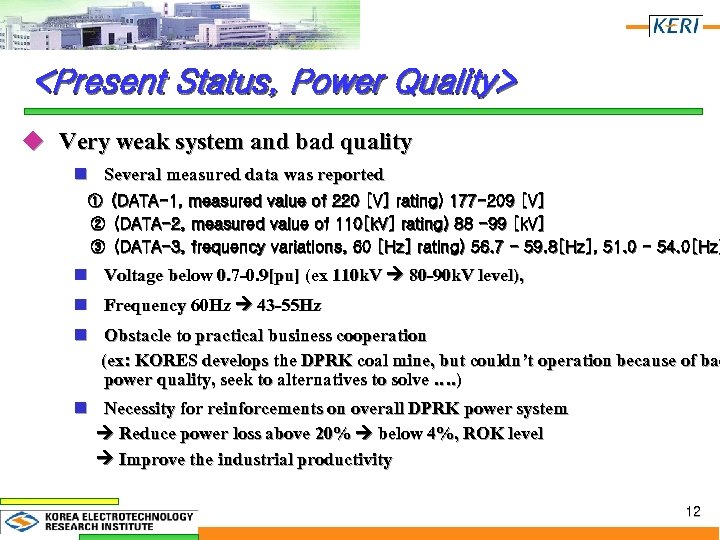 u Very weak system and bad quality n Several measured data was reported ① (DATA-1, measured value of 220 [V] rating) 177 -209 [V] ② (DATA-2, measured value of 110[k. V] rating) 88 -99 [k. V] ③ (DATA-3, frequency variations, 60 [Hz] rating) 56. 7 - 59. 8[Hz], 51. 0 - 54. 0[Hz] n Voltage below 0. 7 -0. 9[pu] (ex 110 k. V 80 -90 k. V level), n Frequency 60 Hz 43 -55 Hz n Obstacle to practical business cooperation (ex: KORES develops the DPRK coal mine, but couldn’t operation because of bad (ex: KORES develops the DPRK coal mine, but couldn’t operation because of ba power quality, seek to alternatives to solve …. ) n Necessity for reinforcements on overall DPRK power system Reduce power loss above 20% below 4%, ROK level Improve the industrial productivity 12
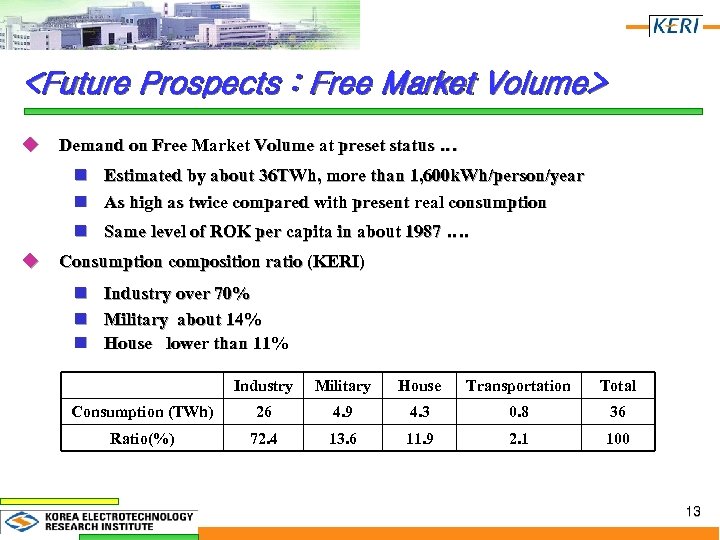 u Demand on Free Market Volume at preset status … n Estimated by about 36 TWh, more than 1, 600 k. Wh/person/year n As high as twice compared with present real consumption n Same level of ROK per capita in about 1987 …. u Consumption composition ratio (KERI) n n n Industry over 70% Military about 14% House lower than 11% Industry Military House Transportation Total Consumption (TWh) 26 4. 9 4. 3 0. 8 36 Ratio(%) 72. 4 13. 6 11. 9 2. 1 100 13
![<Future Prospects announced by DPRK> Category 2010 2020 Total Capacity 11, 730 [MW] 16,](https://present5.com/presentation/d8dc97e0a423a9ea85031f55b4304ebe/image-15.jpg "<Future Prospects announced by DPRK> Category 2010 2020 Total Capacity 11, 730 [MW] 16,") Category 2010 2020 Total Capacity 11, 730 [MW] 16, 150 [MW] Hydro 5, 980 [MW] 6, 950 [MW] Thermal 3, 750 [MW] 4, 000 [MW] Nuclear 2, 000 [MW] 5, 200 [MW] Annual Average Load 9, 727 [MW] 12, 450 [MW] Energy Demand 79 [TWh] 100 [TWh] 14
Category 2010 2020 Total Capacity 11, 730 [MW] 16, 150 [MW] Hydro 5, 980 [MW] 6, 950 [MW] Thermal 3, 750 [MW] 4, 000 [MW] Nuclear 2, 000 [MW] 5, 200 [MW] Annual Average Load 9, 727 [MW] 12, 450 [MW] Energy Demand 79 [TWh] 100 [TWh] 14
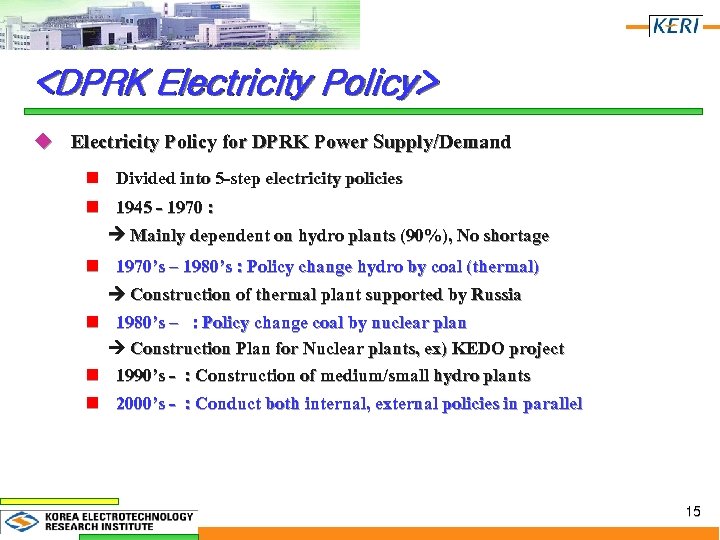 u Electricity Policy for DPRK Power Supply/Demand n Divided into 5 -step electricity policies n 1945 - 1970 : Mainly dependent on hydro plants (90%), No shortage n 1970’s – 1980’s : Policy change hydro by coal (thermal) Construction of thermal plant supported by Russia n 1980’s – : Policy change coal by nuclear plan Construction Plan for Nuclear plants, ex) KEDO project n 1990’s - : Construction of medium/small hydro plants n 2000’s - : Conduct both internal, external policies in parallel 15
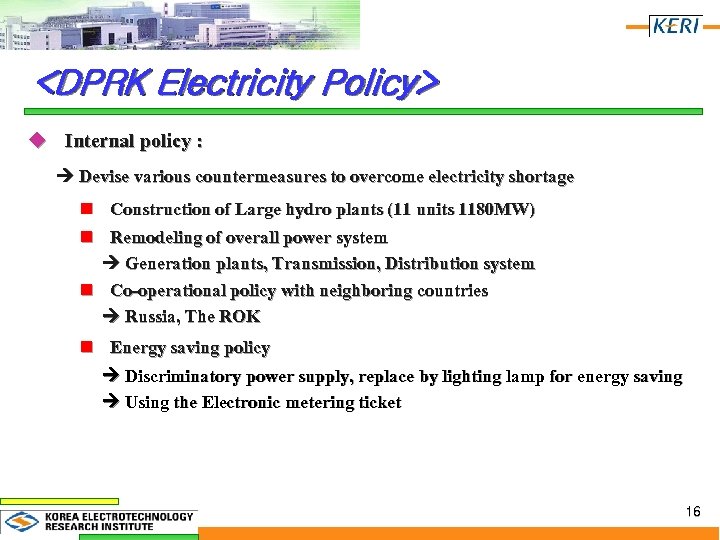 u Internal policy : Devise various countermeasures to overcome electricity shortage n Construction of Large hydro plants (11 units 1180 MW) n Remodeling of overall power system Generation plants, Transmission, Distribution system n Co-operational policy with neighboring countries Russia, The ROK n Energy saving policy Discriminatory power supply, replace by lighting lamp for energy saving Using the Electronic metering ticket 16
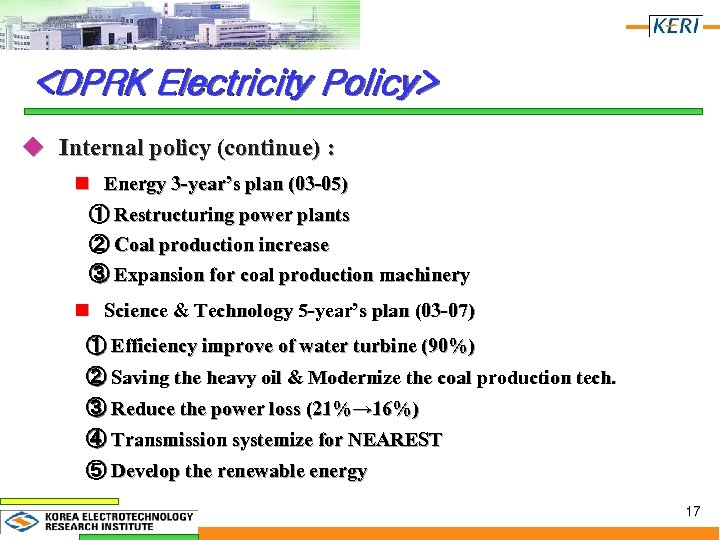 u Internal policy (continue) : n Energy 3 -year’s plan (03 -05) ① Restructuring power plants ② Coal production increase ③ Expansion for coal production machinery n Science & Technology 5 -year’s plan (03 -07) ① Efficiency improve of water turbine (90%) ② Saving the heavy oil & Modernize the coal production tech. ③ Reduce the power loss (21%→ 16%) ④ Transmission systemize for NEAREST ⑤ Develop the renewable energy 17
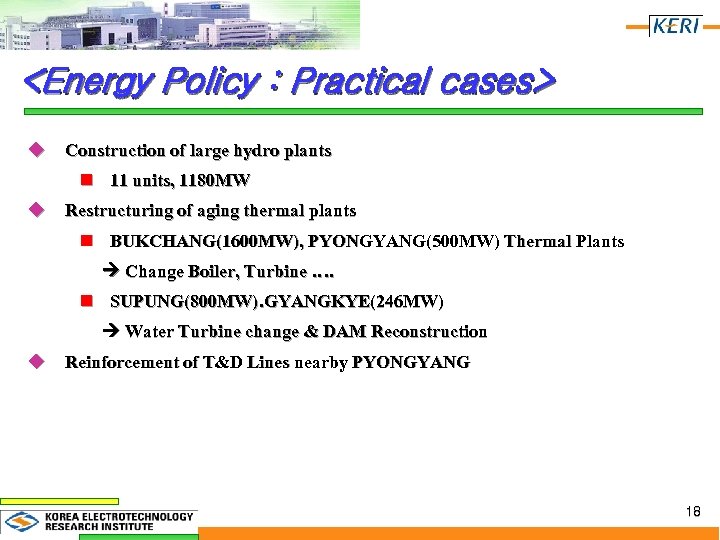 u Construction of large hydro plants n 11 units, 1180 MW u Restructuring of aging thermal plants n BUKCHANG(1600 MW), PYONGYANG(500 MW) Thermal Plants Change Boiler, Turbine …. n SUPUNG(800 MW)․GYANGKYE(246 MW) Water Turbine change & DAM Reconstruction u Reinforcement of T&D Lines nearby PYONGYANG 18
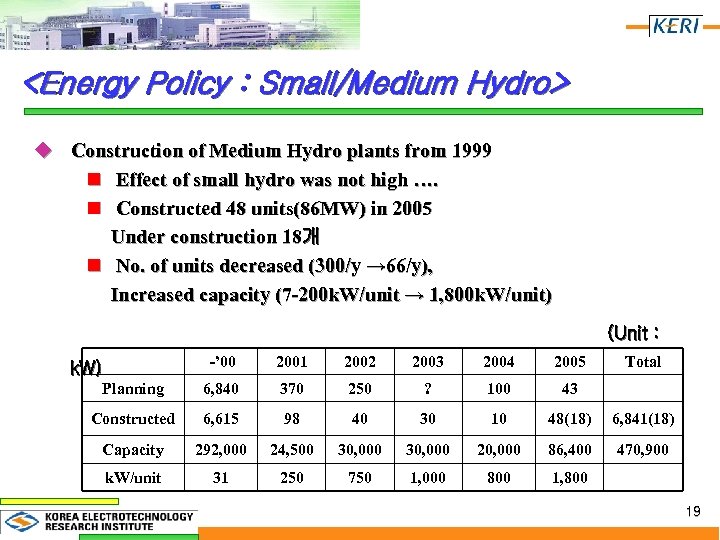 u Construction of Medium Hydro plants from 1999 n Effect of small hydro was not high …. n Constructed 48 units(86 MW) in 2005 Under construction 18개 n No. of units decreased (300/y → 66/y), Increased capacity (7 -200 k. W/unit → 1, 800 k. W/unit) (Unit : -’ 00 2001 2002 2003 2004 2005 Total Planning 6, 840 370 250 ? 100 43 Constructed 6, 615 98 40 30 10 48(18) 6, 841(18) Capacity 292, 000 24, 500 30, 000 20, 000 86, 400 470, 900 k. W/unit 31 250 750 1, 000 800 1, 800 k. W) 19
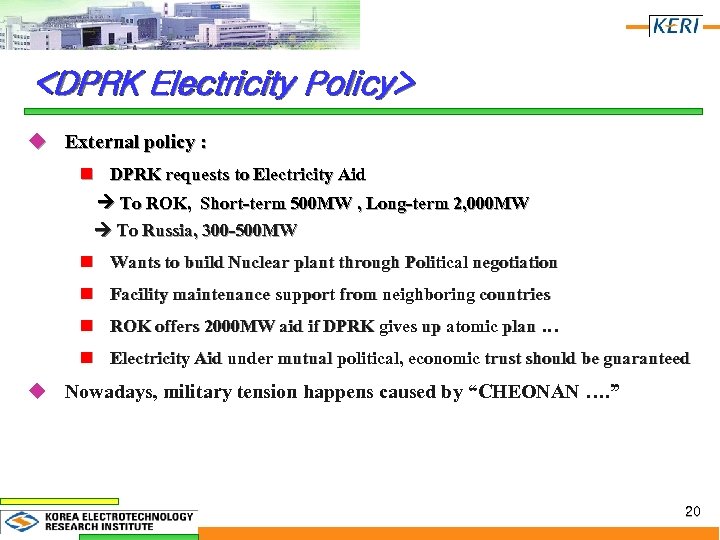 u External policy : n DPRK requests to Electricity Aid To ROK, Short-term 500 MW , Long-term 2, 000 MW To Russia, 300 -500 MW n Wants to build Nuclear plant through Political negotiation n Facility maintenance support from neighboring countries n ROK offers 2000 MW aid if DPRK gives up atomic plan … n Electricity Aid under mutual political, economic trust should be guaranteed u Nowadays, military tension happens caused by “CHEONAN …. ” 20
 u External cooperation n Import used plant facilities with natural resources security from RUSSIA(BUCKCHANG), CHINA (large hydro), HYDRO SWEDEN (small hydro plants) n Collaboration with CHINA : l Construction of Power line & cable factory l Change of T&D power line & lighting (Compact lamp to reduce power loss by 80%) l Supply card type electronic power meter Introduction of capitalism on power consumption 21
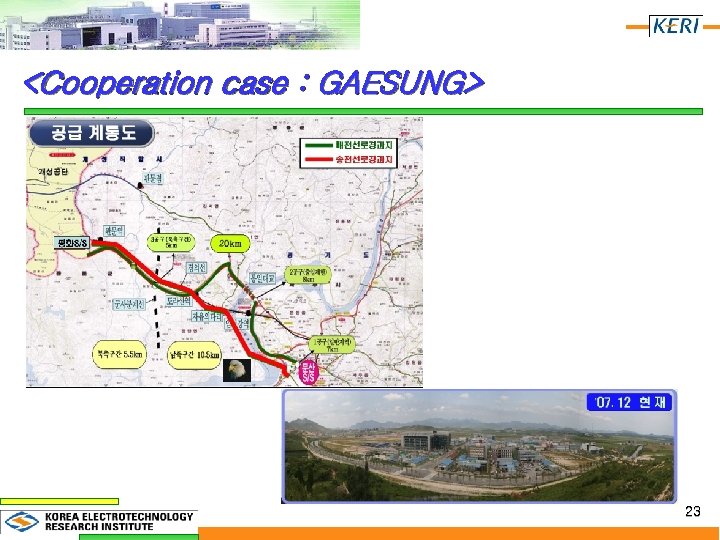
 u 10 MW Capacity Transmission Line & “PEACE substation” n Electricity supply was started since March 2006 n At first, using 22. 9 k. V 2 -circuit distribution line n Now, 154 k. V transmission line and 154 k. V substation, so called “PEACE S/S” since 2007 n 40, 000 North Korean are now working in GAESUNG industrial complex n KEPCO had the financial damage more than 10 million dollars annually because of the high cost but low electricity price for this area 22
 23
23
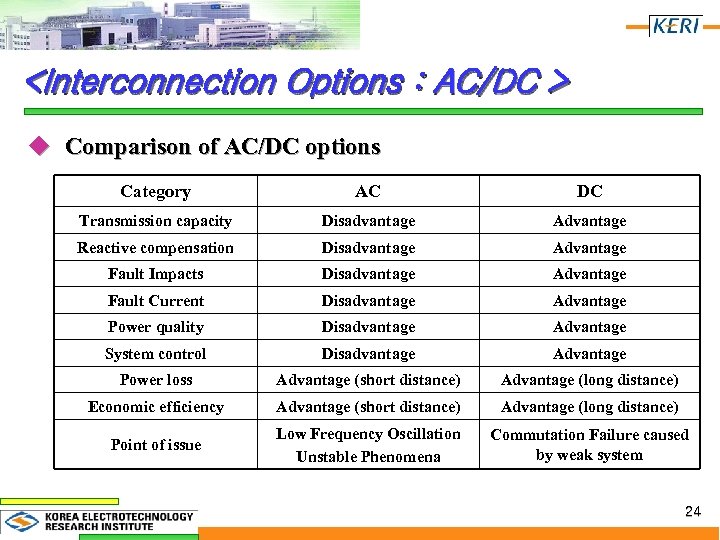 u Comparison of AC/DC options Category AC DC Transmission capacity Disadvantage Advantage Reactive compensation Disadvantage Advantage Fault Impacts Disadvantage Advantage Fault Current Disadvantage Advantage Power quality Disadvantage Advantage System control Disadvantage Advantage Power loss Advantage (short distance) Advantage (long distance) Economic efficiency Advantage (short distance) Advantage (long distance) Point of issue Low Frequency Oscillation Unstable Phenomena Commutation Failure caused by weak system 24
 u Many scenarios for NEAREST has been published n ESI, KERI, NI report/paper etc. n Has rough concept/contents and similarities with each other n Among these scenarios, “(RU)-DPRK-ROK” is the key point u Future interconnection potentials b/t ROK and DPRK n Possibility of power interconnection in future l Power supply for GAESUNG industrial complex was realized l ROK government offers 2000 MW aid if DPRK gives up atomic plan n DPRK wants to build light water reactor …. n Unified power system operation will be realized 25
 u Future potentials for “RF-DPRK” power interconnection n “RU Vladivostok – DPRK Cheongjin” 375 km, DC Line n Expect 220 k. V 50 Hz AC 500 k. V or 600 k. V DC Operation u Future considerable points n Harmonization of Short and Long term Interconnection policy l GAESUNG & Cheongjin l Parallel operation of interconnection system n How to operate 50 Hz AC S/S in Cheongjin after DC operation begins ? 26
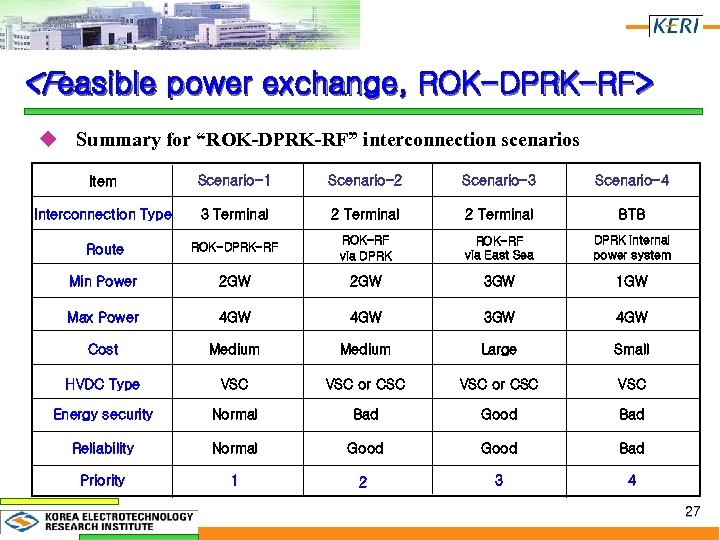 u Summary for “ROK-DPRK-RF” interconnection scenarios Item Scenario-1 Scenario-2 Scenario-3 Scenario-4 Interconnection Type 3 Terminal 2 Terminal BTB Route ROK-DPRK-RF ROK-RF via DPRK ROK-RF via East Sea DPRK internal power system Min Power 2 GW 3 GW 1 GW Max Power 4 GW 3 GW 4 GW Cost Medium Large Small HVDC Type VSC or CSC VSC Energy security Normal Bad Good Bad Reliability Normal Good Bad Priority 1 2 3 4 27
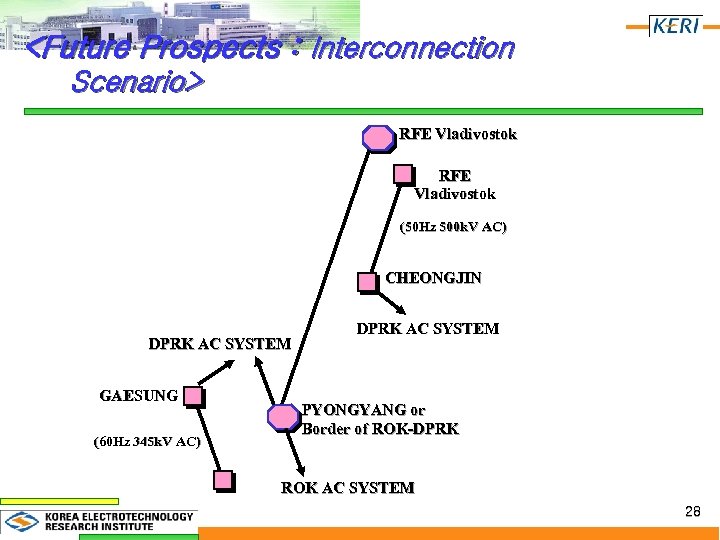 RFE Vladivostok (50 Hz 500 k. V AC) CHEONGJIN DPRK AC SYSTEM GAESUNG (60 Hz 345 k. V AC) DPRK AC SYSTEM PYONGYANG or Border of ROK-DPRK ROK AC SYSTEM 28
 u Structural and regulatory barriers n Political and administrative styles of regulation considering natural monopoly characteristics of transmission n Treaty and Legal barriers n Economy-wide investment conditions n Legal framework for investors including financing 29
 30
30
 u Four Scenarios are proposed n ex) (Scenarios-1) is … l Power System Interconnection “ROK-DPRK-RF” l Capacity of 2~4 GW HVDC, ± 500 -600 k. V 1, 260 km l 3 -C/S Terminal, Seoul, Pyongyang, Vladivostok n Composite system reliability analysis, HL II Level l NEAREL(NEAREST-RELIABILTY) Program is developed l Composite System Reliability Program considering Generation, Transmission and Interconnected Tie Line l TEAG (Tie line constrained Equivalent Assisting Generator Model Considering Assisting System plus Tie Line 31
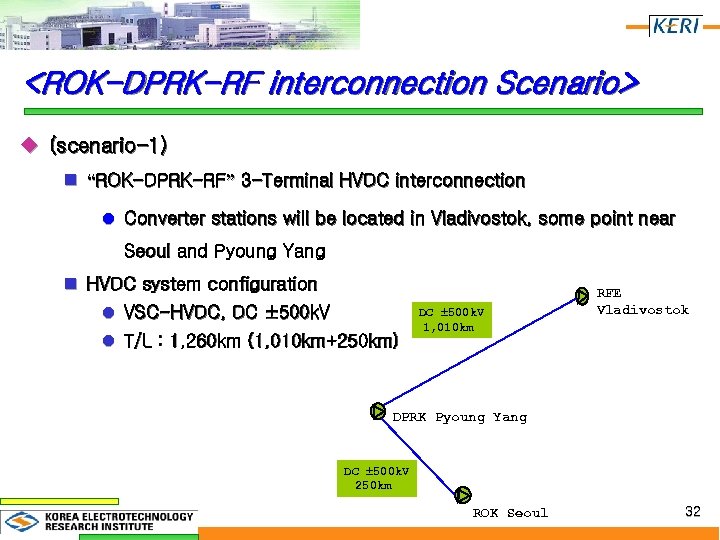 u (scenario-1) n “ROK-DPRK-RF” 3 -Terminal HVDC interconnection l Converter stations will be located in Vladivostok, some point near Seoul and Pyoung Yang n HVDC system configuration l VSC-HVDC, DC ± 500 k. V l T/L : 1, 260 km (1, 010 km+250 km) DC ± 500 k. V 1, 010 km RFE Vladivostok DPRK Pyoung Yang DC ± 500 k. V 250 km ROK Seoul 32
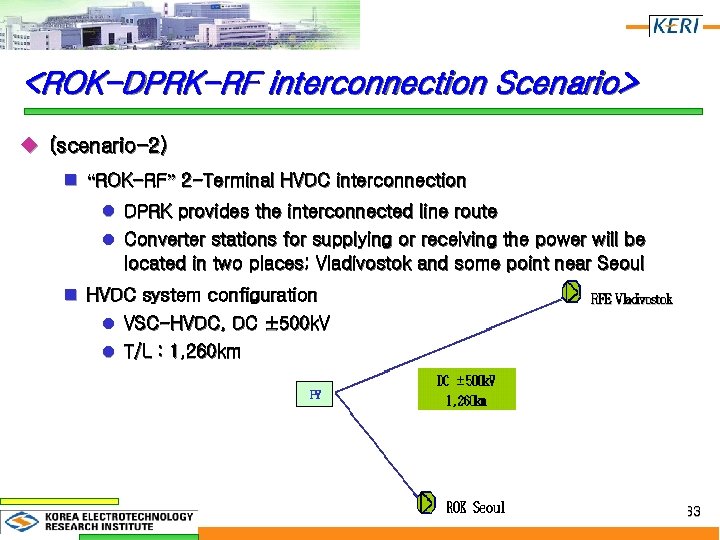 u (scenario-2) n “ROK-RF” 2 -Terminal HVDC interconnection l DPRK provides the interconnected line route l Converter stations for supplying or receiving the power will be located in two places; Vladivostok and some point near Seoul n HVDC system configuration l VSC-HVDC, DC ± 500 k. V l T/L : 1, 260 km 33
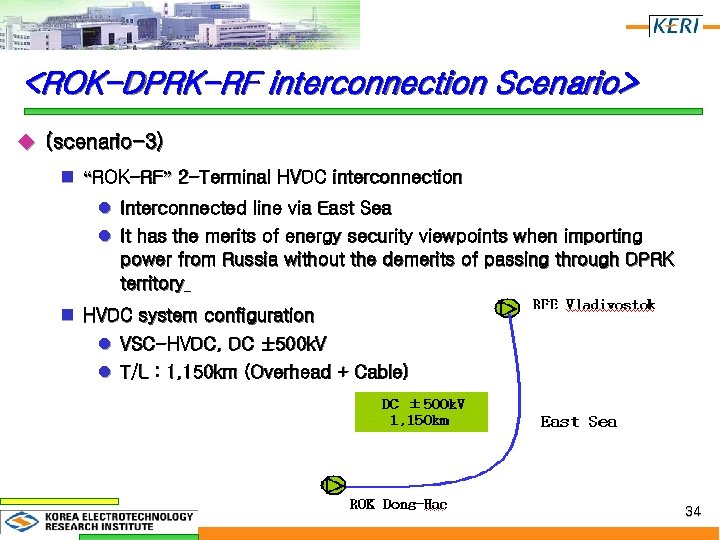 u (scenario-3) n “ROK-RF” 2 -Terminal HVDC interconnection l Interconnected line via East Sea l It has the merits of energy security viewpoints when importing power from Russia without the demerits of passing through DPRK territory n HVDC system configuration l VSC-HVDC, DC ± 500 k. V l T/L : 1, 150 km (Overhead + Cable) 34
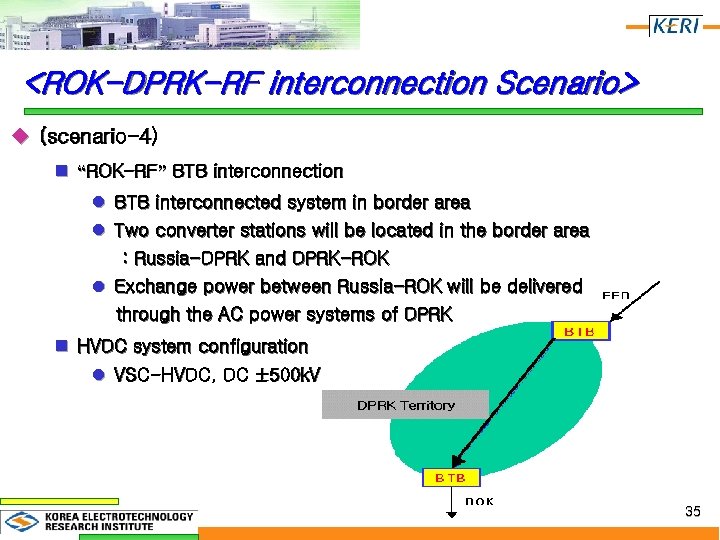 u (scenario-4) n “ROK-RF” BTB interconnection l BTB interconnected system in border area l Two converter stations will be located in the border area : Russia-DPRK and DPRK-ROK l Exchange power between Russia-ROK will be delivered through the AC power systems of DPRK n HVDC system configuration l VSC-HVDC, DC ± 500 k. V 35
 u Proposal for “ROK-DPRK-RF” interconnection n Overview of interconnection l 3 Terminal PTP-HVDC system is suitable for interconnection l Converter stations are located at Vladivostok, Pyung Yang and Seoul l BTB–HVDC is not available due to weak power system of DPRK n System configuration l DC ± 500 k. V, Multi-Terminal HVDC system l VSC type HVDC system is more appropriate for interconnection l Two-Bipole DC transmission n Feasible exchange power l Feasible exchange power taking account of technical and economic constraints is 3 GW to 4 GW l 3 GW to 4 GW is allowable from the viewpoint of energy security (About 5% of power demand in 2017) 36
 u NEAREST Scenarios for NEA 6 -countries : 3 alternatives n (Main Land) // (East Sea) // (Large New Interconnection) n Multi-Terminal HVDC Interconnection, DC ± 500 -± 600 k. V n Possible for CBT caused by base and seasonal load difference u Generation capacity is reduced and Capacity factor is increased for all interconnection scenarios. u (Initially) CBT with contract base (Finally) Market base is reasonable u Deregulation has positive effect on CBT, Uncertainty of DPRK, Pos. /Neg. points of Energy security, Cooperate financing with government guarantee 37
 u Reliability study : n Average reliability index of all countries is greatly increased n But, ROK is slightly decreased in case of unidirectional supply from ROK to DPRK because of the severe electricity deficiency of DPRK n Of course, after DPRK status is stabilized, reliability index of ROK will also be increased. u Different premises for each economic assessment : n (Economic) : max/min import/export tariffs lower than (50 - )Won/k. Wh n (Marketability) : About (40) Won/k. Wh for CBT n Similar results with unidirectional solution, but have small difference caused by different premise 38
 u Proposal for NEAREST region interconnection n Overview of interconnection l (Main Land Circle) 5 Countries : ROK, DPRK, RF, China, Mongolia l (East Sea Circle) 4 Countries : ROK, DPRK, RF, Japan l (Large New Circle) 6 Countries : ROK, DPRK, RF, China, Mongolia, Japan n System configuration l DC ± 500 k. V, Multi-Terminal HVDC system l VSC type HVDC system l Two-Bipole DC transmission (Overhead + Cable) n Power exchange pattern l Seasonal power exchange between interconnected countries l (Summer Season) RF, DPRK ROK, Japan, China l (Winter Season) ROK, Japan, China RF, DPRK, Mongolia 39



 Скачать презентацию Analysis on DPRK Power Industry Interconnection Options