

Analysis of production the specialists who make the










 Скачать презентацию Analysis of production the specialists who make the
13362-23_simple_production_theory_three_stages_of_production_production_elasticity.ppt
- Количество слайдов: 26
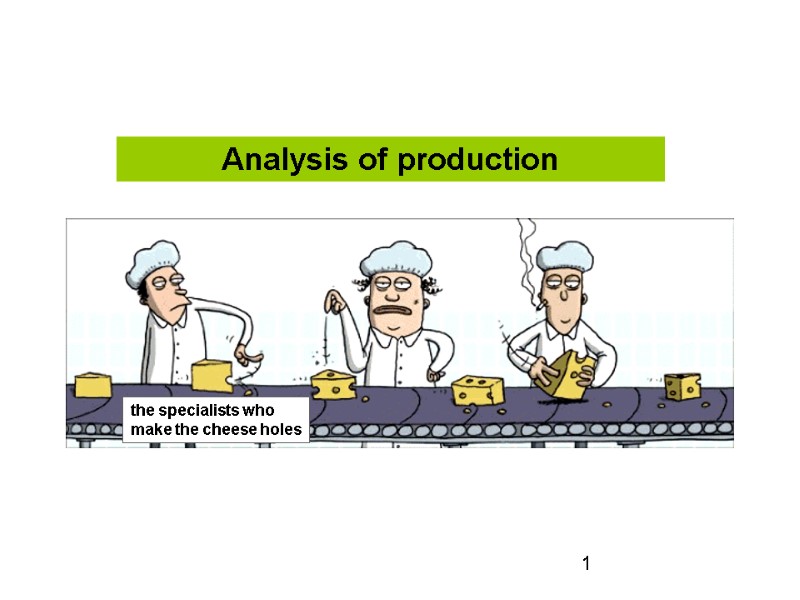
Analysis of production the specialists who make the cheese holes 1
Once the need for this type of goods or services is established, necessary for the production of the specified goods or services the next step in production management should be determination of the most profitable way to use the resources of this company, 2
To make the best decisions it is necessary to introduce the concept of "production function" 3
Production function - interdependence "input-output" between one or more input factors of production and produced goods or services Determination of the most efficient combination of inputs, providing a given level of output Determination of the maximum achievable level of output given the level and structure of inputs The production function is the base for cost analysis 4
The production function is the base for cost analysis Defining the production function of a certain company, you can define the cost function, provided that the market prices of production inputs are known 5
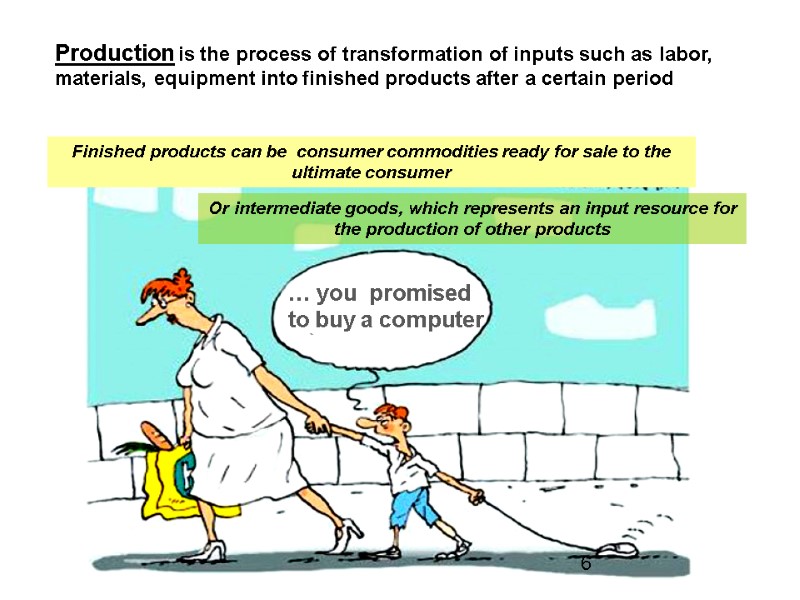
Production is the process of transformation of inputs such as labor, materials, equipment into finished products after a certain period Or intermediate goods, which represents an input resource for the production of other products Finished products can be consumer commodities ready for sale to the ultimate consumer 6 … you promised to buy a computer
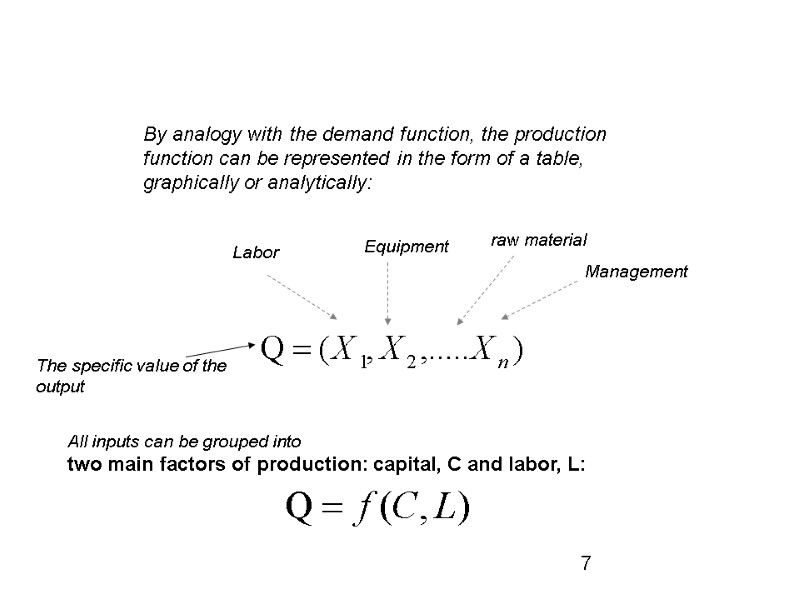
By analogy with the demand function, the production function can be represented in the form of a table, graphically or analytically: The specific value of the output All inputs can be grouped into two main factors of production: capital, C and labor, L: Labor Equipment raw material Management 7
The production function corresponds to the given level of technology It is important to bear in mind that If this level of technology is changing due to the increase in quality of labor, materials, equipment, processing, and management, the production function is changing accordingly 8
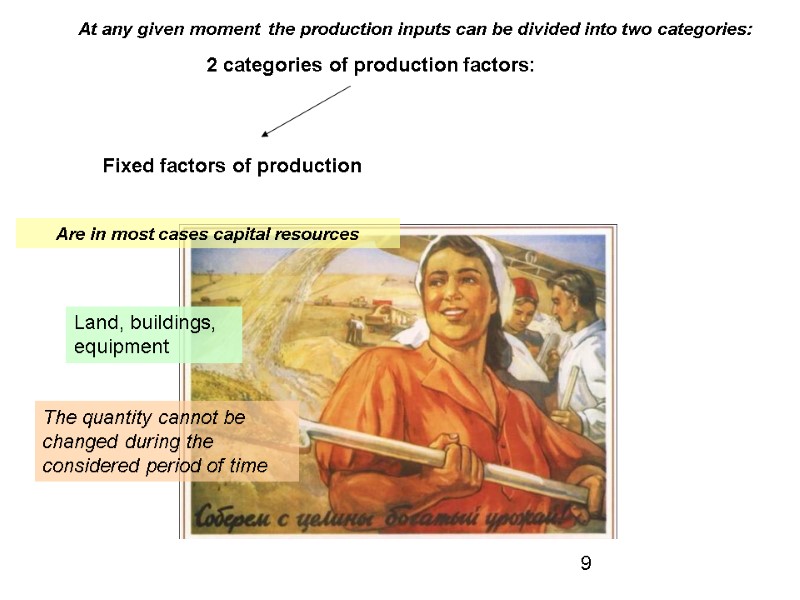
2 categories of production factors: Fixed factors of production The quantity cannot be changed during the considered period of time Land, buildings, equipment At any given moment the production inputs can be divided into two categories: Are in most cases capital resources 9
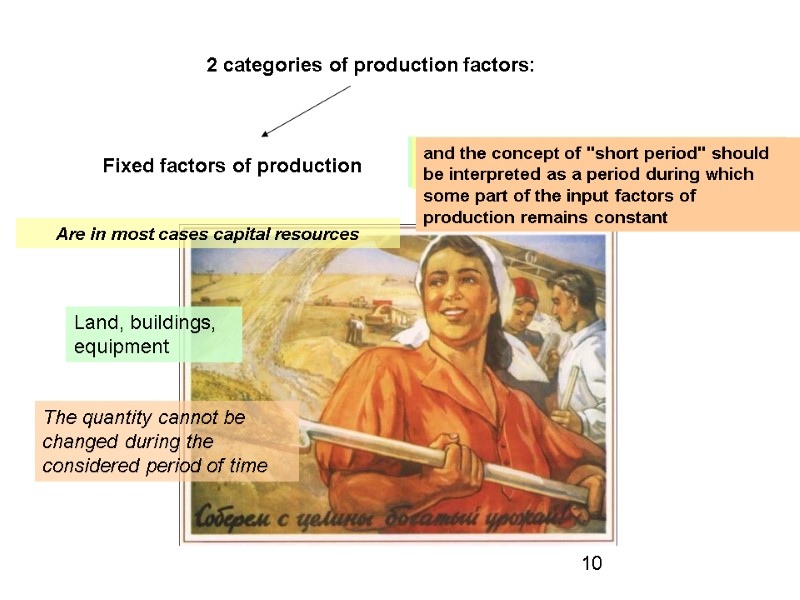
2 categories of production factors: Fixed factors of production The quantity cannot be changed during the considered period of time Land, buildings, equipment Are in most cases capital resources Because in the long run all production inputs can change, permanent production inputs should be considered within a short period, and the concept of "short period" should be interpreted as a period during which some part of the input factors of production remains constant 10
2 categories of production factors: Fixed factors of production Variable factors of production Are those inputs, the number of which is associated with the level of output Watch expended labor, electricity consumption 11
The efficiency of production depends on the balance that is achieved between fixed and variable factors of production 12
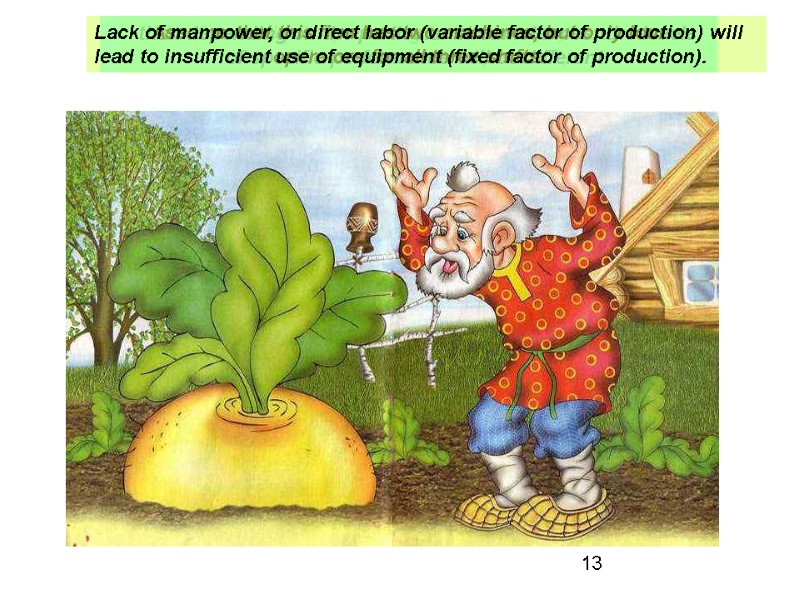
ЕХ: if a certain firm, working in three shifts, requires one operator per machine per shift, than depending on the particular circumstances, the levels of specific performance will be different. Assume that this firm has two machines, but only four operators for all three shifts. Lack of manpower, or direct labor (variable factor of production) will lead to insufficient use of equipment (fixed factor of production). 13
Now consider another case: this same firm has eight operators, but still has only two machines. In this case, lack of equipment leads to suboptimal use of direct labour. And only if you can balance the constant and variable factors of production, the firm will achieve maximum production efficiency 14
The behavior of the production function with one variable input factor of production providing all other inputs are constant 15
To understand the mechanism of changes in the level of production it is useful to assess the impact of one input changing while preserving all other inputs unchanged 16
Mathematically this functional dependence can be represented by the following equation: 17
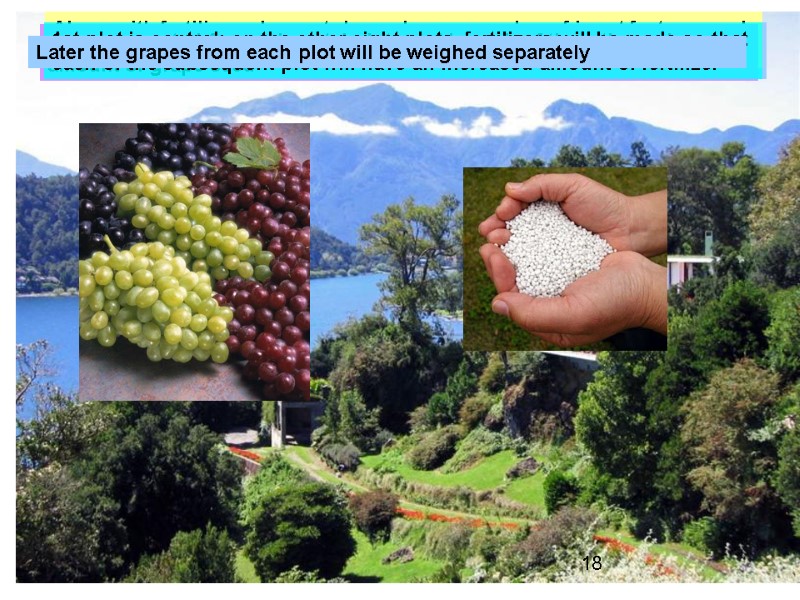
Чили – самая южная в мире страна, находится в Южной Америке и простирается вдоль побережья Тихого океана почти на пять тысяч километров. государство богато природными достопримечательностями: удивительный и таинственный остров Пасхи и его каменные истуканы; великолепная Патагония с покрытыми лесом величественными горами, ледниками и фьордами; национальный парк Торрес дель Пайне, пустыня Акатама. Кордильеры, вулканы и озёра, водопады и пещеры – отдых в Чили подарит вам целый калейдоскоп событий и впечатлений. Suppose a farm plans to conduct a study of the influence of fertilizers on the production of grapes Along with fertilizers, harvest depends on a number of input factors, such as soil, water, sunlight, temperature, direct labour But in this study only fertilizer used as a variable factor of production farmers created 9 experimental plots and in each of them threw the same amount of grape seed 1st plot is control; on the other eight plots fertilizers will be made so that each of the subsequent plot will have an increased amount of fertilizer Later the grapes from each plot will be weighed separately 18
19 the number of bags of fertilizer Total production (pounds) Average production (pounds/bag) Marginal product (pounds)
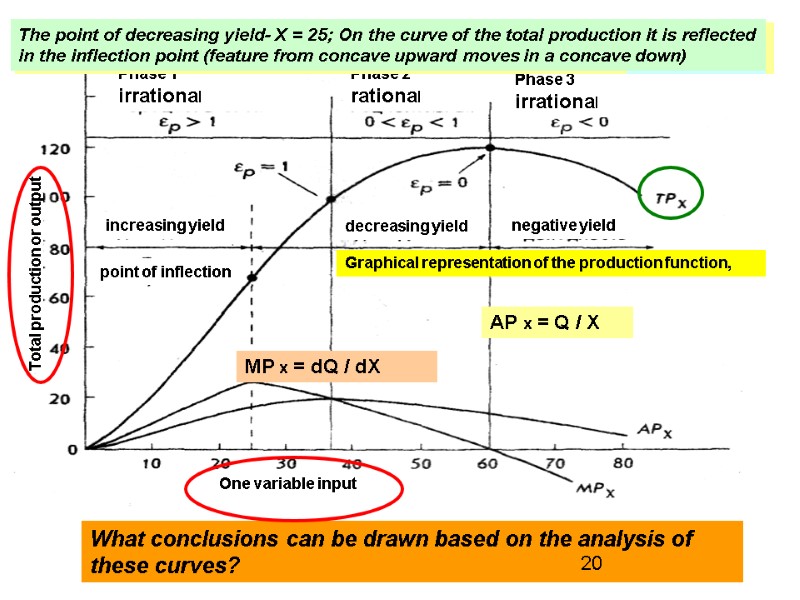
AP x = Q / X MP x = dQ / dX Graphical representation of the production function, What conclusions can be drawn based on the analysis of these curves? 20 Phase 1 irrational Phase 2 rational Phase 3 irrational The figure shows the relationship between total production, TR, marginal product, MP, average production, AP, and the elasticity of production Ep Provided that you change only one of the inputs, while all other inputs remain unchanged Total production or output One variable input increasing yield point of inflection decreasing yield negative yield Marginal product increases in a certain interval; after a certain point on the curve it begins to decrease and eventually becomes negative The point of decreasing yield- X = 25; On the curve of the total production it is reflected in the inflection point (feature from concave upward moves in a concave down)
The law of diminishing returns holds true for all types of production functions! 21
When the curve of total production reaches its maximum, the value of the marginal product is equal to zero The average output increases up until the value of marginal product exceeds the corresponding average value of the output Function of the average output reaches its maximum value when the value of the marginal product and the average output are equal Responding to this event point corresponds to the maximum production efficiency 22
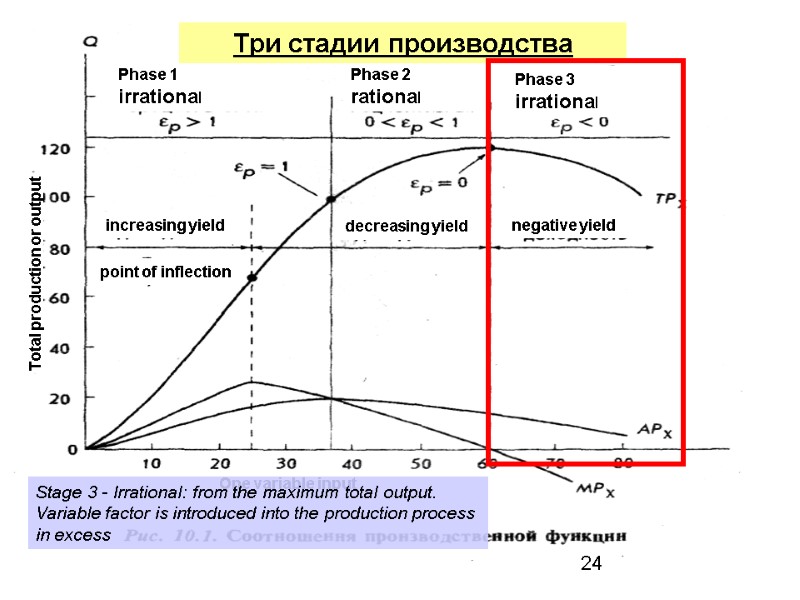
Three stages of production Stage 1 - Irrational: from X = 0 to the maximum average output. Constant factors are entered in excessive quantity, if we consider them in relation to the variable factor Stage 2 is Rational from the maximum average output up to a maximum total output. Achieved the acceptable balance between variable and fixed factors of production Stage 3 - Irrational: from the maximum total output. Variable factor is introduced into the production process in excess 23
Три стадии производства Stage 3 - Irrational: from the maximum total output. Variable factor is introduced into the production process in excess 24
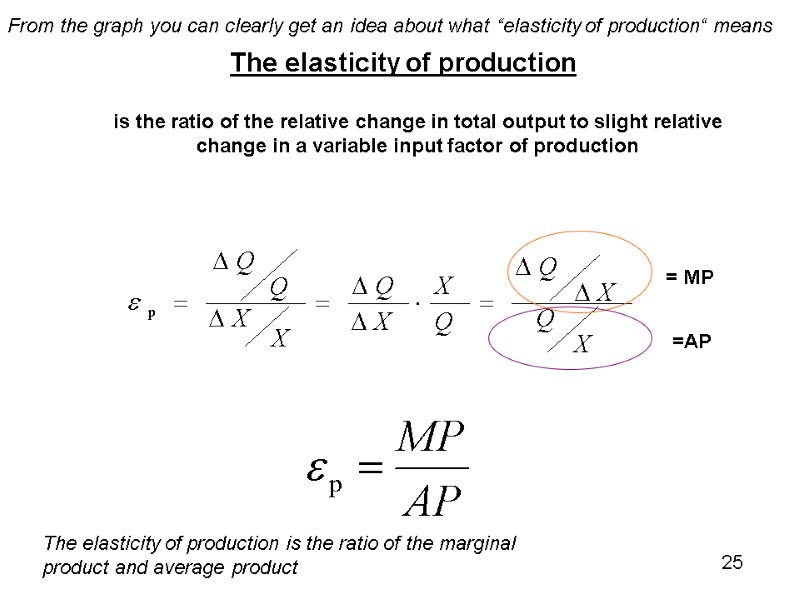
The elasticity of production is the ratio of the relative change in total output to slight relative change in a variable input factor of production = MP =AP From the graph you can clearly get an idea about what “elasticity of production“ means The elasticity of production is the ratio of the marginal product and average product 25
Changing in value of the variable input factor of production by 1% leads to a change in output by more than 1% Changing in value of the variable input factor of production by 1% leads to a change of output by 1% With little change in magnitude of a variable input, there is no change of the output 26