 Analysis of Present Status and Future Supply /Demand Prospects for the DPRK Power System 2006. 6. 25. Power System Group, KERI (J. Y. YOON jyyoon@keri. re. kr )
 u Introduction u Electricity policies in the DPRK u Present status of the DPRK Power System u Future prospects in the DPRK Electricity Sector u Conclusion 1
 u DPRK suffers from Electricity shortage …. n Main reason of DPRK Economy crisis n DPRK devise proper internal & external measures … Construction of generation plants (big or medium hydro plants) Remodeling of power facilities (plants, T/L, D/L. Network …) Reduce Transmission/Distribution loss Strong Demand side managements Co-operational policy with the ROK, RF, China u No exact data & statistics on the DPRK Electricity Sector n Nobody knows the exact data on power plants, power system … 2
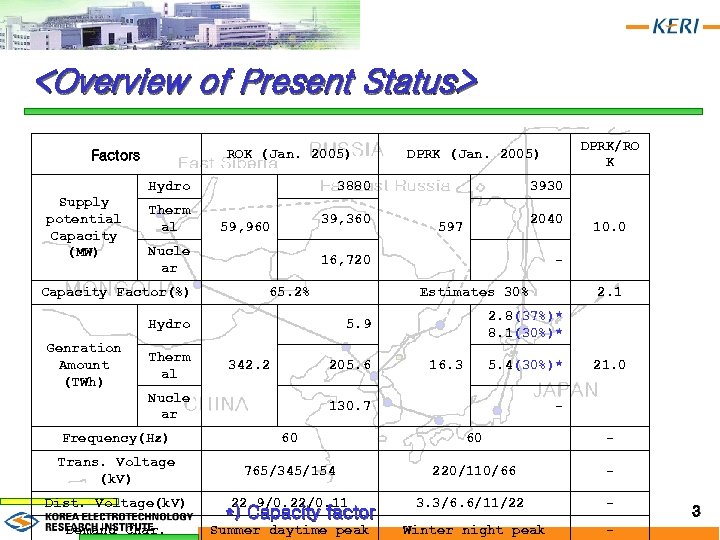 ROK (Jan. 2005) Factors Supply potential Capacity (MW) Hydro Therm al 3880 39, 360 59, 960 Nucle ar Capacity Factor(%) Therm al 2040 597 205. 6 Nucle ar 2. 1 2. 8(37%)* 8. 1(30%)* 5. 9 342. 2 10. 0 Estimates 30% Hydro Genration Amount (TWh) 3930 16, 720 65. 2% DPRK/RO K DPRK (Jan. 2005) 16. 3 5. 4(30%)* 130. 7 21. 0 - Frequency(Hz) 60 60 - Trans. Voltage (k. V) 765/345/154 220/110/66 - 22. 9/0. 22/0. 11 3. 3/6. 6/11/22 - Summer daytime peak Winter night peak - Dist. Voltage(k. V) Demand Char. *) Capacity factor 3
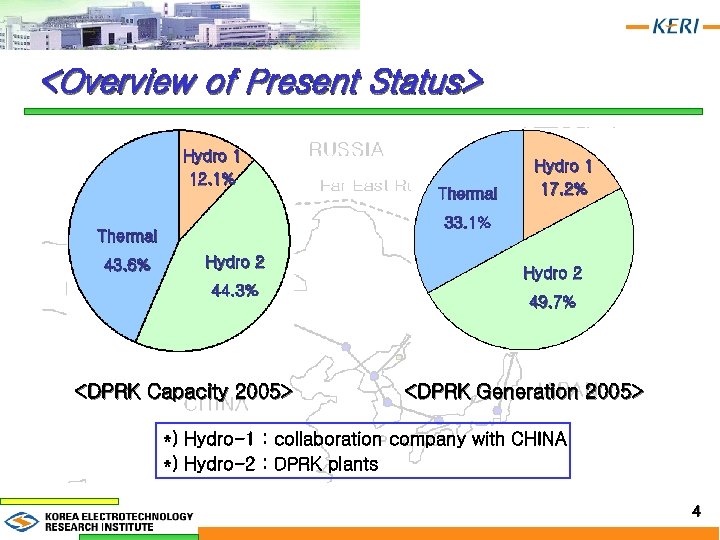 Hydro 1 12. 1% 33. 1% Thermal 43. 6% Thermal Hydro 1 17. 2% Hydro 2 44. 3% Hydro 2 49. 7% *) Hydro-1 : collaboration company with CHINA *) Hydro-2 : DPRK plants 4
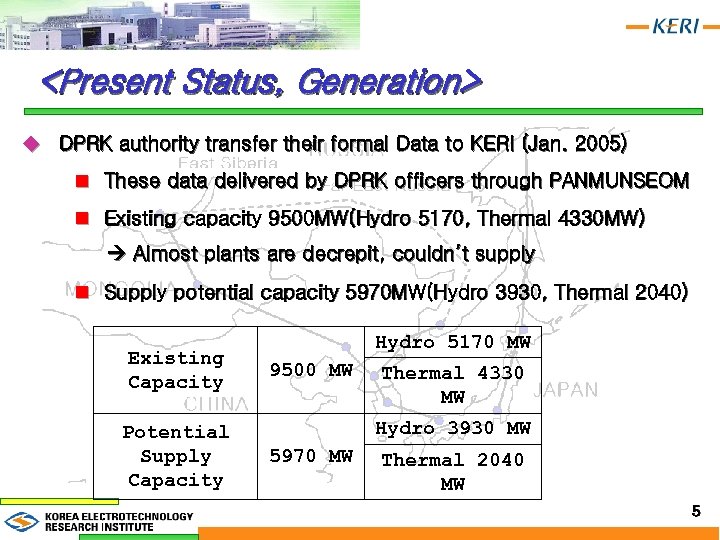 u DPRK authority transfer their formal Data to KERI (Jan. 2005) n These data delivered by DPRK officers through PANMUNSEOM n Existing capacity 9500 MW(Hydro 5170, Thermal 4330 MW) Almost plants are decrepit, couldn’t supply n Supply potential capacity 5970 MW(Hydro 3930, Thermal 2040) Existing Capacity Potential Supply Capacity Hydro 5170 MW 9500 MW Thermal 4330 MW Hydro 3930 MW 5970 MW Thermal 2040 MW 5
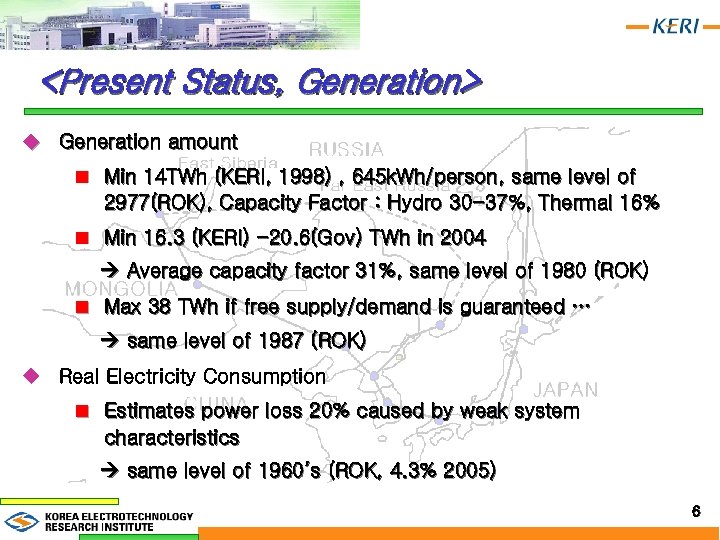 u Generation amount n Min 14 TWh (KERI, 1998) , 645 k. Wh/person, same level of 2977(ROK), Capacity Factor : Hydro 30 -37%, Thermal 16% n Min 16. 3 (KERI) -20. 6(Gov) TWh in 2004 Average capacity factor 31%, same level of 1980 (ROK) n Max 38 TWh if free supply/demand is guaranteed … same level of 1987 (ROK) u Real Electricity Consumption n Estimates power loss 20% caused by weak system characteristics same level of 1960’s (ROK, 4. 3% 2005) 6
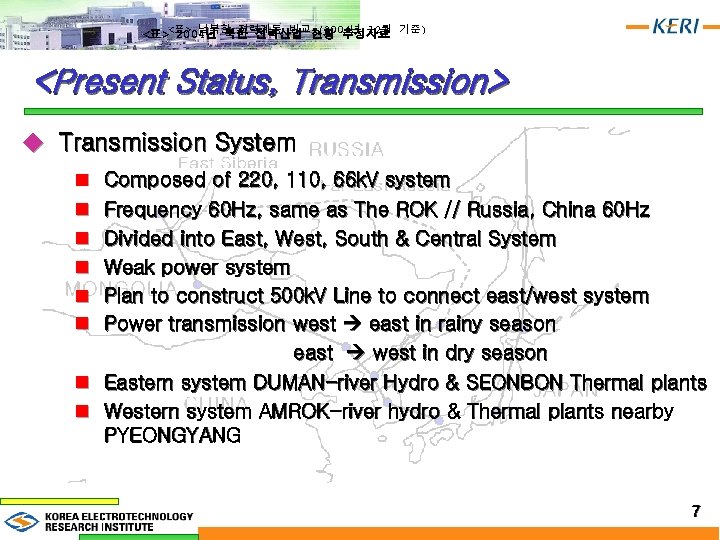 <표> 남북한 전력계통 비교 (2004년 12월 <표> 2004년 북한 전력산업 현황 추정자료 기준) u Transmission System n n n Composed of 220, 110, 66 k. V system Frequency 60 Hz, same as The ROK // Russia, China 60 Hz Divided into East, West, South & Central System Weak power system Plan to construct 500 k. V Line to connect east/west system Power transmission west east in rainy season east west in dry season n Eastern system DUMAN-river Hydro & SEONBON Thermal plants n Western system AMROK-river hydro & Thermal plants nearby PYEONGYANG 7
 u Distribution System n Primary Voltage 3. 3, 6. 6, 11, 22 k. V n Secondary Voltage 110 V, 220 V n Standardization to 11 k. V Primary Voltage KEPCO 22. 9 k. V is more reasonable n 22. 9 k. V system was already applied to supply “GAESUNG Industrial complex”, 30 km, 15 MW x 2 circuits 8
 u Very weak system and bad quality n Several measured data was reported n Voltage below 0. 7 -0. 9[pu] (ex 110 k. V 80 -90 k. V level) n Frequency 60 Hz 43 -48 Hz n Obstacle to practical business cooperation (ex: KORES develops the DPRK coal mine, but couldn’t operation because of bad power quality, seek to alternatives to solve …. ) n Necessity for reinforcements on overall DPRK power system Reduce power loss above 20% below 5%, ROK level Improve the industrial productivity 9
 u Electricity Policy for DPRK Power Supply/Demand n Divided into 5 -step electricity policies n 1945 - 1970 : Mainly dependent on hydro plants (90%), No shortage n 1970’s – 1980’s : Policy change hydro by coal (thermal) Construction of thermal plant supported by Russia n 1980’s – : Policy change coal by nuclear plan Construction Plan for Nuclear plants, ex) KEDO project n 1990’s - : Construction of medium/small hydro plants n 2000’s - : Conduct both internal, external policies in parallel 10
 u Internal policy : Devise various countermeasures to overcome electricity shortage n Construction of Large hydro plants (11 units 1180 MW) n Remodeling of overall power system Generation plants, Transmission, Distribution system n Co-operational policy with neighboring countries Russia, The ROK n Energy saving policy Discriminatory power supply, replace by lighting lamp for energy saving Using the Electronic metering ticket 11
 u Internal policy (continue) : n Energy 3 -year’s plan (03 -05) ① Restructuring power plants ② Coal production increase ③ Expansion for coal production machinery n Science & Technology 5 -year’s plan (03 -07) ① Efficiency improve of water turbine (90%) ② Saving the heavy oil & Modernize the coal production tech. ③ Reduce the power loss (21%→ 16%) ④ Transmission systemize for NEAREST ⑤ Develop the renewable energy 12
 u Construction of large hydro plants n 11 units, 1180 MW u Restructuring of aging thermal plants n BUKCHANG(1600 MW), PYONGYANG(500 MW) Thermal Plants Change Boiler, Turbine …. n SUPUNG(800 MW)․GYANGKYE(246 MW) Water Turbine change & DAM Reconstruction u Reinforcement of T&D Lines nearby PYONGYANG 13
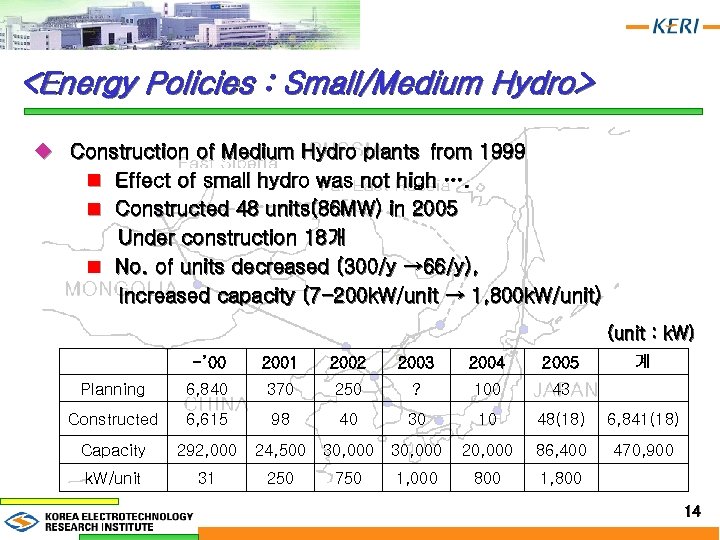 u Construction of Medium Hydro plants from 1999 n Effect of small hydro was not high …. n Constructed 48 units(86 MW) in 2005 Under construction 18개 n No. of units decreased (300/y → 66/y), Increased capacity (7 -200 k. W/unit → 1, 800 k. W/unit) (unit : k. W) -’ 00 2001 2002 2003 2004 2005 계 Planning 6, 840 370 250 ? 100 43 Constructed 6, 615 98 40 30 10 48(18) 6, 841(18) Capacity 292, 000 24, 500 30, 000 20, 000 86, 400 470, 900 k. W/unit 31 250 750 1, 000 800 1, 800 14
 u External policy : n DPRK requests to Electricity Aid To ROK, Short-term 500 MW , Long-term 2, 000 MW To Russia, 300 -500 MW n Wants to build Nuclear plant through Political negotiation n Facility maintenance support from neighboring countries n ROK offers 2000 MW aid if DPRK gives up atomic plan … n Electricity Aid under mutual political, economic trust should be guaranteed 15
 u External cooperation n Import used plant facilities with natural resources security from RUSSIA(BUCKCHANG), CHINA (large hydro), HYDRO SWEDEN (small hydro plants) n Collaboration with CHINA : l Construction of Power line & cable factory l Change of T&D power line & lighting (Compact lamp to reduce power loss by 80%) l Supply card type electronic power meter Introduction of capitalism on power consumption 16
 Everybody wants to know the ① Future possible political scenarios ② Prospects on DPRK power Industry & system ③ Free volume of DPRK electricity market size ED = function ( economy (politics) ) ED : Electricity Demand, DPRK 17
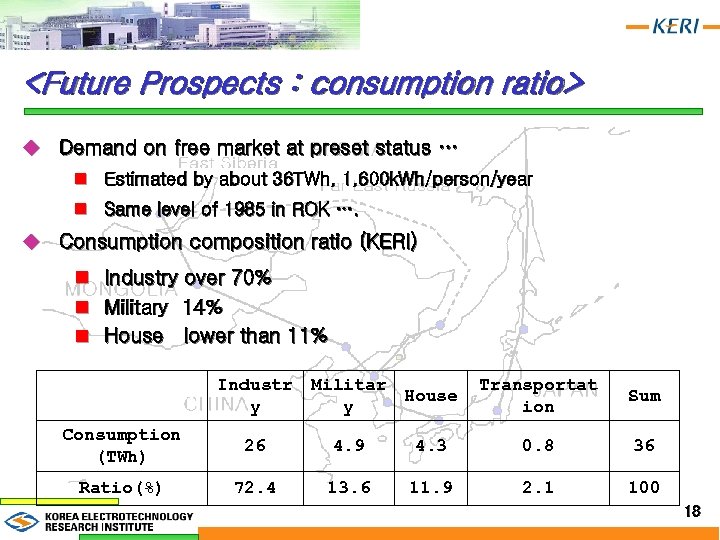 u Demand on free market at preset status … n Estimated by about 36 TWh, 1, 600 k. Wh/person/year n Same level of 1985 in ROK …. u Consumption composition ratio (KERI) n Industry over 70% n Military 14% n House lower than 11% Industr Militar House y y Transportat ion Sum Consumption (TWh) 26 4. 9 4. 3 0. 8 36 Ratio(%) 72. 4 13. 6 11. 9 2. 1 100 18
 u Many scenarios for NEAREST has been published n ESI, KERI, NI report/paper etc. n Has rough concept/contents and similarities with each other n Among these scenarios, “(RU)-DPRK-ROK” is the key point u Future interconnection potentials b/t ROK and DPRK n Possibility of power interconnection in future l Power supply for GAESUNG industrial complex was realized l ROK government offers 2000 MW aid if DPRK gives up atomic plan n DPRK wants to build light water reactor …. n Unified power system operation will be realized 19
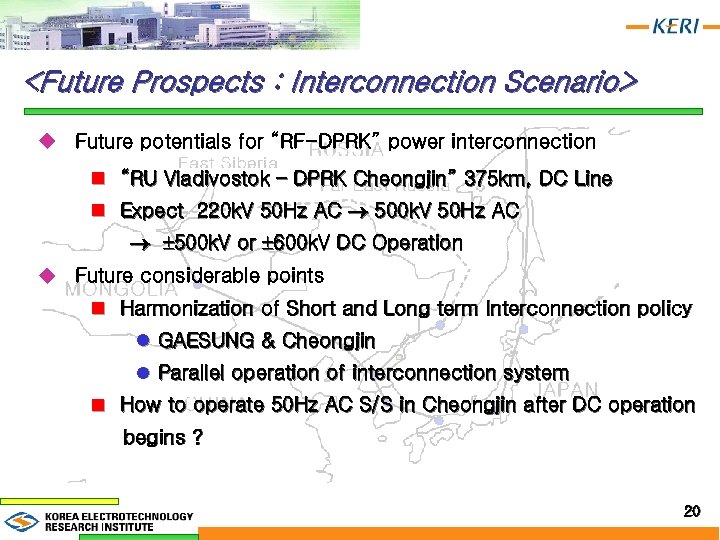 u Future potentials for “RF-DPRK” power interconnection n “RU Vladivostok – DPRK Cheongjin” 375 km, DC Line n Expect 220 k. V 50 Hz AC 500 k. V or 600 k. V DC Operation u Future considerable points n Harmonization of Short and Long term Interconnection policy l GAESUNG & Cheongjin l Parallel operation of interconnection system n How to operate 50 Hz AC S/S in Cheongjin after DC operation begins ? 20
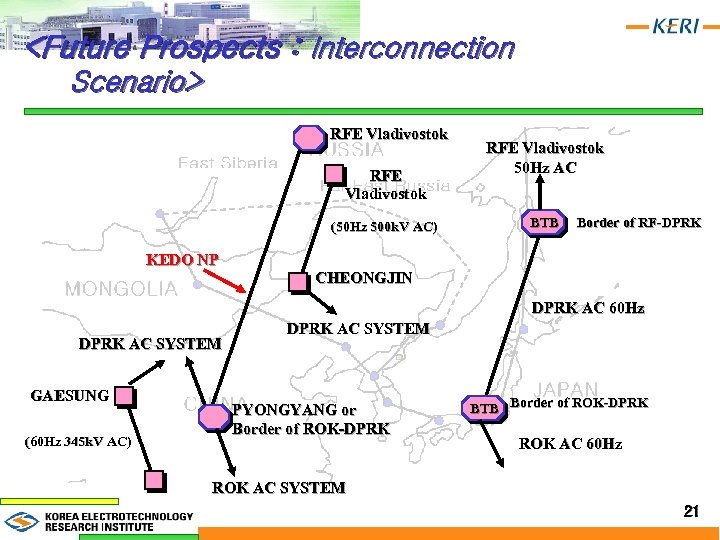 RFE Vladivostok (50 Hz 500 k. V AC) KEDO NP RFE Vladivostok 50 Hz AC BTB Border of RF-DPRK CHEONGJIN DPRK AC 60 Hz DPRK AC SYSTEM GAESUNG (60 Hz 345 k. V AC) DPRK AC SYSTEM PYONGYANG or Border of ROK-DPRK BTB Border of ROK-DPRK ROK AC 60 Hz ROK AC SYSTEM 21



 Скачать презентацию Analysis of Present Status and Future Supply Demand