


 Скачать презентацию Analysis of NGMN Requirements REQ 4 LTE Automatic
042c6af6dca5c8850e63553d2a6fe332.ppt
- Количество слайдов: 10
 Analysis of NGMN Requirements REQ 4: LTE Automatic Neighbor Relation (ANR) and Self Organizing Networks (SON) Operation 1
 LTE Automatic Neighbor Relation (ANR) Related 3 GPP SA 5 specifications • TS 32. 511 • TS 32. 762/763/765 Current Status of the specifications • The Automatic Neighbor Relations related specifications have been completed in Rel-9. This is tied closely to the RAN specifications and any changes/enhancements will be closely worked together with the RAN groups. • Automatic Neighbor relations are supported with planning tools for initial neighbor assignment (optional), automatic discovery in the node using UE measurements and mechanism for the operator to control the neighbor relations using blacklisting and whitelisting. 2
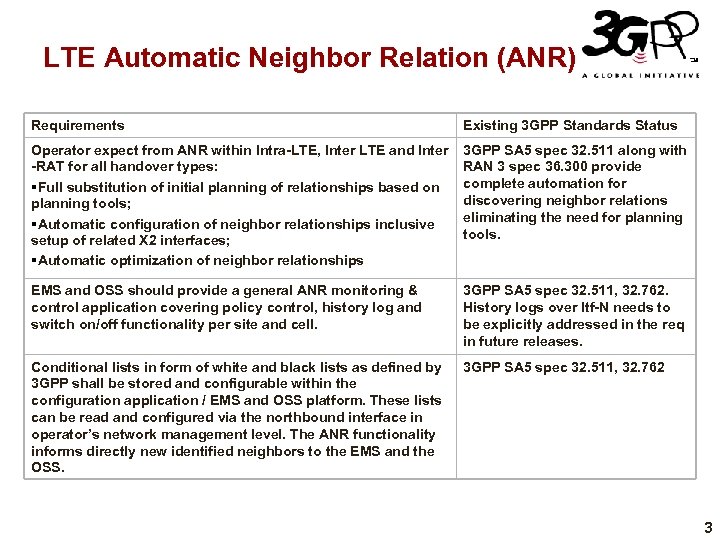 LTE Automatic Neighbor Relation (ANR) Requirements Existing 3 GPP Standards Status Operator expect from ANR within Intra-LTE, Inter LTE and Inter -RAT for all handover types: §Full substitution of initial planning of relationships based on planning tools; §Automatic configuration of neighbor relationships inclusive setup of related X 2 interfaces; §Automatic optimization of neighbor relationships 3 GPP SA 5 spec 32. 511 along with RAN 3 spec 36. 300 provide complete automation for discovering neighbor relations eliminating the need for planning tools. EMS and OSS should provide a general ANR monitoring & control application covering policy control, history log and switch on/off functionality per site and cell. 3 GPP SA 5 spec 32. 511, 32. 762. History logs over Itf-N needs to be explicitly addressed in the req in future releases. Conditional lists in form of white and black lists as defined by 3 GPP shall be stored and configurable within the configuration application / EMS and OSS platform. These lists can be read and configured via the northbound interface in operator’s network management level. The ANR functionality informs directly new identified neighbors to the EMS and the OSS. 3 GPP SA 5 spec 32. 511, 32. 762 3
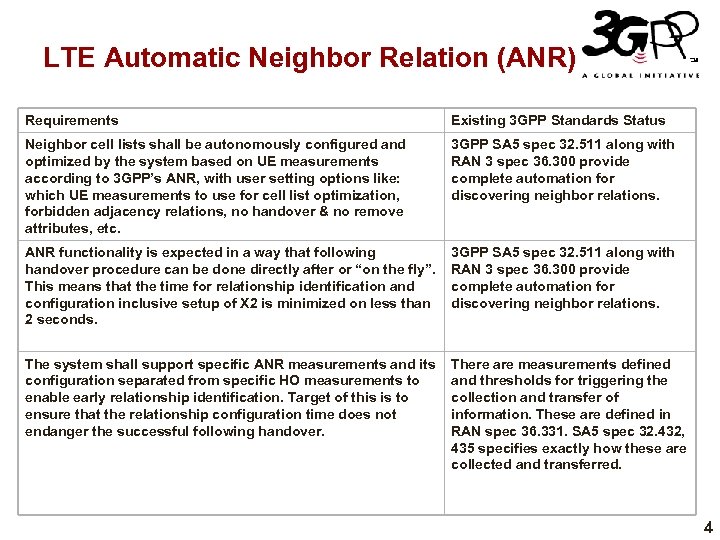 LTE Automatic Neighbor Relation (ANR) Requirements Existing 3 GPP Standards Status Neighbor cell lists shall be autonomously configured and optimized by the system based on UE measurements according to 3 GPP’s ANR, with user setting options like: which UE measurements to use for cell list optimization, forbidden adjacency relations, no handover & no remove attributes, etc. 3 GPP SA 5 spec 32. 511 along with RAN 3 spec 36. 300 provide complete automation for discovering neighbor relations. ANR functionality is expected in a way that following handover procedure can be done directly after or “on the fly”. This means that the time for relationship identification and configuration inclusive setup of X 2 is minimized on less than 2 seconds. 3 GPP SA 5 spec 32. 511 along with RAN 3 spec 36. 300 provide complete automation for discovering neighbor relations. The system shall support specific ANR measurements and its configuration separated from specific HO measurements to enable early relationship identification. Target of this is to ensure that the relationship configuration time does not endanger the successful following handover. There are measurements defined and thresholds for triggering the collection and transfer of information. These are defined in RAN spec 36. 331. SA 5 spec 32. 432, 435 specifies exactly how these are collected and transferred. 4
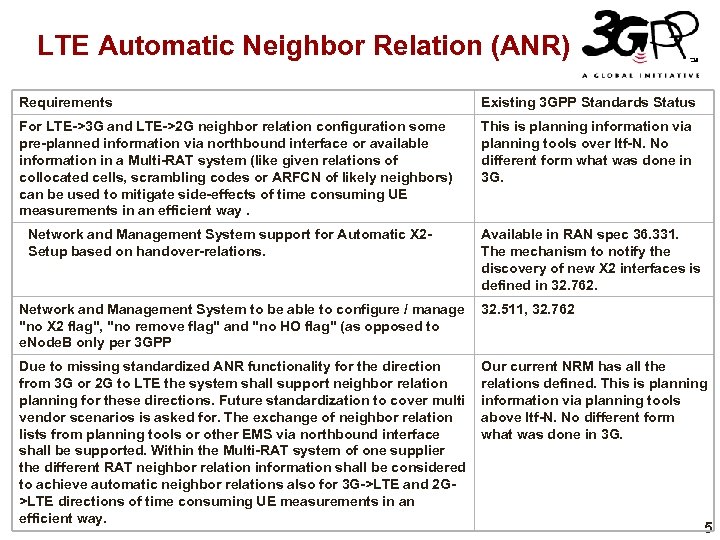 LTE Automatic Neighbor Relation (ANR) Requirements Existing 3 GPP Standards Status For LTE->3 G and LTE->2 G neighbor relation configuration some pre-planned information via northbound interface or available information in a Multi-RAT system (like given relations of collocated cells, scrambling codes or ARFCN of likely neighbors) can be used to mitigate side-effects of time consuming UE measurements in an efficient way. This is planning information via planning tools over Itf-N. No different form what was done in 3 G. Network and Management System support for Automatic X 2 Setup based on handover-relations. Available in RAN spec 36. 331. The mechanism to notify the discovery of new X 2 interfaces is defined in 32. 762. Network and Management System to be able to configure / manage "no X 2 flag", "no remove flag" and "no HO flag" (as opposed to e. Node. B only per 3 GPP 32. 511, 32. 762 Due to missing standardized ANR functionality for the direction from 3 G or 2 G to LTE the system shall support neighbor relation planning for these directions. Future standardization to cover multi vendor scenarios is asked for. The exchange of neighbor relation lists from planning tools or other EMS via northbound interface shall be supported. Within the Multi-RAT system of one supplier the different RAT neighbor relation information shall be considered to achieve automatic neighbor relations also for 3 G->LTE and 2 G>LTE directions of time consuming UE measurements in an efficient way. Our current NRM has all the relations defined. This is planning information via planning tools above Itf-N. No different form what was done in 3 G. 5
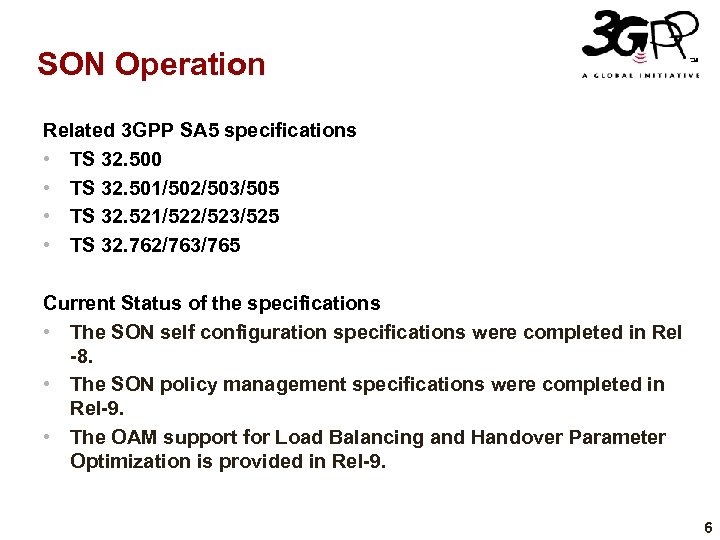 SON Operation Related 3 GPP SA 5 specifications • TS 32. 500 • TS 32. 501/502/503/505 • TS 32. 521/522/523/525 • TS 32. 762/763/765 Current Status of the specifications • The SON self configuration specifications were completed in Rel -8. • The SON policy management specifications were completed in Rel-9. • The OAM support for Load Balancing and Handover Parameter Optimization is provided in Rel-9. 6
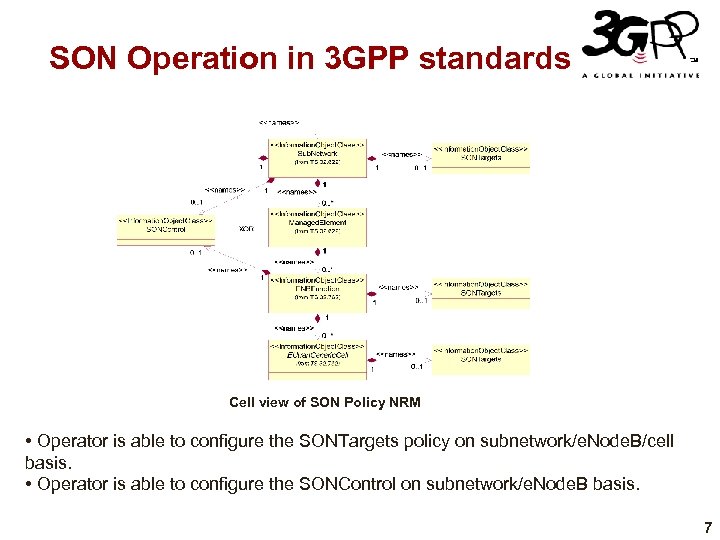 SON Operation in 3 GPP standards Cell view of SON Policy NRM • Operator is able to configure the SONTargets policy on subnetwork/e. Node. B/cell basis. • Operator is able to configure the SONControl on subnetwork/e. Node. B basis. 7
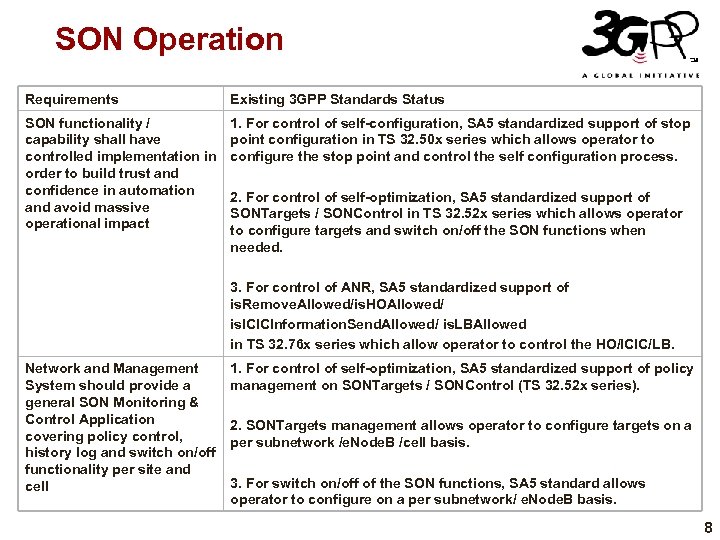 SON Operation Requirements Existing 3 GPP Standards Status SON functionality / capability shall have controlled implementation in order to build trust and confidence in automation and avoid massive operational impact 1. For control of self-configuration, SA 5 standardized support of stop point configuration in TS 32. 50 x series which allows operator to configure the stop point and control the self configuration process. 2. For control of self-optimization, SA 5 standardized support of SONTargets / SONControl in TS 32. 52 x series which allows operator to configure targets and switch on/off the SON functions when needed. 3. For control of ANR, SA 5 standardized support of is. Remove. Allowed/is. HOAllowed/ is. ICICInformation. Send. Allowed/ is. LBAllowed in TS 32. 76 x series which allow operator to control the HO/ICIC/LB. Network and Management System should provide a general SON Monitoring & Control Application covering policy control, history log and switch on/off functionality per site and cell 1. For control of self-optimization, SA 5 standardized support of policy management on SONTargets / SONControl (TS 32. 52 x series). 2. SONTargets management allows operator to configure targets on a per subnetwork /e. Node. B /cell basis. 3. For switch on/off of the SON functions, SA 5 standard allows operator to configure on a per subnetwork/ e. Node. B basis. 8
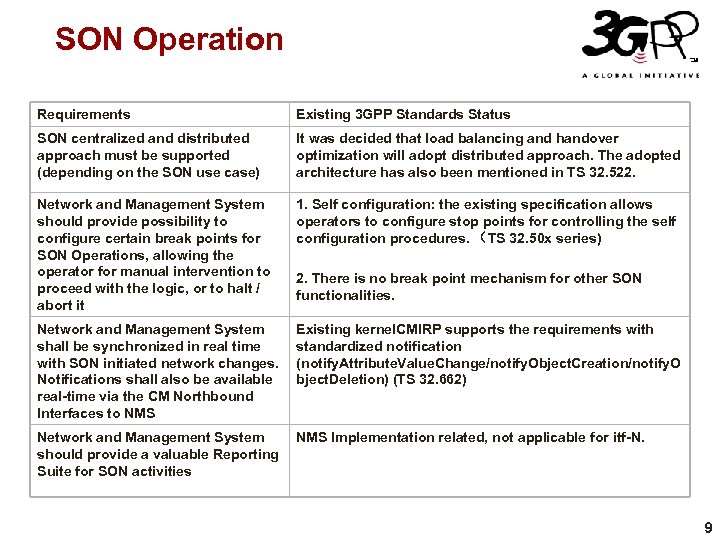 SON Operation Requirements Existing 3 GPP Standards Status SON centralized and distributed approach must be supported (depending on the SON use case) It was decided that load balancing and handover optimization will adopt distributed approach. The adopted architecture has also been mentioned in TS 32. 522. Network and Management System should provide possibility to configure certain break points for SON Operations, allowing the operator for manual intervention to proceed with the logic, or to halt / abort it 1. Self configuration: the existing specification allows operators to configure stop points for controlling the self configuration procedures. (TS 32. 50 x series) Network and Management System shall be synchronized in real time with SON initiated network changes. Notifications shall also be available real-time via the CM Northbound Interfaces to NMS Existing kernel. CMIRP supports the requirements with standardized notification (notify. Attribute. Value. Change/notify. Object. Creation/notify. O bject. Deletion) (TS 32. 662) Network and Management System should provide a valuable Reporting Suite for SON activities NMS Implementation related, not applicable for itf-N. 2. There is no break point mechanism for other SON functionalities. 9
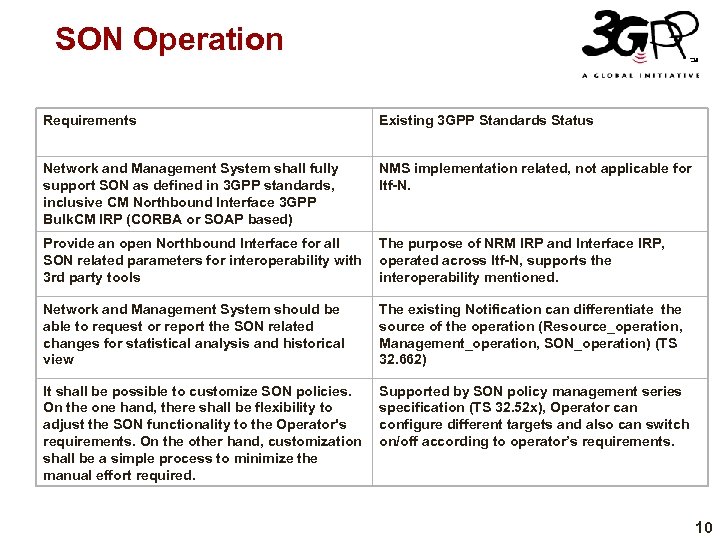 SON Operation Requirements Existing 3 GPP Standards Status Network and Management System shall fully support SON as defined in 3 GPP standards, inclusive CM Northbound Interface 3 GPP Bulk. CM IRP (CORBA or SOAP based) NMS implementation related, not applicable for Itf-N. Provide an open Northbound Interface for all SON related parameters for interoperability with 3 rd party tools The purpose of NRM IRP and Interface IRP, operated across Itf-N, supports the interoperability mentioned. Network and Management System should be able to request or report the SON related changes for statistical analysis and historical view The existing Notification can differentiate the source of the operation (Resource_operation, Management_operation, SON_operation) (TS 32. 662) It shall be possible to customize SON policies. On the one hand, there shall be flexibility to adjust the SON functionality to the Operator's requirements. On the other hand, customization shall be a simple process to minimize the manual effort required. Supported by SON policy management series specification (TS 32. 52 x), Operator can configure different targets and also can switch on/off according to operator’s requirements. 10