


 Скачать презентацию ANALYSIS OF ENERGY SYSTEMS Dr R N Patel
2a0a7ae48cfcde7296697bb31f7fe9d8.ppt
- Количество слайдов: 27
 ANALYSIS OF ENERGY SYSTEMS Dr. R. N. Patel Mechanical Department, Institute of Technology, Nirma University
 OVERVIEW OF TALK Renewables-Characteristics Levels / options Of Analysis Decision Types / Perspectives Energy Chain – Primary Energy Analysis Criteria Net Energy Analysis
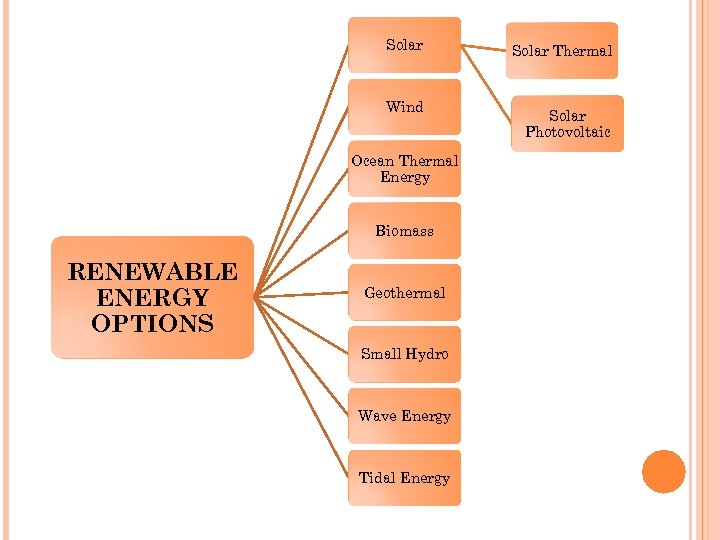 Solar Wind Ocean Thermal Energy Biomass RENEWABLE ENERGY OPTIONS Geothermal Small Hydro Wave Energy Tidal Energy Solar Thermal Solar Photovoltaic
 CHARACTERISTICS OF RENEWABLES Large, Inexhaustible source – Solar Energy intercepted by earth 1. 8*1011 MW Clean Source Of Energy Dilute Source – Even In best Regions 1 kw/m 2 & Total Daily Flux available is 7 kwh/m 2 Large Collection Areas, High Costs Availibility Varies with time Need For Storage, Additional Cost
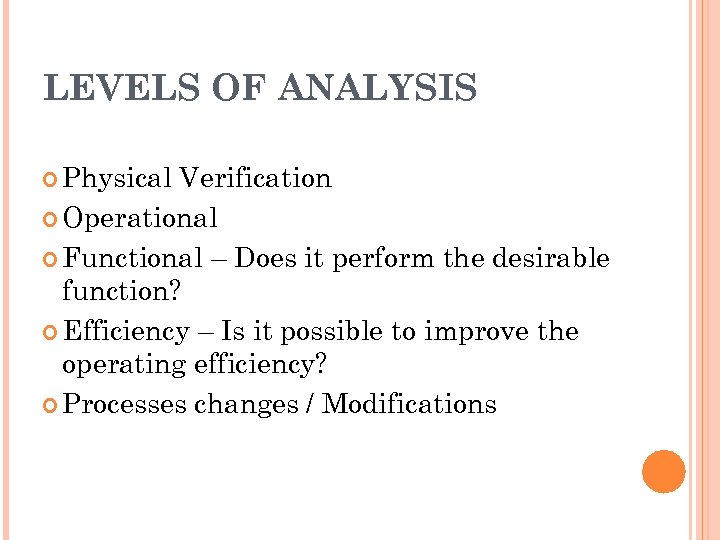 LEVELS OF ANALYSIS Physical Verification Operational Functional – Does it perform the desirable function? Efficiency – Is it possible to improve the operating efficiency? Processes changes / Modifications
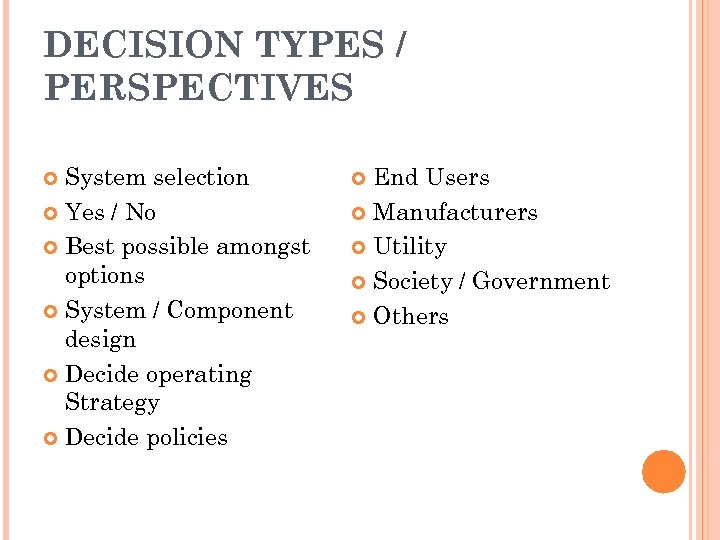 DECISION TYPES / PERSPECTIVES System selection Yes / No Best possible amongst options System / Component design Decide operating Strategy Decide policies End Users Manufacturers Utility Society / Government Others
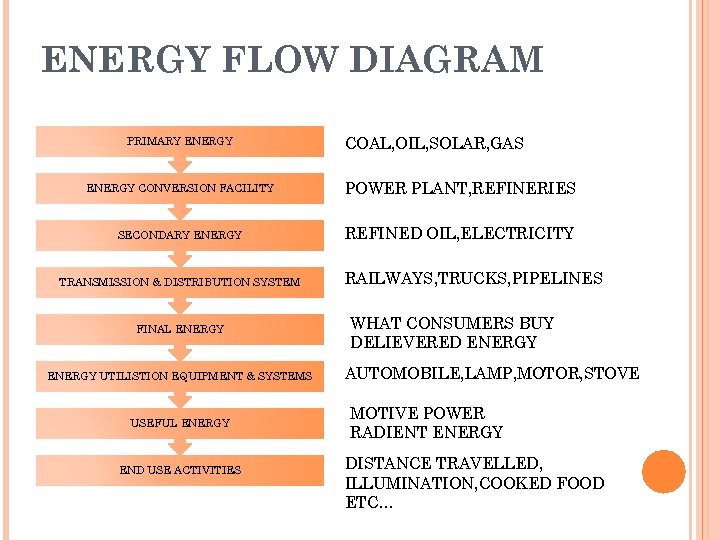 ENERGY FLOW DIAGRAM PRIMARY ENERGY COAL, OIL, SOLAR, GAS ENERGY CONVERSION FACILITY POWER PLANT, REFINERIES SECONDARY ENERGY REFINED OIL, ELECTRICITY TRANSMISSION & DISTRIBUTION SYSTEM FINAL ENERGY UTILISTION EQUIPMENT & SYSTEMS USEFUL ENERGY END USE ACTIVITIES RAILWAYS, TRUCKS, PIPELINES WHAT CONSUMERS BUY DELIEVERED ENERGY AUTOMOBILE, LAMP, MOTOR, STOVE MOTIVE POWER RADIENT ENERGY DISTANCE TRAVELLED, ILLUMINATION, COOKED FOOD ETC…
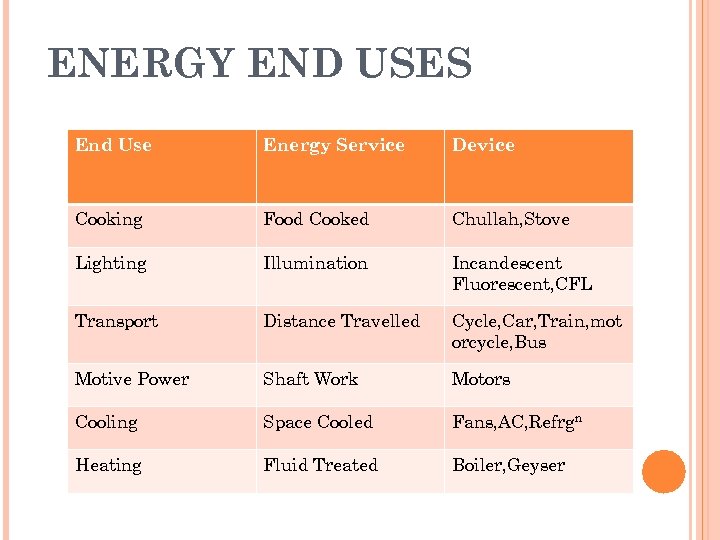 ENERGY END USES End Use Energy Service Device Cooking Food Cooked Chullah, Stove Lighting Illumination Incandescent Fluorescent, CFL Transport Distance Travelled Cycle, Car, Train, mot orcycle, Bus Motive Power Shaft Work Motors Cooling Space Cooled Fans, AC, Refrgn Heating Fluid Treated Boiler, Geyser
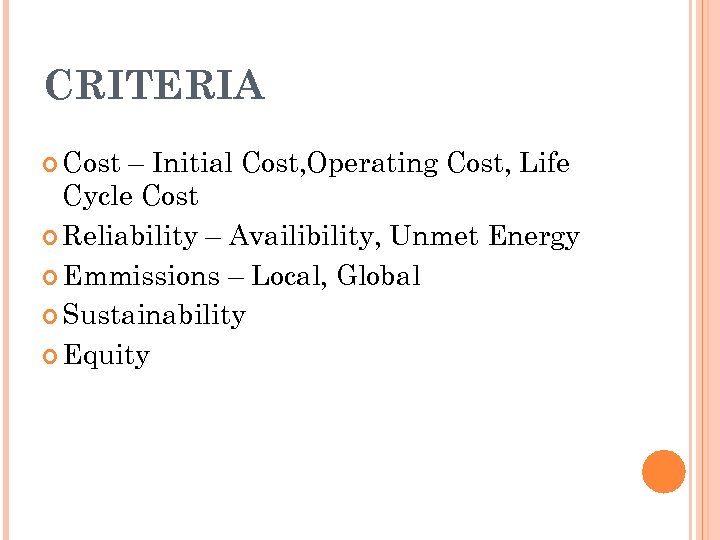 CRITERIA Cost – Initial Cost, Operating Cost, Life Cycle Cost Reliability – Availibility, Unmet Energy Emmissions – Local, Global Sustainability Equity
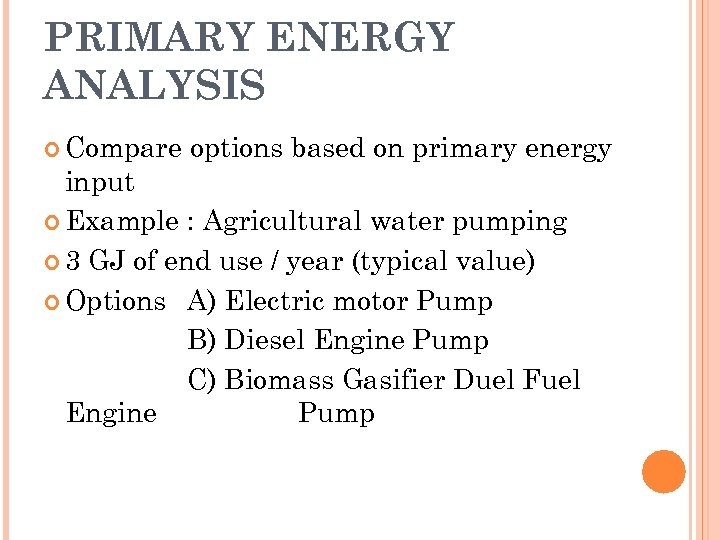 PRIMARY ENERGY ANALYSIS Compare options based on primary energy input Example : Agricultural water pumping 3 GJ of end use / year (typical value) Options A) Electric motor Pump B) Diesel Engine Pump C) Biomass Gasifier Duel Fuel Engine Pump
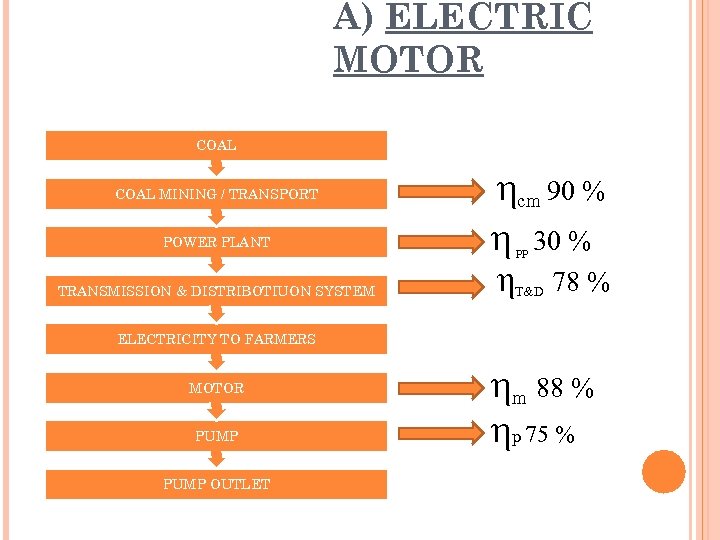 A) ELECTRIC MOTOR COAL MINING / TRANSPORT POWER PLANT TRANSMISSION & DISTRIBOTIUON SYSTEM ηcm 90 % η 30 % pp η T&D 78 % ELECTRICITY TO FARMERS MOTOR PUMP OUTLET ηm 88 % ηp 75 %
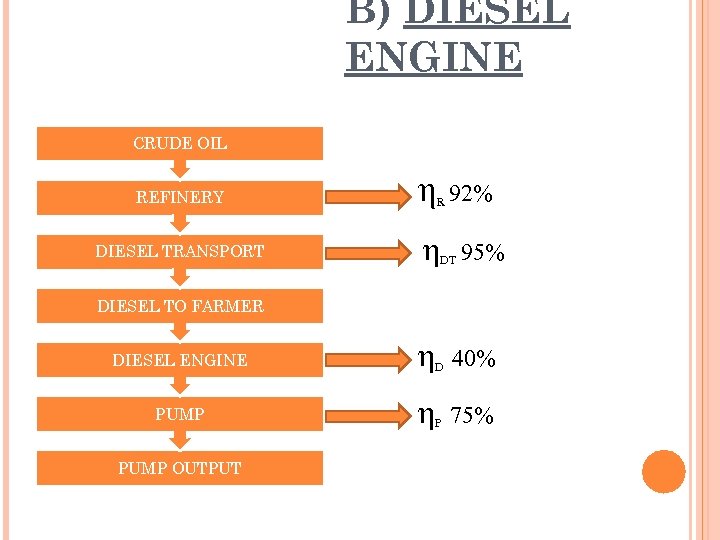 B) DIESEL ENGINE CRUDE OIL REFINERY η DIESEL TRANSPORT η R 92% DT 95% DIESEL TO FARMER DIESEL ENGINE η D 40% PUMP η P 75% PUMP OUTPUT
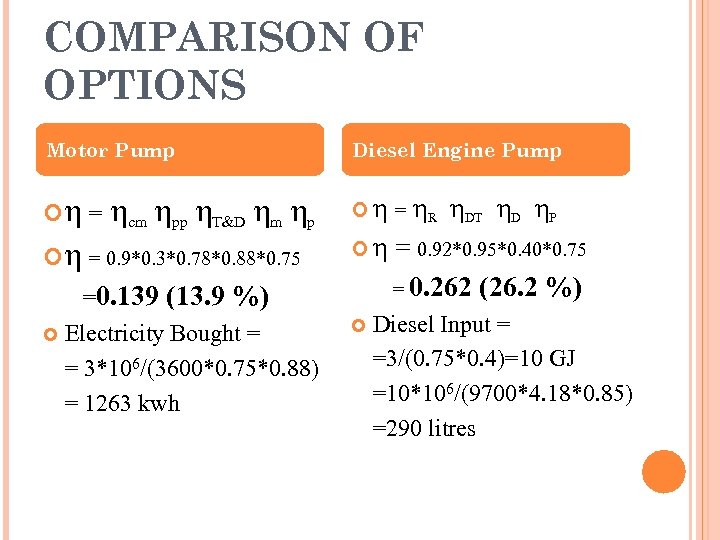 COMPARISON OF OPTIONS Motor Pump Diesel Engine Pump η = ηcm ηpp ηT&D ηm ηp η = 0. 9*0. 3*0. 78*0. 88*0. 75 =0. 139 (13. 9 %) Electricity Bought = = 3*106/(3600*0. 75*0. 88) = 1263 kwh η ηR ηDT ηD ηP = 0. 92*0. 95*0. 40*0. 75 = 0. 262 (26. 2 %) Diesel Input = =3/(0. 75*0. 4)=10 GJ =10*106/(9700*4. 18*0. 85) =290 litres
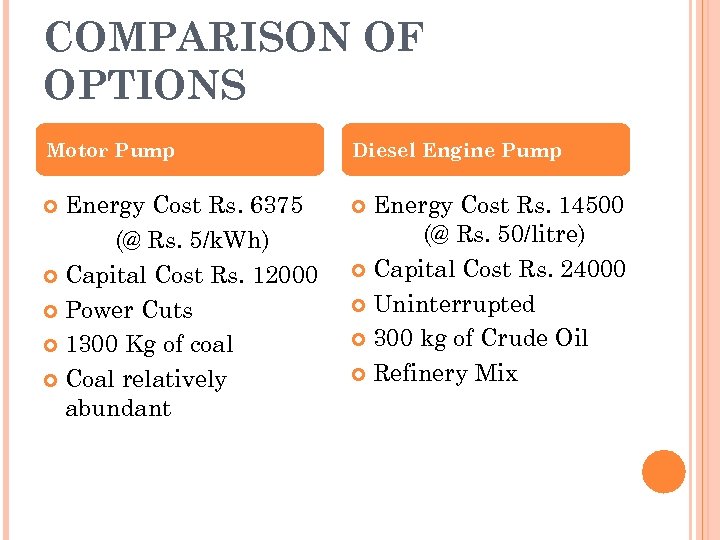 COMPARISON OF OPTIONS Motor Pump Diesel Engine Pump Energy Cost Rs. 6375 (@ Rs. 5/k. Wh) Capital Cost Rs. 12000 Power Cuts 1300 Kg of coal Coal relatively abundant Energy Cost Rs. 14500 (@ Rs. 50/litre) Capital Cost Rs. 24000 Uninterrupted 300 kg of Crude Oil Refinery Mix
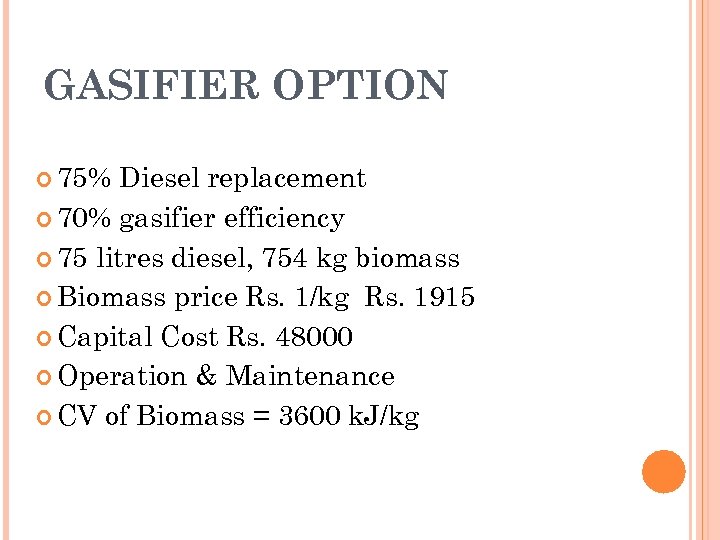 GASIFIER OPTION 75% Diesel replacement 70% gasifier efficiency 75 litres diesel, 754 kg biomass Biomass price Rs. 1/kg Rs. 1915 Capital Cost Rs. 48000 Operation & Maintenance CV of Biomass = 3600 k. J/kg
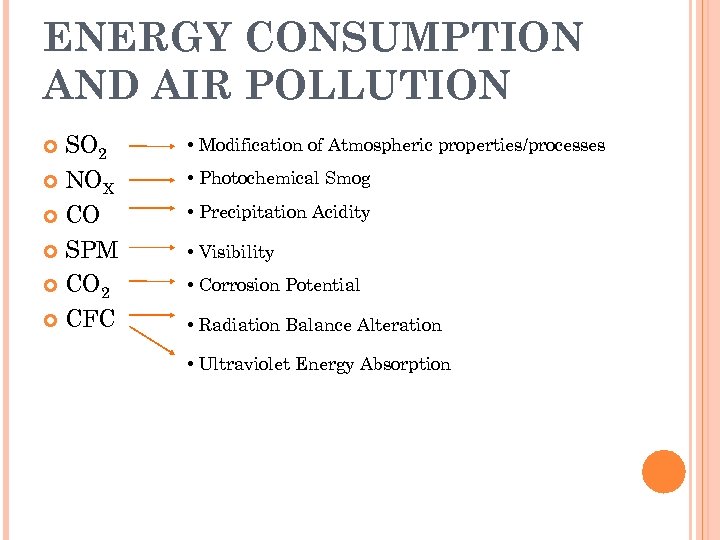 ENERGY CONSUMPTION AND AIR POLLUTION SO 2 NOX CO SPM CO 2 CFC • Modification of Atmospheric properties/processes • Photochemical Smog • Precipitation Acidity • Visibility • Corrosion Potential • Radiation Balance Alteration • Ultraviolet Energy Absorption
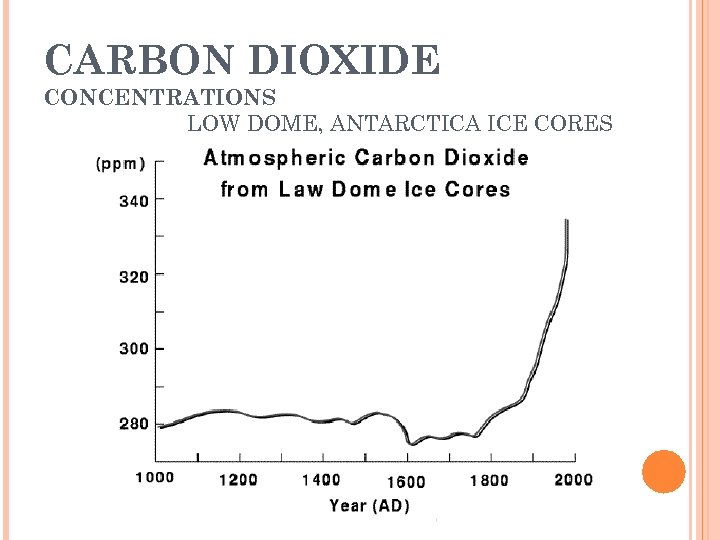 CARBON DIOXIDE CONCENTRATIONS LOW DOME, ANTARCTICA ICE CORES
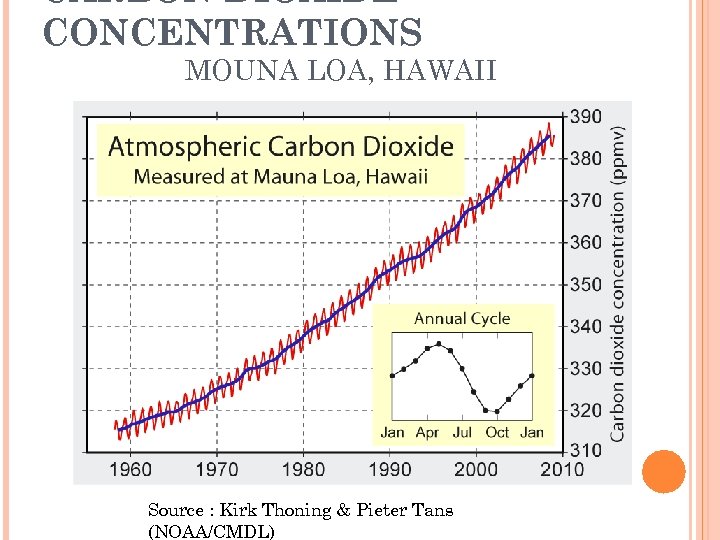 CARBON DIOXIDE CONCENTRATIONS MOUNA LOA, HAWAII Source : Kirk Thoning & Pieter Tans (NOAA/CMDL)
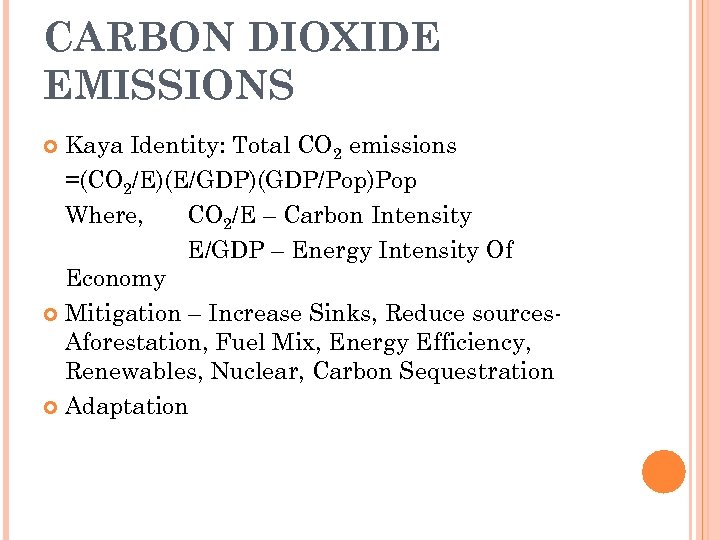 CARBON DIOXIDE EMISSIONS Kaya Identity: Total CO 2 emissions =(CO 2/E)(E/GDP)(GDP/Pop)Pop Where, CO 2/E – Carbon Intensity E/GDP – Energy Intensity Of Economy Mitigation – Increase Sinks, Reduce sources. Aforestation, Fuel Mix, Energy Efficiency, Renewables, Nuclear, Carbon Sequestration Adaptation
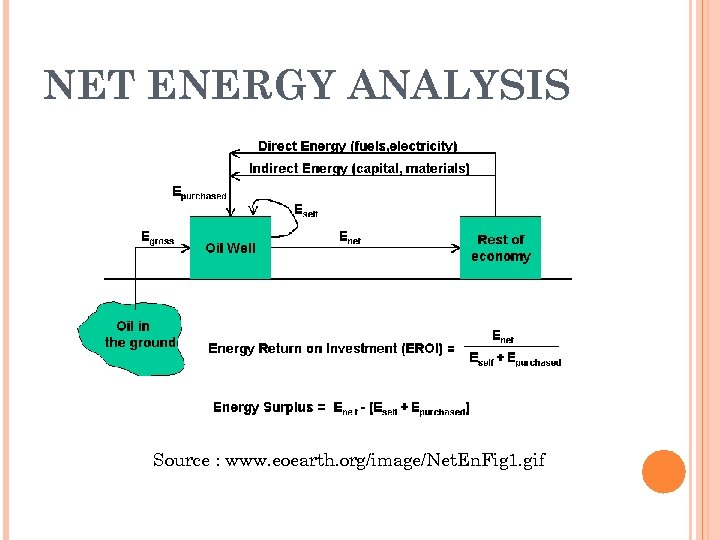 NET ENERGY ANALYSIS Source : www. eoearth. org/image/Net. En. Fig 1. gif
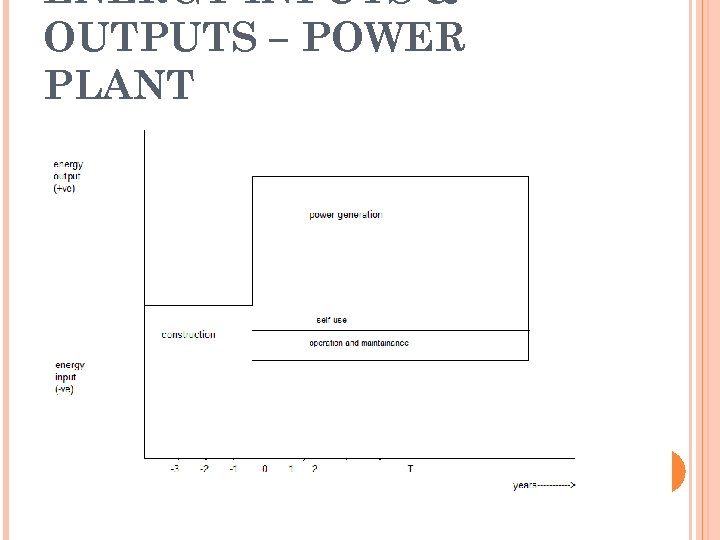 ENERGY INPUTS & OUTPUTS – POWER PLANT
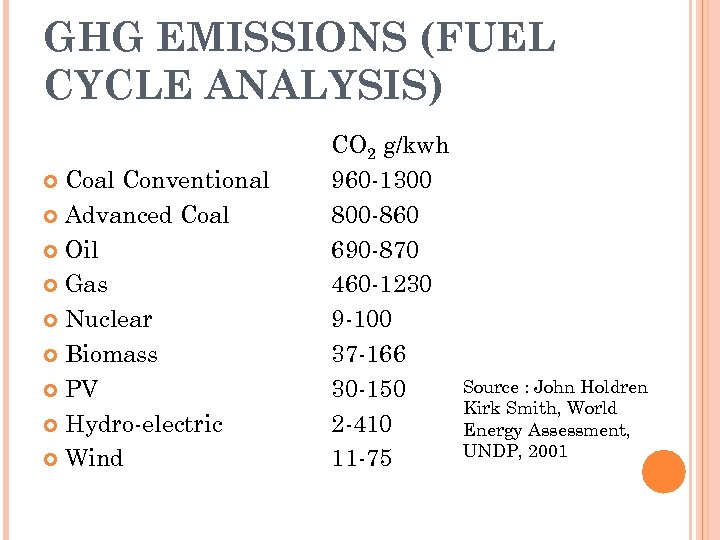 GHG EMISSIONS (FUEL CYCLE ANALYSIS) Coal Conventional Advanced Coal Oil Gas Nuclear Biomass PV Hydro-electric Wind CO 2 g/kwh 960 -1300 800 -860 690 -870 460 -1230 9 -100 37 -166 30 -150 2 -410 11 -75 Source : John Holdren Kirk Smith, World Energy Assessment, UNDP, 2001
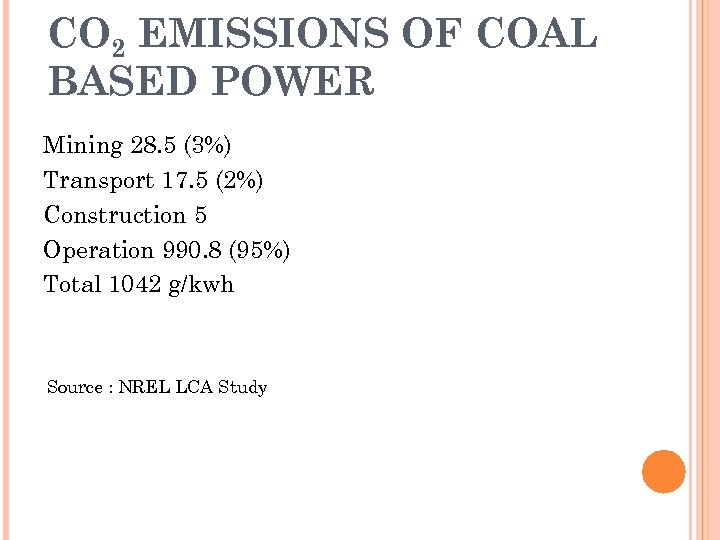 CO 2 EMISSIONS OF COAL BASED POWER Mining 28. 5 (3%) Transport 17. 5 (2%) Construction 5 Operation 990. 8 (95%) Total 1042 g/kwh Source : NREL LCA Study
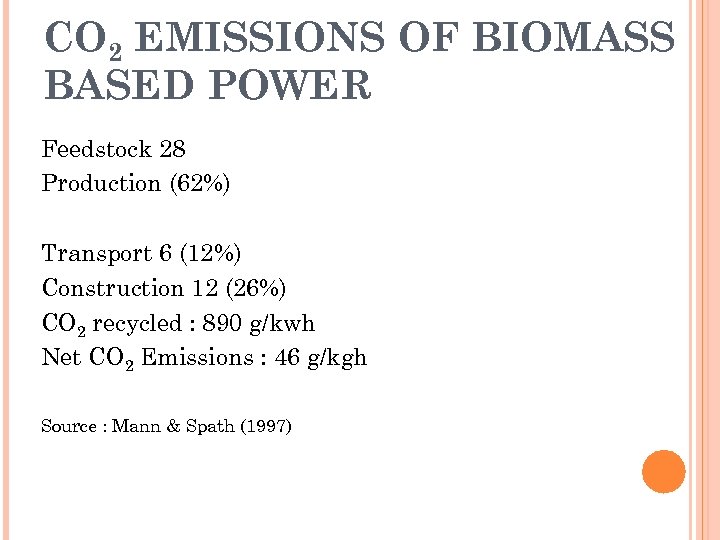 CO 2 EMISSIONS OF BIOMASS BASED POWER Feedstock 28 Production (62%) Transport 6 (12%) Construction 12 (26%) CO 2 recycled : 890 g/kwh Net CO 2 Emissions : 46 g/kgh Source : Mann & Spath (1997)
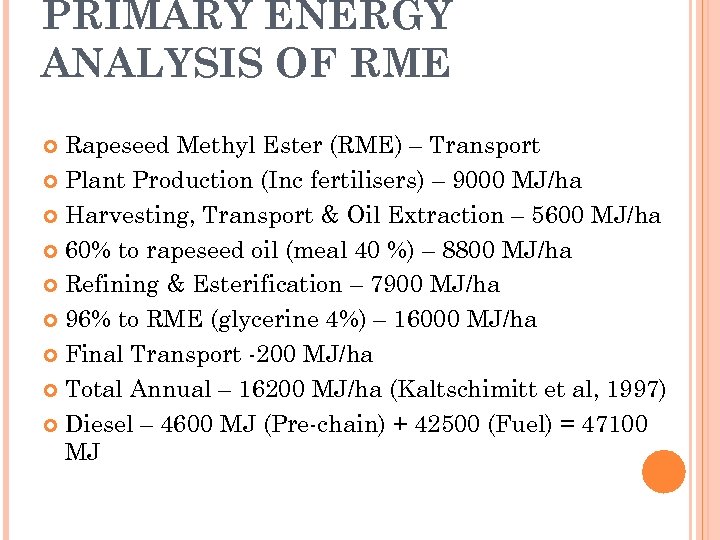 PRIMARY ENERGY ANALYSIS OF RME Rapeseed Methyl Ester (RME) – Transport Plant Production (Inc fertilisers) – 9000 MJ/ha Harvesting, Transport & Oil Extraction – 5600 MJ/ha 60% to rapeseed oil (meal 40 %) – 8800 MJ/ha Refining & Esterification – 7900 MJ/ha 96% to RME (glycerine 4%) – 16000 MJ/ha Final Transport -200 MJ/ha Total Annual – 16200 MJ/ha (Kaltschimitt et al, 1997) Diesel – 4600 MJ (Pre-chain) + 42500 (Fuel) = 47100 MJ
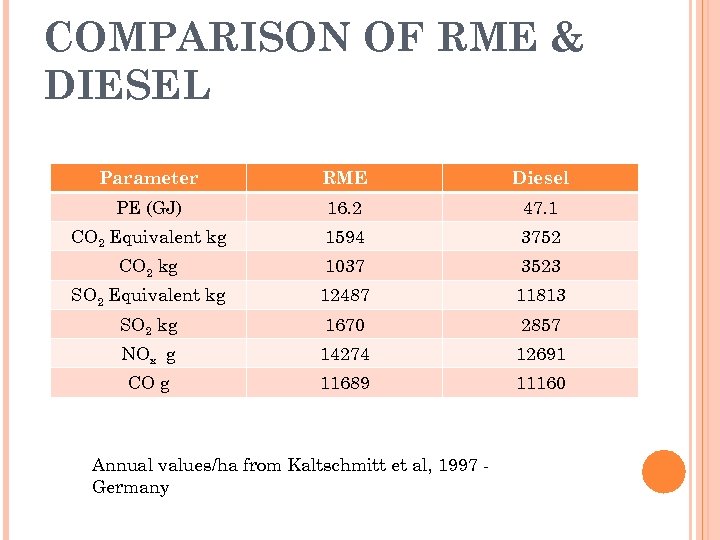 COMPARISON OF RME & DIESEL Parameter RME Diesel PE (GJ) 16. 2 47. 1 CO 2 Equivalent kg 1594 3752 CO 2 kg 1037 3523 SO 2 Equivalent kg 12487 11813 SO 2 kg 1670 2857 NOx g 14274 12691 CO g 11689 11160 Annual values/ha from Kaltschmitt et al, 1997 Germany
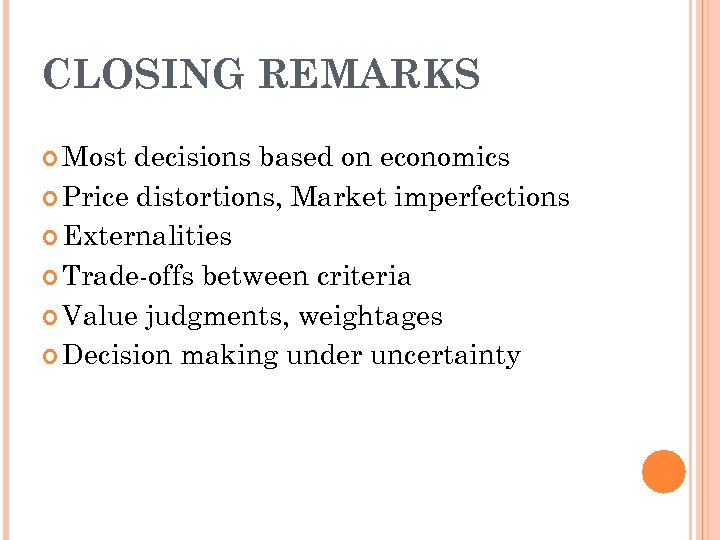 CLOSING REMARKS Most decisions based on economics Price distortions, Market imperfections Externalities Trade-offs between criteria Value judgments, weightages Decision making under uncertainty