


 Скачать презентацию ANALYSIS Multi-lingual Unclear image
b95a884c907b0e997d980f15ecada519.ppt
- Количество слайдов: 56
 ANALYSIS
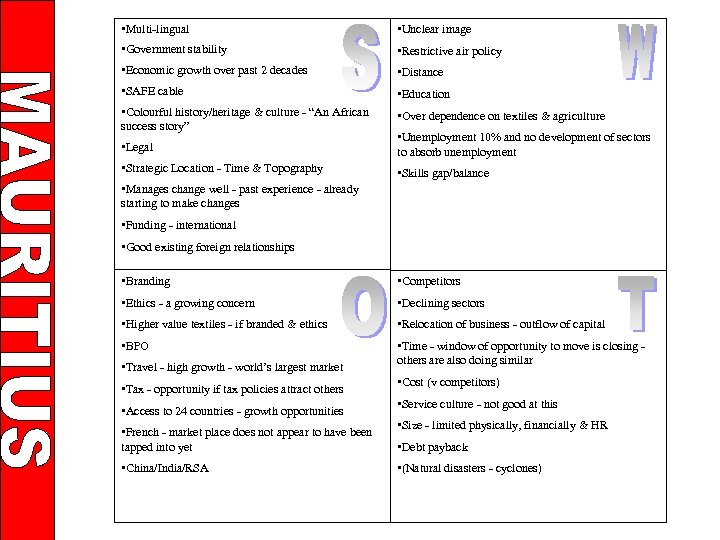 • Multi-lingual • Unclear image • Government stability • Restrictive air policy • Economic growth over past 2 decades • Distance • SAFE cable • Education • Colourful history/heritage & culture - “An African success story” • Over dependence on textiles & agriculture • Legal • Unemployment 10% and no development of sectors to absorb unemployment • Strategic Location - Time & Topography • Skills gap/balance • Manages change well - past experience - already starting to make changes • Funding - international • Good existing foreign relationships • Branding • Competitors • Ethics - a growing concern • Declining sectors • Higher value textiles - if branded & ethics • Relocation of business - outflow of capital • BPO • Time - window of opportunity to move is closing others are also doing similar • Travel - high growth - world’s largest market • Tax - opportunity if tax policies attract others • Access to 24 countries - growth opportunities • French - market place does not appear to have been tapped into yet • China/India/RSA • Cost (v competitors) • Service culture - not good at this • Size - limited physically, financially & HR • Debt payback • (Natural disasters - cyclones)
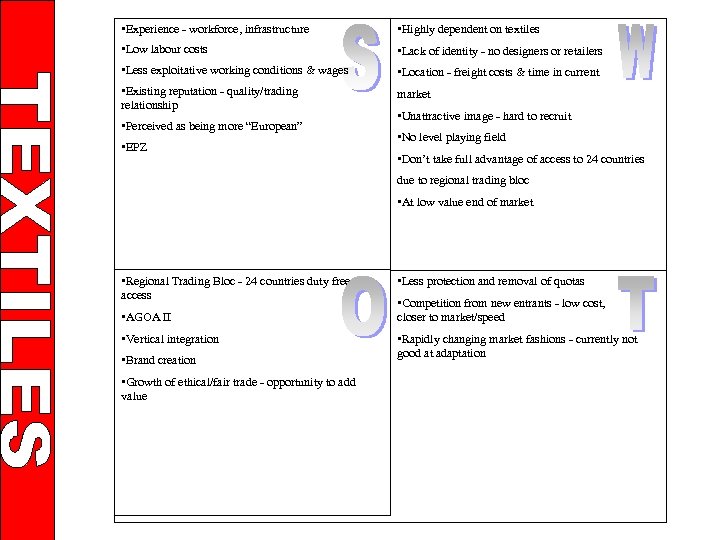 • Experience - workforce, infrastructure • Highly dependent on textiles • Low labour costs • Lack of identity - no designers or retailers • Less exploitative working conditions & wages • Location - freight costs & time in current • Existing reputation - quality/trading relationship market • Perceived as being more “European” • EPZ • Unattractive image - hard to recruit • No level playing field • Don’t take full advantage of access to 24 countries due to regional trading bloc • At low value end of market • Regional Trading Bloc - 24 countries duty free access • AGOA II • Vertical integration • Brand creation • Growth of ethical/fair trade - opportunity to add value • Less protection and removal of quotas • Competition from new entrants - low cost, closer to market/speed • Rapidly changing market fashions - currently not good at adaptation
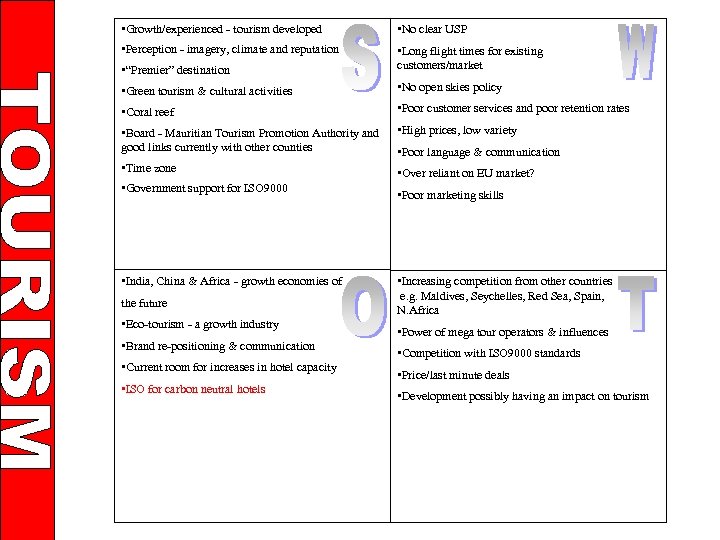 • Growth/experienced - tourism developed • No clear USP • Perception - imagery, climate and reputation • “Premier” destination • Long flight times for existing customers/market • Green tourism & cultural activities • No open skies policy • Coral reef • Poor customer services and poor retention rates • Board - Mauritian Tourism Promotion Authority and good links currently with other counties • High prices, low variety • Time zone • Over reliant on EU market? • Government support for ISO 9000 • India, China & Africa - growth economies of the future • Eco-tourism - a growth industry • Brand re-positioning & communication • Current room for increases in hotel capacity • ISO for carbon neutral hotels • Poor language & communication • Poor marketing skills • Increasing competition from other countries e. g. Maldives, Seychelles, Red Sea, Spain, N. Africa • Power of mega tour operators & influences • Competition with ISO 9000 standards • Price/last minute deals • Development possibly having an impact on tourism
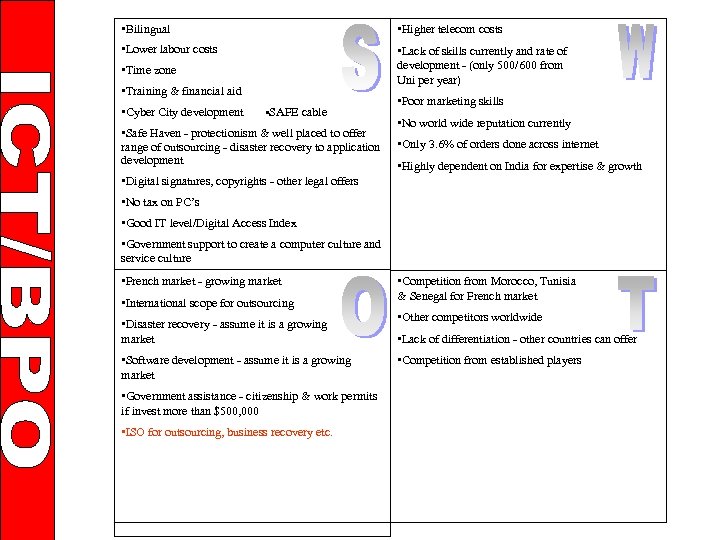 • Bilingual • Higher telecom costs • Lower labour costs • Lack of skills currently and rate of development - (only 500/600 from Uni per year) • Time zone • Training & financial aid • Cyber City development • SAFE cable • Safe Haven - protectionism & well placed to offer range of outsourcing - disaster recovery to application development • Poor marketing skills • No world wide reputation currently • Only 3. 6% of orders done across internet • Highly dependent on India for expertise & growth • Digital signatures, copyrights - other legal offers • No tax on PC’s • Good IT level/Digital Access Index • Government support to create a computer culture and service culture • French market - growing market • International scope for outsourcing • Disaster recovery - assume it is a growing market • Software development - assume it is a growing market • Government assistance - citizenship & work permits if invest more than $500, 000 • ISO for outsourcing, business recovery etc. • Competition from Morocco, Tunisia & Senegal for French market • Other competitors worldwide • Lack of differentiation - other countries can offer • Competition from established players
 Porters Five Forces and PESTLE to come
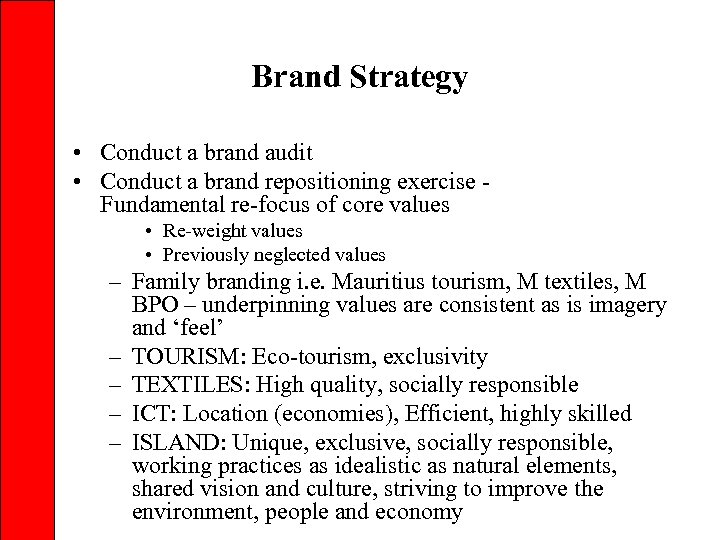 Brand Strategy • Conduct a brand audit • Conduct a brand repositioning exercise Fundamental re-focus of core values • Re-weight values • Previously neglected values – Family branding i. e. Mauritius tourism, M textiles, M BPO – underpinning values are consistent as is imagery and ‘feel’ – TOURISM: Eco-tourism, exclusivity – TEXTILES: High quality, socially responsible – ICT: Location (economies), Efficient, highly skilled – ISLAND: Unique, exclusive, socially responsible, working practices as idealistic as natural elements, shared vision and culture, striving to improve the environment, people and economy
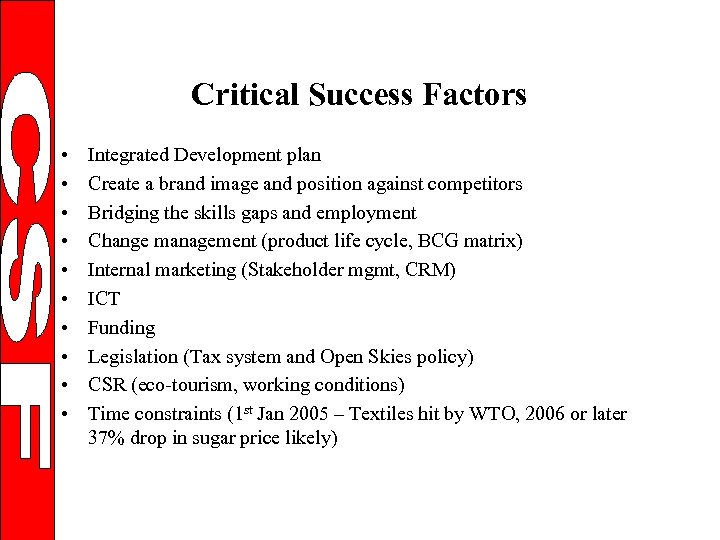 Critical Success Factors • • • Integrated Development plan Create a brand image and position against competitors Bridging the skills gaps and employment Change management (product life cycle, BCG matrix) Internal marketing (Stakeholder mgmt, CRM) ICT Funding Legislation (Tax system and Open Skies policy) CSR (eco-tourism, working conditions) Time constraints (1 st Jan 2005 – Textiles hit by WTO, 2006 or later 37% drop in sugar price likely)
 Vision • Mauritius will continue to be the growth success story of Africa and be recognised as a premium, multi-cultural thriving socially responsible environment in which people are encouraged to live, work, visit and invest in.
 Mission Statement • Through restructuring the economy by developing the seven pillars of growth through a process of change management, Mauritius will continue to respect the environment and traditional values of the island. – Tourism: For Mauritius to become one of the premier tourist destinations in the world, known for its commitment to eco-tourism (related activities), high quality standards and exceptional customer service. – Textiles: To position Mauritius as a socially responsible nation respected for its high quality textile goods, efficient and professional labour force and for it to continue to be a significant contributor to the economy. – ICT: To become the outsourcing location of choice for overseas businesses specialising in French and English, offering training and development to Mauritian citizens to enhance their skills to become the key pillar of growth for the economy.
 Values • Committed to social and environmental responsibility • Committed to education and training • Committed to creating a stable economy through the development of the 7 pillars of growth • Committed to obtaining support and participation of all citizens in achieving our vision.
 Corporate Objectives • Reduce unemployment by 5% by 2008/2010 • Implement socially responsible employment legislation by 2010 • Establish nature reserves and environmental protection/planning laws to maintain environment by 2010 • Increase GDP of the island by X% by X • To achieve a more balanced portfolio of economic activity in the island by increasing the proportion of GDP from tertiary industries, specifically tourism & BPO from X% to Y% • To increase the number of students attaining qualifications from tertiary school enrolment from 12% to 20% by 2010 • Success against objectives will be dependent against the achievement of all goals in an ethical and sustainable manner.
 TOURISM
 MISSION/VISION • Tourism: For Mauritius to become one of the premier tourist destinations in the world, known for its commitment to ecotourism, high quality standards and exceptional customer service.
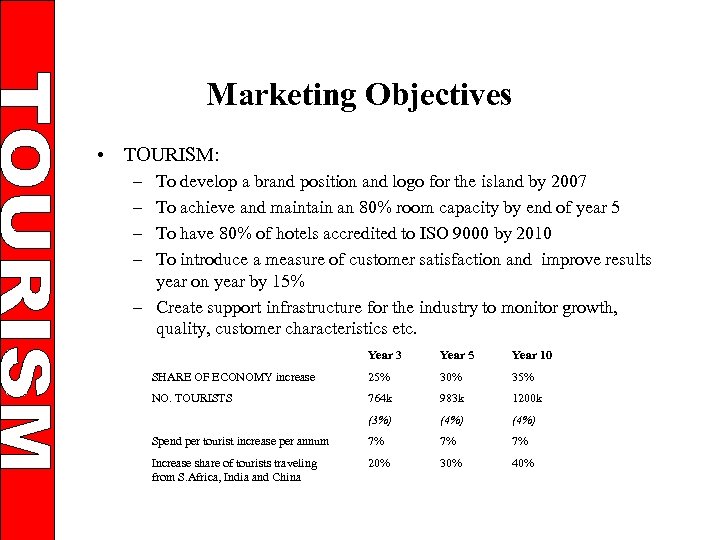 Marketing Objectives • TOURISM: – – To develop a brand position and logo for the island by 2007 To achieve and maintain an 80% room capacity by end of year 5 To have 80% of hotels accredited to ISO 9000 by 2010 To introduce a measure of customer satisfaction and improve results year on year by 15% – Create support infrastructure for the industry to monitor growth, quality, customer characteristics etc. Year 3 Year 5 Year 10 SHARE OF ECONOMY increase 25% 30% 35% NO. TOURISTS 764 k 983 k 1200 k (3%) (4%) Spend per tourist increase per annum 7% 7% 7% Increase share of tourists traveling from S. Africa, India and China 20% 30% 40%
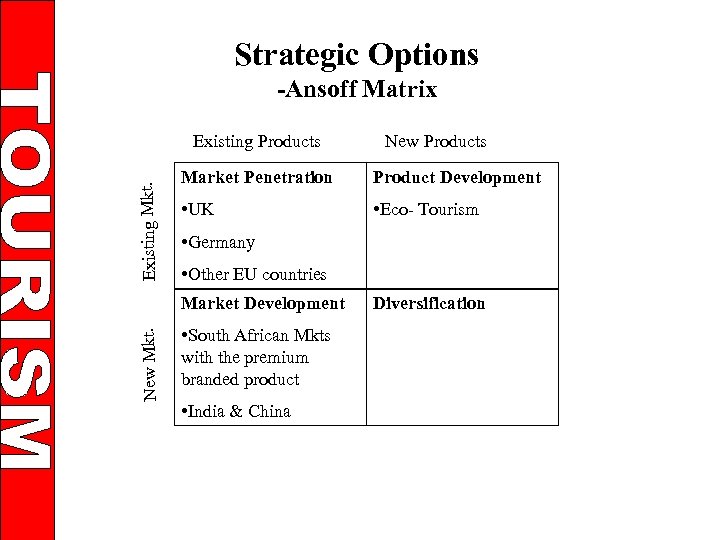 Strategic Options -Ansoff Matrix Existing Mkt. Existing Products Market Penetration Product Development • UK • Eco- Tourism • Germany • Other EU countries Market Development New Mkt. New Products • South African Mkts with the premium branded product • India & China Diversification
 Tourism Segmentation • Segment on needs & wants: – Sophisticated traveler looking for range of activities, new cultures, willing to travel further – Psycho graphic/activity level based segmentation (in implementation would commission market research, surveys at the airport, hotels )etc
 Tourism Target Audience • Recommend key areas for growth: • Target Market - Existing EU - France, UK, Germany (long haul) - Growth/potential - S. Africa, India, China (shorter haul) • “B 2 B” • Tour Operators & Cruise Operators - top end market • Agents • “B 2 C” (Need to influence MTPA, Hotels etc. to improve direct selling to customers) • Affluent Couples & other lucrative individuals prepared to pay a premium • Interest in eco-tourism and culture - want more than just a beach holiday
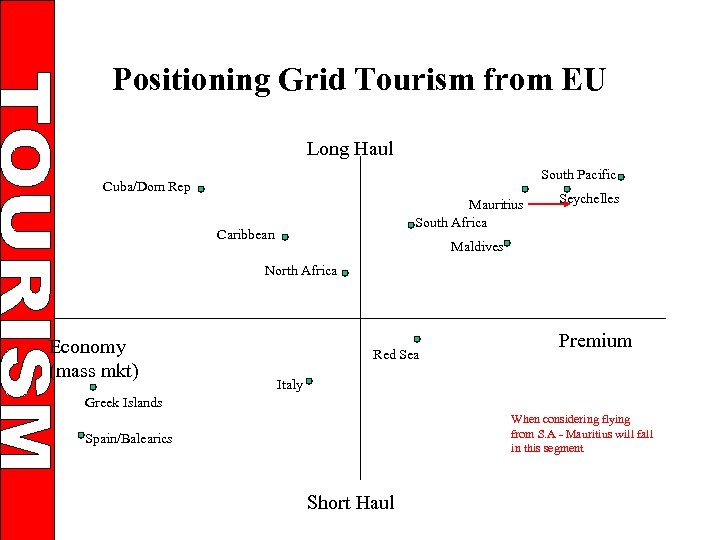 Positioning Grid Tourism from EU Long Haul South Pacific Cuba/Dom Rep Mauritius South Africa Caribbean Seychelles Maldives North Africa Economy (mass mkt) Red Sea Premium Italy Greek Islands When considering flying from S. A - Mauritius will fall in this segment Spain/Balearics Short Haul
 Positioning Statement • Premium Holiday • Premium Pricing - offers certain amount of exclusivity • Differentiate on “Green tourism” (ethical & socially responsible) & range of cultural activities • Rapidly improving quality - positioning will become more important (ISO 9000, exceptional customer services, staff - diverse language skills)
 Marketing Strategy • • From Porter’s 3 generic strategies, we will follow the focus differentiation route WHY – – – Targeting specific countries - therefore have focused on geography Able to differentiate on: Multi-cultural Unique history Eco tourism (coral reef) Rapidly improving quality
 Strategic Management of the Marketing Mix • PRODUCT – Core: Holiday – Physical: Premium offer - location, package, price; service, excursions, hotels – Augmented: BRAND. Develop range of Eco-tourism activities. Develop extended personal service throughout travel chain such as premier check-in, airport lounges, flight, collection etc. Certify environmental credentials with awards by experts. – Offer “working holidays” to link with historical and other educational issues. • PRICE – Establish pricing strategy - premium but ensure ethical & value for money - hotels, tour operators follow these guidelines, (hotel taxes to be used to implement) – Price Bracket will vary for each target market – Encourage volume discounts for tour operators (B 2 B) and discounts for repeat visitors (B 2 C) – Look at opportunities for re-investing money into local economy to make improvements - e. g. green tourism, local skills training
 Strategic Management of the Marketing Mix • PLACE – – – • Existing locations & new target markets World Travel Market, Trade Fairs Develop internet site for direct bookings - managed by MTPA Mauritius Airlines and facilities in departure nations Offer flight access to other tourist operators PROMOTION – – – – – Combination of Profile, Push & Pull Strategies in an Integrated Marketing Plan Campaign is to be developed around re-branding and increasing awareness levels Ensure promotion links with all other aspects of the island Build on existing work carried out by MTPA Experiential displays, Familiarization visits (tour operators, agents) Brochures, DVD, Internet, Direct Mail - more B 2 C focused Annual conference of stakeholders Awards for services to Tourism Celebrity chef Film location – tax incentives to encourage movie usage
 Strategic Management of the Marketing Mix • PEOPLE – – – – – Internal Marketing Campaign Inspire all those involved through training programme Mauritian Tourism Authority Staff training for Hotel, restaurant, activity businesses - customer services, language training Attract local staff and overseas personnel for specific areas - ensure right mix of languages & culture to match visitors. Establish government assisted hotel exchange programme for staff Retain staff and progress employees through personal development Internal buy in of premium positioning “Member get member” - positive word of mouth from existing visitors Consider use of an external marketing agency
 Strategic Management of the Marketing Mix • PROCESSS – MKIS – Regular Internal/External communications – Co-ordinated and effective process in its management of the delivery of the marketing plans – Long-term relationship building - B 2 B - customer involvement – Marketing branding strategy • PHYSICAL EVIDENCE – – – Mauritius logo and brand - present new brand Mark of excellence for tour operators and hotels Minimum hotel standards and code of practice for employees Development of tourism related qualification at University of Mauritius Quality of island -litter policy, infrastructure improvement “Green tourism” - body responsible for protection i. e. to ensure tourism etc. . not having an affect on local environment
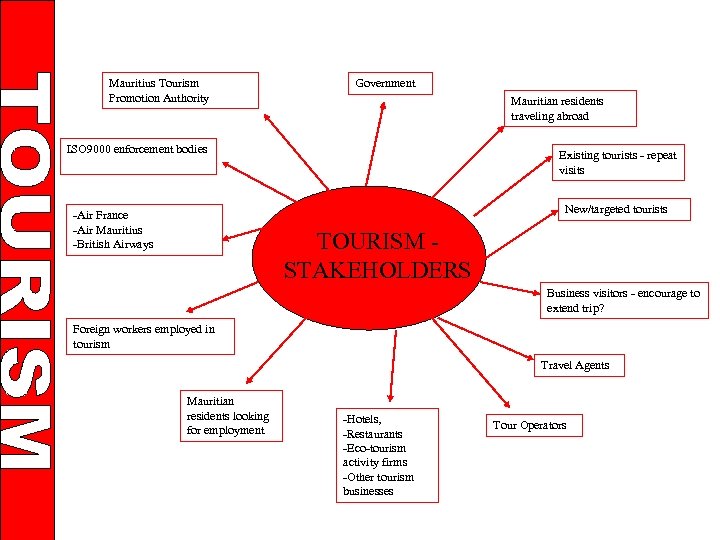 Mauritius Tourism Promotion Authority Government Mauritian residents traveling abroad ISO 9000 enforcement bodies Existing tourists - repeat visits New/targeted tourists -Air France -Air Mauritius -British Airways TOURISM STAKEHOLDERS Business visitors - encourage to extend trip? Foreign workers employed in tourism Travel Agents Mauritian residents looking for employment -Hotels, -Restaurants -Eco-tourism activity firms -Other tourism businesses Tour Operators
 TEXTILES
 Mission/Vision • Textiles: To position Mauritius as a socially responsible nation respected for its high quality textile goods, efficient and professional labour force and for it to continue to be a significant contributor to the economy. Mauritius - “The home of ethical clothing. ”
 Marketing Objectives • TEXTILES: – – Establish clear brand position and logo by 2007 Develop internationally recognised ethical certification by 2008 Achieve ethics certification in 80% of exports by 2010 Work with supply chain to develop ethical practices, achieving ethical supply of fabrics into Mauritius textile firms of 80% by 2010 – Reduce focus of low value exports from X% by moving towards higher value, ethically produced export goods of X% – Maintain the contribution to the economy from the textile sector £ – Maximise allowance in AGOA II to 5% cap
 Marketing Communication Objectives • To increase brand awareness of Mauritius textiles as ethically made to 30% (year 3), 55% (year 5), 75% by 2010 • To increase sales by 10 % within existing markets by 2008
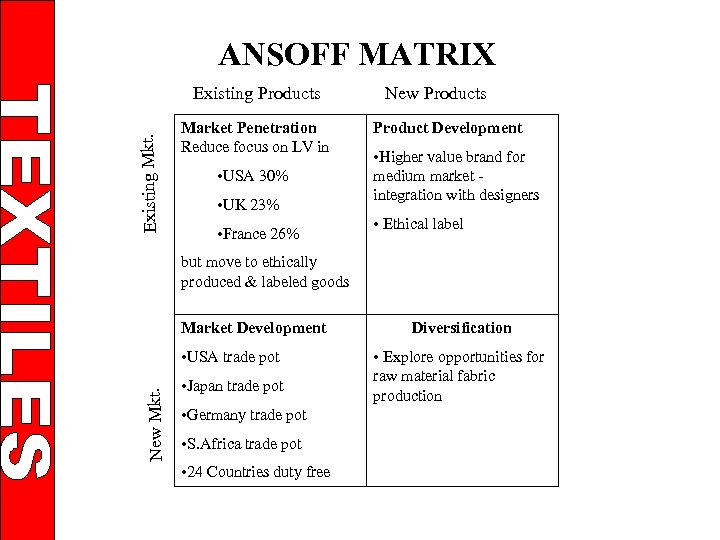 ANSOFF MATRIX Existing Mkt. Existing Products Market Penetration Reduce focus on LV in • USA 30% • UK 23% • France 26% New Products Product Development • Higher value brand for medium market integration with designers • Ethical label but move to ethically produced & labeled goods Market Development New Mkt. • USA trade pot • Japan trade pot • Germany trade pot • S. Africa trade pot • 24 Countries duty free Diversification • Explore opportunities for raw material fabric production
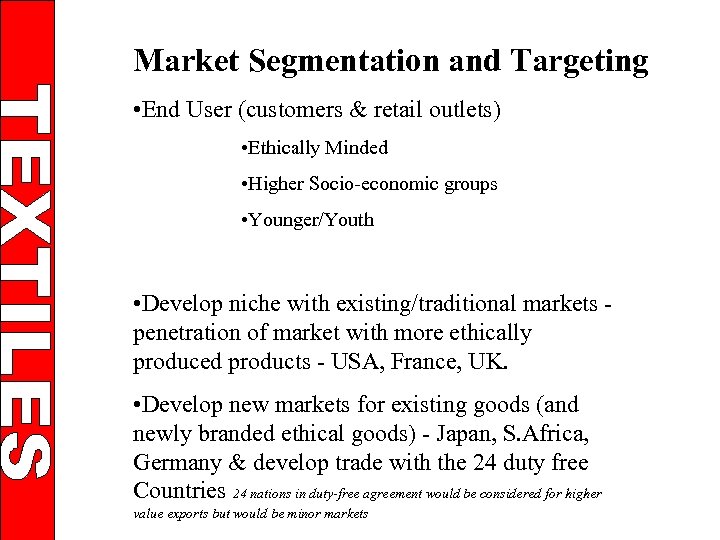 Market Segmentation and Targeting • End User (customers & retail outlets) • Ethically Minded • Higher Socio-economic groups • Younger/Youth • Develop niche with existing/traditional markets penetration of market with more ethically produced products - USA, France, UK. • Develop new markets for existing goods (and newly branded ethical goods) - Japan, S. Africa, Germany & develop trade with the 24 duty free Countries 24 nations in duty-free agreement would be considered for higher value exports but would be minor markets
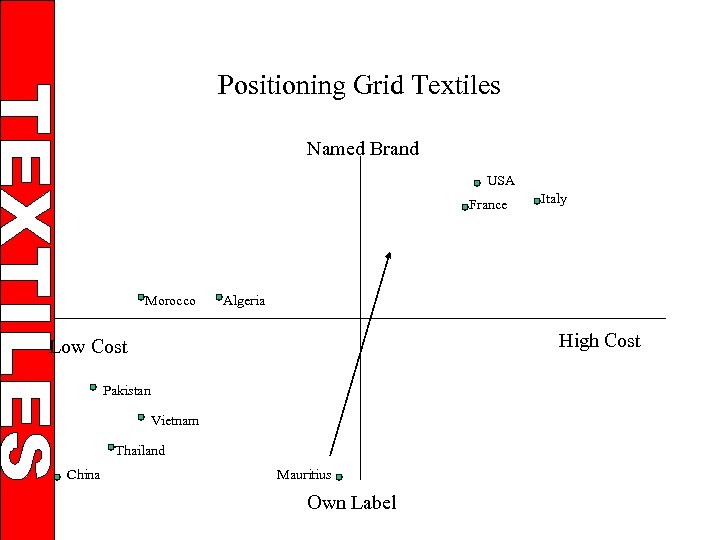 Positioning Grid Textiles Named Brand USA France Morocco Algeria High Cost Low Cost Pakistan Vietnam Thailand China Italy Mauritius Own Label
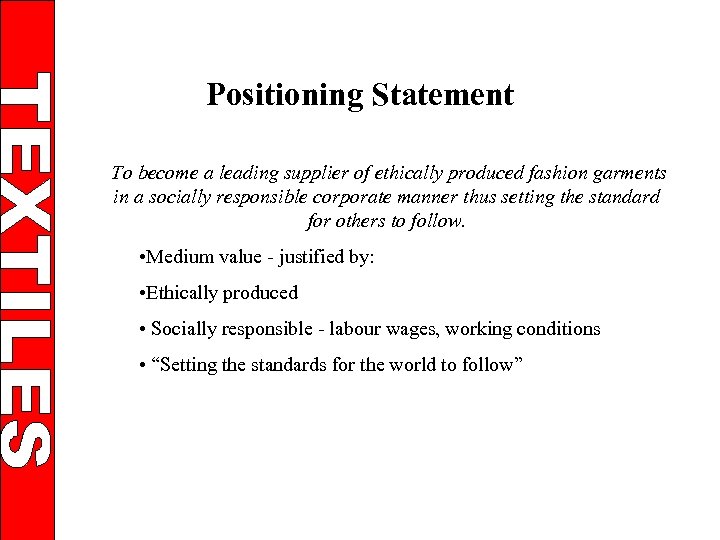 Positioning Statement To become a leading supplier of ethically produced fashion garments in a socially responsible corporate manner thus setting the standard for others to follow. • Medium value - justified by: • Ethically produced • Socially responsible - labour wages, working conditions • “Setting the standards for the world to follow”
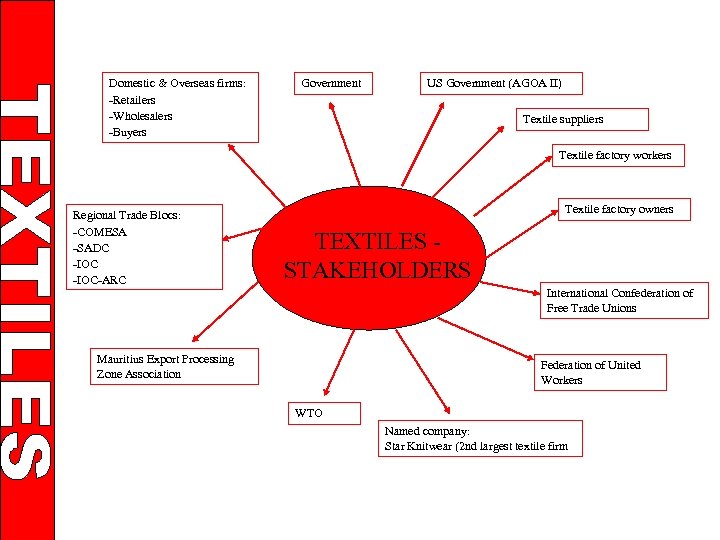 Domestic & Overseas firms: -Retailers -Wholesalers -Buyers Government US Government (AGOA II) Textile suppliers Textile factory workers Regional Trade Blocs: -COMESA -SADC -IOC-ARC Textile factory owners TEXTILES STAKEHOLDERS International Confederation of Free Trade Unions Mauritius Export Processing Zone Association Federation of United Workers WTO Named company: Star Knitwear (2 nd largest textile firm
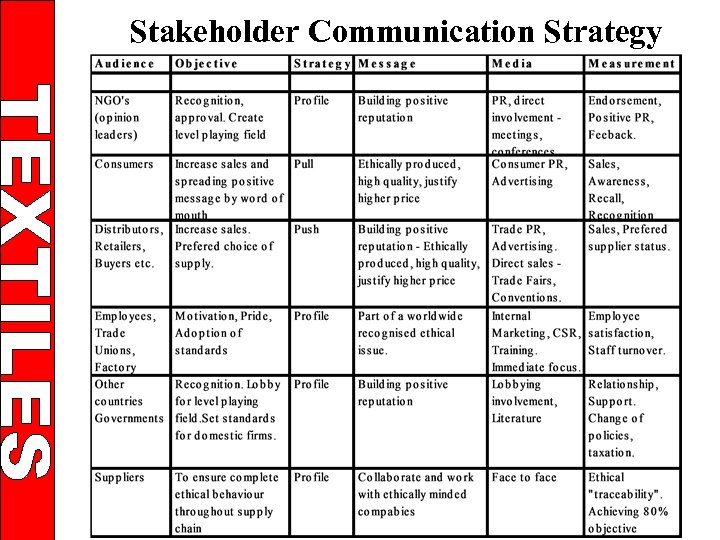 Stakeholder Communication Strategy
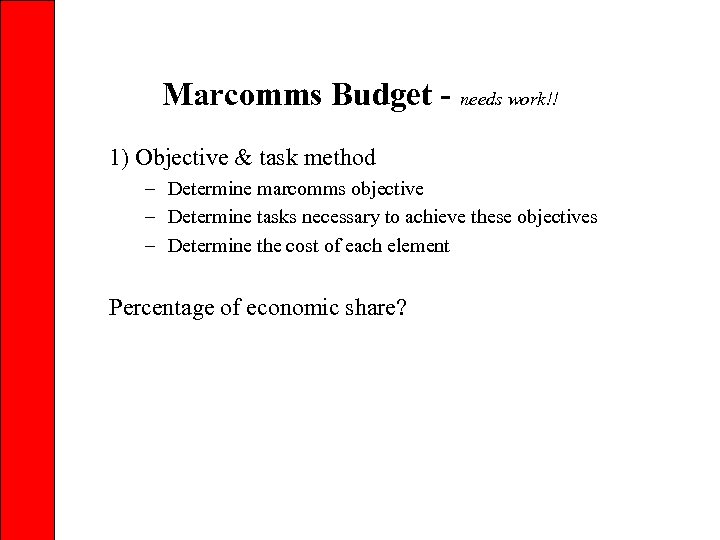 Marcomms Budget - needs work!! 1) Objective & task method – Determine marcomms objective – Determine tasks necessary to achieve these objectives – Determine the cost of each element Percentage of economic share?
 ICT/BPO
 Mission/Vision • ICT: To become the outsourcing location for overseas businesses specialising in French and English, offering training and development to Mauritian citizens to enhance their skills to become the key pillar of growth for the economy.
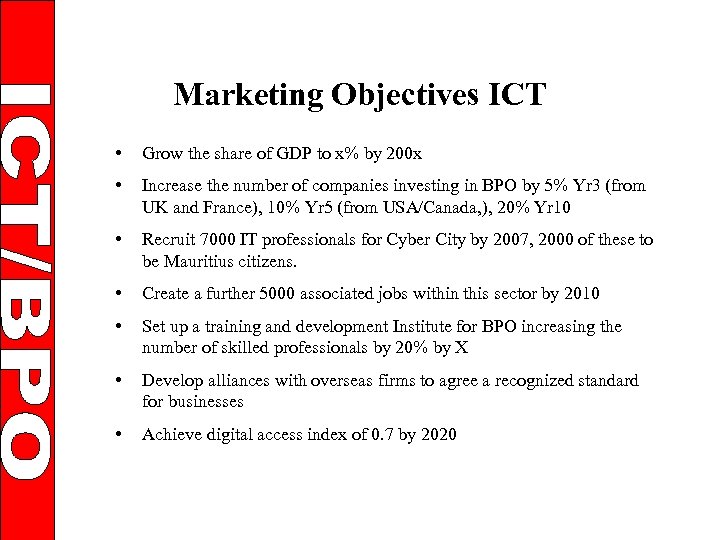 Marketing Objectives ICT • Grow the share of GDP to x% by 200 x • Increase the number of companies investing in BPO by 5% Yr 3 (from UK and France), 10% Yr 5 (from USA/Canada, ), 20% Yr 10 • Recruit 7000 IT professionals for Cyber City by 2007, 2000 of these to be Mauritius citizens. • Create a further 5000 associated jobs within this sector by 2010 • Set up a training and development Institute for BPO increasing the number of skilled professionals by 20% by X • Develop alliances with overseas firms to agree a recognized standard for businesses • Achieve digital access index of 0. 7 by 2020
 Positioning Statement To be the ultimate cyber Island offering state of the art technology to conduct full service outsourcing with a bilingual labour force, in an environment that is ethical. – To ultimately become a Cyber Island – offering state of the art technology with enviable connections through the SAFE fibre optic cable – Ideal location as a “Safe Haven” and full service outsourcing facilities – Bilingual and highly skilled and trained labour force
 Segmentation & Targeting MARKETS: • Prime focus on French & UK market • Develop relationship with other French & English speaking firms • Consider targeting firms in India to relocate to Mauritius INDUSTRIES: • Consider cross links with key economic sectors – Overseas tourism firms - outsourcing to Mauritius - combining two economies – Textile firms - offering speed of communication between manufacturing & retail
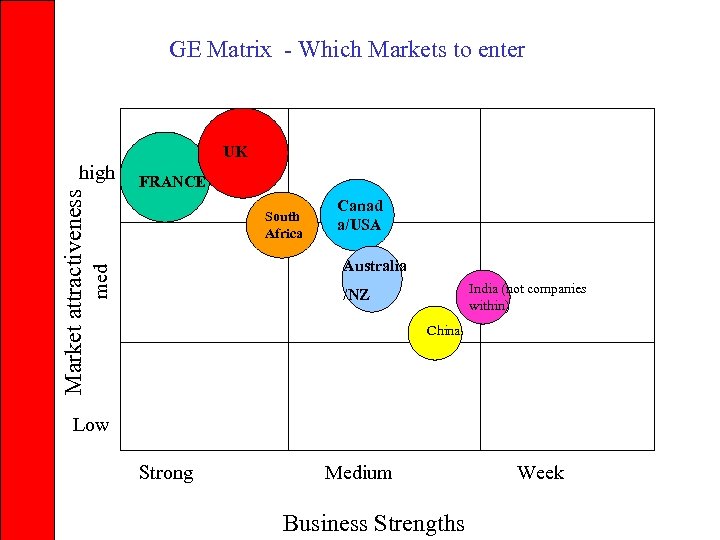 GE Matrix - Which Markets to enter UK FRANCE South Africa Canad a/USA Australia med Market attractiveness high India (not companies within) /NZ China Low Strong Medium Business Strengths Week
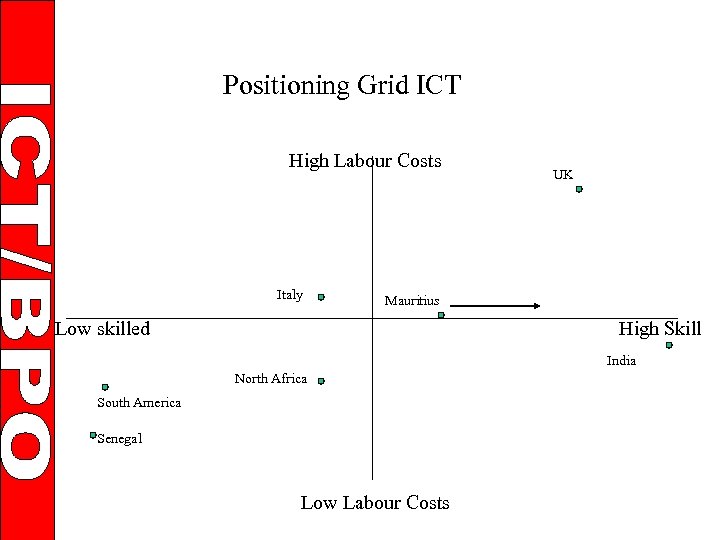 Positioning Grid ICT High Labour Costs Italy UK Mauritius Low skilled High Skill India North Africa South America Senegal Low Labour Costs
 Marketing Strategy • The strategy adopted will be a focused differentiation strategy initially to create a niche within French and English countries specialising in working with firms that deal with fashion/textiles in the first couple of years then Tourism.
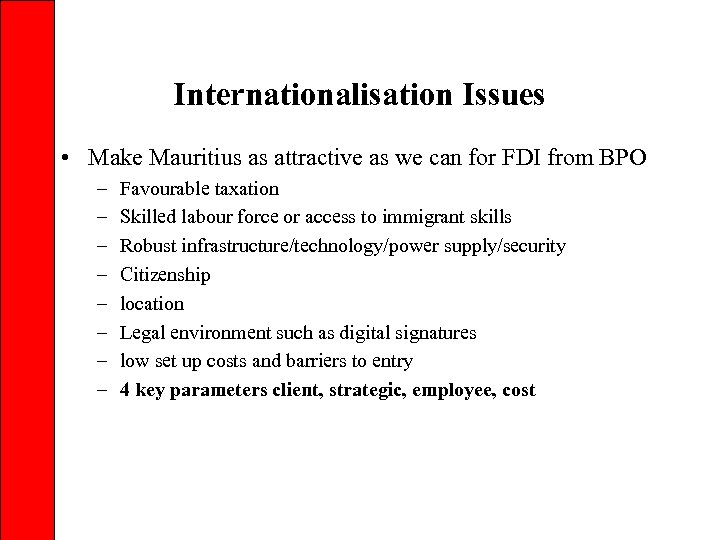 Internationalisation Issues • Make Mauritius as attractive as we can for FDI from BPO – – – – Favourable taxation Skilled labour force or access to immigrant skills Robust infrastructure/technology/power supply/security Citizenship location Legal environment such as digital signatures low set up costs and barriers to entry 4 key parameters client, strategic, employee, cost
 Internationalisation of ICT • Integrate other strategies • Offer specialisms • Focus on offering solutions - e. g. back office processes for Textile companies and then Tourism NEEDS SOME WORK
 Internationalisation - Standardisation vs. Adaptation • An adaptation strategy would be adopted as we would be providing varying different processes for the different businesses. • Adaptation of government offer to specific country-firms e. g. French firm labour regulations and repatriation of profits may be different
 Strategic Management of the Marketing Mix • Product – Core: A location for BPO – Physical: Infrastructure, SAFE cable, labour force, electricity, initially specialising in full back office processes for the textile/fashion industries – Augmented: Legal, reputation, ancillary services, Cyber City • Price – – Low Taxation Favourable Business Rates and utilities rebates for employment generation from the local economy Favourable land costs for development respecting the environment
 Strategic Management of the Marketing Mix • Place – Set up EPZ type zones for BPO around Cyber City – Establish green belts to limit over development, specifically use brown-field sites e. g. decommissioned sugar cane processing factories – Provision of leasehold outsourcing buildings by government (reduces barriers to entry and set up costs) – First target the French and UK markets, then focus on attracting investment from USA and Canada (Have links with Textiles here). • Promotion – Profile and pull strategy to encourage FDI through trade bodies and embassies in target countries. – Publish PR related material for senior decision makers/opinion leaders in relevant magazines • People – Train and educate the labour force. Encourage immigration from target markets to manage teams for each target country e. g. US, UK, France. Then need to think of German, Indian and Chinese markets for the future.
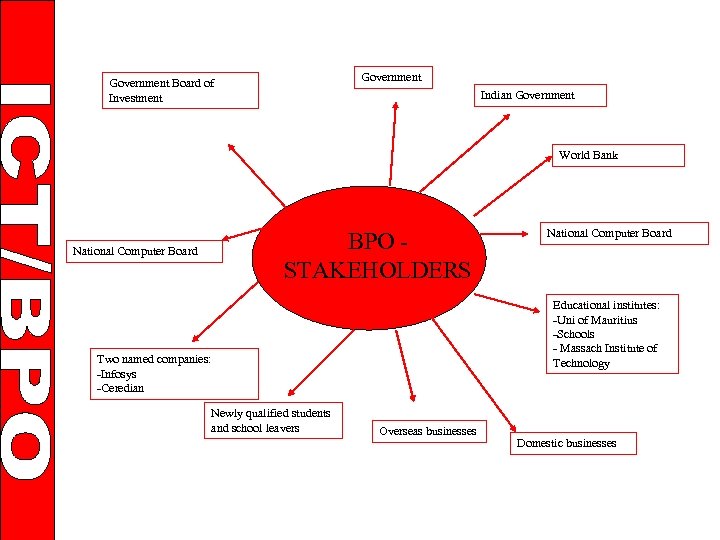 Government Board of Investment Indian Government World Bank BPO STAKEHOLDERS National Computer Board Educational institutes: -Uni of Mauritius -Schools - Massach Institute of Technology Two named companies: -Infosys -Ceredian Newly qualified students and school leavers National Computer Board Overseas businesses Domestic businesses
 IMPLEMENTATION & CONTROL
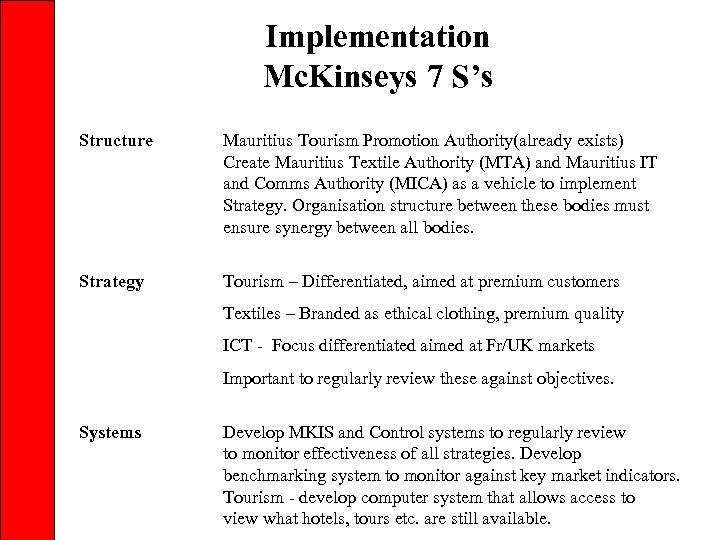 Implementation Mc. Kinseys 7 S’s Structure Mauritius Tourism Promotion Authority(already exists) Create Mauritius Textile Authority (MTA) and Mauritius IT and Comms Authority (MICA) as a vehicle to implement Strategy. Organisation structure between these bodies must ensure synergy between all bodies. Strategy Tourism – Differentiated, aimed at premium customers Textiles – Branded as ethical clothing, premium quality ICT - Focus differentiated aimed at Fr/UK markets Important to regularly review these against objectives. Systems Develop MKIS and Control systems to regularly review to monitor effectiveness of all strategies. Develop benchmarking system to monitor against key market indicators. Tourism - develop computer system that allows access to view what hotels, tours etc. are still available.
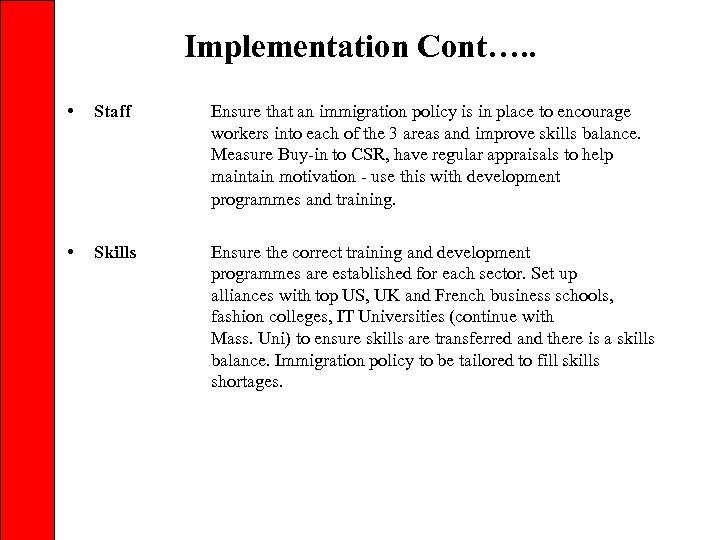 Implementation Cont…. . • Staff Ensure that an immigration policy is in place to encourage workers into each of the 3 areas and improve skills balance. Measure Buy-in to CSR, have regular appraisals to help maintain motivation - use this with development programmes and training. • Skills Ensure the correct training and development programmes are established for each sector. Set up alliances with top US, UK and French business schools, fashion colleges, IT Universities (continue with Mass. Uni) to ensure skills are transferred and there is a skills balance. Immigration policy to be tailored to fill skills shortages.
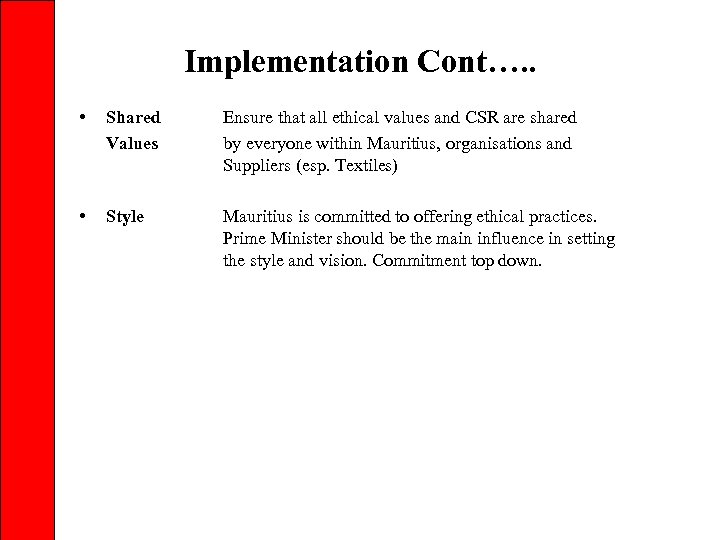 Implementation Cont…. . • Shared Values Ensure that all ethical values and CSR are shared by everyone within Mauritius, organisations and Suppliers (esp. Textiles) • Style Mauritius is committed to offering ethical practices. Prime Minister should be the main influence in setting the style and vision. Commitment top down.
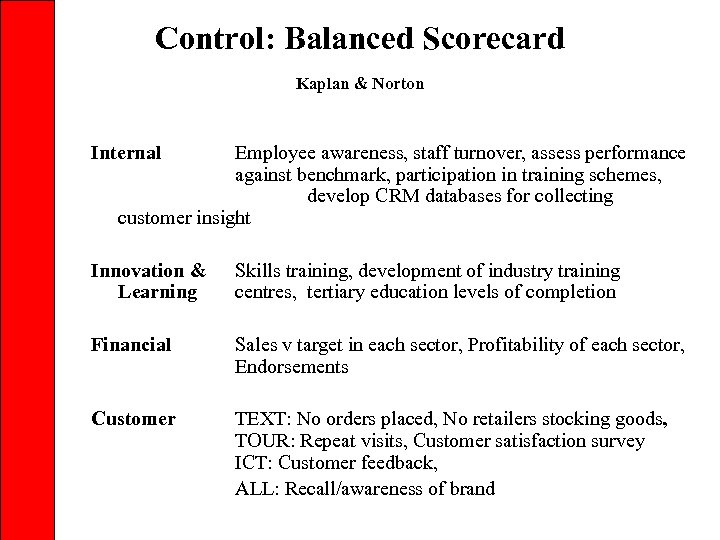 Control: Balanced Scorecard Kaplan & Norton Internal Employee awareness, staff turnover, assess performance against benchmark, participation in training schemes, develop CRM databases for collecting customer insight Innovation & Learning Skills training, development of industry training centres, tertiary education levels of completion Financial Sales v target in each sector, Profitability of each sector, Endorsements Customer TEXT: No orders placed, No retailers stocking goods, TOUR: Repeat visits, Customer satisfaction survey ICT: Customer feedback, ALL: Recall/awareness of brand