


 Скачать презентацию Analogy as leading factor in development of languages
analogy.pptx
- Количество слайдов: 9
 Analogy as leading factor in development of languages. Zagitova Ruslana, Group 301
 Plan: • The meaning of analogy • Types of analogy • The aim of analogy • The role of analogy in language development • The law of analogy • The division of analogy
 Analogy is: • Young grammarians consider analogy - as perpetual mechanism of speech activity -a factor that determines the outer form of language • a cognitive process of transferring information or meaning from a particular subject (the analogue or source) to another particular subject (the target)
 Types of analogy a real group (leveling of case forms of one noun) 2) a formal group, based on functional similarity (all nominative case forms, all weak and strong forms of German) 1)
 The aim of analogy -to bring out the meaning of a concept to easily understand it -to create a bifurcation between two elements -to compare the two things to define their similarity -to have a visual understanding about the logic of what is shown
 The role of analogy -in decision making, perception, memory, creativity, emotion, explanation and communication -in the identification of places, objects and people -the analogy is "the core of cognition“ -in special analogical language: exemplification, comparisons, metaphors, allegories -not only in ordinary language and common sense, but also in science, philosophy and the humanities -an alternative mechanism to generative rules for explaining productive formation of structures such as words
 Analogy as a leading factor in language development 1) the physiological factor, which is found in the phonetic laws 2) the psychological factor, which explains all the "irregularities“ of language
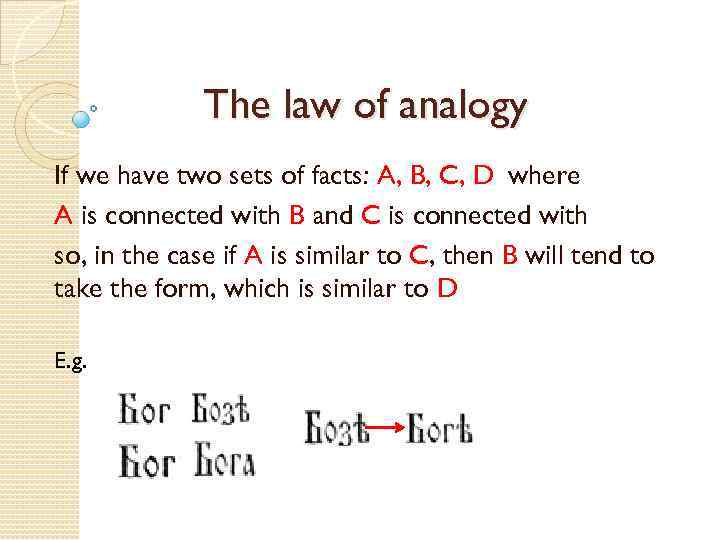 The law of analogy If we have two sets of facts: A, B, C, D, where A is connected with B and C is connected with D, so, in the case if A is similar to C, then B will tend to take the form, which is similar to D E. g.
 The division of analogy • kind of psychological motives (the tendency to differentiation of similar facts) • factors of mixed words (their external or internal similarity) • consequences of the influence of analogy (result of the displacement of forms)