


 Скачать презентацию ANAFE EXPERIENCES IN CURRICULUM REVIEWS AND DEVELOPMENT IN
231acfc9a4718be2fa18c257c8272f14.ppt
- Количество слайдов: 22
 ANAFE EXPERIENCES IN CURRICULUM REVIEWS AND DEVELOPMENT IN AFRICA John Saka 1, Aissetou Yaye 2, Sebastian Chakeredza 3 and August Temu 4 1. NAREC, Faculty of Science, Chancellor College, University of Malawi 2. ES, ANAFE Secretariat, ICRAF 3. SEF, SA-RAFT, ICRAF, Malawi 4. Partnerships Directorate, World Agroforestry Centre Regional workshop of Learning agrobiodiversity, : Options for universities in Sub-Saharan Africa, 21 -23 January, 09, ICRAF House, Nairobi 1
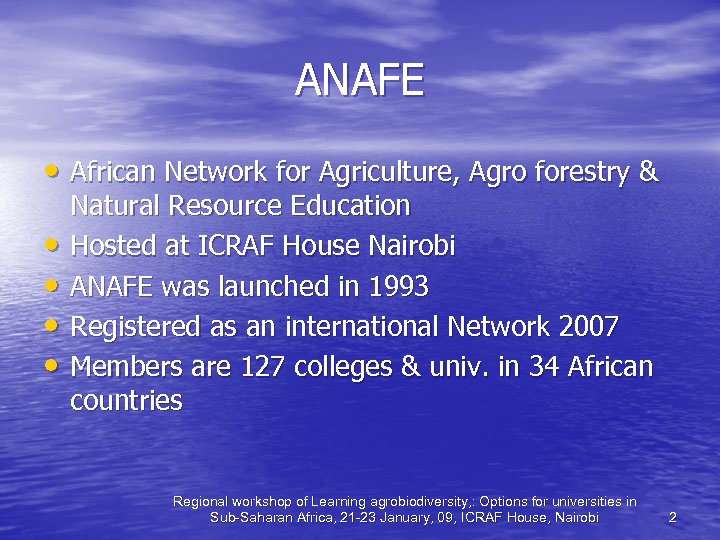 ANAFE • African Network for Agriculture, Agro forestry & • • Natural Resource Education Hosted at ICRAF House Nairobi ANAFE was launched in 1993 Registered as an international Network 2007 Members are 127 colleges & univ. in 34 African countries Regional workshop of Learning agrobiodiversity, : Options for universities in Sub-Saharan Africa, 21 -23 January, 09, ICRAF House, Nairobi 2
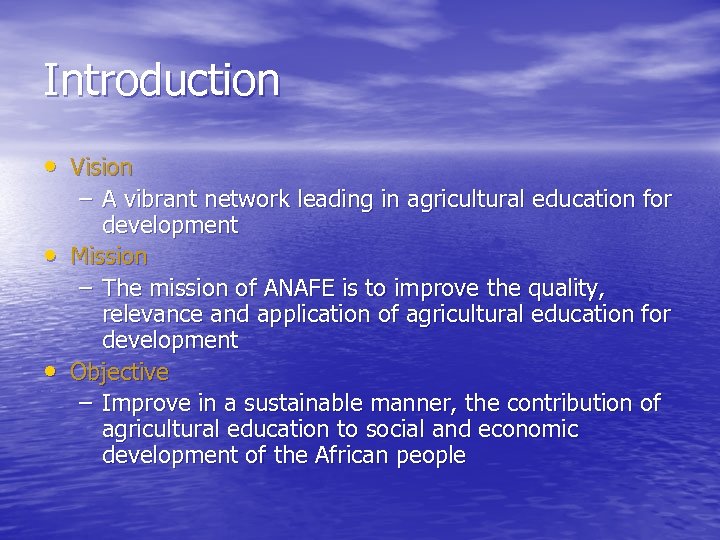 Introduction • Vision – A vibrant network leading in agricultural education for development • Mission – The mission of ANAFE is to improve the quality, relevance and application of agricultural education for development • Objective – Improve in a sustainable manner, the contribution of agricultural education to social and economic development of the African people
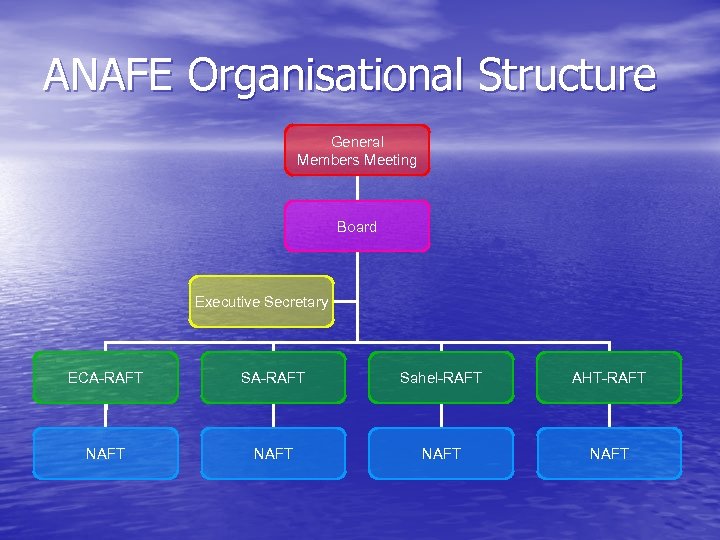 ANAFE Organisational Structure General Members Meeting Board Executive Secretary ECA-RAFT Sahel-RAFT AHT-RAFT NAFT
 ANAFE Activities • Curriculum Review and Development (Using the • • • DACUM process) Training Materials Development Staff exchange Training of trainers Practical facilities development Post-graduate support Institutional reforms to link education to development
 KEY GOALS 1. To strengthen capacity in Agriculture and natural 2. 3. 4. resources Education at African colleges and universities To strengthen capacity for Research and Development To improve opportunities for inter-institutional collaboration through inter alia networking To contextualize education in development needs by bringing colleges and universities closer to local communities and rural institutions Regional workshop of Learning agrobiodiversity, : Options for universities in Sub-Saharan Africa, 21 -23 January, 09, ICRAF House, Nairobi 6
 Curriculum Review • Methods used – Classical Approach—Using a small group of experts to develop curriculum for other people – Faculty initiated, Faculty controlled – Hidden Process—Individual lecturer initiative – Participatory Processes • ANAFE has chosen the DACUM process because it is inclusive, integrative and affordable to our member institutions
 Curriculum Review: The Process Identification of new processes and values to be incorporated into the curricula Identification and survey of potential employers Analysis of gaps between current and expected competencies of graduates Analysis of academic standing of potential graduates standing
 The Process (2) Identification of delivery methods weaknesses and strengths Convening of stakeholders workshop Writing up the curriculum Seeking approval of developed curriculum
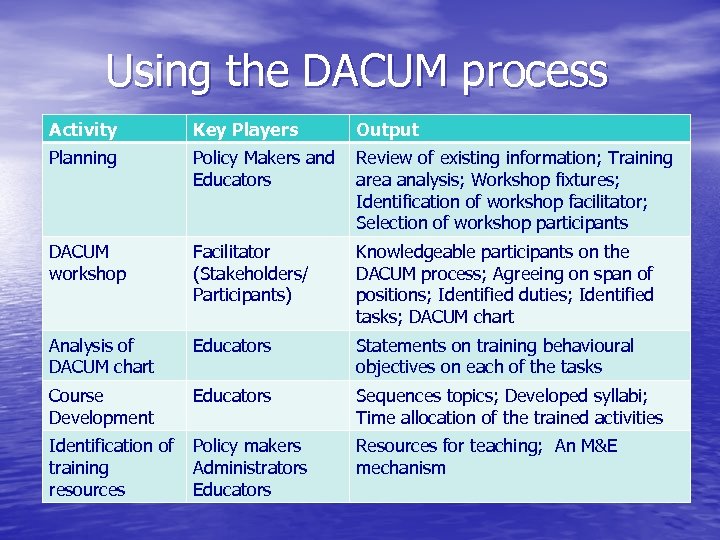 Using the DACUM process Activity Key Players Planning Policy Makers and Review of existing information; Training Educators area analysis; Workshop fixtures; Identification of workshop facilitator; Selection of workshop participants DACUM workshop Facilitator (Stakeholders/ Participants) Knowledgeable participants on the DACUM process; Agreeing on span of positions; Identified duties; Identified tasks; DACUM chart Analysis of DACUM chart Educators Statements on training behavioural objectives on each of the tasks Course Development Educators Sequences topics; Developed syllabi; Time allocation of the trained activities Identification of Policy makers training Administrators resources Educators Output Resources for teaching; An M&E mechanism
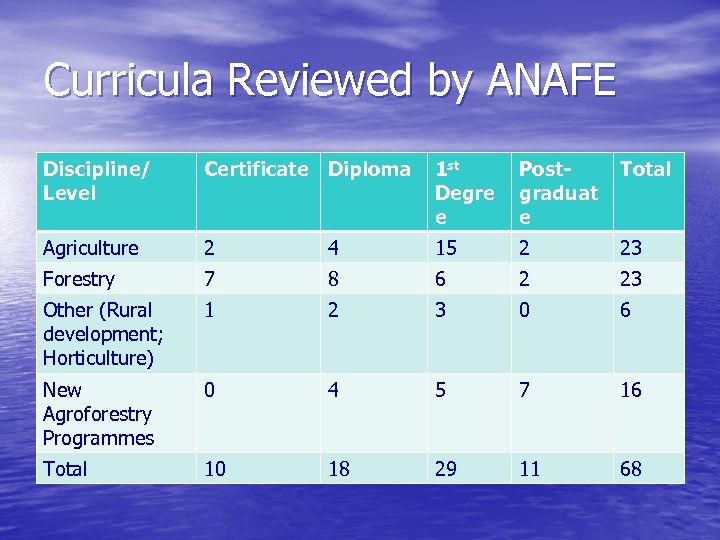 Curricula Reviewed by ANAFE Discipline/ Level Certificate Diploma 1 st Degre e Postgraduat e Total Agriculture 2 4 15 2 23 Forestry 7 8 6 2 23 Other (Rural development; Horticulture) 1 2 3 0 6 New Agroforestry Programmes 0 4 5 7 16 Total 10 18 29 11 68
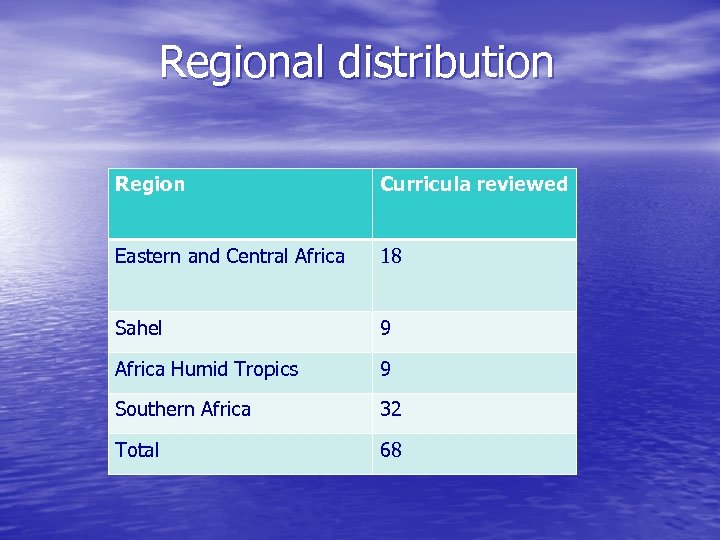 Regional distribution Region Curricula reviewed Eastern and Central Africa 18 Sahel 9 Africa Humid Tropics 9 Southern Africa 32 Total 68
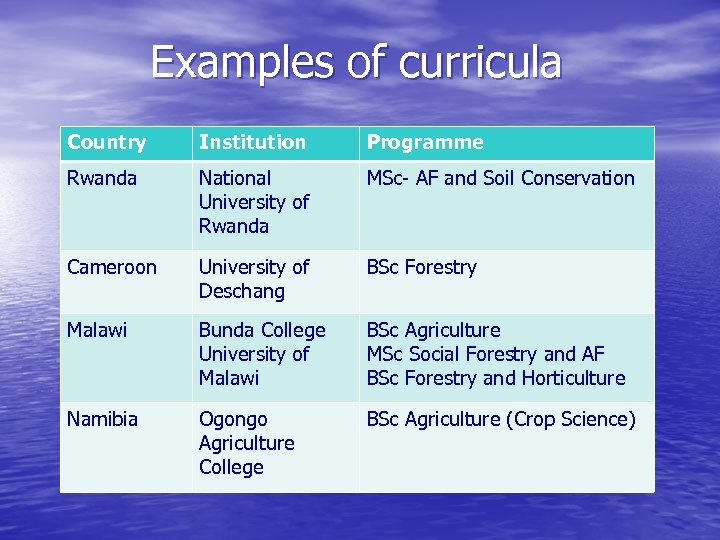 Examples of curricula Country Institution Programme Rwanda National University of Rwanda MSc- AF and Soil Conservation Cameroon University of Deschang BSc Forestry Malawi Bunda College University of Malawi BSc Agriculture MSc Social Forestry and AF BSc Forestry and Horticulture Namibia Ogongo Agriculture College BSc Agriculture (Crop Science)
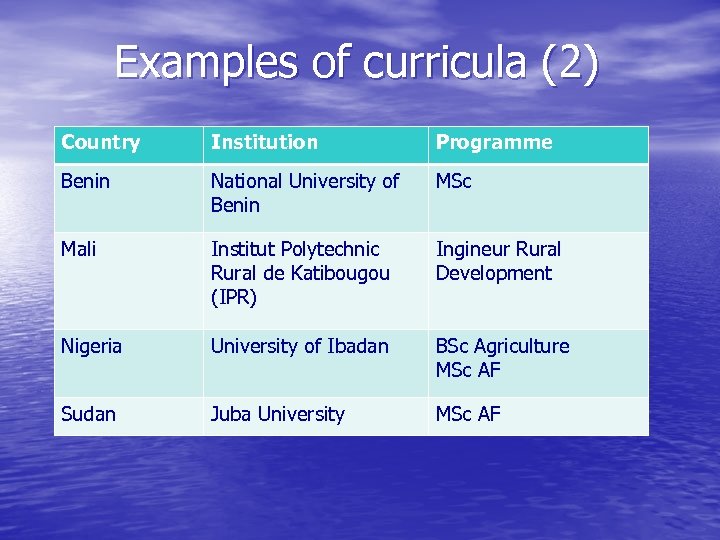 Examples of curricula (2) Country Institution Programme Benin National University of Benin MSc Mali Institut Polytechnic Rural de Katibougou (IPR) Ingineur Rural Development Nigeria University of Ibadan BSc Agriculture MSc AF Sudan Juba University MSc AF
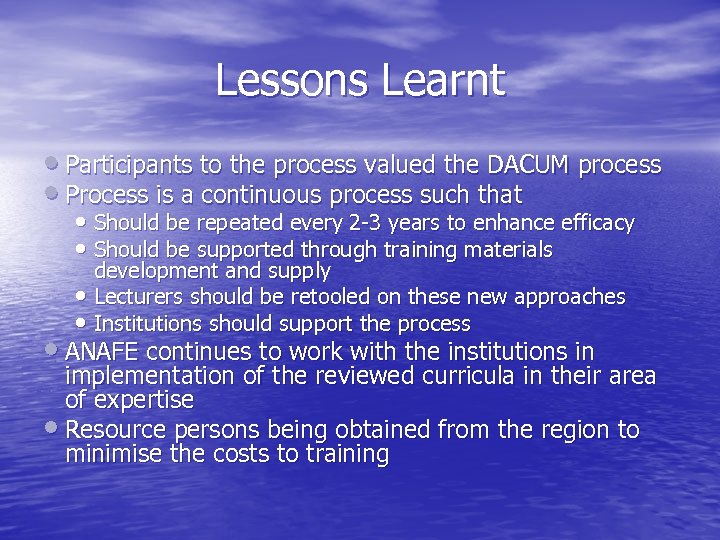 Lessons Learnt Participants to the process valued the DACUM process Process is a continuous process such that Should be repeated every 2 -3 years to enhance efficacy Should be supported through training materials development and supply Lecturers should be retooled on these new approaches Institutions should support the process ANAFE continues to work with the institutions in implementation of the reviewed curricula in their area of expertise Resource persons being obtained from the region to minimise the costs to training
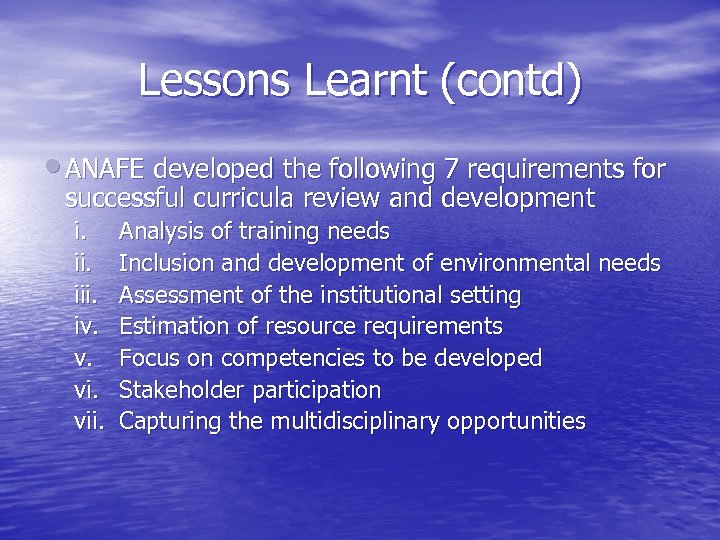 Lessons Learnt (contd) ANAFE developed the following 7 requirements for successful curricula review and development i. iii. iv. v. vii. Analysis of training needs Inclusion and development of environmental needs Assessment of the institutional setting Estimation of resource requirements Focus on competencies to be developed Stakeholder participation Capturing the multidisciplinary opportunities
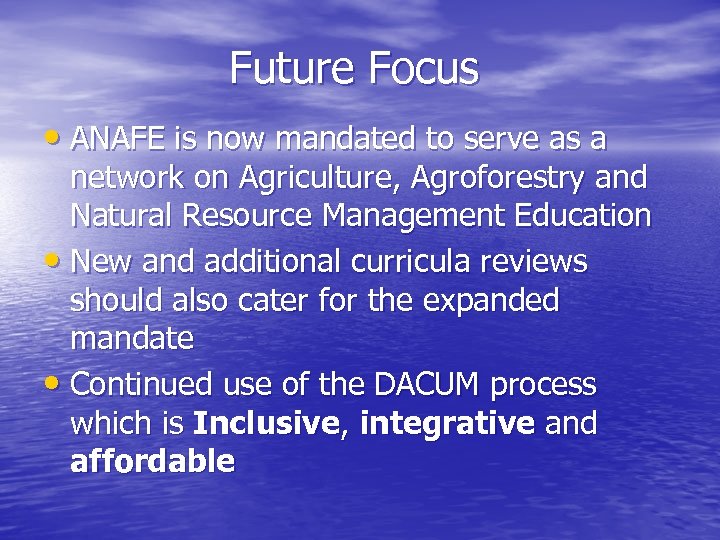 Future Focus • ANAFE is now mandated to serve as a network on Agriculture, Agroforestry and Natural Resource Management Education • New and additional curricula reviews should also cater for the expanded mandate • Continued use of the DACUM process which is Inclusive, integrative and affordable
 Agrobidiversity curriculum • Livelihoods: supplementing agricultural production, foods and • • spices, wood, medicines and gums & essential oils Environment: – Better land use – Soil and water conservation, utilization of marginal lands, regenerating degraded lands, and stemming land degradation – Conservation of environment and biodiversity on agricultural landscapes, including Climate change mitigation – Policy issues Reinforcement of knowledge and institutions for integrated NRM Regional workshop of Learning agrobiodiversity, : options for universities in Sub. Saharan Africa, 21 -23 January, 09, ICRAF House, Nairobi 18
 Key references 1. Adams RE. 1975. DACUM approach to curriculum: learning and evaluation in 2. 3. 4. occupational training. A Nova Scotia newstart. Ottawa: Department of Regional Economic Expansion. Asare EO and Hansson B. 1990. Curriculum development for agroforestry education at universities and technical colleges in eastern and southern Africa. Report from a workshop held 5– 15 November 1990, Nairobi, Kenya. Training and Education report 19. Nairobi: ICRAF, 57 pp. Asare EO and Zulberti E. 1992. Curriculum development for agroforestry education at African universities. Report from a workshop held 27 -30 August 1990, Kumasi, Ghana. Training and Education Report 18. Nairobi: ICRAF, 39 p. Rogers A, Taylor P. 1998 Participatory Curriculum Development in Agricultural Education. A training guide. Food and Agriculture Organization of the United Nations. Rome: FAO. Rudebjer P, Taylor P, Del Castillo RA, eds. 2001. A framework for developing agroforestry curricula in Southeast Asia. Training and Education Report No. 51. Bogor: ICRAF. Regional workshop of Learning agrobiodiversity, : options for universities in Sub. Saharan Africa, 21 -23 January, 09, ICRAF House, Nairobi 19
 Key references • Rudebjer PG, Temu AB and Kung’u J. 2005. Developing agroforestry • • curricula: a practical guide for institutions in Africa and Asia. . 2005. Bogor: World Agroforestry Centre. 53 pp. Taylor P. 1999. Through the Grassroots Towards the Trees - Exploring Participatory Curriculum Development in Forestry Education in Viet Nam. . In: Rudebjer PG and Del Castillo RA. (1999) The 1 st General Meeting of the Southeast Asian Network (SEANAFE), Harrar Hall, IRRI, Los Baños, Laguna, the Philippines, April 26 -28 1999. Training and Education Report No. 49. Bogor: ICRAF Temu, A. B. and Kasolo, W. 2001. Reviewing Curricula—Rationale, Process and Outputs: ANAFE experience with the DACUM method in Africa. FAO expert Consultation on Forestry Education. Regional workshop of Learning agrobiodiversity, : options for universities in Sub-Saharan Africa, 21 -23 January, 09, ICRAF House, Nairobi 20
 Key references • Temu, A. B. Kasolo, W. and Rudebjer, P. 1995. Approaches to agroforestry • • curriculum development. Training and education report no. 32, Nairobi Kenya: International Centre for Research in Agroforestry. Temu, A. B. Kasolo, W. and Rudebjer, P. 1995. Approaches to agroforestry curriculum development. Training and education report no. 32, Nairobi Kenya: International Centre for Research in Agroforestry. Useful websites – African Network for Agriculture, Agroforestry and Natural Resources Education (ANAFE): www. anafeafrica. org – www. anafeafrica. org/curriculum_eval_reviews. php – www. worldagroforestry. org/seanafe – Agroforestry Net: www. agroforestry. net Regional workshop of Learning agrobiodiversity, : options for universities in Sub-Saharan Africa, 21 -23 January, 09, ICRAF House, Nairobi 21
 Thank you ! Obrigado! Asante! Merci! Zikomo! Tatenda! Siyabonga! Gracias! Regional workshop of Learning agrobiodiversity, : Options for universities in Sub-Saharan Africa, 21 -23 January, 09, ICRAF House, Nairobi 22