


 Скачать презентацию Anadolu University Faculty of Pharmacy Department of Pharmaceutical
db654967efab68b5e93d2b528c5e9a27.ppt
- Количество слайдов: 1
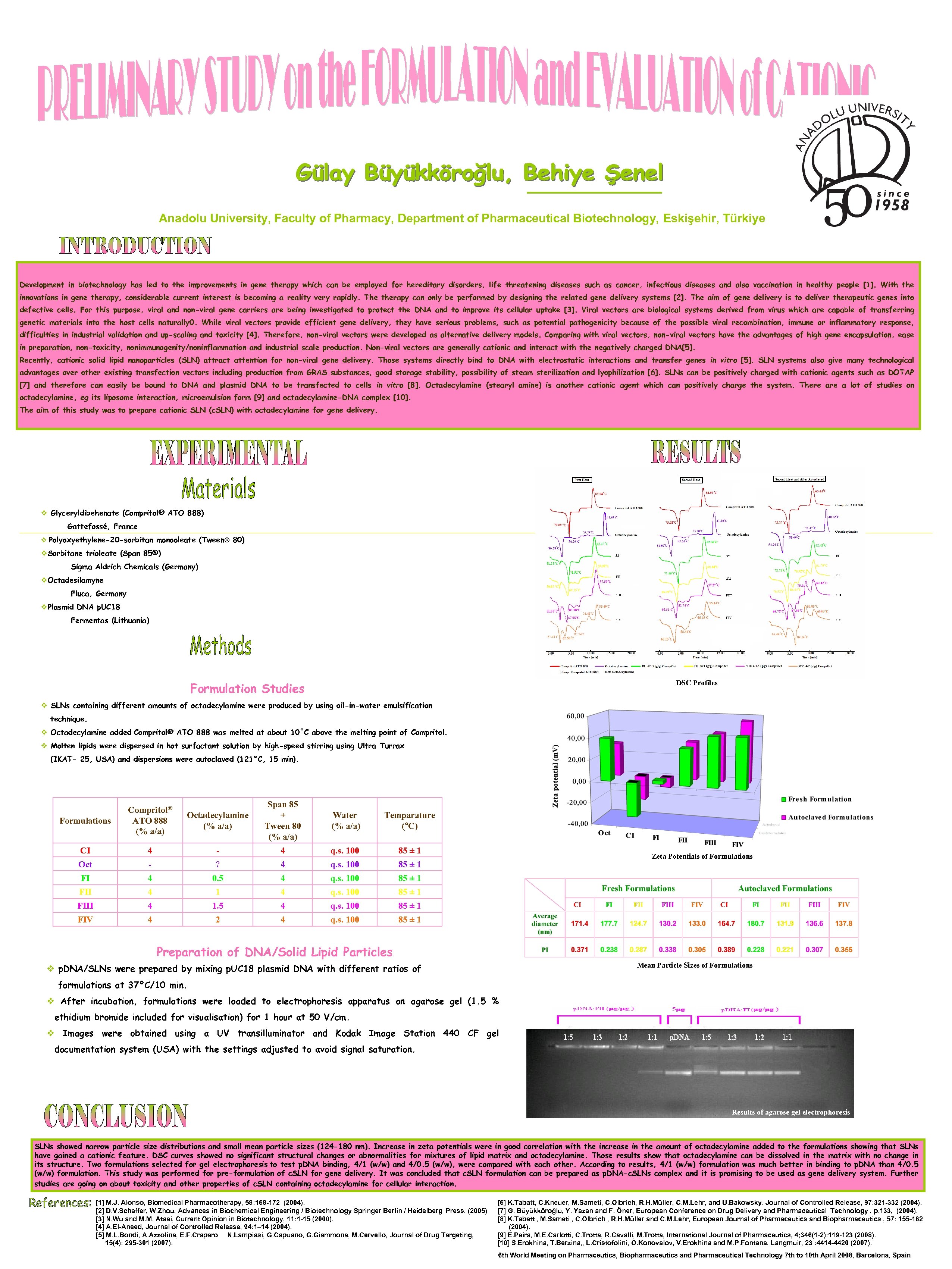 Anadolu University, Faculty of Pharmacy, Department of Pharmaceutical Biotechnology, Eskişehir, Türkiye Development in biotechnology has led to the improvements in gene therapy which can be employed for hereditary disorders, life threatening diseases such as cancer, infectious diseases and also vaccination in healthy people [1]. With the innovations in gene therapy, considerable current interest is becoming a reality very rapidly. The therapy can only be performed by designing the related gene delivery systems [2]. The aim of gene delivery is to deliver therapeutic genes into defective cells. For this purpose, viral and non-viral gene carriers are being investigated to protect the DNA and to improve its cellular uptake [3]. Viral vectors are biological systems derived from virus which are capable of transferring genetic materials into the host cells naturally 0. While viral vectors provide efficient gene delivery, they have serious problems, such as potential pathogenicity because of the possible viral recombination, immune or inflammatory response, difficulties in industrial validation and up-scaling and toxicity [4]. Therefore, non-viral vectors were developed as alternative delivery models. Comparing with viral vectors, non-viral vectors have the advantages of high gene encapsulation, ease in preparation, non-toxicity, nonimmunogenity/noninflammation and industrial scale production. Non-viral vectors are generally cationic and interact with the negatively charged DNA[5]. Recently, cationic solid lipid nanoparticles (SLN) attract attention for non-viral gene delivery. Those systems directly bind to DNA with electrostatic interactions and transfer genes in vitro [5]. SLN systems also give many technological advantages over other existing transfection vectors including production from GRAS substances, good storage stability, possibility of steam sterilization and lyophilization [6]. SLNs can be positively charged with cationic agents such as DOTAP [7] and therefore can easily be bound to DNA and plasmid DNA to be transfected to cells in vitro [8]. Octadecylamine (stearyl amine) is another cationic agent which can positively charge the system. There a lot of studies on octadecylamine, eg its liposome interaction, microemulsion form [9] and octadecylamine-DNA complex [10]. The aim of this study was to prepare cationic SLN (c. SLN) with octadecylamine for gene delivery. v Glyceryldibehenate (Compritol® ATO 888) Gattefossé, France v Polyoxyethylene-20 -sorbitan monooleate (Tween® 80) v. Sorbitane trioleate (Span 85®) Sigma Aldrich Chemicals (Germany) v. Octadesilamyne Fluca, Germany v. Plasmid DNA p. UC 18 Fermentas (Lithuania) DSC Profiles Formulation Studies v SLNs containing different amounts of octadecylamine were produced by using oil-in-water emulsification technique. v Octadecylamine added Compritol® ATO 888 was melted at about 10˚C above the melting point of Compritol. v Molten lipids were dispersed in hot surfactant solution by high-speed stirring using Ultra Turrax (IKAT- 25, USA) and dispersions were autoclaved (121°C, 15 min). Octadecylamine (% a/a) Span 85 + Tween 80 (% a/a) Water (% a/a) Temparature (°C) 4 - 4 q. s. 100 85 ± 1 Oct - ? 4 q. s. 100 85 ± 1 FI 4 0. 5 4 q. s. 100 85 ± 1 FII 4 1 4 q. s. 100 85 ± 1 FIII 4 1. 5 4 q. s. 100 85 ± 1 FIV 4 2 4 q. s. 100 85 ± 1 Formulations Compritol® ATO 888 (% a/a) CI Zeta Potentials of Formulations Preparation of DNA/Solid Lipid Particles Mean Particle Sizes of Formulations v p. DNA/SLNs were prepared by mixing p. UC 18 plasmid DNA with different ratios of formulations at 37ºC/10 min. v After incubation, formulations were loaded to electrophoresis apparatus on agarose gel (1. 5 % ethidium bromide included for visualisation) for 1 hour at 50 V/cm. v Images were obtained using a UV transilluminator and Kodak Image Station 440 CF gel documentation system (USA) with the settings adjusted to avoid signal saturation. Results of agarose gel electrophoresis SLNs showed narrow particle size distributions and small mean particle sizes (124 -180 nm). Increase in zeta potentials were in good correlation with the increase in the amount of octadecylamine added to the formulations showing that SLNs have gained a cationic feature. DSC curves showed no significant structural changes or abnormalities for mixtures of lipid matrix and octadecylamine. Those results show that octadecylamine can be dissolved in the matrix with no change in its structure. Two formulations selected for gel electrophoresis to test p. DNA binding, 4/1 (w/w) and 4/0. 5 (w/w), were compared with each other. According to results, 4/1 (w/w) formulation was much better in binding to p. DNA than 4/0. 5 (w/w) formulation. This study was performed for pre-formulation of c. SLN for gene delivery. It was concluded that c. SLN formulation can be prepared as p. DNA-c. SLNs complex and it is promising to be used as gene delivery system. Further studies are going on about toxicity and other properties of c. SLN containing octadecylamine for cellular interaction. [1] M. J. Alonso, Biomedical Pharmacotherapy, 58: 168 -172 (2004). [2] D. V. Schaffer, W. Zhou, Advances in Biochemical Engineering / Biotechnology Springer Berlin / Heidelberg Press, (2005) [3] N. Wu and M. M. Ataai, Current Opinion in Biotechnology, 11: 1 -15 (2000). [4] A. El-Aneed, Journal of Controlled Release, 94: 1– 14 (2004). [5] M. L. Bondi, A. Azzolina, E. F. Craparo N. Lampiasi, G. Capuano, G. Giammona, M. Cervello, Journal of Drug Targeting, 15(4): 295 -301 (2007). [6] K. Tabatt, C. Kneuer, M. Sameti, C. Olbrich, R. H. Müller, C. M. Lehr, and U. Bakowsky. Journal of Controlled Release, 97: 321 -332 (2004). [7] G. Büyükköroğlu, Y. Yazan and F. Öner, European Conference on Drug Delivery and Pharmaceutical Technology , p. 133, (2004). [8] K. Tabatt , M. Sameti , C. Olbrich , R. H. Müller and C. M. Lehr, European Journal of Pharmaceutics and Biopharmaceutics , 57: 155 -162 (2004). [9] E. Peira, M. E. Carlotti, C. Trotta, R. Cavalli, M. Trotta, International Journal of Pharmaceutics, 4; 346(1 -2): 119 -123 (2008). [10] S. Erokhina, T. Berzina, , L. Cristofolini, O. Konovalov, V. Erokhina and M. P. Fontana, Langmuir, 23 : 4414 -4420 (2007). 6 th World Meeting on Pharmaceutics, Biopharmaceutics and Pharmaceutical Technology 7 th to 10 th April 2008, Barcelona, Spain