 Скачать презентацию An Update to Moon LITE Lunar Mission Rob
02f1e124d3a984e81baa8f15ac787dcc.ppt
- Количество слайдов: 20



An Update to Moon. LITE Lunar Mission Rob Gowen, MSSL/UCL On behalf of the UK Penetrator Consortium + international support EGU Conference, Vienna, April 15, 2008
Moon. LITE - Overview A UK initiated single mission to emplace 4 penetrators widely spaced over the lunar surface to operate for 1 year § 4π seismic network to enable investigation of deep lunar interior mantle/core, and location/nature of strong enigmatic surface quakes possibly dangerous to siting of lunar bases. § Geochemistry, presence of water (ISRU) and volatiles at the poles, and possible organic/astrobiological material of cometary origin. § In-situ exploration of new terrains (far side, poles) § Precursor to exploration of other solar system bodies § Impetus for UK plc § High public interest EGU Conference, Vienna, April 15, 2008
Moon. LITE - Timeline § Jan 2006 – First meeting of UK penetrator consortium, now expanded to 8 UK institutes and 3 industries § Dec 2006 - UK Research Council commissioned report of low cost lunar missions, and gave Moon. LITE top priority. § Apr 2007 – First funding in place for penetrator trials § Feb 2008 - UK Civil Space Strategy: ‘Develop a sustainable programme, in partnership with other agencies, of low cost robotic explorers, initially focused on lunar exploration, to achieve early, high profile science goals’ § Feb 2008 - BNSC/NASA Joint Working Group report describes Moon. LITE as ‘inspirational’ and proposes a joint JPT and Phase A study § <mid 2008 – Joint Phase A study of Moon. LITE expected to begin § ~2013 - Launch EGU Conference, Vienna, April 15, 2008
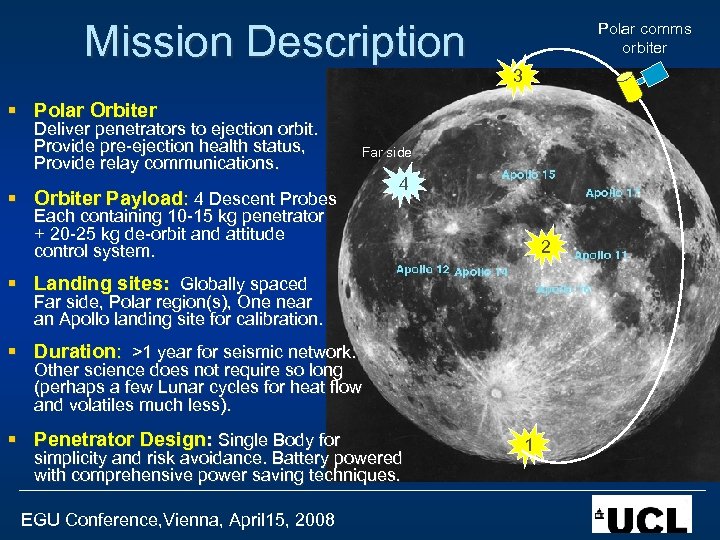
Mission Description Polar comms orbiter 3 § Polar Orbiter Deliver penetrators to ejection orbit. Provide pre-ejection health status, Provide relay communications. Far side § Orbiter Payload: 4 Descent Probes 4 Each containing 10 -15 kg penetrator + 20 -25 kg de-orbit and attitude control system. 2 § Landing sites: Globally spaced Far side, Polar region(s), One near an Apollo landing site for calibration. § Duration: >1 year for seismic network. Other science does not require so long (perhaps a few Lunar cycles for heat flow and volatiles much less). § Penetrator Design: Single Body for simplicity and risk avoidance. Battery powered with comprehensive power saving techniques. EGU Conference, Vienna, April 15, 2008 1
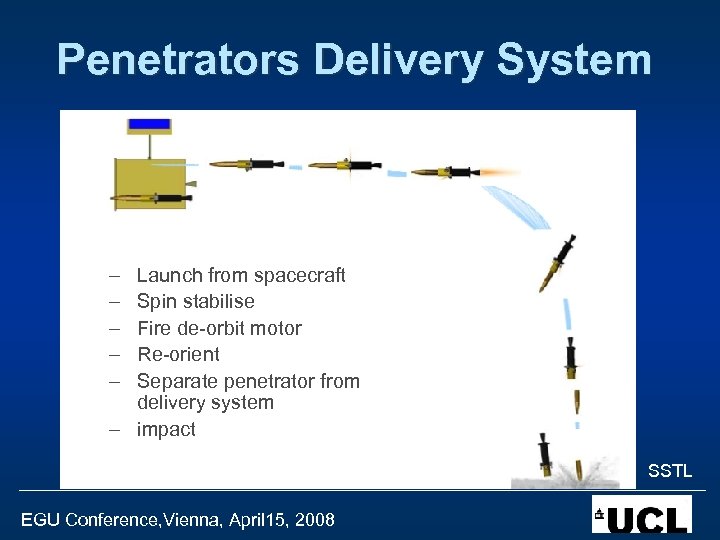
Penetrators Delivery System – – – Launch from spacecraft Spin stabilise Fire de-orbit motor Re-orient Separate penetrator from delivery system – impact SSTL EGU Conference, Vienna, April 15, 2008
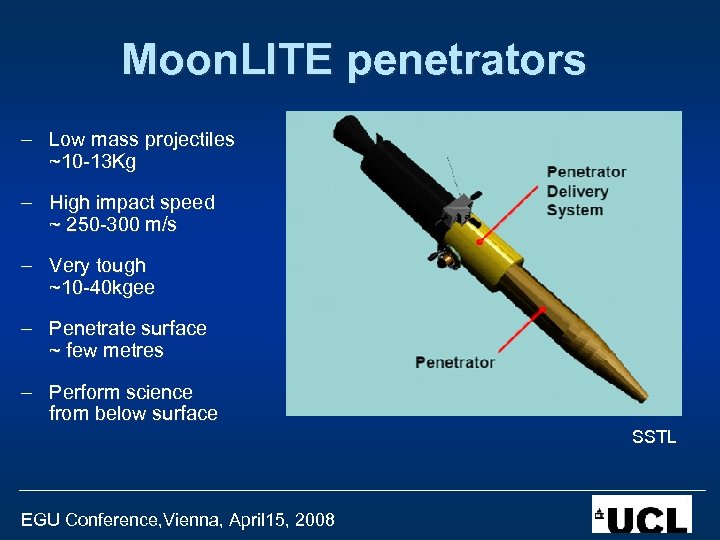
Moon. LITE penetrators – Low mass projectiles ~10 -13 Kg – High impact speed ~ 250 -300 m/s – Very tough ~10 -40 kgee – Penetrate surface ~ few metres – Perform science from below surface SSTL EGU Conference, Vienna, April 15, 2008
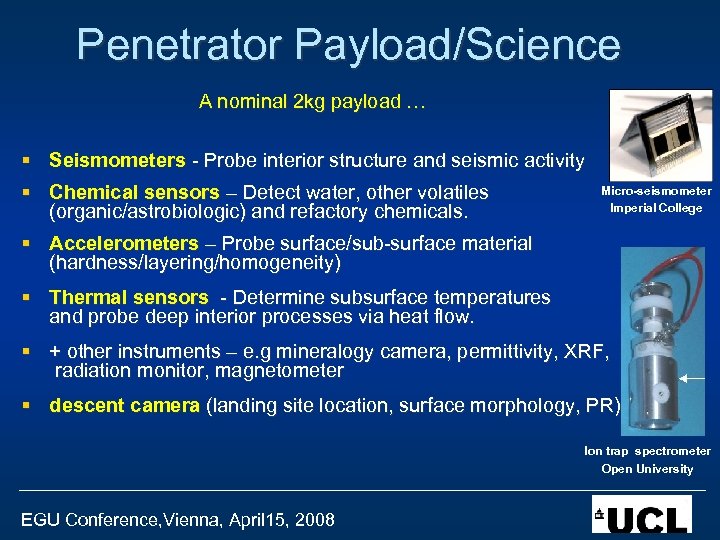
Penetrator Payload/Science A nominal 2 kg payload … § Seismometers - Probe interior structure and seismic activity § Chemical sensors – Detect water, other volatiles (organic/astrobiologic) and refactory chemicals. Micro-seismometer Imperial College § Accelerometers – Probe surface/sub-surface material (hardness/layering/homogeneity) § Thermal sensors - Determine subsurface temperatures and probe deep interior processes via heat flow. § + other instruments – e. g mineralogy camera, permittivity, XRF, radiation monitor, magnetometer § descent camera (landing site location, surface morphology, PR) Ion trap spectrometer Open University EGU Conference, Vienna, April 15, 2008
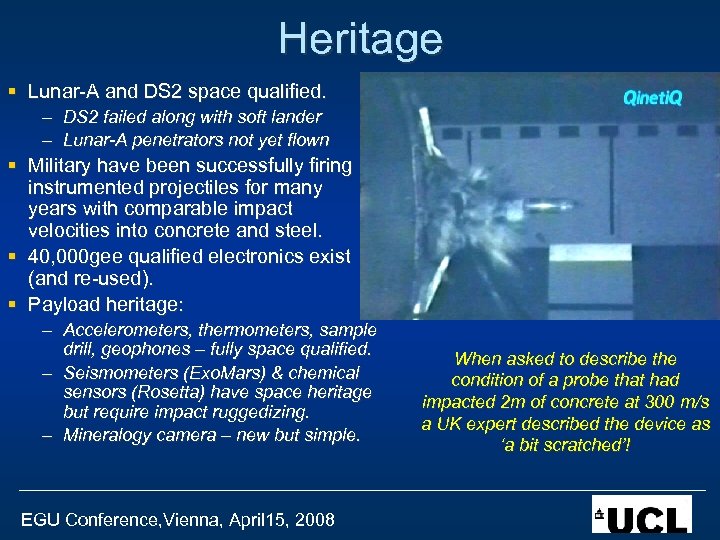
Heritage § Lunar-A and DS 2 space qualified. – DS 2 failed along with soft lander – Lunar-A penetrators not yet flown § Military have been successfully firing instrumented projectiles for many years with comparable impact velocities into concrete and steel. § 40, 000 gee qualified electronics exist (and re-used). § Payload heritage: – Accelerometers, thermometers, sample drill, geophones – fully space qualified. – Seismometers (Exo. Mars) & chemical sensors (Rosetta) have space heritage but require impact ruggedizing. – Mineralogy camera – new but simple. EGU Conference, Vienna, April 15, 2008 When asked to describe the condition of a probe that had impacted 2 m of concrete at 300 m/s a UK expert described the device as ‘a bit scratched’!
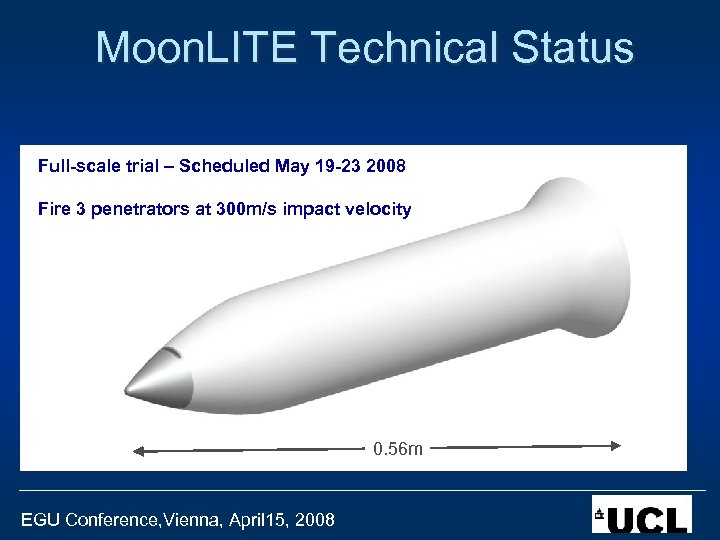
Moon. LITE Technical Status Full-scale trial – Scheduled May 19 -23 2008 Fire 3 penetrators at 300 m/s impact velocity 0. 56 m EGU Conference, Vienna, April 15, 2008
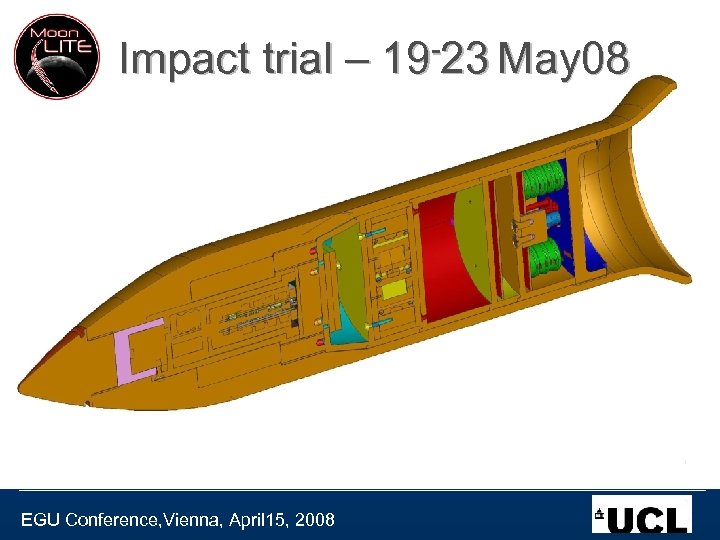
Impact trial – EGU Conference, Vienna, April 15, 2008 -23 May 08 19
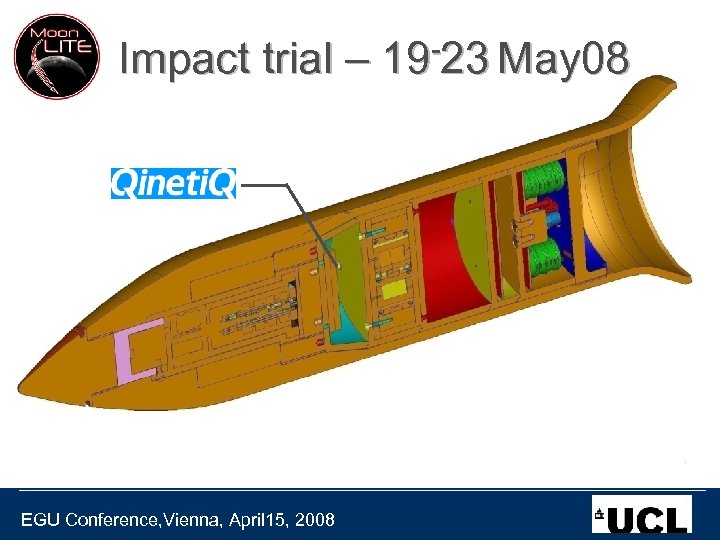
Impact trial – EGU Conference, Vienna, April 15, 2008 -23 May 08 19
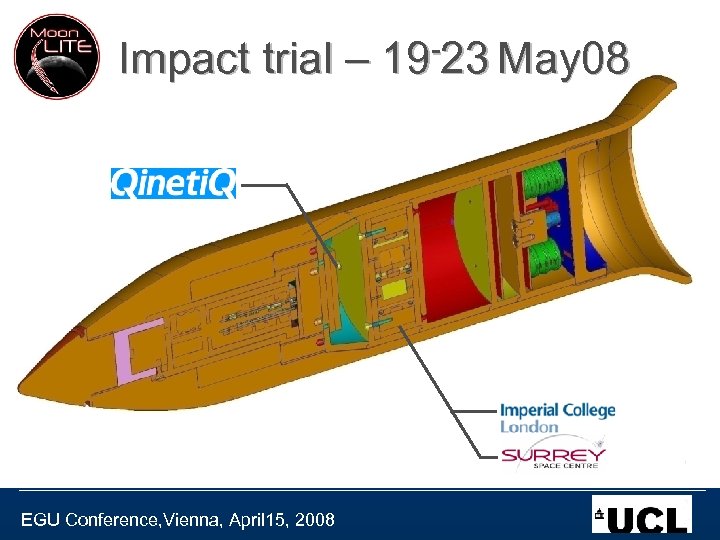
Impact trial – EGU Conference, Vienna, April 15, 2008 -23 May 08 19
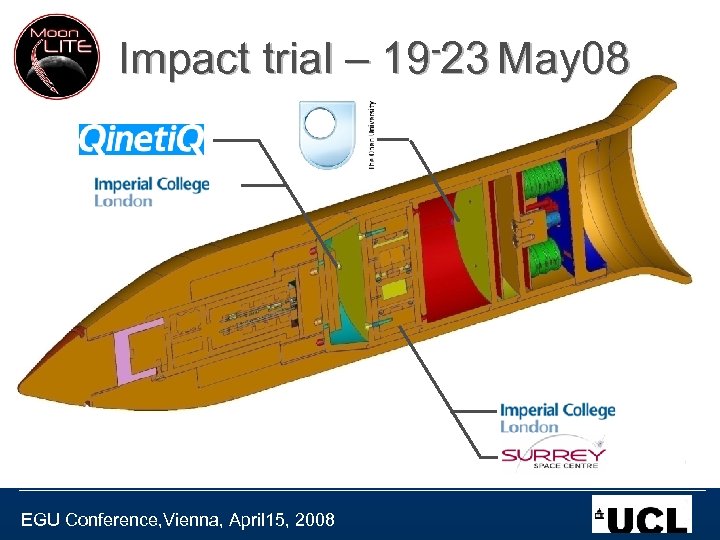
Impact trial – EGU Conference, Vienna, April 15, 2008 -23 May 08 19
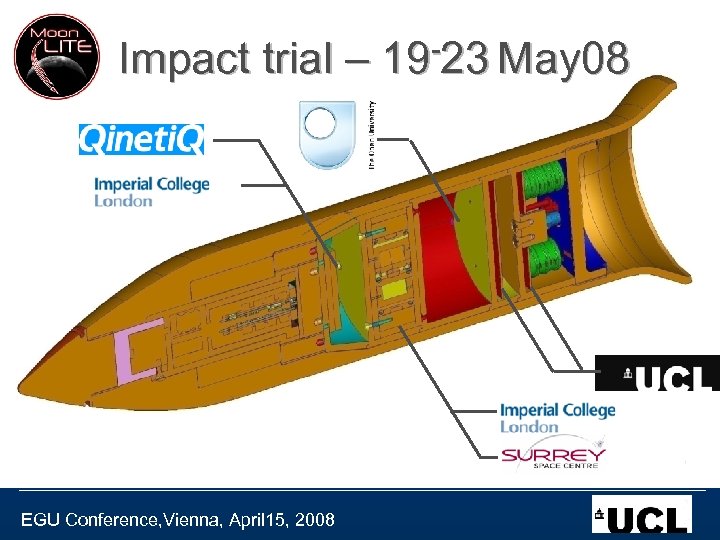
Impact trial – EGU Conference, Vienna, April 15, 2008 -23 May 08 19
Impact Trial Objectives § Demonstrate survivability of penetrator shell, accelerometers and power system. § Determine internal acceleration environment at different positions within penetrator. § Extend and validate sophisticated modelling to new impact and penetrator materials. § Assess impact on penetrator subsystems and instruments. § Assess alternative packing methods. § Assess interconnect philosophy. EGU Conference, Vienna, April 15, 2008
Expected Next Steps § Mission Phase-A to start imminently, and complete by end of year. § Funds to be released for parallel instrument and subsystem technical development. (to achieve TRL level 5 within 2 years) § International peer review for science. § Major system studies (e. g. thermal, comms, descent etc); impact modelling of both regolith and instruments, underpinning future small scale & full scale impact trials. EGU Conference, Vienna, April 15, 2008
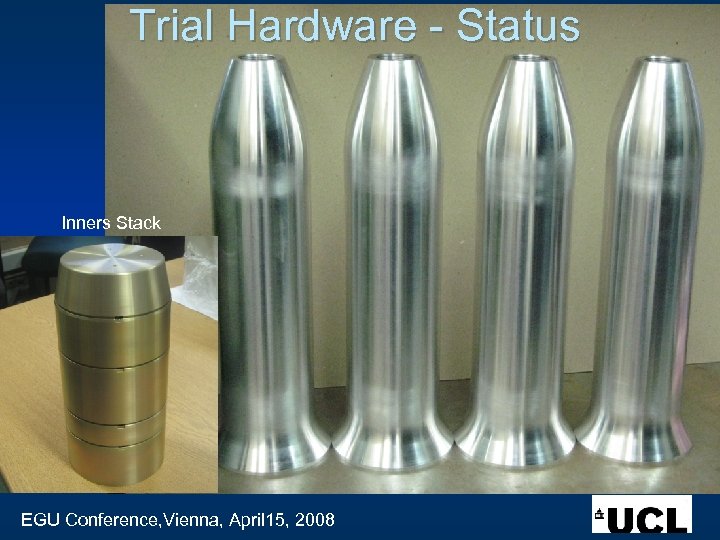
Trial Hardware - Status Inners Stack EGU Conference, Vienna, April 15, 2008
Conclusions Moon. LITE - A focused mission with clear objectives based on a strong technology background Penetrator website: http: //www. mssl. ucl. ac. uk/planetary/missions/Micro_Penetrators. php email: rag@mssl. ucl. ac. uk EGU Conference, Vienna, April 15, 2008
- End - EGU Conference, Vienna, April 15, 2008
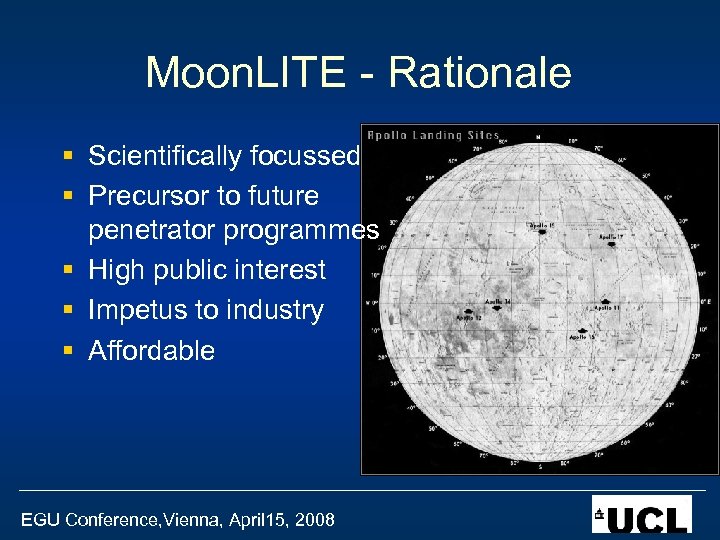
Moon. LITE - Rationale § Scientifically focussed § Precursor to future penetrator programmes § High public interest § Impetus to industry § Affordable EGU Conference, Vienna, April 15, 2008
Скачать презентацию An Update to Moon LITE Lunar Mission Rob
02f1e124d3a984e81baa8f15ac787dcc.ppt