


 Скачать презентацию An Update on the Status of the National
b5f33073f9e32bb44175bf78aee1bd5c.ppt
- Количество слайдов: 29
 An Update on the Status of the National Knowledge Network of India (NKN) Neeraj Sinha and P. S. Dhekne Office of the Principal Scientific Adviser to the Government of India New Delhi And Devender Kumar Gupta National Informatics Centre Services Incorporated Department of Information Technology Government of India New Delhi CHAIN Project meetings during the European Grid Infrastructure Technical Forum 2011 LYON, FRANCE September 20 -21, 2011
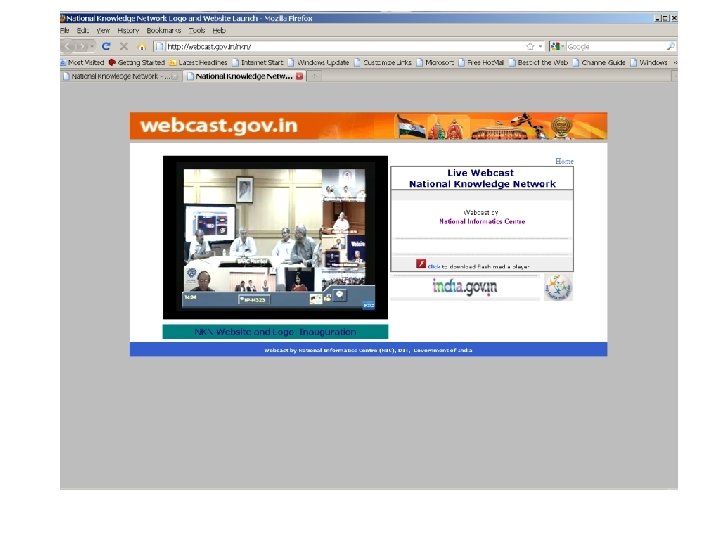
 The National Knowledge Network (NKN) • The Government of India approved the ten-year project to be implemented by the National Informatics Centre (NIC). Objectives: • The NKN project is aimed at establishing a strong and robust internal Indian network which will be capable of providing secure and reliable connectivity. • To bring together all the stakeholders from Higher Education, Science, Technology, Healthcare, Agriculture, GRID Computing and egovernance. • • • The inauguration of the initial phase of the NKN, with about 60 institute connections, by the President of India on 9 th April, 2009. The leading agencies in research & education are the first major organizations to be connected through this network. NKN Web site & Logo launching by Mr. Kapil Sibal, Union Minister for Communications and Information Technology and Minister of Human Resource Development, Government of India, on Feb. 5, 2011.
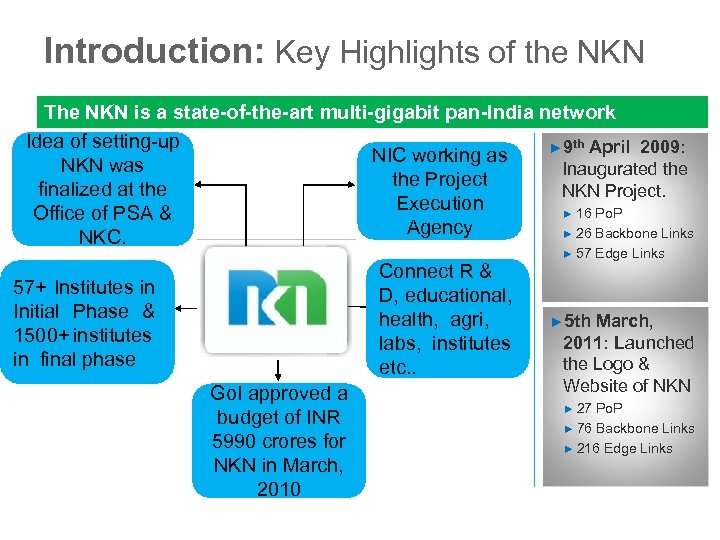 Introduction: Key Highlights of the NKN The NKN is a state-of-the-art multi-gigabit pan-India network Idea of setting-up ► 9 th April 2009: NIC working as NKN was Inaugurated the Project finalized at the NKN Project. Execution ► 16 Po. P Office of PSA & Agency ► 26 Backbone Links NKC. Connect R & D, educational, health, agri, labs, institutes etc. . 57+ Institutes in Initial Phase & 1500+ institutes in final phase Go. I approved a budget of INR 5990 crores for NKN in March, 2010 ► 57 Edge Links ► 5 th March, 2011: Launched the Logo & Website of NKN ► 27 Po. P ► 76 Backbone Links ► 216 Edge Links
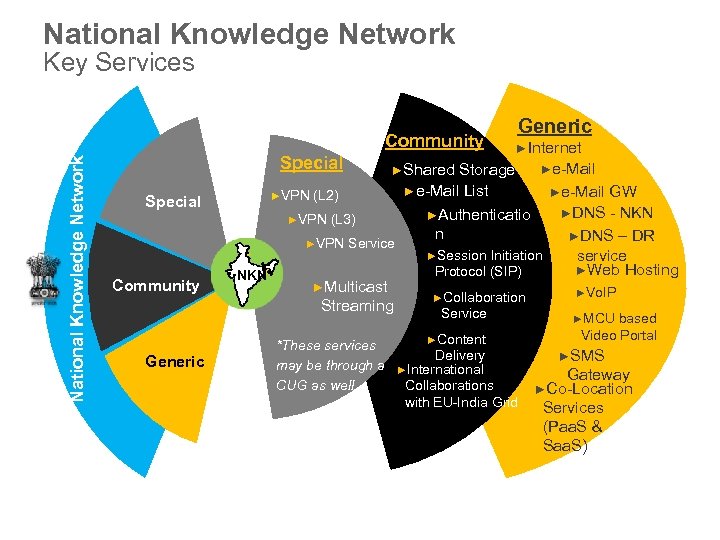 National Knowledge Network Key Services National Knowledge Network Community Special ►VPN Special (L 3) ►VPN Community NKN Service ►Multicast Streaming Generic ►Internet ►Shared (L 2) ►VPN Generic *These services may be through a CUG as well Storage ►e-Mail List ►Authenticatio n ►Session ►e-Mail Initiation Protocol (SIP) ►Collaboration Service ►Content GW ►DNS - NKN ►DNS – DR service ►Web Hosting ►Vo. IP ►MCU based Video Portal Delivery ►SMS Collaborations with EU-India Grid ►Co-Location ►International Gateway Services (Paa. S & Saa. S)
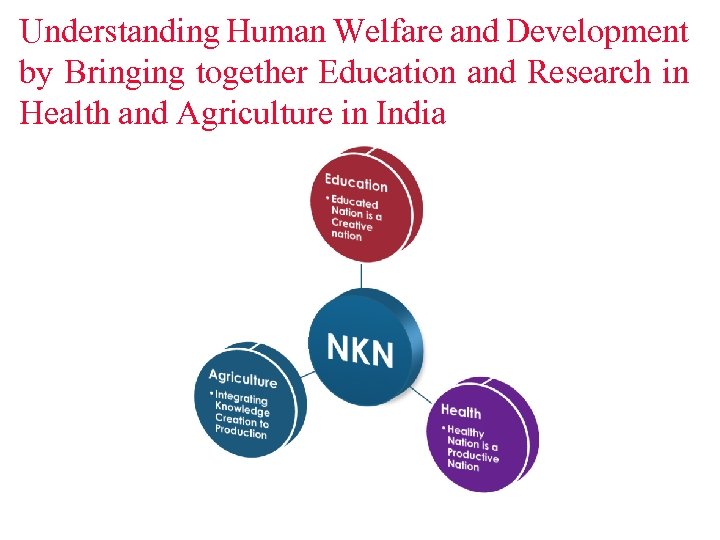 Understanding Human Welfare and Development by Bringing together Education and Research in Health and Agriculture in India
 NKN update • Full financial sanction for the NKN received in March, 2010. • Initial phase with INR 15. 00 crores, having multiple 2. 5 Gbps (26 fiber links) connecting over 60 institutes with 1 Gbps, has been completed in 2009. • Virtual class rooms, GARUDA, the Department of Atomic Energy Grid operation and the Collab-CAD are running on the NKN. • Open Drug Discovery project of the Council of Scientific and Industrial Research (CSIR) running over the NKN. • 300 institutes connected till now and the remaining 400 institutes will be connected by March 2012.
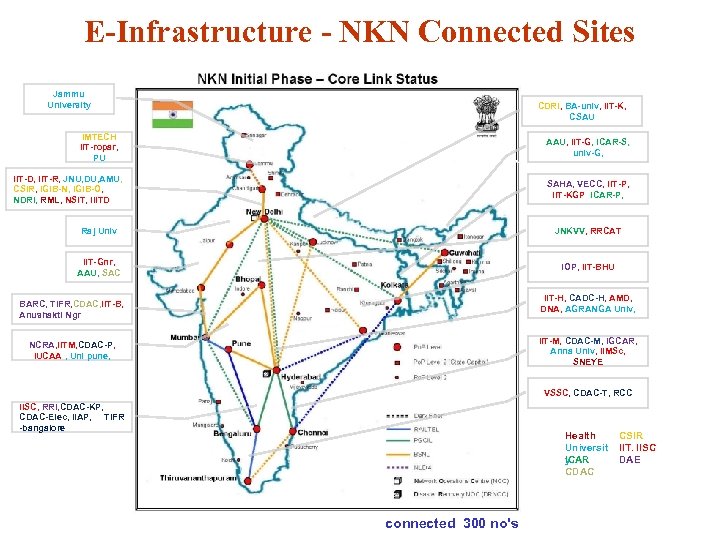 E-Infrastructure - NKN Connected Sites Jammu University CDRI, BA-univ, IIT-K, CSAU IMTECH IIT-ropar, PU AAU, IIT-G, ICAR-S, univ-G, IIT-D, IIT-R, JNU, DU, AMU, CSIR, IGIB-N, IGIB-O, NDRI, RML, NSIT, IIITD SAHA, VECC, IIT-P, IIT-KGP ICAR-P, Raj Univ JNKVV, RRCAT IIT-Gnr, AAU, SAC IOP, IIT-BHU IIT-H, CADC-H, AMD, DNA, AGRANGA Univ, BARC, TIFR, CDAC, IIT-B, Anushakti Ngr IIT-M, CDAC-M, IGCAR, Anna Univ, IIMSc, SNEYE NCRA, IITM, CDAC-P, IUCAA , Uni pune, VSSC, CDAC-T, RCC IISC, RRI, CDAC-KP, CDAC-Elec, IIAP, TIFR -bangalore Health Universit ICAR y CDAC connected 300 no's CSIR IIT. IISC DAE
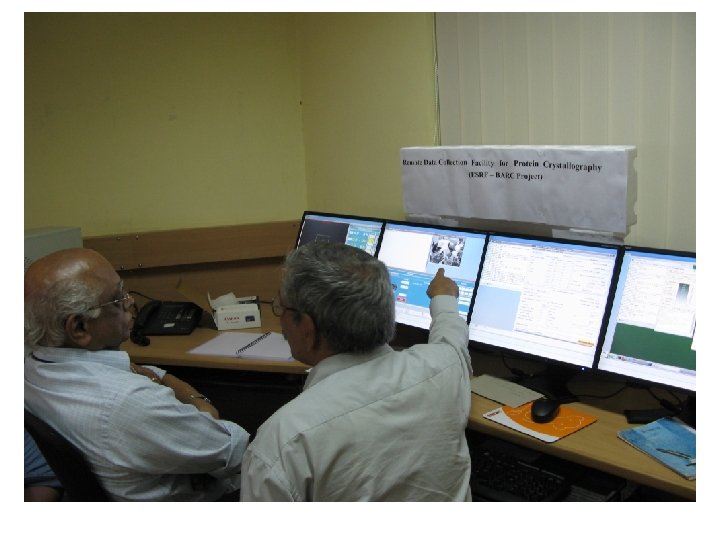
 NKN an integral part of e-science Infrastructure v Earliest use was to establish Virtual classrooms in the Indian Institutes of Technology (IITs). v Tele-Medicine. v Grid for LHC Grid, Climate Science, Cancer Grid, Brain Grid, … v ESRF – Remote access to Synchrotron Beam line at Grenoble, France (BARC). v Open Source Drug Discovery (CSIR). v Research Collaboration(National and International).
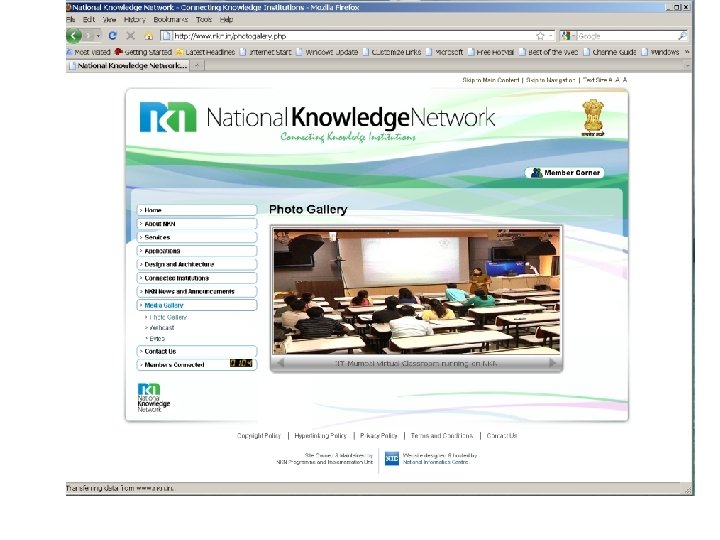
 National Knowledge Network Creation of Virtual Classrooms • A total of 66 Virtual Classrooms (VCRs) are being created under this project (38 VCRs in the IITs; 23 VCRs collectively in the National Institutes of Technology, the Indian Institute of Science and the Indian Institutes of Scientific Education and Research; 5 VCRs in the NIC).
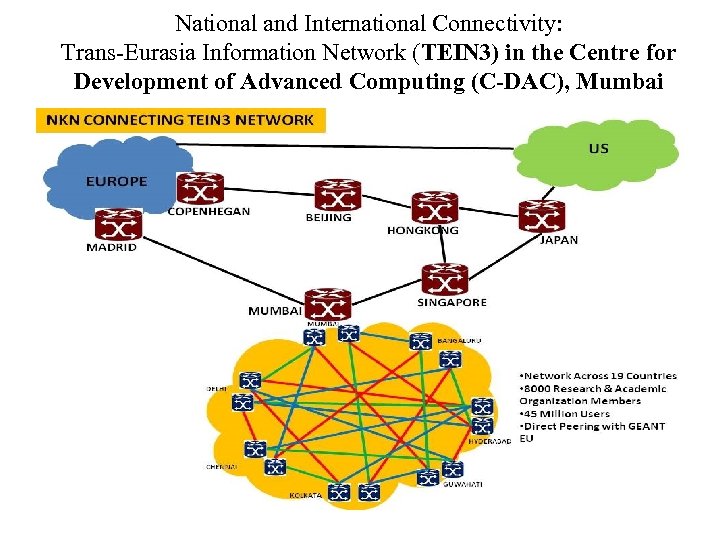 National and International Connectivity: Trans-Eurasia Information Network (TEIN 3) in the Centre for Development of Advanced Computing (C-DAC), Mumbai
 E-science Infrastructure • The NKN is fast becoming a major component of the escience infrastructure in India. • India, today, has the following dedicated links : 1. One Gigabit fiber link to the CERN, Geneva. 2. Two 2. 5 Gigabit TEIN 3 links – one to Europe and the other to Singapore through the TEIN 3 programme. 3. One Gigabit link to Institutes via the NKN.
 EU-India. Grid project • The first phase was started in Oct, 2008, and made significant progress by connecting the European grid infrastructures to the Indian Grids, even exceeding the initial goals. • This has encouraged the European Union to initiate the EU-India. Grid 2 project. • Organizations working on Grid enabled applications: The partners of the project are both European (INFN) and Indian (Pune University, C-DAC, ERNET, NIC, BARC, TIFR, SINP, VECC, IISc, IITD) Institutes.
 EU-India. Grid project : Achievements so far. . o Building an e-Science community. o Establishing collaborations and synergies with related applications and initiatives between the European and the Indian users. o Identifying researchers interested in Grid infrastructures or in e-Science based on Grid infrastructures. o Bridging e-Infrastructures within Europe and India.
 The CHAIN Project • The EU-India. Grid project fully achieved its objectives and technical goals and even exceeded expectations. • As a result of the excellent achievements, a 2 -year Eu. India. Grid 2 project – Sustainable e-Infrastructures across Europe and India – funded by the EC, was approved, with the start date as 1/1/2010. • The Co-ordination and Harmonization of Advanced e. INfrastructures (CHAIN) project is expected to reinforce coherent synergy between India and Europe and would help in consolidating India’s multi-gigabit, low latency, einfrastructure: NKN.
 GARUDA Grid v The PARAM series of supercomputers was a pioneering initiative of the C-DAC. v GARUDA is the Grid Computing initiative of the C-DAC to allow access for scientific and academic institutions to the aggregation of High Performance Computing (HPC) clusters from various C-DAC centres and partners, comprising now over 6000 CPUs (~ 70 teraflops) and terabytes of mass storage to provide distributed data. v Most of the partners of the GARUDA have already migrated to the NKN. v The GARUDA Grid is now powered by the NKN - a highly reliable and secure national backbone.
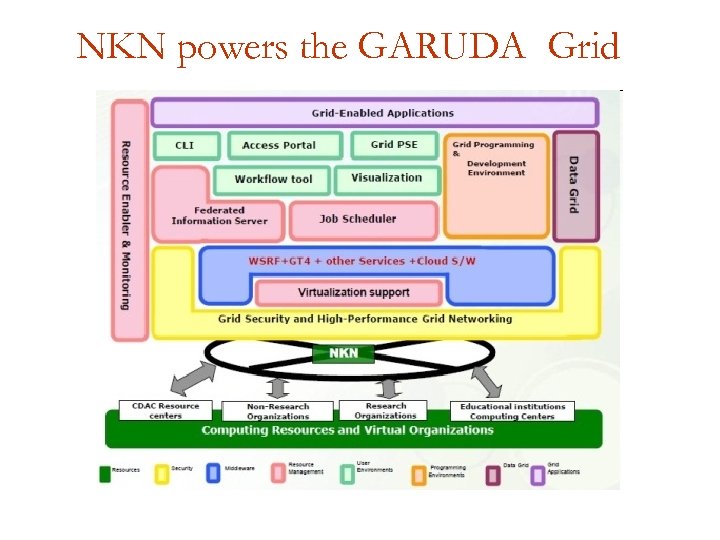 NKN powers the GARUDA Grid
 IGCA and the C-DAC • The ASGC played the role of Grid Certifying Authority (GCA) for India until recently. • The first GCA in India was established in the C-DAC, Bangalore; the Indian Grid Certification Authority (IGCA) has been accredited by the APGrid. PMA. • The C-DAC presented the IGCA in the APGrid. PMA during a meeting on the 16 th of Sept. , 2008 @ the OGF 24, Singapore. – Reference: http: //www. ogf. org/OGF 24/ http: //www. apgridpma. org/meetings/index. html
 • The IGCA was formally inaugurated on Jan 14, 2009 by Dr. R Chidambaram , Principal Scientific Adviser to the Government of India in the presence of the Secretary, Department of Information Technology, Government of India. • The IGCA is fully operational now and is issuing user and host certificates.
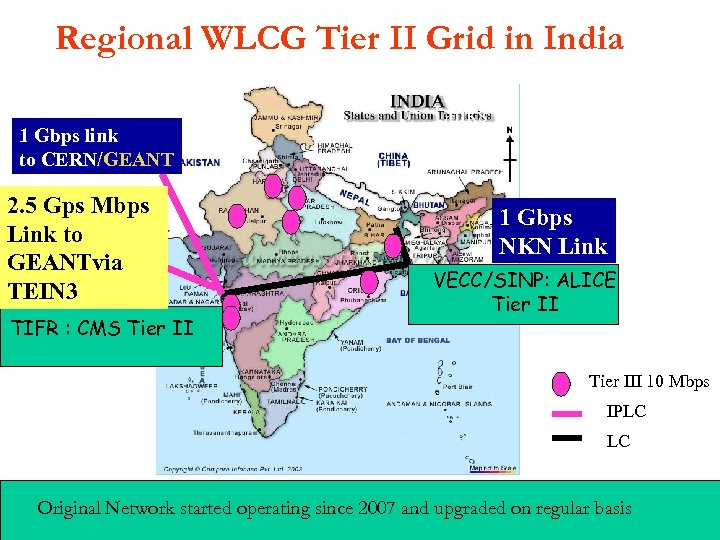 Regional WLCG Tier II Grid in India 1 Gbps link to CERN/GEANT 2. 5 Gps Mbps Link to GEANTvia TEIN 3 TIFR : CMS Tier II 4 Mbps Links 1 Gbps NKN Link VECC/SINP: ALICE Tier III 10 Mbps IPLC LC April 22, Network started operating since 2007 and upgraded on regular basis Developing e-infrastructures in India Original 2009 21
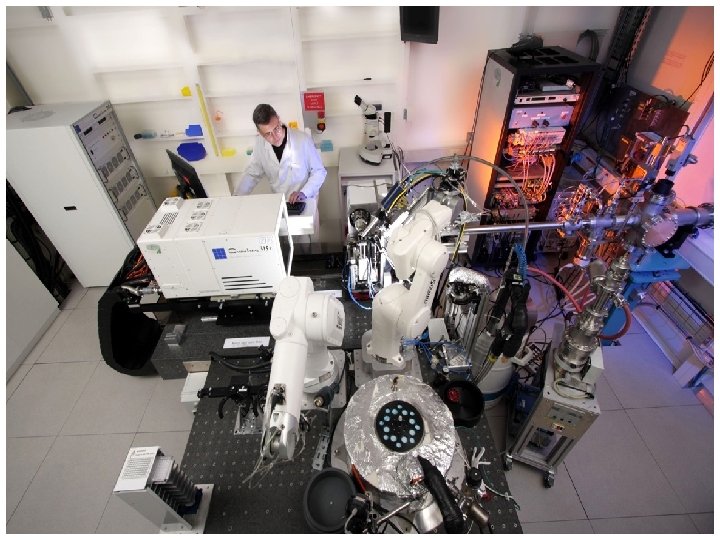
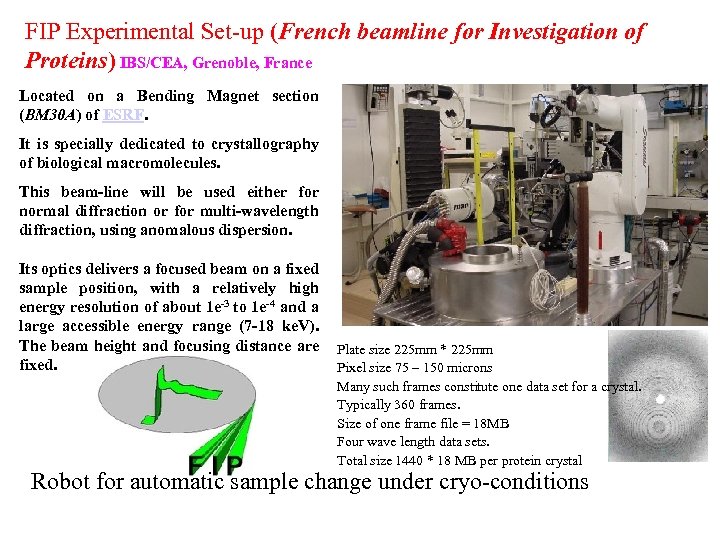 FIP Experimental Set-up (French beamline for Investigation of Proteins) IBS/CEA, Grenoble, France Located on a Bending Magnet section (BM 30 A) of ESRF. It is specially dedicated to crystallography of biological macromolecules. This beam-line will be used either for normal diffraction or for multi-wavelength diffraction, using anomalous dispersion. Its optics delivers a focused beam on a fixed sample position, with a relatively high energy resolution of about 1 e-3 to 1 e-4 and a large accessible energy range (7 -18 ke. V). The beam height and focusing distance are fixed. Plate size 225 mm * 225 mm Pixel size 75 – 150 microns Many such frames constitute one data set for a crystal. Typically 360 frames. Size of one frame file = 18 MB Four wave length data sets. Total size 1440 * 18 MB per protein crystal Robot for automatic sample change under cryo-conditions
 Collaboratory?
 Reg. CM 4 Demo for Interoperation • Reg. CM 4 application demonstration by the C-DAC, Pune – Successful job submission of Reg. CM 4 has been carried-out in EUIndia. Grid 2 workshop held on December 16, 2010, at the Indian Institute of Technology Delhi, New Delhi : • The Parallel version of Reg. CM 4 application (2 days climate simulation of the Indian subcontinent) has been successfully submitted and executed in the GARUDA resources( Duration: 20 min). • The serial version of Reg. CM 4 (2 days climate simulation of the Indian sub continent) has been successfully submitted and executed at the EGI Test bed resources (Duration: 4 hours).
 Work of Prof S. K. Dash, IITD The GARUDA GRID provided HPC facilities for climate research using high resolution regional models. Reg. CM 3 simulations of summer monsoon precipitation are done under the EU-India. Grid 2 project and simulations are closer to the observed values.
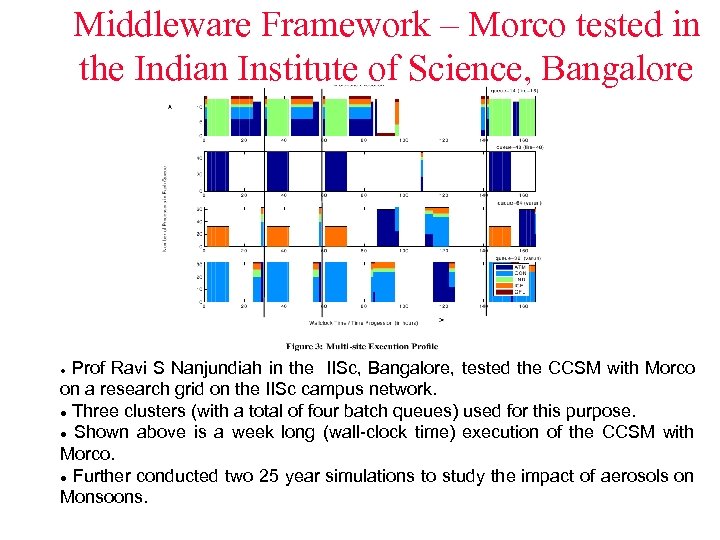 Middleware Framework – Morco tested in the Indian Institute of Science, Bangalore Prof Ravi S Nanjundiah in the IISc, Bangalore, tested the CCSM with Morco on a research grid on the IISc campus network. Three clusters (with a total of four batch queues) used for this purpose. Shown above is a week long (wall-clock time) execution of the CCSM with Morco. Further conducted two 25 year simulations to study the impact of aerosols on Monsoons.
 Typical Proposals: Model Projects • Education – Amrita Vishwa Vidyapeetham, Coimbatore, Tamil Nadu Buffalo University Link – IIT Hyderabad – Keio University • Science and Technology – Remote operation of Synchrotron at Grenoble, France – Climate Change Modeling with the ICTP – Astronomy Community on Gamma Ray Telescopes • Data Centres – Connecting the Eka Supercomputer on the NKN
 Thank you for being so patient