


 Скачать презентацию An Update on Network Protocol Security Anupam Datta
ca1be0d7a1b087354c7286dd9934eca0.ppt
- Количество слайдов: 33
 An Update on Network Protocol Security Anupam Datta John Mitchell Stanford University Stanford Computer Forum, 2007
 Roadmap u. Network protocol examples u. Are industrial protocols secure? • Case studies of industry standards u. Research state-of-the-art • Fully automated bug-finding tools • Methods for proving absence of bugs – Protocol Composition Logic • Modular proof-techniques • Cryptographic soundness u. Conclusions and Future Work
 Many Protocols u. Authentication • Kerberos u. Key Exchange • SSL/TLS handshake, IKE, JFK, IKEv 2, u. Wireless and mobile computing • Mobile IP, WEP, 802. 11 i, 802. 16 e, Wi-Fi u. Electronic commerce • Contract signing, SET, electronic cash, …
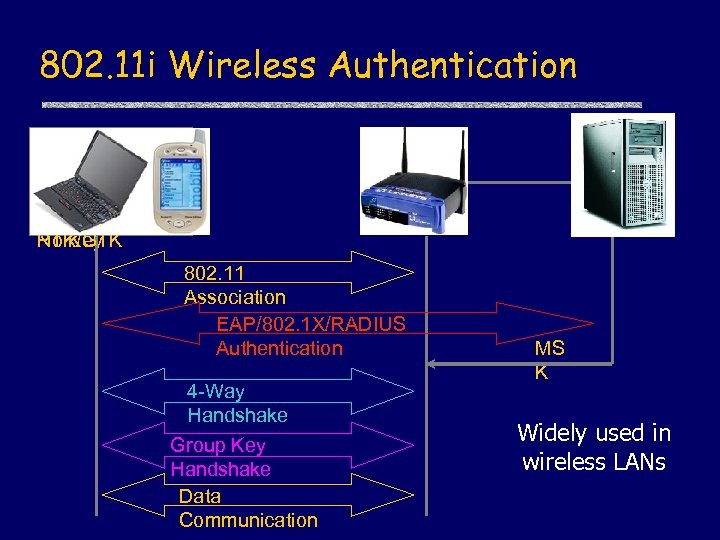 802. 11 i Wireless Authentication Supplicant Auth/Assoc Un. Auth/Un. Asso 802. 1 X c Un. Blocked 802. 1 X Blocked PTK/GTK No Key 802. 11 Association EAP/802. 1 X/RADIUS Authentication 4 -Way Handshake Group Key Handshake Data Communication MS K Widely used in wireless LANs
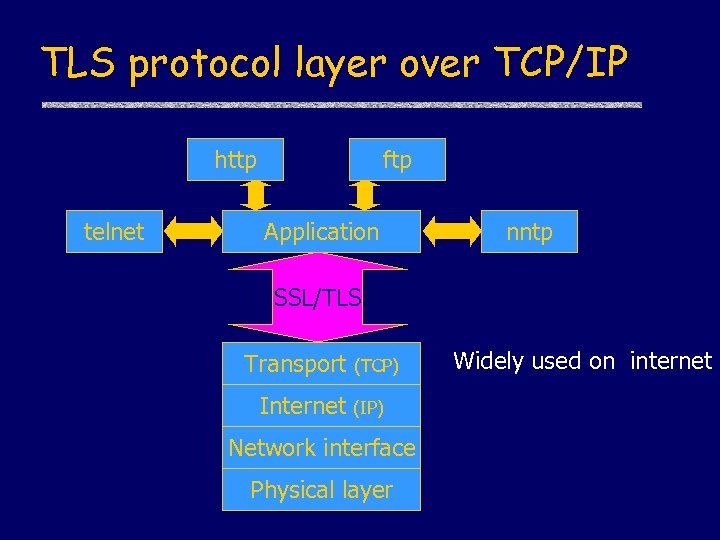 TLS protocol layer over TCP/IP http telnet ftp Application nntp SSL/TLS Transport Internet (TCP) (IP) Network interface Physical layer Widely used on internet
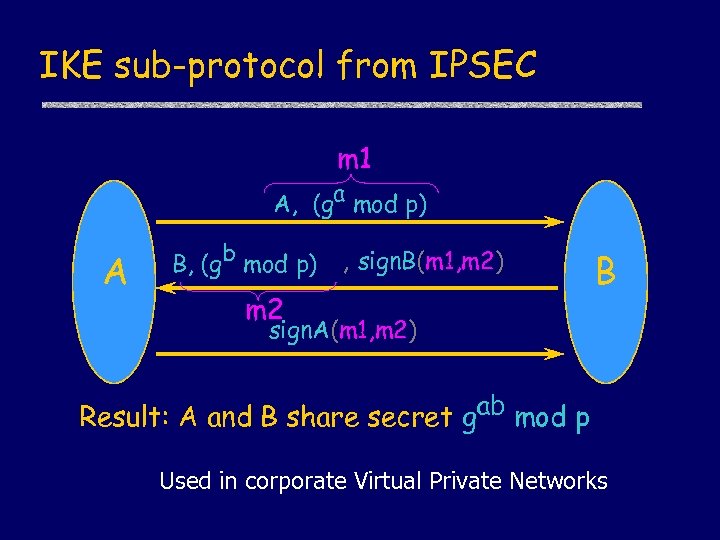 IKE sub-protocol from IPSEC m 1 A, (ga mod p) A B, (gb mod p) , sign. B(m 1, m 2) m 2 B sign. A(m 1, m 2) Result: A and B share secret gab mod p Used in corporate Virtual Private Networks
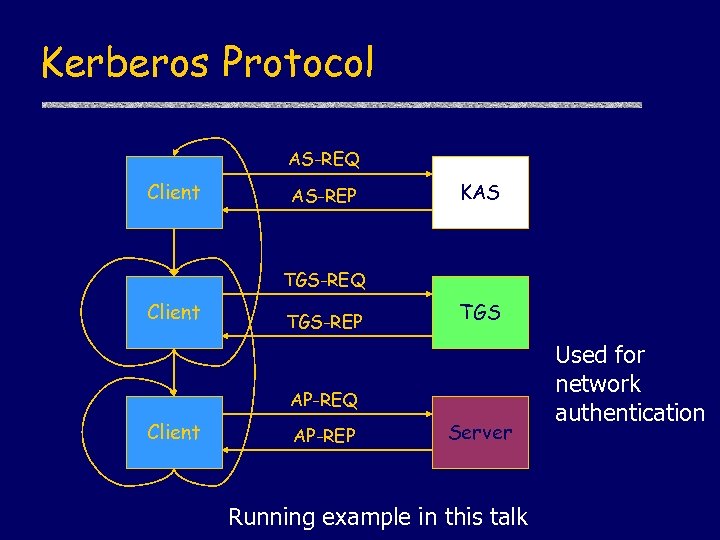 Kerberos Protocol AS-REQ Client AS-REP KAS TGS-REQ Client TGS-REP TGS AP-REQ Client AP-REP Server Running example in this talk Used for network authentication
 Roadmap u. Network protocol examples u. Are industrial protocols secure? • Case studies of industry standards u. Research state-of-the-art • Fully automated bug-finding tools • Methods for proving absence of bugs – Protocol Composition Logic • Modular proof-techniques • Cryptographic soundness u. Conclusions and Future Work
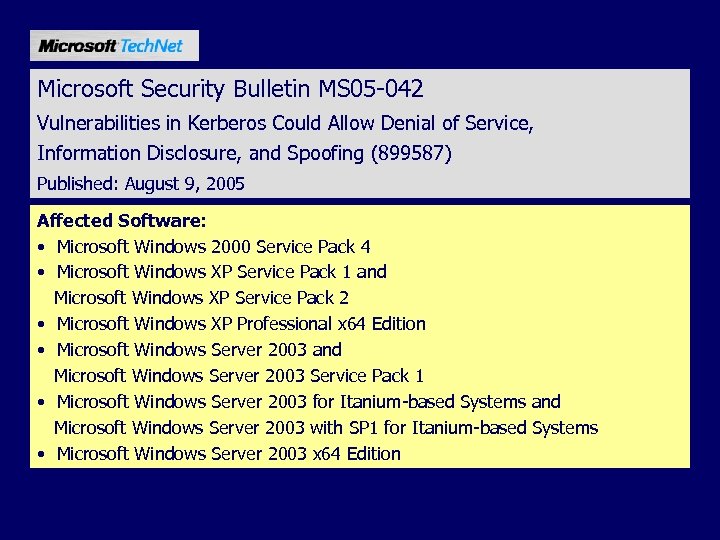 Microsoft Security Bulletin MS 05 -042 Vulnerabilities in Kerberos Could Allow Denial of Service, Information Disclosure, and Spoofing (899587) Published: August 9, 2005 Affected Software: • Microsoft Windows 2000 Service Pack 4 • Microsoft Windows XP Service Pack 1 and Microsoft Windows XP Service Pack 2 • Microsoft Windows XP Professional x 64 Edition • Microsoft Windows Server 2003 and Microsoft Windows Server 2003 Service Pack 1 • Microsoft Windows Server 2003 for Itanium-based Systems and Microsoft Windows Server 2003 with SP 1 for Itanium-based Systems • Microsoft Windows Server 2003 x 64 Edition
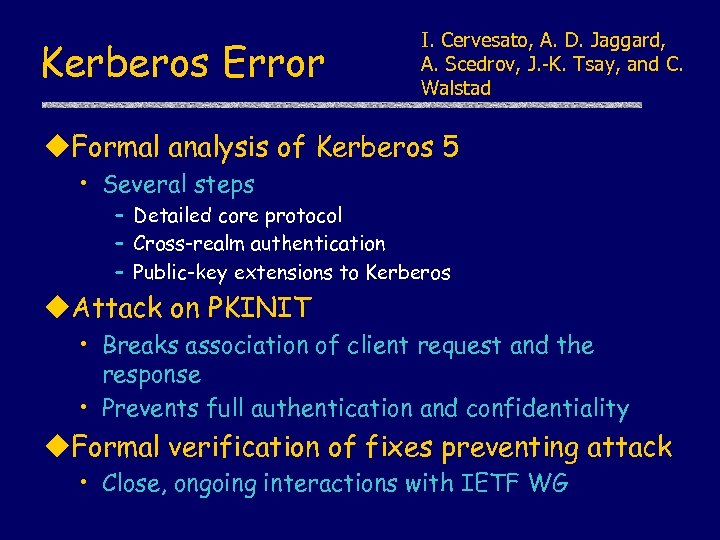 Kerberos Error I. Cervesato, A. D. Jaggard, A. Scedrov, J. -K. Tsay, and C. Walstad u. Formal analysis of Kerberos 5 • Several steps – Detailed core protocol – Cross-realm authentication – Public-key extensions to Kerberos u. Attack on PKINIT • Breaks association of client request and the response • Prevents full authentication and confidentiality u. Formal verification of fixes preventing attack • Close, ongoing interactions with IETF WG
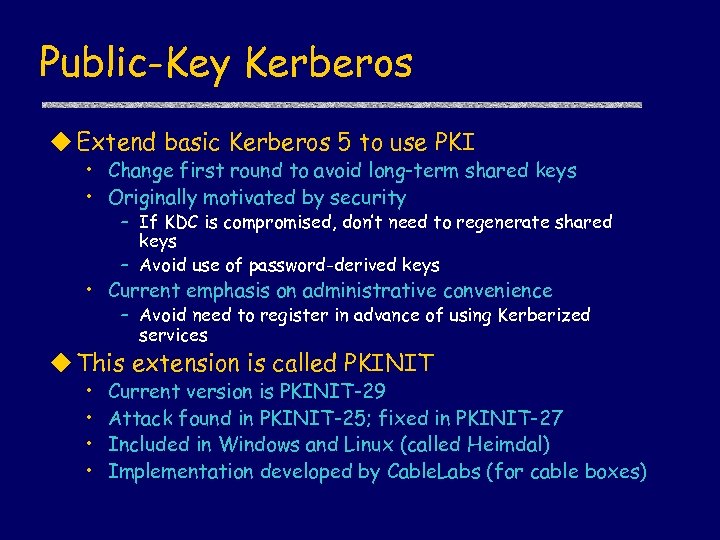 Public-Key Kerberos u Extend basic Kerberos 5 to use PKI • Change first round to avoid long-term shared keys • Originally motivated by security – If KDC is compromised, don’t need to regenerate shared keys – Avoid use of password-derived keys • Current emphasis on administrative convenience – Avoid need to register in advance of using Kerberized services u This extension is called PKINIT • • Current version is PKINIT-29 Attack found in PKINIT-25; fixed in PKINIT-27 Included in Windows and Linux (called Heimdal) Implementation developed by Cable. Labs (for cable boxes)
![Attack C Cert. C, [t. C, n 2]sk. C, C, T, n 1 I](https://present5.com/presentation/ca1be0d7a1b087354c7286dd9934eca0/image-12.jpg "Attack C Cert. C, [t. C, n 2]sk. C, C, T, n 1 I") Attack C Cert. C, [t. C, n 2]sk. C, C, T, n 1 I I I C {[k, n 2]sk. K}pk. C, C, TGT, {AK, …}k • I knows fresh keys k and AK • C receives K’s signature over k, n 2 and assumes k, AK, etc. , were generated for C (not I) Cert. I, [t. C, n 2]sk. I, I, T, n 1 {[k, n 2]sk. K}pk. I, I, TGT, {AK, …}k K K I • Principal P has secret key sk. P, public key pk. P • {msg}key is encryption of msg with key • [msg]key is signature over msg with key
Attack C Cert. C, [t. C, n 2]sk. C, C, T, n 1 I I I C {[k, n 2]sk. K}pk. C, C, TGT, {AK, …}k • I knows fresh keys k and AK • C receives K’s signature over k, n 2 and assumes k, AK, etc. , were generated for C (not I) Cert. I, [t. C, n 2]sk. I, I, T, n 1 {[k, n 2]sk. K}pk. I, I, TGT, {AK, …}k K K I • Principal P has secret key sk. P, public key pk. P • {msg}key is encryption of msg with key • [msg]key is signature over msg with key
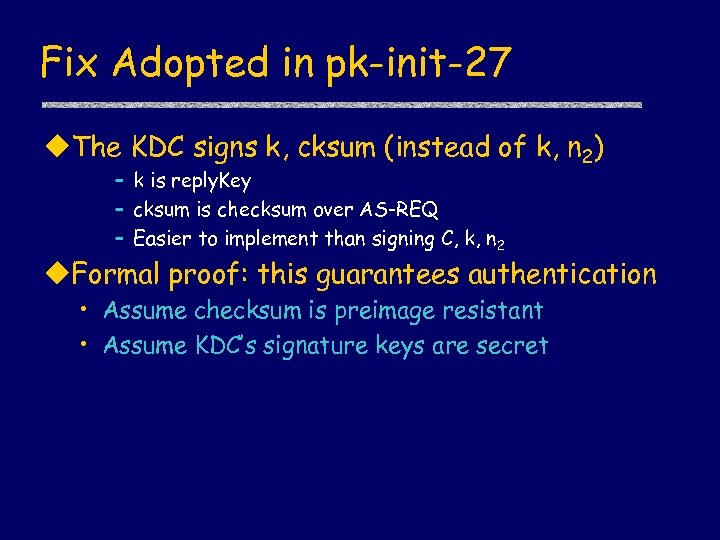 Fix Adopted in pk-init-27 u. The KDC signs k, cksum (instead of k, n 2) – k is reply. Key – cksum is checksum over AS-REQ – Easier to implement than signing C, k, n 2 u. Formal proof: this guarantees authentication • Assume checksum is preimage resistant • Assume KDC’s signature keys are secret
![Attacks on Industry Standards u. IKE [Meadows; 1999] • Reflection attack; fix adopted by](https://present5.com/presentation/ca1be0d7a1b087354c7286dd9934eca0/image-14.jpg "Attacks on Industry Standards u. IKE [Meadows; 1999] • Reflection attack; fix adopted by") Attacks on Industry Standards u. IKE [Meadows; 1999] • Reflection attack; fix adopted by IETF WG u. IEEE 802. 11 i [He, Mitchell; 2004] • Do. S attack; fix adopted by IEEE WG u. GDOI [Meadows, Pavlovic; 2004] • Composition attack; fix adopted by IETF WG u. Kerberos V 5 [Scedrov et al; 2005] • Identity misbinding attack; fix adopted by IETF WG; Windows update released by Microsoft Identified using logical methods
Attacks on Industry Standards u. IKE [Meadows; 1999] • Reflection attack; fix adopted by IETF WG u. IEEE 802. 11 i [He, Mitchell; 2004] • Do. S attack; fix adopted by IEEE WG u. GDOI [Meadows, Pavlovic; 2004] • Composition attack; fix adopted by IETF WG u. Kerberos V 5 [Scedrov et al; 2005] • Identity misbinding attack; fix adopted by IETF WG; Windows update released by Microsoft Identified using logical methods
 Roadmap u. Network protocol examples u. Are industrial protocols secure? • Case studies of industry standards u. Security analysis state-of-the-art • Fully automated bug-finding tools • Methods for proving absence of bugs – Protocol Composition Logic • Modular proof-techniques • Cryptographic soundness u. Conclusions and Future Work
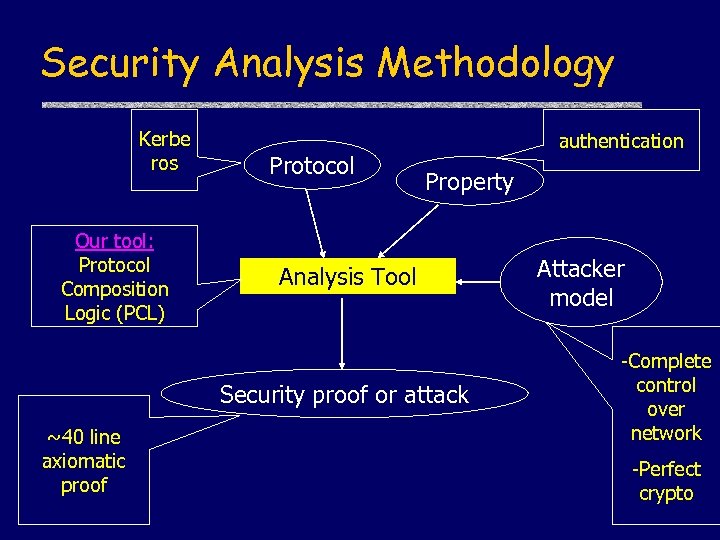 Security Analysis Methodology Kerbe ros Our tool: Protocol Composition Logic (PCL) Protocol authentication Property Analysis Tool Security proof or attack ~40 line axiomatic proof Attacker model -Complete control over network -Perfect crypto
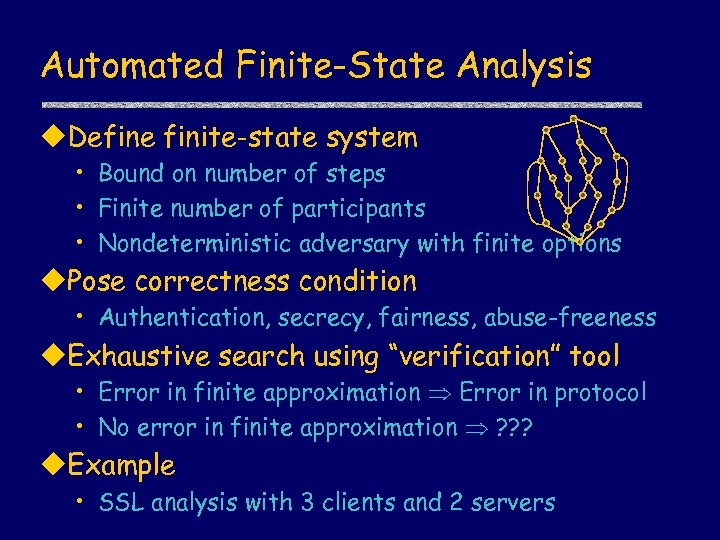 Automated Finite-State Analysis u. Define finite-state system • Bound on number of steps • Finite number of participants • Nondeterministic adversary with finite options u. Pose correctness condition • Authentication, secrecy, fairness, abuse-freeness u. Exhaustive search using “verification” tool • Error in finite approximation Error in protocol • No error in finite approximation ? ? ? u. Example • SSL analysis with 3 clients and 2 servers
 Bug-finding Tools and Case Studies u. Murphi model-checking of protocols • Generic model-checker developed by David Dill’s group at Stanford • Method for security protocol analysis developed by Mitchell, Shmatikov et al (1997 -) • Many case studies including SSL, 802. 11 i • Tool and case studies available at http: //cs 259. stanford. edu u. Many other fully automated tools • AVISPA project, SRI constraint solver, … u. Ready for industrial use
 Roadmap u. Network protocol examples u. Are industrial protocols secure? • Case studies of industry standards u. Security analysis state-of-the-art • Fully automated bug-finding tools • Methods for proving absence of bugs – Protocol Composition Logic • Modular proof-techniques • Cryptographic soundness u. Conclusions and Future Work
 Proving Security of Protocols u. Cryptographic reductions • More realistic model involving probabilistic polynomial time attackers • Difficult to scale to industrial protocols u. Symbolic methods and proof tools • NRL Protocol Analyzer, Paulson’s Inductive Method, Process calculi, Specialized protocol logics, MSR (see http: //cs 259. stanford. edu ) • 2 challenges: – Scale to industrial protocols: modular analysis desired – Use cryptographic model instead of idealized symbolic model • Progress on challenges in last 5 years
 Our Result u. Protocol Composition Logic (PCL): • Unbounded number of sessions (vs. model -checking) • Short high-level proofs: 2 -3 pages • Sound wrt – symbolic model – computational cryptography model Focus today • Modular proof techniques [DMP 01, DDMP 03, …, RDDM 06]
![PCL Results: Industrial Protocols u IEEE 802. 11 i [IEEE Standards; 2004] [HSDDM 05]](https://present5.com/presentation/ca1be0d7a1b087354c7286dd9934eca0/image-22.jpg "PCL Results: Industrial Protocols u IEEE 802. 11 i [IEEE Standards; 2004] [HSDDM 05]") PCL Results: Industrial Protocols u IEEE 802. 11 i [IEEE Standards; 2004] [HSDDM 05] u. TLS/SSL [RFC 2246] is a component (Attack using model-checking; fix adopted by WG) u GDOI Secure Group Communication [RFC 3547] [MP 04] (Attack using PCL; fix adopted by IETF WG) u Kerberos V 5 [IETF ID; 2004] [CMP 05, RDDM 06] u Mobile IPv 6 [RFC 3775] in progress u IKE/JFK family u. IKEv 2 [IETF ID; 2004] in progress [RDM 06] Except Kerberos, results currently apply only to symbolic model
PCL Results: Industrial Protocols u IEEE 802. 11 i [IEEE Standards; 2004] [HSDDM 05] u. TLS/SSL [RFC 2246] is a component (Attack using model-checking; fix adopted by WG) u GDOI Secure Group Communication [RFC 3547] [MP 04] (Attack using PCL; fix adopted by IETF WG) u Kerberos V 5 [IETF ID; 2004] [CMP 05, RDDM 06] u Mobile IPv 6 [RFC 3775] in progress u IKE/JFK family u. IKEv 2 [IETF ID; 2004] in progress [RDM 06] Except Kerberos, results currently apply only to symbolic model
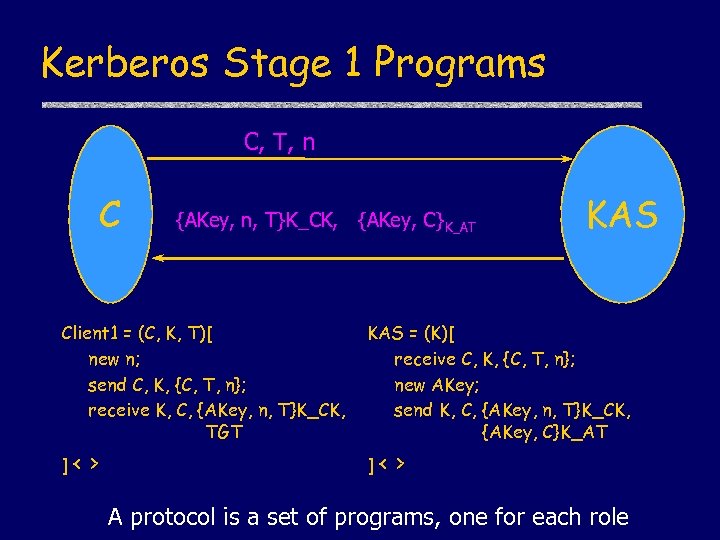 Kerberos Stage 1 Programs C, T, n C {AKey, n, T}K_CK, {AKey, C}K_AT KAS Client 1 = (C, K, T)[ new n; send C, K, {C, T, n}; receive K, C, {AKey, n, T}K_CK, TGT KAS = (K)[ receive C, K, {C, T, n}; new AKey; send K, C, {AKey, n, T}K_CK, {AKey, C}K_AT ]< ]< > > A protocol is a set of programs, one for each role
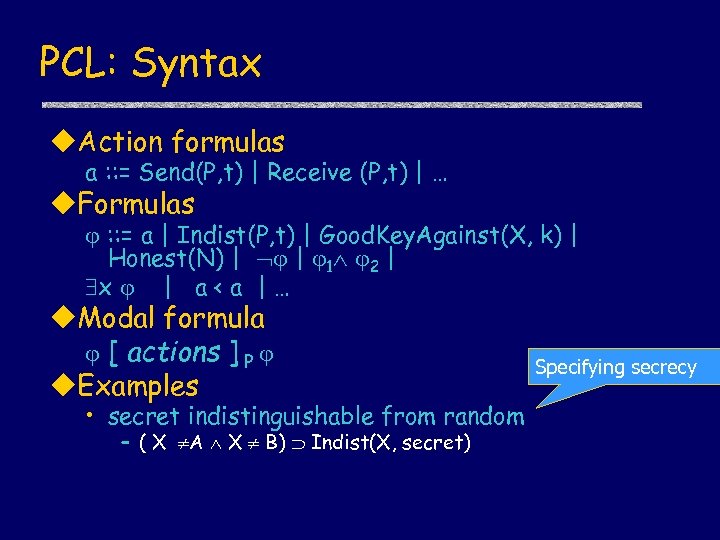 PCL: Syntax u. Action formulas a : : = Send(P, t) | Receive (P, t) | … u. Formulas : : = a | Indist(P, t) | Good. Key. Against(X, k) | Honest(N) | | 1 2 | x | a < a | … u. Modal formula [ actions ] P u. Examples • secret indistinguishable from random – ( X A X B) Indist(X, secret) Specifying secrecy
![Kerberos Stage 1 Property u. Client guarantee true [ Client 1(C, T, K) ]](https://present5.com/presentation/ca1be0d7a1b087354c7286dd9934eca0/image-25.jpg "Kerberos Stage 1 Property u. Client guarantee true [ Client 1(C, T, K) ]") Kerberos Stage 1 Property u. Client guarantee true [ Client 1(C, T, K) ] C Honest(C, T, K) (Good. Key. Against(X, AKey) X {C, T, K} ) u. Key usable for encryption
Kerberos Stage 1 Property u. Client guarantee true [ Client 1(C, T, K) ] C Honest(C, T, K) (Good. Key. Against(X, AKey) X {C, T, K} ) u. Key usable for encryption
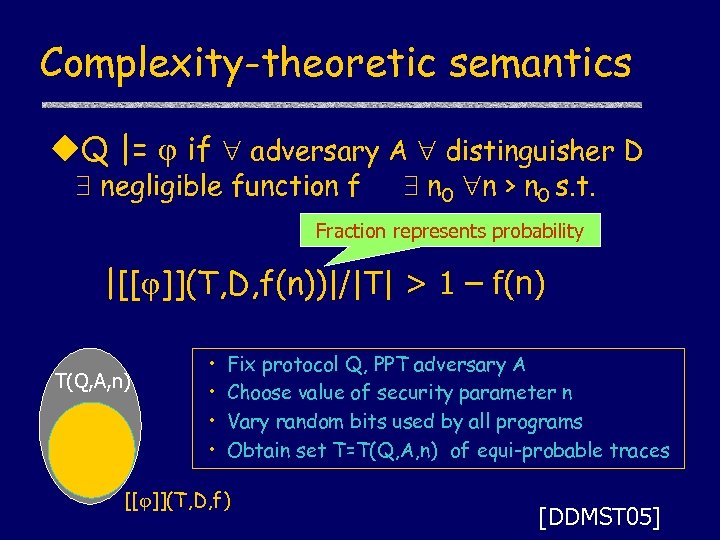 Complexity-theoretic semantics u. Q |= if adversary A distinguisher D negligible function f n 0 n > n 0 s. t. Fraction represents probability |[[ ]](T, D, f(n))|/|T| > 1 – f(n) T(Q, A, n) • • Fix protocol Q, PPT adversary A Choose value of security parameter n Vary random bits used by all programs Obtain set T=T(Q, A, n) of equi-probable traces [[ ]](T, D, f) [DDMST 05]
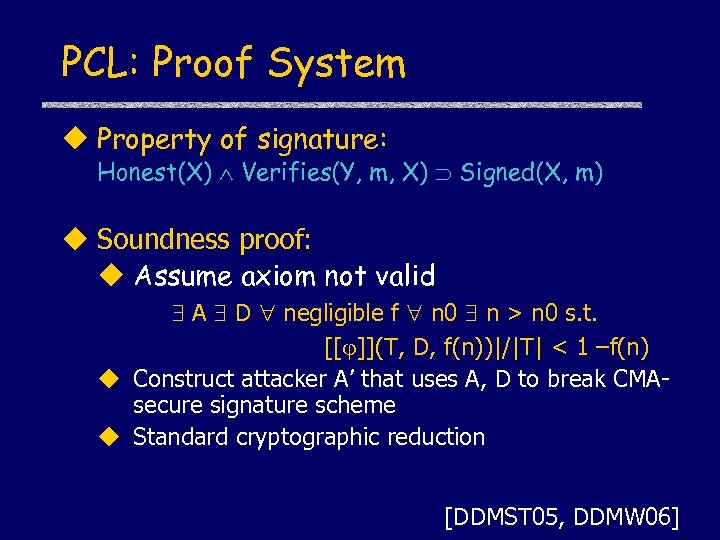 PCL: Proof System u Property of signature: Honest(X) Verifies(Y, m, X) Signed(X, m) u Soundness proof: u Assume axiom not valid A D negligible f n 0 n > n 0 s. t. [[ ]](T, D, f(n))|/|T| < 1 –f(n) u Construct attacker A’ that uses A, D to break CMAsecure signature scheme u Standard cryptographic reduction [DDMST 05, DDMW 06]
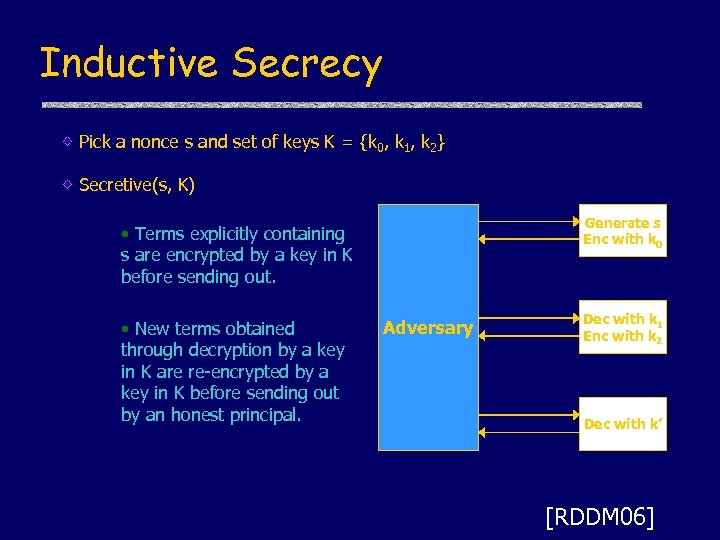 Inductive Secrecy Pick a nonce s and set of keys K = {k 0, k 1, k 2} Secretive(s, K) Generate s Enc with k 0 • Terms explicitly containing s are encrypted by a key in K before sending out. • New terms obtained through decryption by a key in K are re-encrypted by a key in K before sending out by an honest principal. Adversary Dec with k 1 Enc with k 2 Dec with k’ [RDDM 06]
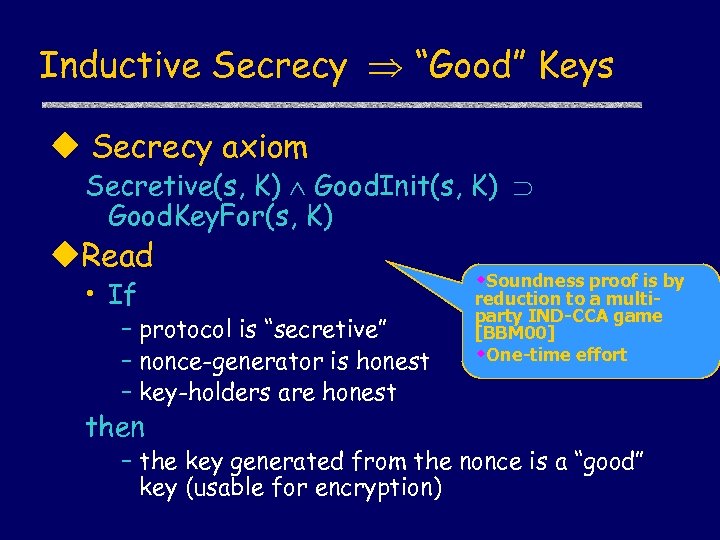 Inductive Secrecy “Good” Keys u Secrecy axiom Secretive(s, K) Good. Init(s, K) Good. Key. For(s, K) u. Read • If – protocol is “secretive” – nonce-generator is honest – key-holders are honest then w. Soundness proof is by reduction to a multiparty IND-CCA game [BBM 00] w. One-time effort – the key generated from the nonce is a “good” key (usable for encryption)
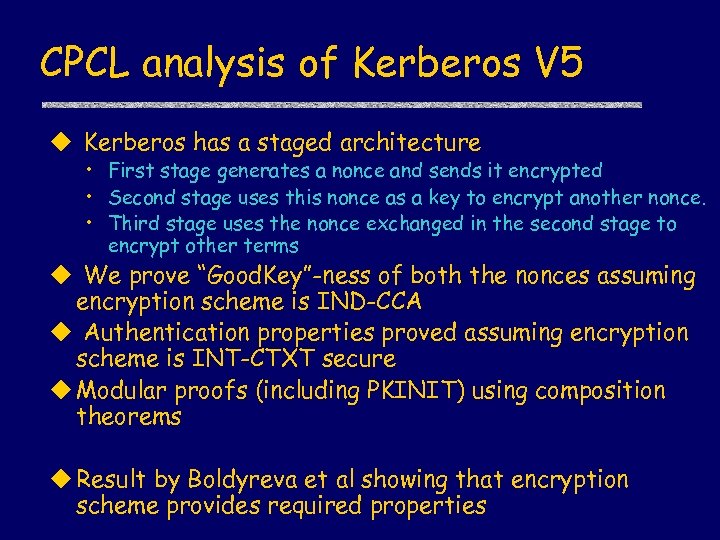 CPCL analysis of Kerberos V 5 u Kerberos has a staged architecture • First stage generates a nonce and sends it encrypted • Second stage uses this nonce as a key to encrypt another nonce. • Third stage uses the nonce exchanged in the second stage to encrypt other terms u We prove “Good. Key”-ness of both the nonces assuming encryption scheme is IND-CCA u Authentication properties proved assuming encryption scheme is INT-CTXT secure u Modular proofs (including PKINIT) using composition theorems u Result by Boldyreva et al showing that encryption scheme provides required properties
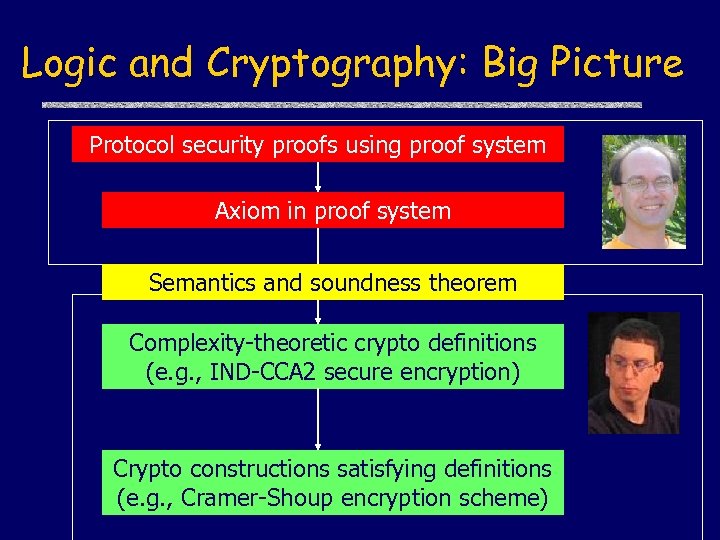 Logic and Cryptography: Big Picture Protocol security proofs using proof system Axiom in proof system Semantics and soundness theorem Complexity-theoretic crypto definitions (e. g. , IND-CCA 2 secure encryption) Crypto constructions satisfying definitions (e. g. , Cramer-Shoup encryption scheme)
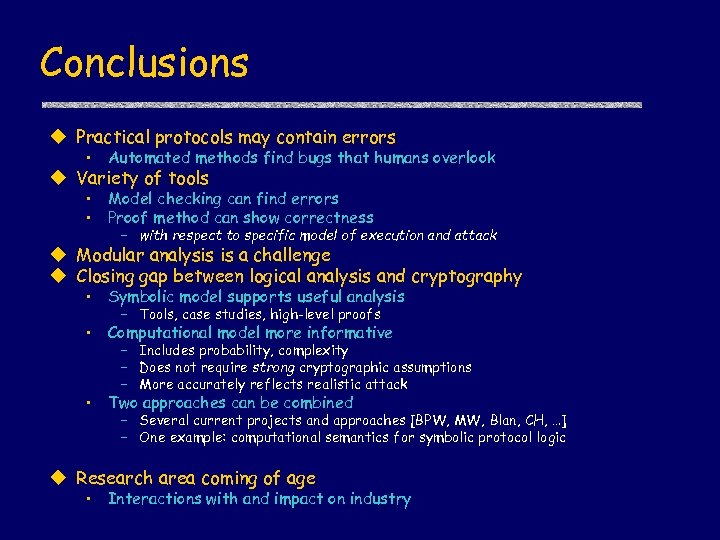 Conclusions u Practical protocols may contain errors • Automated methods find bugs that humans overlook u Variety of tools • Model checking can find errors • Proof method can show correctness – with respect to specific model of execution and attack u Modular analysis is a challenge u Closing gap between logical analysis and cryptography • Symbolic model supports useful analysis – Tools, case studies, high-level proofs • Computational model more informative – Includes probability, complexity – Does not require strong cryptographic assumptions – More accurately reflects realistic attack • Two approaches can be combined – Several current projects and approaches [BPW, MW, Blan, CH, …] – One example: computational semantics for symbolic protocol logic u Research area coming of age • Interactions with and impact on industry
 Thanks! Questions?