


 Скачать презентацию An Overview of the Israeli Economy Prof Manuel
550b6f6ae2b5cd6d29c96f7c870c12eb.ppt
- Количество слайдов: 23
 An Overview of the Israeli Economy Prof. Manuel Trajtenberg Head of the National Economic Council The Prime Minister’s Office, Israel May 2008
 • Background • Economic Policy • Challenges and Opportunities • R&D and Innovation
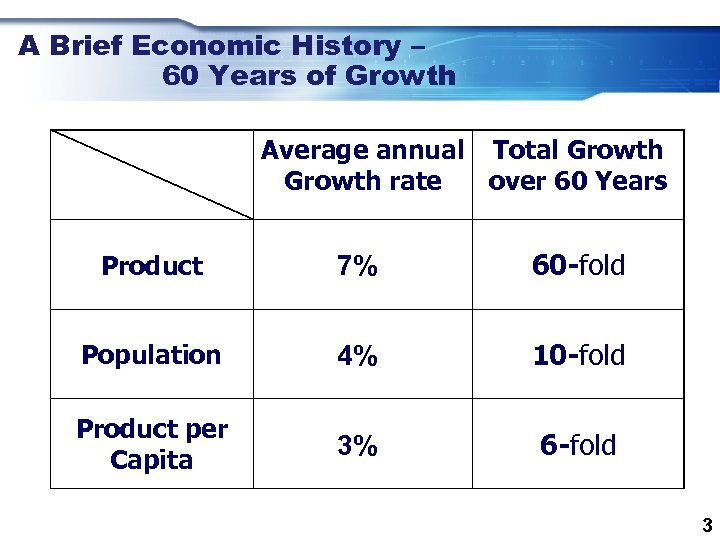 A Brief Economic History – 60 Years of Growth Average annual Total Growth rate over 60 Years Product 7% 60 -fold Population 4% 10 -fold Product per Capita 3% 6 -fold 3 3
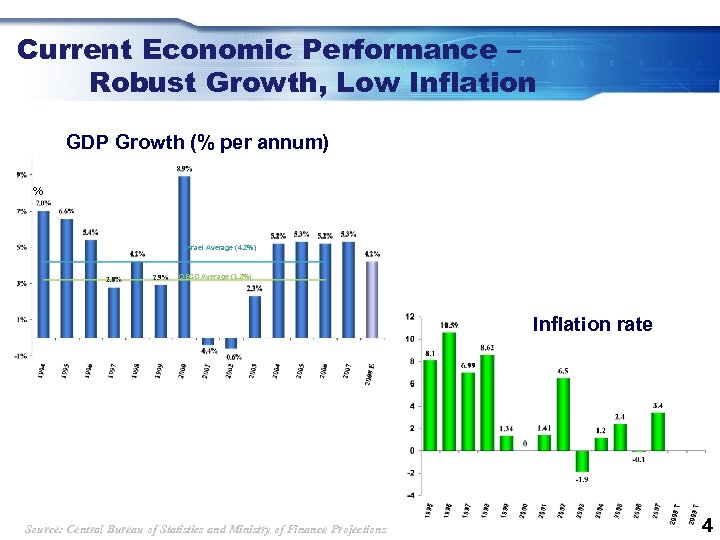 Current Economic Performance – Robust Growth, Low Inflation GDP Growth (% per annum) % Israel Average (4. 2%) OECD Average (3. 2%) Inflation rate Source: Central Bureau of Statistics and Ministry of Finance Projections 4 4
 The Current Account Deficit/Surplus as % of GDP Sources: Central Bureau of Statistics and the Bank of Israel 5 5
 • Background • Economic Policy • Challenges and Opportunities • R&D and Innovation
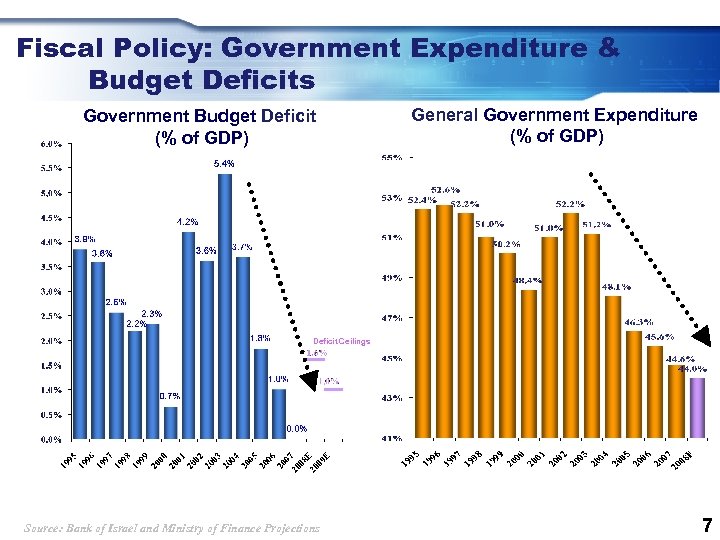 Fiscal Policy: Government Expenditure & Budget Deficits Government Budget Deficit (% of GDP) General Government Expenditure (% of GDP) Deficit Ceilings Source: Bank of Israel and Ministry of Finance Projections 7 7
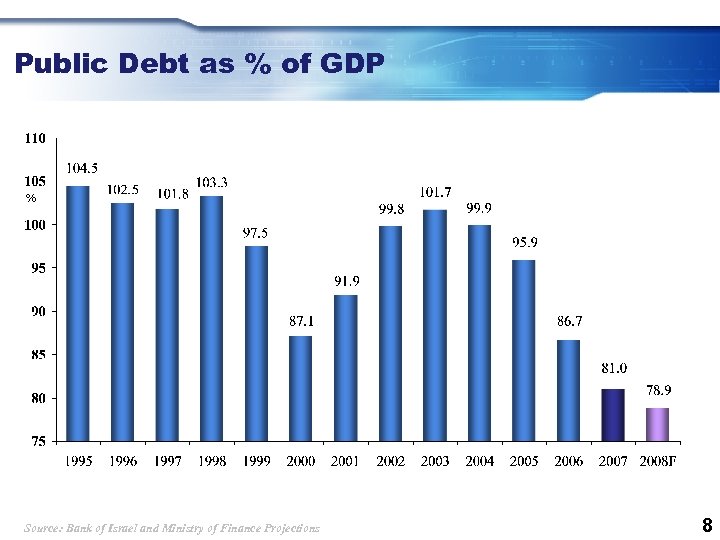 Public Debt as % of GDP % Source: Bank of Israel and Ministry of Finance Projections 8 8
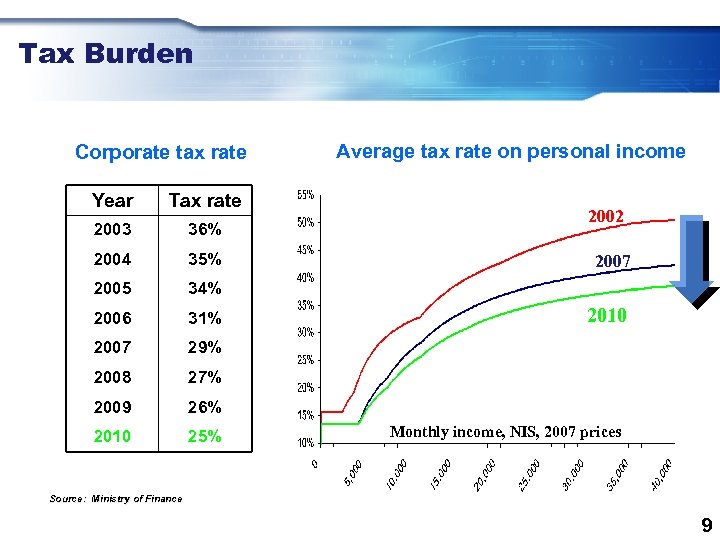 Tax Burden Corporate tax rate Year Tax rate 2003 36% 2004 35% 2005 34% 2006 31% 2007 29% 2008 27% 2009 26% 2010 25% Average tax rate on personal income 2002 2007 2010 Monthly income, NIS, 2007 prices Source: Ministry of Finance 9 9
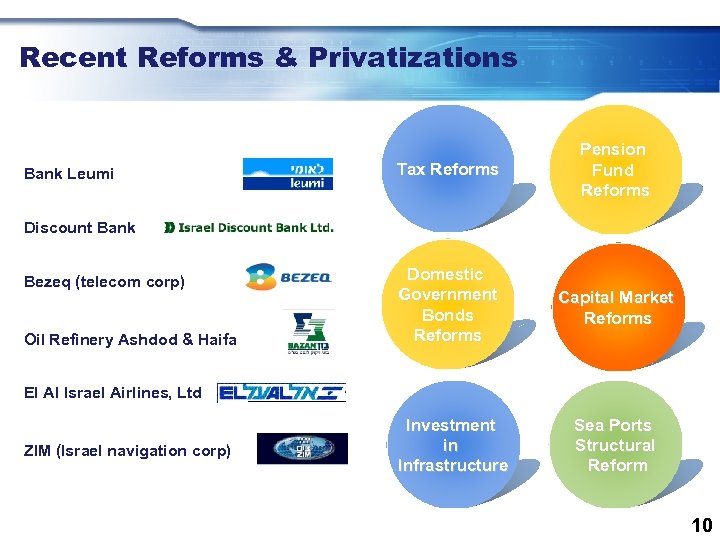 Recent Reforms & Privatizations Bank Leumi Tax Reforms Pension Fund Reforms Domestic Government Bonds Reforms Capital Market Reforms Discount Bank Bezeq (telecom corp) Oil Refinery Ashdod & Haifa El Al Israel Airlines, Ltd ZIM (Israel navigation corp) Investment in Infrastructure Sea Ports Structural Reform 10 10
 • Background • Economic Policy • Challenges and Opportunities • R&D and Innovation
 The Snapshot on the Israel’s Challenges § Israel’s highly heterogeneous society, with a tremendous range of different » backgrounds » cultures » religions § Exposed to the rigors of the global economy § Challenged by its geo-political situation 12 12
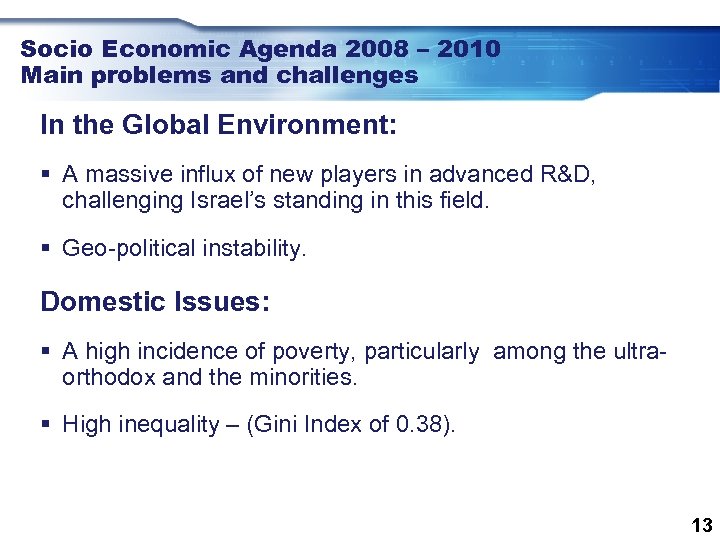 Socio Economic Agenda 2008 – 2010 Main problems and challenges In the Global Environment: § A massive influx of new players in advanced R&D, challenging Israel’s standing in this field. § Geo-political instability. Domestic Issues: § A high incidence of poverty, particularly among the ultraorthodox and the minorities. § High inequality – (Gini Index of 0. 38). 13 13
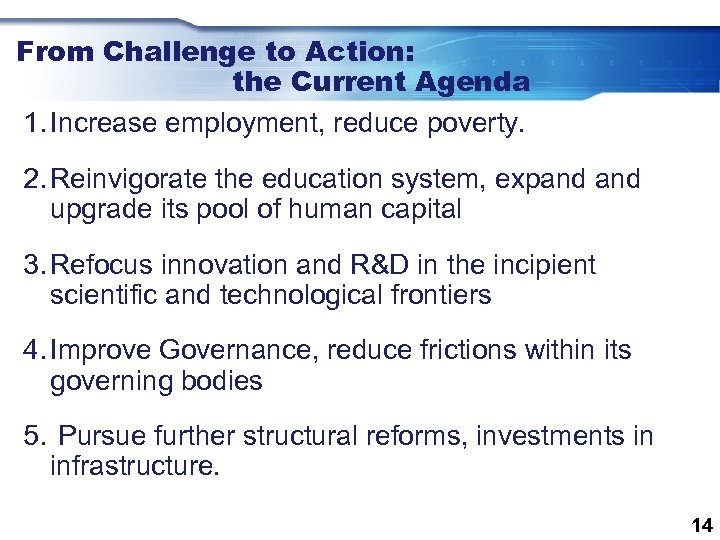 From Challenge to Action: the Current Agenda 1. Increase employment, reduce poverty. 2. Reinvigorate the education system, expand upgrade its pool of human capital 3. Refocus innovation and R&D in the incipient scientific and technological frontiers 4. Improve Governance, reduce frictions within its governing bodies 5. Pursue further structural reforms, investments in infrastructure. 14 14
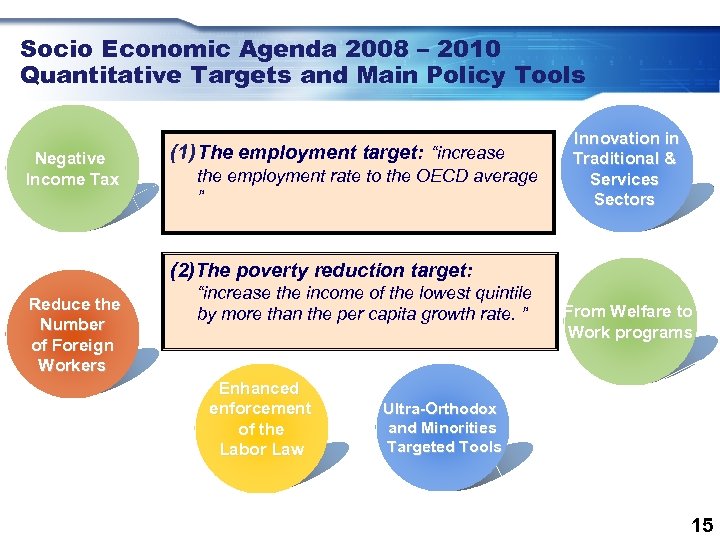 Socio Economic Agenda 2008 – 2010 Quantitative Targets and Main Policy Tools Negative Income Tax (1) The employment target: “increase the employment rate to the OECD average ” Innovation in Traditional & Services Sectors (2)The poverty reduction target: Reduce the Number of Foreign Workers “increase the income of the lowest quintile by more than the per capita growth rate. ” Enhanced enforcement of the Labor Law From Welfare to Work programs Ultra-Orthodox and Minorities Targeted Tools 15 15
 • Background • Economic Policy • Challenges and Opportunities • R&D and Innovation
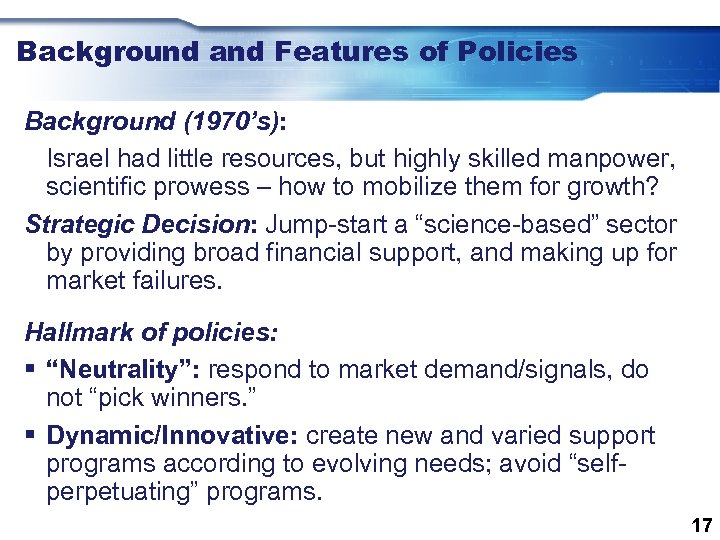 Background and Features of Policies Background (1970’s): Israel had little resources, but highly skilled manpower, scientific prowess – how to mobilize them for growth? Strategic Decision: Jump-start a “science-based” sector by providing broad financial support, and making up for market failures. Hallmark of policies: § “Neutrality”: respond to market demand/signals, do not “pick winners. ” § Dynamic/Innovative: create new and varied support programs according to evolving needs; avoid “selfperpetuating” programs. 17 17
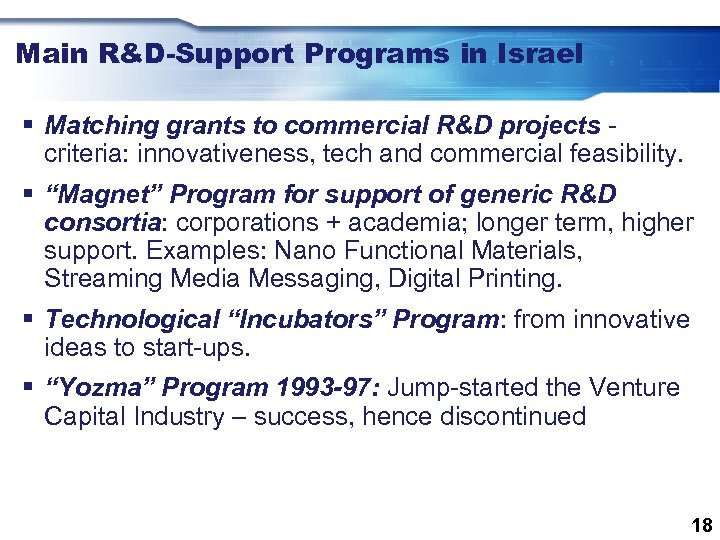 Main R&D-Support Programs in Israel § Matching grants to commercial R&D projects criteria: innovativeness, tech and commercial feasibility. § “Magnet” Program for support of generic R&D consortia: corporations + academia; longer term, higher support. Examples: Nano Functional Materials, Streaming Media Messaging, Digital Printing. § Technological “Incubators” Program: from innovative ideas to start-ups. § “Yozma” Program 1993 -97: Jump-started the Venture Capital Industry – success, hence discontinued 18 18
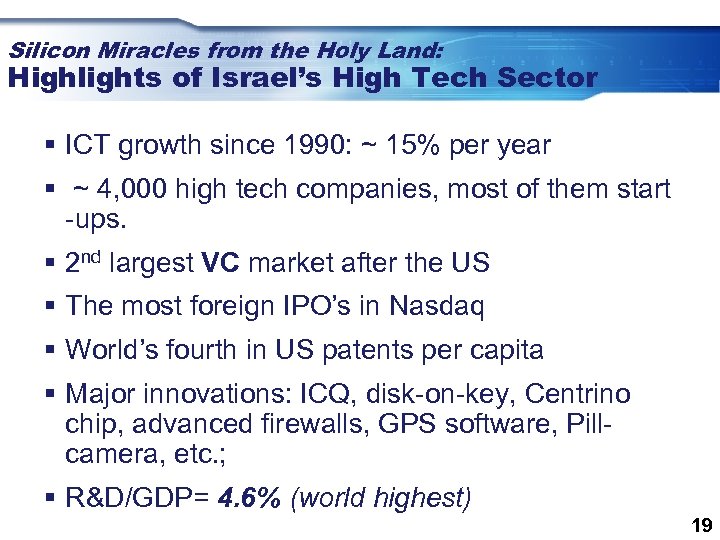 Silicon Miracles from the Holy Land: Highlights of Israel’s High Tech Sector § ICT growth since 1990: ~ 15% per year § ~ 4, 000 high tech companies, most of them start -ups. § 2 nd largest VC market after the US § The most foreign IPO’s in Nasdaq § World’s fourth in US patents per capita § Major innovations: ICQ, disk-on-key, Centrino chip, advanced firewalls, GPS software, Pillcamera, etc. ; § R&D/GDP= 4. 6% (world highest) 19 19
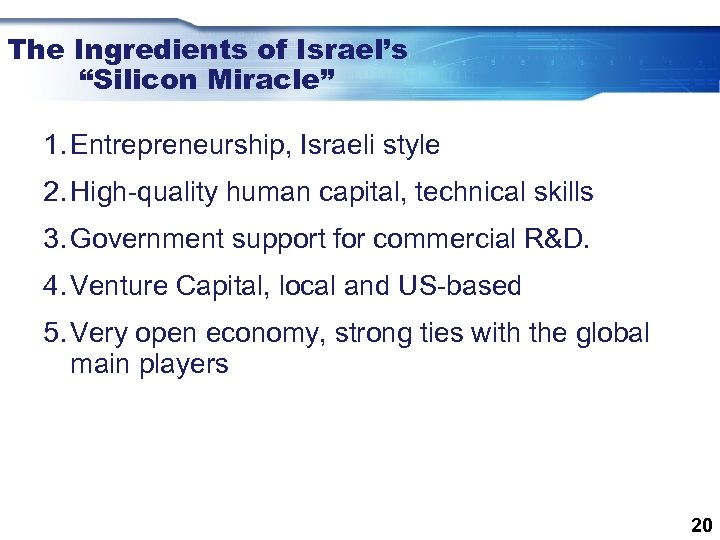 The Ingredients of Israel’s “Silicon Miracle” 1. Entrepreneurship, Israeli style 2. High-quality human capital, technical skills 3. Government support for commercial R&D. 4. Venture Capital, local and US-based 5. Very open economy, strong ties with the global main players 20 20
 But Israel’s Silicon miracle not for all § Wide disparity between thriving High Tech and rest of the economy: High. T grew 5 times as fast! § Low productivity of non-tradables, non-ICT sectors – a “dual economy”. § Rising socio-economic inequality, in part consequence of dual economy : concern in itself, and narrowing future pool of human capital. 21 21
 Why? Innovate here, benefit elsewhere… 1. Innovations mainly for exports, some spillovers internal, but benefits realized mostly abroad. • not much “Wal-Mart effect” in Israel 2. Gov. supports mostly product rather than process innovations; hence little R&D in traditional industries, services. 3. VC-backed startups: must exit, mostly by selling off to US-based corporations – who benefits? Israel: powerhouse in generating innovations, but not quite in benefiting from them. 22 22
 Some lessons from the Israeli experience 1. Cannot have economy-wide growth by relying just on one fast-growing sector (ICT), Need to encourage and channel innovativeness also to non-High Tech sectors 2. Cannot have sustained growth widening socio-economic gaps : Need policies of inclusion, of expanding the pool of human capital. 23 23