


 Скачать презентацию An overview of the critical issues underlying interconnection
907292a4da77007df48fc71d7ed7335c.ppt
- Количество слайдов: 21
 An overview of the critical issues underlying interconnection Dr Tim Kelly, Head, Strategy & Policy Unit, ITU Workshop on Interconnection, Sanya City, 17 -19 August 2001 The views expressed in this paper are those of the authors and do not necessarily reflect the opinions of the ITU or its Membership. The author can contacted by e-mail at Tim. Kelly@itu. int.
 International Telecommunication Union Agenda l The need for interconnection Ø Growth of competition and market entry Ø Interconnection between networks l Interconnection principles Ø WTO regulatory reference paper Ø Cost models l Interconnection regulatory frameworks Ø Worldwide Ø Within the European Union l Looking ahead 2 Ø Interconnection issues in an IP world
 International Telecommunication Union 3 Source: ITU Telecommunications Regulatory Database.
 International Telecommunication Union 4 Source: ITU Telecommunications Regulatory Database.
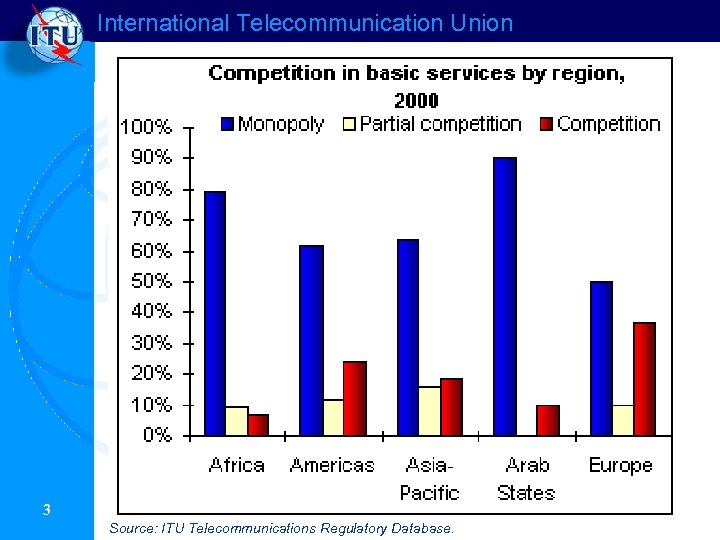
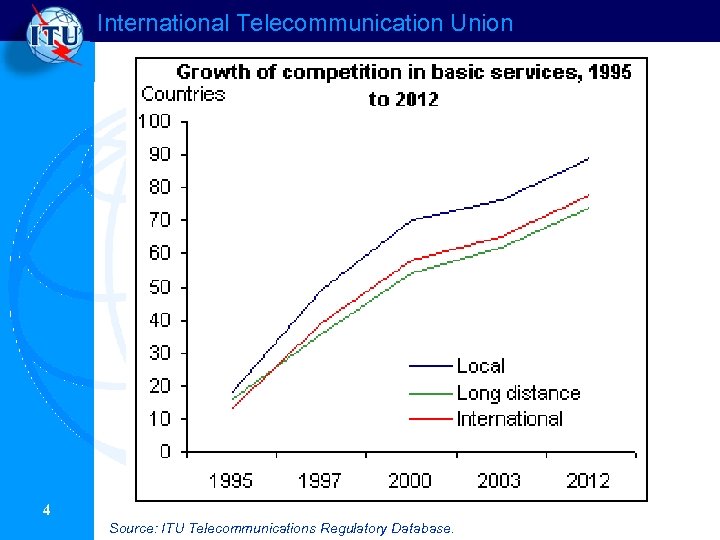
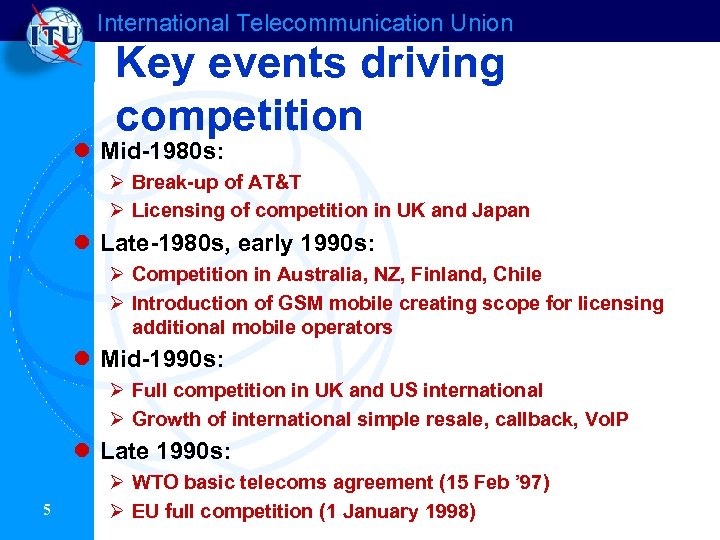 International Telecommunication Union Key events driving competition l Mid-1980 s: Ø Break-up of AT&T Ø Licensing of competition in UK and Japan l Late-1980 s, early 1990 s: Ø Competition in Australia, NZ, Finland, Chile Ø Introduction of GSM mobile creating scope for licensing additional mobile operators l Mid-1990 s: Ø Full competition in UK and US international Ø Growth of international simple resale, callback, Vo. IP l Late 1990 s: 5 Ø WTO basic telecoms agreement (15 Feb ’ 97) Ø EU full competition (1 January 1998)
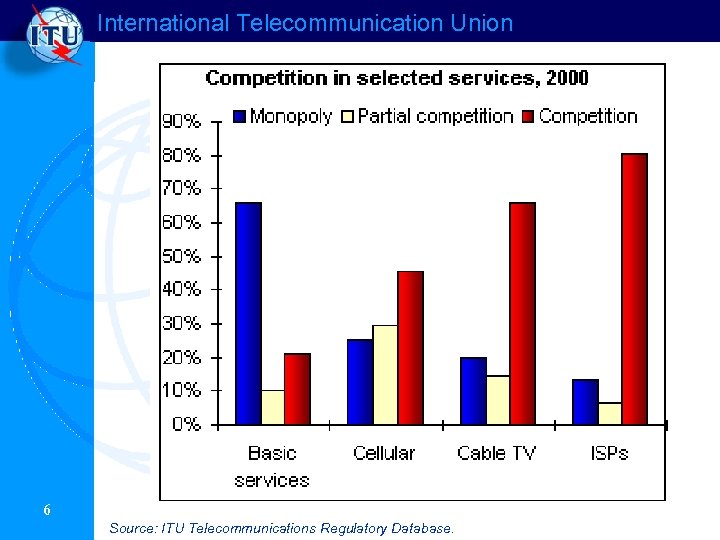 International Telecommunication Union 6 Source: ITU Telecommunications Regulatory Database.
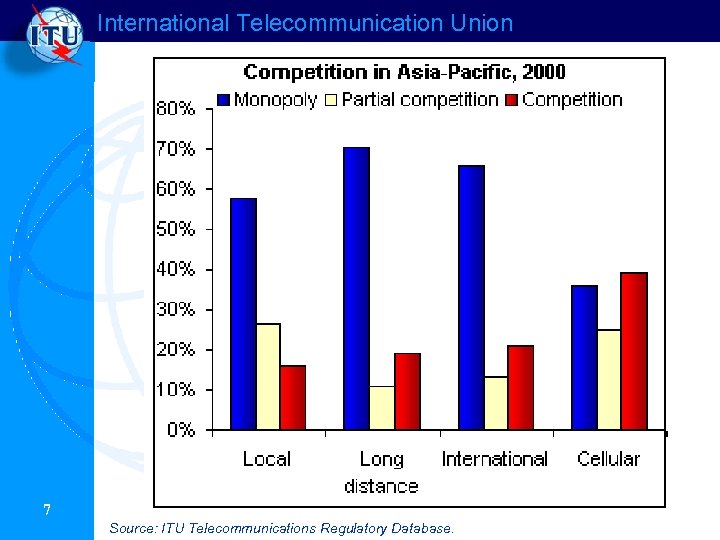 International Telecommunication Union 7 Source: ITU Telecommunications Regulatory Database.
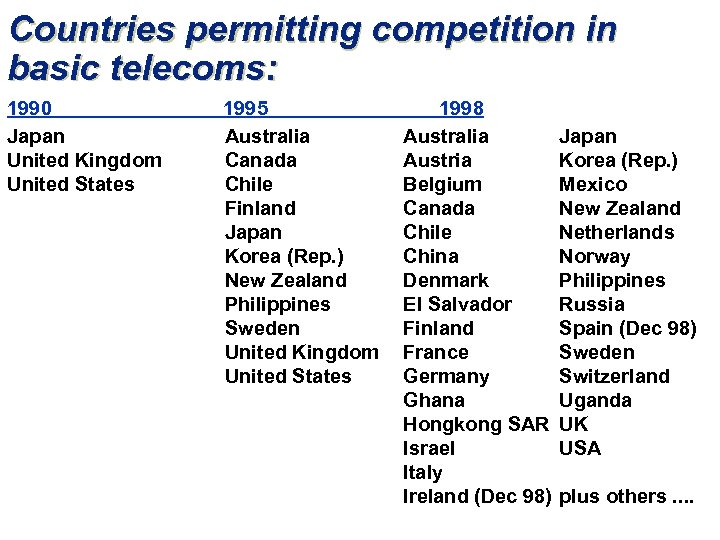 Countries permitting competition in basic telecoms: 1990 Japan United Kingdom United States 1995 Australia Canada Chile Finland Japan Korea (Rep. ) New Zealand Philippines Sweden United Kingdom United States 1998 Australia Austria Belgium Canada Chile China Denmark El Salvador Finland France Germany Ghana Hongkong SAR Israel Italy Ireland (Dec 98) Japan Korea (Rep. ) Mexico New Zealand Netherlands Norway Philippines Russia Spain (Dec 98) Sweden Switzerland Uganda UK USA plus others. .
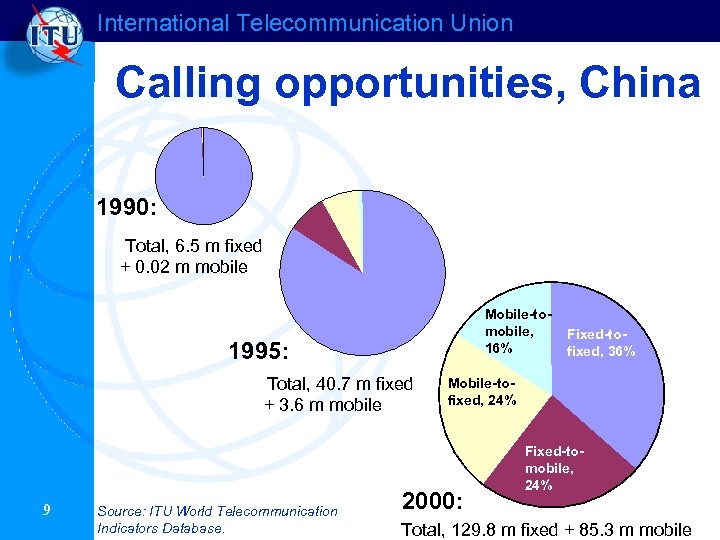 International Telecommunication Union Calling opportunities, China 1990: Total, 6. 5 m fixed + 0. 02 m mobile Mobile-tomobile, 16% 1995: Total, 40. 7 m fixed + 3. 6 m mobile 9 Source: ITU World Telecommunication Indicators Database. Fixed-tofixed, 36% Mobile-tofixed, 24% 2000: Fixed-tomobile, 24% Total, 129. 8 m fixed + 85. 3 m mobile
 International Telecommunication Union WTO regulatory reference paper, principles l Competitive safeguards l Interconnection Ø “linking with suppliers providing public telecommunications transport networks or services in order to allow the users of one supplier to communicate with users of another supplier and to access services provided by another supplier” l l 10 Universal service Transparency Independent regulators Allocation and use of scarce resources
 International Telecommunication Union Interconnection principles (1) l Interconnection with a major supplier will be ensured at any technically feasible point in the network. Such interconnection is provided. 11 (a) under non-discriminatory terms, conditions (including technical standards and specifications) and rates and of a quality no less favourable than that provided for its own like services or for like services of non-affiliated service suppliers or for its subsidiaries or other affiliates; (b) in a timely fashion, on terms, conditions (including technical standards and specifications) and cost-oriented rates that are transparent, reasonable, having regard to economic feasibility, and sufficiently unbundled so that the supplier need not pay for network components or facilities that it does not require for the service to be provided; and (c) upon request, at points in addition to the network termination points offered to the majority of users, subject to charges that reflect the cost of construction of necessary additional facilities.
 International Telecommunication Union Interconnection principles (2) l Public availability of the procedures for interconnection negotiations Ø The procedures applicable for interconnection to a major supplier will be made publicly available. l Transparency of interconnection arrangements Ø It is ensured that a major supplier will make publicly available either its interconnection agreements or a reference interconnection offer. l Interconnection: dispute settlement Ø A service supplier requesting interconnection with a major supplier will have recourse, either: 12 • (a) at any time or • (b) after a reasonable period of time which has been made publicly known to an independent [regulatory authority] to resolve disputes regarding appropriate terms, conditions and rates for interconnection within a reasonable period of time, to the extent that these have not been established previously.
 International Telecommunication Union Approaches to costing l Fully-allocated pricing models Ø total costs for providing service (including historical, depreciated investment costs) divided by the volume of service provided (e. g. , minutes of use, number of subscribers) l Incremental pricing models (e. g. , LRIC) Ø marginal cost of providing an additional unit of service (e. g. , next minute of traffic, next subscriber) l 1001 different flavours of the above 13
 International Telecommunication Union Alternative methodologies for interconnection l Per minute Ø Based on level of usage in each direction Ø Normal system for interconnection between fixed and mobile l Revenue-sharing Ø Based on level of usage in both directions Ø Normal system for international traffic (international accounting rate system) l Capacity-based Ø Based on level of capacity requested Ø Normal system for Internet peering l Hybrid 14 Ø Variations on the above
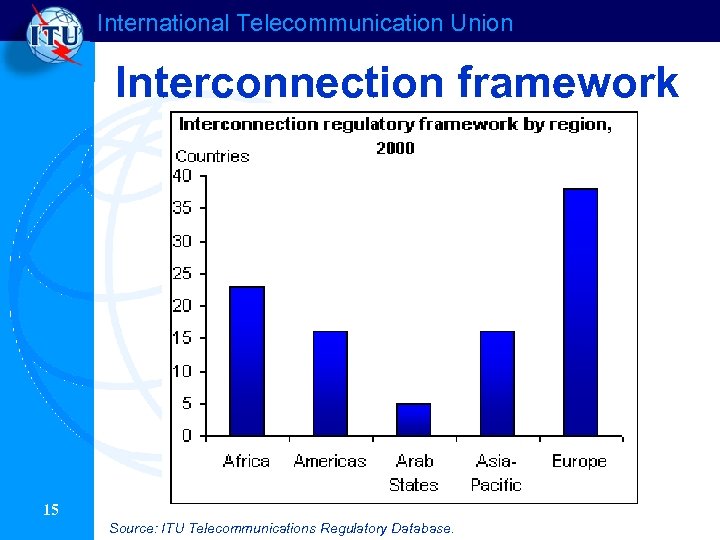 International Telecommunication Union Interconnection framework 15 Source: ITU Telecommunications Regulatory Database.
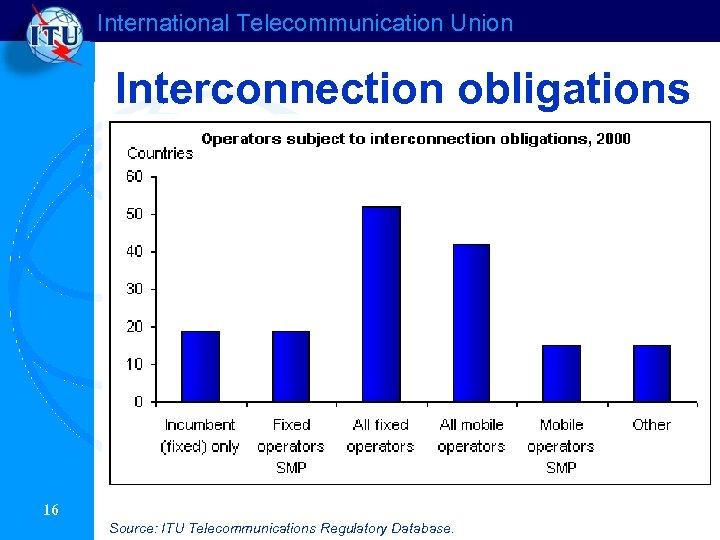 International Telecommunication Union Interconnection obligations 16 Source: ITU Telecommunications Regulatory Database.
 International Telecommunication Union Interconnection in Europe l Existing regulatory framework Ø Many different sector-specific directives, notably Interconnection Directive (97/33/EC) Ø Two parts: Recommendations on Interconnection pricing and accounting separation l Methodology for identifying “best practice” pricing Ø Lowest 20% of published interconnection offers in 15 EU Member States at local (0. 9 €/100), single transit (1. 5 €/100) and double transit (1. 8 €/100) l New technologically-neutral regulatory framework Ø Access to, and interconnection of, electronic communications networks and associated facilities Ø First reading in European Parliament on 4 July 2001 Ø Amended proposal available at: 17 Ø http: //europa. eu. int/information_society/topics/telecoms/regulatory/new_rf/com 2001 -369 en. pdf
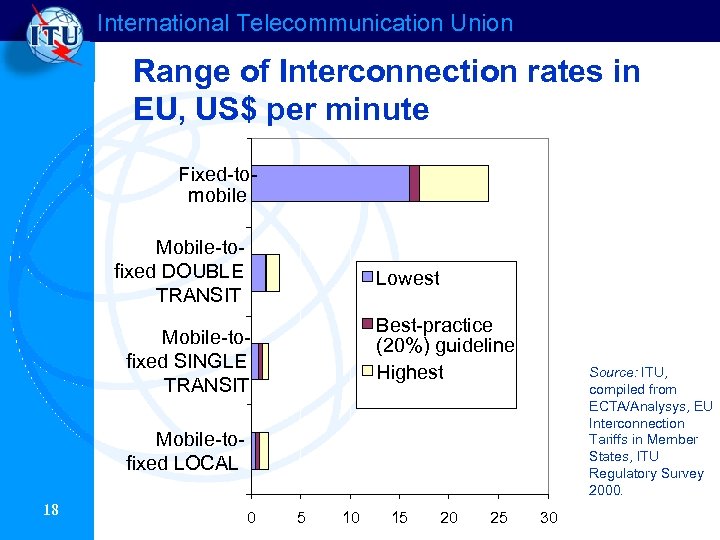 International Telecommunication Union Range of Interconnection rates in EU, US$ per minute Fixed-tomobile Mobile-tofixed DOUBLE TRANSIT Lowest Best-practice (20%) guideline Highest Mobile-tofixed SINGLE TRANSIT Source: ITU, compiled from ECTA/Analysys, EU Interconnection Tariffs in Member States, ITU Regulatory Survey 2000. Mobile-tofixed LOCAL 18 0 5 10 15 20 25 30
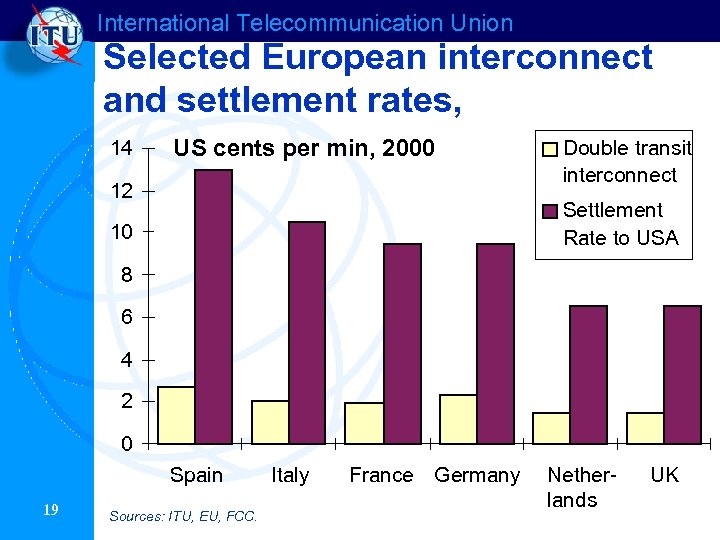 International Telecommunication Union Selected European interconnect and settlement rates, 14 Double transit US cents per min, 2000 interconnect 12 Settlement Rate to USA 10 8 6 4 2 0 Spain 19 Sources: ITU, EU, FCC. Italy France Germany Netherlands UK
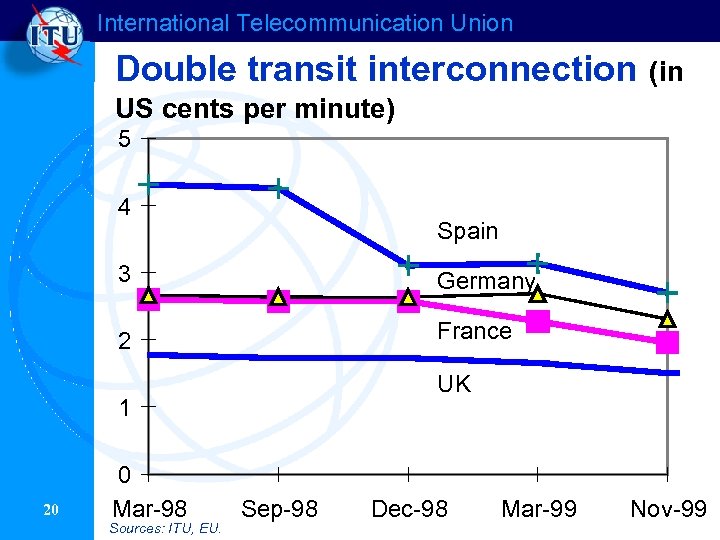 International Telecommunication Union Double transit interconnection (in US cents per minute) 5 4 Spain 3 Germany 2 France UK 1 20 0 Mar-98 Sources: ITU, EU. Sep-98 Dec-98 Mar-99 Nov-99
 International Telecommunication Union Looking ahead: Interconnection issues under IP l Full circuit model Ø Separate charges for circuits and traffic exchange (peering) Ø Obligation for entity requesting interconnection to pay full charges, even though traffic flows both ways l Capacity-based model Ø Charges according to capacity (bandwidth) rather than usage (minutes) l Technology neutral model Ø Many different types of service (e. g. , voice/data, realtime/store and forward) over same network l Variable quality of service 21 Ø Possible variation in interconnection charges (or refunds) according to different levels of service quality