


 Скачать презентацию An Overview of Spreading Chinese Culture Overseas The
1d1e66e56948af01845a6b101705f1f1.ppt
- Количество слайдов: 34
 An Overview of Spreading Chinese Culture Overseas The 4 th Untested Ideas (UI) International Research Conference Yuping Zhou Yunnan Minzu University, China
 Contents • Spreading Chinese Language Overseas in History • Spreading Chinese language Overseas in the New Era • Development and Challenges of Spreading Chinese Language Overseas through Confucius Institutes
 Spreading Chinese Language Overseas in History • 1. Han Dynasty: the start of spreading Chinese language overseas • “It started from Han Dynasty, but developed and prospered in Tang Dynasty. ” • Zhang Qian explored the way to the west and opened the trade route, the Silk Road. →Trade • The introduction of Buddhism→ Translation of the Buddhist scripture • In the ninth year of the reign of Emperor Mingdi(66 AD) of the Eastern Han Dynasty(25 -220 AD) , the schools for children of outstanding officials, “Royal Schools of the so-called Big Four, was so famous that the huns also sent their children there. By teaching Chinese to the huns’children, the international spread of Chinese made a good start.
 International Spread of Chinese in History • 2. Wei, Jin and the Northern and Southern Dynasties(420 -589 AD): spreading Chinese by Buddhist monks • (1) With rapid development of Buddhism, translating Buddhist Scriptures was one of the most important activities among Buddhists. During the years of Eastern Jin period(317 -420 AD, Jiumoluoshendong, one of the eminent monks, went to Changan (present-day Xi'an) and was engaged in translating Buddhist Scriptures. It was said that with the help of his three thousand disciples, He translated 74 Buddhist scriptures, amounting to 384 volumes. • (2) Places for Chinese teaching: Dunhuang, Jiuquan, Zhang ye, Liangzhou • (3) Inter-language for Chinese teaching: Darouzhi language
 International Spread of Chinese in History • 3. Sui and Tang Dynasties(581 -907 AD): formalization • During Sui and Tang Dynasties, China had frequent economic, trade and cultural exchanges with countries in Asia, Europe and Africa. These countries were keen to come to China for business, learning, preaching, and so on, because of admiration for China's highly-developed civilization, advanced production technology and rich resources, which laid a solid foundation for the spread of Chinese. • Specialized management institutions were established and some rules and regulations were formulated by the government of Tang Dynasty(618 -907 AD) for the effective Chinese language teaching and the spread of Chinese culture.
 Spreading Chinese Language Overseas in History • • • 1. Establishment of the system of government-supported international students. The international students recruited would study in Guo Zi Jian, the highest-level academic institution in China at that time and they were financially supported by the Chinese government with a maximum learning period of 9 years. A preliminary election would be carried out by the competent authorities with Chinese to be the core knowledge tested. 2. Three categories: Long-term students, further-study students, conditional students. Long-term students referred to the students aiming at long-term study in China. Further-study students were those who were already good at certain areas and aimed to further their study. Conditional students referred to those coming to Tang Dynasty for further study together with their ambassadors under the condition of going back together with them.
 Spreading Chinese language Overseas in the History • 3. The special administration in Tang Dynasty --Honglu Temple • After the foreign students came to China, Honglu Temple would first establish their school archives and provide their daily necessities and arrange accommodation for them. When they finished their studies, Honglu Temple would supervise the students to return to their own countries. • 4. Guo Zi Jian • The highest educational institution which was also responsible for the foreign students education. After getting the approval of the Chinese emperor, the foreign students would generally study in colleges of Tai Xue, Guo Zi Xue, Si Men Xue, and Lv Xue Guan respectively, focusing mainly on classics such as, the Book of Rites, the Book of History, and the Spring and Autumn Annals. • 5. Teachers were arranged for students counseling.
 • Iv. The Song Dynasty • 1. Although the Song Dynasty was not as prosperous as Tang Dynasty, it was still highly developed economically and culturally and the overseas trade was prosperous. During this period, the objects and teaching institutions changed a lot with Fan Xue, a special organization, set up in the ports recruiting foreign students. • 2. The countries and minority group regimes around Song Dynasty such as, the Khitan, Jurchen, Korea, Japan, and Vietnam valued Chinese and Chinese culture a lot, which they actively learned and helped promote. They even developed their own characters based on the Chinese characters, which enhanced the depth of the international promotion of Chinese.
 Spreading Chinese Language Overseas in History • 5) the Yuan Dynasty (1271 -1368 AD) • Throughout Chinese history, the Yuan empire boasted the most expansive territory, thereby ushering in a new era for communication between China and the West, creating an unprecedented favorable environment for the exchange and spread of Chinese and foreign cultures. • During the Yuan Dynasty, overland routes from China to western Asia, Europe and Africa could directly reach present-day Russia, eastern Europe, the Middle East and Africa, and waterways to the Middle East, India, Persia and Africa were also developed. • Moreover, the Yuan court actively conducted diplomatic activities with its neighboring countries. This kind of opening-up policy enabled not only foreign cultures to pour into China but also facilitated China’s spread of culture to foreign nations. In this course of culture exchanges, the international spread of Chinese was pushed forward to a new level.
 Spreading Chinese Language Overseas in history • 1. The emergence of special Chinese teaching textbooks • At present, the preserved earliest Chinese teaching textbooks in ancient Korean peninsula are the Nogeoldae and Pu Tongshi which were compiled in late Yuan Dynasty. These Chinese teaching books were exclusively used for teaching Chinese to Koreans, while the Beijing dialect spoken at that time was adopted as their standard pronunciation. Included in the books are daily conversations covering topics of travel, trade, folk customs, ancient laws and regulations which are both practical and entertaining for Chinese learners. The books played a tremendously important role in the development course of Chinese teaching textbooks foreign learners.
 Spreading Chinese Language Overseas in History • 2. Catholic missionaries and Chinese learning • After the Mongolian cavalries blazed the trail for transportation of the Eurasian Continent, Catholicism was spread to China. In 1289 AD, Jean de Montecorvino set out his journey to China with order from the Pope. Four years later, he reached China’s then capital (present-day Beijing) through sea route and was received by the fifth emperor of Yuan Dynasty Kublai Khan who allowed him to carry out missionary work in China. During his thirty-plus-year stay in China, Jean de Montecorvino translated many biblical scriptures and poems. According to historical records, he baptized more than 30, 000 people over a time span of 38 years. In 1305, he built a Catholic church in China. In 1328, he passed away in Beijing at the advanced age of 80. However, the massive-scale language exchanges in real sense between China and Europe, the time when Europeans began to learn Chinese, started only when the Portuguese colonialists started their eastward expansion.
 Spreading Chinese Language Overseas in History • VI. International Spread of Chinese during the Ming and Qing Dynasties(1368 -1911 AD) Missionaries' learning of Chinese • 1. During the Ming and Qing Dynasties, the missionaries who came to China played a very important role in the international spread of Chinese. These missionaries had to learn Chinese and Chinese culture well so that they could use Chinese to explain western religion and to spread science and technology of the West. Missionaries were mainly in contact with the Chinese intellectuals and the scholar-officials of the upper class and they maintained a relationship of both teachers and friends, such as Xu Guangqi, et al. Not only did Chinese intellectuals and the scholar-officials acquire scientific knowledge from the missionaries, they also co-translated and co-authored many scientific works with the missionaries. After having a good command of Chinese, the missionaries wrote a series of works introducing western religion and western learning. According to incomplete statistics, the missionaries wrote a total of 229 Chinese works during the Ming and Qing Dynasties. • The Missionaries who came to China started the European Sinology research, and kicked off the Chinese learning in Europe.
 Spreading Chinese Language Overseas in History • International Spread of Chinese by Chinese Students Abroad • 2. European countries not only sent the missionaries to China, but also brought Chinese students back to Europe for training. According to statistics, 63 Chinese students went to Europe to study in 1795. They studied theology, western philosophy, language among others there. And at the same time, they spread Chinese culture and taught Chinese. For example, Huang Jialue became the founder of French Chinese language teaching after he came to France. Huang especially wrote Chinese Grammar (1976) and Chinese Dictionary for French people to learn Chinese. And the former is the first Chinese grammar book in the history of French Sinology.
 Spreading Chinese Language Overseas in History • VII. Republic of China(1912 -1949) • Social status of this period • Ceaseless wars, tumultuous society, depressed economy and suffered people were the common scences during the period of Republic of China. World War I, the Great Depression and World War II also occurred during this period. For these reasons, the number of Chinese learners around the world was very limited. • However, due to the need of exchanges with China, some foreign institutions hired Chinese teachers to teach abroad through private channels. Scholars like Lao She and Xiao Qian once taught Chinese in UK. There were also some foreigners who came to China to study because of their interests in Chinese language and culture. Another important spread approach is the organization of Chinese teaching in China by Church and missionary.
 Spreading Chinese Language Overseas in History • 2. North China Union Language School • North China Union Language School was an association related to the teaching of Chinese, established by the foreigners in the early 1910. It was formally founded in Beijing in 1913, with Edward as its principal, and later Pettus, the president. In 1925, it was affiliated to Yenching University as an independent department, and was renamed “Chinese Yenching Institute”. In 1928, this school cooperated with Harvard University to set up the Harvard-Yenching Institute. In 1920, this school became a large-scale language training school with 20 foreign teachers and 80 Chinese teachers. Until 1925, 1621 students, from 24 different countries, graduated from this school. The department includes preachers, diplomatic corps and foreign investment corporations. The school-year is 4 -5 and Chinese course is its main course, with the course of Chinese history ans culture supplemented. • This school brought up an array of eminent sinologists and diplomats, such as Pettus, Leighton Stuart, Stilwell, Arthur W. Hummel, John King Fairbank , etc, who imposed fundamental influence on the development of international promotion of Chinese and Sino-US relationship.
 Spreading Chinese language Overseas in the New Era • (1)From 1949 to late 1970 s: the initial time of teaching Chinese as foreign language • ( 2) From late 1970 s to 2000: the deepening period of subject establishment and development • ( 3) From 2000 to present day: the rapid development period with equal attention to home and abroad
 (1) The initial time of teaching Chinese as foreign language : 1. The establishment of Chinese class in Tsinghua University Spreading Chinese language Overseas in the new era originated in September, 1950. Ministry of Education formally informed the Tsinghua University to assume the task of teaching the first group of foreign Chinese learners, and set up the “Tsinghua University-East Europe Chinese special class”. This special class has a director, held by the Tsinghau University’s academic dean of that time, the famous physicist, professor Zhou Yuanpei. Besides, Tsinghua University also formed Foreign student administration committee, with the well-known linguistic professor Lv Shuxiang as its president. In January 1951, 33 oversee students of the special class attended the class, their textbook was adapted from the “Introduction of Chinese”by Deng Yi, and the Chinese phonetic transcription adopted Wade-Giles romanization.
 • 2. The publication of the first TCFL textbook since 1949 • The publication of the annotated Russian Chinese Textbook, edited by Deng. Yi, which was specific foreigner students in intensive class of Chinese language in Peking University, in September 1958, signified the first formally published Chinese textbook foreigners. National language policy of promoting Chinese Pinyin and mandarin was fully demonstrated in the textbook. In particular, the compilation of Chinese grammar laid the foundation for the TCFL grammar system, which had a profound influence on the compilation of following TCFL textbooks in China.
 • 3. The establishment of Beijing Language Institute • With increasing number of international students in China, there would be more Chinese students studying abroad and more kinds of languages to be learned. Meanwhile, some Asian and African countries had repeatedly requested China to send some teachers of basic Chinese course who could teach in foreign language. In response to this demand, Chinese Ministry of Education determined to set up a language base for international students, China's overseas students and teachers. In early 1965, Higher Preparatory School for International Students was renamed Beijing Language Institute. Since then, Beijing Language Institute has always been the only University in China, whose primary mission is TCFL, and it acts as the base, main force and leader in teaching, research, teacher-training and international and domestic communications in the field of TCFL.
 • )The Development and Intensification of the Discipline • 1. the establishment of TCFL and teacher training • The purpose of setting up the discipline is to produce professional TCFL teachers. • Peking University and Beijing Language Institute began to train postgraduate students of TCFL in 1986. • Beijing Language and Culture University set up the first Ph. D. program of linguistics and applied linguistics with TCFL in 1997. • Thus, a complete Academic Education system from undergraduates to Ph. D graduates for the training of TCFL teachers has been established.
 (2)The standardization and institutionalization of teacher management and training In order to further normalize and institutionalize the managem ent and training of TCFL teachers, the former State Education Commission promulgated the Measures for certifying teachers ’ ability to teach Chinese as a foreign language in 1990. The re vised version in 1996 made it more scientific and normalized. Since 1991, approximately 3000 people have passed the exami nation for Certifying Teachers’ Ability to Teach Chinese as a Foreign Language and received the Certificate of Accreditation in Teac hing Chinese as a Foreign Language.
 • 3. Language test and syllabus compilation • (1) Background of the development of language assessment • Language test is an important part of language teaching. Great importance had been attached to researches on standardized language test in foreign countries. • Standardized language test was under research in China, hindering the development of TCFL. Under this circumstance, Chinese Ministry of Education entrusted Beijing Language Institute with the establishment of a specific organization to develop Chinese proficiency test.
 (2)HSK • HSK is standard test set for testing Chinese proficiency of non-native speakers (including foreigners, overseas Chinese and minorities in China). Since June of 1988, HSK has been s uccessively held in cities such as Beijing, Shanghai and Tianji n, also in countries like Japan, America, Canada and Korea, as well as in Hong. Kong district, which has achieved the expected results. In 1990, the HSK research gaine d the approval of expert group from State Education Commiss ion. In 1993, HSK officially became the National Standardized Test.
 • Compilation of Syllabus • In order to promote Chinese language teaching foreign learners in a scientific and standardized way, competent authoritiess organized experts and scholars to develop some syllabuses. These syllabuses, a summary and enhancement of the previous teaching experience and research findings, play an important role in making teaching objectives clear and standardizing teaching activities, and offers a standard reference for the compilation of teaching material and testing of varied levels of Chinese proficiency.
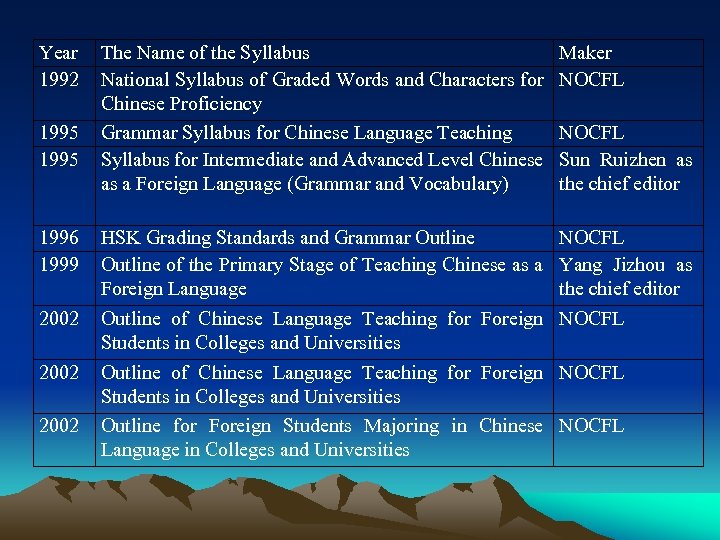 Year 1992 1995 1996 1999 2002 The Name of the Syllabus National Syllabus of Graded Words and Characters for Chinese Proficiency Grammar Syllabus for Chinese Language Teaching Syllabus for Intermediate and Advanced Level Chinese as a Foreign Language (Grammar and Vocabulary) Maker NOCFL HSK Grading Standards and Grammar Outline of the Primary Stage of Teaching Chinese as a Foreign Language Outline of Chinese Language Teaching for Foreign Students in Colleges and Universities Outline for Foreign Students Majoring in Chinese Language in Colleges and Universities NOCFL Yang Jizhou as the chief editor NOCFL Sun Ruizhen as the chief editor NOCFL
 • Compilation of teaching material • The teaching material is rich and varied in content and form, and covers a variety of topics, including science and technology, tourism, translation, trade, commerce and so on. The teaching material is designed to meet the needs of foreign learners of different levels and offers extensive additional resources and support. • With clear targeted readers and scientific structures, the teaching material is practical and interesting. • The scientific nature is the soul of the teaching material. The language in the teaching material should be standardized, the layout of the content should move forward step by step and in line with the law of language acquisition and learning, the practice should be effective.
 • 5. Theoretical researches • The subject theory of the teaching of Chinese as a foreign language comes down to two aspects: basic theory and teaching theory. The followings are the perspective introductions. • 1. The focuses of basic theory development are language theory and language learning theory. For one, there are 860 research papers concerning language theory from 1978 to 1998. For another, the research mainly focuses on reviewing and bringing in language learning and acquisition theories abroad while doing researches and discussing on them by combining Chinese and Chinese teaching, among them the most remarkable achievements are made in error analysis of Chinese learning of foreigners and inter-language study.
 • 2) Teaching theory development • The direct research object of language teaching theory is language teaching itself, of which the major research contents are the nature and features of language teaching, teaching process and activities as well as the effects internal and external factors relating to language teaching exert in language teaching. The research is aimed at revealing the objective law inside language teaching and put forward teaching principles and methods in accordance with the law, so as to push forward all teaching activities to develop in a scientific, standardized way.
 6. The Foundation of Academic societies, academic institutions and professional periodicals In June, 1983, Teaching Chinese as a Foreign Language Institute of China Education Society was established with an aim to “unifying staff of Chinese teaching foreign students to promote theoretical research on this subject and academic exchange both at home and abroad. ” In 1988, it was renamed Chinese Society for Teaching Chinese as a Foreign Language. In September, 1979, the restricted publication of Language Teaching and Linguistic Studies started in 1977 by Beijing Language and Culture University was officially published, which marked the first professional periodical of teaching Chinese as a foreign language in China. In March, 1987, Chinese society for teaching Chinese as a foreign language cofounded Chinese Teaching in the World with Beijing Language and Culture University. In addition, there are other professional periodicals such as, Chinese Culture Research, Chinese Language Learning, Research on Chinese as a Second Language and Chinese Learning which take international students as its main targets.
 7. Special Leadership and Management institution was set in our country In July, 1987, State Council approved to establish China National Office of Teaching Chinese as a Foreign Language (NOCFL for short). It leads and coordinates Chinese teaching work abroad and under the administration of State Education Commission. Since then, Chinese teaching work abroad walk on a more well-organized and systematic road. The founding of NOCEL and a lot of work afterwards promote the development of Chinese teaching as a foreign language in our country.
 The development and challenges of the International Spread of Confucius Institutes (1) The motivation of Confucius Institutes (2) The development and states quo of Confucius Institutes (3) The development and challenges of International Confucius Institutes
 The motivation of establishing Confucius Institutes • 1. Reform and opening up, emerging economy and peaceful development. • 2. Comprehensive strength and International competitiveness have been enhanced. • 3. Chinese language has been a major tool which helps world know more about and establishes relationship with China. • 4. Overseas people show great enthusiasm in learning Chinese. •
 The development and status quo of Confucius Institute • In 2004, the first Confucius Institute was inaugurated in Seoul, South Korea, symbolizing the formal establishment of Confucius Institute. • In 2005, the “First World Chinese Conference” themed “cultural dialogue and harmonious world” was convened. • In July, 2006, the “First Conference of Confucius Institute” was convened.
 The year 2014 witnessed the tenth anniversary of the founding of the first Confucius Institute. On September 27 of that year, over 1, 200 Confucius Institutes and Classrooms from 126 countries celebrated the first “World Confucius Institute Day” together. Up to 2015, globally, there has been over 500 Confucius Institutes and 1000 Confucius Classrooms, spreading across 110 plus countries and regions. In 2015, the “Tenth Conference of Confucius Institute” was open with an unprecedented scale.