


 Скачать презентацию An Overview of Smart Grid Standards Erich W
8b57a49db2d2f6c25aa9a52777c684ad.ppt
- Количество слайдов: 22
 An Overview of Smart Grid Standards Erich W. Gunther erich@enernex. com February 2009
 Why Use Standards? • • • Avoid re-inventing the wheel Learn from industry best practices Specify requirements more easily Reduce integration costs Prevent single vendor “lock-in” Vendors share a much larger market 2
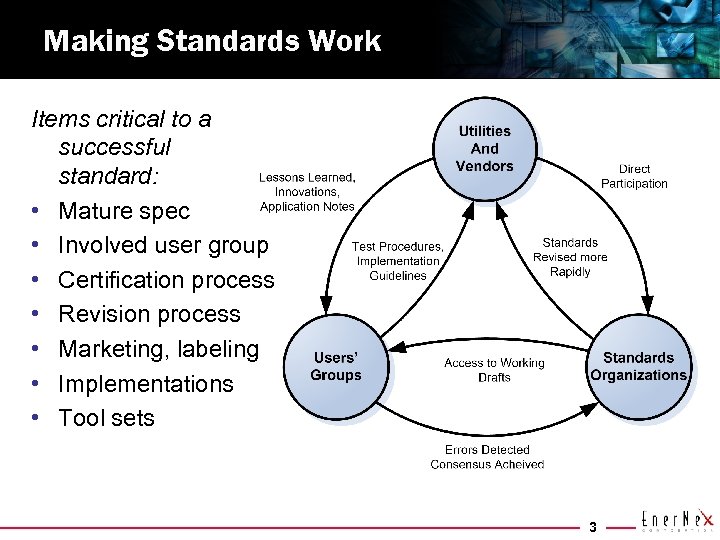 Making Standards Work Items critical to a successful standard: • Mature spec • Involved user group • Certification process • Revision process • Marketing, labeling • Implementations • Tool sets 3
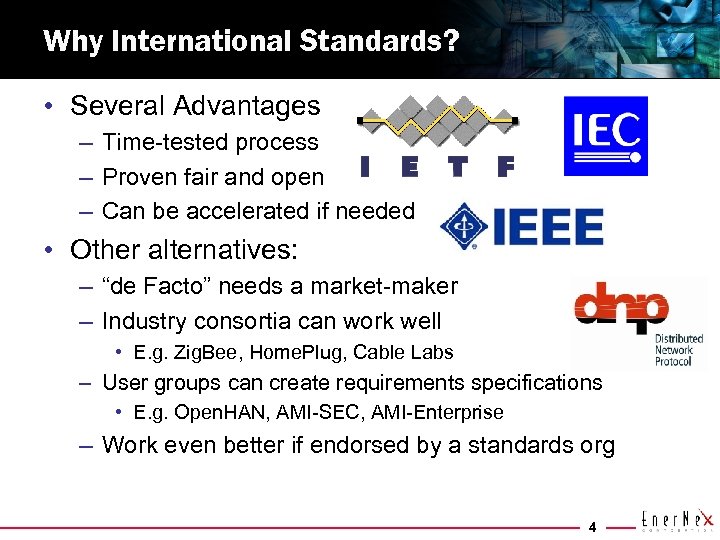 Why International Standards? • Several Advantages – Time-tested process – Proven fair and open – Can be accelerated if needed • Other alternatives: – “de Facto” needs a market-maker – Industry consortia can work well • E. g. Zig. Bee, Home. Plug, Cable Labs – User groups can create requirements specifications • E. g. Open. HAN, AMI-SEC, AMI-Enterprise – Work even better if endorsed by a standards org 4
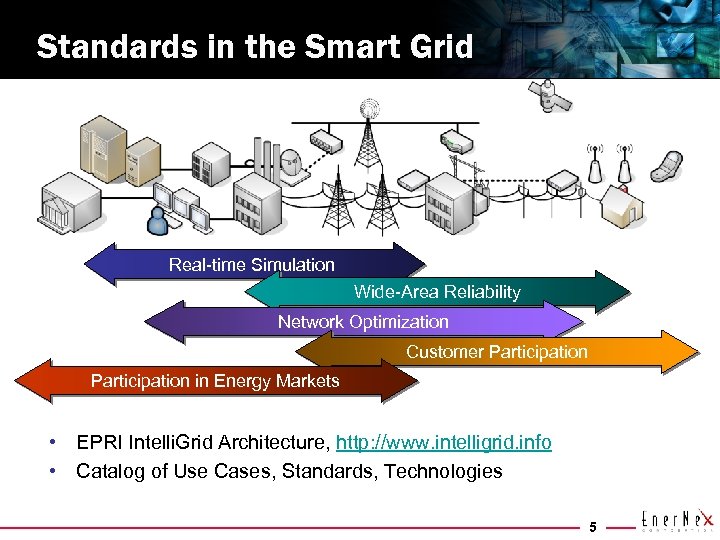 Standards in the Smart Grid Real-time Simulation Wide-Area Reliability Network Optimization Customer Participation in Energy Markets • EPRI Intelli. Grid Architecture, http: //www. intelligrid. info • Catalog of Use Cases, Standards, Technologies 5
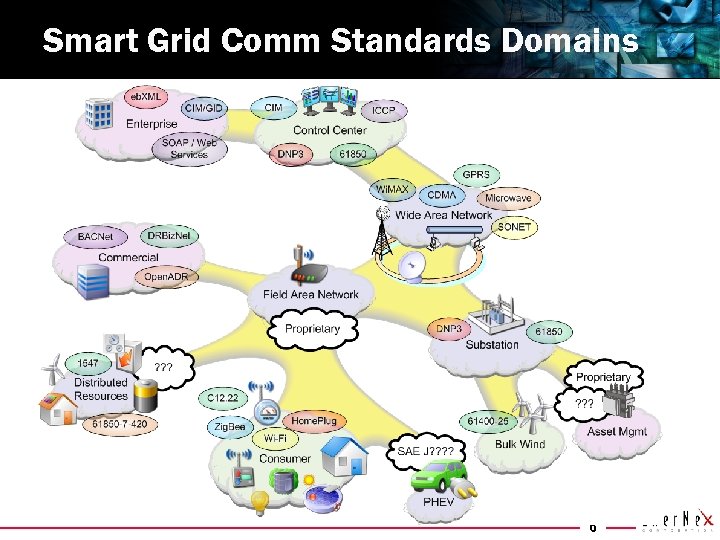 Smart Grid Comm Standards Domains 6
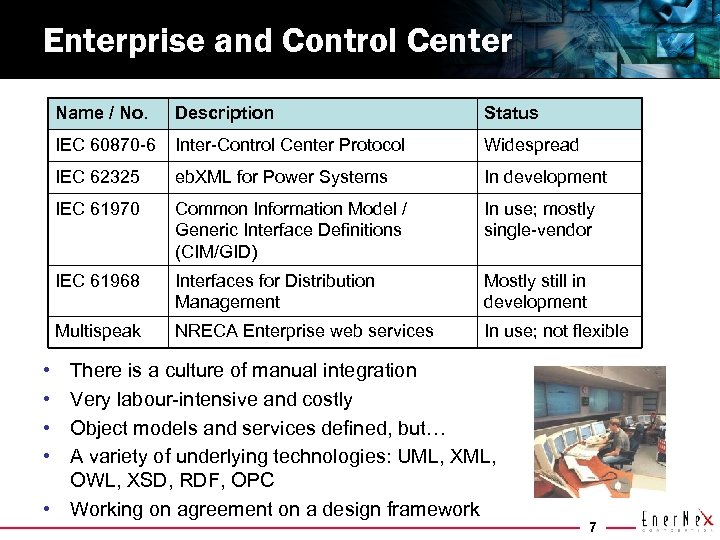 Enterprise and Control Center Name / No. Description Status IEC 60870 -6 Inter-Control Center Protocol Widespread IEC 62325 eb. XML for Power Systems In development IEC 61970 Common Information Model / Generic Interface Definitions (CIM/GID) In use; mostly single-vendor IEC 61968 Interfaces for Distribution Management Mostly still in development Multispeak NRECA Enterprise web services In use; not flexible • • There is a culture of manual integration Very labour-intensive and costly Object models and services defined, but… A variety of underlying technologies: UML, XML, OWL, XSD, RDF, OPC • Working on agreement on a design framework 7
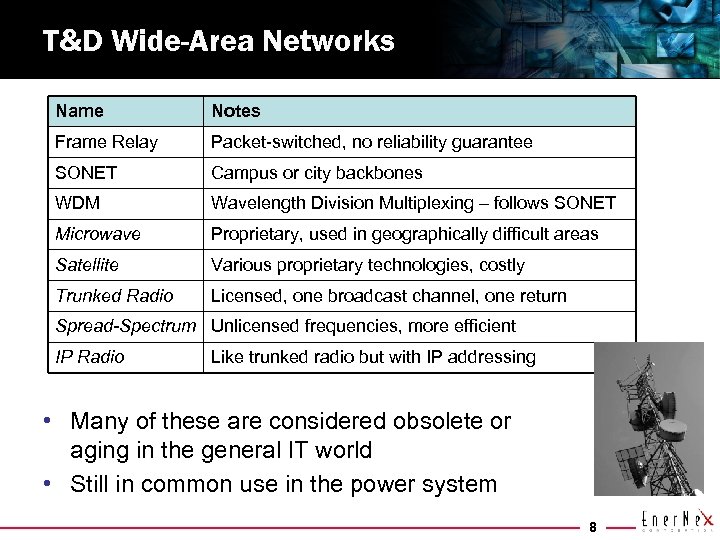 T&D Wide-Area Networks Name Notes Frame Relay Packet-switched, no reliability guarantee SONET Campus or city backbones WDM Wavelength Division Multiplexing – follows SONET Microwave Proprietary, used in geographically difficult areas Satellite Various proprietary technologies, costly Trunked Radio Licensed, one broadcast channel, one return Spread-Spectrum Unlicensed frequencies, more efficient IP Radio Like trunked radio but with IP addressing • Many of these are considered obsolete or aging in the general IT world • Still in common use in the power system 8
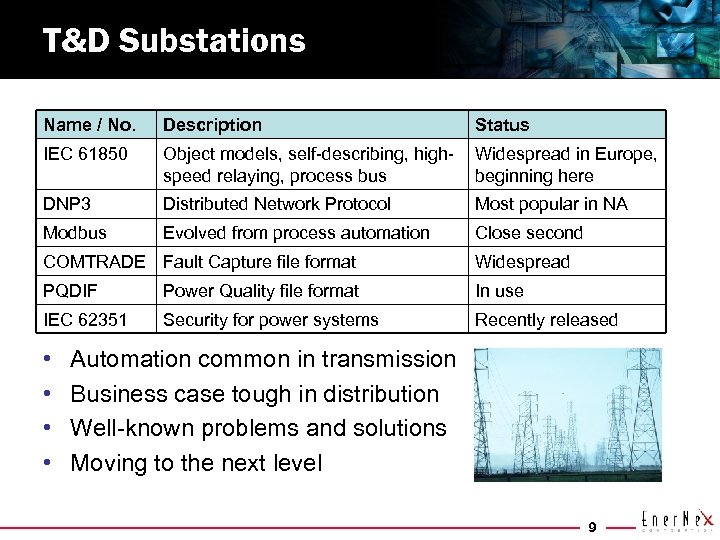 T&D Substations Name / No. Description Status IEC 61850 Object models, self-describing, highspeed relaying, process bus Widespread in Europe, beginning here DNP 3 Distributed Network Protocol Most popular in NA Modbus Evolved from process automation Close second COMTRADE Fault Capture file format Widespread PQDIF Power Quality file format In use IEC 62351 Security for power systems Recently released • • Automation common in transmission Business case tough in distribution Well-known problems and solutions Moving to the next level 9
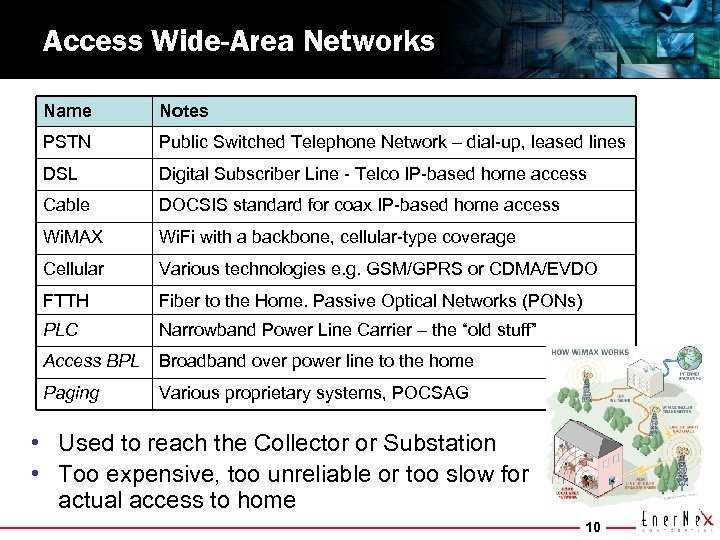 Access Wide-Area Networks Name Notes PSTN Public Switched Telephone Network – dial-up, leased lines DSL Digital Subscriber Line - Telco IP-based home access Cable DOCSIS standard for coax IP-based home access Wi. MAX Wi. Fi with a backbone, cellular-type coverage Cellular Various technologies e. g. GSM/GPRS or CDMA/EVDO FTTH Fiber to the Home. Passive Optical Networks (PONs) PLC Narrowband Power Line Carrier – the “old stuff” Access BPL Broadband over power line to the home Paging Various proprietary systems, POCSAG • Used to reach the Collector or Substation • Too expensive, too unreliable or too slow for actual access to home 10
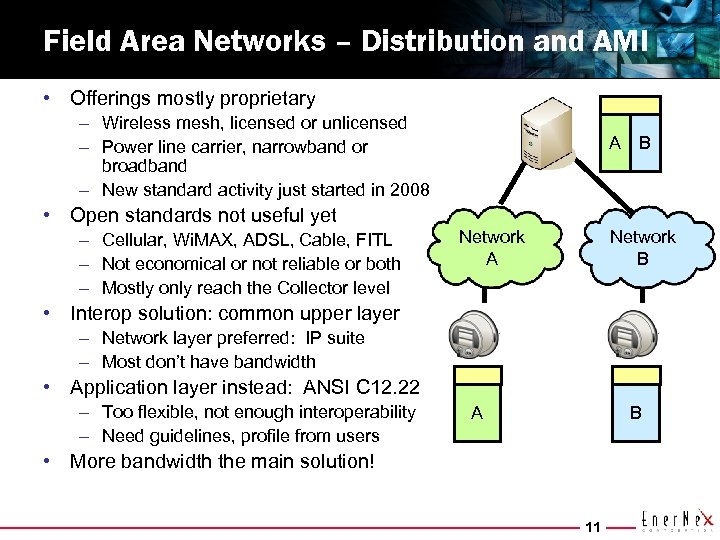 Field Area Networks – Distribution and AMI • Offerings mostly proprietary – Wireless mesh, licensed or unlicensed – Power line carrier, narrowband or broadband – New standard activity just started in 2008 A B • Open standards not useful yet – Cellular, Wi. MAX, ADSL, Cable, FITL – Not economical or not reliable or both – Mostly only reach the Collector level Network A Network B • Interop solution: common upper layer – Network layer preferred: IP suite – Most don’t have bandwidth • Application layer instead: ANSI C 12. 22 – Too flexible, not enough interoperability – Need guidelines, profile from users A B • More bandwidth the main solution! 11
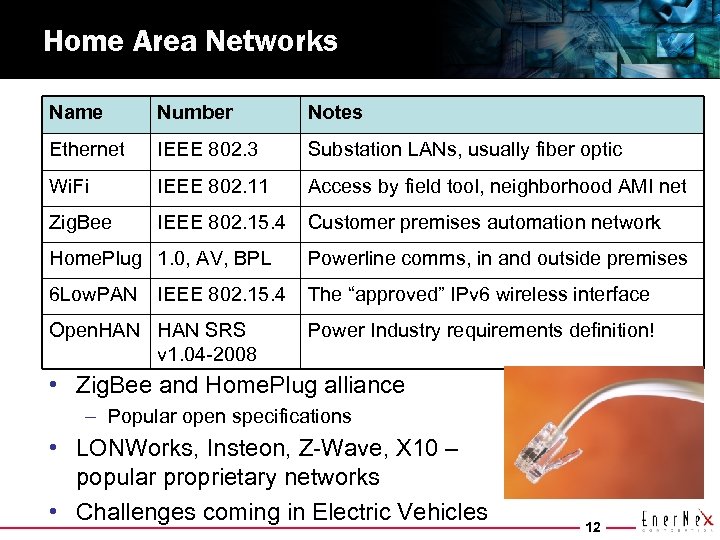 Home Area Networks Name Number Notes Ethernet IEEE 802. 3 Substation LANs, usually fiber optic Wi. Fi IEEE 802. 11 Access by field tool, neighborhood AMI net Zig. Bee IEEE 802. 15. 4 Customer premises automation network Home. Plug 1. 0, AV, BPL Powerline comms, in and outside premises 6 Low. PAN IEEE 802. 15. 4 The “approved” IPv 6 wireless interface Open. HAN SRS v 1. 04 -2008 Power Industry requirements definition! • Zig. Bee and Home. Plug alliance – Popular open specifications • LONWorks, Insteon, Z-Wave, X 10 – popular proprietary networks • Challenges coming in Electric Vehicles 12
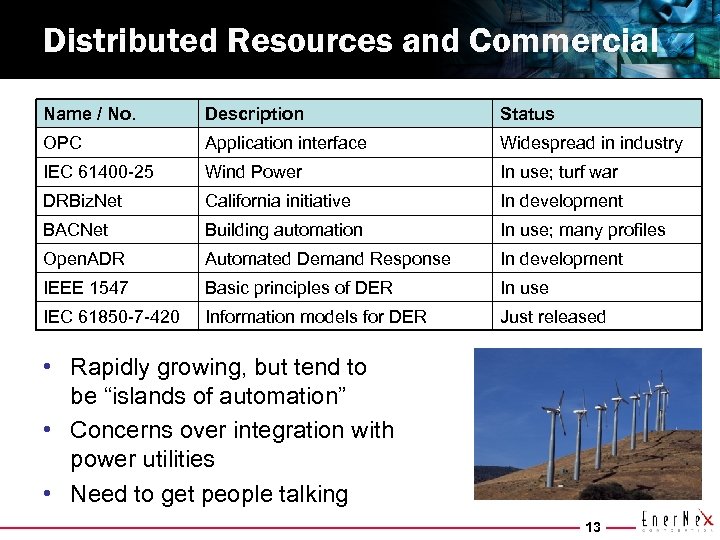 Distributed Resources and Commercial Name / No. Description Status OPC Application interface Widespread in industry IEC 61400 -25 Wind Power In use; turf war DRBiz. Net California initiative In development BACNet Building automation In use; many profiles Open. ADR Automated Demand Response In development IEEE 1547 Basic principles of DER In use IEC 61850 -7 -420 Information models for DER Just released • Rapidly growing, but tend to be “islands of automation” • Concerns over integration with power utilities • Need to get people talking 13
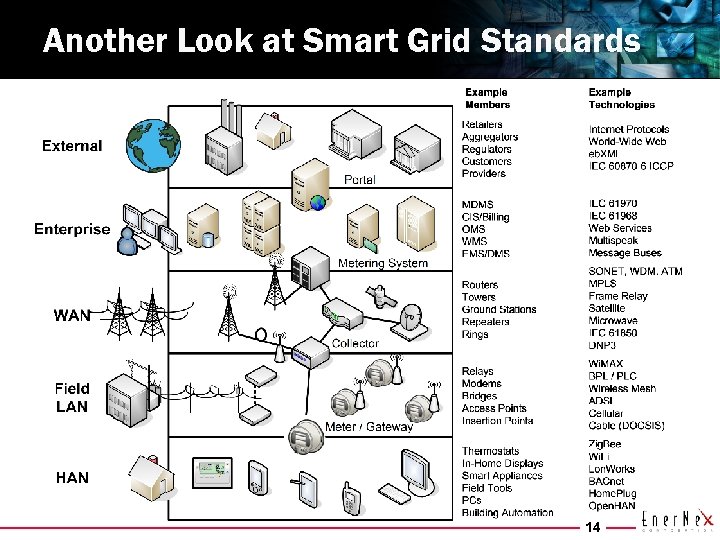 Another Look at Smart Grid Standards 14
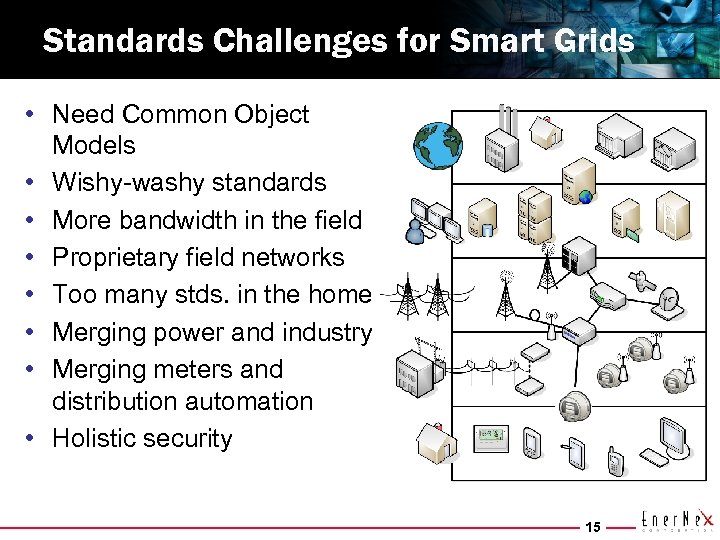 Standards Challenges for Smart Grids • Need Common Object Models • Wishy-washy standards • More bandwidth in the field • Proprietary field networks • Too many stds. in the home • Merging power and industry • Merging meters and distribution automation • Holistic security 15
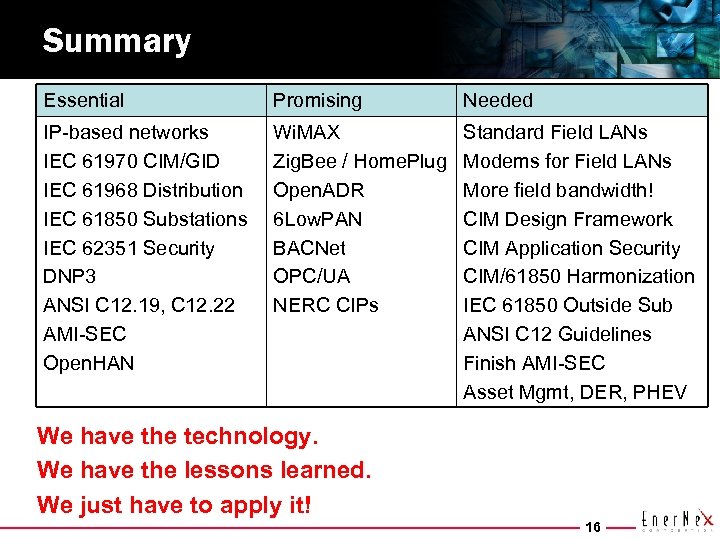 Summary Essential Promising Needed IP-based networks IEC 61970 CIM/GID IEC 61968 Distribution IEC 61850 Substations IEC 62351 Security DNP 3 ANSI C 12. 19, C 12. 22 AMI-SEC Open. HAN Wi. MAX Zig. Bee / Home. Plug Open. ADR 6 Low. PAN BACNet OPC/UA NERC CIPs Standard Field LANs Modems for Field LANs More field bandwidth! CIM Design Framework CIM Application Security CIM/61850 Harmonization IEC 61850 Outside Sub ANSI C 12 Guidelines Finish AMI-SEC Asset Mgmt, DER, PHEV We have the technology. We have the lessons learned. We just have to apply it! 16
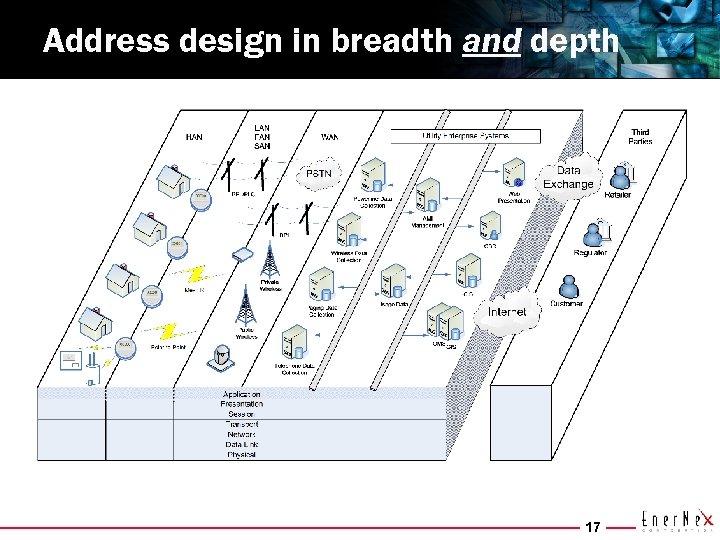 Address design in breadth and depth 17
 Address design in breadth and depth • A software application is evident to users only at one level – Must operate transparently to the appropriate depth to interact with other systems – May be tied to key hardware elements of the system – If tied, must be upgradable and extensible – If hardware is exchanged, must continue transparent operation (with some configuration) • At the physical level, not allways possible to have an appropriate connection that facilitates openness and competition (e. g. , meter under-glass interface for communications boards; multi-vendor interface inside of relays) 18
 Recommended focus areas • Standard field LANs (FANs) – Innovation drived by vendor tension • More field bandwidth – Eliminate single-purpose networks and facilitate innovation • CIM design framework – Tighten allowable choices and develop implementation guide • CIM application security – Guidelines needed for verifiable security • CIM / IEC 61850 harmonization – Motivate users group to eliminate identified gaps • IEC 61850 outside of the substation – Incentivize vendors to extend reach of products and systems 19
 Recommended focus areas, pt. 2 • ANSI C 12 guidelines – Demand demonstrations of interoperable products • Finish AMI-SEC work products – Component catalog and implementation guide • Asset Management – Incentivize utilities to leverage infrastructure to better manage business • Distributed Energy Resources – Re-think and re-design hardware and software to account for two -way energy flow • Plug-in Hybrid Electric Vehicles – Need policies, regulations, business model, standards, etc. 20
 Key Strategies • Drive stakeholders from standards development to interoperability demonstrations • Holistic targets eliminate single-purpose design and incompatibilities – Technical, communications, environment, regulation, etc. • Apply systems engineering and third-party metrics to avoid single-entity rate-or-return projects 21
 Key recommendations • DOE Grid. Wise Architecture Interoperability Checklist should be used by policy makers to evaluate utility proposals • Smart Grid News technology/product/project checklist or equivalent should be used to validate “smartgridness” • Standards-based solutions should be favored over proprietary solutions via legislation, rules and regulations • Desired outcomes and important characteristics (e. g. , interoperability) should be specified by policy makers rather than specific standards (where possible) • Research needed to accelerate development and fill the gaps in security, smart grid networks, device management, information privacy and field network interoperability 22