


 Скачать презентацию An Overview of Response to Intervention A module
ec751066e9d8f4f461059529098d09eb.ppt
- Количество слайдов: 64
 An Overview of Response to Intervention A module for pre-service and in-service professional development MN RTI Center Authors: Kim Gibbons, Ph. D St Croix River Education District Lisa H. Stewart, Ph. D Minnesota State University Moorhead www. scred. k 12. mn. us click on RTI Center MN Rt. I Center 1
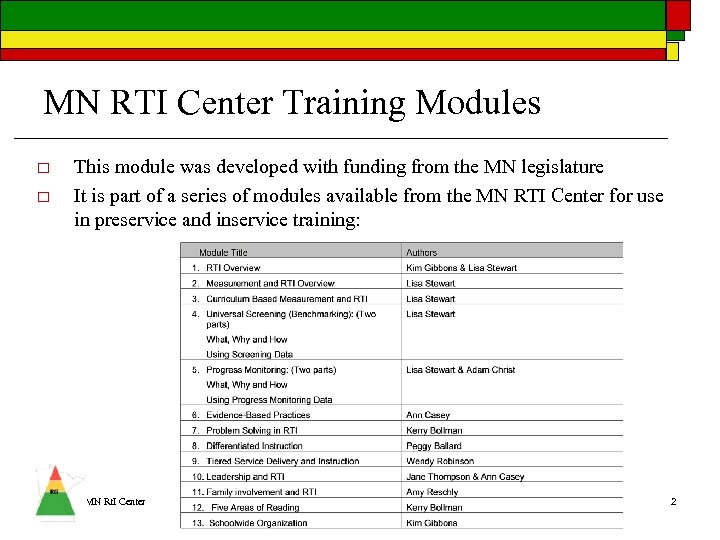 MN RTI Center Training Modules o o This module was developed with funding from the MN legislature It is part of a series of modules available from the MN RTI Center for use in preservice and inservice training: MN Rt. I Center 2
 Overview o o o What is Rt. I? Necessary Components of Rt. I MN Data and Rt. I Implementation Note: The RTI framework is applicable to many academic areas and behavior. However, the MN RTI Center funding was focused on RTI in the area of reading, therefore this module focuses on applications of RTI in reading. MN Rt. I Center
 Warm Up Activity o What have you heard (if anything) about RTI? o What questions and/or concerns do you have? MN Rt. I Center
 What to do with Billy? ? o o o 6 th Grade, behind in reading Slow progress compared to peers Likely to miss benchmarks related to passing statewide accountability tests Distractible, inattentive, disruptive Sound familiar? What Happens Next? n Driven by Federal Legislation for the Past 30 Years! MN Rt. I Center
 Background IDEA Reauthorization: o o o Role of the federal government in the funding of special education Issue of over identification in the area of LD Response to Intervention MN Rt. I Center
 IDEA Reauthorization o Reauthorization was preceded by four consensus reports: n n o NRC report on minority overrepresentation in special education Report on rethinking special education LD Summit Presidents Commission on Excellence in Special Education Each of these reports was influenced by reading research and the current classification system of individuals with LD. MN Rt. I Center
 What did the Four Consensus Reports Say? o The number of individuals identified with LD could be reduced if more effective reading instruction was in place o Current regulations for LD lacked a research base and presented obstacles to the implementation of better instructional approaches for students with disabilities. MN Rt. I Center
 Background: How Does Reading Achievement Fit in? o “Not so new” legislation mandates scientifically-based reading instruction o Why is reading a problem? n Demand for literacy is high and getting higher n Increased accountability n Large federal investment in education n Achievement gap of minority students o No Child Left Behind ACT (NCLB) is the accountability mechanism for ensuring that all children learn to read effectively. o IDEA reauthorization is requiring effective reading instruction as a way to prevent LD identification. MN Rt. I Center
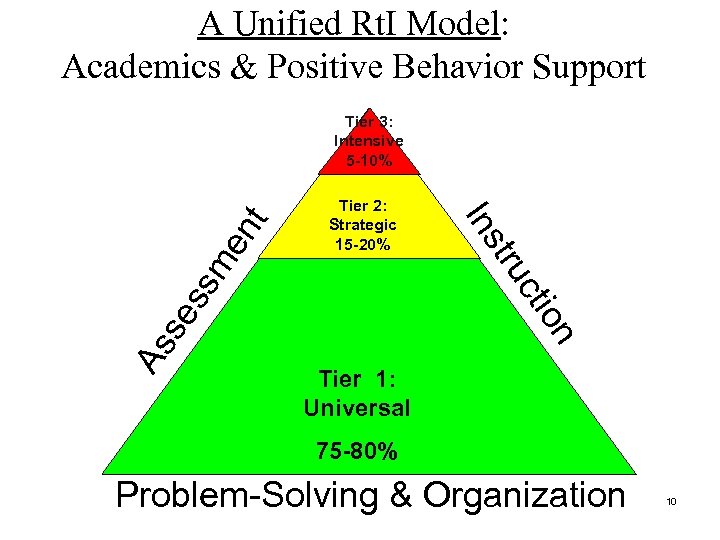 A Unified Rt. I Model: Academics & Positive Behavior Support me ss se As on cti tru Tier 2: Strategic 15 -20% Ins nt Tier 3: Intensive 5 -10% Tier 1: Universal 75 -80% Problem-Solving & Organization 10
 The Basics: What is RTI? o Response to Intervention (RTI) n The practice of providing high quality instruction and interventions matched to student need, monitoring progress frequently to make changes in instruction, and applying child response data to important educational decisions. NASDSE, 2006 o Two RTI “Camps” n n Preventative: Use data to identify students who need extra assistance and provide extra help right away! Prevent large numbers of students from being referred for special education services. Reactive: A new way to identify students as learning disabled. Much narrower in focus and missing the regular education application of the framework. MN Rt. I Center
 Working Together Under NCLB & IDEA o RTI in the Context of No Child Left Behind (NCLB): n n n Emphasis on universal screening of all students for achievement difficulties. Placement in early intervention programs Careful monitoring of progress and accountability for results MN Rt. I Center
 Core Principles of Rt. I o o o We must view RTI as proactive, system-wide reform of education. We can effectively teach all children. Intervene early. Use a multi-tier model of service delivery. Use a problem-solving method to make decisions within a multi-tier model. MN Rt. I Center o o Use research-based, scientifically validations interventions to the extent available. Monitor student progress to inform instruction. Use data to make decisions. Use assessment for three purposes. 13
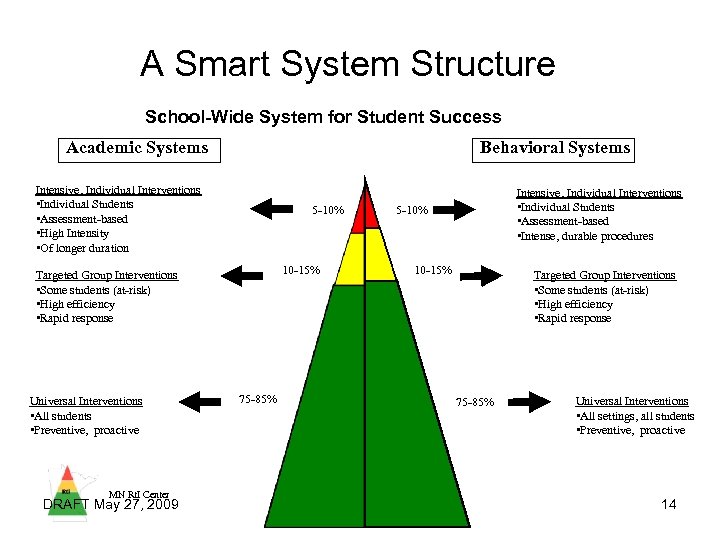 A Smart System Structure School-Wide System for Student Success Academic Systems Behavioral Systems Intensive, Individual Interventions • Individual Students • Assessment-based • High Intensity • Of longer duration 5 -10% 10 -15% Targeted Group Interventions • Some students (at-risk) • High efficiency • Rapid response Universal Interventions • All students • Preventive, proactive MN Rt. I Center DRAFT May 27, 2009 75 -85% Intensive, Individual Interventions • Individual Students • Assessment-based • Intense, durable procedures 5 -10% 10 -15% Targeted Group Interventions • Some students (at-risk) • High efficiency • Rapid response 75 -85% Universal Interventions • All settings, all students • Preventive, proactive 14
 Working Together Under NCLB & IDEA o o First, put in place a core curriculum that is effective for all subgroups. Next, back up the core curriculum with supplemental instruction for those in need. Finally, use intensive interventions and/or special education for students who are still not being successful. Moving from what kind of a problem the child has to what and how much does the student need. MN Rt. I Center
 RTI: Two Versions o Problem Solving n Solutions to instructional and behavioral problems are induced by evaluating student’s responsiveness to a four-stage process: o o o Problem Identification Problem Analysis Plan Implementation Plan Evaluation Standard Treatment Protocol n Requires the use of the same empirically validated treatment for all children with similar problems. MN Rt. I Center
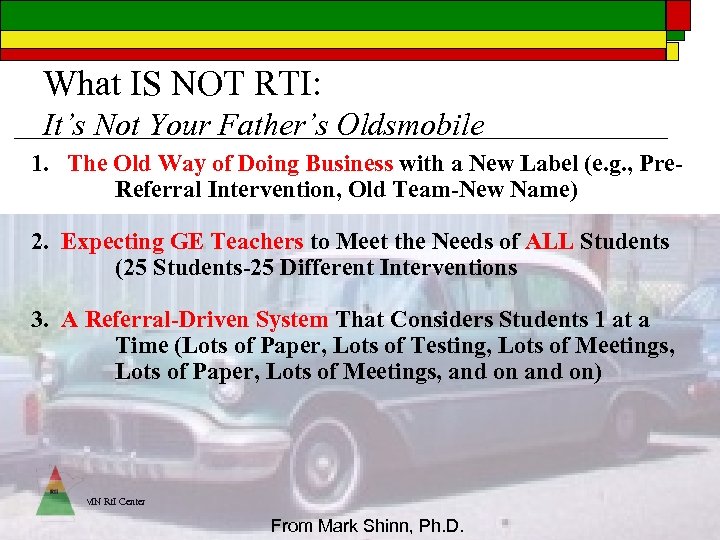 What IS NOT RTI: It’s Not Your Father’s Oldsmobile 1. The Old Way of Doing Business with a New Label (e. g. , Pre. Referral Intervention, Old Team-New Name) 2. Expecting GE Teachers to Meet the Needs of ALL Students (25 Students-25 Different Interventions 3. A Referral-Driven System That Considers Students 1 at a Time (Lots of Paper, Lots of Testing, Lots of Meetings, Lots of Paper, Lots of Meetings, and on) MN Rt. I Center From Mark Shinn, Ph. D.
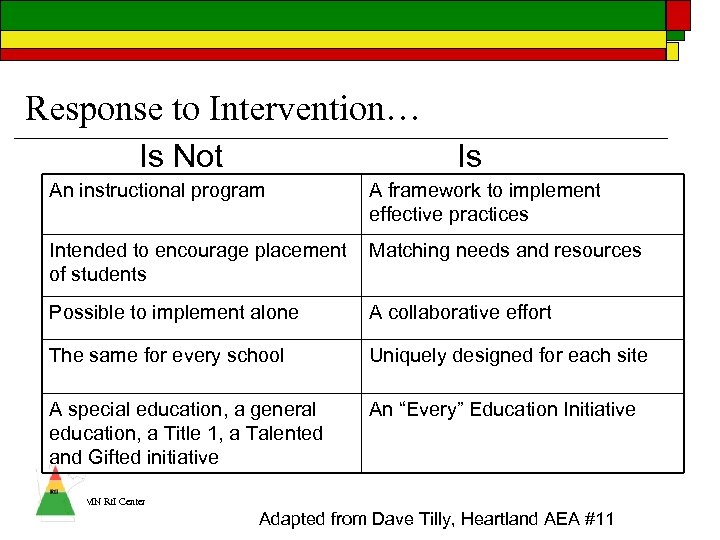 Response to Intervention… Is Not Is An instructional program A framework to implement effective practices Intended to encourage placement of students Matching needs and resources Possible to implement alone A collaborative effort The same for every school Uniquely designed for each site A special education, a general education, a Title 1, a Talented and Gifted initiative An “Every” Education Initiative MN Rt. I Center Adapted from Dave Tilly, Heartland AEA #11
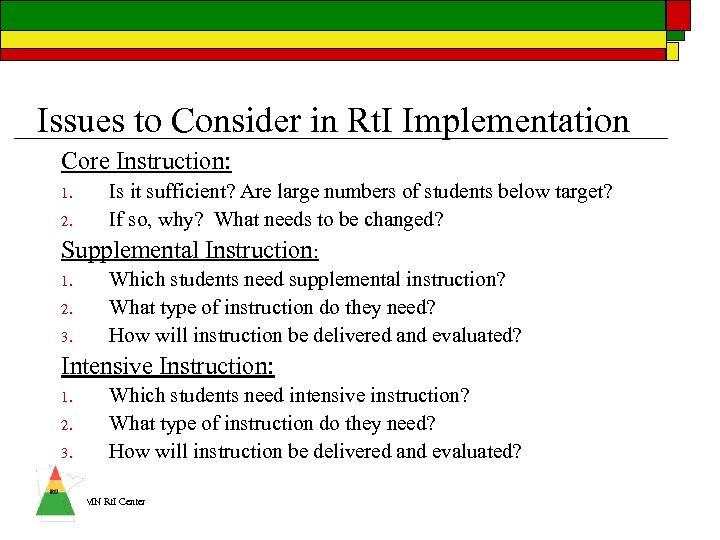 Issues to Consider in Rt. I Implementation Core Instruction: 1. 2. Is it sufficient? Are large numbers of students below target? If so, why? What needs to be changed? Supplemental Instruction: 1. 2. 3. Which students need supplemental instruction? What type of instruction do they need? How will instruction be delivered and evaluated? Intensive Instruction: 1. 2. 3. Which students need intensive instruction? What type of instruction do they need? How will instruction be delivered and evaluated? MN Rt. I Center
 Rt. I: It isn’t just for elementary schools! • There is a false assumption that Rt. I only works at the elementary level. • Rt. I is a framework that can be used from early childhood through high school. MN Rt. I Center
 RTI and Secondary The main elements are the same, but operationalized a bit differently at the secondary level: • • • Grade level teams are usually replaced by the building problem solving team working in conjunction with content teachers. Supplemental interventions usually involve an additional course that students take for credit. Screening data usually takes the form of many sources of data (grades, MAP tests, etc. ) rather than 3 x per year benchmarking procedures. Progress monitoring continues to be used for at-risk students using General Outcome Measures. Problem solving teams continue to use the problem solving model for decision-making. MN Rt. I Center
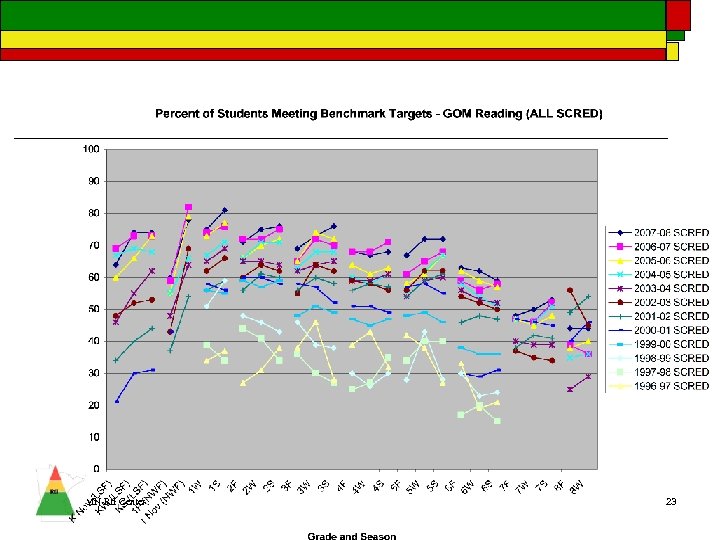
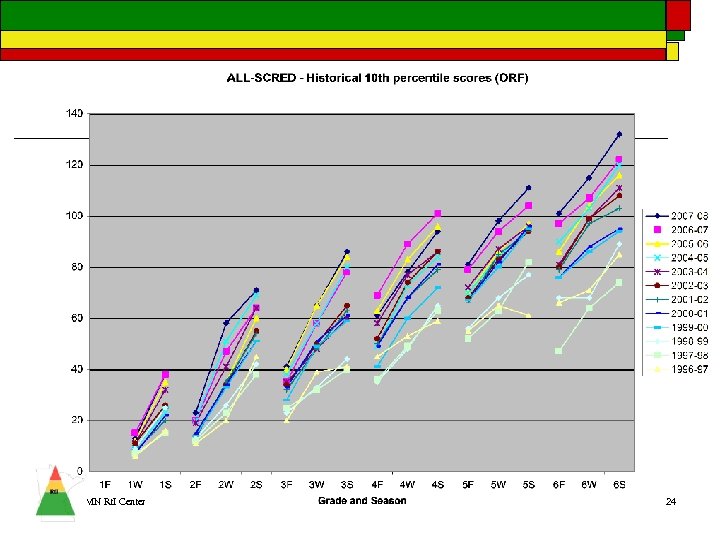
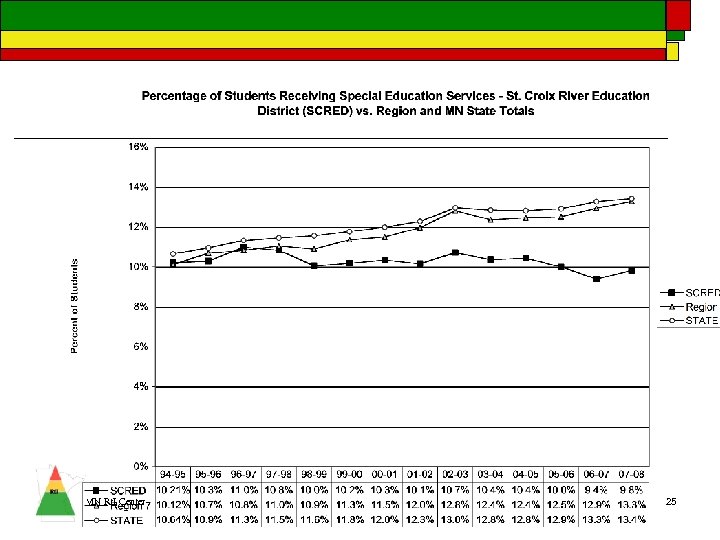
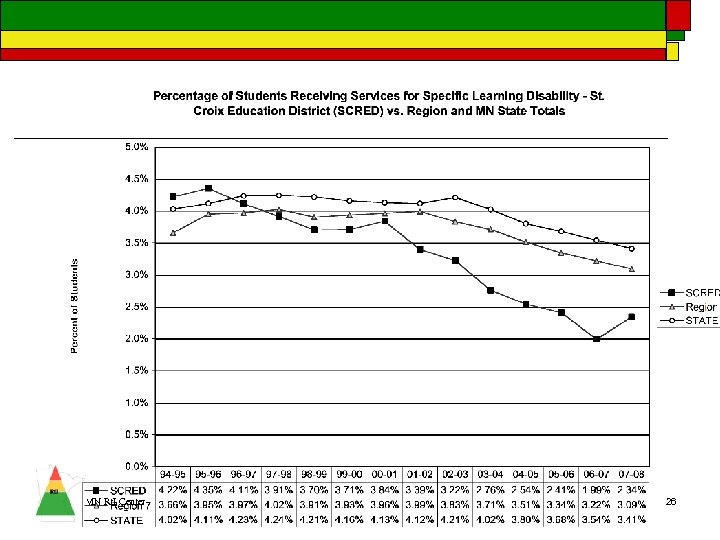
 Example of Outcomes o The St. Croix River Education District in Eastern MN has been implementing all three parts of the RTI model since 1995. o Beginning in the 2005 -06 school year, districts used data from the Rt. I process to determine special education eligibility. MN Rt. I Center 22
 MN Rt. I Center 23
 MN Rt. I Center 24
 MN Rt. I Center 25
 MN Rt. I Center 26
 m ss se As n io ct tru en t s In RTI Problem-Solving & Organization MN Rt. I Center DRAFT May 27, 2009 27
 Establishing a Measurement System o A core feature of RTI is identifying a measurement system n Screen large numbers of students o n Identify students in need of additional intervention Monitor students of concern more frequently o o n 1 to 4 x per month Typically weekly Diagnostic testing used for instructional planning to help target interventions as needed MN Rt. I Center DRAFT May 27, 2009 28
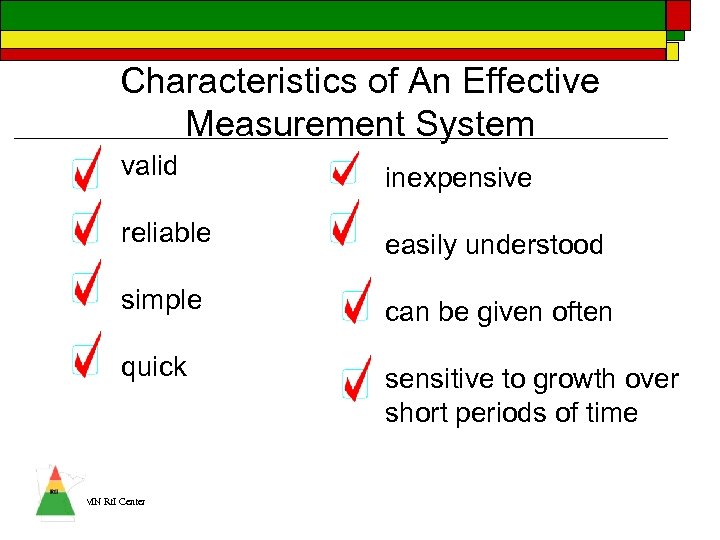 Characteristics of An Effective Measurement System valid inexpensive reliable easily understood simple can be given often quick sensitive to growth over short periods of time MN Rt. I Center
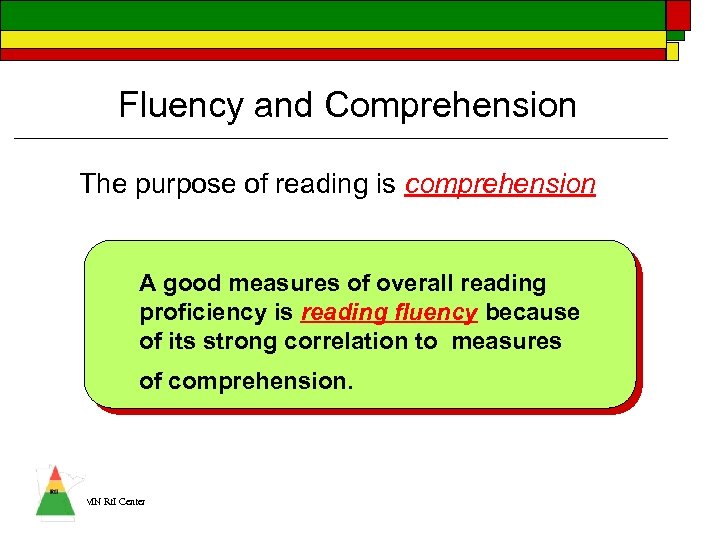 Fluency and Comprehension The purpose of reading is comprehension A good measures of overall reading proficiency is reading fluency because of its strong correlation to measures of comprehension. MN Rt. I Center
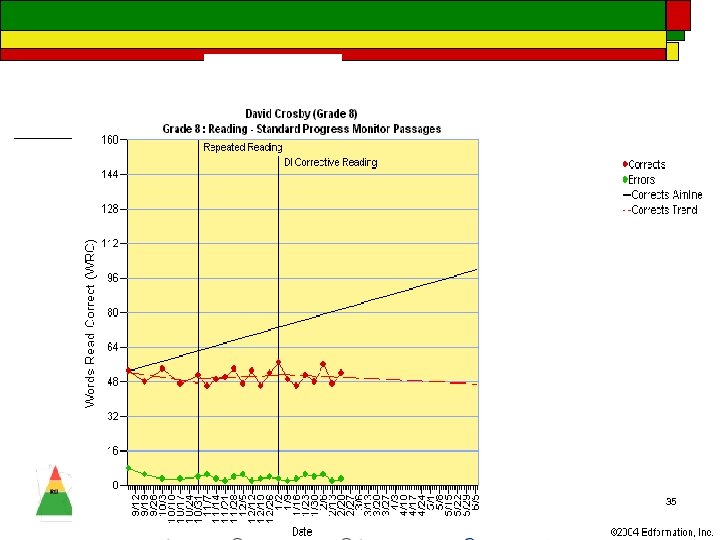
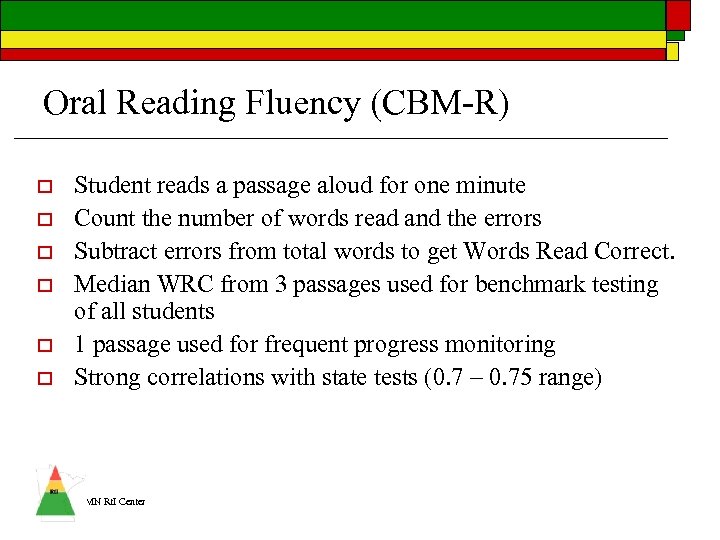 Oral Reading Fluency (CBM-R) o o o Student reads a passage aloud for one minute Count the number of words read and the errors Subtract errors from total words to get Words Read Correct. Median WRC from 3 passages used for benchmark testing of all students 1 passage used for frequent progress monitoring Strong correlations with state tests (0. 7 – 0. 75 range) MN Rt. I Center
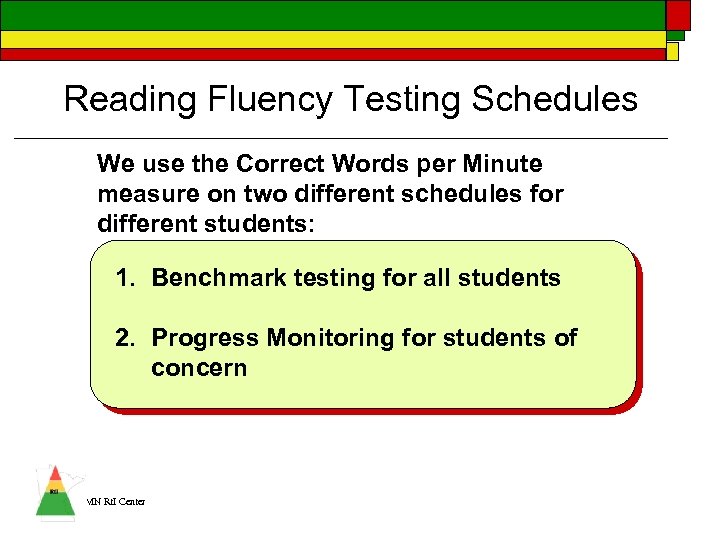 Reading Fluency Testing Schedules We use the Correct Words per Minute measure on two different schedules for different students: 1. Benchmark testing for all students 2. Progress Monitoring for students of concern MN Rt. I Center
 Frequent Monitoring We do NOT KNOW ahead of time whether an intervention will be successful for an individual student Do they assume in the hospital that your heart is working just fine after your bypass surgery? After all… the surgery works well for MOST patients…. . MN Rt. I Center
 Frequent Monitoring is used : o o o for students of concern, i. e. , students who are below target to provide a basis for evaluation of instructional programming for individual students as the instruction is occurring to provide information to help teachers make decisions about goals, materials, levels, and groups to aid in communication with parents to document progress for IEP students as is required for periodic and annual reviews MN Rt. I Center
 MN Rt. I Center 35
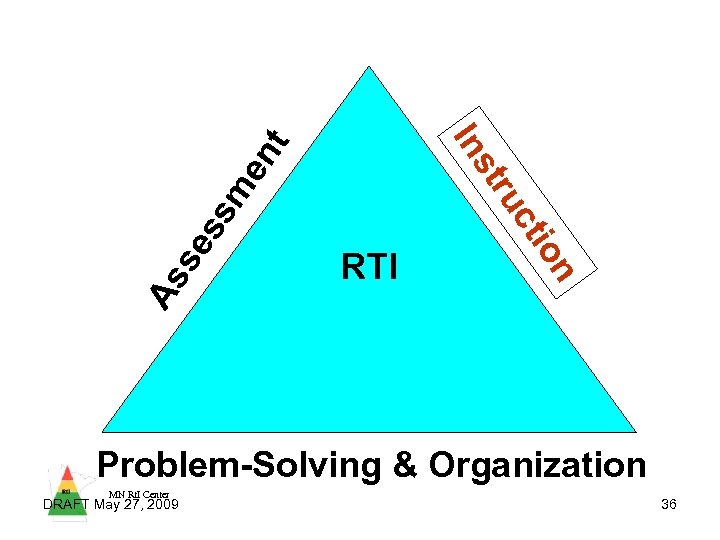 As se n io ct ss m ru st en t In RTI Problem-Solving & Organization MN Rt. I Center DRAFT May 27, 2009 36
 Curriculum & Instruction o In an RTI model, it is imperative to have a high-quality, research-based curriculum in place that meets the needs of most students (~80%) o You don’t want to have large numbers of students referred for problem solving (or special education) due to an inadequate curriculum! o Emphasis on a 3 -Tier Model MN Rt. I Center
 Big Ideas: Curriculum/Standards o Curriculum is the body of knowledge that all students are expected to learn. Curriculum can be specific knowledge and learning processes. Curriculum is defined in district standards and benchmarks. n Consider: o o o MN Rt. I Center Are the Big Ideas (Important concepts, knowledge and skills) covered in the written curriculum and taught curriculum? Is the curriculum driven by the standards/benchmarks? Is there breadth and depth to the curriculum across grade levels?
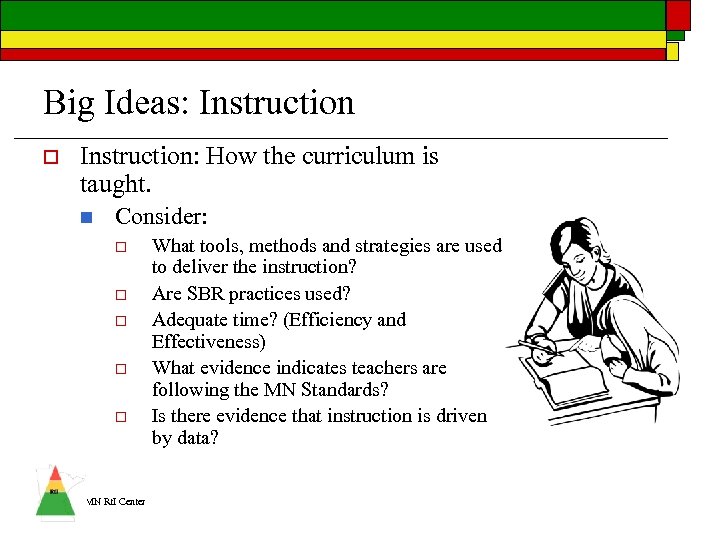 Big Ideas: Instruction o Instruction: How the curriculum is taught. n Consider: o o o MN Rt. I Center What tools, methods and strategies are used to deliver the instruction? Are SBR practices used? Adequate time? (Efficiency and Effectiveness) What evidence indicates teachers are following the MN Standards? Is there evidence that instruction is driven by data?
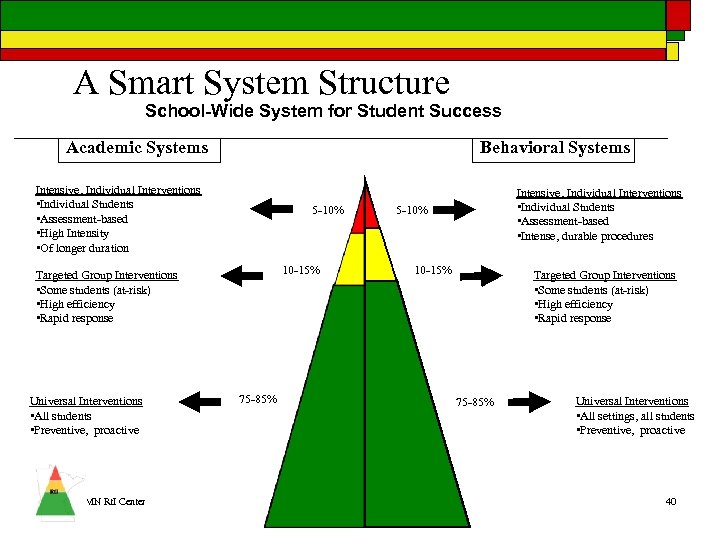 A Smart System Structure School-Wide System for Student Success Academic Systems Behavioral Systems Intensive, Individual Interventions • Individual Students • Assessment-based • High Intensity • Of longer duration 5 -10% 10 -15% Targeted Group Interventions • Some students (at-risk) • High efficiency • Rapid response Universal Interventions • All students • Preventive, proactive MN Rt. I Center 75 -85% Intensive, Individual Interventions • Individual Students • Assessment-based • Intense, durable procedures 5 -10% 10 -15% Targeted Group Interventions • Some students (at-risk) • High efficiency • Rapid response 75 -85% Universal Interventions • All settings, all students • Preventive, proactive 40
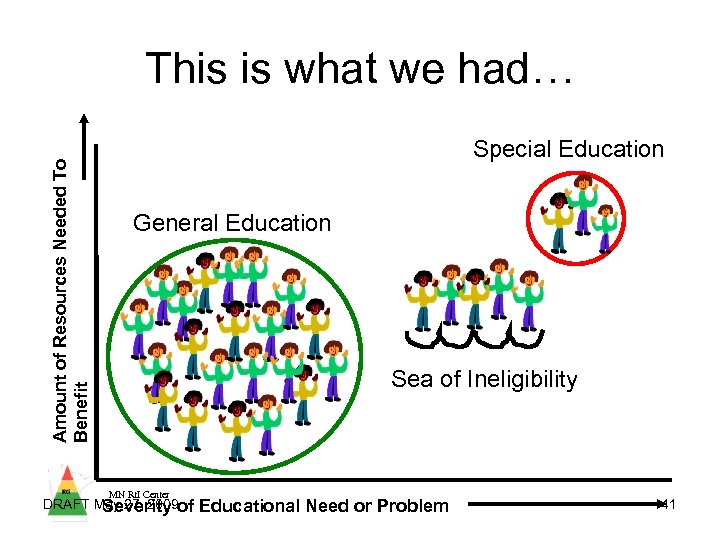 Amount of Resources Needed To Benefit This is what we had… Special Education General Education Sea of Ineligibility MN Rt. I Center DRAFT May 27, 2009 of Severity Educational Need or Problem 41
 Successful Multi-Tier Models Have: o A continuum of services and/or programs across the tiers that are scientifically based o Methods of evaluating and monitoring progress across the tiers, ideally those that are considered scientifically based o Efficient, COMMON methods of communicating student performance for all disciplines. MN Rt. I Center
 Multi-Tiered Models and Instructional Time o Tier One n n o Tier Two n n o Core instruction to all students Example: 90 minutes per day of reading instruction for all students Supplemental instruction for some students Example: Core + 30 minutes extra instruction (Standard Treatment Protocol) Tier Three n n n Intensive Instruction for some students Example: Core + 30 minutes of intensive instruction IEP team determines time for students eligible for special education services MN Rt. I Center
 Tier 1 is Delivery of a Scientifically Based Core Program with. . . o Fidelity o Intensity o Passion o Reasonable Accommodations If Done Well, We Expect to Meet the Needs of Most. . . Some Will Need More MN Rt. I Center
 Tier 2 is “MORE” o o o o (More) Time (More) Explicit Teacher-Led Instruction (More) Scaffolded Instruction (More) Opportunities to Respond with Corrective Feedback (More) Language Support, Especially Vocabulary (More) Intensive Motivational Strategies (More) Frequent Progress Monitoring MN Rt. I Center
 Tier 3 is “MOST” o o o o (Most) Time (Most) Explicit Teacher-Led Instruction (Most) Scaffolded Instruction (Most) Opportunities to Respond with Corrective Feedback (Most) Language Support, Especially Vocabulary (Most) Intensive Motivational Strategies (Most) Frequent Progress Monitoring MN Rt. I Center
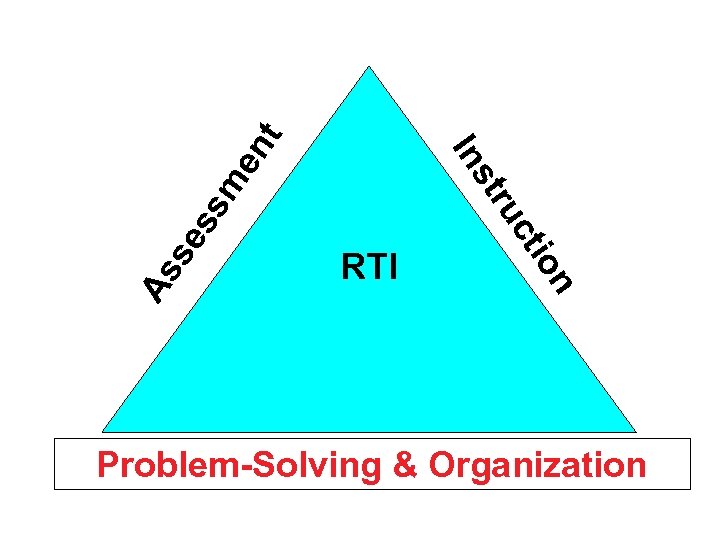 en t ss se As n io ct tru m s In RTI Problem-Solving & Organization
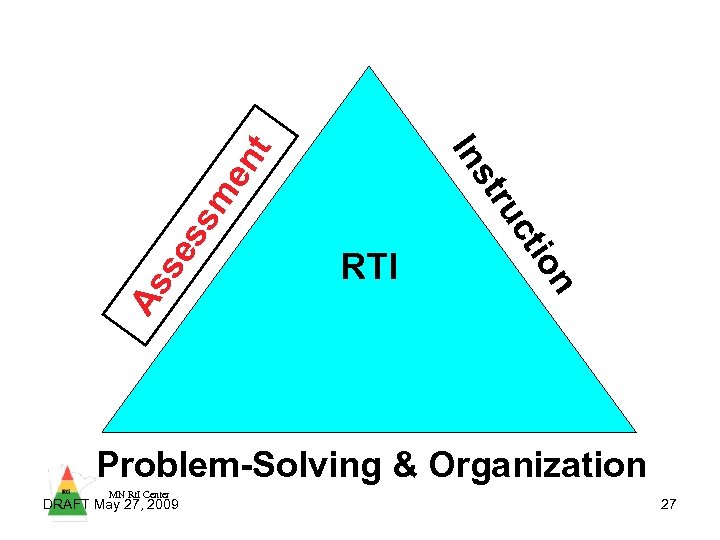
 Problem Solving Process and School-Wide Organization o Once a measurement system and research-based curriculum are in place, schools must have a problem solving system to meet the needs of unique learners. o Problem Solving Teams must have a process to use to develop interventions for at-risk students. o Buildings must be organized to support problem solving MN Rt. I Center
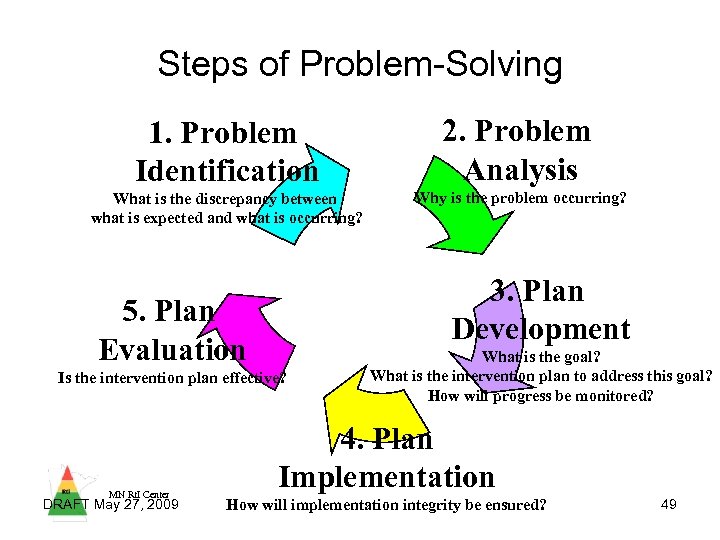 Steps of Problem-Solving 1. Problem Identification 2. Problem Analysis What is the discrepancy between what is expected and what is occurring? Why is the problem occurring? 3. Plan Development 5. Plan Evaluation Is the intervention plan effective? MN Rt. I Center DRAFT May 27, 2009 What is the goal? What is the intervention plan to address this goal? How will progress be monitored? 4. Plan Implementation How will implementation integrity be ensured? 49
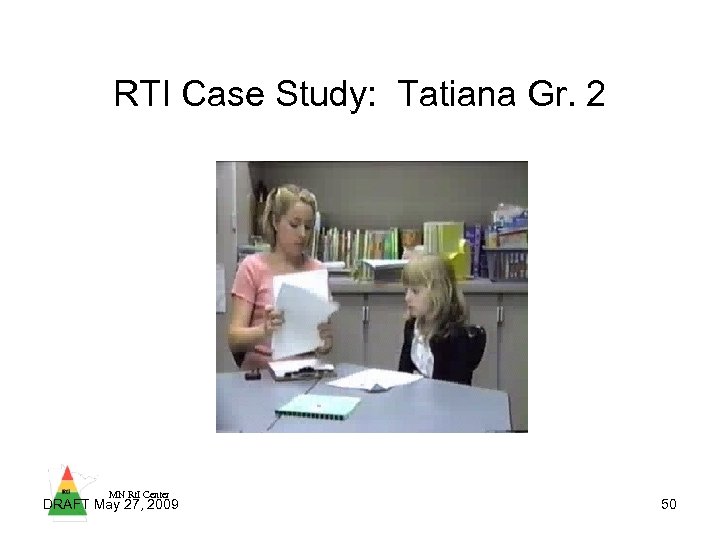 RTI Case Study: Tatiana Gr. 2 MN Rt. I Center DRAFT May 27, 2009 50
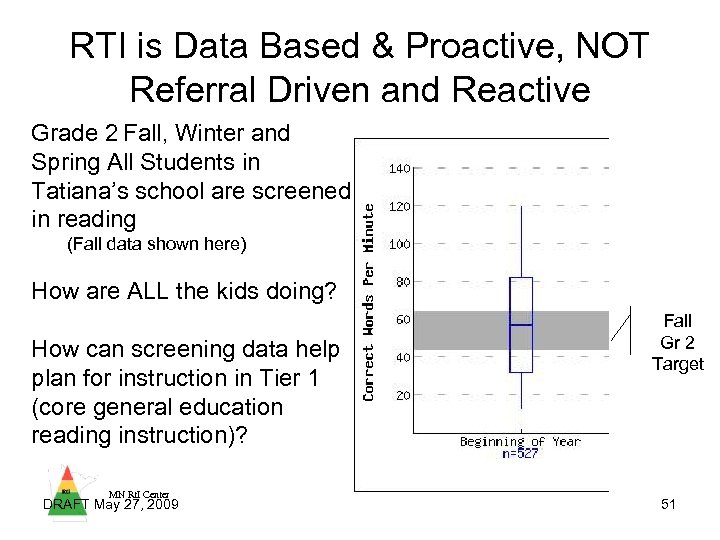 RTI is Data Based & Proactive, NOT Referral Driven and Reactive Grade 2 Fall, Winter and Spring All Students in Tatiana’s school are screened in reading (Fall data shown here) How are ALL the kids doing? How can screening data help plan for instruction in Tier 1 (core general education reading instruction)? MN Rt. I Center DRAFT May 27, 2009 Fall Gr 2 Target 51
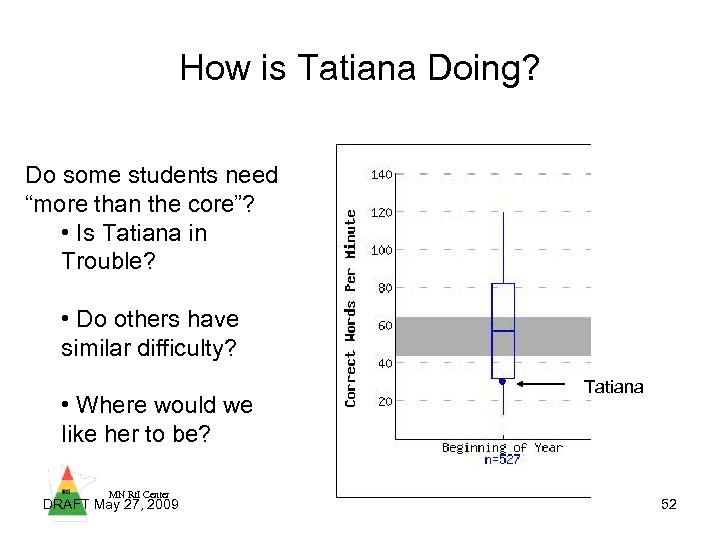 How is Tatiana Doing? Do some students need “more than the core”? • Is Tatiana in Trouble? • Do others have similar difficulty? • Where would we like her to be? MN Rt. I Center DRAFT May 27, 2009 Tatiana 52
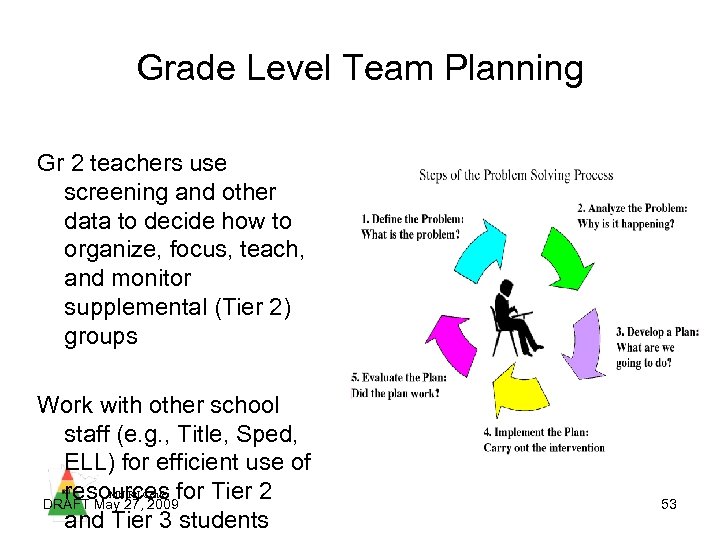 Grade Level Team Planning Gr 2 teachers use screening and other data to decide how to organize, focus, teach, and monitor supplemental (Tier 2) groups Work with other school staff (e. g. , Title, Sped, ELL) for efficient use of MN Rt. I Center resources for Tier 2 DRAFT May 27, 2009 and Tier 3 students 53
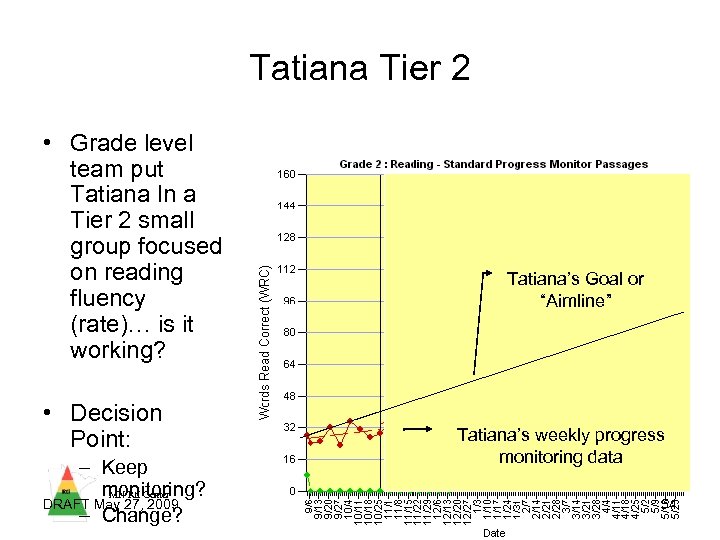 Tatiana Tier 2 • Grade level team put Tatiana In a Tier 2 small group focused on reading fluency (rate)… is it working? • Decision Point: – Keep monitoring? MN Rt. I Center DRAFT May 27, 2009 – Change? Tatiana’s Goal or “Aimline” Tatiana’s weekly progress monitoring data 54
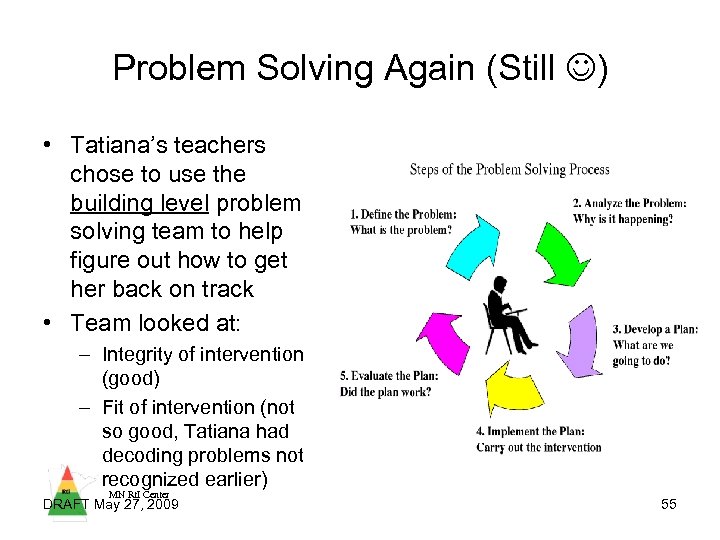 Problem Solving Again (Still ) • Tatiana’s teachers chose to use the building level problem solving team to help figure out how to get her back on track • Team looked at: – Integrity of intervention (good) – Fit of intervention (not so good, Tatiana had decoding problems not recognized earlier) MN Rt. I Center DRAFT May 27, 2009 55
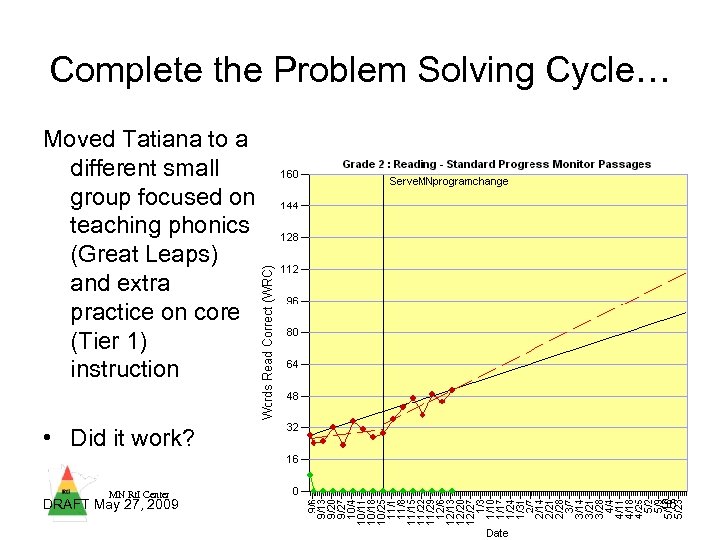 Complete the Problem Solving Cycle… Moved Tatiana to a different small group focused on teaching phonics (Great Leaps) and extra practice on core (Tier 1) instruction • Did it work? MN Rt. I Center DRAFT May 27, 2009 56
 Final Activity Think-Pair-Share 1. On your own, think of the top three important things you have learned about Rt. I today. 2. Share your top three list with the person seated next to you. 3. Agree on a new top three list. 4. Prepare to share this with the rest of class. MN Rt. I Center 57
 RTI Related websites o o o o National Center on RTI http: //www. rti 4 success. org/ RTI Action Network http: //www. rtinetwork. org/ RTI WIRE http: //www. interventioncentral. org National Center on Student Progress Monitoring http: //www. studentprogress. org/ National Assoc School Psych www. nasponline. org St Croix River Ed District and MN RTI Center http: //www. scred. k 12. mn. us/ Council of Administrators of Special Education www. casecec. org Office of Special Education Programs (OSEP) rti toolkit http: //www. osepideasthatwork. org/toolkit/ta_responsiveness_intervention. asp MN Rt. I Center 58
 Print Resources o Batsche, G. , Elliott, J. , Graden, J. et al. , (2006), Response to Intervention: Policy Considerations and Implementation, Alexandria, VA: National Association of State Directors of Special Education. o Multiple books available on RTI, but buyer beware: read before you buy! MN Rt. I Center
 Articles available with this module: o Martinez, R. S. , Nellis, L. M. , & Pedergast, K. A. (2006). Closing the Achievement Gap Series: Part II Response to Intervention (RTI): Basic Elements, Practical Application, and Policy Recommendations, Center for Evaluation and Education Policy Brief, Volume 4(8), Bloomington, IN: Indiana University. Web: ceep. indiana. edu o Fuchs, D. , & Fuchs, L. S. (2006) Introduction to Response to Intervention: What, why and how valid is it? Reading Research Quarterly, 41(1) 93 -99. o NASDSE & CASE (2006). Response to Intervention: National Association of State Directors of Special Education and Council of Administrators of Special Education White Paper on Rt. I. www. nasdse. org o International Reading Association, Implications for Reading Teachers in Response to Intervention (RTI). Web resource: http: //www. reading. org/downloads/resources/rti 0707_implications. pdf o NASDSE (2006) Myths about Response to Intervention (RTI ) Implementation. Accessed from www. nasdse. org MN Rt. I Center
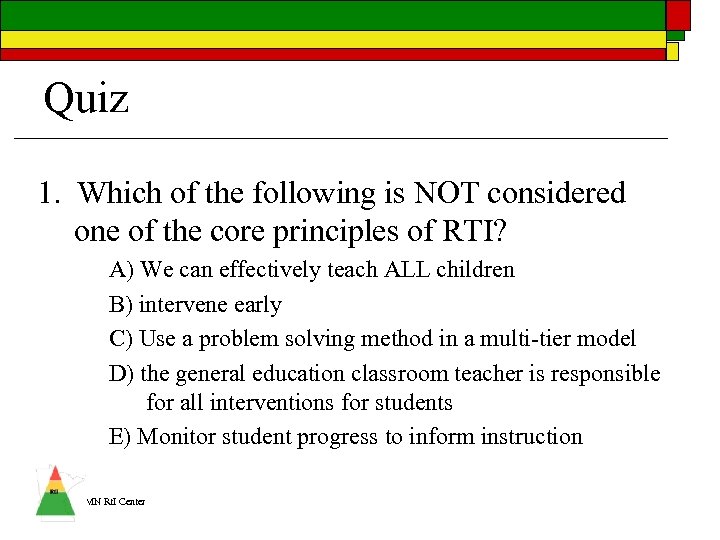 Quiz 1. Which of the following is NOT considered one of the core principles of RTI? A) We can effectively teach ALL children B) intervene early C) Use a problem solving method in a multi-tier model D) the general education classroom teacher is responsible for all interventions for students E) Monitor student progress to inform instruction MN Rt. I Center
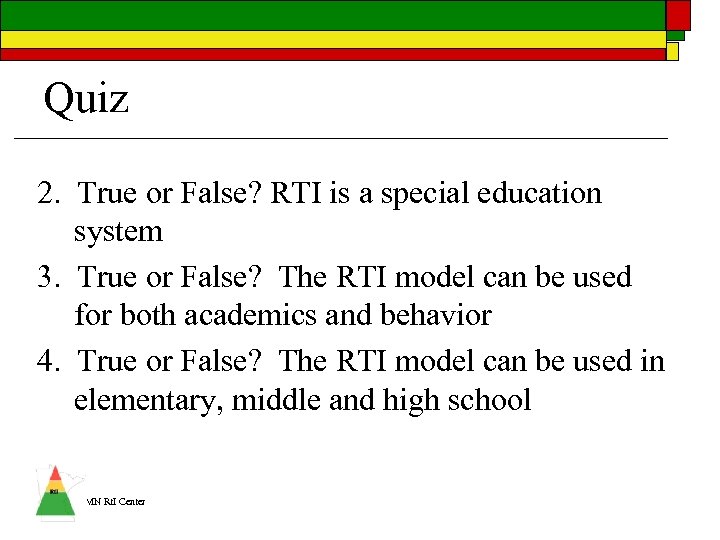 Quiz 2. True or False? RTI is a special education system 3. True or False? The RTI model can be used for both academics and behavior 4. True or False? The RTI model can be used in elementary, middle and high school MN Rt. I Center
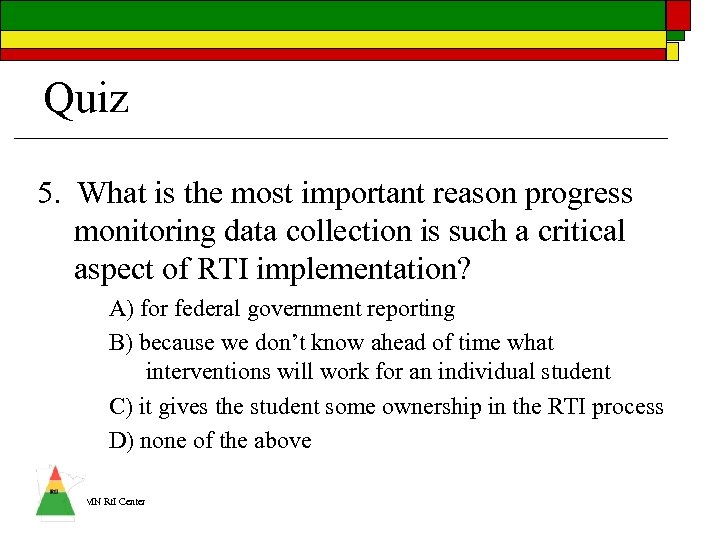 Quiz 5. What is the most important reason progress monitoring data collection is such a critical aspect of RTI implementation? A) for federal government reporting B) because we don’t know ahead of time what interventions will work for an individual student C) it gives the student some ownership in the RTI process D) none of the above MN Rt. I Center
 The End o Note: The MN RTI Center does not endorse any particular product. Examples used are for instructional purposes only. o Special Thanks: n n Thank you to Dr. Ann Casey, director of the MN RTI Center, for her leadership Thank you to Aimee Hochstein, Kristen Bouwman, and Nathan Rowe, Minnesota State University Moorhead graduate students, for editing, writing quizzes, and enhancing the quality of these training materials MN Rt. I Center