


 Скачать презентацию An Overview of Race Discrimination under the Equality
055d211d24d4735219f9d7a7d25c053e.ppt
- Количество слайдов: 17
 An Overview of Race Discrimination under the Equality Act 2010 Institute for Employment Rights Rakesh Patel Thompsons Solicitors Congress House, London
 Introduction Purpose of the Equality Act harmonise, simplify and strengthen discrimination legislation
 Protected Characteristics (s. 4 and 9) • Race means Colour, Nationality, Ethnic or National Origin (s. 9) Nationality can be acquired by birth or by other means. Akin to citizenship. National Origin means more than nationality. Ethnic origin Mandla v Dowell Lee a long shared history and a cultural tradition of its own.
 Who is Covered? (Part 5) Employees, workers, agency workers, contract workers, apprentices Protection applies from day one of employment Job applicants (nb Keane –v- Investigo & ors EAT 0389/09). Post Employment Discrimination
 Direct Discrimination s. 13 • A person (A) discriminates against another (“B”) if, because of a protected characteristic (A) treats (B) less favourably than A treats or would treat others. • Associative & Perception Discrimination Weathersfield v Sergeant [1999] Serco v Redfern [2006]
 Direct Discrimination s. 13 • TEST (1) whether less favourable treatment (Comparators) (2) whether the less favourable because of race • Motive irrelevant. Amnesty Int v Ahmed [2008] • Race need not be sole reason for treatment. Owen & Briggs v James [1982] • Burden of Proof • Vicarious Liability – act/omission “in the course of employment”. Jones v Tower Boot Co Ltd [1997] ; Sidhu v Aerospace Composite Technology Ltd [2000]
 Indirect Discrimination s. 19 • A person (A) discriminates against another (B) if (A) applies to (B), without justification a PCP which is discriminatory in relation to a relevant protected characteristic of (B) B must show that it does or would put persons with whom (B) shares the characteristic at a particular disadvantage when compared with persons who do not share it and it puts or would put B at a disadvantage.
 Indirect Discrimination • The same definition applies to colour and nationality as well as ethnic or national origin • Examples - Hussain –v- Saints Complete House Furnishers [1979] IRLR 337 • Osborne Clarke Services v Purohit [2009] IRLR 341 –
 Harassment s. 26 • A person “A” harasses another, “B” if: (A) engages in unwanted conduct related to a relevant protected characteristic and the conduct has the purpose or effect of • Violating “B’s” dignity; or • Creating an intimidating, hostile, degrading, humiliating or offensive environment for “B”
 Harassment s. 26 • Associative and perception harassment • Third Party Harassment Employer only liable if aware of the harassment and on at least two occasions
 Victimisation s. 27 • A person (A) victimises another, (B) if: – (A) subjects (B) to a detriment because: “B’ does a protected act, or “A” believes that “B” had done or may do a protected act
 Time limits (s 123 and 129) 1. Within 3 months of discrimination. 2. ET has discretion for late claim if just and equitable 3. Continuing Discrimination
 Remedies ET can order: • Declaration • Compensation • Recommendation
 Public Sector Duties (s 149) • Comes into force on 6 th April 2011 • General Duty • To eliminate unlawful discrimination, • • To Advance equality of opportunity • Foster good relations
 Public Sector Duties (s 149) What are the Specific Duties? 1. By 31 st July 2011 and annually thereafter publish information to show compliance with general duty. • Information to include effect policies and practices have had on people with protected characteristics. • bodies of 150 employees or more the information will need to include the effect polices have had on their workforce.
 Public Sector Duties 2. Prepare and publish equality objectives • By 6 April 2012 and every 4 years thereafter, prepare and publish equality objectives that it reasonably thinks it should achieve to meet aims of the general equality duty. • Details of the engagement that it undertook, in developing its objectives
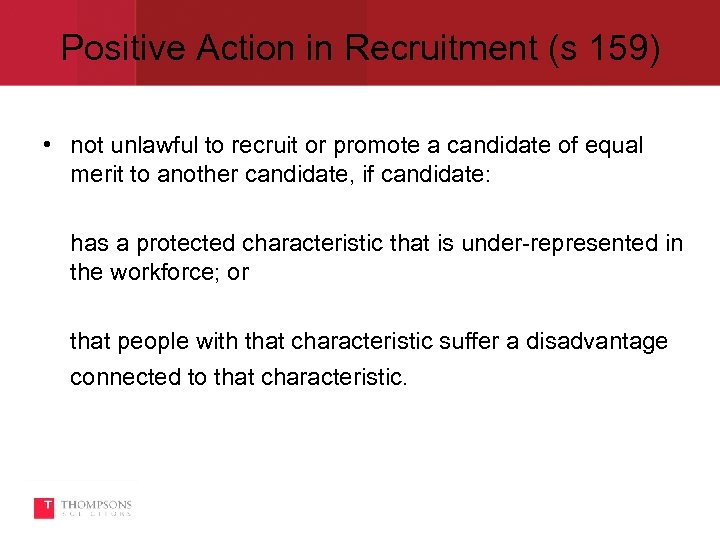 Positive Action in Recruitment (s 159) • not unlawful to recruit or promote a candidate of equal merit to another candidate, if candidate: has a protected characteristic that is under represented in the workforce; or that people with that characteristic suffer a disadvantage connected to that characteristic.