


 Скачать презентацию An Overview of Future Concretes with a Description
7ed91c4132ca1a0f9688ae852ab63b86.ppt
- Количество слайдов: 78
 An Overview of Future Concretes with a Description of the Role of Reactive Magnesia • Part 1 • Concrete – Where are we? • Drivers for Change => Opportunities • Barriers to Change • Guides to Change • Contenders with Commentary • Part 2 • The Role of Reactive Mg. O 1 www. tececo. com
 Concrete - Where are we? • The hard mineral composite we build with. • Next to water the most used. – Buildings account for ~40% of the materials and ~33% of the energy consumed by the world economy. 1 – 7 billion M 3 per annum 2 – 5% - 10% of CO 2 emissions depending on the authority. • Concrete infrastructure expenditure a huge investment for governments at all levels • A cost cutting volume business model for many players in the supply chain • Already one of the most environmentally friendly building materials – significant improvements are possible however. • Affect on embodied energies and emissions as well as lifetime energies significant. 1 Rees, W. E. (1999). The Built Environment and Ecosphere: A Global Perspective. Building Research and Information. British Columbia, William E Rees. 27: 206 -220 2 Wallenvik, Olafur, Carbon Footprint of High Performance Versus Conventional Vibrated Concrete 2 www. tececo. com
 Drivers for Change • Stakeholder demands for greater sustainability – Brungart definition and triple bottom line. – The precautionary principle & intergenerational equity – Every improvement counts but paradigm improvements really matter – If implemented!, but – Quick fixes = paradigm changes • Economic Cost Benefit given – Rapidly rising energy costs – Carbon taxes • Construction activities contribute over 35% of total global CO 2 emissions 3 so carbon taxes will have a big impact. • > Sustainability can deliver > profit. • Competition – Leed, the Green Building Council etc. • Improved technical understanding and practice • Government research and development as well as procurement policies 3 UNEP (2001). Energy and Cities: Sustainable Building and Construction Summary of Main Issues, IETC Side Event at UNEP Governing Council, Nairobi, Kenya, UNEP. 3 www. tececo. com
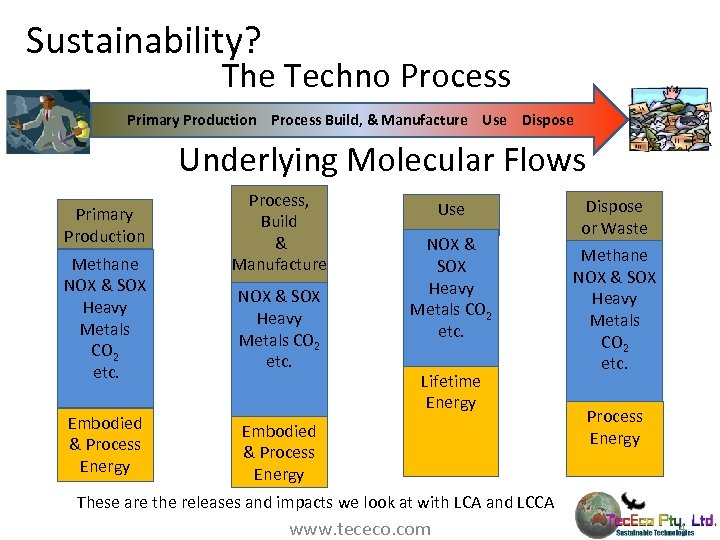 Sustainability? The Techno Process Primary Production Process Build, & Manufacture Use Dispose Underlying Molecular Flows Primary Production Methane NOX & SOX Heavy Metals CO 2 etc. Embodied & Process Energy Process, Build & Manufacture NOX & SOX Heavy Metals CO 2 etc. Use NOX & SOX Heavy Metals CO 2 etc. Lifetime Energy Embodied & Process Energy Dispose or Waste Methane NOX & SOX Heavy Metals CO 2 etc. Process Energy These are the releases and impacts we look at with LCA and LCCA www. tececo. com 4
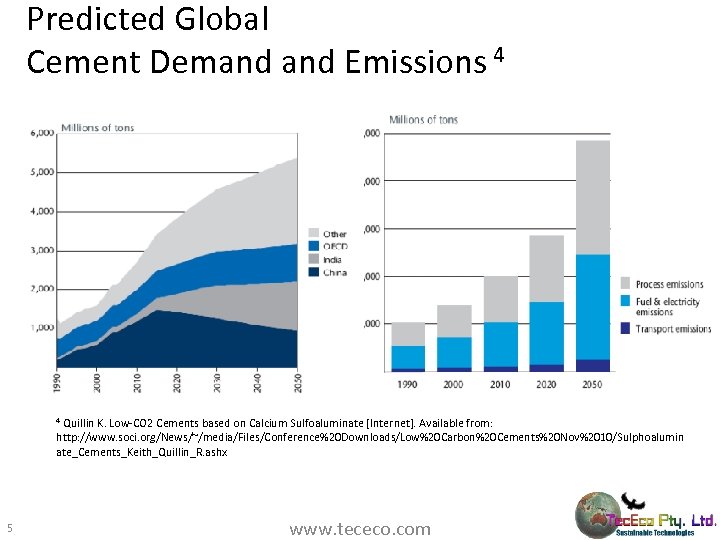 Predicted Global Cement Demand Emissions 4 4 Quillin K. Low-CO 2 Cements based on Calcium Sulfoaluminate [Internet]. Available from: http: //www. soci. org/News/~/media/Files/Conference%20 Downloads/Low%20 Carbon%20 Cements%20 Nov%2010/Sulphoalumin ate_Cements_Keith_Quillin_R. ashx 5 www. tececo. com
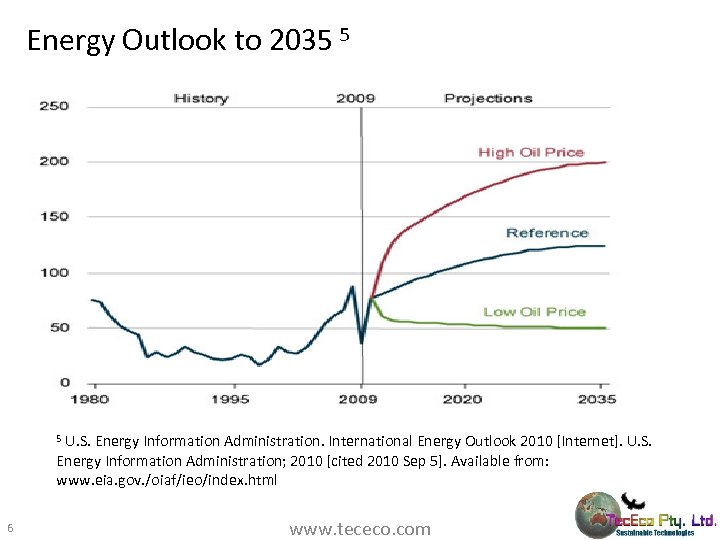 Energy Outlook to 2035 5 5 U. S. Energy Information Administration. International Energy Outlook 2010 [Internet]. U. S. Energy Information Administration; 2010 [cited 2010 Sep 5]. Available from: www. eia. gov. /oiaf/ieo/index. html 6 www. tececo. com
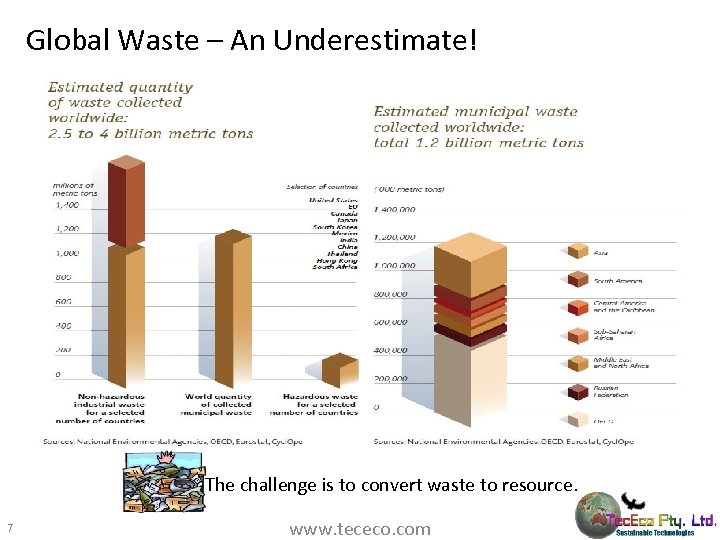 Global Waste – An Underestimate! The challenge is to convert waste to resource. 7 www. tececo. com
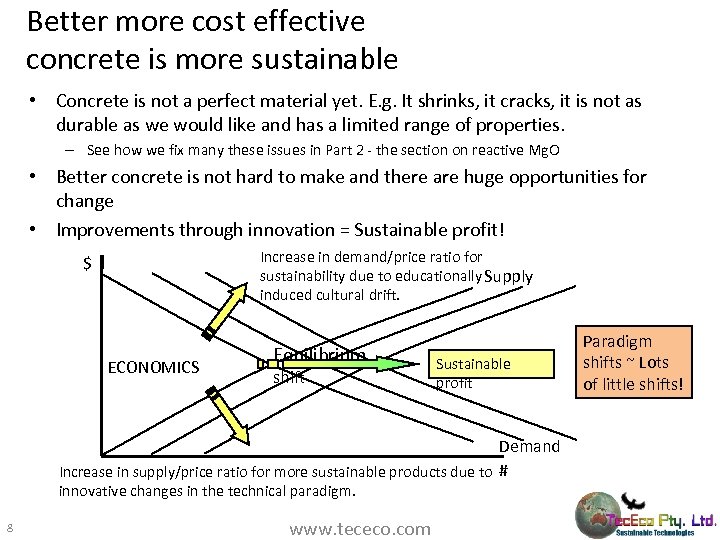 Better more cost effective concrete is more sustainable • Concrete is not a perfect material yet. E. g. It shrinks, it cracks, it is not as durable as we would like and has a limited range of properties. – See how we fix many these issues in Part 2 - the section on reactive Mg. O • Better concrete is not hard to make and there are huge opportunities for change • Improvements through innovation = Sustainable profit! Increase in demand/price ratio for sustainability due to educationally Supply induced cultural drift. $ ECONOMICS Equilibrium shift Sustainable profit Demand Increase in supply/price ratio for more sustainable products due to # innovative changes in the technical paradigm. 8 www. tececo. com Paradigm shifts ~ Lots of little shifts!
 Examples of Huge Change Opportunities • A wide variety of possible end uses with higher potential margins for which current solutions are sub-optimal. – E. g. Addressing properties affecting lifetime energy. • E. g. Mineral composites with higher “R” value – E. g. Particle boards made with mineral binders – E. g. Exterior structural panels with insulating properties The use of Reactive Mg. O makes this possible. See Part 2 • Huge opportunities for reducing the cost base and improving the properties of concretes by focusing on the process by which they are made and what they are made with. – A few tweaks to the formulations – Major changes to the process and some – Lateral thinking in relation to aggregates => Man made carbonate aggregate. See Part 2 for the ramifications of using reactive Mg. O • De-materialization through design (Reductions in Kg CO 2 -e/MPa, see Olafur Wellevik’s presentation 7) • Improvements in durability. Missing from the current analyses for sustainability 7 Wallenvik, Olafur, Carbon Footprint of High Performance Versus Conventional Vibrated Concrete 9 www. tececo. com
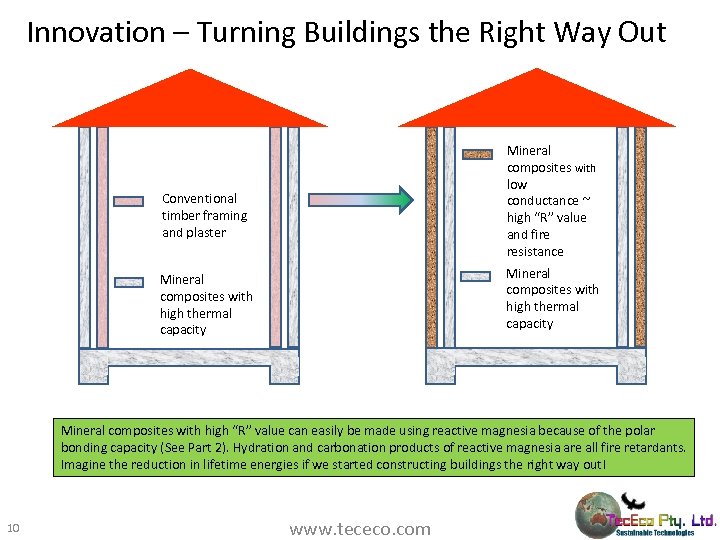 Innovation – Turning Buildings the Right Way Out Mineral composites with low conductance ~ high “R” value and fire resistance Conventional timber framing and plaster Mineral composites with high thermal capacity Mineral composites with high “R” value can easily be made using reactive magnesia because of the polar bonding capacity (See Part 2). Hydration and carbonation products of reactive magnesia are all fire retardants. Imagine the reduction in lifetime energies if we started constructing buildings the right way out! 10 www. tececo. com
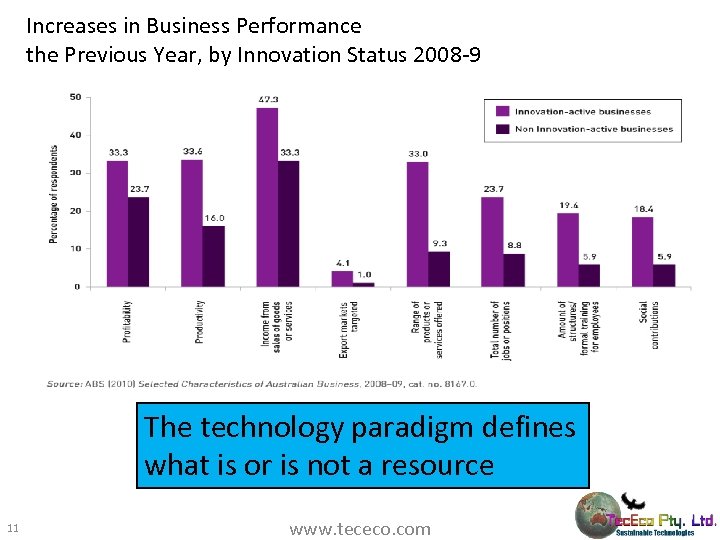 Increases in Business Performance the Previous Year, by Innovation Status 2008 -9 The technology paradigm defines what is or is not a resource 11 www. tececo. com
 Barriers to Innovation and Change • Out of date and inappropriate legislative restriction. – See other presentations • A prescription rather than performance based standards and approvals system. – See Colin Lobo 1 and Wassim Mansour 3 and other presentations as well as what I have to say. • A corrupt patent System. – – • Lack of transparency in relation to new products. – • Conflicting Secret formulations more often than not in breach of other people’s intellectual property (ip). Knowledge should be free – • Governments tend to issue patents to anyone for the money A lack of know how in patent offices as a result of low pay Wikipedia v Science Direct etc. Green wash. – See other presentations • A focus on cost instead of cost effective – Little or no support for “cutting edge research” (See Lionel Lemay’s presentation 4) • • Conservatism (Goes without saying? ) A low level of skills in the industry 9 Lobo, Colin, The role of Performance Based Specification in Sustainable Development 10 Mansour, Wassim, Towards Performance-based Specification – Case Studies on Construction Projects in Abu Dhabi 11 Lemay, Lionel, Life cycle Assessment of Concrete Structures 12 www. tececo. com
 The Standards and Approvals Systems • Far too often our standards and approvals ratings are prescription based stifling innovation and change. • Even Leeds in the US and the Green Building Council in Australia make the same mistake • Standards should be based on a list of metrics for properties including embodied energy and emissions, thermal capacity and conductance, strength (compressive, shear and flexural) etc. • This means that many existing standards should be relegated to being “codes of practice” • Proper audit process instead? ? See Colin Lobo’s presentation (NRMCA) 13 www. tececo. com
 A Corrupt Global Patent System • Patents are taken far to literally; the intent and purpose are almost irrelevant. • Most patent examiners are basically incompetent – How could they be otherwise? • The revenue raised is of greater importance to the grantee government than the value of the so called monopoly rights given. • Patents are an invitation and challenge to others to steal ip. – Many secret formulations end up being identified as stolen ip. • Governments do not protect the ip they “grant” they let the players fight it out in court. • It follows that patents are little more than meat for dogs to fight over. – Consider geopolymers for example and my own experience. 14 www. tececo. com
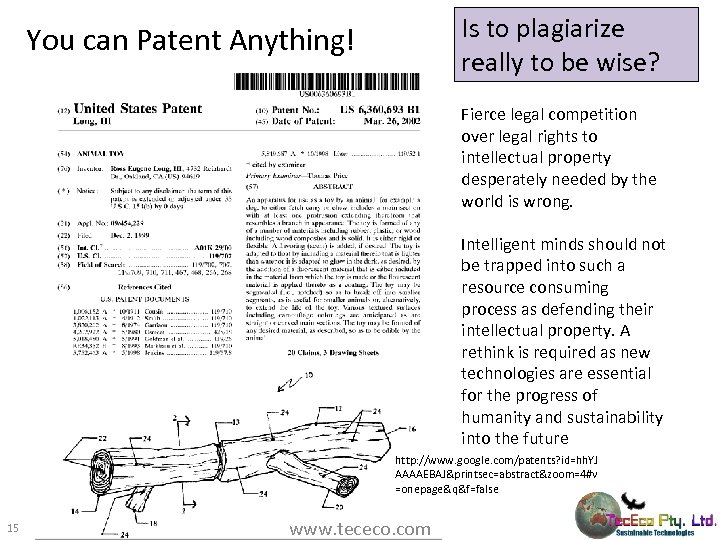 Is to plagiarize really to be wise? You can Patent Anything! Fierce legal competition over legal rights to intellectual property desperately needed by the world is wrong. Intelligent minds should not be trapped into such a resource consuming process as defending their intellectual property. A rethink is required as new technologies are essential for the progress of humanity and sustainability into the future http: //www. google. com/patents? id=hh. YJ AAAAEBAJ&printsec=abstract&zoom=4#v =onepage&q&f=false 15 www. tececo. com
 Cost rather than Profit Based Business Models • Most corporations in the concrete industry have business model that relies on significant turnover and cost cutting to deliver profit. – Research and development budgets that deliver innovations and potentially more profitable product are generally small. If the industry believe in “cutting edge” research then they are going to have to practice what they preach and support innovation. In Australia there is now benchmark support for R & D and commercialisation 16 www. tececo. com
 Conservatism • With the exception of perhaps the architectural fraternity players in the construction industry are generally conservative • There is little incentive and a lot of risk in using new materials that have reduced embodied energies and emissions and substantial impact on reducing lifetime energies. • One of the reasons for this conservatism is the legal liability of designers and engineers. • Perhaps prescription standards should become codes of practice and greater support given for testing of new materials. • Audited procedures and less reliance on standards? 17 www. tececo. com
 The Low Level of Skills in the Industry • There is an appallingly low level of skills in the concrete industry. – Electricians and plumbers must have licenses in most countries yet concrete placers and finishers seldom have any training at all. – Most civil engineers are taught very little and understand less about the material they use every day. • It is no wonder we have the attitude that all that is grey is great, all we make goes out the gate. (With affront meant to Grey Matters) – any diversion is risky! • This terrible situation needs to change. – Congratulations to the NRMCA re their producer training programs but what about placers and finishers? • Quality control should go beyond testing, it must include risk management through training. 18 www. tececo. com
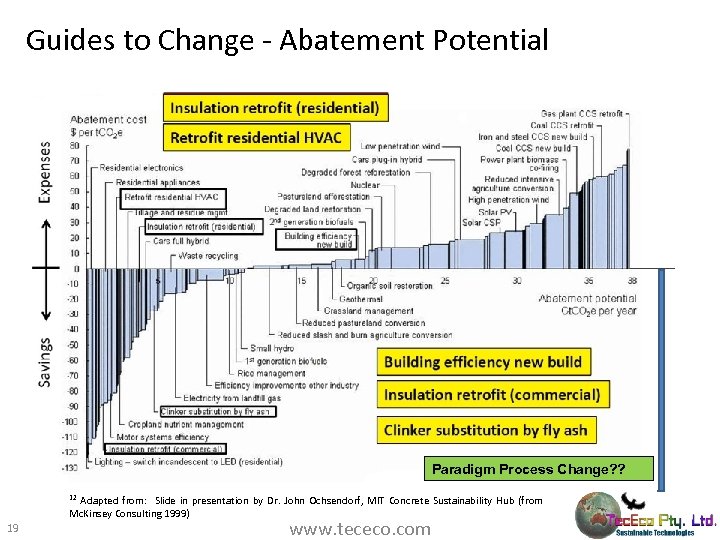 Guides to Change - Abatement Potential Paradigm Process Change? ? 12 Adapted from: Slide in presentation by Dr. John Ochsendorf, MIT Concrete Sustainability Hub (from Mc. Kinsey Consulting 1999) 19 www. tececo. com
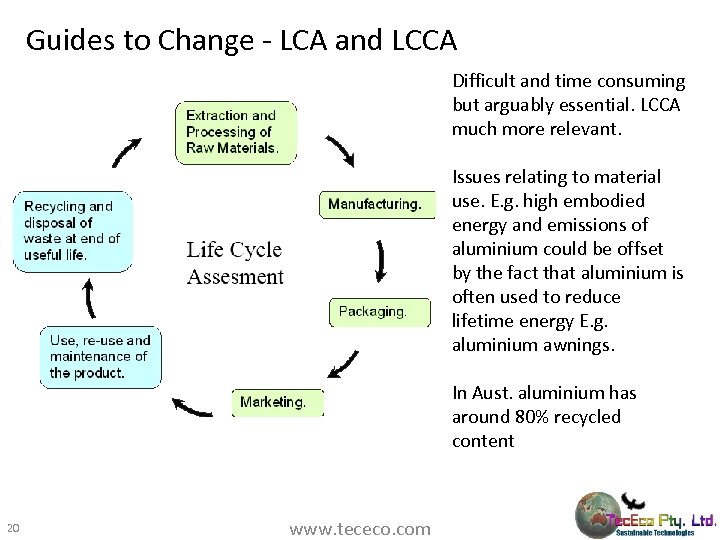 Guides to Change - LCA and LCCA Difficult and time consuming but arguably essential. LCCA much more relevant. Issues relating to material use. E. g. high embodied energy and emissions of aluminium could be offset by the fact that aluminium is often used to reduce lifetime energy E. g. aluminium awnings. In Aust. aluminium has around 80% recycled content 20 www. tececo. com
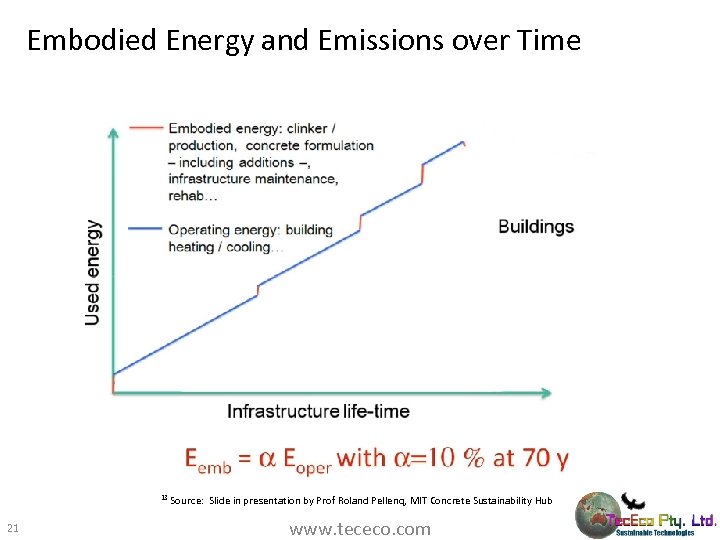 Embodied Energy and Emissions over Time 13 Source: Slide in presentation by Prof Roland Pellenq, MIT Concrete Sustainability Hub 21 www. tececo. com
 Summary • The use of Abatement Potential and LCA and in particular LCCA should guide cost effective reductions in embodied energy and emissions • Cost effective reductions in lifetime energies • De materialization (reduced over design) • The MIT Sustainability Hub 14 are probably the most advanced – Missing the impact of mineral composites made possible with reactive Mg. O with properties other than high thermal capacity such as “R” value – Missing is any contemplation of paradigm changes. E. g. in the way we make cements. 14 http: //web. mit. edu/cshub/ 22 www. tececo. com
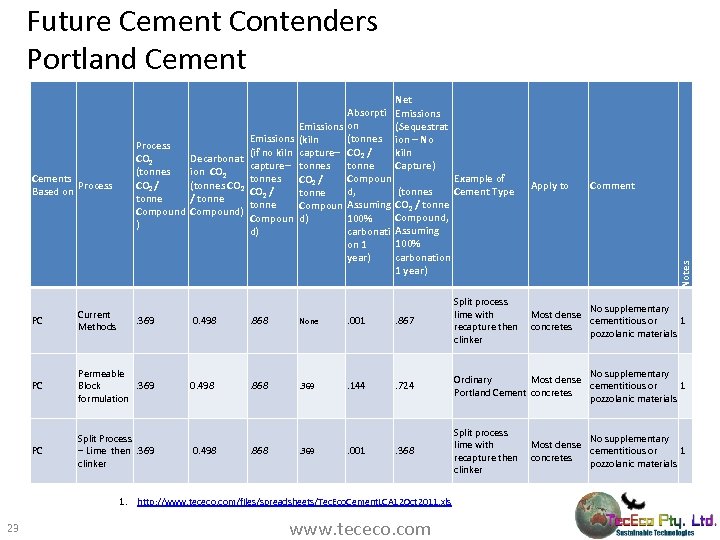 Future Cement Contenders Portland Cement Apply to Comment Notes Cements Process Based on Net Absorpti Emissions (Sequestrat Emissions on (tonnes ion – No Emissions (kiln Process (if no kiln capture– CO 2 / kiln Decarbonat CO 2 tonne capture– tonnes Capture) (tonnes ion CO 2 Compoun Example of tonnes CO 2 / (tonnes CO 2 (tonnes d, CO 2 / Cement Type tonne / tonne CO 2 / tonne Compoun Assuming Compound) Compound, 100% Compoun d) ) carbonati Assuming d) 100% on 1 carbonation year) 1 year) PC Current Methods . 369 0. 498 . 868 None . 001 . 867 Split process No supplementary Most dense lime with cementitious or 1 recapture then concretes pozzolanic materials clinker PC Permeable Block . 369 formulation 0. 498 . 868 . 369 . 144 . 724 No supplementary Ordinary Most dense cementitious or 1 Portland Cement concretes pozzolanic materials PC Split Process – Lime then . 369 clinker . 368 Split process No supplementary Most dense lime with cementitious or 1 recapture then concretes pozzolanic materials clinker 0. 498 . 868 . 369 . 001 1. http: //www. tececo. com/files/spreadsheets/Tec. Eco. Cement. LCA 12 Oct 2011. xls 23 www. tececo. com
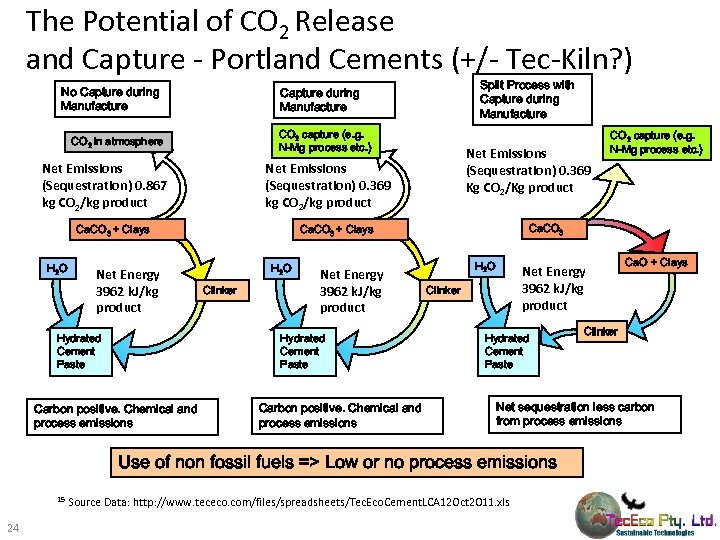 The Potential of CO 2 Release and Capture - Portland Cements (+/- Tec-Kiln? ) No Capture during Manufacture CO 2 capture (e. g. N-Mg process etc. ) CO 2 in atmosphere Hydrated Cement Paste H 2 O Clinker Net Energy 3962 k. J/kg product Hydrated Cement Paste Carbon positive. Chemical and process emissions H 2 O Net Energy 3962 k. J/kg product Clinker Hydrated Cement Paste Ca. O + Clays Clinker Net sequestration less carbon from process emissions Use of non fossil fuels => Low or no process emissions 15 Source Data: http: //www. tececo. com/files/spreadsheets/Tec. Eco. Cement. LCA 12 Oct 2011. xls 24 CO 2 capture (e. g. N-Mg process etc. ) Ca. CO 3 + Clays Net Energy 3962 k. J/kg product Net Emissions (Sequestration) 0. 369 Kg CO 2/Kg product Net Emissions (Sequestration) 0. 369 kg CO 2/kg product Net Emissions (Sequestration) 0. 867 kg CO 2/kg product H 2 O Split Process with Capture during Manufacture
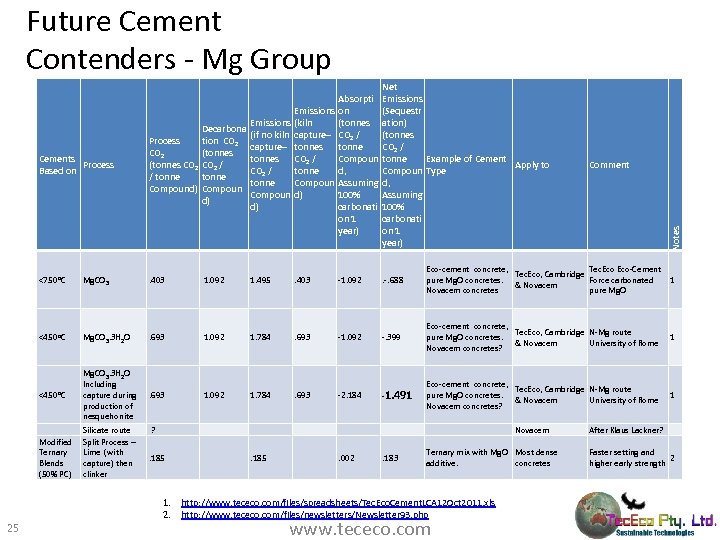 Future Cement Contenders - Mg Group Cements Process Based on Absorpti Emissions on Emissions (kiln (tonnes Decarbona (if no kiln capture– CO 2 / Process tion CO 2 capture– tonnes tonne CO 2 (tonnes CO 2 / Compoun (tonnes CO 2 / tonne d, / tonne Compoun Assuming Compound) Compoun d) 100% d) d) carbonati on 1 year) Net Emissions (Sequestr ation) (tonnes CO 2 / tonne Example of Cement Apply to Compoun Type d, Assuming 100% carbonati on 1 year) <750 o. C Mg. CO 3 . 403 1. 092 1. 495 . 403 -1. 092 . -. 688 Eco-cement concrete, Tec. Eco-Cement Tec. Eco, Cambridge pure Mg. O concretes. Force carbonated & Novacem concretes pure Mg. O 1 <450 o. C Mg. CO 3. 3 H 2 O . 693 1. 092 1. 784 . 693 -1. 092 -. 399 Eco-cement concrete, Tec. Eco, Cambridge N-Mg route pure Mg. O concretes. & Novacem University of Rome Novacem concretes? 1 . 693 1. 092 1. 784 . 693 -2. 184 -1. 491 Eco-cement concrete, Tec. Eco, Cambridge N-Mg route pure Mg. O concretes. & Novacem University of Rome Novacem concretes? 1 ? . 185 . 002 . 183 Ternary mix with Mg. O Most dense additive. concretes Mg. CO 3. 3 H 2 O Including <450 o. C capture during production of nesquehonite Silicate route Modified Split Process – Ternary Lime (with Blends capture) then (50% PC) clinker 25 1. http: //www. tececo. com/files/spreadsheets/Tec. Eco. Cement. LCA 12 Oct 2011. xls 2. http: //www. tececo. com/files/newsletters/Newsletter 93. php www. tececo. com Novacem Notes Comment After Klaus Lackner? Faster setting and 2 higher early strength
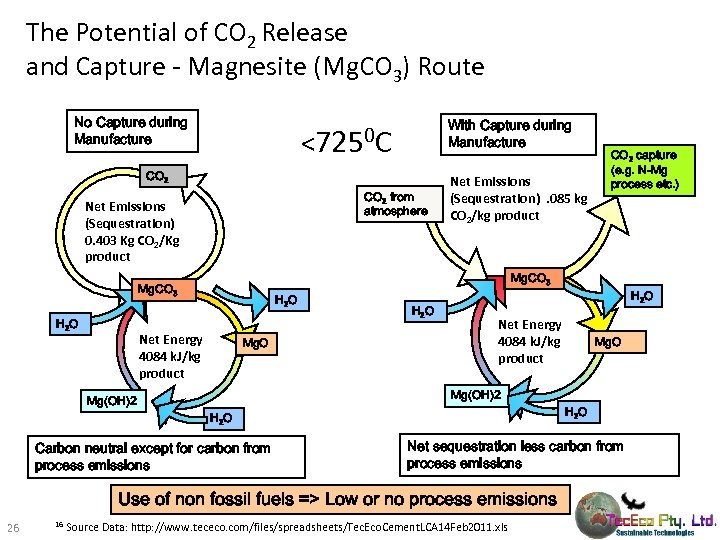 The Potential of CO 2 Release and Capture - Magnesite (Mg. CO 3) Route No Capture during Manufacture With Capture during Manufacture <7250 C CO 2 from atmosphere Net Emissions (Sequestration) 0. 403 Kg CO 2/Kg product Mg. CO 3 H 2 O Net Emissions (Sequestration). 085 kg CO 2/kg product H 2 O Net Energy 4084 k. J/kg product Mg. O Mg(OH)2 H 2 O Carbon neutral except for carbon from process emissions Net sequestration less carbon from process emissions Use of non fossil fuels => Low or no process emissions 26 CO 2 capture (e. g. N-Mg process etc. ) 16 Source Data: http: //www. tececo. com/files/spreadsheets/Tec. Eco. Cement. LCA 14 Feb 2011. xls
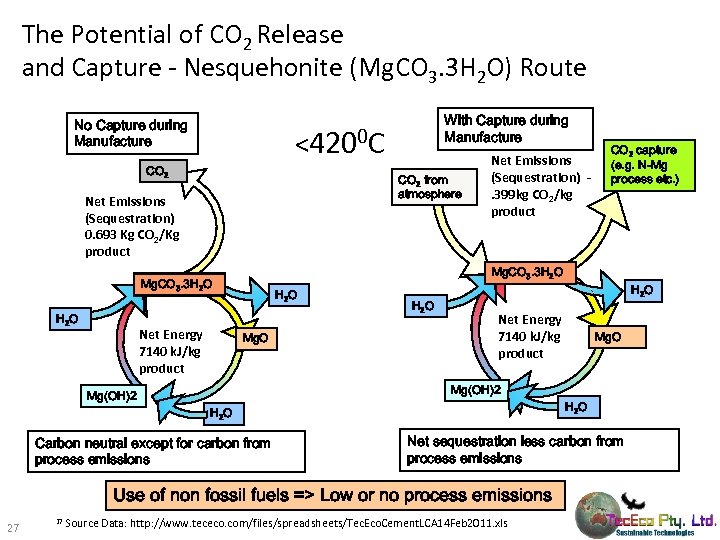 The Potential of CO 2 Release and Capture - Nesquehonite (Mg. CO 3. 3 H 2 O) Route No Capture during Manufacture <4200 C CO 2 from atmosphere Net Emissions (Sequestration) 0. 693 Kg CO 2/Kg product Net Energy 7140 k. J/kg product Net Emissions (Sequestration). 399 kg CO 2/kg product H 2 O Mg. O H 2 O Net Energy 7140 k. J/kg product H 2 O Carbon neutral except for carbon from process emissions Net sequestration less carbon from process emissions Use of non fossil fuels => Low or no process emissions 17 Mg. O Mg(OH)2 27 CO 2 capture (e. g. N-Mg process etc. ) Mg. CO 3. 3 H 2 O With Capture during Manufacture Source Data: http: //www. tececo. com/files/spreadsheets/Tec. Eco. Cement. LCA 14 Feb 2011. xls
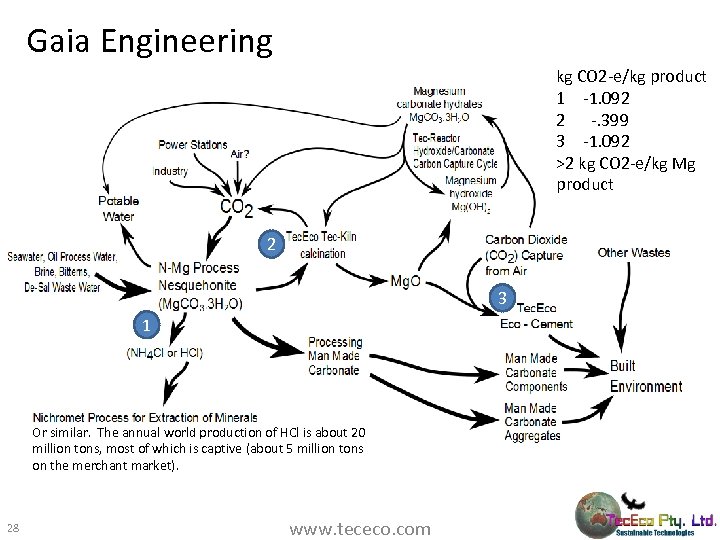 Gaia Engineering kg CO 2 -e/kg product 1 -1. 092 2 -. 399 3 -1. 092 >2 kg CO 2 -e/kg Mg product 2 3 1 Or similar. The annual world production of HCl is about 20 million tons, most of which is captive (about 5 million tons on the merchant market). 28 www. tececo. com
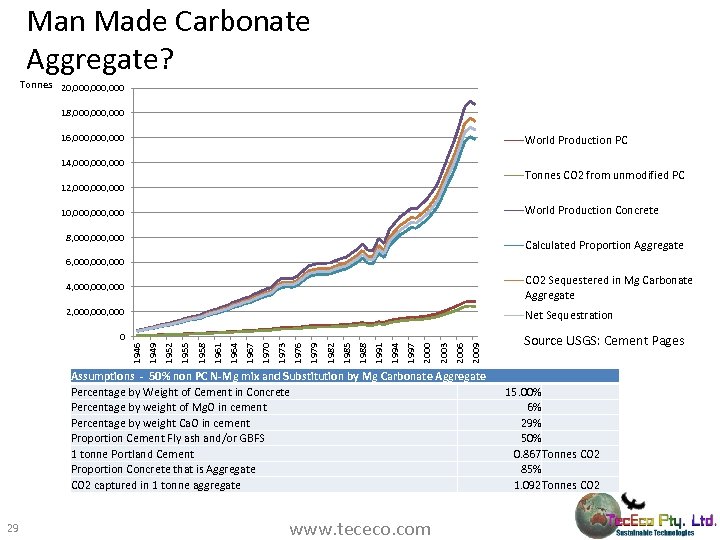 Man Made Carbonate Aggregate? Tonnes 20, 000, 000 18, 000, 000 16, 000, 000 World Production PC 14, 000, 000 Tonnes CO 2 from unmodified PC 12, 000, 000 World Production Concrete 10, 000, 000 8, 000, 000 Calculated Proportion Aggregate 6, 000, 000 4, 000, 000 CO 2 Sequestered in Mg Carbonate Aggregate 2, 000, 000 Net Sequestration 2009 2006 2003 2000 1997 1994 1991 1988 1985 1982 1979 1976 1973 1970 1967 1964 1961 1958 1955 1952 1949 1946 0 Assumptions - 50% non PC N-Mg mix and Substitution by Mg Carbonate Aggregate Percentage by Weight of Cement in Concrete Percentage by weight of Mg. O in cement Percentage by weight Ca. O in cement Proportion Cement Fly ash and/or GBFS 1 tonne Portland Cement Proportion Concrete that is Aggregate CO 2 captured in 1 tonne aggregate 29 www. tececo. com Source USGS: Cement Pages 15. 00% 6% 29% 50% 0. 867 Tonnes CO 2 85% 1. 092 Tonnes CO 2
 Magnesium Carbonate Cements • Magnesite (Mg. CO 3) and the di, tri, and pentahydrates known as barringtonite (Mg. CO 3· 2 H 2 O), nesquehonite (Mg. CO 3· 3 H 2 O), and lansfordite (Mg. CO 3· 5 H 2 O), respectively. • Some basic forms such as artinite (Mg. CO 3·Mg(OH)2· 3 H 2 O), hydromagnestite (4 Mg. CO 3·Mg(OH)2· 4 H 2 O) and dypingite (4 Mg. CO 3· Mg(OH)2· 5 H 2 O) also occur as minerals. • We pointed out as early as 2001 that magnesium carbonates are ideal for sequestration as building materials mainly because a higher proportion of CO 2 than with calcium can be bound and significant strength can be achieved. • The significant strength is a result of increased density through carbonation (high molar volume increases) and the microstructure developed by some forms. Tec. Eco-Cements have relatively high proportions of magnesia which in permeable materials carbonates forming lansfordite and nesquehonite adding strength and durability. Eco-Cement formulations are generally used for bricks, blocks, pavers, pervious pavements and other permeable cement based products. See http: //www. tececo. com/products. eco-cement. php 30 www. tececo. com
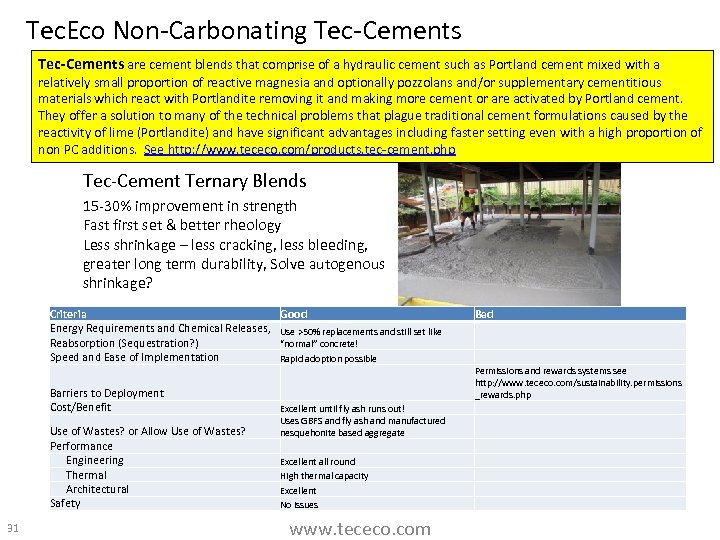 Tec. Eco Non-Carbonating Tec-Cements are cement blends that comprise of a hydraulic cement such as Portland cement mixed with a relatively small proportion of reactive magnesia and optionally pozzolans and/or supplementary cementitious materials which react with Portlandite removing it and making more cement or are activated by Portland cement. They offer a solution to many of the technical problems that plague traditional cement formulations caused by the reactivity of lime (Portlandite) and have significant advantages including faster setting even with a high proportion of non PC additions. See http: //www. tececo. com/products. tec-cement. php Tec-Cement Ternary Blends 15 -30% improvement in strength Fast first set & better rheology Less shrinkage – less cracking, less bleeding, greater long term durability, Solve autogenous shrinkage? Criteria Energy Requirements and Chemical Releases, Reabsorption (Sequestration? ) Speed and Ease of Implementation Barriers to Deployment Cost/Benefit Use of Wastes? or Allow Use of Wastes? Performance Engineering Thermal Architectural Safety 31 Good Use >50% replacements and still set like “normal” concrete! Rapid adoption possible Excellent until fly ash runs out! Uses GBFS and fly ash and manufactured nesquehonite based aggregate Excellent all round High thermal capacity Excellent No issues www. tececo. com Bad Permissions and rewards systems see http: //www. tececo. com/sustainability. permissions _rewards. php
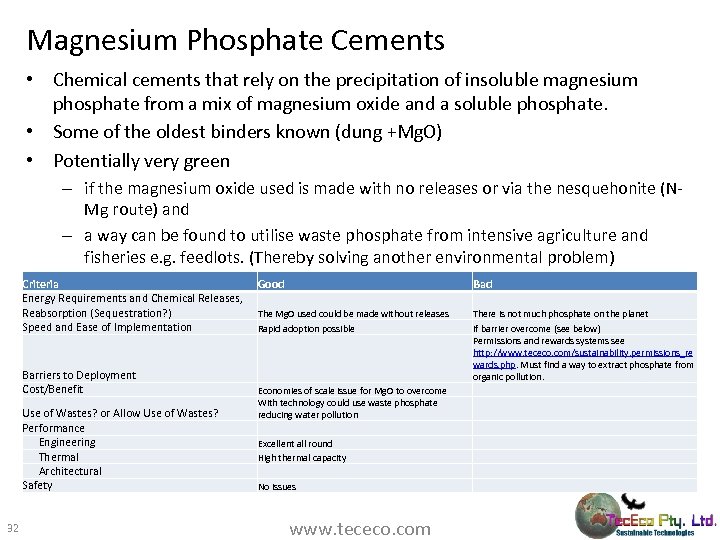 Magnesium Phosphate Cements • Chemical cements that rely on the precipitation of insoluble magnesium phosphate from a mix of magnesium oxide and a soluble phosphate. • Some of the oldest binders known (dung +Mg. O) • Potentially very green – if the magnesium oxide used is made with no releases or via the nesquehonite (NMg route) and – a way can be found to utilise waste phosphate from intensive agriculture and fisheries e. g. feedlots. (Thereby solving another environmental problem) Criteria Good Energy Requirements and Chemical Releases, Reabsorption (Sequestration? ) The Mg. O used could be made without releases Speed and Ease of Implementation Rapid adoption possible Barriers to Deployment Cost/Benefit Use of Wastes? or Allow Use of Wastes? Performance Engineering Thermal Architectural Safety 32 Economies of scale issue for Mg. O to overcome With technology could use waste phosphate reducing water pollution Excellent all round High thermal capacity No issues www. tececo. com Bad There is not much phosphate on the planet If barrier overcome (see below) Permissions and rewards systems see http: //www. tececo. com/sustainability. permissions_re wards. php. Must find a way to extract phosphate from organic pollution.
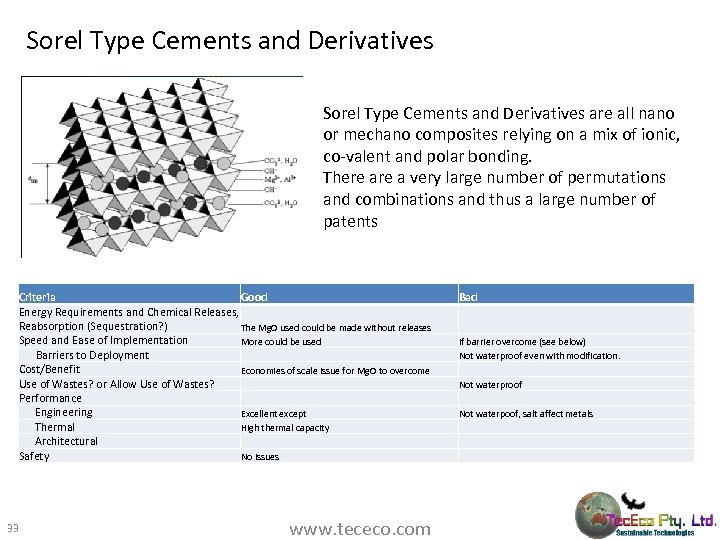 Sorel Type Cements and Derivatives are all nano or mechano composites relying on a mix of ionic, co-valent and polar bonding. There a very large number of permutations and combinations and thus a large number of patents Criteria Good Energy Requirements and Chemical Releases, Reabsorption (Sequestration? ) The Mg. O used could be made without releases Speed and Ease of Implementation More could be used Barriers to Deployment Cost/Benefit Economies of scale issue for Mg. O to overcome Use of Wastes? or Allow Use of Wastes? Performance Engineering Excellent except Thermal High thermal capacity Architectural Safety No issues 33 www. tececo. com Bad If barrier overcome (see below) Not waterproof even with modification. Not waterproof Not waterpoof, salt affect metals
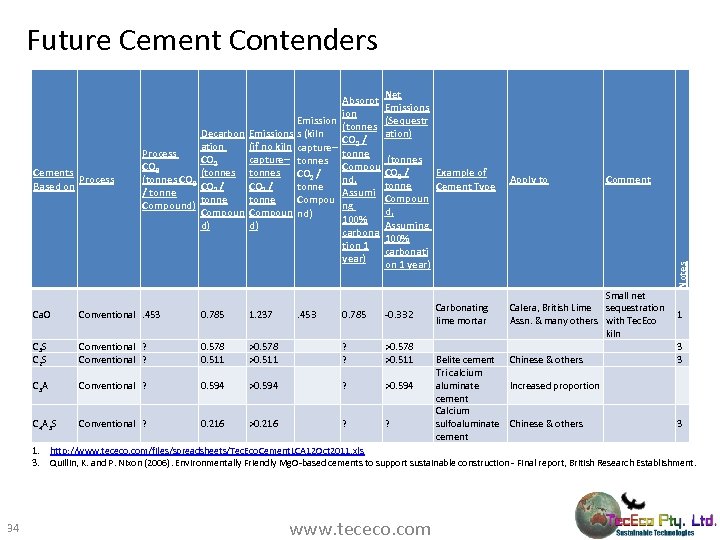 Future Cement Contenders (tonnes CO 2 / Example of tonne Cement Type Compoun d, Assuming 100% carbonati on 1 year) 0. 785 -0. 332 >0. 578 >0. 511 ? ? >0. 578 >0. 511 0. 594 >0. 594 ? >0. 594 0. 216 >0. 216 ? ? Ca. O Conventional . 453 0. 785 1. 237 C 3 S C 2 S Conventional ? 0. 578 0. 511 C 3 A Conventional ? C 4 A 3 S Conventional ? . 453 Net Emissions (Sequestr ation) Carbonating lime mortar Apply to Comment Notes Cements Process Based on Absorpt ion Emission (tonnes Decarbon Emissions s (kiln CO 2 / ation (if no kiln capture– tonne Process CO 2 capture– tonnes Compou CO 2 (tonnes CO 2 / nd, (tonnes CO 2 / tonne Assumi / tonne Compou ng Compound) Compoun nd) 100% d) d) carbona tion 1 year) Small net Calera, British Lime sequestration 1 Assn. & many others with Tec. Eco kiln 3 Chinese & others 3 Belite cement Tri calcium Increased proportion aluminate cement Calcium sulfoaluminate Chinese & others cement 3 1. http: //www. tececo. com/files/spreadsheets/Tec. Eco. Cement. LCA 12 Oct 2011. xls 3. Quillin, K. and P. Nixon (2006). Environmentally Friendly Mg. O-based cements to support sustainable construction - Final report, British Research Establishment. 34 www. tececo. com
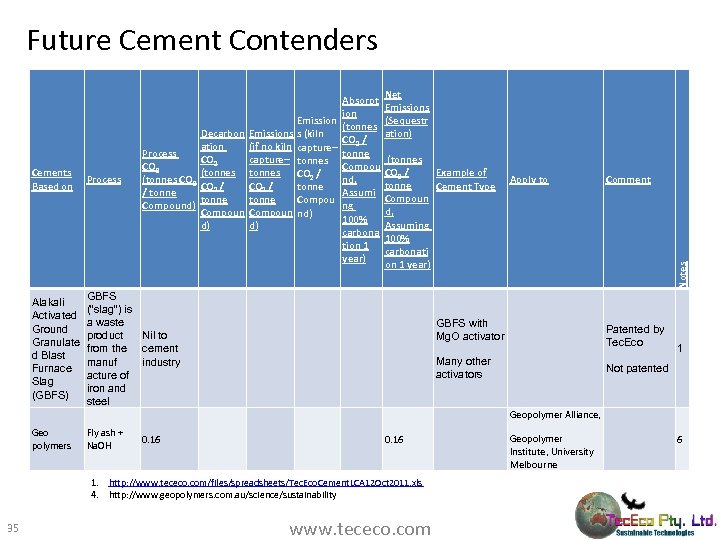 Future Cement Contenders Cements Based on Process Alakali Activated Ground Granulate d Blast Furnace Slag (GBFS) Net Emissions (Sequestr ation) (tonnes CO 2 / Example of tonne Cement Type Compoun d, Assuming 100% carbonati on 1 year) GBFS (“slag”) is a waste Nil to product from the cement manuf industry acture of iron and steel Apply to Comment Notes Absorpt ion Emission (tonnes Decarbon Emissions s (kiln CO 2 / ation (if no kiln capture– tonne Process CO 2 capture– tonnes Compou CO 2 (tonnes CO 2 / nd, (tonnes CO 2 / tonne Assumi / tonne Compou ng Compound) Compoun nd) 100% d) d) carbona tion 1 year) GBFS with Mg. O activator Patented by Tec. Eco Many other activators 1 Not patented Geopolymer Alliance, Geo polymers Fly ash + Na. OH 0. 16 1. http: //www. tececo. com/files/spreadsheets/Tec. Eco. Cement. LCA 12 Oct 2011. xls 4. http: //www. geopolymers. com. au/science/sustainability 35 www. tececo. com Geopolymer Institute, University Melbourne 6
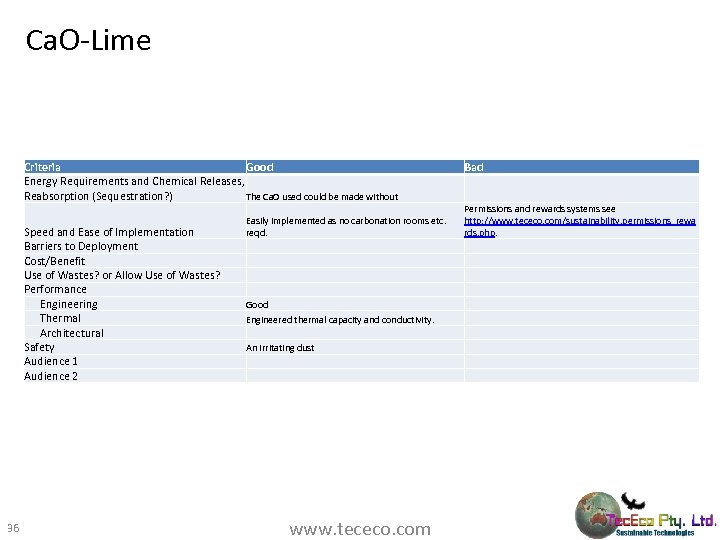 Ca. O-Lime Criteria Good Energy Requirements and Chemical Releases, Reabsorption (Sequestration? ) The Ca. O used could be made without Speed and Ease of Implementation Barriers to Deployment Cost/Benefit Use of Wastes? or Allow Use of Wastes? Performance Engineering Thermal Architectural Safety Audience 1 Audience 2 36 Easily implemented as no carbonation rooms etc. reqd. Good Engineered thermal capacity and conductivity. An irritating dust www. tececo. com Bad Permissions and rewards systems see http: //www. tececo. com/sustainability. permissions_rewa rds. php.
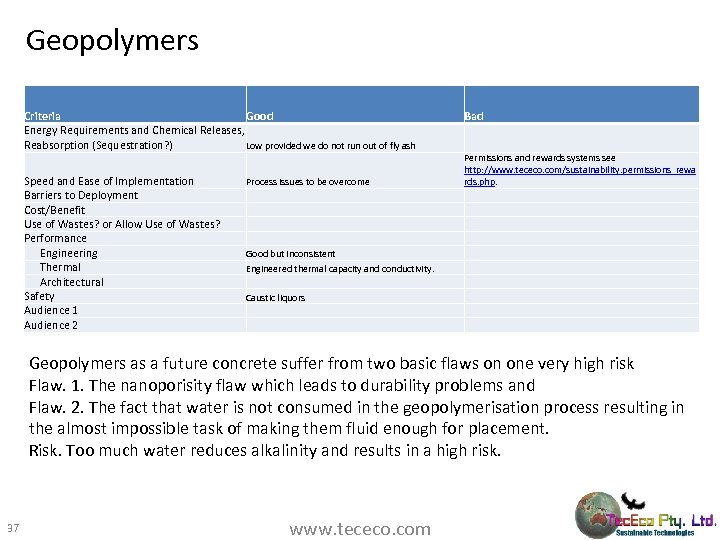 Geopolymers Criteria Good Energy Requirements and Chemical Releases, Reabsorption (Sequestration? ) Low provided we do not run out of fly ash Speed and Ease of Implementation Barriers to Deployment Cost/Benefit Use of Wastes? or Allow Use of Wastes? Performance Engineering Thermal Architectural Safety Audience 1 Audience 2 Process issues to be overcome Bad Permissions and rewards systems see http: //www. tececo. com/sustainability. permissions_rewa rds. php. Good but inconsistent Engineered thermal capacity and conductivity. Caustic liquors Geopolymers as a future concrete suffer from two basic flaws on one very high risk Flaw. 1. The nanoporisity flaw which leads to durability problems and Flaw. 2. The fact that water is not consumed in the geopolymerisation process resulting in the almost impossible task of making them fluid enough for placement. Risk. Too much water reduces alkalinity and results in a high risk. 37 www. tececo. com
 Other Contenders • Slag cements a variant of Portland cement as CSH is the main product. • Supersulfated cements have potential as they are made mostly from GBFS and gypsum which are wastes and only a small amount of PC or lime. The main hydration product is ettringite and they show good resistance to aggressive agents including sulphate but are slow to set. (A derivative) • Calcium aluminate cements are hydraulic cements made from limestone and bauxite. The main components are monocalcium aluminate Ca. Al 2 O 4 (CA) and mayenite Ca 12 Al 14 O 33 (C 12 A 7) which hydrate to give strength. Calcium aluminate cements are chemically resistant and stable to quite high temperatures. • Calcium sulfoaluminate cements & belite calcium sulfoaluminate cements are low energy cements that have the potential to be made from industrial by products such as low calcium fly ash and sulphur rich wastes. The main hydration product producing strength is ettringite. Their use has been pioneered in China (A derivative) • Fly ash Cements based on Class C fly ash. As this type of fly ash varies it has been difficult to produce a consistent product. 38 www. tececo. com
 Other Contenders • Belite cements can be made at a lower temperature and contains less lime than Portland cement and therefore has much lower embodied energy and emissions. Cements containing predominantly belite are slower to set but otherwise have satisfactory properties. Many early Portland type cements such as Rosendale cement were rich in belite like phases. (a variant, See http: //www. tececo. com/links. cement_rosendale. php. ) • PC - Mg. O – GBFS – fly ash blends. Mg. O is the most powerful new tool in hydraulic cement blends since the revelation that reactive magnesia can be blended with other hydraulic cements such as Portland cement. 25 -30% improvements in compressive strength and greater improvements in tensile strength, faster first set, better rheology and less shrinkage and cracking less bleeding and long term durability have been demonstrated. It is also possible autogenous shrinkage has been solved. • Mg. O blended with other hydraulic cements, pozzolans and supplementary cementitious materials (SCM’s). Amazingly very little real research has been done on optimised blends particularly with cements other than Portland cement. 18 See also: Sanjayan, Jay, Recent advances in geopolymer and other non-Portland based cements. Proc. Concrete 2011, CIA. 39 www. tececo. com
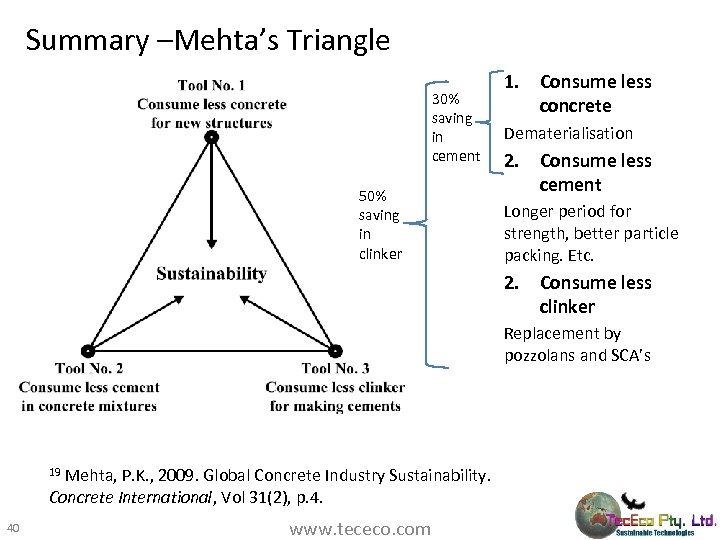 Summary –Mehta’s Triangle 30% saving in cement 50% saving in clinker 1. Consume less concrete Dematerialisation 2. Consume less cement Longer period for strength, better particle packing. Etc. 2. Consume less clinker Replacement by pozzolans and SCA’s 19 Mehta, P. K. , 2009. Global Concrete Industry Sustainability. Concrete International, Vol 31(2), p. 4. 40 www. tececo. com
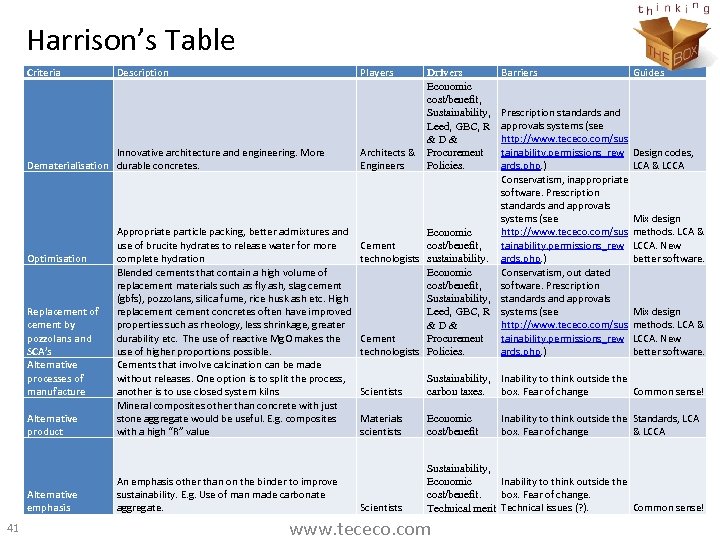 Harrison’s Table Criteria Description Players Drivers Economic cost/benefit, Sustainability, Leed, GBC, R &D& Architects & Procurement Engineers Policies. Barriers Guides Prescription standards and approvals systems (see http: //www. tececo. com/sus Innovative architecture and engineering. More tainability. permissions_rew Design codes, Dematerialisation durable concretes. ards. php. ) LCA & LCCA Conservatism, inappropriate software. Prescription standards and approvals Mix design systems (see Appropriate particle packing, better admixtures and http: //www. tececo. com/sus methods. LCA & Economic Cement use of brucite hydrates to release water for more tainability. permissions_rew LCCA. New cost/benefit, Optimisation complete hydration technologists sustainability. ards. php. ) better software. Blended cements that contain a high volume of Conservatism, out dated Economic replacement materials such as fly ash, slag cement software. Prescription cost/benefit, (gbfs), pozzolans, silica fume, rice husk ash etc. High Sustainability, standards and approvals Replacement of Mix design replacement concretes often have improved Leed, GBC, R systems (see cement by properties such as rheology, less shrinkage, greater http: //www. tececo. com/sus methods. LCA & &D& pozzolans and durability etc. The use of reactive Mg. O makes the Cement tainability. permissions_rew LCCA. New Procurement SCA’s use of higher proportions possible. ards. php. ) better software. technologists Policies. Alternative Cements that involve calcination can be made processes of without releases. One option is to split the process, Sustainability, Inability to think outside the manufacture another is to use closed system kilns Scientists Common sense! carbon taxes. box. Fear of change Mineral composites other than concrete with just stone aggregate would be useful. E. g. composites Alternative Materials Inability to think outside the Standards, LCA Economic product with a high “R” value scientists box. Fear of change & LCCA cost/benefit Alternative emphasis 41 An emphasis other than on the binder to improve sustainability. E. g. Use of man made carbonate aggregate. Scientists Sustainability, Inability to think outside the Economic box. Fear of change. cost/benefit. Common sense! Technical merit Technical issues (? ). www. tececo. com
 Part 2 The Role of Reactive Mg. O – An Update on Tec. Eco Technology An update on recent advances in Tec and Eco. Cements including the use of high proportions of fly ash and SCMS with added reactive magnesia Reactive Magnesia is the most powerful new tool in cement chemistry 42 www. tececo. com
 Tec. Eco Patents • Reactive magnesia (calcined at less than about 750 0 C) included in a hydraulic composition with or without added pozzolans. They may or may not carbonate. • We define in most jurisdictions hydraulic cements according to the ASTM C 219 -94 definition as “a cement that sets and hardens by chemical interaction with water and that is capable of doing so under water” • We include slag cements as hydraulic and notice the American Slag Association think likewise. • Beware of imitators and charlatans 43 www. tececo. com
 Tec. Eco Cements • Eco-Cements have relatively high proportions of magnesia which in permeable materials carbonates adding strength and durability. Eco-Cement formulations are generally used for bricks, blocks, pavers, pervious pavements and other permeable cement based products. See http: //www. tececo. com/products. eco-cement. php • Enviro-Cements are made using large quantities of reactive magnesia which reacts to form brucite. Brucite is unique to Tec. Eco Cements and is an ideal mineral for trapping toxic and hazardous wastes due to its layered structure, equilibrium p. H level, durability and low solubility. See http: //www. tececo. com/products. enviro-cement. php • Tec-Cements are cement blends that comprise of a hydraulic cement such as Portland cement mixed with a relatively small proportion of reactive magnesia and optionally pozzolans and/or supplementary cementitious materials which react with Portlandite removing it and making more cement or are activated by Portland cement. They offer a solution to many of the technical problems that plague traditional cement formulations caused by the reactivity of lime (Portlandite) and have significant advantages including faster setting even with a high proportion of non PC additions. See http: //www. tececo. com/products. tec-cement. php 44 www. tececo. com
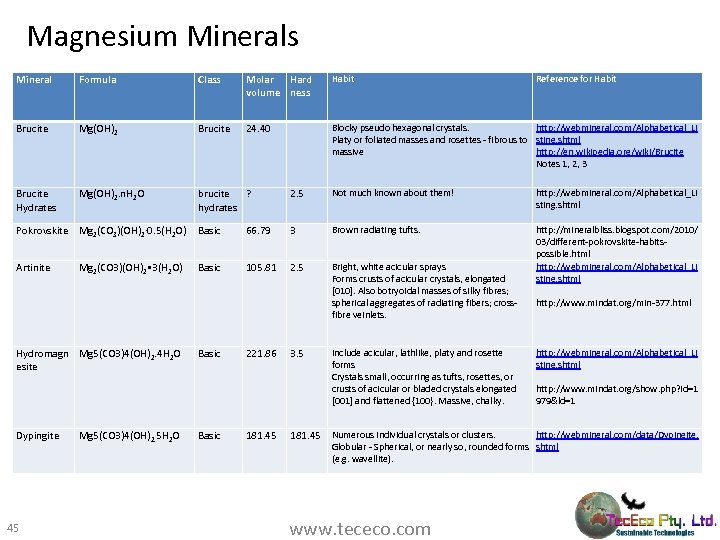 Magnesium Minerals Mineral Formula Class Molar Hard volume ness Habit Brucite Mg(OH)2 Brucite 24. 40 Blocky pseudo hexagonal crystals. http: //webmineral. com/Alphabetical_Li Platy or foliated masses and rosettes - fibrous to sting. shtml massive http: //en. wikipedia. org/wiki/Brucite Notes 1, 2, 3 Brucite Hydrates Mg(OH)2. n. H 2 O brucite ? hydrates 2. 5 Not much known about them! http: //webmineral. com/Alphabetical_Li sting. shtml Pokrovskite Mg 2(CO 3)(OH)2· 0. 5(H 2 O) Basic 66. 79 3 Brown radiating tufts. Artinite Mg 2(CO 3)(OH)2 • 3(H 2 O) Basic 105. 81 2. 5 Bright, white acicular sprays Forms crusts of acicular crystals, elongated [010]. Also botryoidal masses of silky fibres; spherical aggregates of radiating fibers; crossfibre veinlets. http: //mineralbliss. blogspot. com/2010/ 03/different-pokrovskite-habitspossible. html http: //webmineral. com/Alphabetical_Li sting. shtml http: //www. mindat. org/min-377. html Hydromagn Mg 5(CO 3)4(OH)2. 4 H 2 O esite Basic 221. 86 3. 5 Include acicular, lathlike, platy and rosette forms Crystals small, occurring as tufts, rosettes, or crusts of acicular or bladed crystals elongated [001] and flattened {100}. Massive, chalky. Dypingite Basic 181. 45 Numerous individual crystals or clusters. 45 Mg 5(CO 3)4(OH)2. 5 H 2 O Reference for Habit http: //webmineral. com/Alphabetical_Li sting. shtml http: //www. mindat. org/show. php? id=1 979&ld=1 http: //webmineral. com/data/Dypingite. Globular - Spherical, or nearly so, rounded forms shtml (e. g. wavellite). www. tececo. com
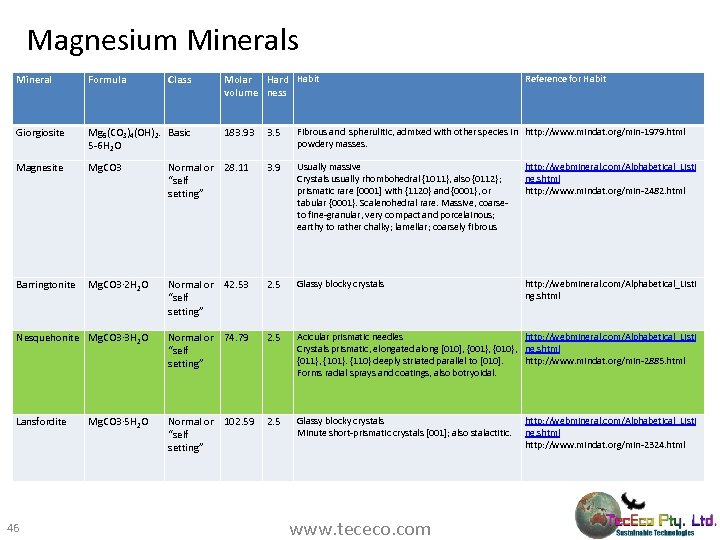 Magnesium Minerals Mineral Formula Class Giorgiosite Mg 5(CO 3)4(OH)2. Basic 5 -6 H 2 O Magnesite Mg. CO 3 Barringtonite Molar Hard Habit volume ness 3. 5 Fibrous and spherulitic, admixed with other species in http: //www. mindat. org/min-1979. html powdery masses. Normal or 28. 11 “self setting” 3. 9 Usually massive Crystals usually rhombohedral {1011}, also {0112}; prismatic rare [0001] with {1120} and {0001}, or tabular {0001}. Scalenohedral rare. Massive, coarse- to fine-granular, very compact and porcelainous; earthy to rather chalky; lamellar; coarsely fibrous http: //webmineral. com/Alphabetical_Listi ng. shtml http: //www. mindat. org/min-2482. html Mg. CO 3· 2 H 2 O Normal or 42. 53 “self setting” 2. 5 Glassy blocky crystals http: //webmineral. com/Alphabetical_Listi ng. shtml Nesquehonite Mg. CO 3· 3 H 2 O Normal or 74. 79 “self setting” 2. 5 Acicular prismatic needles http: //webmineral. com/Alphabetical_Listi Crystals prismatic, elongated along [010], {001}, {010}, ng. shtml {011}, {101}. {110} deeply striated parallel to [010]. http: //www. mindat. org/min-2885. html Forms radial sprays and coatings, also botryoidal. Lansfordite Normal or 102. 59 “self setting” 2. 5 Glassy blocky crystals Minute short-prismatic crystals [001]; also stalactitic. 46 Mg. CO 3· 5 H 2 O 183. 93 Reference for Habit www. tececo. com http: //webmineral. com/Alphabetical_Listi ng. shtml http: //www. mindat. org/min-2324. html
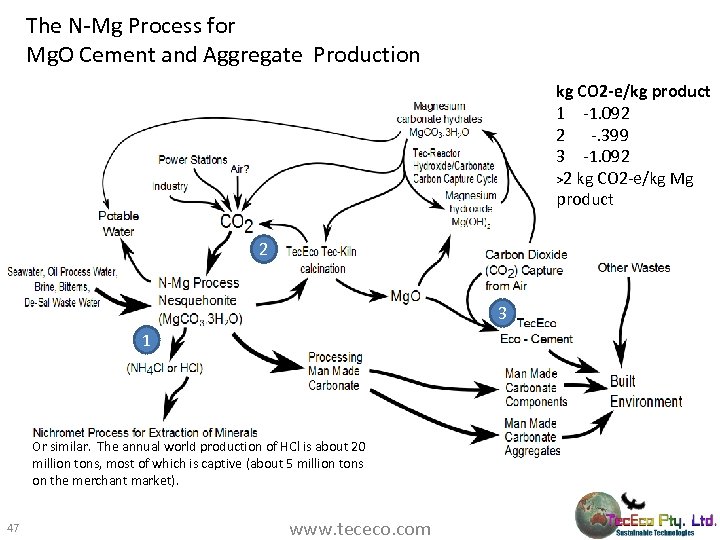 The N-Mg Process for Mg. O Cement and Aggregate Production kg CO 2 -e/kg product 1 -1. 092 2 -. 399 3 -1. 092 >2 kg CO 2 -e/kg Mg product 2 3 1 Or similar. The annual world production of HCl is about 20 million tons, most of which is captive (about 5 million tons on the merchant market). 47 www. tececo. com
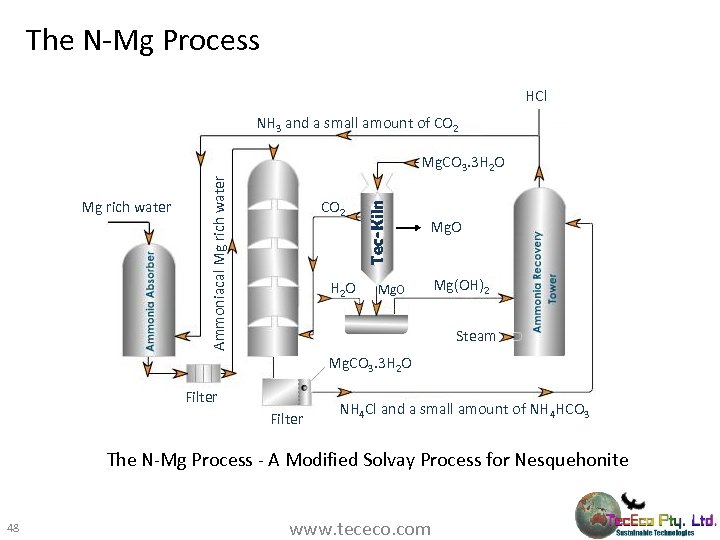 The N-Mg Process HCl NH 3 and a small amount of CO 2 H 2 O Tec-Kiln Mg rich water Ammoniacal Mg rich water Mg. CO 3. 3 H 2 O Mg(OH)2 Steam Mg. CO 3. 3 H 2 O Filter NH 4 Cl and a small amount of NH 4 HCO 3 The N-Mg Process - A Modified Solvay Process for Nesquehonite 48 www. tececo. com
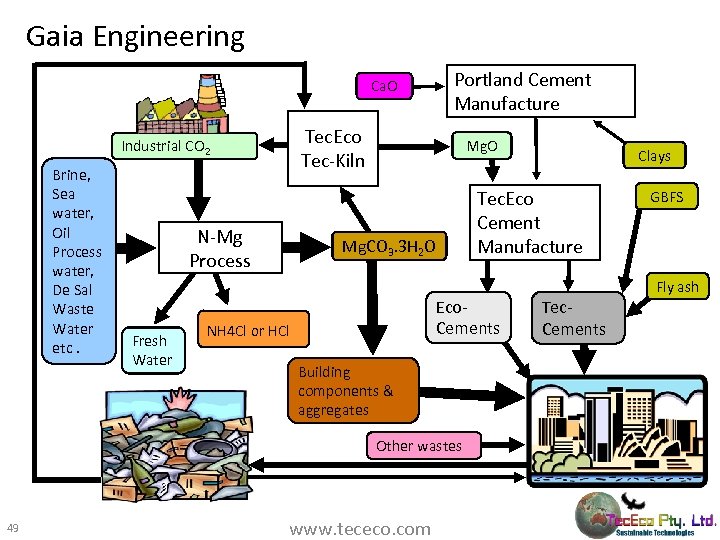 Gaia Engineering Portland Cement Manufacture Ca. O Tec. Eco Tec-Kiln Industrial CO 2 Brine, Sea water, Oil Process water, De Sal Waste Water etc. N-Mg Process Fresh Water Mg. O Mg. CO 3. 3 H 2 O Building components & aggregates Other wastes 49 Tec. Eco Cement Manufacture Eco. Cements NH 4 Cl or HCl www. tececo. com Clays Tec. Cements GBFS Fly ash
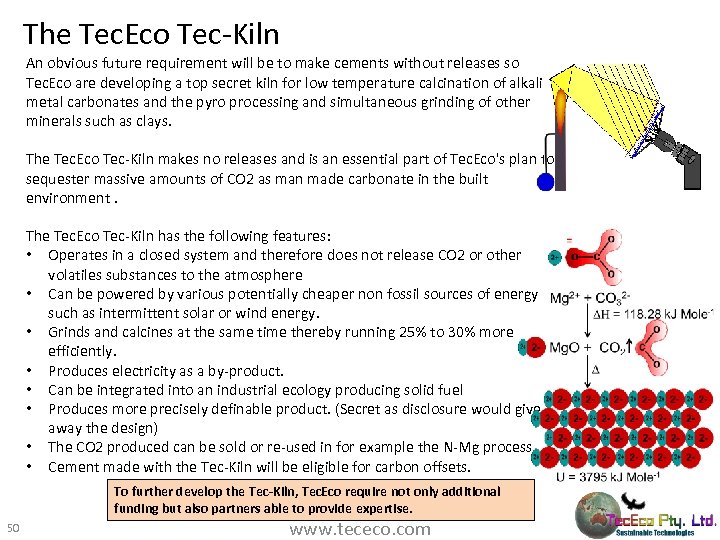 The Tec. Eco Tec-Kiln An obvious future requirement will be to make cements without releases so Tec. Eco are developing a top secret kiln for low temperature calcination of alkali metal carbonates and the pyro processing and simultaneous grinding of other minerals such as clays. The Tec. Eco Tec-Kiln makes no releases and is an essential part of Tec. Eco's plan to sequester massive amounts of CO 2 as man made carbonate in the built environment. The Tec. Eco Tec-Kiln has the following features: • Operates in a closed system and therefore does not release CO 2 or other volatiles substances to the atmosphere • Can be powered by various potentially cheaper non fossil sources of energy such as intermittent solar or wind energy. • Grinds and calcines at the same time thereby running 25% to 30% more efficiently. • Produces electricity as a by-product. • Can be integrated into an industrial ecology producing solid fuel • Produces more precisely definable product. (Secret as disclosure would give away the design) • The CO 2 produced can be sold or re-used in for example the N-Mg process. • Cement made with the Tec-Kiln will be eligible for carbon offsets. To further develop the Tec-Kiln, Tec. Eco require not only additional funding but also partners able to provide expertise. 50 www. tececo. com
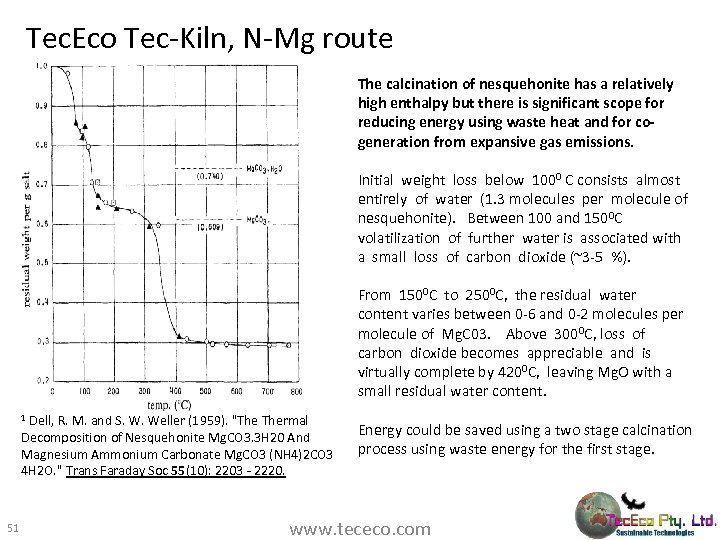 Tec. Eco Tec-Kiln, N-Mg route The calcination of nesquehonite has a relatively high enthalpy but there is significant scope for reducing energy using waste heat and for cogeneration from expansive gas emissions. Initial weight loss below 1000 C consists almost entirely of water (1. 3 molecules per molecule of nesquehonite). Between 100 and 1500 C volatilization of further water is associated with a small loss of carbon dioxide (~3 -5 %). From 1500 C to 2500 C, the residual water content varies between 0 -6 and 0 -2 molecules per molecule of Mg. C 03. Above 3000 C, loss of carbon dioxide becomes appreciable and is virtually complete by 4200 C, leaving Mg. O with a small residual water content. 1 Dell, R. M. and S. W. Weller (1959). "The Thermal Decomposition of Nesquehonite Mg. CO 3. 3 H 20 And Magnesium Ammonium Carbonate Mg. CO 3 (NH 4)2 CO 3 4 H 2 O. " Trans Faraday Soc 55(10): 2203 - 2220. 51 Energy could be saved using a two stage calcination process using waste energy for the first stage. www. tececo. com
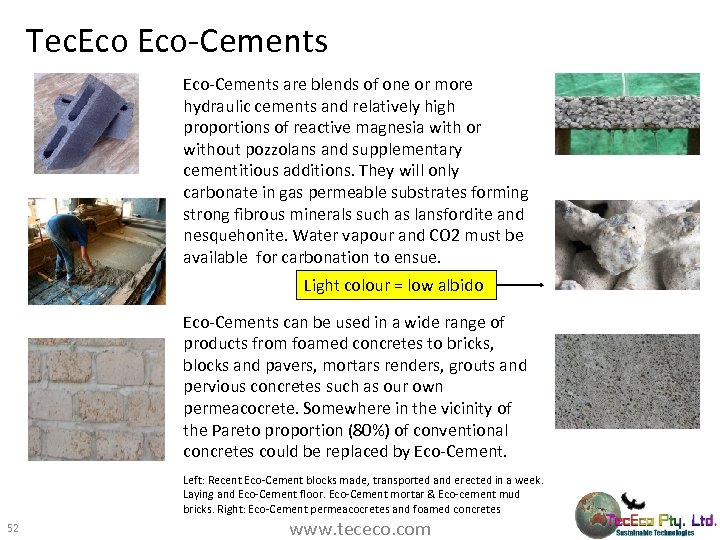 Tec. Eco-Cements are blends of one or more hydraulic cements and relatively high proportions of reactive magnesia with or without pozzolans and supplementary cementitious additions. They will only carbonate in gas permeable substrates forming strong fibrous minerals such as lansfordite and nesquehonite. Water vapour and CO 2 must be available for carbonation to ensue. Light colour = low albido Eco-Cements can be used in a wide range of products from foamed concretes to bricks, blocks and pavers, mortars renders, grouts and pervious concretes such as our own permeacocrete. Somewhere in the vicinity of the Pareto proportion (80%) of conventional concretes could be replaced by Eco-Cement. Left: Recent Eco-Cement blocks made, transported and erected in a week. Laying and Eco-Cement floor. Eco-Cement mortar & Eco-cement mud bricks. Right: Eco-Cement permeacocretes and foamed concretes 52 www. tececo. com
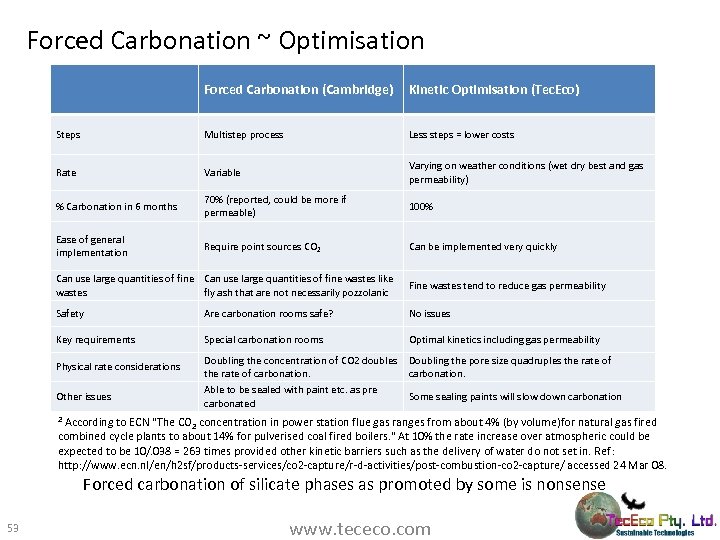 Forced Carbonation ~ Optimisation Forced Carbonation (Cambridge) Kinetic Optimisation (Tec. Eco) Steps Multistep process Less steps = lower costs Rate Variable Varying on weather conditions (wet dry best and gas permeability) % Carbonation in 6 months 70% (reported, could be more if permeable) 100% Ease of general implementation Require point sources CO 2 Can be implemented very quickly Can use large quantities of fine wastes like wastes fly ash that are not necessarily pozzolanic Fine wastes tend to reduce gas permeability Safety Are carbonation rooms safe? No issues Key requirements Special carbonation rooms Optimal kinetics including gas permeability Physical rate considerations Other issues 2 According to ECN "The CO Doubling the concentration of CO 2 doubles Doubling the pore size quadruples the rate of carbonation. Able to be sealed with paint etc. as pre Some sealing paints will slow down carbonation carbonated 2 concentration in power station flue gas ranges from about 4% (by volume)for natural gas fired combined cycle plants to about 14% for pulverised coal fired boilers. " At 10% the rate increase over atmospheric could be expected to be 10/. 038 = 263 times provided other kinetic barriers such as the delivery of water do not set in. Ref : http: //www. ecn. nl/en/h 2 sf/products-services/co 2 -capture/r-d-activities/post-combustion-co 2 -capture/ accessed 24 Mar 08. Forced carbonation of silicate phases as promoted by some is nonsense 53 www. tececo. com
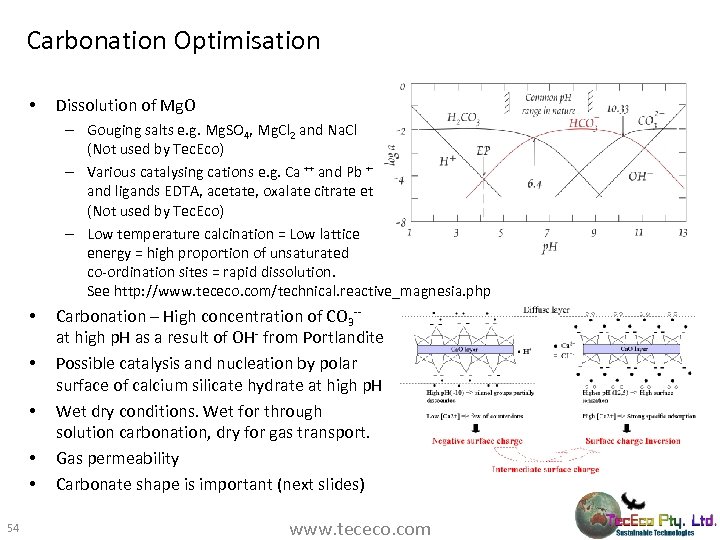 Carbonation Optimisation • Dissolution of Mg. O – Gouging salts e. g. Mg. SO 4, Mg. Cl 2 and Na. Cl (Not used by Tec. Eco) – Various catalysing cations e. g. Ca ++ and Pb ++ and ligands EDTA, acetate, oxalate citrate etc. (Not used by Tec. Eco) – Low temperature calcination = Low lattice energy = high proportion of unsaturated co-ordination sites = rapid dissolution. See http: //www. tececo. com/technical. reactive_magnesia. php • • • 54 Carbonation – High concentration of CO 3 -- at high p. H as a result of OH- from Portlandite Possible catalysis and nucleation by polar surface of calcium silicate hydrate at high p. H Wet dry conditions. Wet for through solution carbonation, dry for gas transport. Gas permeability Carbonate shape is important (next slides) www. tececo. com
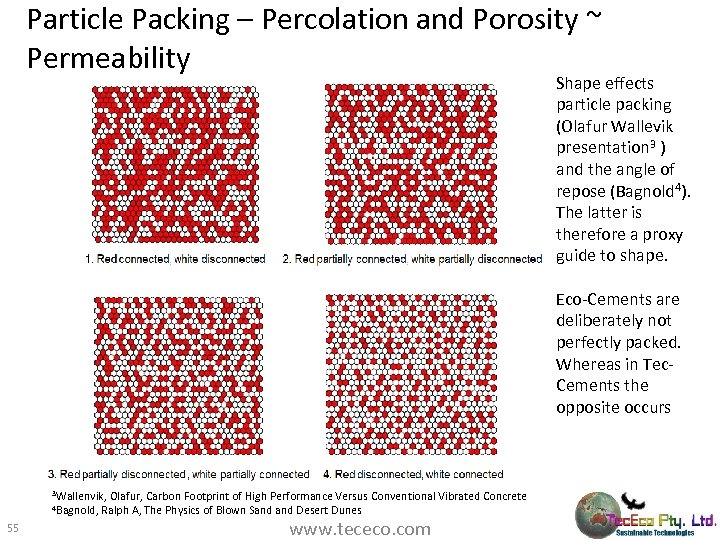 Particle Packing – Percolation and Porosity ~ Permeability Shape effects particle packing (Olafur Wallevik presentation 3 ) and the angle of repose (Bagnold 4). The latter is therefore a proxy guide to shape. Eco-Cements are deliberately not perfectly packed. Whereas in Tec. Cements the opposite occurs 3 Wallenvik, Olafur, Carbon Footprint of High Performance Versus Conventional Vibrated Concrete 4 Bagnold, Ralph A, The Physics of Blown Sand Desert Dunes 55 www. tececo. com
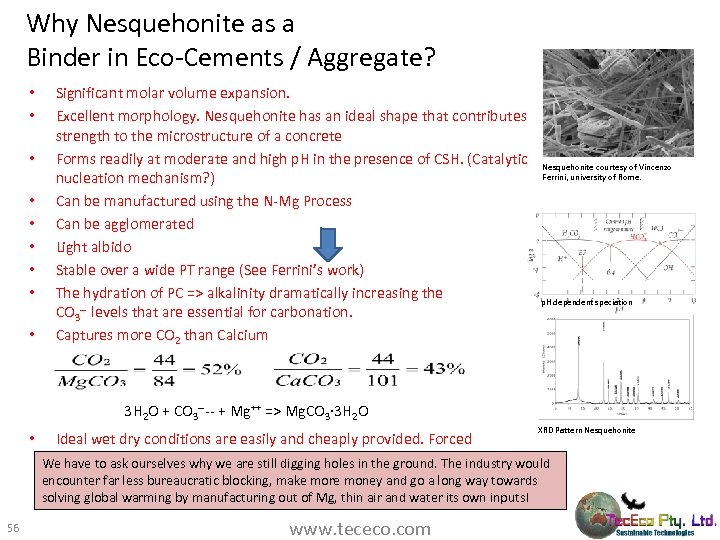 Why Nesquehonite as a Binder in Eco-Cements / Aggregate? • • • Significant molar volume expansion. Excellent morphology. Nesquehonite has an ideal shape that contributes strength to the microstructure of a concrete Forms readily at moderate and high p. H in the presence of CSH. (Catalytic nucleation mechanism? ) Can be manufactured using the N-Mg Process Can be agglomerated Light albido Stable over a wide PT range (See Ferrini’s work) The hydration of PC => alkalinity dramatically increasing the CO 3 -- levels that are essential for carbonation. Captures more CO 2 than Calcium Nesquehonite courtesy of Vincenzo Ferrini, university of Rome. p. H dependent speciation 3 H 2 O + CO 3 ---- + Mg++ => Mg. CO 3· 3 H 2 O • XRD Pattern Nesquehonite Ideal wet dry conditions are easily and cheaply provided. Forced carbonation is not required (Cambridge uni and others) We have to ask ourselves why we are still digging holes in the ground. The industry would encounter far less bureaucratic blocking, make more money and go a long way towards solving global warming by manufacturing out of Mg, thin air and water its own inputs! 56 www. tececo. com
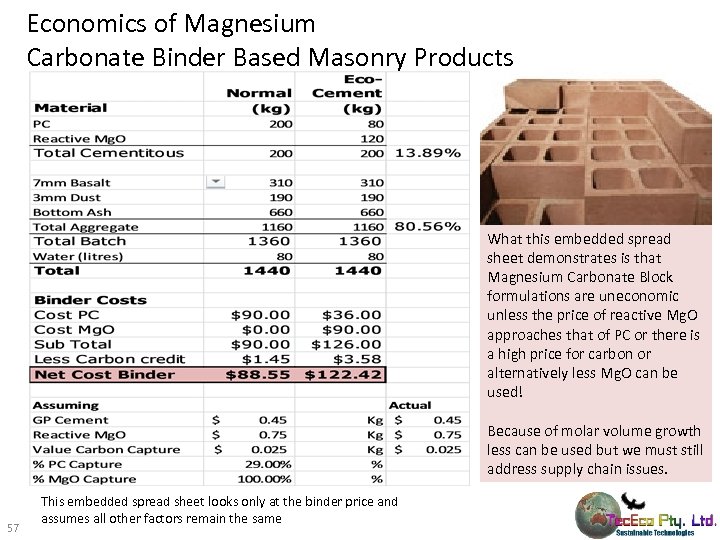 Economics of Magnesium Carbonate Binder Based Masonry Products What this embedded spread sheet demonstrates is that Magnesium Carbonate Block formulations are uneconomic unless the price of reactive Mg. O approaches that of PC or there is a high price for carbon or alternatively less Mg. O can be used! Because of molar volume growth less can be used but we must still address supply chain issues. 57 This embedded spread sheet looks only at the binder price and assumes all other factors remain the same
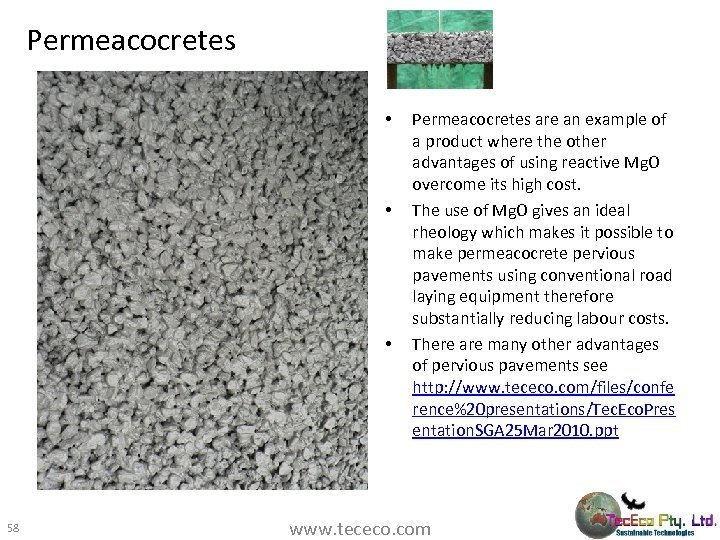 Permeacocretes • • • 58 Permeacocretes are an example of a product where the other advantages of using reactive Mg. O overcome its high cost. The use of Mg. O gives an ideal rheology which makes it possible to make permeacocrete pervious pavements using conventional road laying equipment therefore substantially reducing labour costs. There are many other advantages of pervious pavements see http: //www. tececo. com/files/confe rence%20 presentations/Tec. Eco. Pres entation. SGA 25 Mar 2010. ppt www. tececo. com
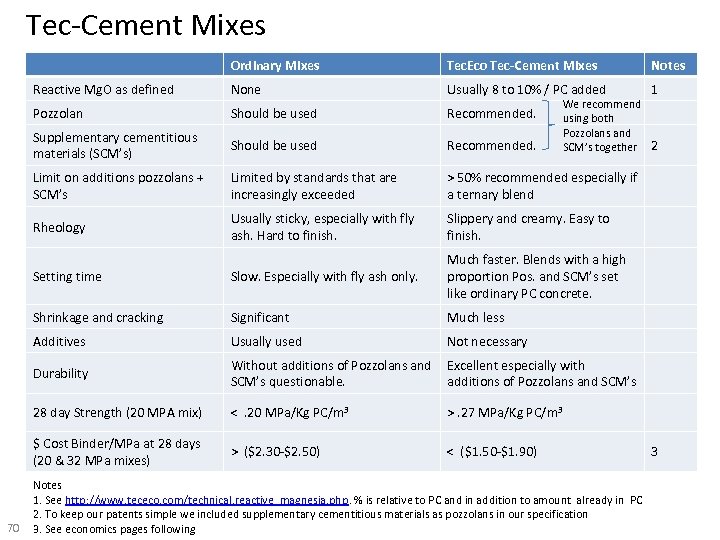
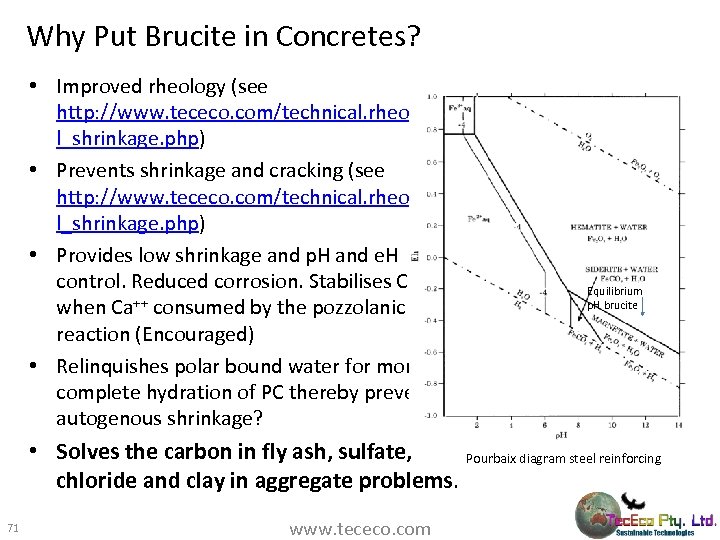
 Tec-Cements • Tec-Cements (5 -20% Mg. O, 80 -95% OPC) – contain more Portland cement than reactive magnesia. Reactive magnesia hydrates in the same rate order as Portland cement forming Brucite which uses up excess water reducing the voids: paste ratio, increasing density and possibly raising the short term p. H. – Reactions with pozzolans are more affective. After much of the Portlandite has been consumed Brucite tends to control the long term p. H which is lower and due to it’s low solubility, mobility and reactivity results in greater durability. – Other benefits include improvements in density, strength and rheology, reduced permeability and shrinkage and the use of a wider range of aggregates many of which are potentially wastes without reaction problems. 59 www. tececo. com
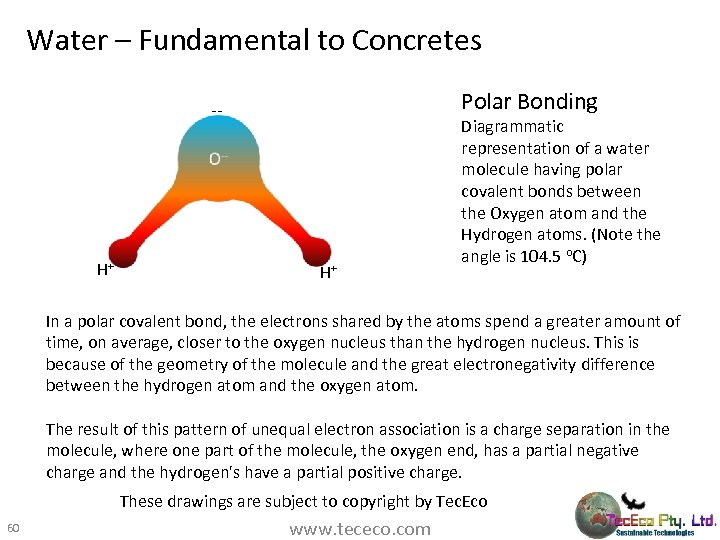 Water – Fundamental to Concretes Polar Bonding -- H+ H+ Diagrammatic representation of a water molecule having polar covalent bonds between the Oxygen atom and the Hydrogen atoms. (Note the angle is 104. 5 o. C) In a polar covalent bond, the electrons shared by the atoms spend a greater amount of time, on average, closer to the oxygen nucleus than the hydrogen nucleus. This is because of the geometry of the molecule and the great electronegativity difference between the hydrogen atom and the oxygen atom. The result of this pattern of unequal electron association is a charge separation in the molecule, where one part of the molecule, the oxygen end, has a partial negative charge and the hydrogen's have a partial positive charge. These drawings are subject to copyright by Tec. Eco 60 www. tececo. com
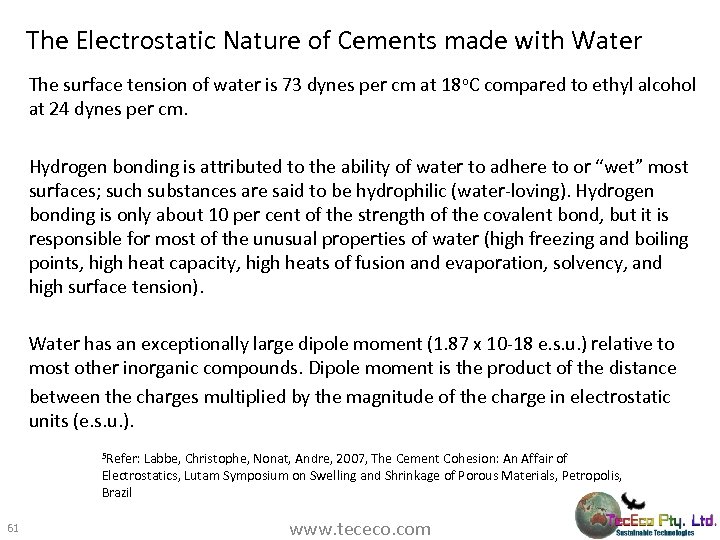 The Electrostatic Nature of Cements made with Water The surface tension of water is 73 dynes per cm at 18 o. C compared to ethyl alcohol at 24 dynes per cm. Hydrogen bonding is attributed to the ability of water to adhere to or “wet” most surfaces; such substances are said to be hydrophilic (water-loving). Hydrogen bonding is only about 10 per cent of the strength of the covalent bond, but it is responsible for most of the unusual properties of water (high freezing and boiling points, high heat capacity, high heats of fusion and evaporation, solvency, and high surface tension). Water has an exceptionally large dipole moment (1. 87 x 10 -18 e. s. u. ) relative to most other inorganic compounds. Dipole moment is the product of the distance between the charges multiplied by the magnitude of the charge in electrostatic units (e. s. u. ). 5 Refer: Labbe, Christophe, Nonat, Andre, 2007, The Cement Cohesion: An Affair of Electrostatics, Lutam Symposium on Swelling and Shrinkage of Porous Materials, Petropolis, Brazil 61 www. tececo. com
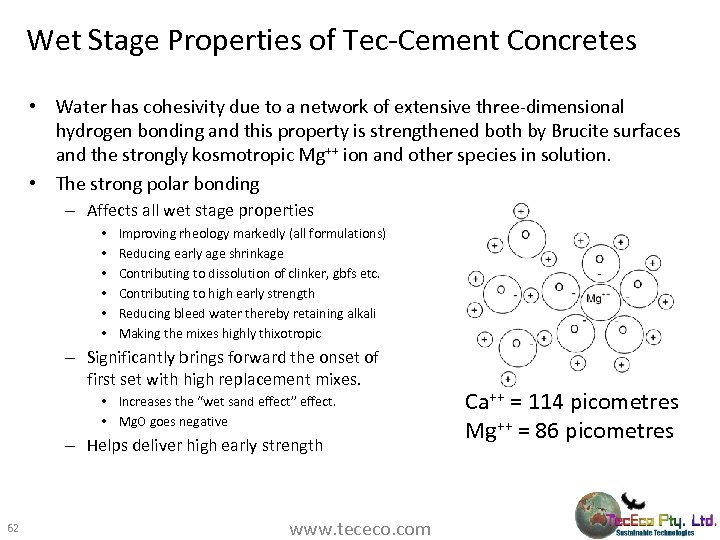 Wet Stage Properties of Tec-Cement Concretes • Water has cohesivity due to a network of extensive three-dimensional hydrogen bonding and this property is strengthened both by Brucite surfaces and the strongly kosmotropic Mg++ ion and other species in solution. • The strong polar bonding – Affects all wet stage properties • • • Improving rheology markedly (all formulations) Reducing early age shrinkage Contributing to dissolution of clinker, gbfs etc. Contributing to high early strength Reducing bleed water thereby retaining alkali Making the mixes highly thixotropic – Significantly brings forward the onset of first set with high replacement mixes. • Increases the “wet sand effect” effect. • Mg. O goes negative – Helps deliver high early strength 62 www. tececo. com Ca++ = 114 picometres Mg++ = 86 picometres
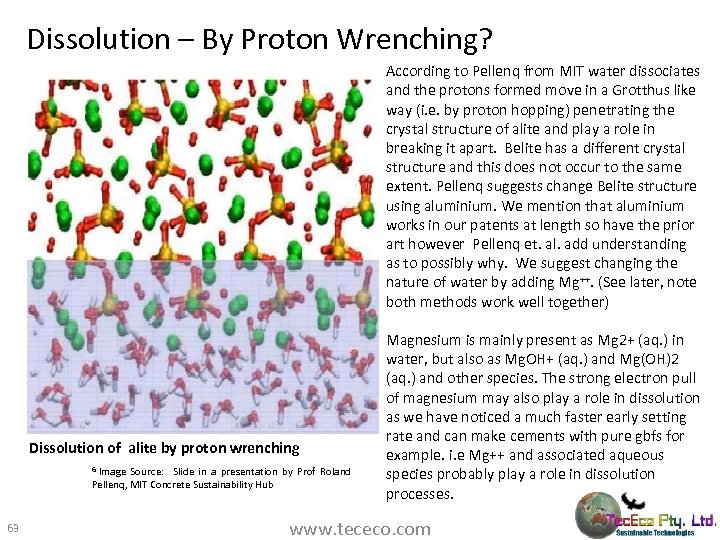 Dissolution – By Proton Wrenching? According to Pellenq from MIT water dissociates and the protons formed move in a Grotthus like way (i. e. by proton hopping) penetrating the crystal structure of alite and play a role in breaking it apart. Belite has a different crystal structure and this does not occur to the same extent. Pellenq suggests change Belite structure using aluminium. We mention that aluminium works in our patents at length so have the prior art however Pellenq et. al. add understanding as to possibly why. We suggest changing the nature of water by adding Mg++. (See later, note both methods work well together) Dissolution of alite by proton wrenching 6 Image Source: Slide in a presentation by Prof Roland Pellenq, MIT Concrete Sustainability Hub 63 Magnesium is mainly present as Mg 2+ (aq. ) in water, but also as Mg. OH+ (aq. ) and Mg(OH)2 (aq. ) and other species. The strong electron pull of magnesium may also play a role in dissolution as we have noticed a much faster early setting rate and can make cements with pure gbfs for example. i. e Mg++ and associated aqueous species probably play a role in dissolution processes. www. tececo. com
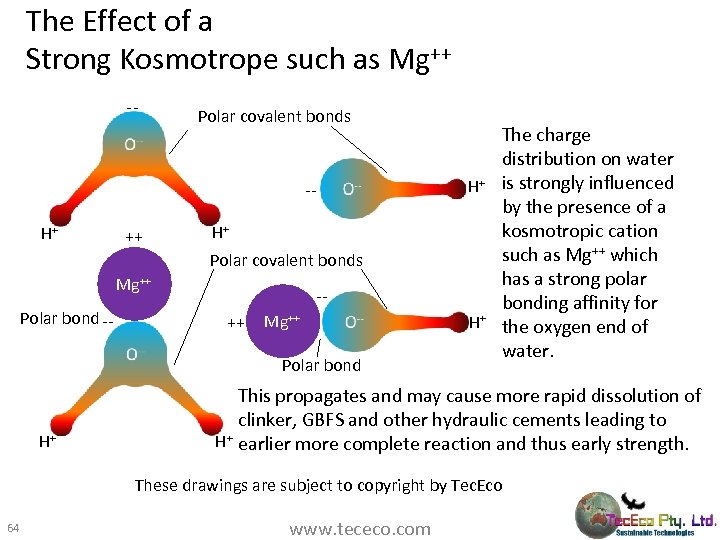 The Effect of a Strong Kosmotrope such as Mg++ -- Polar covalent bonds -H+ ++ H+ H+ Polar covalent bonds Mg++ Polar bond -- -++ Mg++ Polar bond H+ H+ The charge distribution on water is strongly influenced by the presence of a kosmotropic cation such as Mg++ which has a strong polar bonding affinity for the oxygen end of water. This propagates and may cause more rapid dissolution of clinker, GBFS and other hydraulic cements leading to H+ earlier more complete reaction and thus early strength. These drawings are subject to copyright by Tec. Eco 64 www. tececo. com
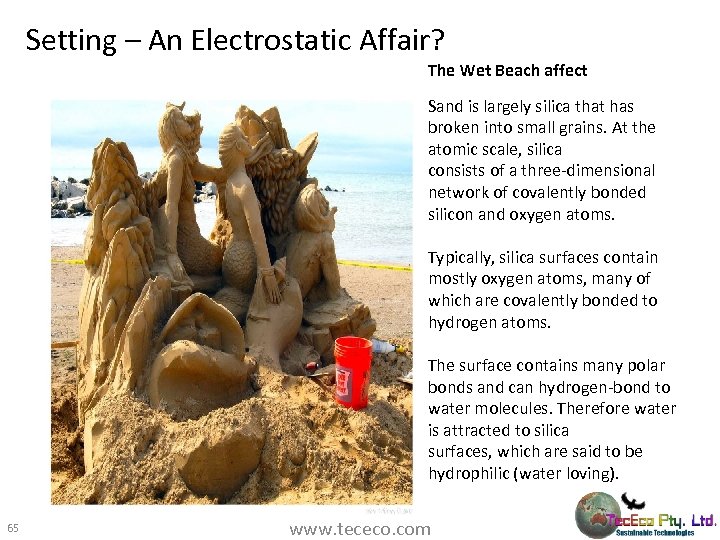 Setting – An Electrostatic Affair? The Wet Beach affect Sand is largely silica that has broken into small grains. At the atomic scale, silica consists of a three-dimensional network of covalently bonded silicon and oxygen atoms. Typically, silica surfaces contain mostly oxygen atoms, many of which are covalently bonded to hydrogen atoms. The surface contains many polar bonds and can hydrogen-bond to water molecules. Therefore water is attracted to silica surfaces, which are said to be hydrophilic (water loving). 65 www. tececo. com
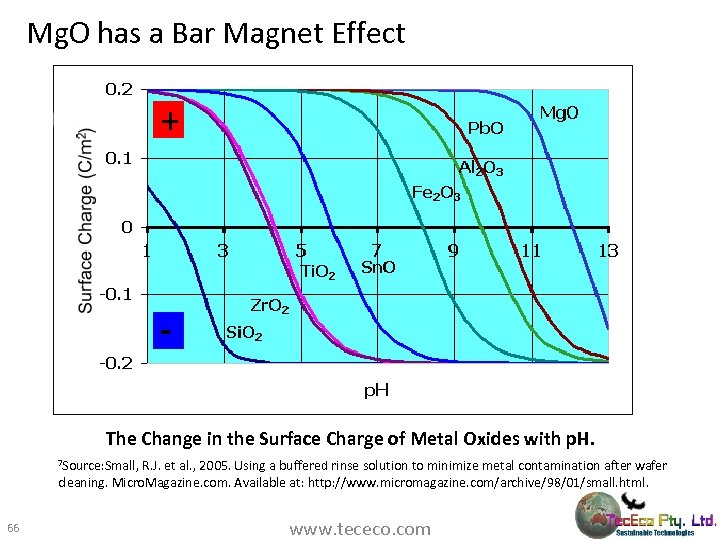 Mg. O has a Bar Magnet Effect The Change in the Surface Charge of Metal Oxides with p. H. 7 Source: Small, R. J. et al. , 2005. Using a buffered rinse solution to minimize metal contamination after wafer cleaning. Micro. Magazine. com. Available at: http: //www. micromagazine. com/archive/98/01/small. html. 66 www. tececo. com
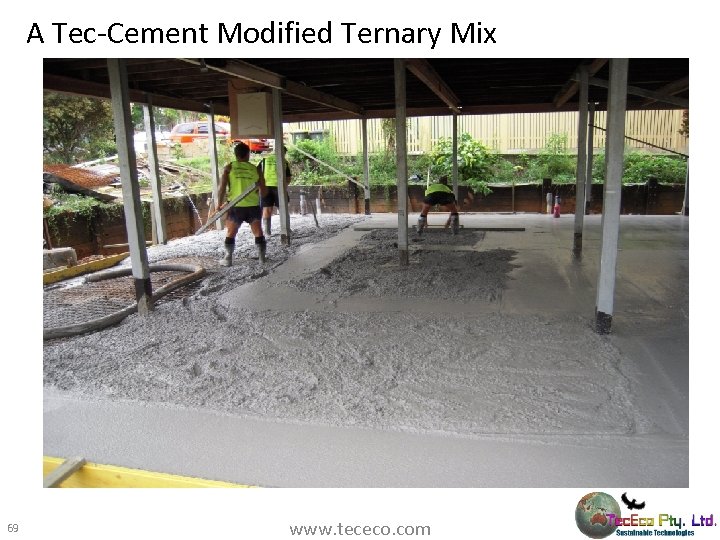
 High and Total Replacement Cements • Tec. Eco recently announced a way forward to greater sustainability for the Portland cement industry. • Up to 30% or more strength at all stages with high & very high replacement ternary mixes. (GBFS +- fly ash replacing PC. ) • Total replacement with class C fly ash and gbfs is possible • Finishers can go home early using >50% replacement mixes removing the remaining barrier to their implementation. • Brilliant rheology, low shrinkage and little or no cracking. • Excellent durability. • A solution to autogenous shrinkage? • Mixes with Mg. O can tolerate carbon in fly ash and clays to some extent. • Mg++ combines with chloride or sulphate immobilising these cations 67 www. tececo. com
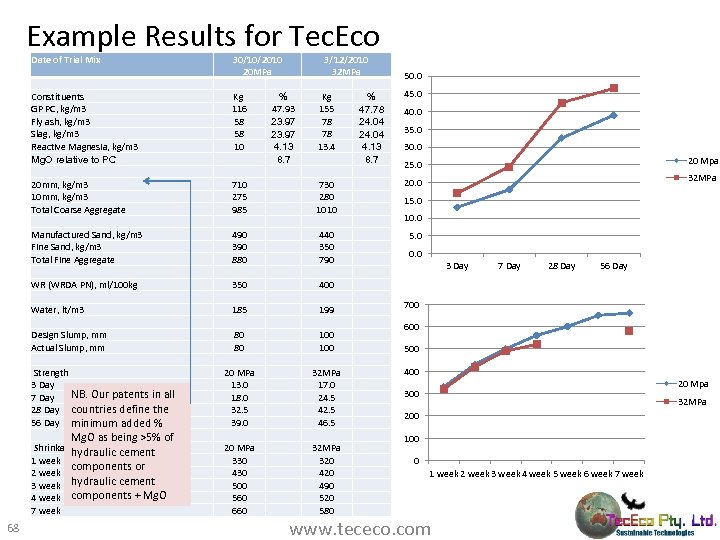 Example Results for Tec. Eco Date of Trial Mix Constituents GP PC, kg/m 3 Fly ash, kg/m 3 Slag, kg/m 3 Reactive Magnesia, kg/m 3 Mg. O relative to PC 20 mm, kg/m 3 10 mm, kg/m 3 Total Coarse Aggregate Manufactured Sand, kg/m 3 Fine Sand, kg/m 3 Total Fine Aggregate WR (WRDA PN), ml/100 kg Water, lt/m 3 Design Slump, mm Actual Slump, mm Strength 3 Day 7 Day NB. Our patents in all 28 Day countries define the 56 Day minimum added % Mg. O as being >5% of Shrinkage hydraulic cement 1 week components or 2 week 3 week hydraulic cement 4 week components + Mg. O 7 week 68 30/10/2010 20 MPa Kg % 116 47. 93 58 23. 97 10 4. 13 8. 7 710 275 985 490 390 880 350 185 80 80 20 MPa 13. 0 18. 0 32. 5 39. 0 20 MPa 330 430 500 560 660 3/12/2010 32 MPa Kg % 155 47. 78 78 24. 04 13. 4 4. 13 8. 7 730 280 1010 440 350 790 400 199 100 32 MPa 17. 0 24. 5 42. 5 46. 5 32 MPa 320 490 520 580 50. 0 45. 0 40. 0 35. 0 30. 0 25. 0 20 Mpa 20. 0 32 MPa 15. 0 10. 0 5. 0 0. 0 3 Day 7 Day 28 Day 56 Day 700 600 500 400 20 Mpa 300 32 MPa 200 100 0 1 week 2 week 3 week 4 week 5 week 6 week 7 week www. tececo. com
 A Tec-Cement Modified Ternary Mix 69 www. tececo. com
 Tec-Cement Mixes Ordinary Mixes Notes Reactive Mg. O as defined None Usually 8 to 10% / PC added 1 Pozzolan Should be used Recommended. Supplementary cementitious materials (SCM’s) Should be used Recommended. Limit on additions pozzolans + SCM’s Limited by standards that are increasingly exceeded > 50% recommended especially if a ternary blend Rheology Usually sticky, especially with fly ash. Hard to finish. Slippery and creamy. Easy to finish. Setting time Slow. Especially with fly ash only. Much faster. Blends with a high proportion Pos. and SCM’s set like ordinary PC concrete. Shrinkage and cracking Significant Much less Additives Usually used Not necessary Durability Without additions of Pozzolans and Excellent especially with SCM’s questionable. additions of Pozzolans and SCM’s 28 day Strength (20 MPA mix) < . 20 MPa/Kg PC/m 3 >. 27 MPa/Kg PC/m 3 $ Cost Binder/MPa at 28 days (20 & 32 MPa mixes) 70 Tec. Eco Tec-Cement Mixes > ($2. 30 -$2. 50) < ($1. 50 -$1. 90) We recommend using both Pozzolans and SCM’s together 2 Notes 1. See http: //www. tececo. com/technical. reactive_magnesia. php. % is relative to PC and in addition to amount already in PC 2. To keep our patents simple we included supplementary cementitious materials as pozzolans in our specification 3. See economics pages following 3
 Why Put Brucite in Concretes? • Improved rheology (see http: //www. tececo. com/technical. rheologica l_shrinkage. php) • Prevents shrinkage and cracking (see http: //www. tececo. com/technical. rheologica l_shrinkage. php) • Provides low shrinkage and p. H and e. H control. Reduced corrosion. Stabilises CSH when Ca++ consumed by the pozzolanic reaction (Encouraged) • Relinquishes polar bound water for more complete hydration of PC thereby preventing autogenous shrinkage? Equilibrium p. H brucite • Solves the carbon in fly ash, sulfate, Pourbaix diagram steel reinforcing chloride and clay in aggregate problems. 71 www. tececo. com
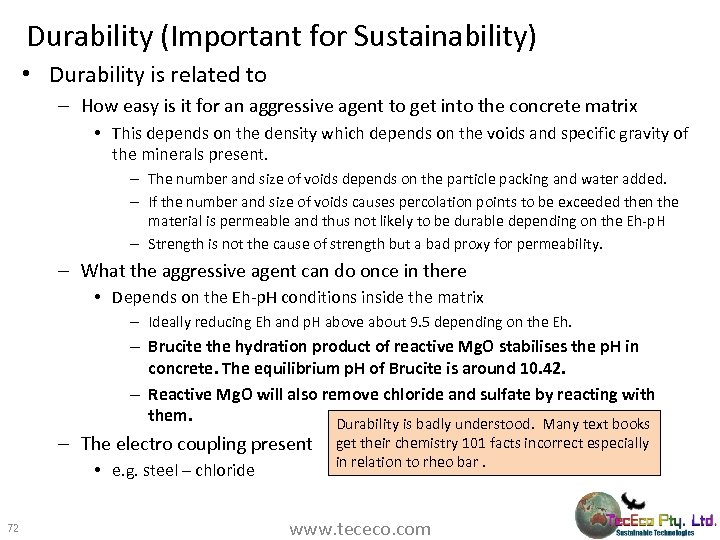 Durability (Important for Sustainability) • Durability is related to – How easy is it for an aggressive agent to get into the concrete matrix • This depends on the density which depends on the voids and specific gravity of the minerals present. – The number and size of voids depends on the particle packing and water added. – If the number and size of voids causes percolation points to be exceeded then the material is permeable and thus not likely to be durable depending on the Eh-p. H – Strength is not the cause of strength but a bad proxy for permeability. – What the aggressive agent can do once in there • Depends on the Eh-p. H conditions inside the matrix – Ideally reducing Eh and p. H above about 9. 5 depending on the Eh. – Brucite the hydration product of reactive Mg. O stabilises the p. H in concrete. The equilibrium p. H of Brucite is around 10. 42. – Reactive Mg. O will also remove chloride and sulfate by reacting with them. Durability is badly understood. Many text books – The electro coupling present • e. g. steel – chloride 72 get their chemistry 101 facts incorrect especially in relation to rheo bar. www. tececo. com
 Dry Stage Properties of Tec-Cement Concretes • Significantly increased tensile strength • Increased compressive strength (especially early strength) particularly with high replacement mixes containing significant amounts of GBFS compacting factor • Reduced shrinkage and cracking • Improved durability • Higher tensile strain capacity? • Greater creep • Less permeable? • Lighter albido • Solves autogenous shrinkage problems • May solve other delayed reaction problems 8 Recommended Reading: Du C. A Review of Magnesium Oxide in Concrete - A serendipitous discovery leads to new concrete for dam construction. Concrete International. 2005; (December 2005): 45 - 50. 73 www. tececo. com
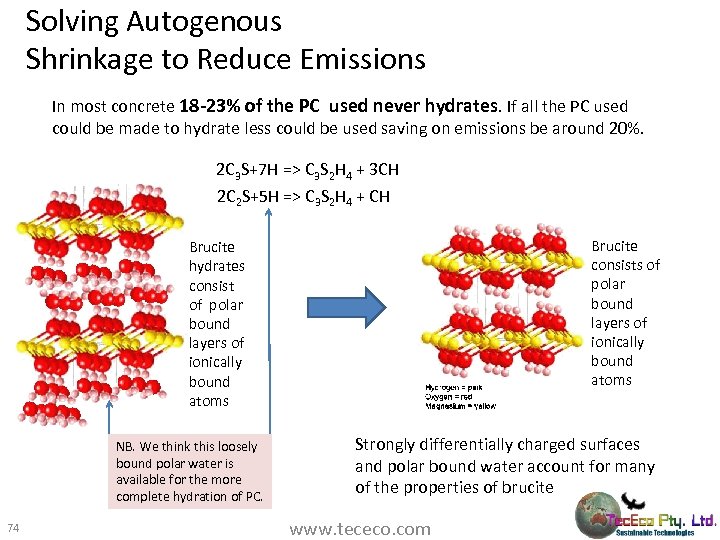 Solving Autogenous Shrinkage to Reduce Emissions In most concrete 18 -23% of the PC used never hydrates. If all the PC used could be made to hydrate less could be used saving on emissions be around 20%. 2 C 3 S+7 H => C 3 S 2 H 4 + 3 CH 2 C 2 S+5 H => C 3 S 2 H 4 + CH Brucite consists of polar bound layers of ionically bound atoms Brucite hydrates consist of polar bound layers of ionically bound atoms NB. We think this loosely bound polar water is available for the more complete hydration of PC. 74 Strongly differentially charged surfaces and polar bound water account for many of the properties of brucite www. tececo. com
 Economics of Tec-Cements Binder Prices Only 75 This embedded spread sheet looks only at the binder price and assumes all other factors remain the same www. tececo. com
 Agglomeration of Carbonates, Fly ash and other Wastes • Sand stone aggregate are in short supply in some areas. • Nesquehonite is an ideal micro aggregate so why not agglomerate it and/or other magnesium carbonates to make man made manufactured aggregate? • Mg. O binders will be suitable for this purpose and Tec. Eco are seeking funding to demonstrate the technology. • Tec. Eco can already agglomerate fly ash and nesquehonite without additional energy. We just can’t tell you how as we have not had the money to pursue a patent. 76 www. tececo. com
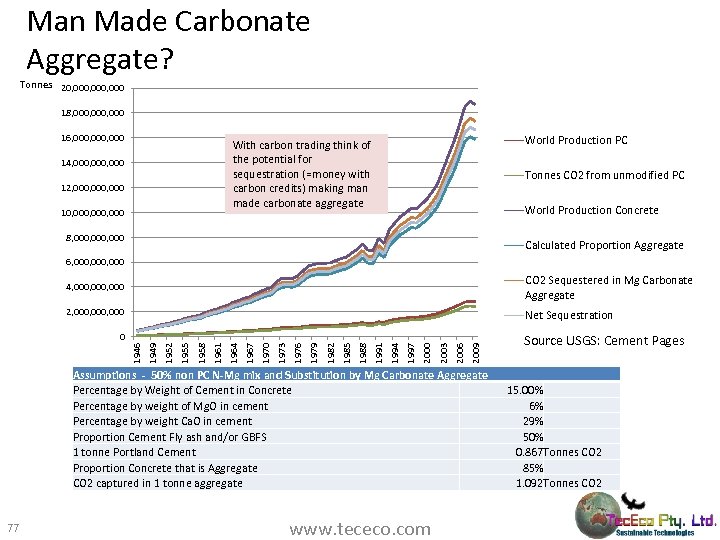 Man Made Carbonate Aggregate? Tonnes 20, 000, 000 18, 000, 000 16, 000, 000 World Production PC With carbon trading think of the potential for sequestration (=money with carbon credits) making man made carbonate aggregate 14, 000, 000 12, 000, 000 10, 000, 000 Tonnes CO 2 from unmodified PC World Production Concrete 8, 000, 000 Calculated Proportion Aggregate 6, 000, 000 4, 000, 000 CO 2 Sequestered in Mg Carbonate Aggregate 2, 000, 000 Net Sequestration 2009 2006 2003 2000 1997 1994 1991 1988 1985 1982 1979 1976 1973 1970 1967 1964 1961 1958 1955 1952 1949 1946 0 Assumptions - 50% non PC N-Mg mix and Substitution by Mg Carbonate Aggregate Percentage by Weight of Cement in Concrete Percentage by weight of Mg. O in cement Percentage by weight Ca. O in cement Proportion Cement Fly ash and/or GBFS 1 tonne Portland Cement Proportion Concrete that is Aggregate CO 2 captured in 1 tonne aggregate 77 www. tececo. com Source USGS: Cement Pages 15. 00% 6% 29% 50% 0. 867 Tonnes CO 2 85% 1. 092 Tonnes CO 2
 A final Note re Tec. Eco Technology In this presentation we have given you so some insights into why reactive Mg. O is the most powerful new tool in cement chemistry. The ramifications of the effect of the Mg++ ion on water chemistry will go beyond hydraulic cements but we are a small company and do not have the money to patent other applications we are aware of. In relation to hydraulic cements including by definition gbfs in some of our applications we would appreciate that you honour intellectual property. For the good of all we are working now to produce reactive Mg. O cheaply from brines rich in Mg++ such as oil and gas or de-sal process water. If you are interested further please contact us. 78 www. tececo. com