


 Скачать презентацию An Overview of ASM in Asia Prof Mihir
71e7108c21f55d2877442a13d889ad5a.ppt
- Количество слайдов: 23
 An Overview of ASM in Asia Prof. Mihir Deb Director, School of Environmental Studies University of Delhi, Delhi 110007, India mihirdeb@gmail. com
 Outline • • • Countries covered in this review ASM commodities Status of ASM in these countries Different issues Various initiatives Future directions for CASM-Asia
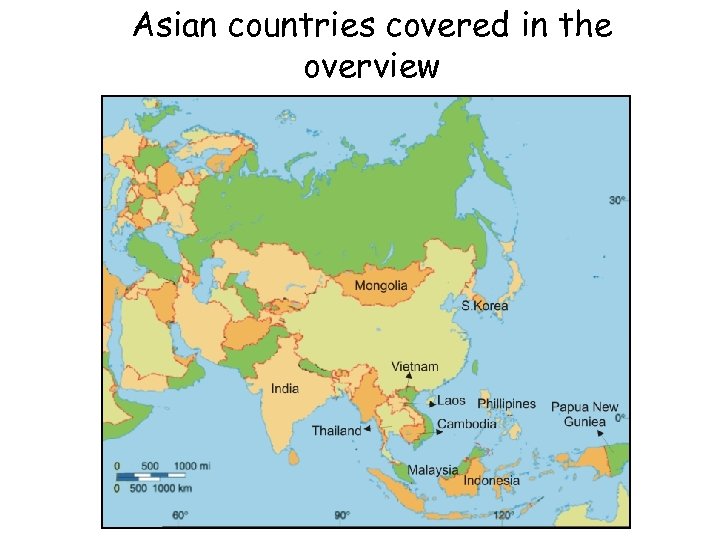 Asian countries covered in the overview
 ASM Commodities
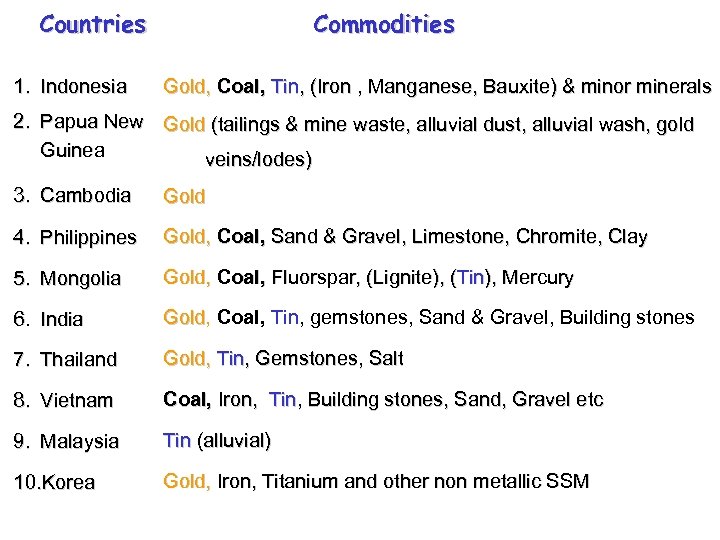 Countries 1. Indonesia Commodities Gold, Coal, Tin, (Iron , Manganese, Bauxite) & minor minerals 2. Papua New Gold (tailings & mine waste, alluvial dust, alluvial wash, gold Guinea veins/lodes) 3. Cambodia Gold 4. Philippines Gold, Coal, Sand & Gravel, Limestone, Chromite, Clay 5. Mongolia Gold, Coal, Fluorspar, (Lignite), (Tin), Mercury 6. India Gold, Coal, Tin, gemstones, Sand & Gravel, Building stones Gold 7. Thailand Gold, Tin, Gemstones, Salt 8. Vietnam Coal, Iron, Tin, Building stones, Sand, Gravel etc 9. Malaysia Tin (alluvial) 10. Korea Gold, Iron, Titanium and other non metallic SSM
 Status of ASM
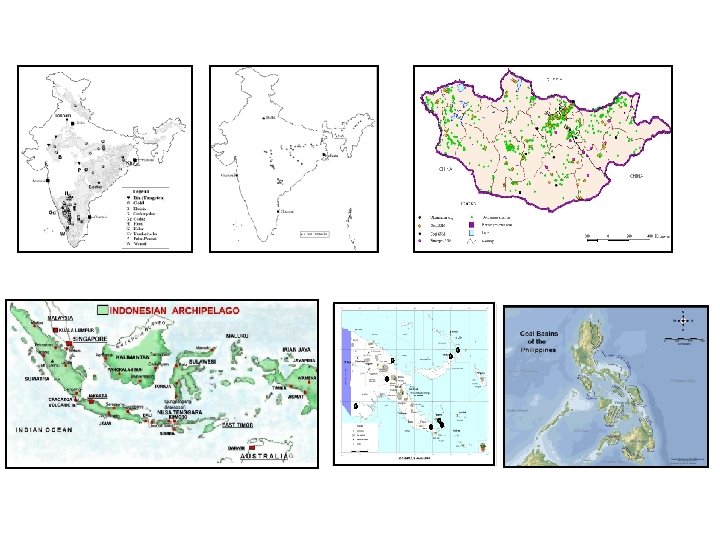
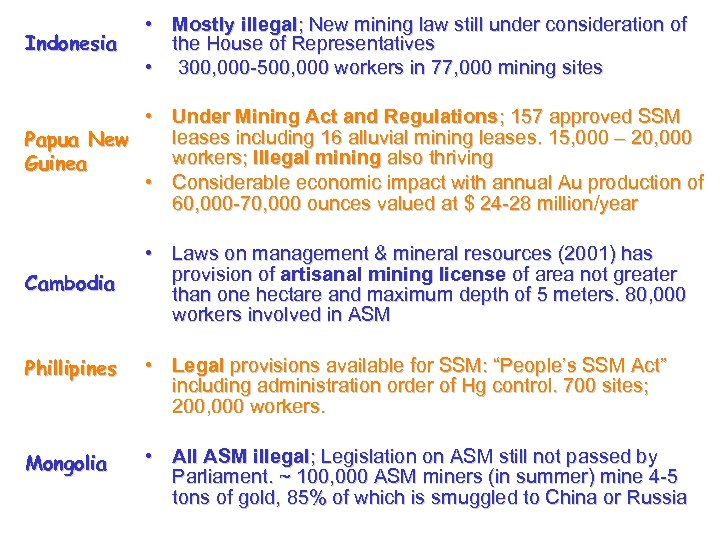 Indonesia • Mostly illegal; New mining law still under consideration of the House of Representatives • 300, 000 -500, 000 workers in 77, 000 mining sites • Under Mining Act and Regulations; 157 approved SSM leases including 16 alluvial mining leases. 15, 000 – 20, 000 Papua New workers; Illegal mining also thriving Guinea • Considerable economic impact with annual Au production of 60, 000 -70, 000 ounces valued at $ 24 -28 million/year Cambodia • Laws on management & mineral resources (2001) has provision of artisanal mining license of area not greater than one hectare and maximum depth of 5 meters. 80, 000 workers involved in ASM Phillipines • Legal provisions available for SSM: “People’s SSM Act” including administration order of Hg control. 700 sites; 200, 000 workers. Mongolia • All ASM illegal; Legislation on ASM still not passed by Parliament. ~ 100, 000 ASM miners (in summer) mine 4 -5 tons of gold, 85% of which is smuggled to China or Russia
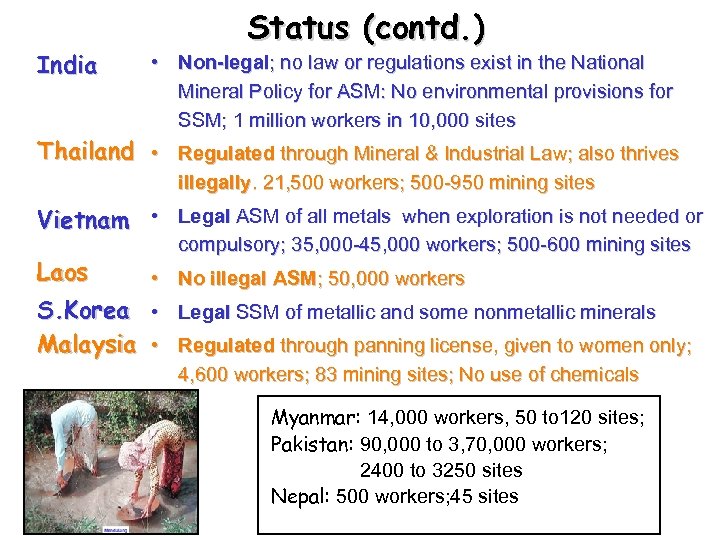 India Status (contd. ) • Non-legal; no law or regulations exist in the National Mineral Policy for ASM: No environmental provisions for SSM; 1 million workers in 10, 000 sites Thailand • Regulated through Mineral & Industrial Law; also thrives illegally. 21, 500 workers; 500 -950 mining sites Vietnam • Legal ASM of all metals when exploration is not needed or Laos compulsory; 35, 000 -45, 000 workers; 500 -600 mining sites • No illegal ASM; 50, 000 workers S. Korea • Legal SSM of metallic and some nonmetallic minerals Malaysia • Regulated through panning license, given to women only; 4, 600 workers; 83 mining sites; No use of chemicals Myanmar: 14, 000 workers, 50 to 120 sites; Pakistan: 90, 000 to 3, 70, 000 workers; 2400 to 3250 sites Nepal: 500 workers; 45 sites
 Issues
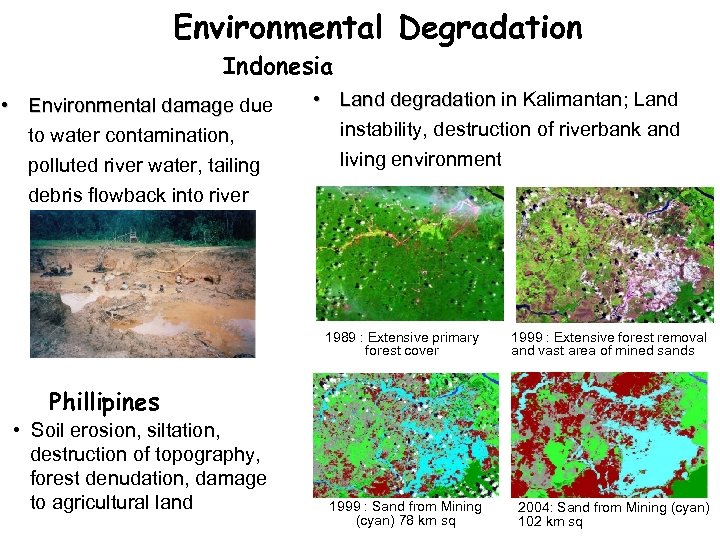 Environmental Degradation Indonesia • Environmental damage due to water contamination, polluted river water, tailing debris flowback into river • Land degradation in Kalimantan; Land instability, destruction of riverbank and living environment 1989 : Extensive primary forest cover 1999 : Extensive forest removal and vast area of mined sands 1999 : Sand from Mining (cyan) 78 km sq 2004: Sand from Mining (cyan) 102 km sq Phillipines • Soil erosion, siltation, destruction of topography, forest denudation, damage to agricultural land
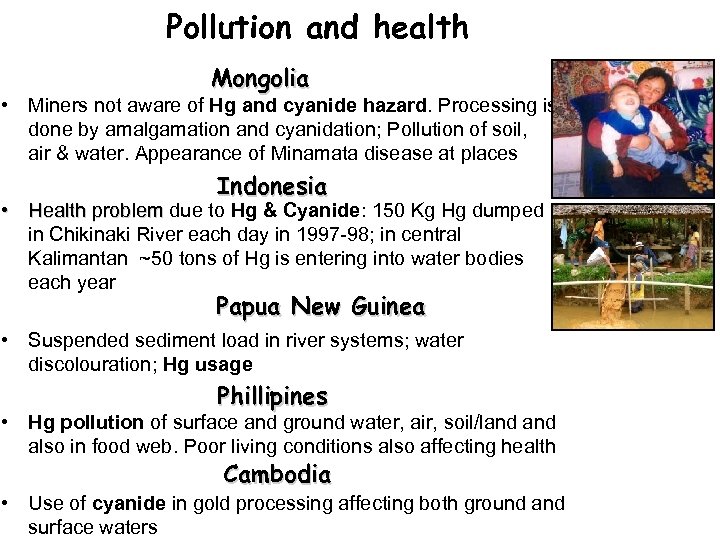 Pollution and health Mongolia • Miners not aware of Hg and cyanide hazard. Processing is done by amalgamation and cyanidation; Pollution of soil, air & water. Appearance of Minamata disease at places Indonesia • Health problem due to Hg & Cyanide: 150 Kg Hg dumped in Chikinaki River each day in 1997 -98; in central Kalimantan ~50 tons of Hg is entering into water bodies each year Papua New Guinea • Suspended sediment load in river systems; water discolouration; Hg usage Phillipines • Hg pollution of surface and ground water, air, soil/land also in food web. Poor living conditions also affecting health Cambodia • Use of cyanide in gold processing affecting both ground and surface waters
 Social Issues • Social unrest due to gambling, drinking, prostitution; ASM breeds anarchy; conflict with large mining companies; violence • Low literacy; high infant mortality; STD/HIV/AIDS; drug & alcohol abuse. • Alluvial mining of Au and Sn by indigenous groups; lack of sociological data; Many areas affected by Naxalite movement. • Anarchy, mafia and smuggling of coal across the border of Nepal and Bangladesh. • Indigenous people need to be protected from the negative impact of ASM and supplied with uncontaminated water, air and soil. Indonesia Papua New Guinea India Cambodia
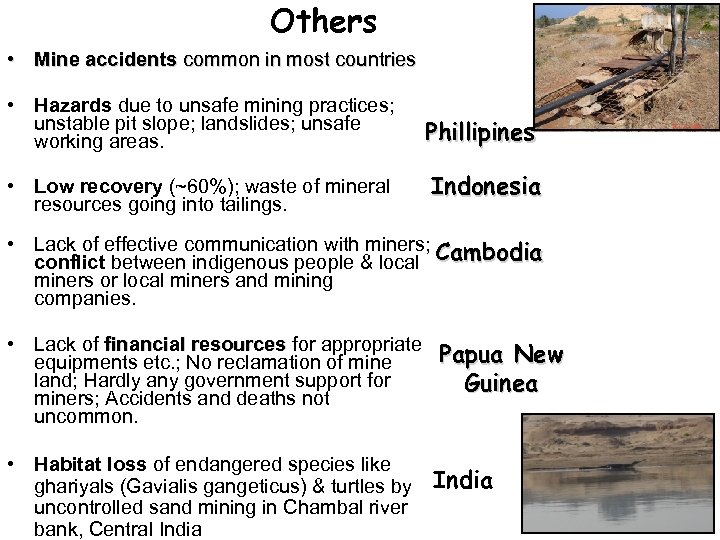 Others • Mine accidents common in most countries • Hazards due to unsafe mining practices; unstable pit slope; landslides; unsafe working areas. Phillipines • Low recovery (~60%); waste of mineral resources going into tailings. Indonesia • Lack of effective communication with miners; Cambodia conflict between indigenous people & local miners or local miners and mining companies. • Lack of financial resources for appropriate Papua New equipments etc. ; No reclamation of mine land; Hardly any government support for Guinea miners; Accidents and deaths not uncommon. • Habitat loss of endangered species like ghariyals (Gavialis gangeticus) & turtles by uncontrolled sand mining in Chambal river bank, Central India
 Initiatives (some examples)
 Indonesia • Government initiative through ‘people’s mining area’ or through small scale assistance: Local village cooperatives (KUDs) with permits • Mercury hazard awareness program • Global mercury project of UNIDO in central Kalimantan and Sulawasi Papua New Guinea • Mercury awareness amongst mining community • Improved mining techniques and increased gold production. • Establishment of Wau Micro Bank (ADB) to assist miners with mini loans and banking facilities • Conference (WIM) to address gender issues in mining communities • External donor assistance through Aus. Aid, World Bank, JSDF, SYSMIN
 India • Clear-cut definition and distinction between artisanal and small scale mining • Locate the responsible body within the administration to deal with ASM, e. g. , Village level ‘Panchayats’. • Review the existing legal framework for mining in the country, with special attention to ASM, making it a sustainable, povertyalleviating, environment-friendly enterprise. • Develop a database of ASM sites in the country
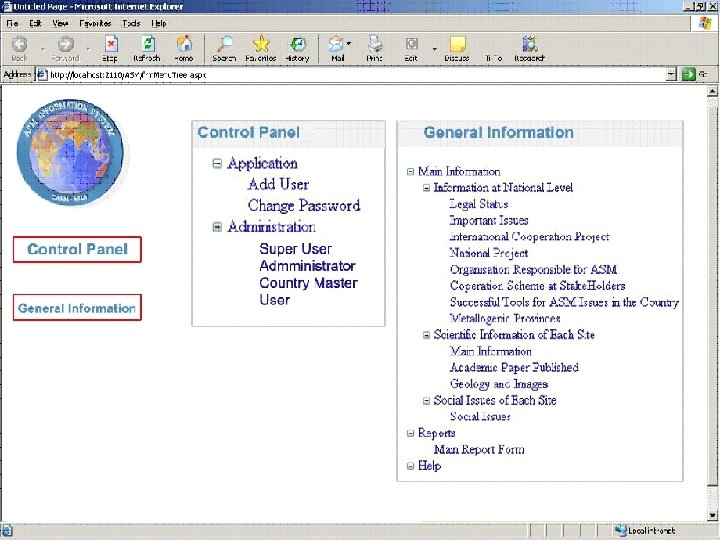
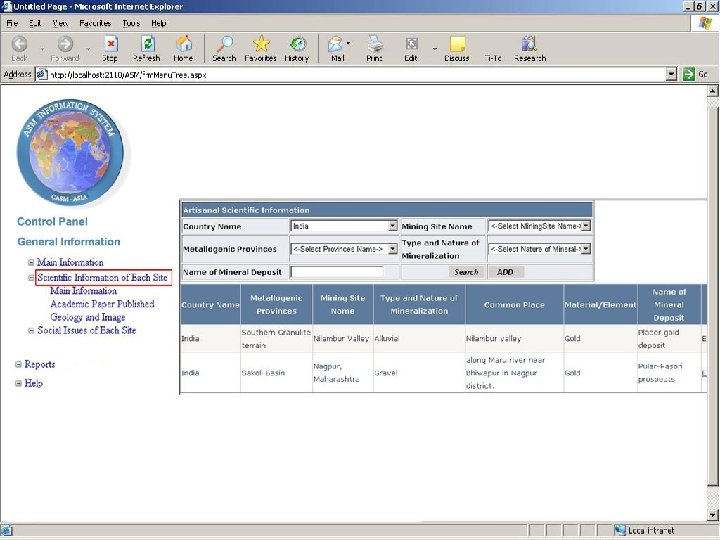
 Future directions for CASM-Asia • Legal provisions for ASM in all countries as a sustainable long-term economic activity; Policy for mining rights of cultural minorities within their lands. • Capacity building of small scale miners through improved mining technology, micro-financing and business development: to help in poverty alleviation • Base line study of health issues particularly with respect to mercury and cyanide toxicity. • Reclamation and remediation of degraded lands and ecosystems • Involvement of government agencies, NGOs in and external donor assistance to ASM sector, for better living standards for miners and for protection of the environment. • Development of a comprehensive ASM database
 Thank you for your attention