


 Скачать презентацию An Overview and Examination of the Malaysian Services
c17b7390c732efc075333b0fe959f71b.ppt
- Количество слайдов: 20
 An Overview and Examination of the Malaysian Services Sector Lisa Alejandro Jennifer Baumert Powell Samantha Brady Pham Isaac Wohl Office of Industries, Services Division
 Key Findings The service sector is a large and growing component of Malaysia’s economy Malaysia is one of Asia’s leading service economies, and maintains significant bilateral trade and investment relationships with the United States As part of its current economic strategy, the Malaysian government aims to improve the competitiveness of its service industries (with special emphasis on those segments that provide specialized services to Muslims) and has introduced various incentives and programs to achieve this goal Although Malaysia continues to maintain significant trade barriers in certain service sectors, recent liberalization may lead to an increase in service sector exports to Malaysia
 The Malaysian Services Sector The services sector accounts for over half of Malaysia’s GDP and employment. Wholesale and retail trade and finance and insurance account for the largest shares of Malaysian service sector GDP. Small- and medium-sized enterprises account for over 99 percent of Malaysian services companies.
 Government policies have had a significant impact on the Malaysian services sector Bumiputra preferences Increased investment in physical infrastructure Support for manufacturing-related services Policies encouraging service sector investment, such as tax incentives and liberalization of measures affecting foreign equity participation
 Other factors that affect the Malaysian services sector Growth in disposable incomes and spending power in Asia Persistent labor shortages
 Malaysian services trade with the world In 2008, Malaysian services exports and imports each totaled approximately $30 billion, accounting for about one percent of world services trade and 13 percent of Malaysian trade Travel accounts for over half of Malaysian services exports, while sea freight transport accounts for the largest share of Malaysian services imports
 U. S. -Malaysia services trade The United States maintains a services trade surplus with Malaysia, with exports of $2. 0 billion and imports of $1. 3 billion in 2008 – Royalties and license fees and research and development services accounted for the largest shares of U. S. exports and imports, respectively In 2007, U. S. affiliate sales to Malaysia totaled $3. 7 billion, while U. S. affiliate purchases totaled $422 million
 Trade barriers and recent liberalization Malaysia’s GATS commitments include significant foreign equity limitations, and reserve the right to restrict services trade pursuant to development goals Under its Ninth Master Plan (2006 -2010), Malaysia has lifted bumiputra equity requirements in several service industries, and liberalized foreign equity restrictions in the financial services sector Malaysia has also liberalized services trade under ASEAN in an effort to create an ASEAN Economic community by 2020
 Potential effects of additional liberalization A basic gravity model: i = country i j = country j IM= imports Y = GDP D = distance
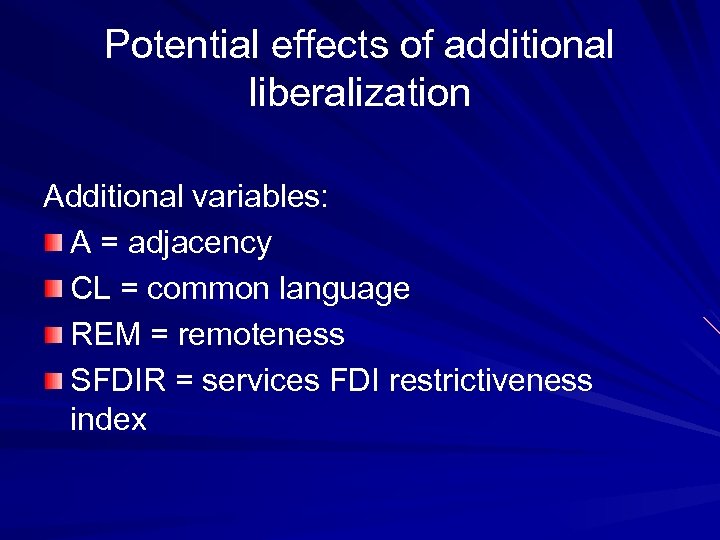 Potential effects of additional liberalization Additional variables: A = adjacency CL = common language REM = remoteness SFDIR = services FDI restrictiveness index
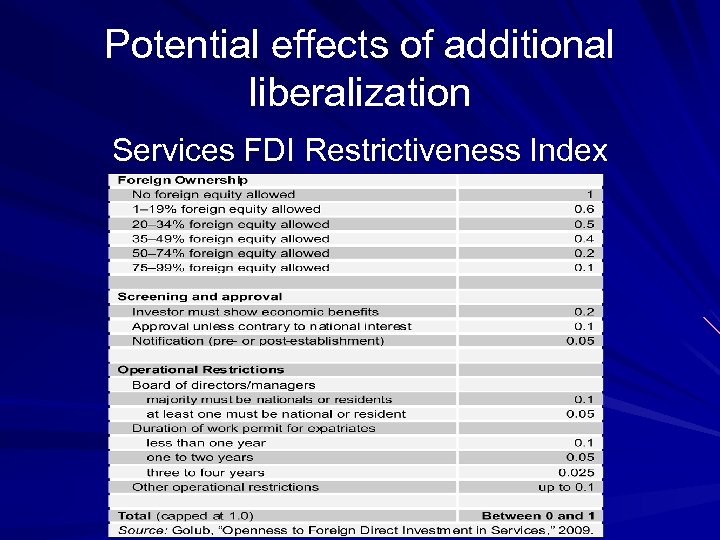 Potential effects of additional liberalization Services FDI Restrictiveness Index
 Potential effects of additional liberalization Panel regression (random effects), 2000 -06 Ordinary Least Squares (OLS), 2004
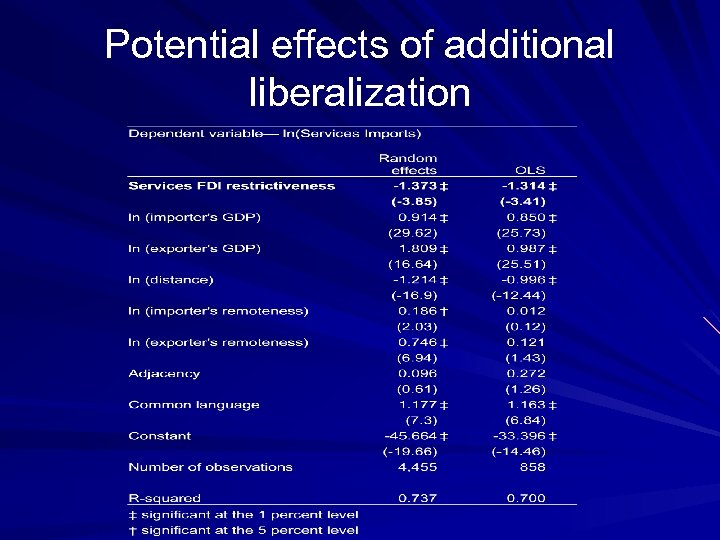 Potential effects of additional liberalization
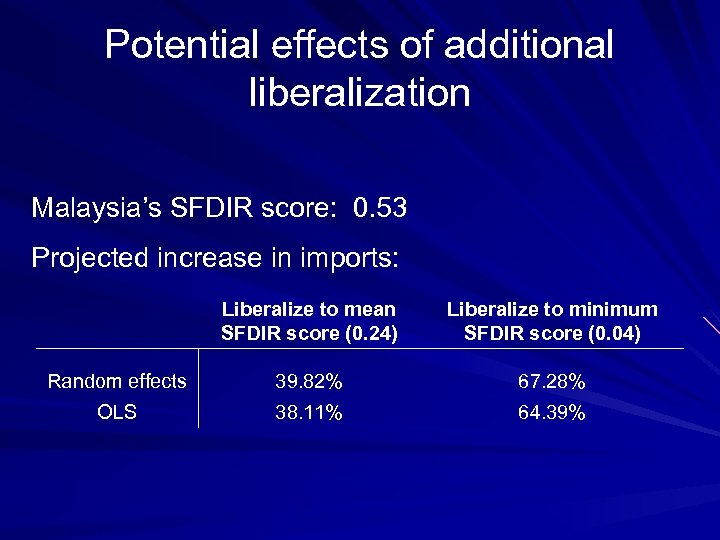 Potential effects of additional liberalization Malaysia’s SFDIR score: 0. 53 Projected increase in imports: Liberalize to mean SFDIR score (0. 24) Liberalize to minimum SFDIR score (0. 04) Random effects 39. 82% 67. 28% OLS 38. 11% 64. 39%
 Industry Profiles
 Banking The financial services industry is an increasingly important segment of the Malaysian economy—bank assets and employment posted overall growth of 76 percent and 11 percent, respectively, from 2005 to 2010 Under its Financial Sector Master Plan, the Malaysian government aims to strengthen the banking sector through consolidation and reform Although domestic firms dominate the sector and are well protected by foreign equity limitations and other government regulations, Malaysia’s foreign banking sector has grown rapidly Most financial services liberalization has been focused on Islamic banking, as growth in this segment of the market is a government priority
 Healthcare Services Malaysia has a growing healthcare services industry, and is Asia’s third-largest provider of medical tourism services Government incentives—including infrastructure development, tax incentives, and a telehealth initiative, among others—have had a substantial and positive impact on Malaysia’s public and private healthcare institutions Population growth, economic development, and sensitivity toward practicing Muslims have also contributed to growth and increasing competitiveness among Malaysian healthcare services providers Many foreign firms have entered the Malaysian healthcare market, although the country maintains significant foreign equity and employment restrictions
 Logistics Malaysia’s logistics sector is growing, and is emerging as a logistics hub for halal food products, but continues to face strong competition from Singapore’s logistics firms The Malaysian government has encouraged the development of its logistics sector through infrastructure investment and improved policy coordination, among other efforts. Although Malaysia has made some effort to liberalize its logistics sector, it continues to maintain significant foreign equity limitations.
 Topics for further analysis Examinations of additional Malaysian services industries – Passenger air services – Insurance Further comparisons of Malaysia’s services sector to the service sectors of other countries Additional research examining the effect of previous services liberalization
 Thank You!