


 Скачать презентацию An Open Service Architecture with Location Aware Calls
2d9c921ab172e3c22f16d307a59d7973.ppt
- Количество слайдов: 24
 An Open Service Architecture with Location Aware Calls and Services Lill Kristiansen, Prof. Dr. Scient Dept. of Telematics, NTNU, Norway www. item. ntnu. no/~lillk www. pats. no (lab-information) lill_kristiansen@hotmail. com 1
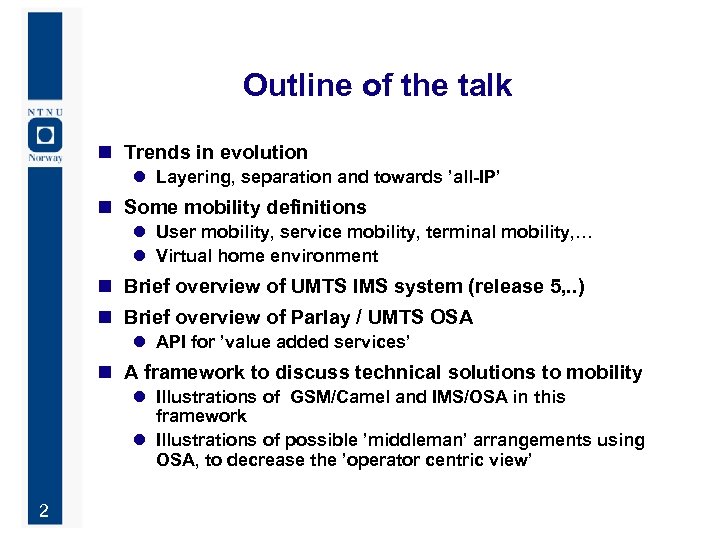 Outline of the talk n Trends in evolution l Layering, separation and towards ’all-IP’ n Some mobility definitions l User mobility, service mobility, terminal mobility, … l Virtual home environment n Brief overview of UMTS IMS system (release 5, . . ) n Brief overview of Parlay / UMTS OSA l API for ’value added services’ n A framework to discuss technical solutions to mobility l Illustrations of GSM/Camel and IMS/OSA in this framework l Illustrations of possible ’middleman’ arrangements using OSA, to decrease the ’operator centric view’ 2
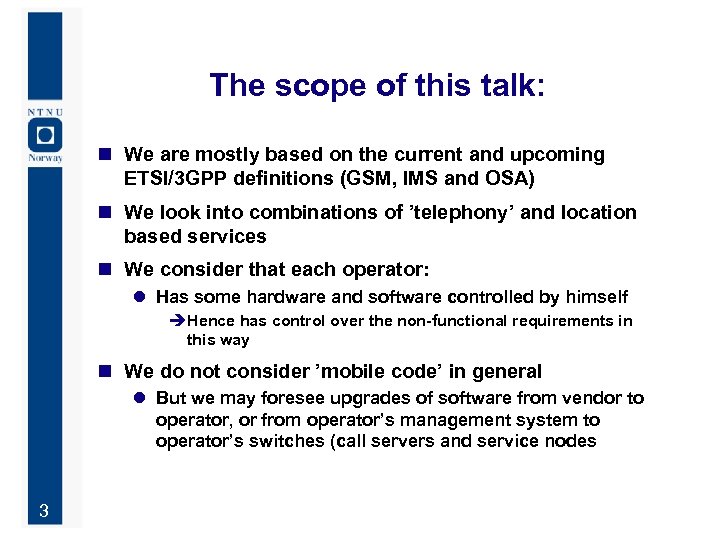 The scope of this talk: n We are mostly based on the current and upcoming ETSI/3 GPP definitions (GSM, IMS and OSA) n We look into combinations of ’telephony’ and location based services n We consider that each operator: l Has some hardware and software controlled by himself èHence has control over the non-functional requirements in this way n We do not consider ’mobile code’ in general l But we may foresee upgrades of software from vendor to operator, or from operator’s management system to operator’s switches (call servers and service nodes 3
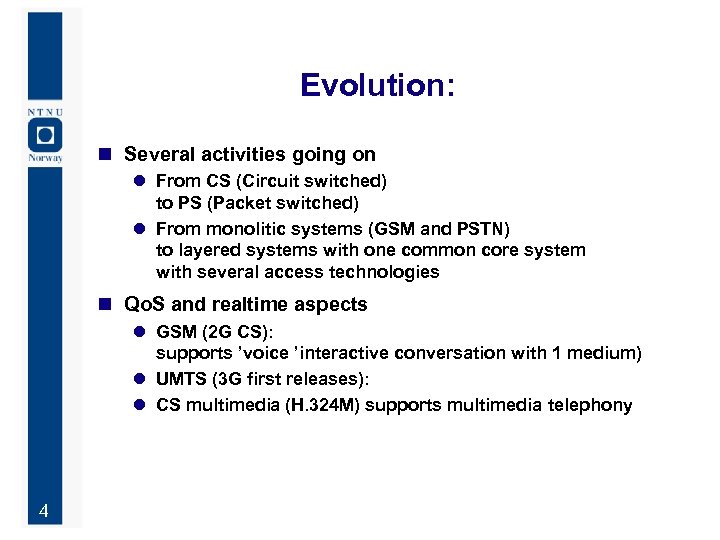 Evolution: n Several activities going on l From CS (Circuit switched) to PS (Packet switched) l From monolitic systems (GSM and PSTN) to layered systems with one common core system with several access technologies n Qo. S and realtime aspects l GSM (2 G CS): supports ’voice ’interactive conversation with 1 medium) l UMTS (3 G first releases): l CS multimedia (H. 324 M) supports multimedia telephony 4
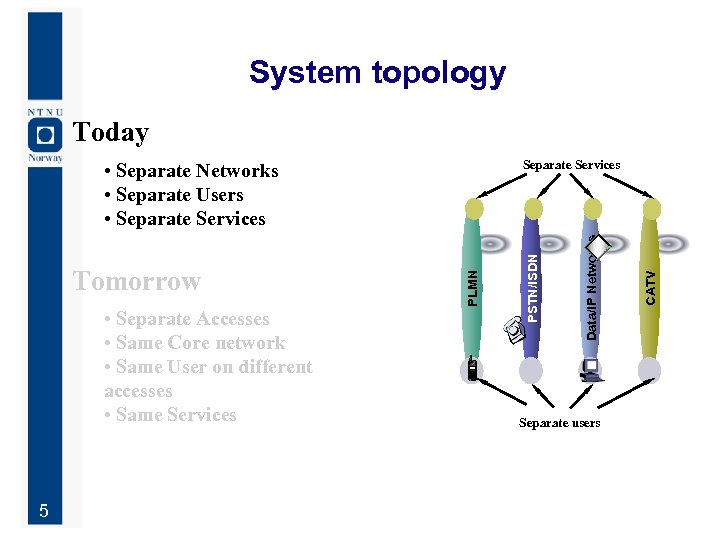 System topology Today 5 Separate users CATV Data/IP Networks • Separate Accesses • Same Core network • Same User on different accesses • Same Services PLMN Tomorrow PSTN/ISDN Separate Services • Separate Networks • Separate Users • Separate Services
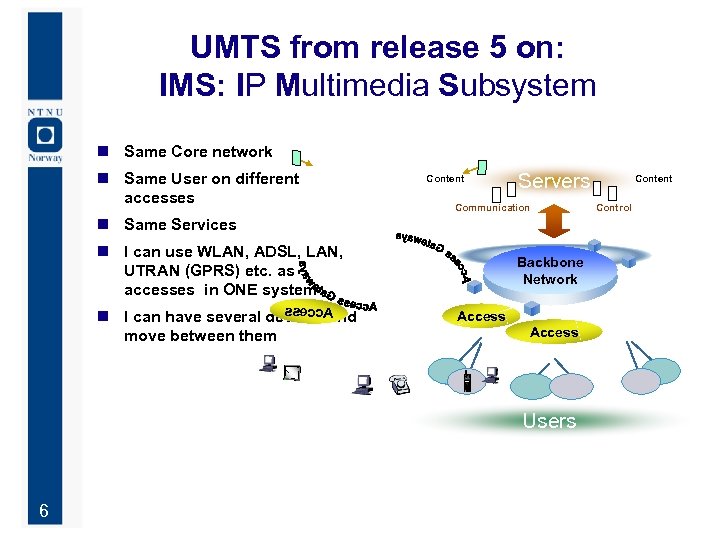 UMTS from release 5 on: IMS: IP Multimedia Subsystem n Same Core network n Same User on different accesses Content Servers Communication n Same Services n I can use WLAN, ADSL, LAN, UTRAN (GPRS) etc. as accesses in ONE system ssecc and n I can have several devices. A move between them Backbone Network Access Users 6 Content Control
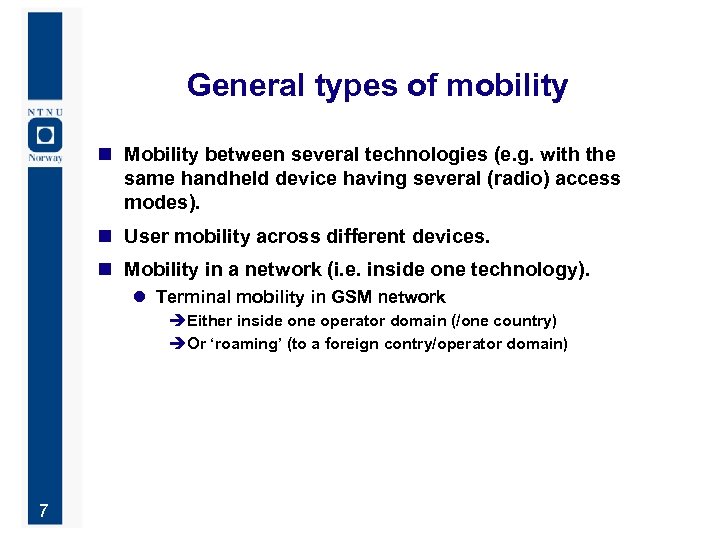 General types of mobility n Mobility between several technologies (e. g. with the same handheld device having several (radio) access modes). n User mobility across different devices. n Mobility in a network (i. e. inside one technology). l Terminal mobility in GSM network èEither inside one operator domain (/one country) èOr ‘roaming’ (to a foreign contry/operator domain) 7
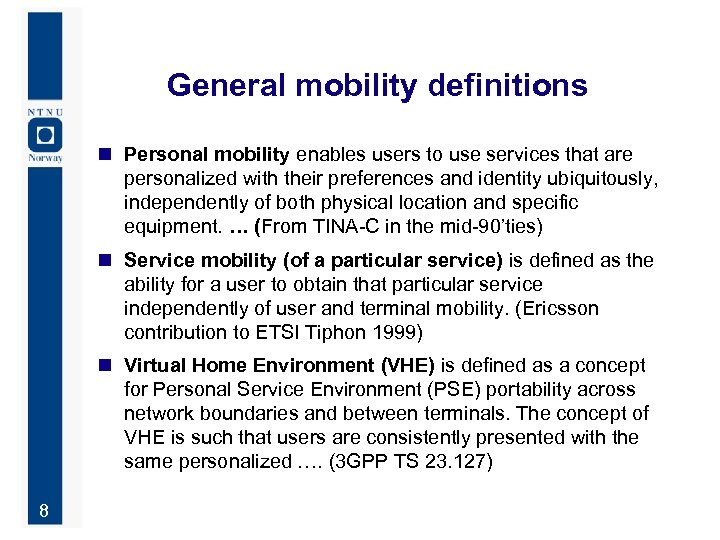 General mobility definitions n Personal mobility enables users to use services that are personalized with their preferences and identity ubiquitously, independently of both physical location and specific equipment. … (From TINA-C in the mid-90’ties) n Service mobility (of a particular service) is defined as the ability for a user to obtain that particular service independently of user and terminal mobility. (Ericsson contribution to ETSI Tiphon 1999) n Virtual Home Environment (VHE) is defined as a concept for Personal Service Environment (PSE) portability across network boundaries and between terminals. The concept of VHE is such that users are consistently presented with the same personalized …. (3 GPP TS 23. 127) 8
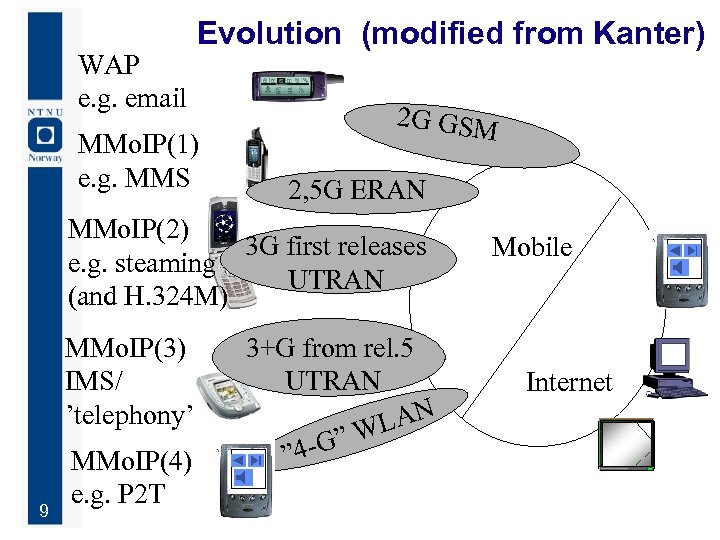 WAP e. g. email Evolution (modified from Kanter) MMo. IP(1) e. g. MMS 2 G GSM 2, 5 G ERAN MMo. IP(2) 3 G first releases e. g. steaming UTRAN (and H. 324 M) MMo. IP(3) IMS/ ’telephony’ 9 MMo. IP(4) e. g. P 2 T 3+G from rel. 5 UTRAN LAN W -G” ” 4 Mobile Internet
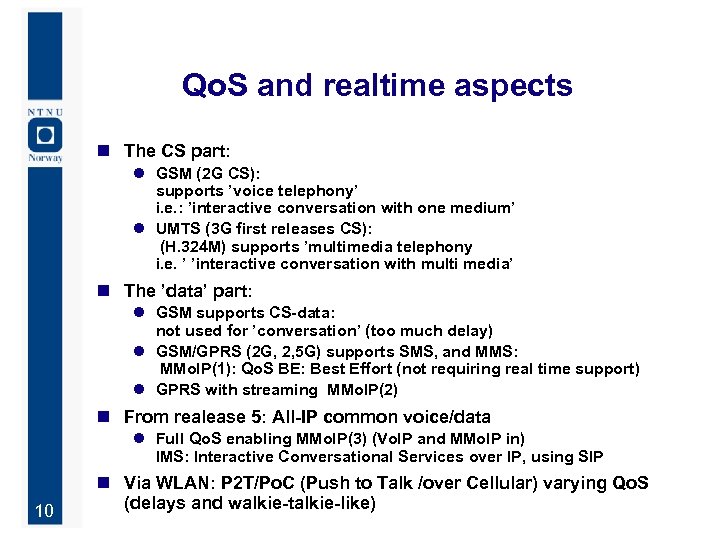 Qo. S and realtime aspects n The CS part: l GSM (2 G CS): supports ’voice telephony’ i. e. : ’interactive conversation with one medium’ l UMTS (3 G first releases CS): (H. 324 M) supports ’multimedia telephony i. e. ’ ’interactive conversation with multi media’ n The ’data’ part: l GSM supports CS-data: not used for ’conversation’ (too much delay) l GSM/GPRS (2 G, 2, 5 G) supports SMS, and MMS: MMo. IP(1): Qo. S BE: Best Effort (not requiring real time support) l GPRS with streaming MMo. IP(2) n From realease 5: All-IP common voice/data l Full Qo. S enabling MMo. IP(3) (Vo. IP and MMo. IP in) IMS: Interactive Conversational Services over IP, using SIP 10 n Via WLAN: P 2 T/Po. C (Push to Talk /over Cellular) varying Qo. S (delays and walkie-talkie-like)
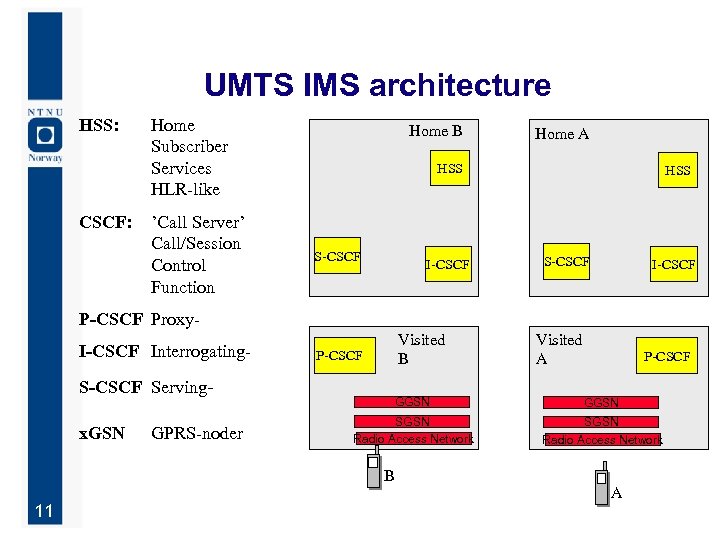 UMTS IMS architecture HSS: CSCF: Home Subscriber Services HLR-like ’Call Server’ Call/Session Control Function Home B Home A HSS S-CSCF I-CSCF P-CSCF Proxy. I-CSCF Interrogating. S-CSCF Servingx. GSN GPRS-noder Visited B P-CSCF Visited A P-CSCF GGSN SGSN Radio Access Network B 11 A
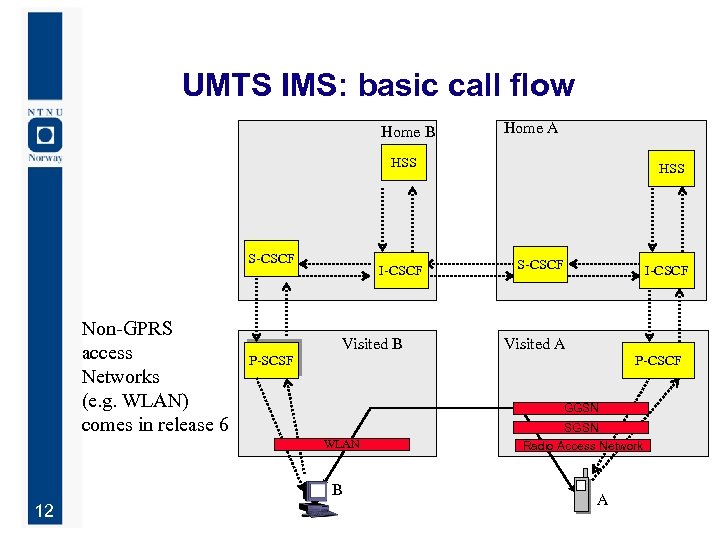 UMTS IMS: basic call flow Home B Home A HSS S-CSCF Non-GPRS access Networks (e. g. WLAN) comes in release 6 I-CSCF Visited B S-CSCF I-CSCF Visited A P-SCSF P-CSCF GGSN SGSN WLAN B 12 HSS Radio Access Network A
 Virtual Home Environment (3 GPP): n VHE enables end users to bring with them their personal service environment whilst roaming between networks, and also being independent of terminal used n PSE Personal Service Environment: l describes how the user wishes to manage and interact with her communication services. It is a combination of a list of subscribed to services, service preferences and terminal interface preferences. PSE also encompasses the user management of multiple subscriptions, e. g. business and private, multiple terminal types and location preferences. l The PSE is defined in terms of one or more User Profiles. 13
 3 GPP OSA architecture n Allows application to use underlying network resources n Allows combinations: l Location capabilities (from GSM/UMTS and WLAN) èRadionor Cordis Radioeye allows detailed location in WLAN l SMS/MMS capabilities l Call Control capabilities 14
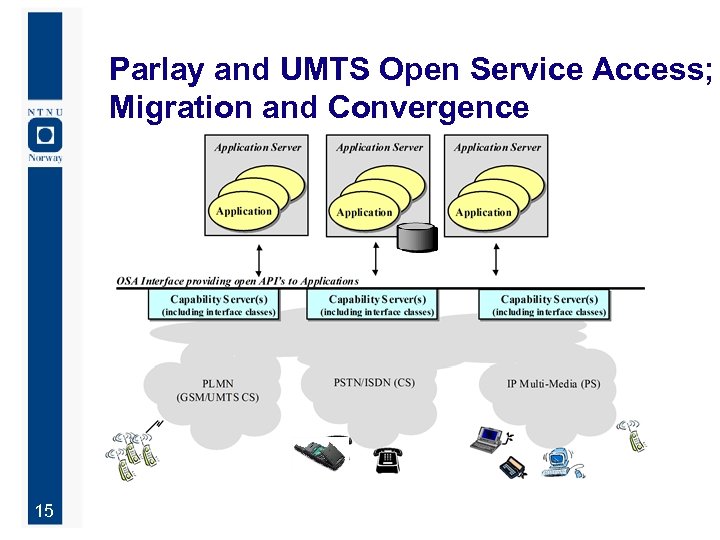 Parlay and UMTS Open Service Access; Migration and Convergence 15
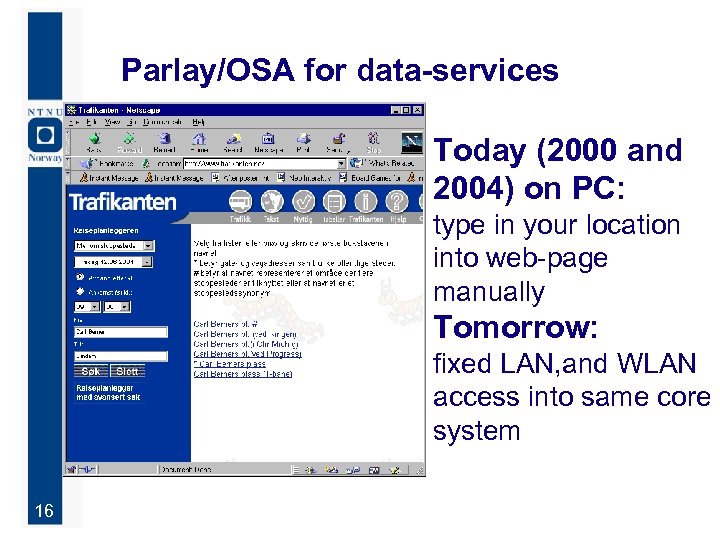 Parlay/OSA for data-services Today (2000 and 2004) on PC: type in your location into web-page manually Tomorrow: fixed LAN, and WLAN access into same core system 16
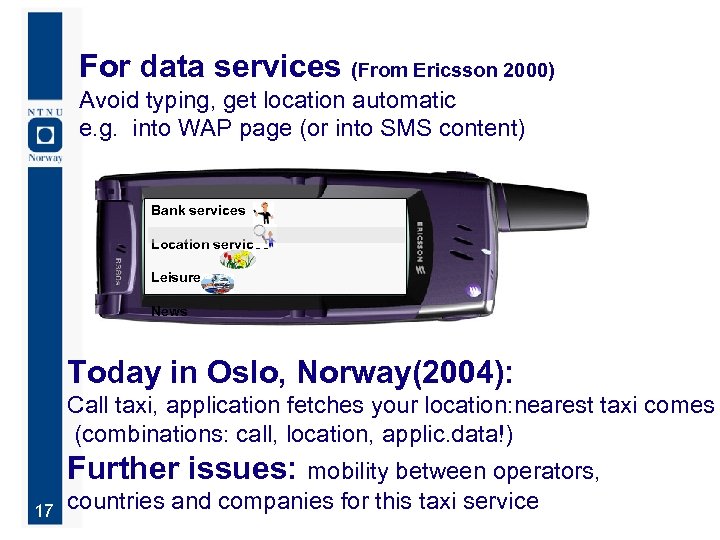 For data services (From Ericsson 2000) Avoid typing, get location automatic e. g. into WAP page (or into SMS content) Bank services Location services Leisure News Today in Oslo, Norway(2004): Call taxi, application fetches your location: nearest taxi comes (combinations: call, location, applic. data!) Further issues: mobility between operators, 17 countries and companies for this taxi service
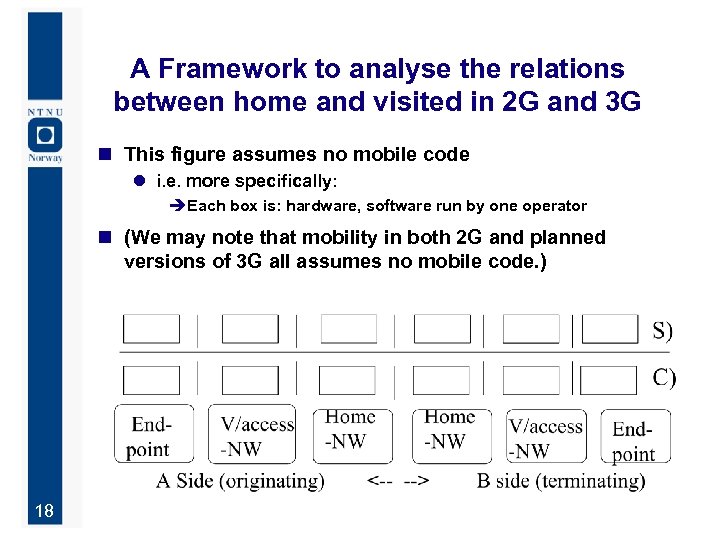 A Framework to analyse the relations between home and visited in 2 G and 3 G n This figure assumes no mobile code l i. e. more specifically: èEach box is: hardware, software run by one operator n (We may note that mobility in both 2 G and planned versions of 3 G all assumes no mobile code. ) 18
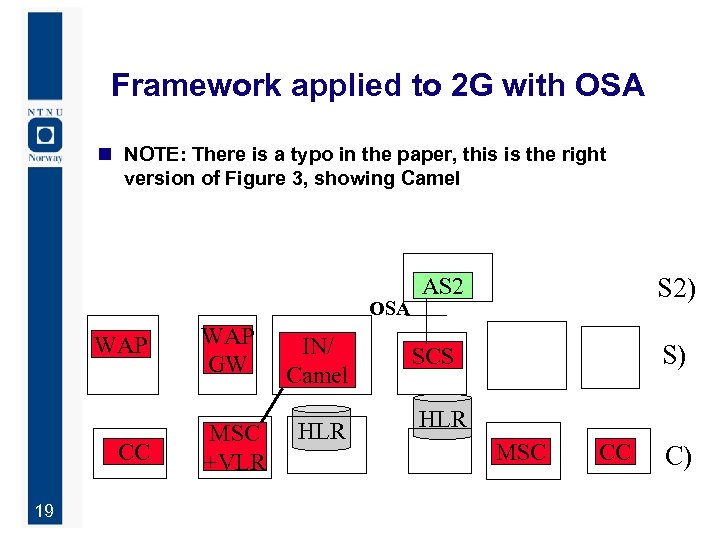 Framework applied to 2 G with OSA n NOTE: There is a typo in the paper, this is the right version of Figure 3, showing Camel OSA WAP CC 19 WAP GW IN/ Camel MSC +VLR HLR S 2) AS 2 S) SCS HLR MSC CC C)
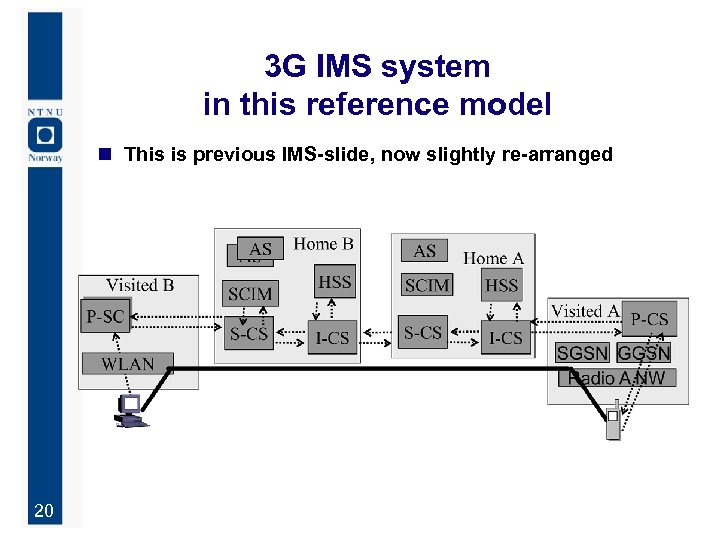 3 G IMS system in this reference model n This is previous IMS-slide, now slightly re-arranged 20
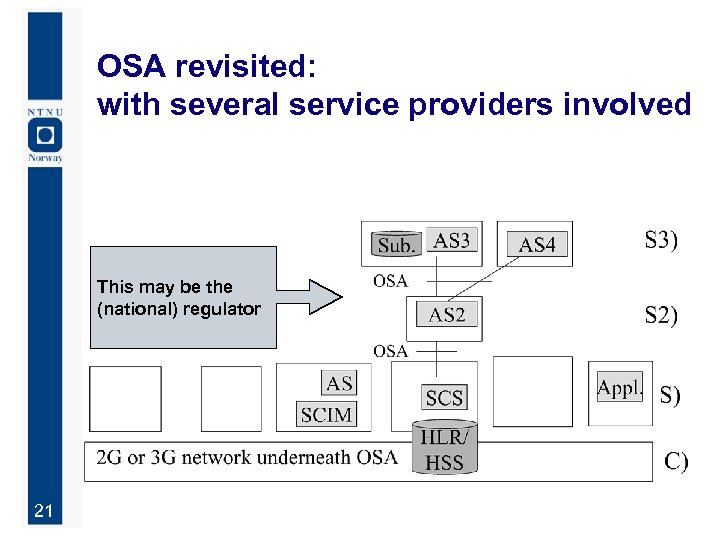 OSA revisited: with several service providers involved This may be the (national) regulator 21
 Advantages with this new solution n Less ’operator centric’ l Does not require the 3 rd party service provider to have a business relation with the operator l The regulator acts as ’neutral middleman’: è assuring equal access for all service providers èSingle point of contact for the enduser èEasier for the enduser to enforce a good privacy policy 22
 Network centric =/= operator centric n AS 3 is a network based solution, but totally independent from the network operator domain n A personal web-page might also act as a network based solution l See Jan Egil Kristiansen Our addresses and phones, http: //heima. olivant. fo/~styrheim/kontakt. en. html èThe enduser himself controls the user mobility, and (in nonrealtime) informs his contacts about the ’current terminal/SIM card) èAllows the enduser to buy local GSM-cards, instead of the often more expence network operator centric solution with ’roaming’ That is often very expensive, and subject to little competition 23
 Summing up the reference figure n Allows us to discuss different business models between home and visited networks l Fits in with 2 G & Camel &OSA èShows some major drawback with Camel èDue to call server (MSC in visited network) l Also fits in with 3+G (IMS) & OSA èNice to use when discussing the advantages of having SCSCF in home network vs. (the now gone option of S-SCSF in visited network) èUseful when discussing the fully mobile case of ’call nearest taxi’ èFits in also with private initiatives not described in the 3 GPP standards n Further issues: Mobile code is not covered 24