 Скачать презентацию An Ontology-Based Approach for Computational Phenomics Application to
5701fdbb0dc46fd475abdda9e40334dd.ppt
- Количество слайдов: 57



An Ontology-Based Approach for Computational Phenomics: Application to Autism Spectrum Disorder Amar K. Das, MD, Ph. D Departments of Medicine and of Psychiatry and Behavioral Sciences Stanford Center for Biomedical Informatics Research
Outline Motivations n NDAR project n Phenologue project n Future Directions n NCBO Webinar October 7, 2009
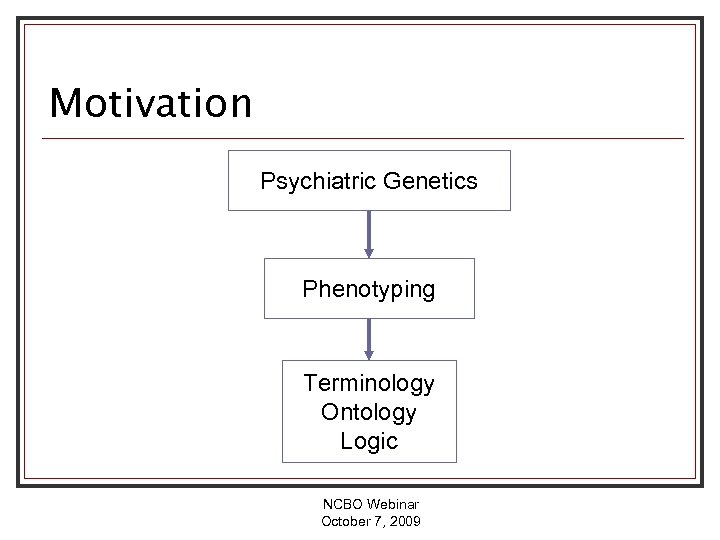
Motivation Psychiatric Genetics Phenotyping Terminology Ontology Logic NCBO Webinar October 7, 2009
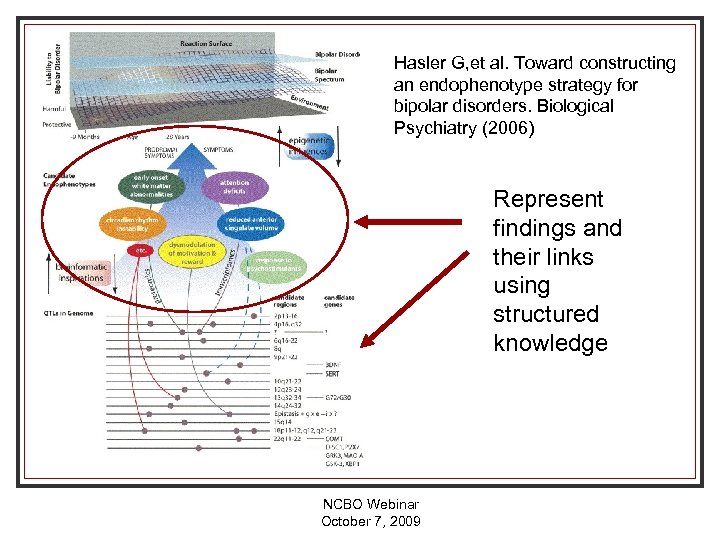
Hasler G, et al. Toward constructing an endophenotype strategy for bipolar disorders. Biological Psychiatry (2006) Represent findings and their links using structured knowledge NCBO Webinar October 7, 2009
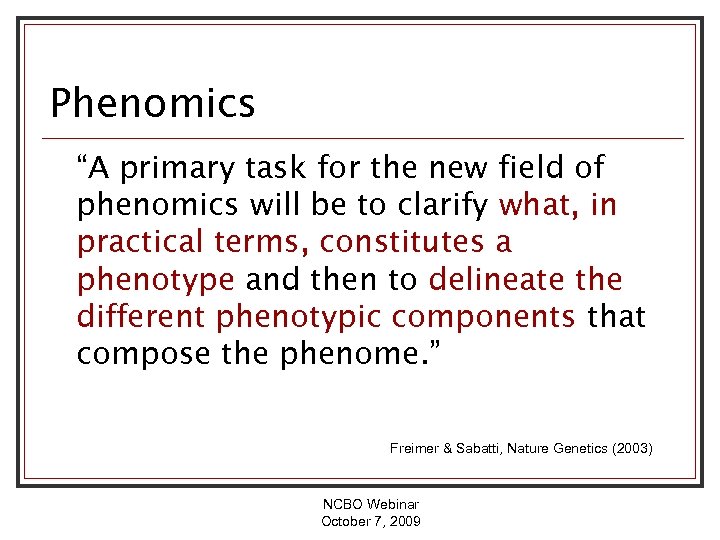
Phenomics “A primary task for the new field of phenomics will be to clarify what, in practical terms, constitutes a phenotype and then to delineate the different phenotypic components that compose the phenome. ” Freimer & Sabatti, Nature Genetics (2003) NCBO Webinar October 7, 2009
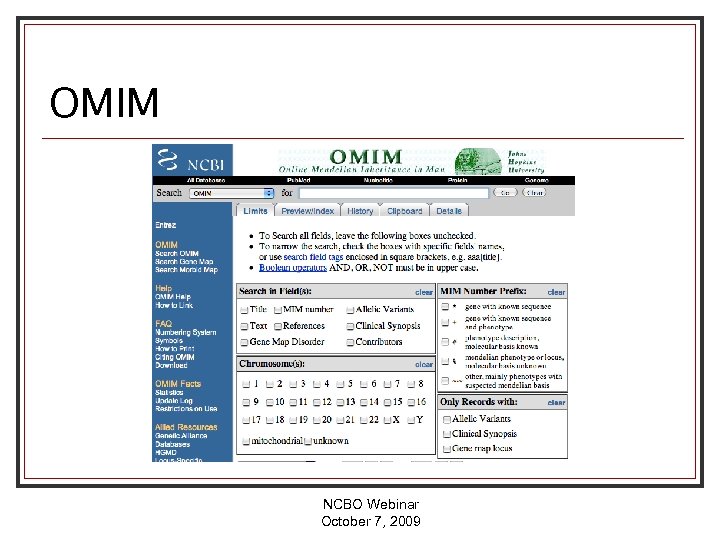
OMIM NCBO Webinar October 7, 2009
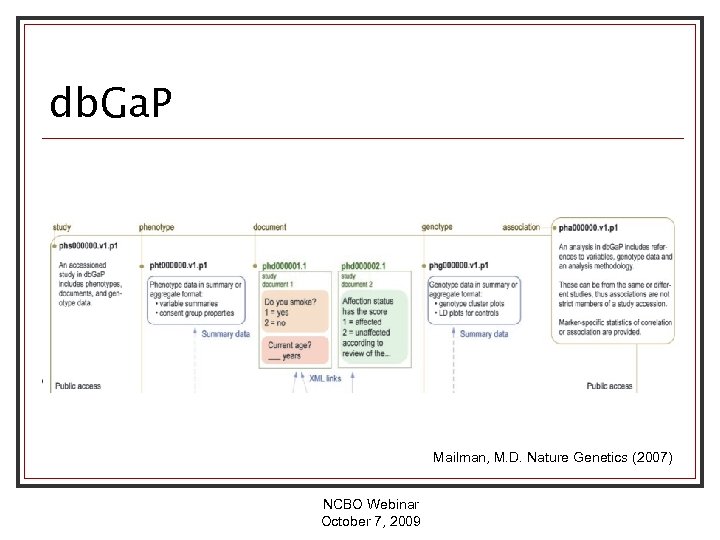
db. Ga. P Mailman, M. D. Nature Genetics (2007) NCBO Webinar October 7, 2009
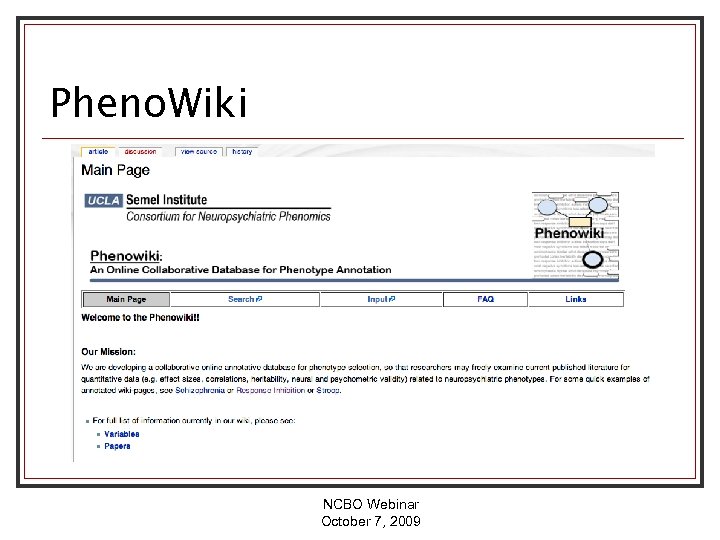
Pheno. Wiki NCBO Webinar October 7, 2009
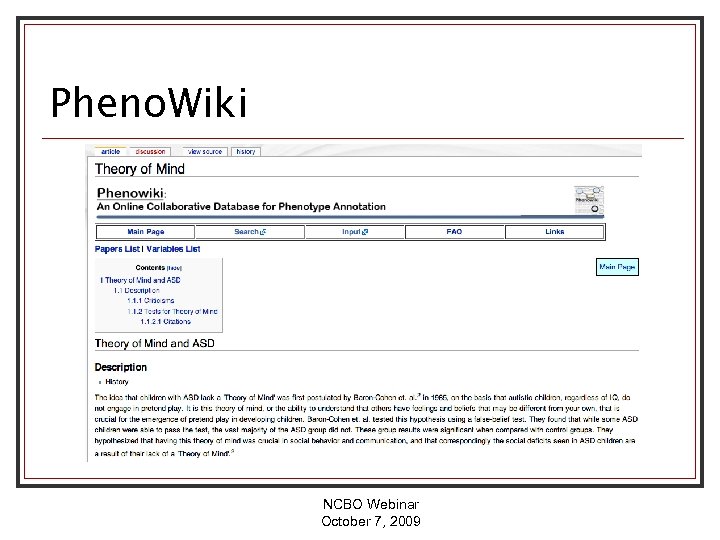
Pheno. Wiki NCBO Webinar October 7, 2009
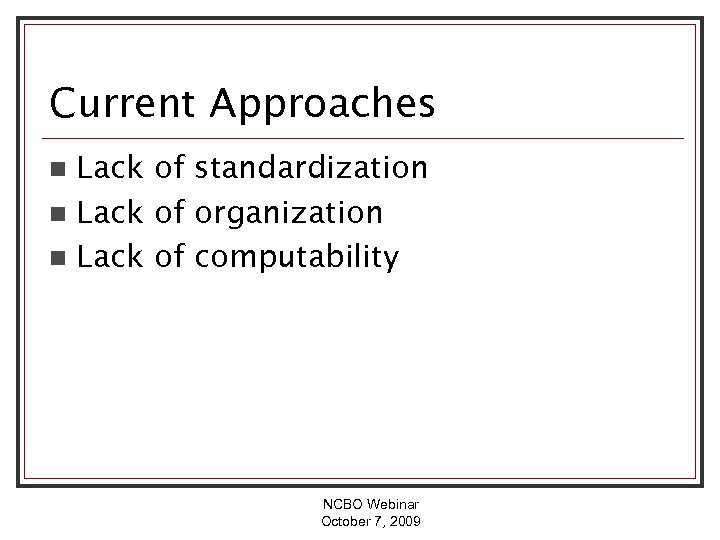
Current Approaches Lack of standardization n Lack of organization n Lack of computability n NCBO Webinar October 7, 2009
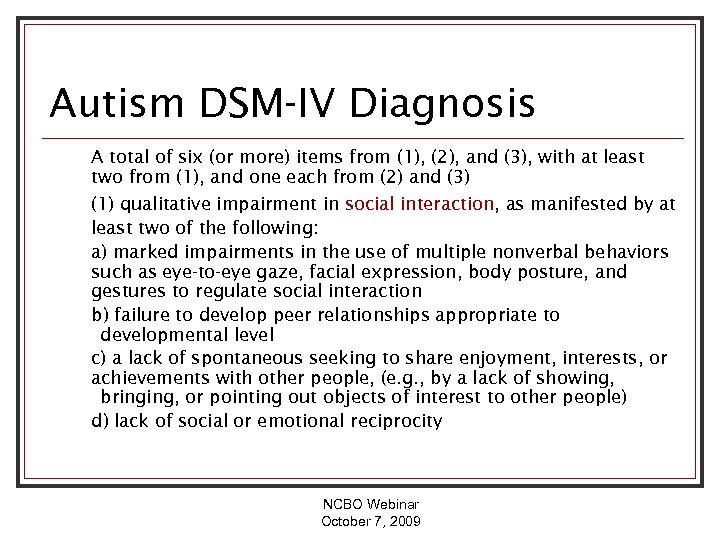
Autism DSM-IV Diagnosis A total of six (or more) items from (1), (2), and (3), with at least two from (1), and one each from (2) and (3) (1) qualitative impairment in social interaction, as manifested by at least two of the following: a) marked impairments in the use of multiple nonverbal behaviors such as eye-to-eye gaze, facial expression, body posture, and gestures to regulate social interaction b) failure to develop peer relationships appropriate to developmental level c) a lack of spontaneous seeking to share enjoyment, interests, or achievements with other people, (e. g. , by a lack of showing, bringing, or pointing out objects of interest to other people) d) lack of social or emotional reciprocity NCBO Webinar October 7, 2009
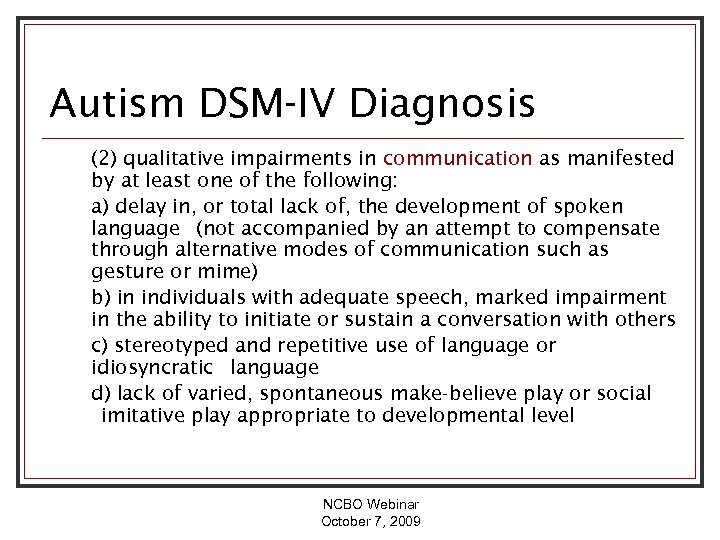
Autism DSM-IV Diagnosis (2) qualitative impairments in communication as manifested by at least one of the following: a) delay in, or total lack of, the development of spoken language (not accompanied by an attempt to compensate through alternative modes of communication such as gesture or mime) b) in individuals with adequate speech, marked impairment in the ability to initiate or sustain a conversation with others c) stereotyped and repetitive use of language or idiosyncratic language d) lack of varied, spontaneous make-believe play or social imitative play appropriate to developmental level NCBO Webinar October 7, 2009
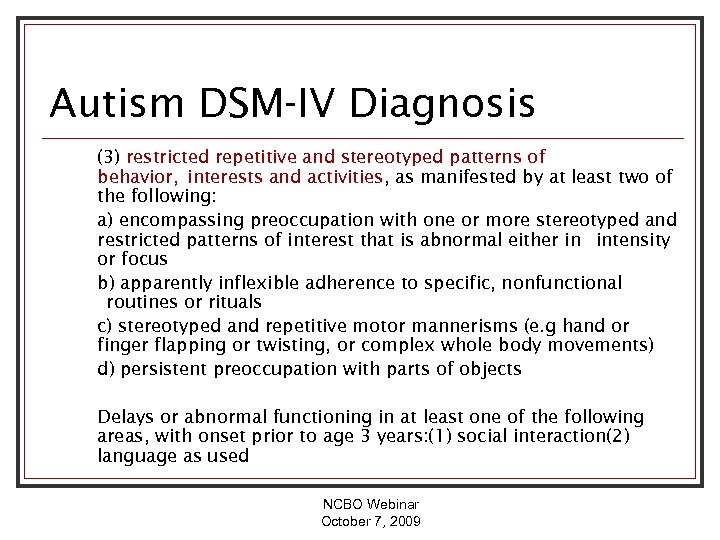
Autism DSM-IV Diagnosis (3) restricted repetitive and stereotyped patterns of behavior, interests and activities, as manifested by at least two of the following: a) encompassing preoccupation with one or more stereotyped and restricted patterns of interest that is abnormal either in intensity or focus b) apparently inflexible adherence to specific, nonfunctional routines or rituals c) stereotyped and repetitive motor mannerisms (e. g hand or finger flapping or twisting, or complex whole body movements) d) persistent preoccupation with parts of objects Delays or abnormal functioning in at least one of the following areas, with onset prior to age 3 years: (1) social interaction(2) language as used NCBO Webinar October 7, 2009
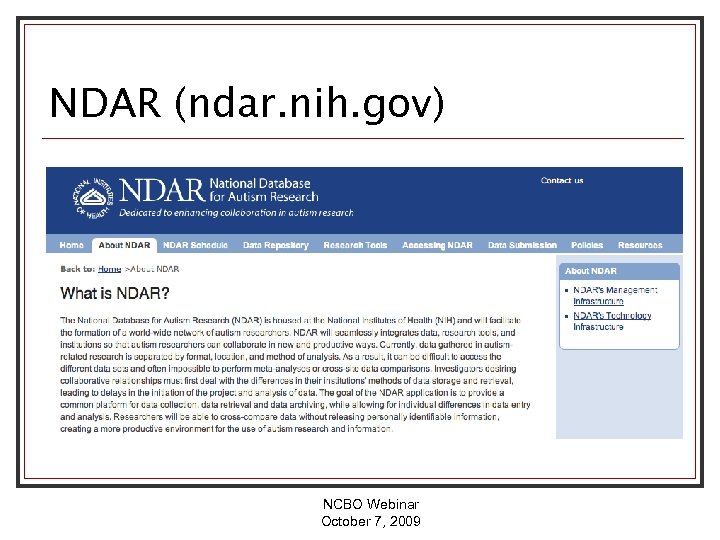
NDAR (ndar. nih. gov) NCBO Webinar October 7, 2009
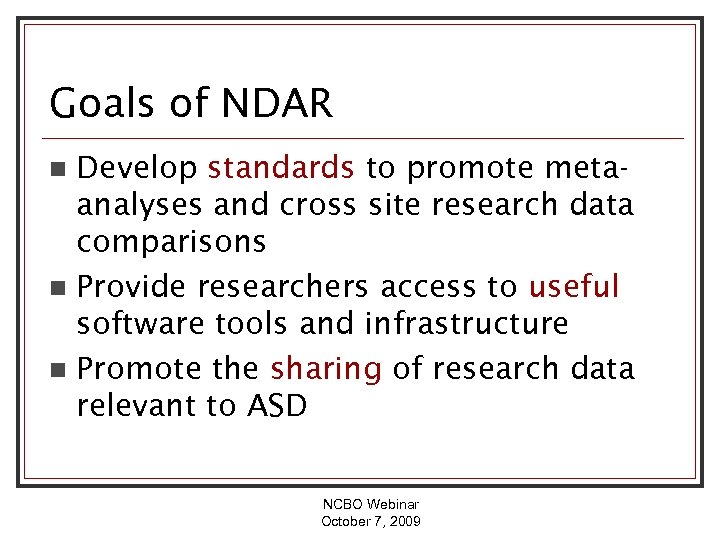
Goals of NDAR Develop standards to promote metaanalyses and cross site research data comparisons n Provide researchers access to useful software tools and infrastructure n Promote the sharing of research data relevant to ASD n NCBO Webinar October 7, 2009
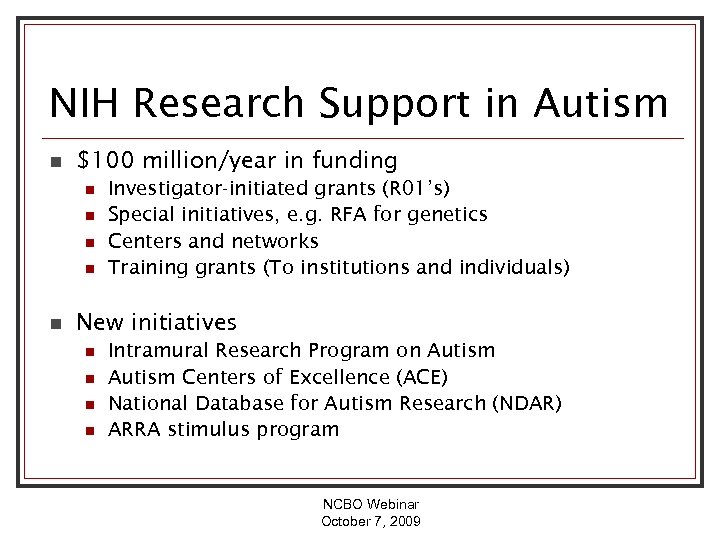
NIH Research Support in Autism n $100 million/year in funding n n n Investigator-initiated grants (R 01’s) Special initiatives, e. g. RFA for genetics Centers and networks Training grants (To institutions and individuals) New initiatives n n Intramural Research Program on Autism Centers of Excellence (ACE) National Database for Autism Research (NDAR) ARRA stimulus program NCBO Webinar October 7, 2009
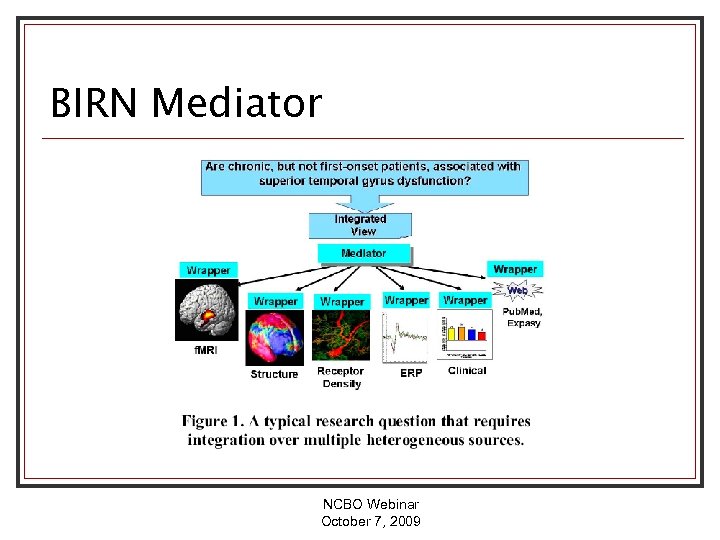
BIRN Mediator NCBO Webinar October 7, 2009
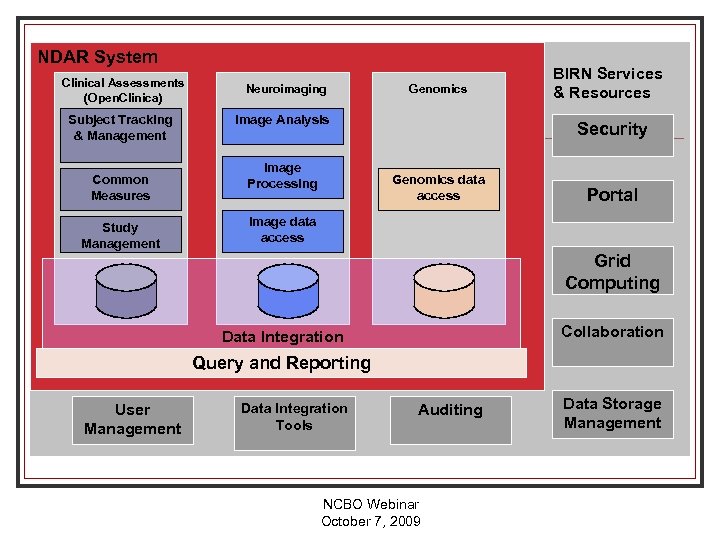
NDAR System Clinical Assessments (Open. Clinica) Neuroimaging Subject Tracking & Management Image Analysis Common Measures Study Management Image Processing Genomics BIRN Services & Resources Security Genomics data access Portal Image data access Grid Computing Collaboration Data Integration Query and Reporting User Management Data Integration Tools Auditing NCBO Webinar October 7, 2009 Data Storage Management
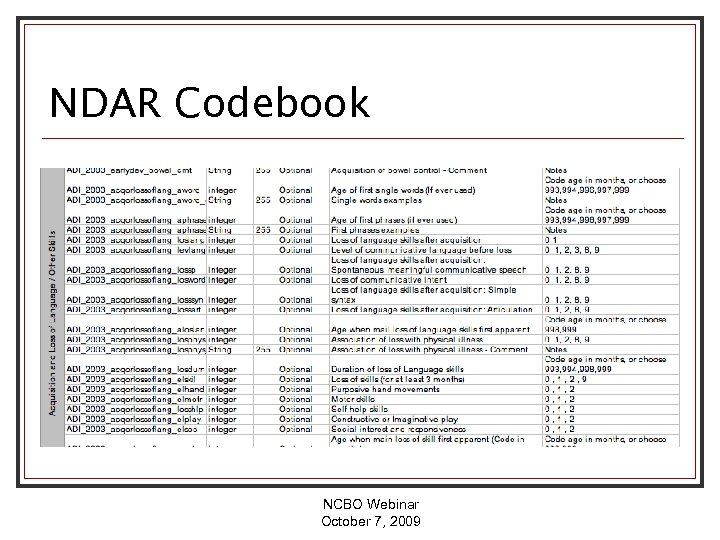
NDAR Codebook NCBO Webinar October 7, 2009
Phenotypes in Psychiatry ‘The observable structural and functional characteristics of an organism determined by its genotype and modulated by its environment’ Diagnostic component n Intermediate phenotype n Quantitative phenotype n Covariates n NCBO Webinar October 7, 2009
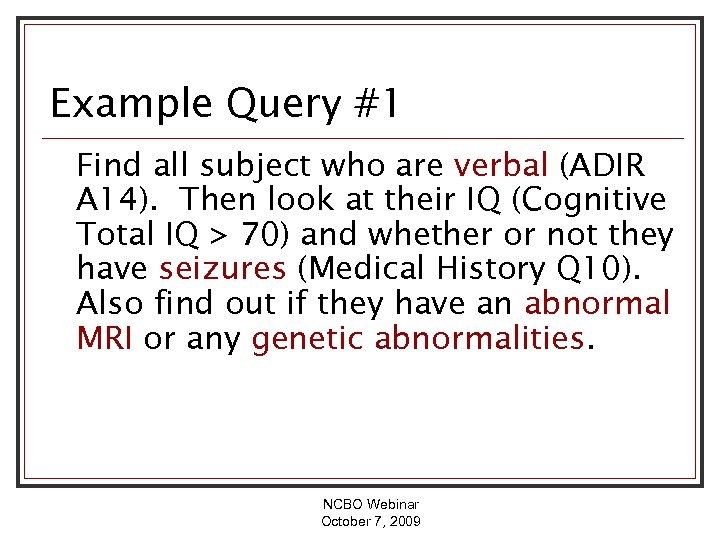
Example Query #1 Find all subject who are verbal (ADIR A 14). Then look at their IQ (Cognitive Total IQ > 70) and whether or not they have seizures (Medical History Q 10). Also find out if they have an abnormal MRI or any genetic abnormalities. NCBO Webinar October 7, 2009
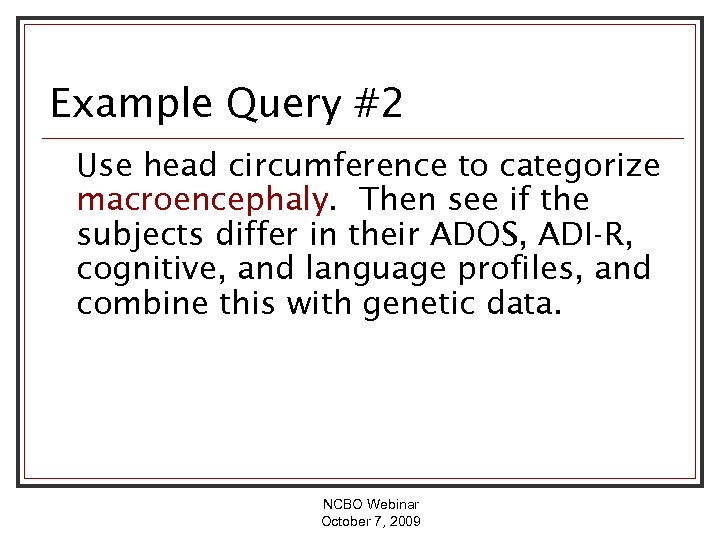
Example Query #2 Use head circumference to categorize macroencephaly. Then see if the subjects differ in their ADOS, ADI-R, cognitive, and language profiles, and combine this with genetic data. NCBO Webinar October 7, 2009
NDAR Project Systematic Review n Ontology Development n Database Infrastructure n NCBO Webinar October 7, 2009
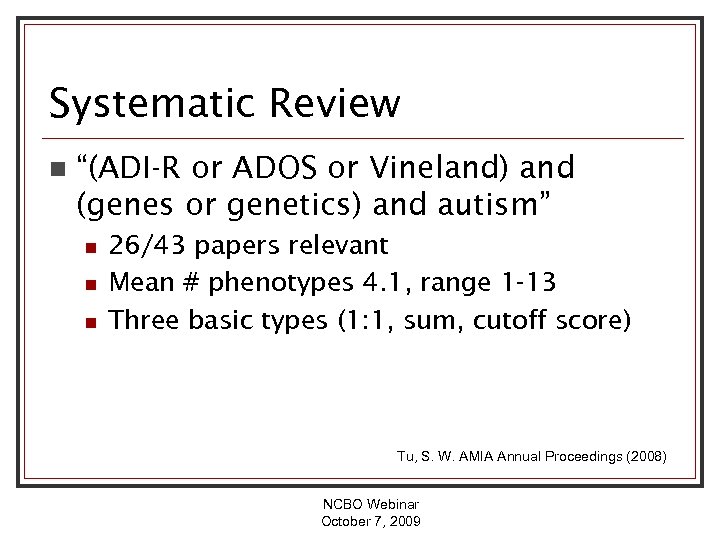
Systematic Review n “(ADI-R or ADOS or Vineland) and (genes or genetics) and autism” n n n 26/43 papers relevant Mean # phenotypes 4. 1, range 1 -13 Three basic types (1: 1, sum, cutoff score) Tu, S. W. AMIA Annual Proceedings (2008) NCBO Webinar October 7, 2009
Systematic Review n Different terms e. g. , ‘age of first phrases’ and ‘age of onset of phrase speech’ n Different cutoff scores e. g. , ‘delayed word’ n Different definitions e. g. , ‘regression’ e. g. , use of different instruments NCBO Webinar October 7, 2009
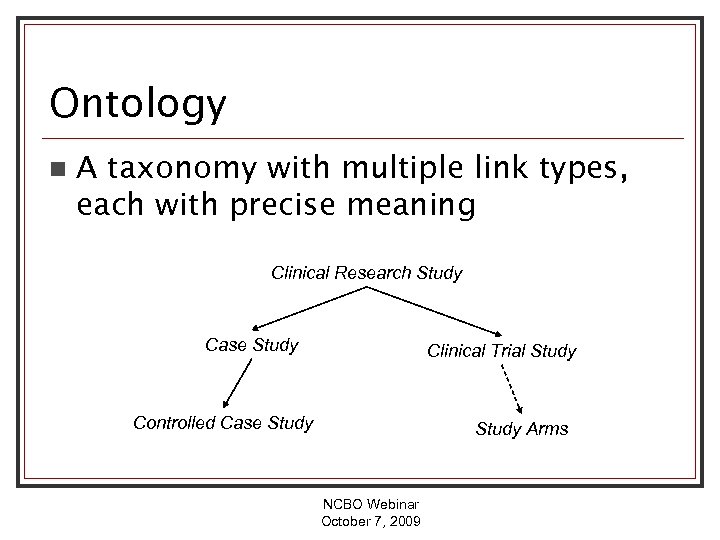
Ontology n A taxonomy with multiple link types, each with precise meaning Clinical Research Study Case Study Clinical Trial Study Controlled Case Study Arms NCBO Webinar October 7, 2009
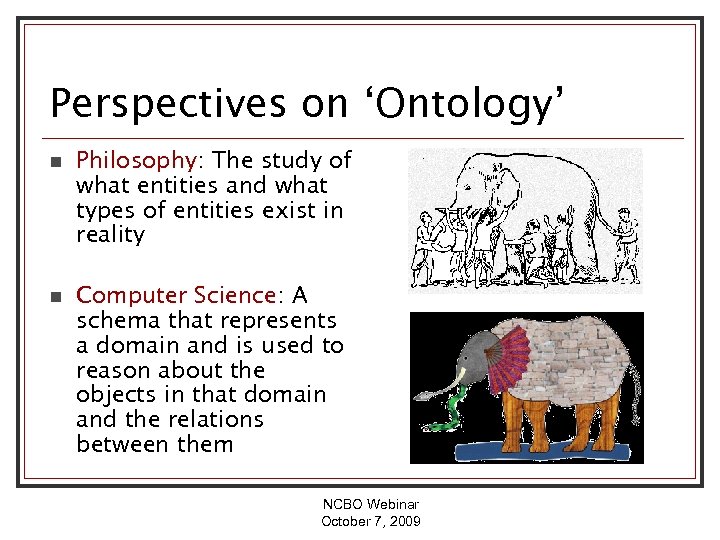
Perspectives on ‘Ontology’ n Philosophy: The study of what entities and what types of entities exist in reality n Computer Science: A schema that represents a domain and is used to reason about the objects in that domain and the relations between them NCBO Webinar October 7, 2009
Critical to the ‘Semantic Web’ n Shared research and development plan to n n Provide explicit semantic meaning to data and knowledge shared on the Web Bring structure to Web content Advance the current state-of-the-art in Web information retrieval, which is keyword searching Distributed applications will be able to process data and knowledge automatically through the use of ontologies NCBO Webinar October 7, 2009
OWL: Web Ontology Language n n Advances current Semantic Web standards by using ontologies to represent knowledge OWL can be used to build ontologies of highlevel descriptions, based on three concepts: n n n Classes (e. g. , Subject, Phenotype, Genotype) Properties (e. g. , is. Bearer. Of, has. Results) Individuals (e. g. , “Macroencephaly”) NCBO Webinar October 7, 2009
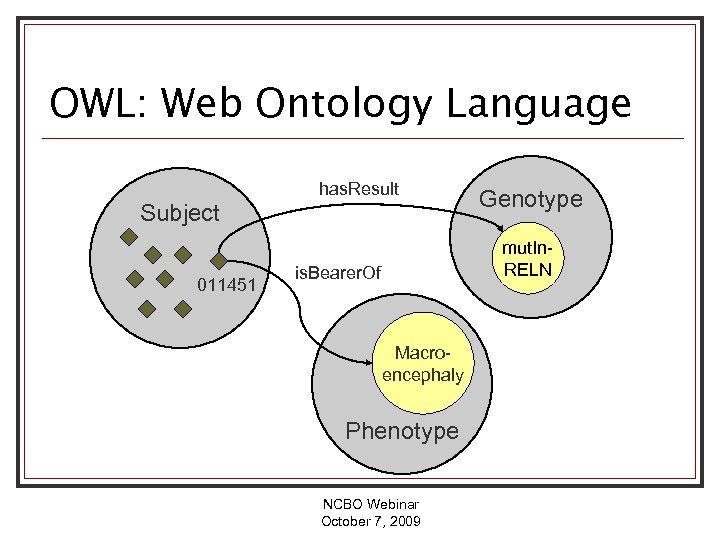
OWL: Web Ontology Language has. Result Subject 011451 Genotype mut. In. RELN is. Bearer. Of Macroencephaly Phenotype NCBO Webinar October 7, 2009
BIRNLex A controlled terminology for annotation of BIRN data sources, focusing on imaging data from human subjects and mouse models n Terms cover neuroanatomy, molecular species, behavioral and cognitive processes, subject information, experimental practice and design n NCBO Webinar October 7, 2009
Basic Formal Ontology An upper ontology which can be used to support the development of domain ontologies used in scientific research n All concepts are subclasses of n n n Continuants: exists in full at any time in which it exists at all Occurants: has temporal parts and that happens, unfolds or develops through time NCBO Webinar October 7, 2009
OBO Foundry n Ontologies should be orthogonal n n n Minimize overlap Each distinct entity type (universal) should only be represented once Partition efforts in the OBO Foundry rationally to help organize and coordinate the ontology development NCBO Webinar October 7, 2009
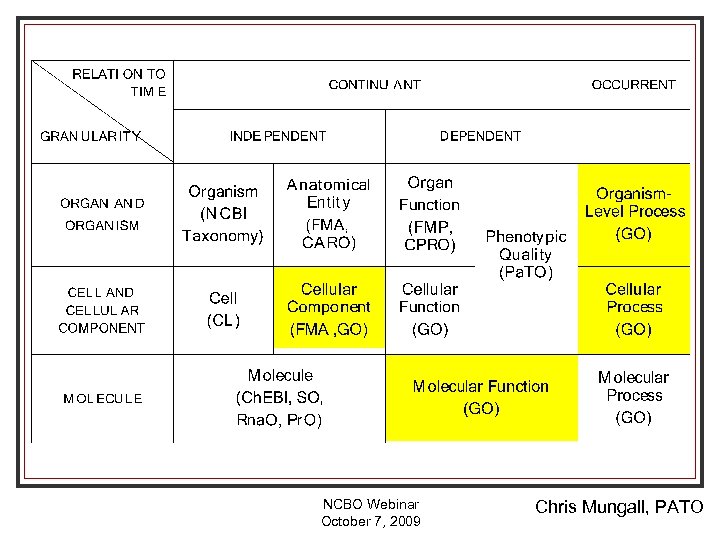
NCBO Webinar October 7, 2009 Chris Mungall, PATO
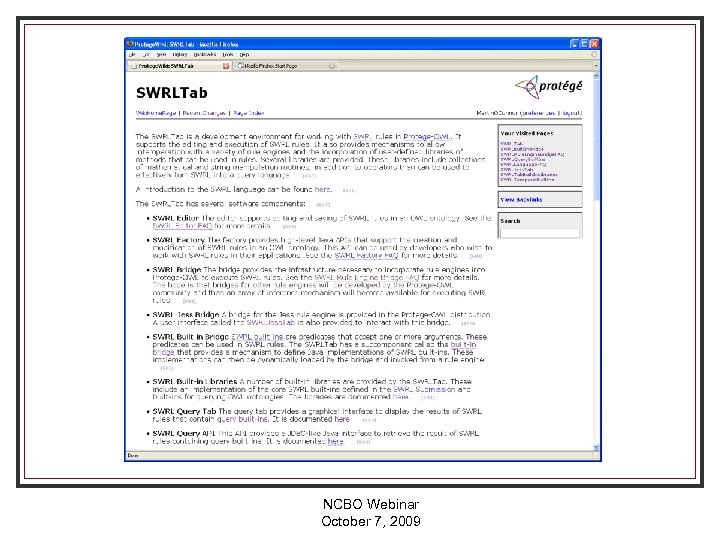
SWRL: Semantic Web Rule Language W 3 C specification for expressing logical rules that can be formulated in terms of OWL concepts n Rules in SWRL can be used to deduce new knowledge about an existing OWL ontology n Specification can be extended through the use of built ins n NCBO Webinar October 7, 2009
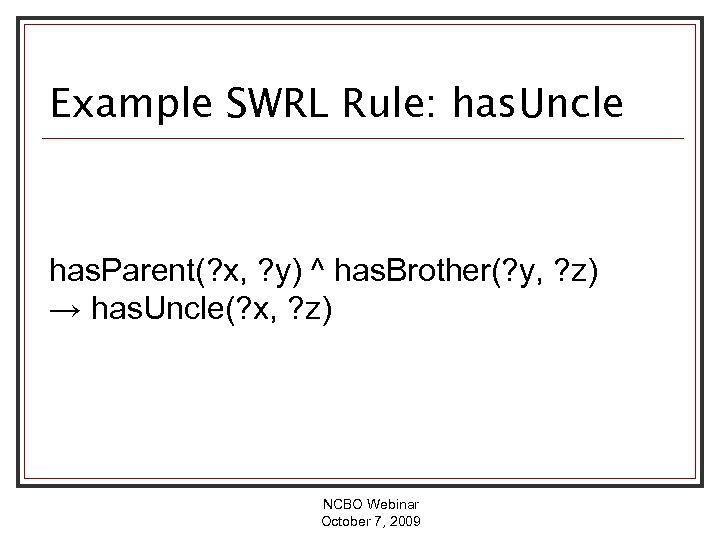
Example SWRL Rule: has. Uncle has. Parent(? x, ? y) ^ has. Brother(? y, ? z) → has. Uncle(? x, ? z) NCBO Webinar October 7, 2009
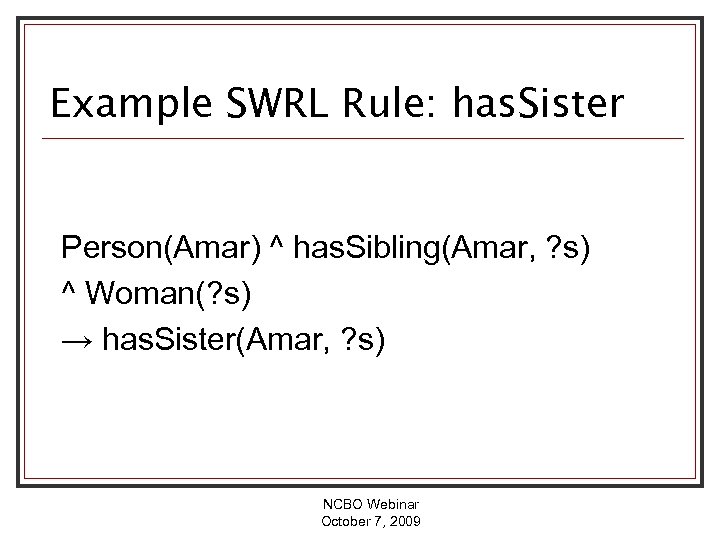
Example SWRL Rule: has. Sister Person(Amar) ^ has. Sibling(Amar, ? s) ^ Woman(? s) → has. Sister(Amar, ? s) NCBO Webinar October 7, 2009
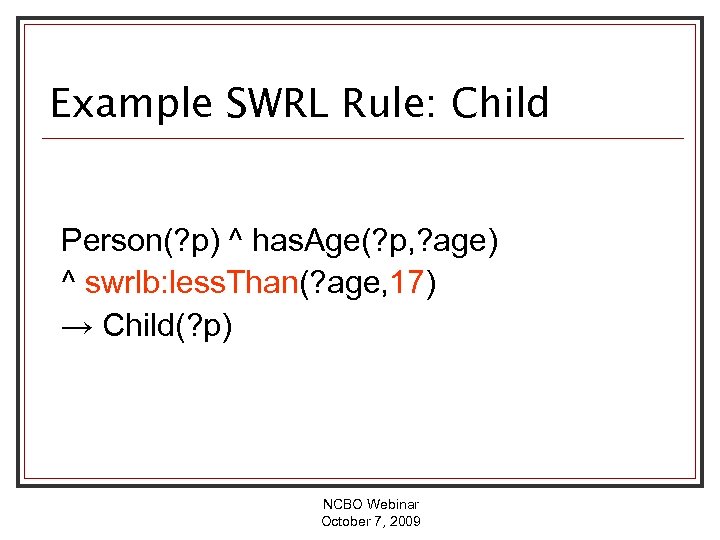
Example SWRL Rule: Child Person(? p) ^ has. Age(? p, ? age) ^ swrlb: less. Than(? age, 17) → Child(? p) NCBO Webinar October 7, 2009
NCBO Webinar October 7, 2009
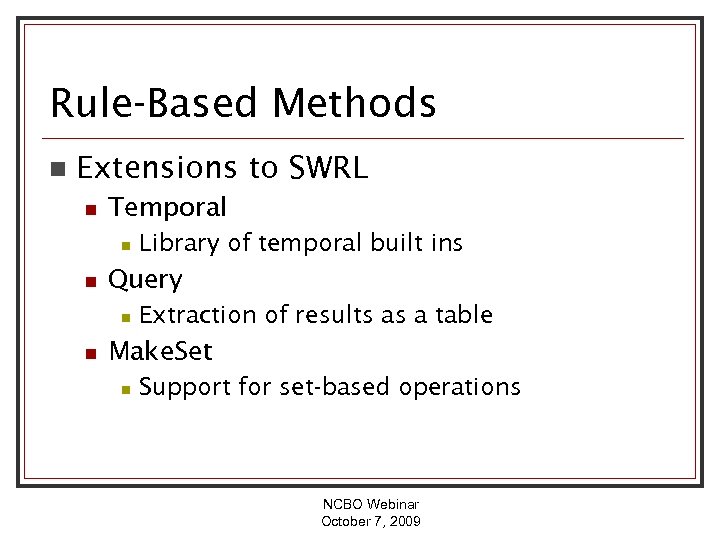
Rule-Based Methods n Extensions to SWRL n Temporal n n Query n n Library of temporal built ins Extraction of results as a table Make. Set n Support for set-based operations NCBO Webinar October 7, 2009
Development Methods Extensions to BIRNLex n Encoding of phenotypes n Querying of NDAR database n NCBO Webinar October 7, 2009
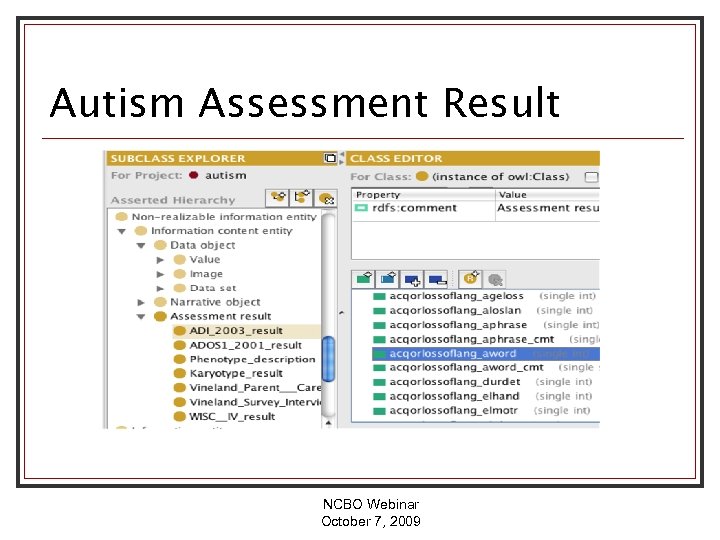
Autism Assessment Result Figure 1. The representation of data collected through the ADI-2003 autism assessment instrument as part of the autism ontology. NCBO Webinar October 7, 2009
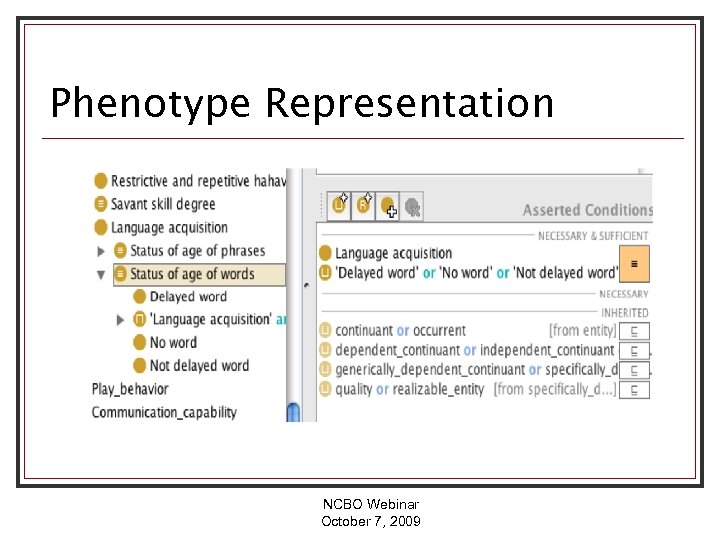
Phenotype Representation Figure 2. The representation of the Status of age of words phentotype group as a OWL class partition by the possible statuses. NCBO Webinar October 7, 2009
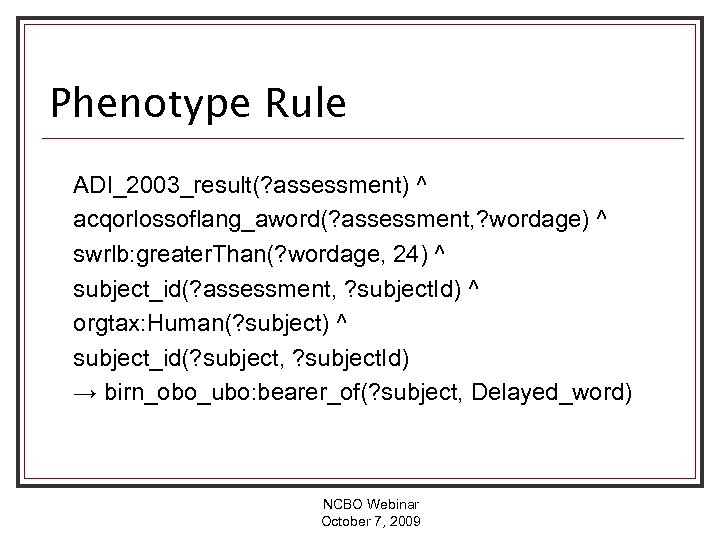
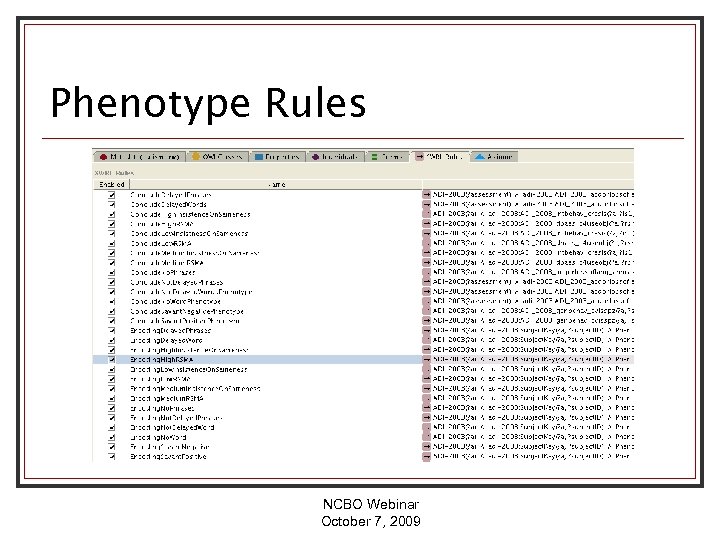
Phenotype Rule ADI_2003_result(? assessment) ^ acqorlossoflang_aword(? assessment, ? wordage) ^ swrlb: greater. Than(? wordage, 24) ^ subject_id(? assessment, ? subject. Id) ^ orgtax: Human(? subject) ^ subject_id(? subject, ? subject. Id) → birn_obo_ubo: bearer_of(? subject, Delayed_word) NCBO Webinar October 7, 2009
Phenotype Rules NCBO Webinar October 7, 2009
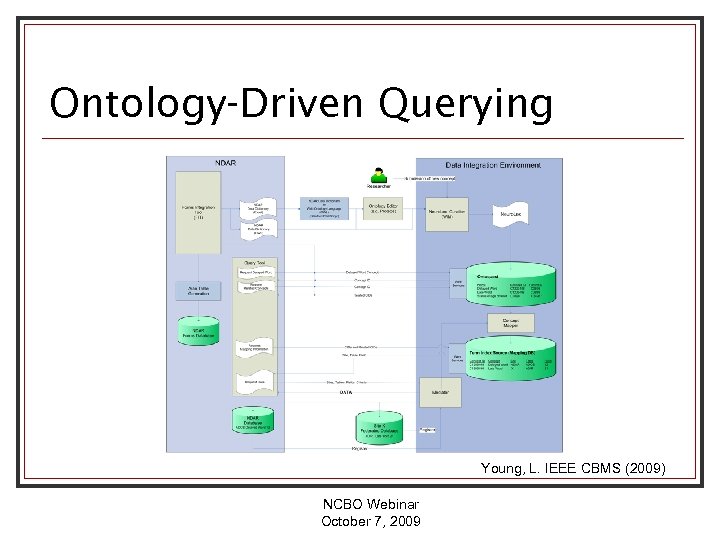
Ontology-Driven Querying Young, L. IEEE CBMS (2009) NCBO Webinar October 7, 2009
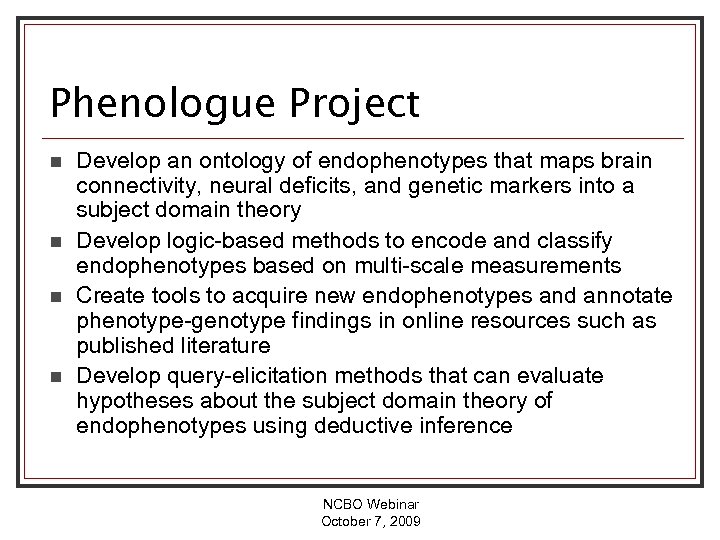
Phenologue Project n n Develop an ontology of endophenotypes that maps brain connectivity, neural deficits, and genetic markers into a subject domain theory Develop logic-based methods to encode and classify endophenotypes based on multi-scale measurements Create tools to acquire new endophenotypes and annotate phenotype-genotype findings in online resources such as published literature Develop query-elicitation methods that can evaluate hypotheses about the subject domain theory of endophenotypes using deductive inference NCBO Webinar October 7, 2009
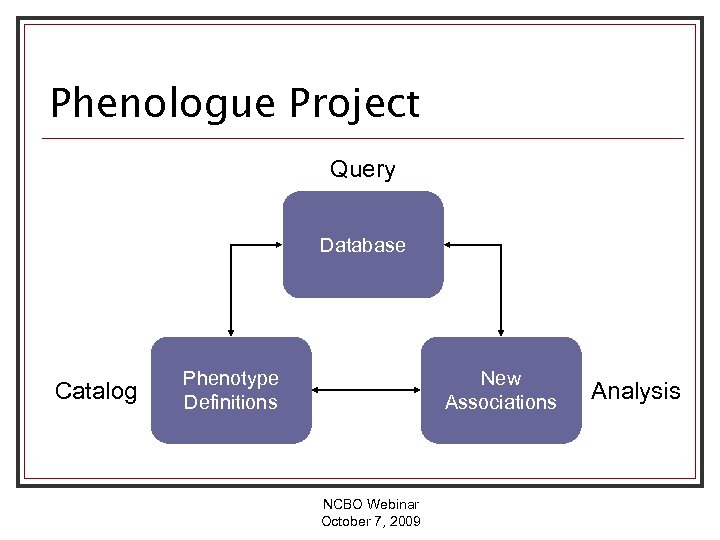
Phenologue Project Query Database Catalog Phenotype Definitions New Associations NCBO Webinar October 7, 2009 Analysis
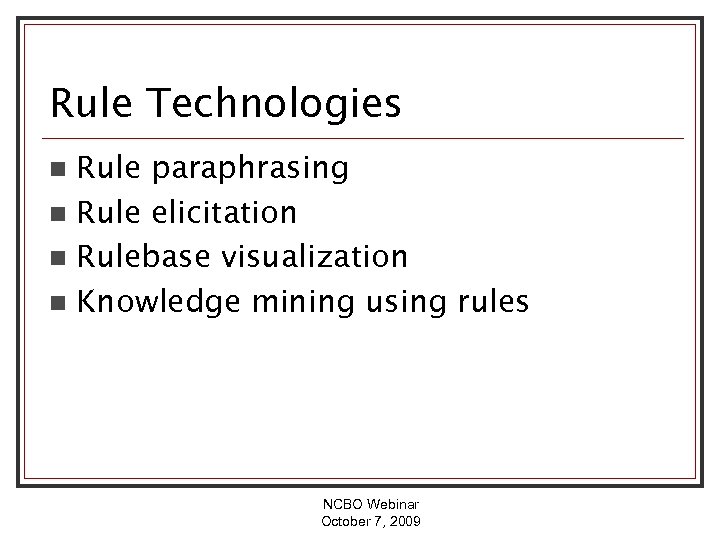
Rule Technologies Rule paraphrasing n Rule elicitation n Rulebase visualization n Knowledge mining using rules n NCBO Webinar October 7, 2009
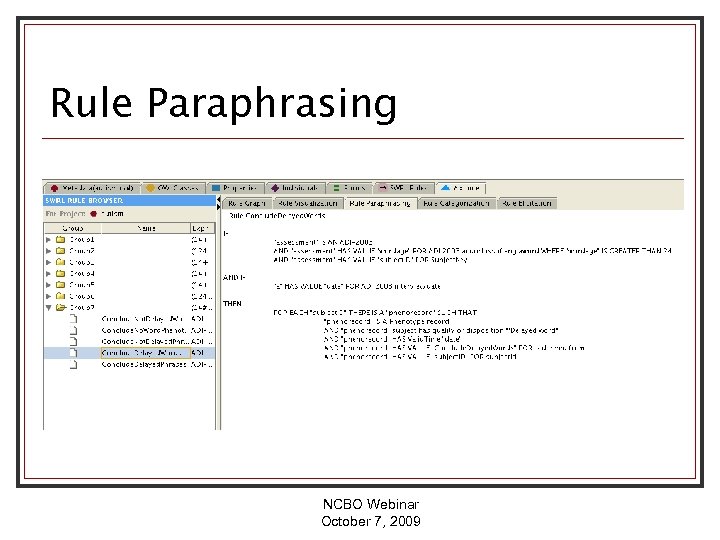
Rule Paraphrasing NCBO Webinar October 7, 2009
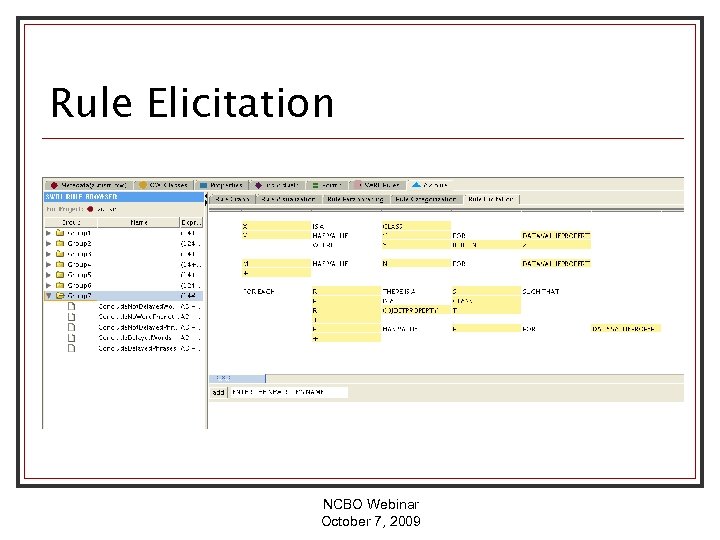
Rule Elicitation NCBO Webinar October 7, 2009
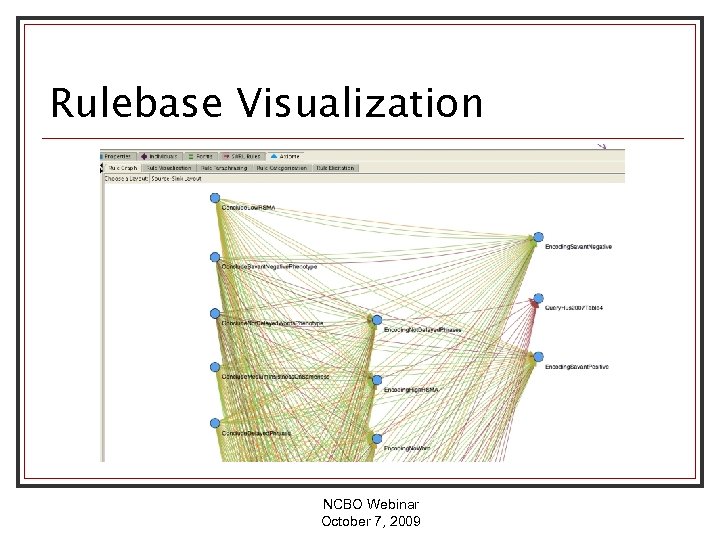
Rulebase Visualization NCBO Webinar October 7, 2009
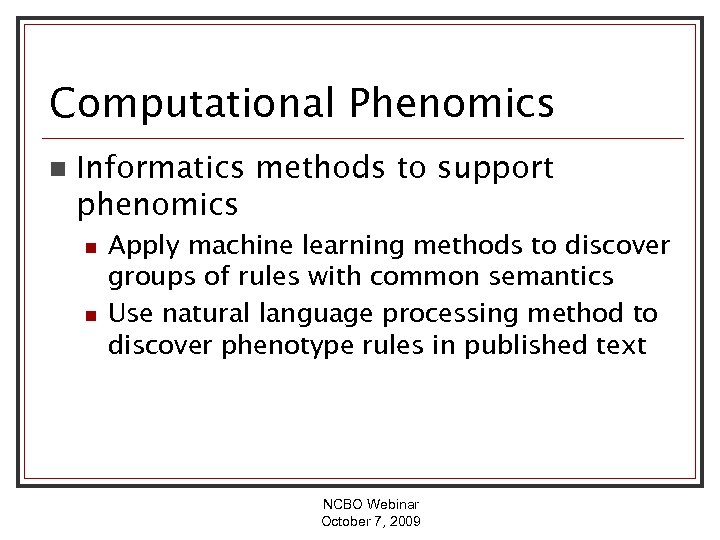
Computational Phenomics n Informatics methods to support phenomics n n Apply machine learning methods to discover groups of rules with common semantics Use natural language processing method to discover phenotype rules in published text NCBO Webinar October 7, 2009
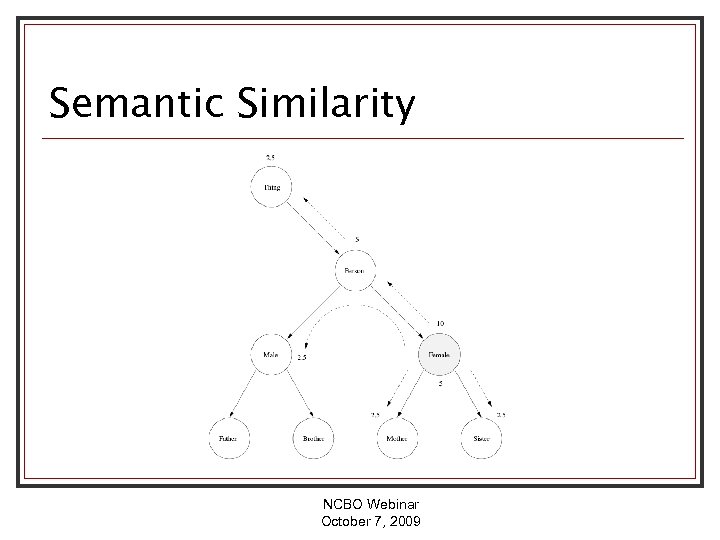
Semantic Similarity NCBO Webinar October 7, 2009
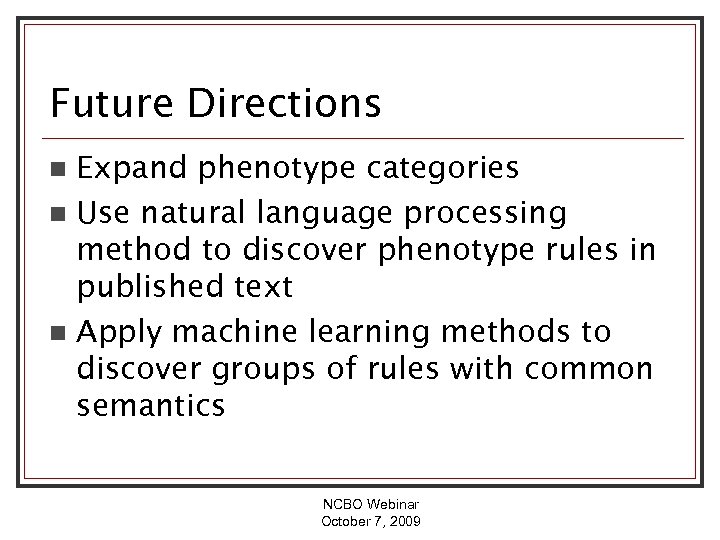
Future Directions Expand phenotype categories n Use natural language processing method to discover phenotype rules in published text n Apply machine learning methods to discover groups of rules with common semantics n NCBO Webinar October 7, 2009
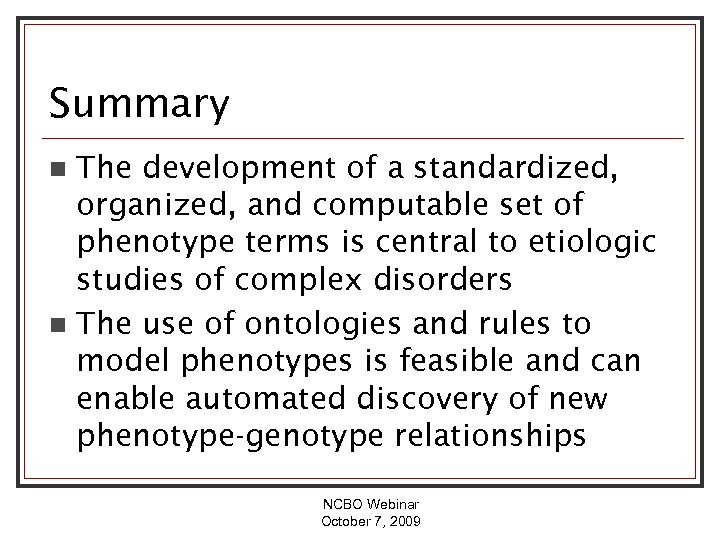
Summary The development of a standardized, organized, and computable set of phenotype terms is central to etiologic studies of complex disorders n The use of ontologies and rules to model phenotypes is feasible and can enable automated discovery of new phenotype-genotype relationships n NCBO Webinar October 7, 2009
Acknowledgments n n Stanford Group n Martin O’Connor n Saeed Hassanpour n Duriel Hardy n Ravi Shankar n Lakshika Tennakoon n Samson Tu National Center for Biomedical Ontology n Mark Musen n Daniel Rubin n NDAR/NIMH n Lynn Young n Matthew Mc. Auliffe n Dan Hall n Lisa Gilotty n Biomedical Informatics Research Network n Bill Bug n Maryann Martone NCBO Webinar October 7, 2009
Скачать презентацию An Ontology-Based Approach for Computational Phenomics Application to
5701fdbb0dc46fd475abdda9e40334dd.ppt