


 Скачать презентацию AN INVESTIGATION OF THE SOLAR ENERGY TECHNOLOGY PRODUCTION
0edbba94239ee351272573db4950753c.ppt
- Количество слайдов: 18
 AN INVESTIGATION OF THE SOLAR ENERGY TECHNOLOGY PRODUCTION IN SOUTH AFRICA BY SILAS K. MULAUDZI A DOCTORAL DEGREE INSTITUTE FOR ECONOMIC RESEARCH ON INNOVATION (IERI), TSHWANE UNIVERSITY OF TECHNOLOGY (TUT), PRETORIA NOVEMBER 2011
 Background • Energy is the nucleus of any development in the world • Every development owes its being to energy • If the world’s economy expands to meet the aspirations of countries around the globe, energy demand is likely to increase • Because of that energy is considered as the life-blood of every development in the world
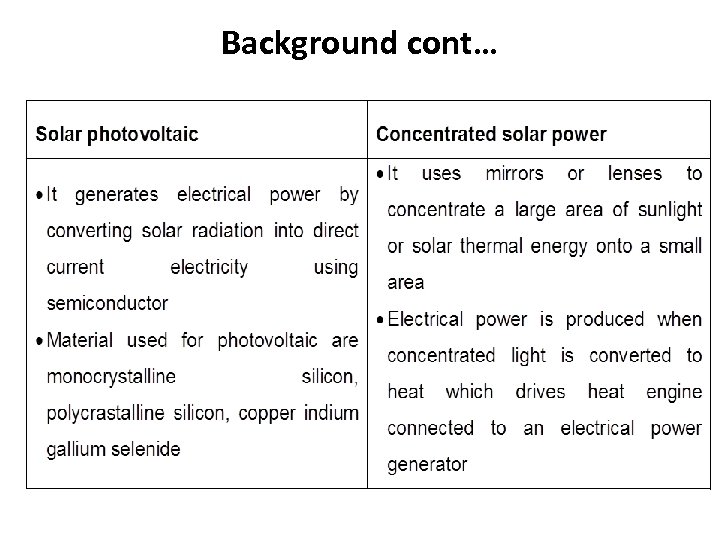
 Background cont… • Globally, the renewable energy industry is projected to grow rapidly in the next few years. • The International Energy Agency estimates that 15 -20% of total energy supply contribution will be from renewable energy by 2026 • Nearly 11 GW of solar PV was produced globally • According to REN 21 (2010) first Solar (which is in USA) became the first firm ever to produce over 1 GW in a single year • Solar energy is categorized into concentrated solar power, solar photovoltaic and solar water heating. • South Africa is regarded as having good solar potential in areas around Limpopo, Northern Cape, North West and Mpumalanga Provinces
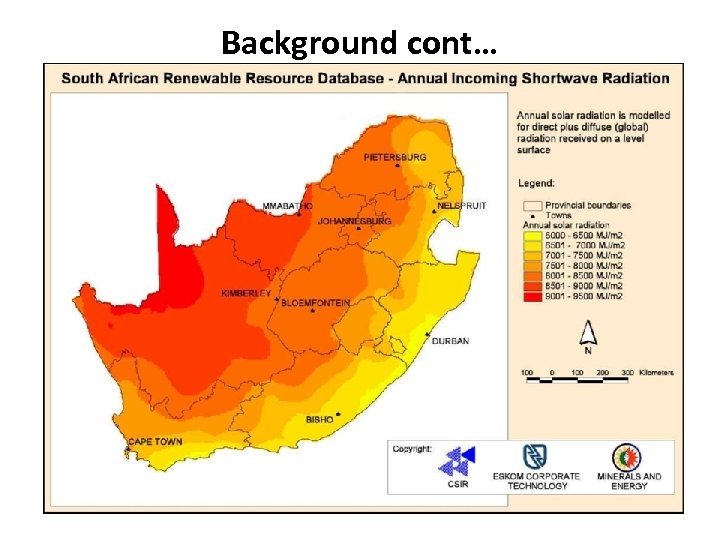 Background cont…
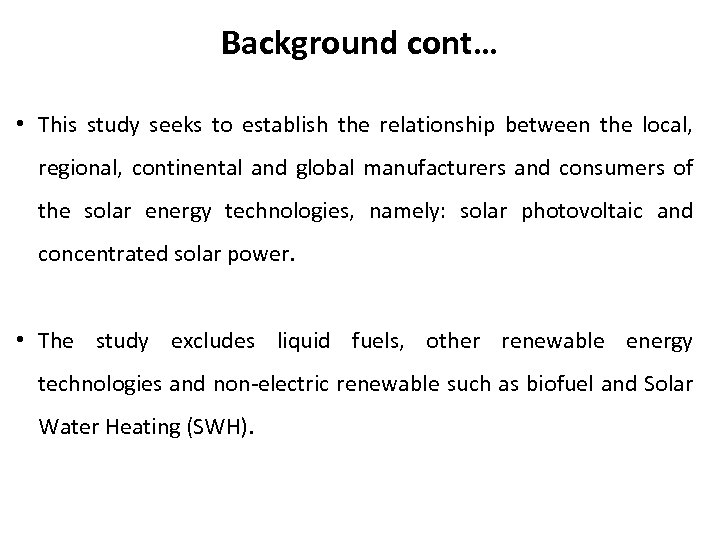 Background cont… • This study seeks to establish the relationship between the local, regional, continental and global manufacturers and consumers of the solar energy technologies, namely: solar photovoltaic and concentrated solar power. • The study excludes liquid fuels, other renewable energy technologies and non-electric renewable such as biofuel and Solar Water Heating (SWH).
 Background cont…
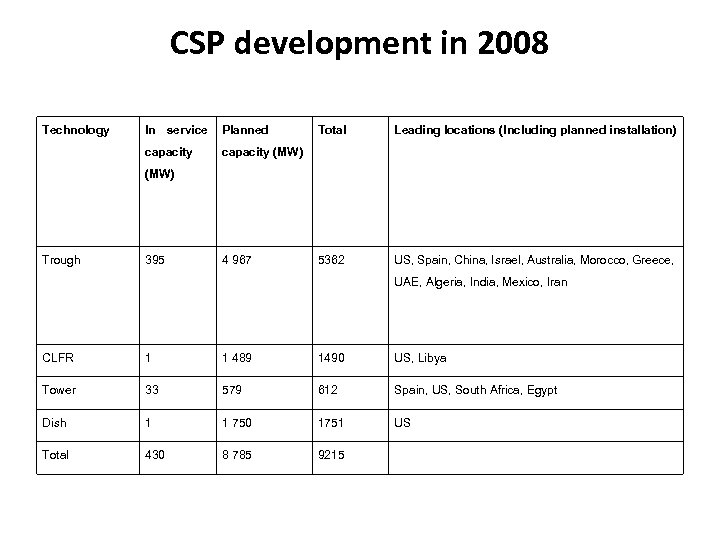 CSP development in 2008 Technology In service Planned capacity Total Leading locations (Including planned installation) capacity (MW) 5362 US, Spain, China, Israel, Australia, Morocco, Greece, (MW) Trough 395 4 967 UAE, Algeria, India, Mexico, Iran CLFR 1 1 489 1490 US, Libya Tower 33 579 612 Spain, US, South Africa, Egypt Dish 1 1 750 1751 US Total 430 8 785 9215
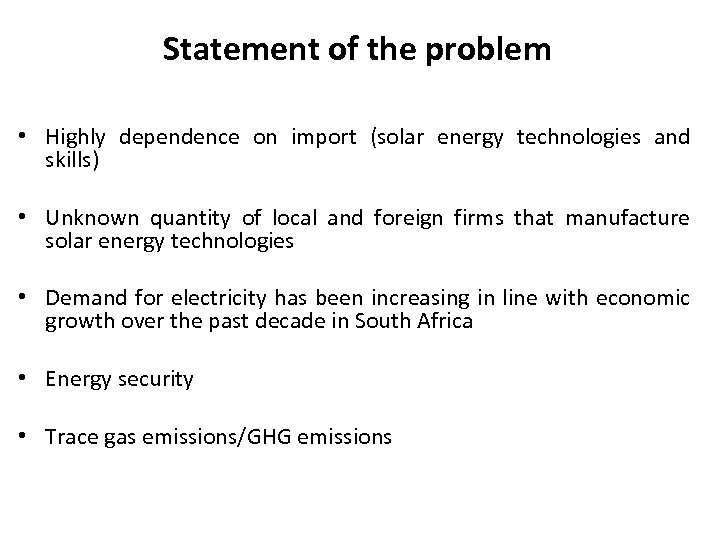 Statement of the problem • Highly dependence on import (solar energy technologies and skills) • Unknown quantity of local and foreign firms that manufacture solar energy technologies • Demand for electricity has been increasing in line with economic growth over the past decade in South Africa • Energy security • Trace gas emissions/GHG emissions
 Research objectives General objective • To establish the import and export relationship between the domestic and international firms that manufacture and develop solar energy technologies and the growth impediments in the solar energy industry in South Africa Specific objectives • To find out which solar energy technology are imported and exported and factors that influence export and import in South Africa; • To find out which regional and international countries import and export solar energy technology to and from South Africa; • To establish the market forces for manufacturing and using solar energy technology in South Africa; and • To determine the impediments hampering the growth of solar energy manufacturing industry in South Africa.
 Research questions The research intends to answer the following questions, amongst others: • Which solar energy technologies are imported and exported from and to South Africa? • Who is the user of these solar energy technologies in South Africa and why? • What is the emerging type of manufacturers-users interactions in the solar energy sector? • What are the factors hampering growth and development in the solar energy manufacturing industry in South Africa? • Which regional, continental and international countries are these solar energy technologies imported from and exported to? • What is the market force for export and import for these solar energy
 Methodology • Types of data and data collection (see the Annexure provided) o Primary o Secondary • Sampling o Stratified random sampling
 Preliminary findings • Preliminary data collected from the academic, manufacturing, research institutions, association, consumers, generators and government have shown that there is a strong link, bond, cooperation and support amongst the manufacturing companies locally, regionally and globally. • The Government of South Africa has signed Memorandum of Understandings (Mo. U) with many Asian and European countries on solar energy development. • These findings will be discussed further with the respondents.
 Preliminary findings cont… • The major factor hampering the development of solar energy seems to be institutional arrangement, regulatory framework, skills, policy uncertainty and gaps as well as economic climate. • Both institutions interviewed are of the opinion that the current contribution of solar energy at this point in time is negligible.
 Outcomes • • Publications in peer reviewed journals Publications in books and conferences Presentations Posters
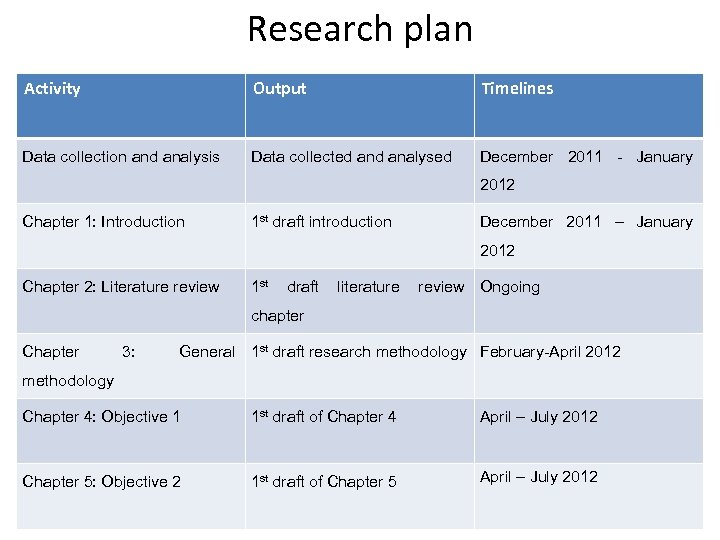 Research plan Activity Output Timelines Data collection and analysis Data collected analysed December 2011 - January 2012 Chapter 1: Introduction 1 st draft introduction December 2011 – January 2012 Chapter 2: Literature review 1 st draft literature review Ongoing chapter Chapter 3: General 1 st draft research methodology February-April 2012 methodology Chapter 4: Objective 1 1 st draft of Chapter 4 April – July 2012 Chapter 5: Objective 2 1 st draft of Chapter 5 April – July 2012
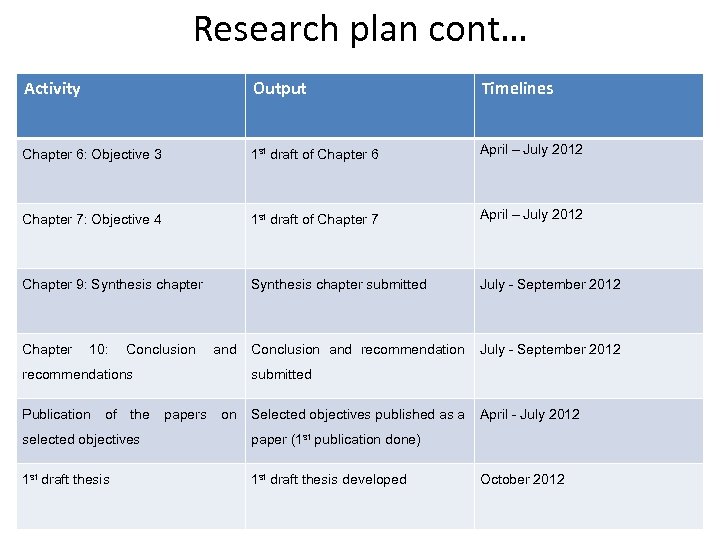 Research plan cont… Activity Output Timelines Chapter 6: Objective 3 1 st draft of Chapter 6 April – July 2012 Chapter 7: Objective 4 1 st draft of Chapter 7 April – July 2012 Chapter 9: Synthesis chapter submitted July - September 2012 Chapter 10: Conclusion and recommendation July - September 2012 recommendations submitted Publication of the papers on Selected objectives published as a April - July 2012 selected objectives paper (1 st publication done) 1 st draft thesis developed October 2012
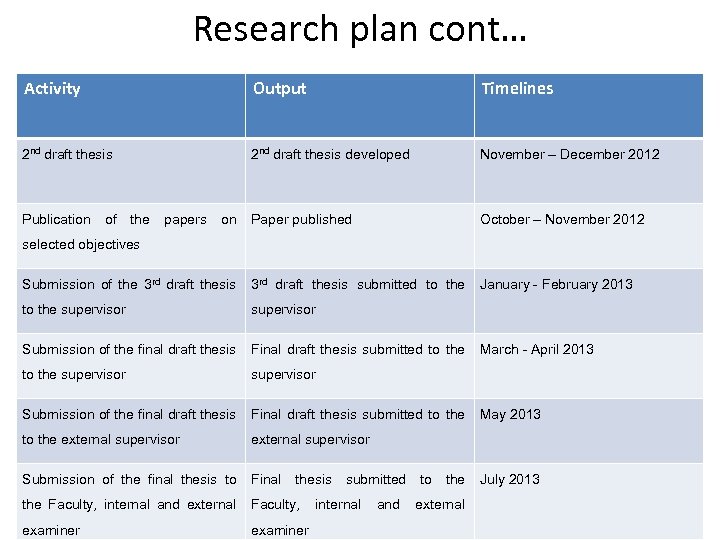 Research plan cont… Activity Output Timelines 2 nd draft thesis developed November – December 2012 Publication of the papers on Paper published October – November 2012 selected objectives Submission of the 3 rd draft thesis submitted to the January - February 2013 to the supervisor Submission of the final draft thesis Final draft thesis submitted to the March - April 2013 to the supervisor Submission of the final draft thesis Final draft thesis submitted to the May 2013 to the external supervisor Submission of the final thesis to Final thesis submitted to the July 2013 the Faculty, internal and external examiner
 THANK YOU FOR YOUR ATTENTION MR SILAS K. MULAUDZI (012) 358 1865 Silasmu@Tshwane. gov. za