


 Скачать презентацию An investigation into whether independent learning can increase
a1d8dce825375f5b8aa92c0777d31813.ppt
- Количество слайдов: 20
 An investigation into whether independent learning can increase the motivation of Year 9 geography students. Catherine Thursby Research Paper
 Introduction “It would be easier if she just told us the answers, but this way I have to think more. ” Year 10 Pupil School A (a faith school in North-West England)
 Introduction Government policy generally makes indirect reference to independent learning (Df. ES 2004, 2005; Campaign for Learning 2007). Other organisations have placed a much clearer emphasis on its importance, particularly when a geographical perspective is taken (Weeden 2008; RGS 2008; OFSTED 2013).
 Introduction What is independent learning and is it of importance? What is meant by motivation and how is it related to independent learning? How successful are independent learning tasks at increasing Year 9 pupil motivation when put into practice?
 Literature Defining independent learning A transfer of responsibility from teacher to pupil (Meyer et al. 2008). Pupils cannot just be left to go off on their own, nor just be given more choice. They need to manage, organise and understand their own learning (Kenny 1993; Dickinson 1995; Lamb 2009).
 Literature The meaning of pupil motivation ‘what learners are prepared to learn…and…how much effort they are prepared to exert in order to learn it’ (Dickinson, 1995, pp. 168). Successful learners may not always be the most natural learners. Teachers play an important role in stimulating motivation, and greater autonomy can help achieve this (Daskalovska et al. 2012).
 Literature The importance of independent learning Can provide pupils with the choice and control that stimulates intrinsic motivation. In turn leads to greater self-esteem, improved academic performance and better behaviour (Meyer et al. 2008). Can promote lifelong learning skills – metacognition (Lamb 2001).
 Literature Independent learning strategies Flexible learning schemes (Lamb 2001, 2006) Greater use of ICT (GTCE 2007) Project-based work (Kenny 1993)
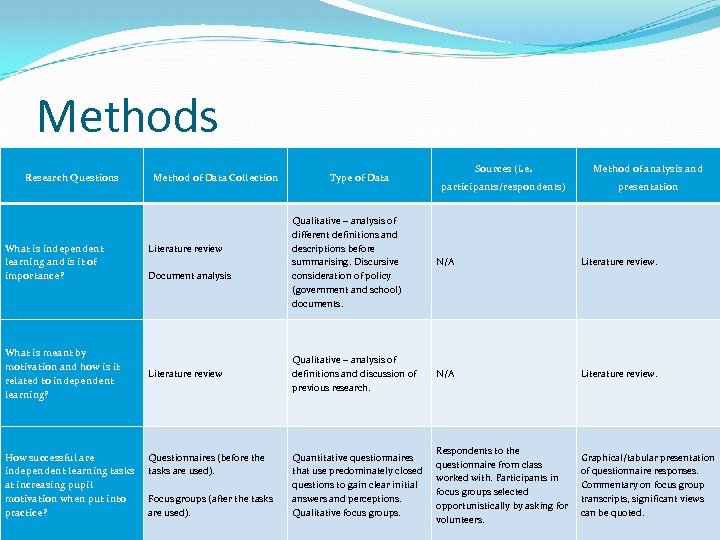 Methods Research Questions Method of Data Collection Type of Data Sources (i. e. Method of analysis and participants/respondents) presentation Literature review Document analysis Qualitative – analysis of different definitions and descriptions before summarising. Discursive consideration of policy (government and school) documents. N/A Literature review. What is meant by motivation and how is it related to independent learning? Literature review Qualitative – analysis of definitions and discussion of previous research. N/A Literature review. How successful are independent learning tasks at increasing pupil motivation when put into practice? Questionnaires (before the tasks are used). Focus groups (after the tasks are used). Quantitative questionnaires that use predominately closed questions to gain clear initial answers and perceptions. Qualitative focus groups. Respondents to the questionnaire from class worked with. Participants in focus groups selected opportunistically by asking for volunteers. Graphical/tabular presentation of questionnaire responses. Commentary on focus group transcripts, significant views can be quoted. What is independent learning and is it of importance?
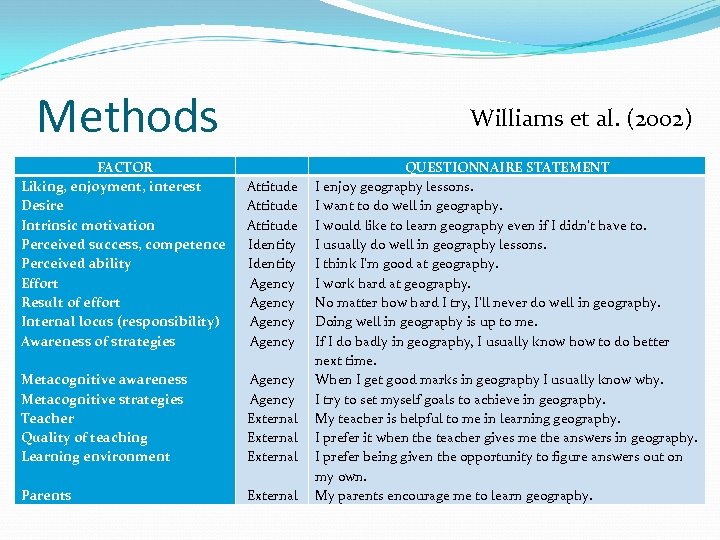 Methods Williams et al. (2002) FACTOR Liking, enjoyment, interest Desire Intrinsic motivation Perceived success, competence Perceived ability Effort Result of effort Internal locus (responsibility) Awareness of strategies Attitude Identity Agency Metacognitive awareness Metacognitive strategies Teacher Quality of teaching Learning environment Parents Agency External QUESTIONNAIRE STATEMENT I enjoy geography lessons. I want to do well in geography. I would like to learn geography even if I didn’t have to. I usually do well in geography lessons. I think I’m good at geography. I work hard at geography. No matter how hard I try, I’ll never do well in geography. Doing well in geography is up to me. If I do badly in geography, I usually know how to do better next time. When I get good marks in geography I usually know why. I try to set myself goals to achieve in geography. My teacher is helpful to me in learning geography. I prefer it when the teacher gives me the answers in geography. I prefer being given the opportunity to figure answers out on my own. My parents encourage me to learn geography.
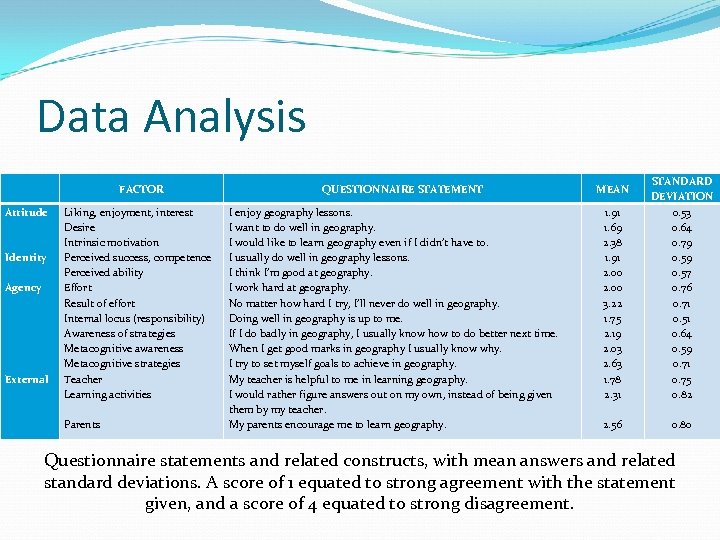 Data Analysis FACTOR Attitude Identity Agency External Liking, enjoyment, interest Desire Intrinsic motivation Perceived success, competence Perceived ability Effort Result of effort Internal locus (responsibility) Awareness of strategies Metacognitive awareness Metacognitive strategies Teacher Learning activities Parents QUESTIONNAIRE STATEMENT I enjoy geography lessons. I want to do well in geography. I would like to learn geography even if I didn’t have to. I usually do well in geography lessons. I think I’m good at geography. I work hard at geography. No matter how hard I try, I’ll never do well in geography. Doing well in geography is up to me. If I do badly in geography, I usually know how to do better next time. When I get good marks in geography I usually know why. I try to set myself goals to achieve in geography. My teacher is helpful to me in learning geography. I would rather figure answers out on my own, instead of being given them by my teacher. My parents encourage me to learn geography. MEAN 1. 91 1. 69 2. 38 1. 91 2. 00 3. 22 1. 75 2. 19 2. 03 2. 63 1. 78 2. 31 2. 56 STANDARD DEVIATION 0. 53 0. 64 0. 79 0. 57 0. 76 0. 71 0. 51 0. 64 0. 59 0. 71 0. 75 0. 82 0. 80 Questionnaire statements and related constructs, with mean answers and related standard deviations. A score of 1 equated to strong agreement with the statement given, and a score of 4 equated to strong disagreement.
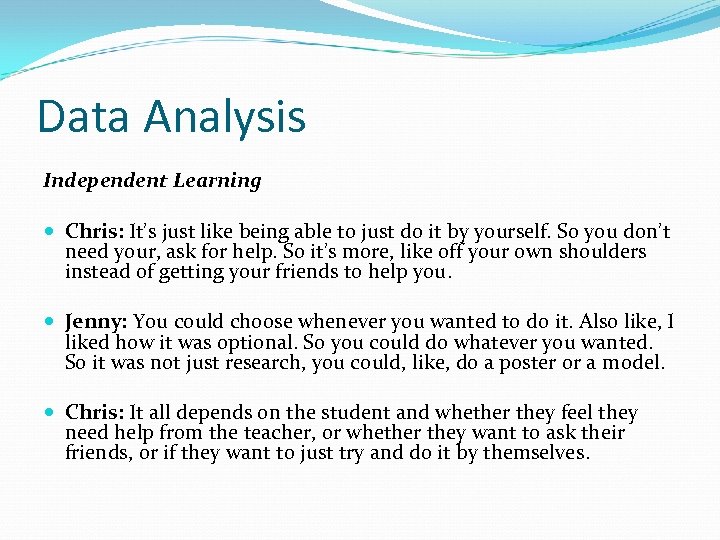 Data Analysis Independent Learning Chris: It’s just like being able to just do it by yourself. So you don’t need your, ask for help. So it’s more, like off your own shoulders instead of getting your friends to help you. Jenny: You could choose whenever you wanted to do it. Also like, I liked how it was optional. So you could do whatever you wanted. So it was not just research, you could, like, do a poster or a model. Chris: It all depends on the student and whether they feel they need help from the teacher, or whether they want to ask their friends, or if they want to just try and do it by themselves.
 Data Analysis Motivation Chris: It all depends on the relationships students have with their teachers. Because if they have, like, sort of a negative relationship they’ll start to not care as much when it comes to the subject, they’ll just start ignoring the teacher. Whereas, if, a student comes in and the teacher starts to interact with them in a positive way they’ll start to more enjoy the lessons, and want to take part a lot more in lessons. David: Like if you have a negative, like you wake up and you’re really tired, you’re not really going to feel motivated. Whereas if you wake up and you’re like, I’m ready, I think I’m going to do well, and you keep telling yourself. It’s all about inside, telling yourself you’re going to do well, rather than telling yourself that you’re not going to do well. Chris: Yeah that would give you a real incentive to start learning, erm, because it’s more of like an outside reward for, doing geography. Like those little postcards you send home when you get a good result in your tests, which I’ve had four of now! Erm it’s just like, it’s just like an incentive to try your best, and try a little bit harder.
 Data Analysis Pupils rated highly the choice that independent learning offered them. There was agreement that independent learning can be motivating. Focus group participants stressed the importance in having the appropriate mind-set i. e. being intrinsically motivated. Often the case in the focus group interview that external factors (e. g. the teacher, learning activities) inspired this internal motivation. Teachers and classroom activities are external motivational factors, but can be used to develop the preferable intrinsic motivation (see also Daskalovska et al. 2012)
 Conclusions What is independent learning and is it of importance? What is meant by motivation and how is it related to independent learning? How successful are independent learning tasks at increasing Year 9 pupil motivation when put into practice?
 Conclusions Insider researcher. Opportunistic sampling for focus groups. Small scale research.
 Conclusions Consider other variables – gender, age, ability. Conduct a longer study. Conduct a different, but related study.
 Conclusions “Students need the attitudes and skills of independence for long term success. Ironically, independence that is built into many primary schools during Key Stage 1 and Key Stage 2 is dismantled in many secondary schools during Key Stage 3, only to be required again at Key Stage 4 (and even more so at Key Stage 5)” Ginnis (2002)
 References Daskalovska, N. , Gudeva, L. and Ivanovska, B. (2012) Learner motivation and interest, Procedia – Social and Behavioural Sciences, 46, pp. 1187 -1191. Department for Education and Skills (2004) A National Conversation about Personalised Learning. Nottingham: Df. ES Publications. Department for Education and Skills (2005 a) Higher Standards, Better Schools for All. Nottingham: Df. ES Publications. Department for Education and Skills (2005 b) 14 -19 Education and Skills. Nottingham: Df. ES Publications. Dickinson, L. (1995) Autonomy and Motivation – A Literature Review. System, 23(2), pp. 165 -174. Ginnis, P. (2002) The Teacher’s Toolkit: Raise Classroom Achievement with Strategies for Every Learner. Carmarthen: Crown House Publishing. Kenny, B. (1993) For more autonomy. System, 21(4), pp. 431 -442. Lamb, T. (2001) Metacognition and motivation: learning to learn. In: G. Chambers, ed. 2001. Reflections on Motivation. London: CILT, pp. 85 -93. Lamb, T. (2006) Supporting independence: students’ perceptions of self-management. In T. Lamb and H. Reinders, ed. 2006. Supporting Independent Learning: Issues and Interventions. Frankfurt-am-Main: Peter Lang, pp. 95 -120.
 References Lamb, T. (2009) Controlling learning: relationships between motivation and learner autonomy. In R. Pemberton, S. Toogood and A. Barfield ed. 2009. Maintaining Control: Autonomy and Language Learning. Hong Kong: Hong Kong University Press, pp. 67 -86. Meyer, B. , Haywood, N. , Sachdev, D. and Faraday, S. (2008) Independent Learning Literature Review. (Learning and Skills Network). OFSTED (2013) Geography Survey Visits: Generis grade descriptors and supplementary subject-specific guidance for inspectors on making judgements during visits to schools (pdf) Available from http: //www. ofsted. gov. uk/resources/generic-grade-descriptors-andsupplementary-subject-specific-guidance-for-inspectors-making-judgemen [Accessed 20 July 2013]. Royal Geographical Society (2008) Key Stage Three curriculum (pdf) Available from: http: //www. rgs. org/NR/rdonlyres/6 BA 88 E 58 -6 FBD-4524 -8421 AB 4 D 50 B 41 DA 9/0/KS 3 Curriculum. pdf [Accessed October 2013]. Weeden, P. (2008) GTIP Think Piece – Assessment for Learning [Online] Available from: http: //www. geography. org. uk/gtip/thinkpieces/assessmentforlearning [Accessed October 2013]. Williams, M. , Burden, R. and Lanvers, U. (2002) ‘French is the Language of Love and Stuff’: student perceptions of issues related to motivation in learning a foreign language. British Educational Research Journal, 28(4), pp. 503 -528.