


 Скачать презентацию An Introduction to your Professional Portfolio Reflective
54c8007e017604cfed94162315e4c7a4.ppt
- Количество слайдов: 17
 An Introduction to your Professional Portfolio & Reflective Practice Leanne Covey DCP Tutor and Practice Facilitator Hampshire & Isle of Wight
 What is a ‘portfolio’? o A posh word for a ring binder! o “. . . is a very powerful means by which educational and professional activities can be documented to demonstrate the continuing acquisitions of skills, knowledge, understanding and individual achievement” o Think of it as a sophisticated scrapbook! BMS March 2006 pp 223 -225
 Why the need for one? • Demonstrates tangible proof of your skills and on-going learning • Keeps essential work-related samples and documents in one place if you need them for job search, performance appraisal or application for promotion • It will help you stand out in the crowd • You can be as creative as you like • Instead of talking, you can SHOW what you can do.
 Quite simply put. . . • Your portfolio should capture all Continuing Professional Development (CPD) activities undertaken by you • The evidence held should satisfy the various political, professional and legal requirements all under one portfolio • What does this mean?
 • ALL DCPs will have to complete and keep a record of completing 150 hours of CPD over 5 years • At least 50 hours of this must be ‘verifiable’ • The remaining 100 hours can be ‘nonverifiable’ or ‘general’ CPD • This requirement applies to all; part-time or full-time • CPD completed BEFORE today is NOT counted • Trying to complete all 150 hours in the last 12 months is NOT recommended!
 Currently. . . • There is no formal structure for developing a personal professional portfolio. • This information is based on advice from the BADN and other sources. • You have each been given a CD Rom which has all of the templates and information for you to modify.
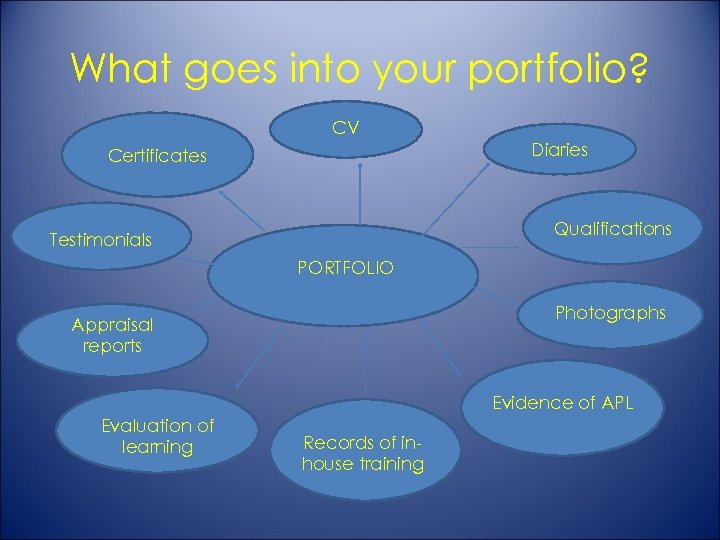 What goes into your portfolio? CV Diaries Certificates Qualifications Testimonials PORTFOLIO Photographs Appraisal reports Evidence of APL Evaluation of learning Records of inhouse training
 Who owns your portfolio? • You do! • Reflecting on your performance and deciding objectives for the future • Promotion or interview • On all occasions you choose what to share
 Reflective Practice
 Reflective Practice • Is a key ‘buzz’ term throughout the healthcare community • Exploring and learning what you do as an individual, why you do it and the impact it has on you and others • It is something we do all of the time, we just don't realise it. • It will enhance your professional development
 • Can assist in applying new knowledge to practice • It strengthens the link between CPD & registration • Reflections will form the basis of your portfolios, it represents evidence of competence • Is the deliberate process of critically reviewing an event in order to change, adapt or learn.
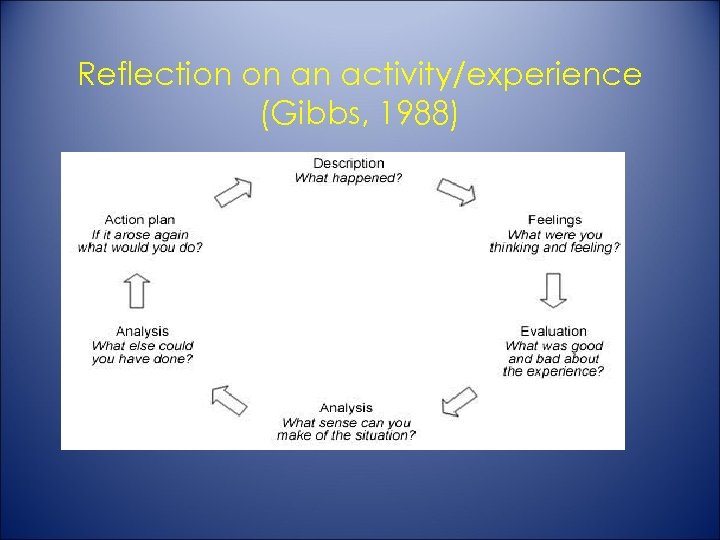 Reflection on an activity/experience (Gibbs, 1988)
 An exercise • You have got 5 minutes • A piece of personal history that will help people get to know you. • Think of a happy or sad childhood memory. Can you remember your feelings? • Someone in your life that has had a significant impact on you as a person. Why?
 Your five minutes start now!
 Was it easy to reflect? • Did you probe your mind for the memory • Did the feelings come back just as they were at the time of the event? • Did you make changes a result? • Why did the person have such an effect on you?
 To summarise • Don’t be scared to reflect, take CPD as a positive step towards people recognising you as professionals in your own right! • Reflect straight away. • Keep your Portfolio updated • Enjoy the experience of the new skill, it can benefit you in all ways.
 Are there any questions?