 Скачать презентацию An introduction to the program Bob Anderson Co-chair
574397f4b36652bdc56749234eed3151.ppt
- Количество слайдов: 35



An introduction to the program Bob Anderson Co-chair International GEOTRACES SSC http: //www. geotraces. org/
GEOTRACES guiding mission “To identify processes and quantify fluxes that control the distributions of key trace elements and isotopes ( TEIs) in the ocean, and to establish the sensitivity of these distributions to changing environmental conditions” Mission
What are the “key” elements? They include: • Those acting as micronutrients to control ocean productivity and ecosystems • Those tracing modern processes in the ocean • Contaminants in the present and future ocean • Chemical species used as proxies to reconstruct past climate Key TEIs
What are the anticipated benefits? They include: 1) Identify sources and sinks and quantify internal cycling of essential micronutrients (e. g. , Fe, Zn, Co, Cd, Cu). 2) Calibrate geochemical tracers used to reconstruct past ocean conditions (e. g. , circulation, chemistry, biological productivity, carbon fluxes) for more reliable applications. 3) Quantify groundwater supply of dissolved materials. 4) Improve predictions of the transport and fate of contaminants. Anticipated Benefits
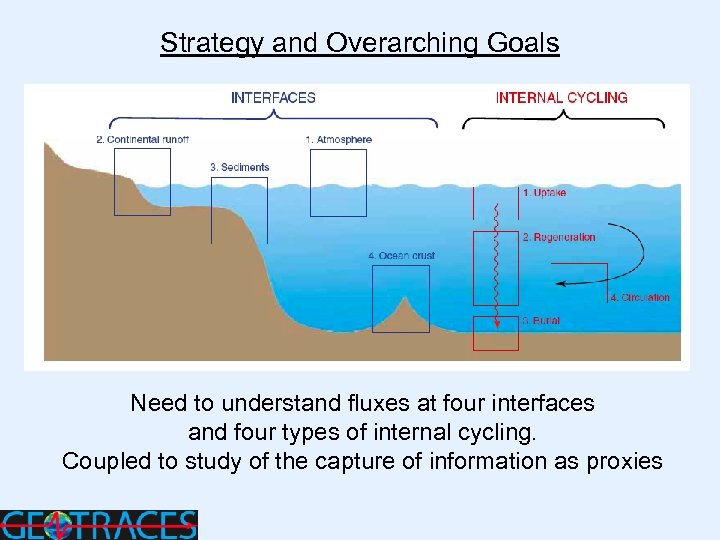
Strategy and Overarching Goals Need to understand fluxes at four interfaces and four types of internal cycling. Coupled to study of the capture of information as proxies
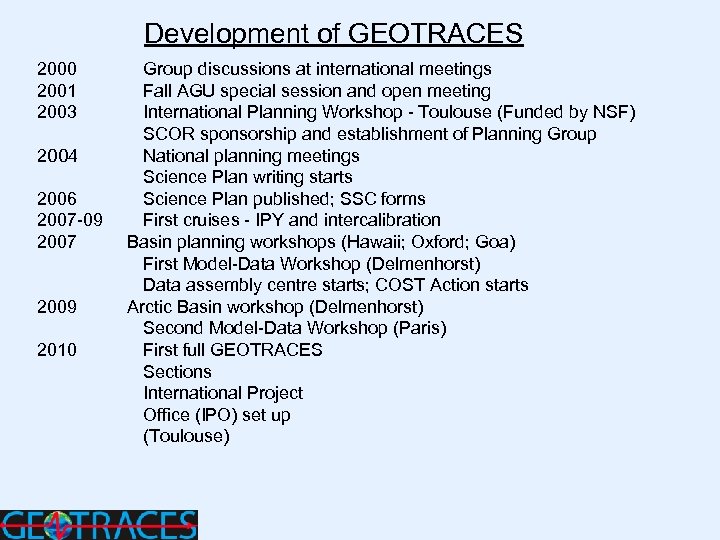
Development of GEOTRACES 2000 2001 2003 2004 2006 2007 -09 2007 2009 2010 Timeline Group discussions at international meetings Fall AGU special session and open meeting International Planning Workshop - Toulouse (Funded by NSF) SCOR sponsorship and establishment of Planning Group National planning meetings Science Plan writing starts Science Plan published; SSC forms First cruises - IPY and intercalibration Basin planning workshops (Hawaii; Oxford; Goa) First Model-Data Workshop (Delmenhorst) Data assembly centre starts; COST Action starts Arctic Basin workshop (Delmenhorst) Second Model-Data Workshop (Paris) First full GEOTRACES Sections International Project Office (IPO) set up (Toulouse)
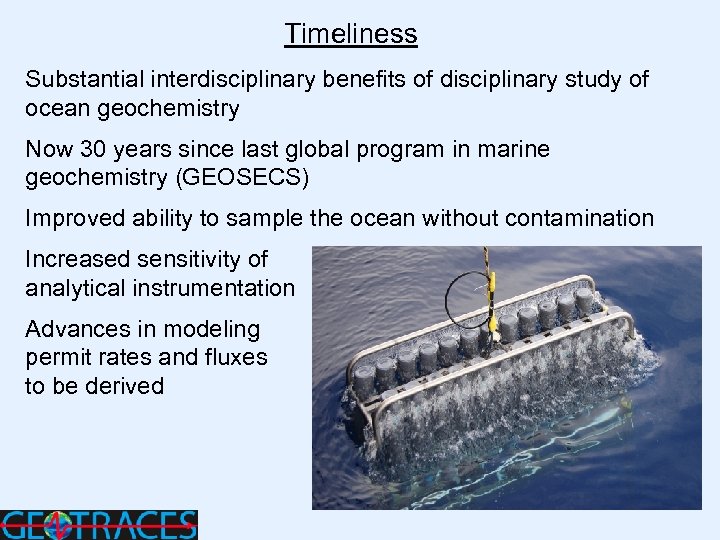
Timeliness Substantial interdisciplinary benefits of disciplinary study of ocean geochemistry Now 30 years since last global program in marine geochemistry (GEOSECS) Improved ability to sample the ocean without contamination Increased sensitivity of analytical instrumentation Advances in modeling permit rates and fluxes to be derived
Contamination free sampling systems: Principal GEOTRACES Capacity-Building Effort • • • Japan Netherlands U. S. A. New Zealand (2000 m) France (under construction) Germany (funded) Canada (expanding) India (funded) Australia (under construction) Taiwan (3000 m) UK (awaiting winch) China (seeking funding with new ship)
GEOTRACES: Capacity Building Trace metal - clean sampling technology and methods Many nations lack infrastructure and expertise for clean sampling Principal barrier is sampling at sea, not analyses GEOTRACES offers international assistance in design, construction and use of clean sampling systems
GEOTRACES: Program Elements Enabling Activities Standards and intercalibration Data protocols, management, archiving Modeling Capacity Building International Polar Year Ocean Sections Core activity - requires international cooperation Covering regions dominated by major processes National cruises with international collaboration Process Studies Targeted at processes known to be important Targeted at “anomalies” detected in ocean sections Some will focus on ocean boundaries (e. g. , coastal regions) Some will exploit time-series stations
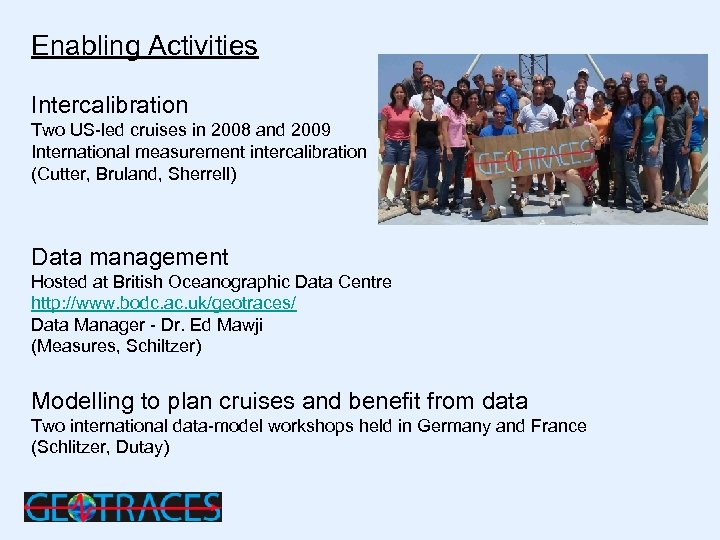
Enabling Activities Intercalibration Two US-led cruises in 2008 and 2009 International measurement intercalibration (Cutter, Bruland, Sherrell) Data management Hosted at British Oceanographic Data Centre http: //www. bodc. ac. uk/geotraces/ Data Manager - Dr. Ed Mawji (Measures, Schiltzer) Modelling to plan cruises and benefit from data Two international data-model workshops held in Germany and France (Schlitzer, Dutay)
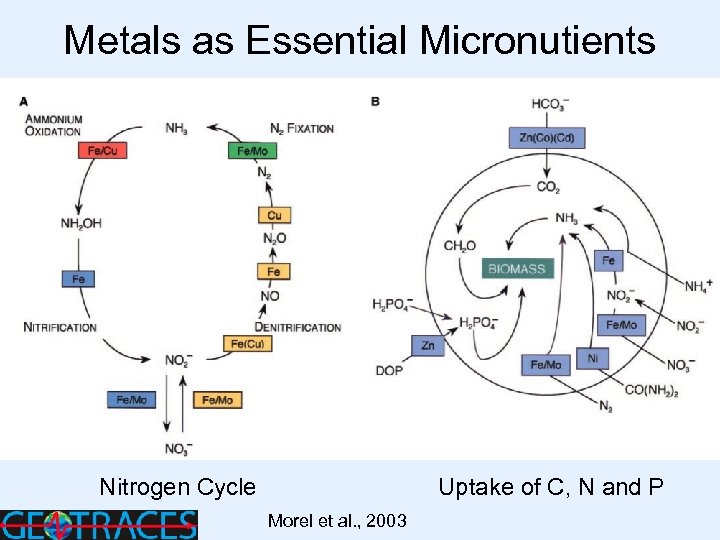
Metals as Essential Micronutients Nitrogen Cycle Uptake of C, N and P Morel et al. , 2003
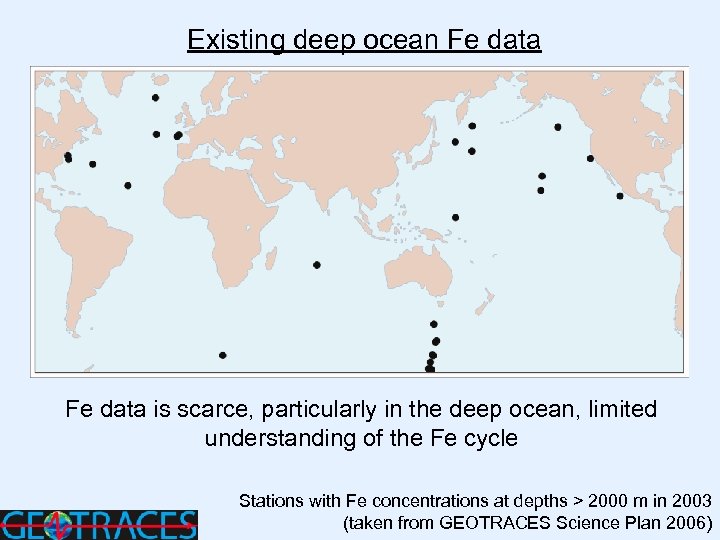
Existing deep ocean Fe data is scarce, particularly in the deep ocean, limited understanding of the Fe cycle Data. Limited for Fe Stations with Fe concentrations at depths > 2000 m in 2003 (taken from GEOTRACES Science Plan 2006)
Existing deep ocean Zn data Distribution and cycling of other micronutrients poorly known Data. Limited for Fe Stations with Zn concentrations at depths > 2000 m As of 2009 - compiled by Maeve Lohan
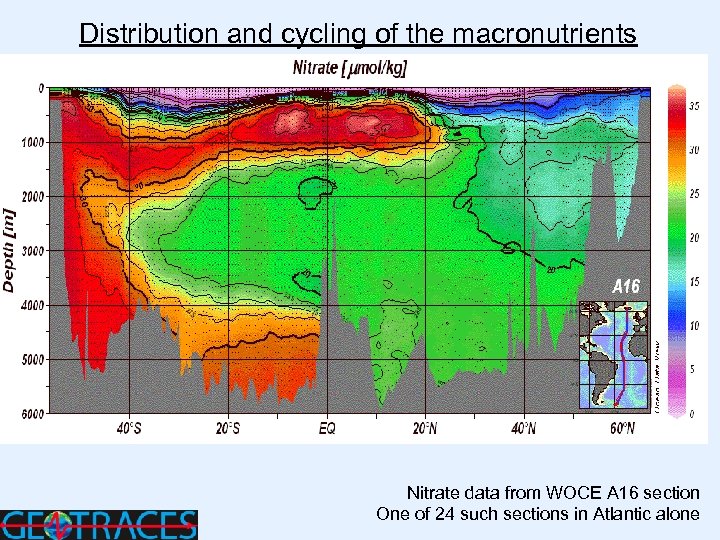
Distribution and cycling of the macronutrients Atlantic. Nitrate data from WOCE A 16 section One of 24 such sections in Atlantic alone
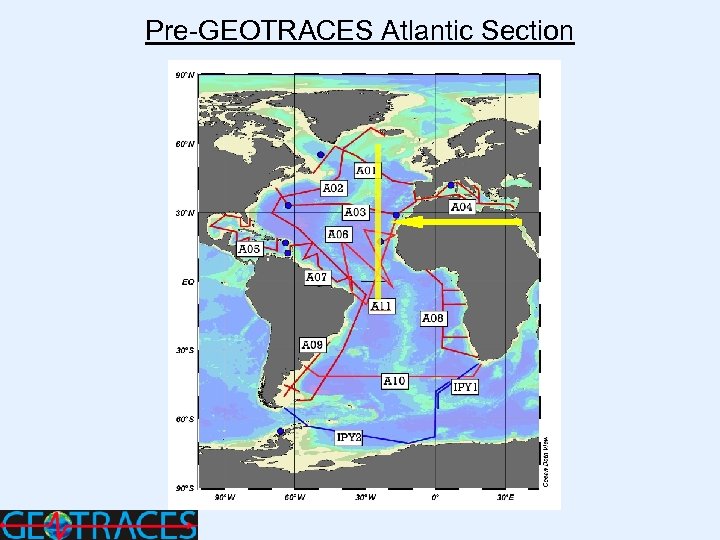
Pre-GEOTRACES Atlantic Section
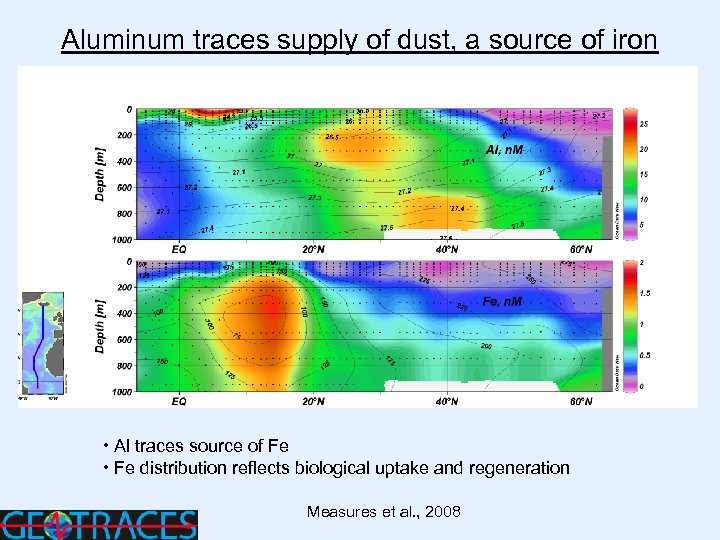
Aluminum traces supply of dust, a source of iron • Al traces source of Fe • Fe distribution reflects biological uptake and regeneration Measures et al. , 2008
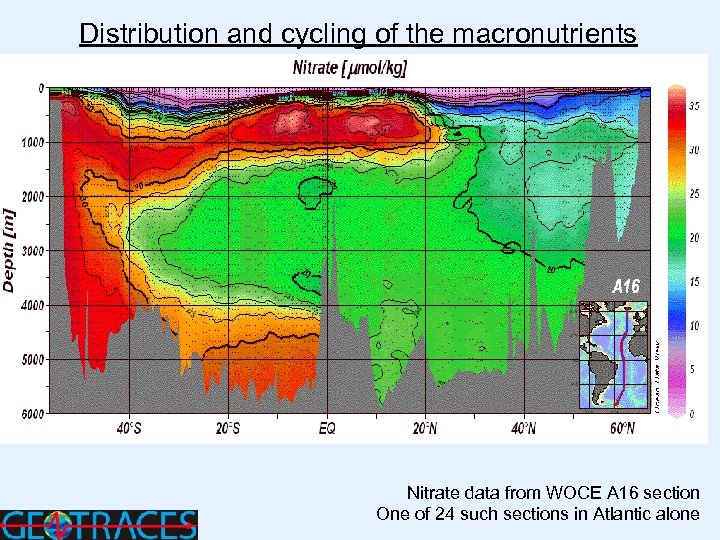
Distribution and cycling of the macronutrients Atlantic. Nitrate data from WOCE A 16 section One of 24 such sections in Atlantic alone
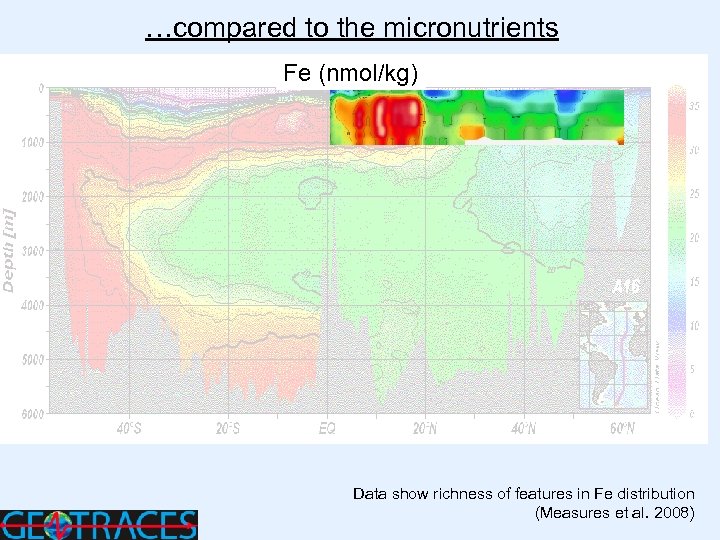
…compared to the micronutrients Fe (nmol/kg) Data show richness of features in Fe distribution (Measures et al. 2008) Atlantic Fe
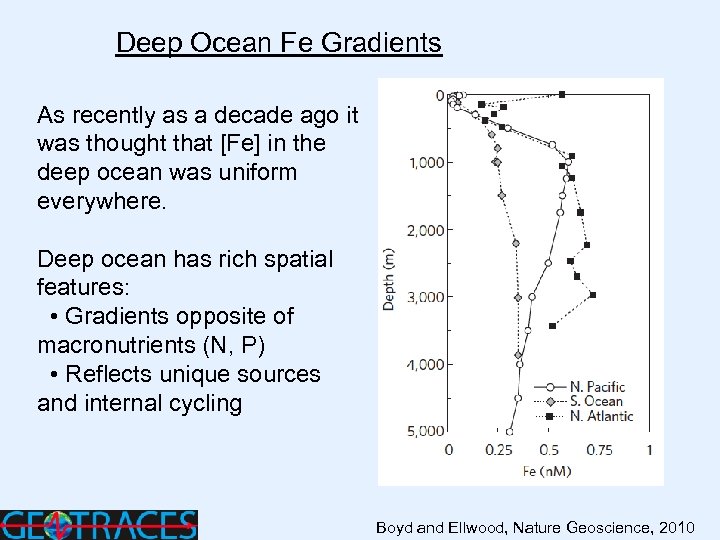
Deep Ocean Fe Gradients As recently as a decade ago it was thought that [Fe] in the deep ocean was uniform everywhere. Deep ocean has rich spatial features: • Gradients opposite of macronutrients (N, P) • Reflects unique sources and internal cycling Boyd and Ellwood, Nature Geoscience, 2010
Overriding Goal: Characterize TEI distributions • Combine distributions with knowledge of basic processes • Infer: Sources, sinks, internal cycling • Multi TEI strategy reveals additional information • Initial emphasis on sections to characterize distributions
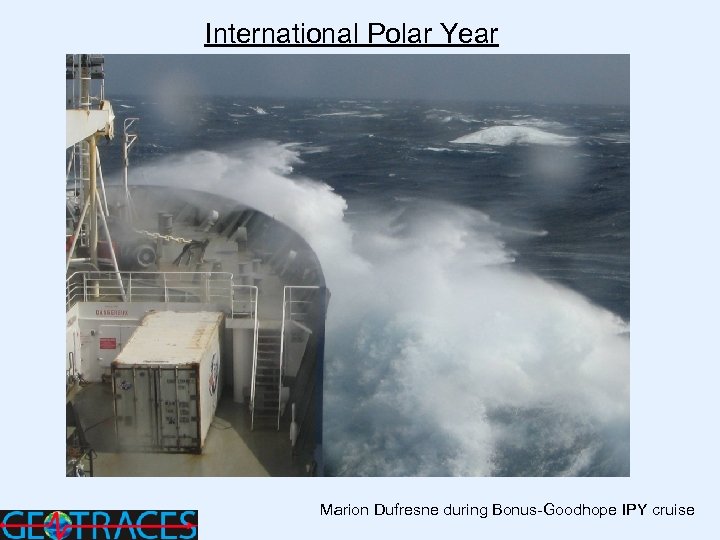
International Polar Year Marion Dufresne during Bonus-Goodhope IPY cruise
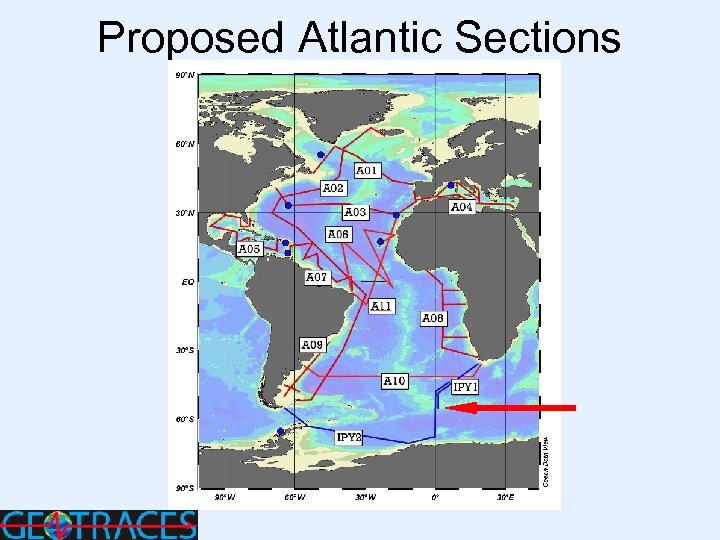
Proposed Atlantic Sections
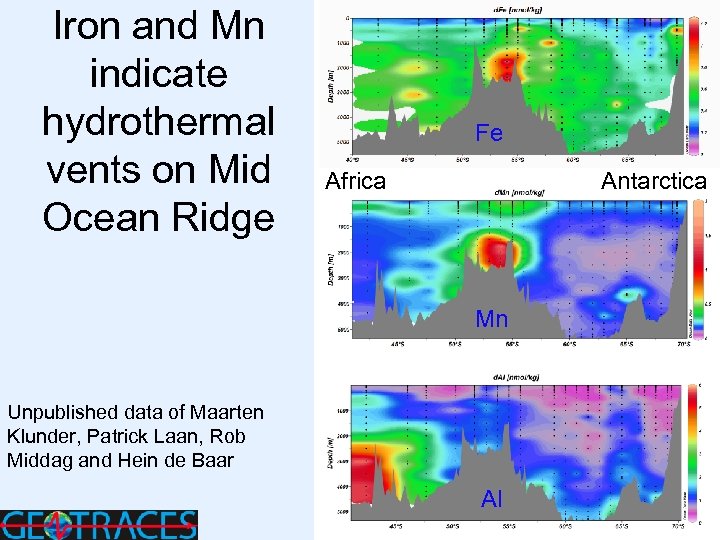
Iron and Mn indicate hydrothermal vents on Mid Ocean Ridge Fe Africa Antarctica Mn Unpublished data of Maarten Klunder, Patrick Laan, Rob Middag and Hein de Baar Al
Strategy for Global Ocean Coverage • International workshops define priorities for each basin • National committees select elements based on: National priorities Anticipated benefits Resources Interests and expertise • Coordination via international SSC
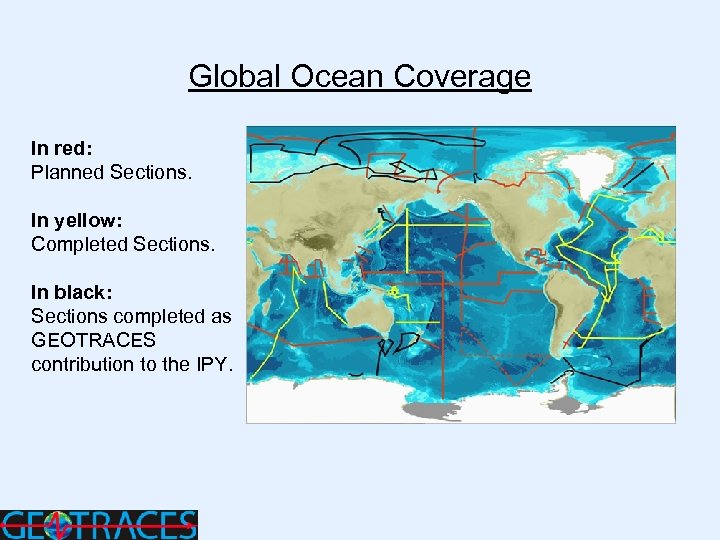
Global Ocean Coverage In red: Planned Sections. In yellow: Completed Sections. In black: Sections completed as GEOTRACES contribution to the IPY.
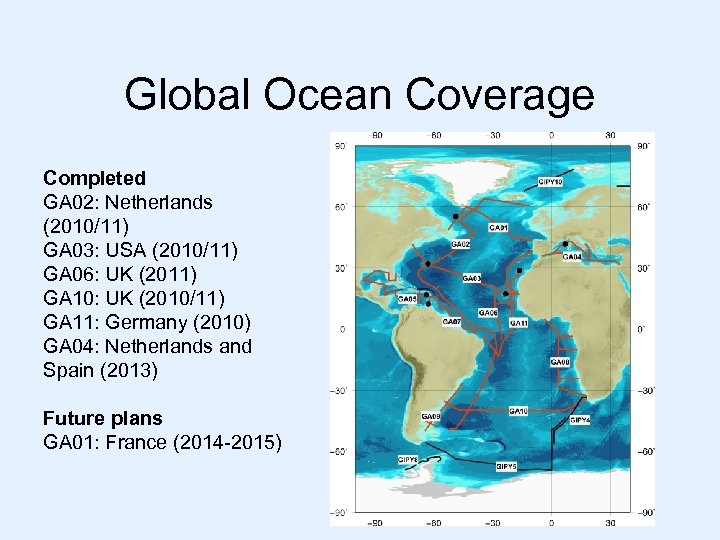
Global Ocean Coverage Completed GA 02: Netherlands (2010/11) GA 03: USA (2010/11) GA 06: UK (2011) GA 10: UK (2010/11) GA 11: Germany (2010) GA 04: Netherlands and Spain (2013) Future plans GA 01: France (2014 -2015)
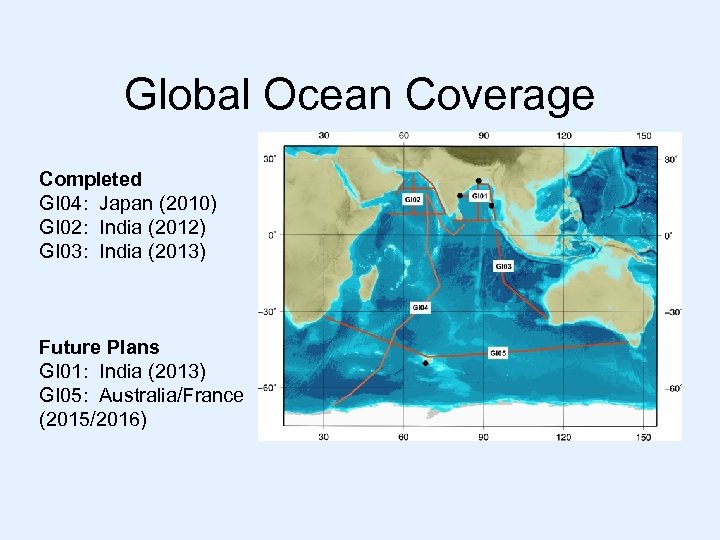
Global Ocean Coverage Completed GI 04: Japan (2010) GI 02: India (2012) GI 03: India (2013) Future Plans GI 01: India (2013) GI 05: Australia/France (2015/2016)
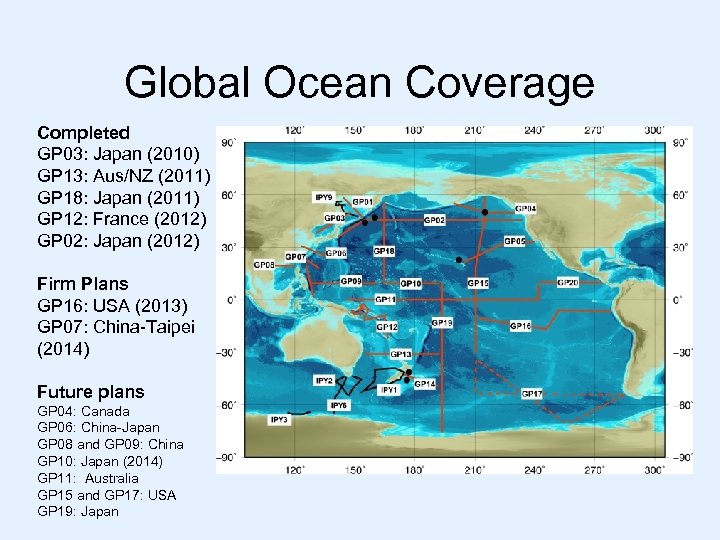
Global Ocean Coverage Completed GP 03: Japan (2010) GP 13: Aus/NZ (2011) GP 18: Japan (2011) GP 12: France (2012) GP 02: Japan (2012) Firm Plans GP 16: USA (2013) GP 07: China-Taipei (2014) Future plans GP 04: Canada GP 06: China-Japan GP 08 and GP 09: China GP 10: Japan (2014) GP 11: Australia GP 15 and GP 17: USA GP 19: Japan
Transnational GEOTRACES Activities - European co-ordination: An ESF COST Action was funding networking and meetings across Europe (http: //costaction. earth. ox. ac. uk/) Involvement of 18 European countries (Belgium, Croatia, Finland, France, Germany, Greece, Iceland, Ireland, Israel, Italy, Netherlands, Norway, Poland, Portugal, Spain, Sweden, Switzerland, United Kingdom) One focus is on co-ordination and organization of a Mediterranean Sea cruise (June-August 2013) - Arctic co-ordination: Co-ordination meeting in Delmenhorst, Germany 2009 - Second co-ordination meeting (29 September - 1 October, 2010), Washington, D. C. - Third co-ordination meeting in Vancouver, Canada 2012.
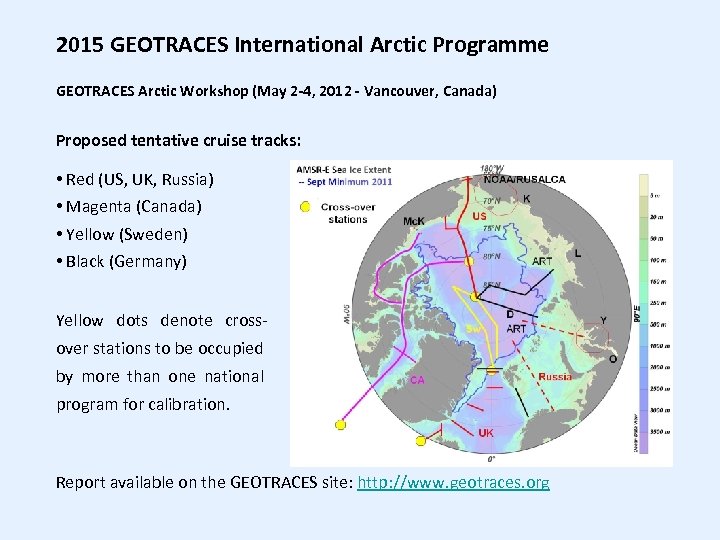
2015 GEOTRACES International Arctic Programme GEOTRACES Arctic Workshop (May 2 -4, 2012 - Vancouver, Canada) Proposed tentative cruise tracks: • Red (US, UK, Russia) • Magenta (Canada) • Yellow (Sweden) • Black (Germany) Yellow dots denote crossover stations to be occupied by more than one national program for calibration. Report available on the GEOTRACES site: http: //www. geotraces. org
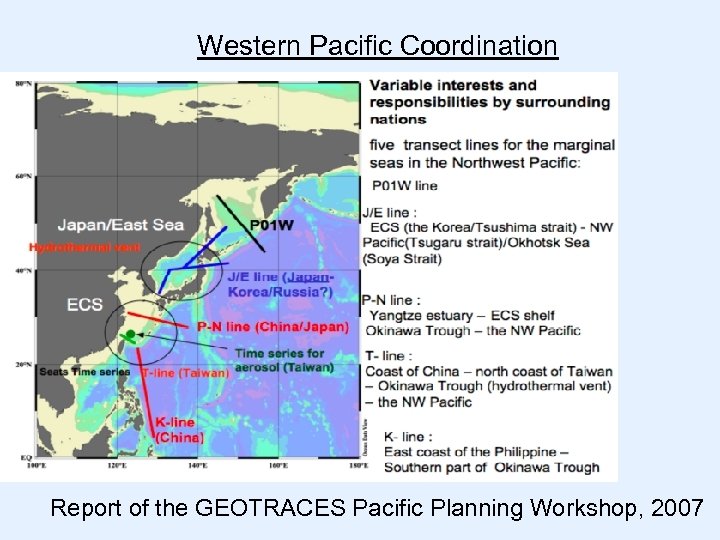
Western Pacific Coordination Report of the GEOTRACES Pacific Planning Workshop, 2007
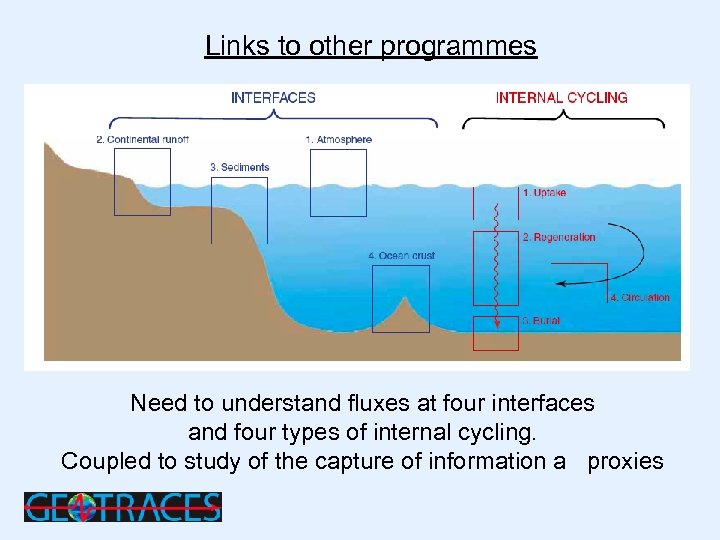
Links to other programmes Need to understand fluxes at four interfaces and four types of internal cycling. Coupled to study of the capture of information a proxies
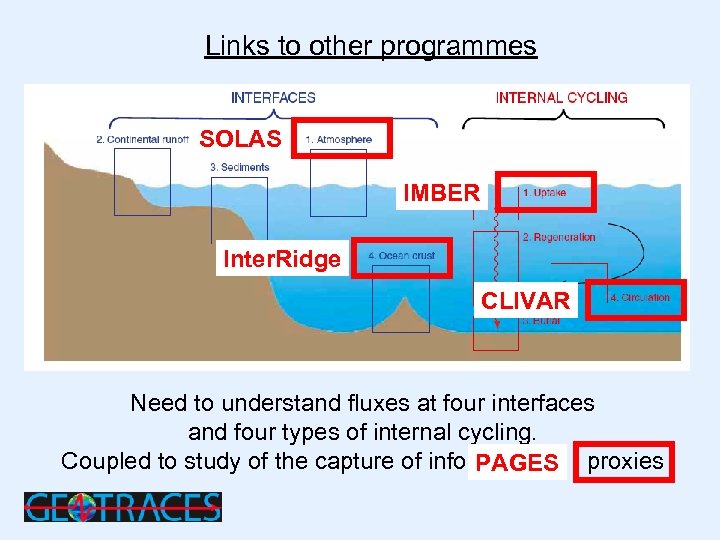
Links to other programmes SOLAS IMBER Inter. Ridge CLIVAR Need to understand fluxes at four interfaces and four types of internal cycling. Coupled to study of the capture of information a proxies PAGES
www. geotraces. org ipo@geotraces. org
Скачать презентацию An introduction to the program Bob Anderson Co-chair
574397f4b36652bdc56749234eed3151.ppt