


 Скачать презентацию An introduction to standards and standardization for nanotechnologies
7efba561bfff0958837a72a9c877863b.ppt
- Количество слайдов: 26
 An introduction to standards and standardization for nanotechnologies Dr Peter Hatto, Chairman UK NTI/1 and ISO TC 229 Nanotechnologies Standardization committees Read more at BSI’s nanotechnology website for standards and news www. bsigroup. com/nano
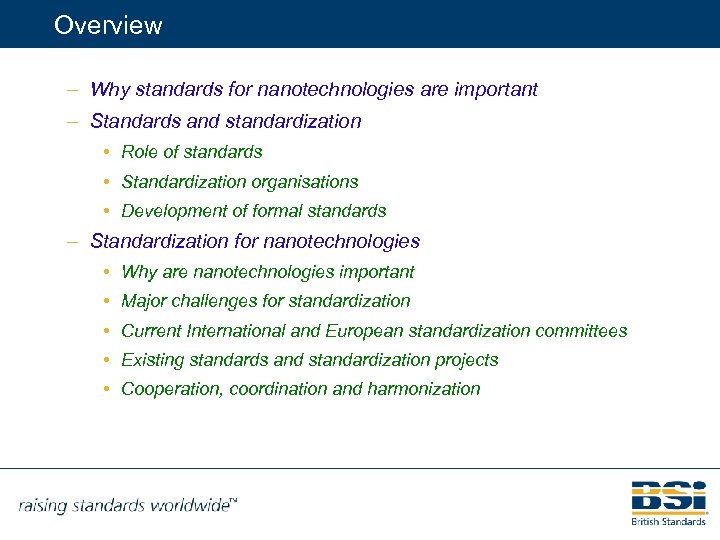 Overview – Why standards for nanotechnologies are important – Standards and standardization • Role of standards • Standardization organisations • Development of formal standards – Standardization for nanotechnologies • Why are nanotechnologies important • Major challenges for standardization • Current International and European standardization committees • Existing standards and standardization projects • Cooperation, coordination and harmonization
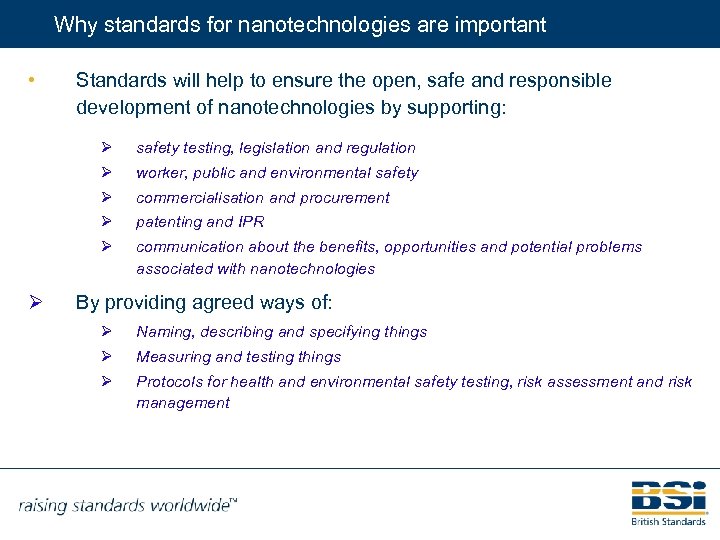 Why standards for nanotechnologies are important • Standards will help to ensure the open, safe and responsible development of nanotechnologies by supporting: Ø Ø worker, public and environmental safety Ø commercialisation and procurement Ø patenting and IPR Ø Ø safety testing, legislation and regulation communication about the benefits, opportunities and potential problems associated with nanotechnologies By providing agreed ways of: Ø Naming, describing and specifying things Ø Measuring and testing things Ø Protocols for health and environmental safety testing, risk assessment and risk management
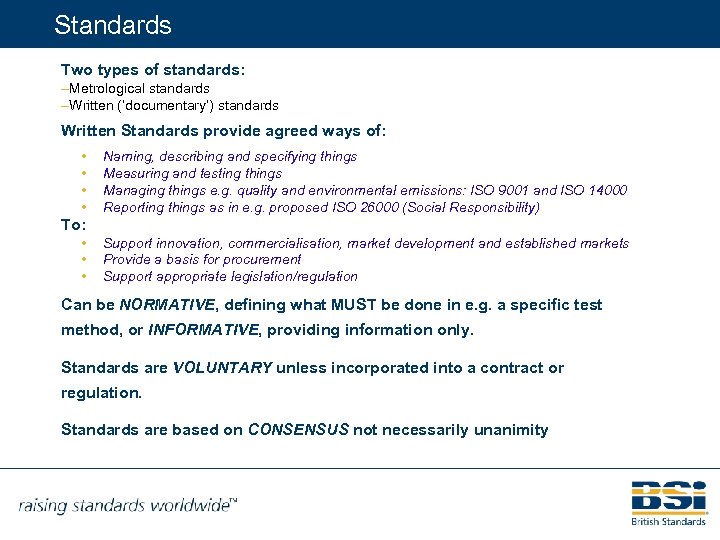 Standards Two types of standards: –Metrological standards –Written (‘documentary’) standards Written Standards provide agreed ways of: • • Naming, describing and specifying things Measuring and testing things Managing things e. g. quality and environmental emissions: ISO 9001 and ISO 14000 Reporting things as in e. g. proposed ISO 26000 (Social Responsibility) To: • • • Support innovation, commercialisation, market development and established markets Provide a basis for procurement Support appropriate legislation/regulation Can be NORMATIVE, defining what MUST be done in e. g. a specific test method, or INFORMATIVE, providing information only. Standards are VOLUNTARY unless incorporated into a contract or regulation. Standards are based on CONSENSUS not necessarily unanimity
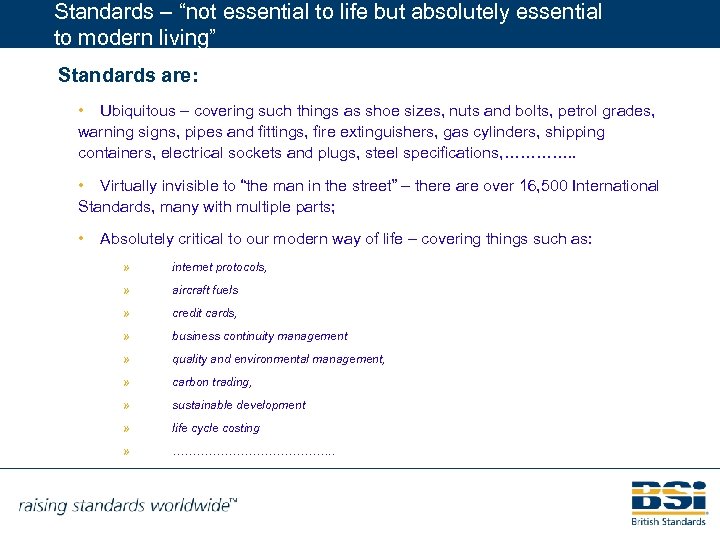 Standards – “not essential to life but absolutely essential to modern living” Standards are: • Ubiquitous – covering such things as shoe sizes, nuts and bolts, petrol grades, warning signs, pipes and fittings, fire extinguishers, gas cylinders, shipping containers, electrical sockets and plugs, steel specifications, …………. . • Virtually invisible to “the man in the street” – there are over 16, 500 International Standards, many with multiple parts; • Absolutely critical to our modern way of life – covering things such as: » internet protocols, » aircraft fuels » credit cards, » business continuity management » quality and environmental management, » carbon trading, » sustainable development » life cycle costing » …………………. .
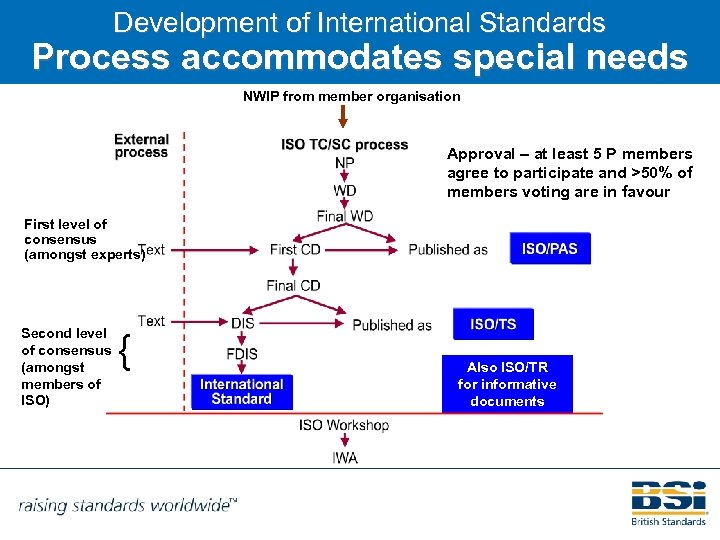 Development of International Standards Process accommodates special needs NWIP from member organisation Approval – at least 5 P members agree to participate and >50% of members voting are in favour First level of consensus (amongst experts) Second level of consensus (amongst members of ISO) { Also ISO/TR for informative documents
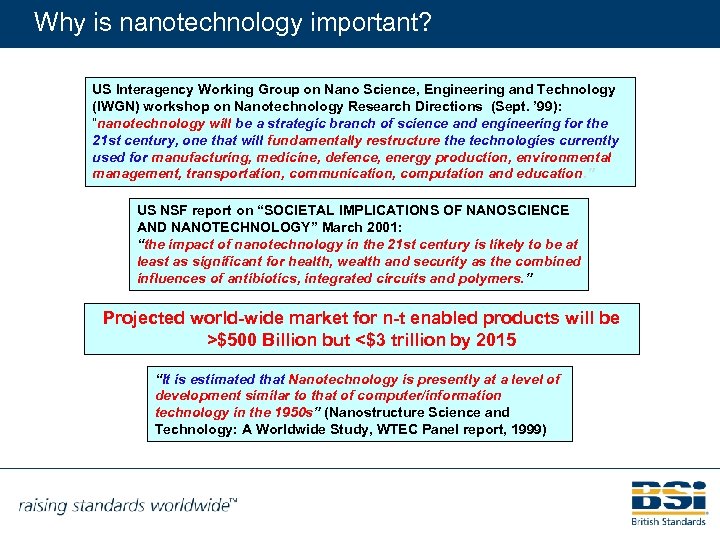 Why is nanotechnology important? US Interagency Working Group on Nano Science, Engineering and Technology (IWGN) workshop on Nanotechnology Research Directions (Sept. ’ 99): “nanotechnology will be a strategic branch of science and engineering for the 21 st century, one that will fundamentally restructure the technologies currently used for manufacturing, medicine, defence, energy production, environmental management, transportation, communication, computation and education. ” US NSF report on “SOCIETAL IMPLICATIONS OF NANOSCIENCE AND NANOTECHNOLOGY” March 2001: “the impact of nanotechnology in the 21 st century is likely to be at least as significant for health, wealth and security as the combined influences of antibiotics, integrated circuits and polymers. ” Projected world-wide market for n-t enabled products will be >$500 Billion but <$3 trillion by 2015 “It is estimated that Nanotechnology is presently at a level of development similar to that of computer/information technology in the 1950 s” (Nanostructure Science and Technology: A Worldwide Study, WTEC Panel report, 1999)
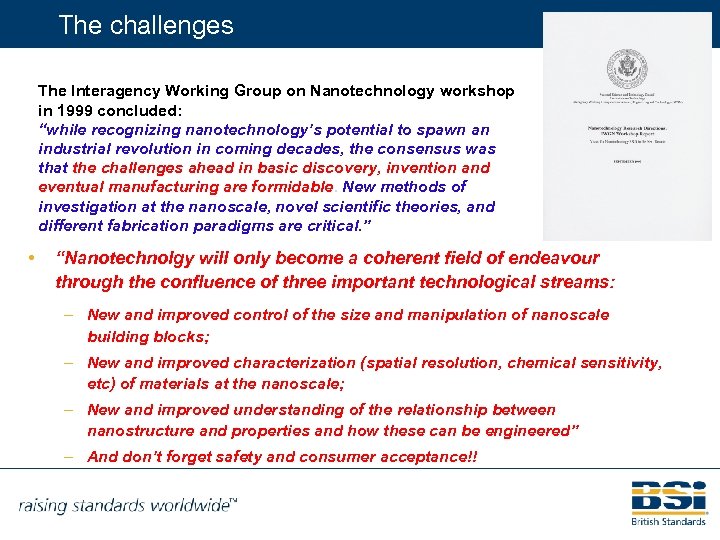 The challenges The Interagency Working Group on Nanotechnology workshop in 1999 concluded: “while recognizing nanotechnology’s potential to spawn an industrial revolution in coming decades, the consensus was that the challenges ahead in basic discovery, invention and eventual manufacturing are formidable. New methods of investigation at the nanoscale, novel scientific theories, and different fabrication paradigms are critical. ” • “Nanotechnolgy will only become a coherent field of endeavour through the confluence of three important technological streams: – New and improved control of the size and manipulation of nanoscale building blocks; – New and improved characterization (spatial resolution, chemical sensitivity, etc) of materials at the nanoscale; – New and improved understanding of the relationship between nanostructure and properties and how these can be engineered” – And don’t forget safety and consumer acceptance!!
 Major challenges for standardization for nanotechnologies • Diversity of disciplines impacted by and contributing to nanotechnologies • Global impact • Rapid speed of development and apparent speed of commercialisation (over 800 consumer products on the market – see Woodrow Wilson International Center for Scholars inventory: www. nanotechproject. org/inventories/consumer ) • Critical areas: – Coordination and harmonization across standards developers and stakeholders – Terminology – Measurement and characterization – Health, safety and environmental issues – Material specifications
 International Organisation for Standardization ISO/TC 229 Nanotechnologies – Established in June 2005 – 44 members – 36 “P” and 8 “O” (see www. iso. org/iso/standards_development/technical_comm ittees/list_of_iso_technical_committees/iso_technical_co mmittee. htm? commid=381983 ) – Works closely with IEC/TC 113 and CEN/TC 352 – Liaisons with 26 ISO/IEC/CEN TCs and 9 external bodies –Asia Nano Forum, BIPM, EC JRC, ECOS, ETUI, IRMM, IUPAC, OECD and VAMAS – Exploring additional external liaisons with other groups and with emerging economies
 International Electrotechnical Commission IEC/TC 113 – “Nanotechnology standardization for electrical and electronic products and systems” • Established June 2006 with US Chair and German secretariat • www. iec. ch/cgibin/procgi. pl/www/iecwww. p? wwwlang=e&wwwprog=dirdet. p&progdb=db 1&cs s_color=purple&committee=TC&number=113 • 32 members - 18 “P” and 14 “O” • Agreed to establish two Joint Working Groups with ISO/TC 229: • JWG 1 – Terminology and nomenclature • JWG 2 – Measurement and characterization • Together with a third Working Group: • WG 3 – Performance assessment
 • European Committee for Standardization CEN/TC 352 - Nanotechnologies • Established November 2005 following a recommendation from CEN/BTWG 166 – French chair and joint French/Czech Republic secretariat – All 30 members of CEN are notionally members – around 14 active – Works closely with ISO/TC 229 using the ‘Vienna Agreement’ for cooperative working. – Developing a work programme to include areas of specific interest to Europe and areas that will be relevant to European legislation. – Coordinating work programme to address European Commission mandate M/461 for standardization activities regarding nanotechnologies and nanomaterials. – Two working groups established in September 2008: • WG 1 'Measurement, characterization and performance evaluation' • WG 2 'Commercial and other stakeholder aspects'
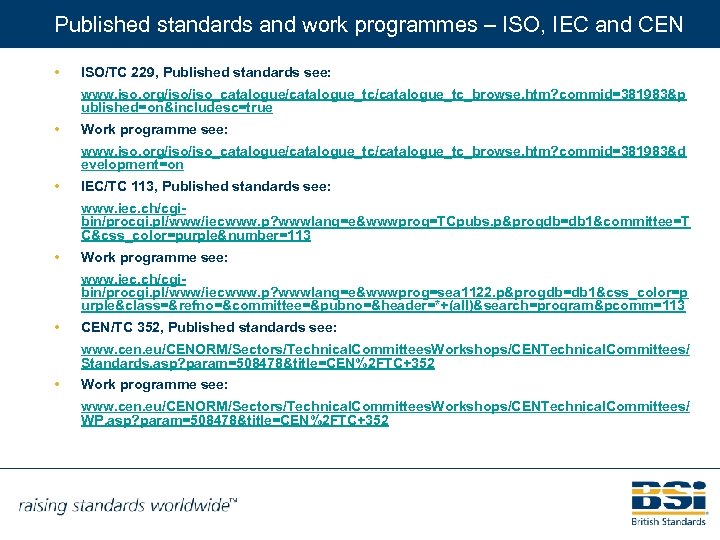 Published standards and work programmes – ISO, IEC and CEN • ISO/TC 229, Published standards see: www. iso. org/iso_catalogue/catalogue_tc_browse. htm? commid=381983&p ublished=on&includesc=true • Work programme see: www. iso. org/iso_catalogue/catalogue_tc_browse. htm? commid=381983&d evelopment=on • IEC/TC 113, Published standards see: www. iec. ch/cgibin/procgi. pl/www/iecwww. p? wwwlang=e&wwwprog=TCpubs. p&progdb=db 1&committee=T C&css_color=purple&number=113 • Work programme see: www. iec. ch/cgibin/procgi. pl/www/iecwww. p? wwwlang=e&wwwprog=sea 1122. p&progdb=db 1&css_color=p urple&class=&refno=&committee=&pubno=&header=*+(all)&search=program&pcomm=113 • CEN/TC 352, Published standards see: www. cen. eu/CENORM/Sectors/Technical. Committees. Workshops/CENTechnical. Committees/ Standards. asp? param=508478&title=CEN%2 FTC+352 • Work programme see: www. cen. eu/CENORM/Sectors/Technical. Committees. Workshops/CENTechnical. Committees/ WP. asp? param=508478&title=CEN%2 FTC+352
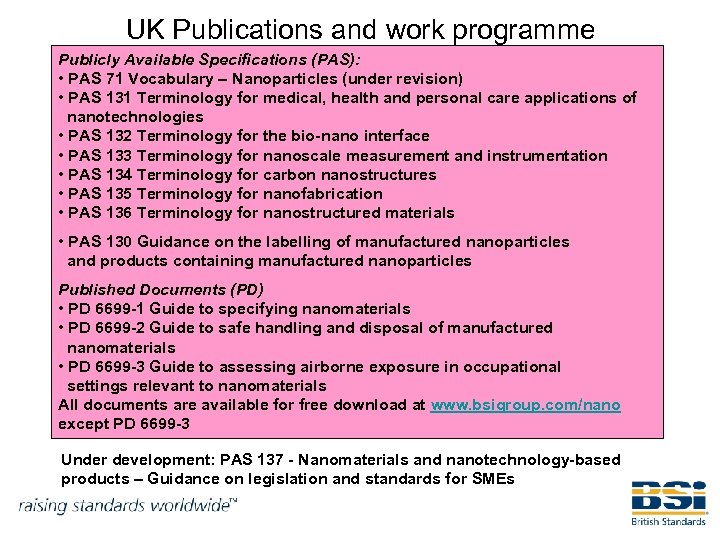 UK Publications and work programme Publicly Available Specifications (PAS): • PAS 71 Vocabulary – Nanoparticles (under revision) • PAS 131 Terminology for medical, health and personal care applications of nanotechnologies • PAS 132 Terminology for the bio-nano interface • PAS 133 Terminology for nanoscale measurement and instrumentation • PAS 134 Terminology for carbon nanostructures • PAS 135 Terminology for nanofabrication • PAS 136 Terminology for nanostructured materials • PAS 130 Guidance on the labelling of manufactured nanoparticles and products containing manufactured nanoparticles Published Documents (PD) • PD 6699 -1 Guide to specifying nanomaterials • PD 6699 -2 Guide to safe handling and disposal of manufactured nanomaterials • PD 6699 -3 Guide to assessing airborne exposure in occupational settings relevant to nanomaterials All documents are available for free download at www. bsigroup. com/nano except PD 6699 -3 Under development: PAS 137 - Nanomaterials and nanotechnology-based products – Guidance on legislation and standards for SMEs
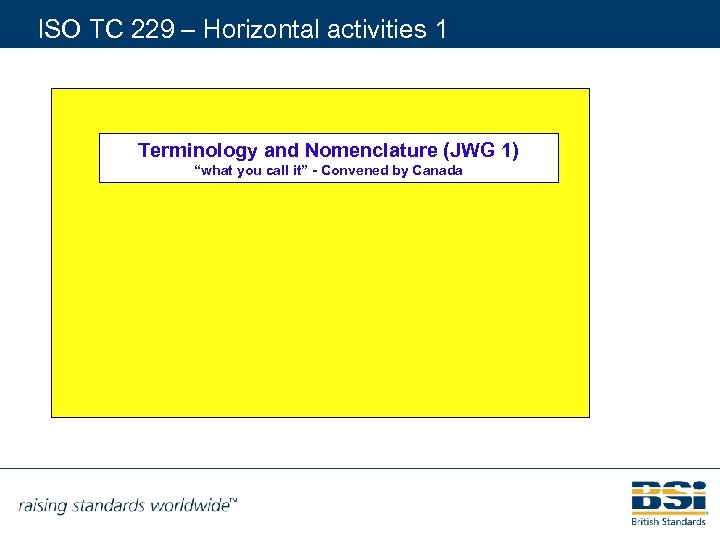 ISO TC 229 – Horizontal activities 1 Terminology and Nomenclature (JWG 1) “what you call it” - Convened by Canada
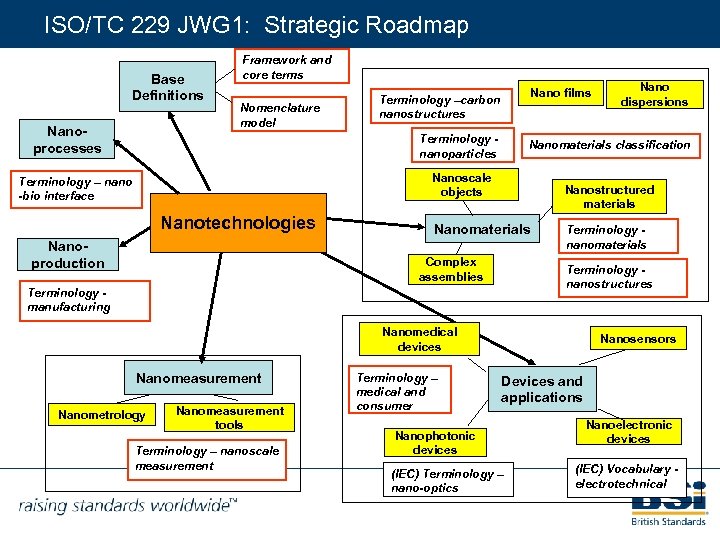 ISO/TC 229 JWG 1: Strategic Roadmap Base Definitions Nanoprocesses Framework and core terms Nomenclature model Nano films Terminology –carbon nanostructures Terminology nanoparticles Nanomaterials classification Nanoscale objects Terminology – nano -bio interface Nanotechnologies Nanoproduction Nanostructured materials Nanomaterials Complex assemblies Terminology nanomaterials Terminology nanostructures Terminology manufacturing Nanomedical devices Nanomeasurement Nanometrology Nanomeasurement tools Terminology – nanoscale measurement Terminology – medical and consumer Nano dispersions Nanosensors Devices and applications Nanophotonic devices (IEC) Terminology – nano-optics Nanoelectronic devices (IEC) Vocabulary electrotechnical
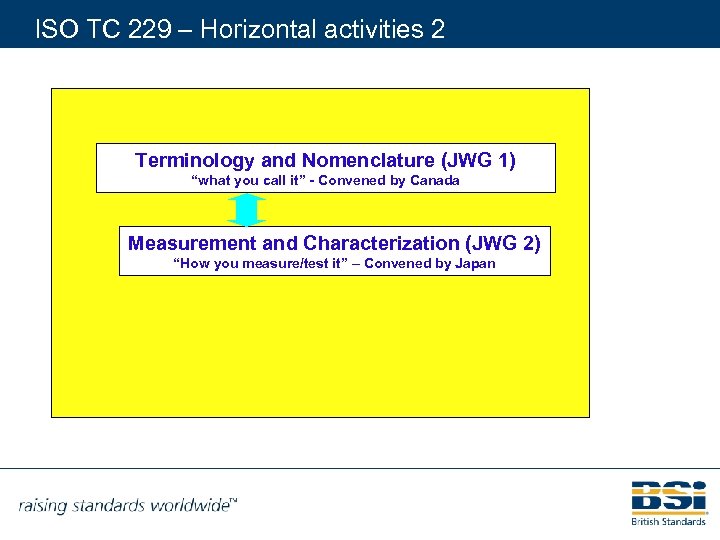 ISO TC 229 – Horizontal activities 2 Terminology and Nomenclature (JWG 1) “what you call it” - Convened by Canada Measurement and Characterization (JWG 2) “How you measure/test it” – Convened by Japan
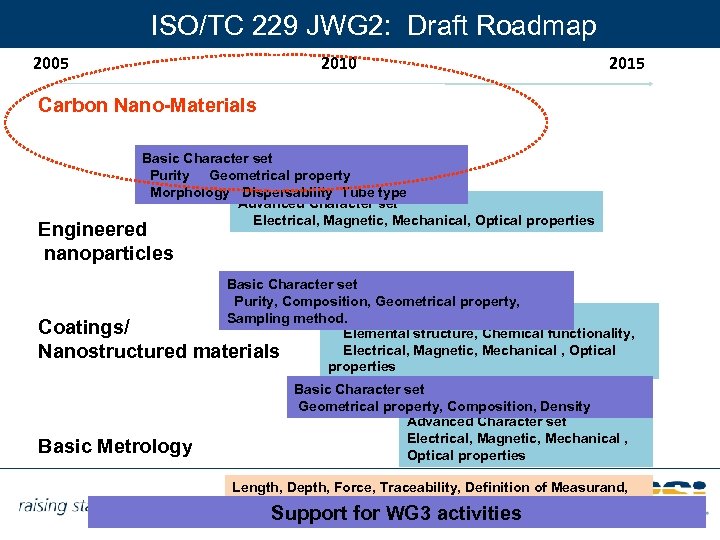 ISO/TC 229 JWG 2: Draft Roadmap 2005 2010 2015 Carbon Nano-Materials Basic Character set Purity Geometrical property Morphology Dispersability Tube type Advanced Character set Electrical, Magnetic, Mechanical, Optical properties Engineered nanoparticles Coatings/ Nanostructured Basic Character set Purity, Composition, Geometrical property, Advanced Character set Sampling method. Elemental structure, Chemical functionality, Electrical, Magnetic, Mechanical , Optical materials properties Basic Metrology Basic Character set Geometrical property, Composition, Density Advanced Character set Electrical, Magnetic, Mechanical , Optical properties Length, Depth, Force, Traceability, Definition of Measurand, Uncertainty Interoperability Support for WG 3 activities
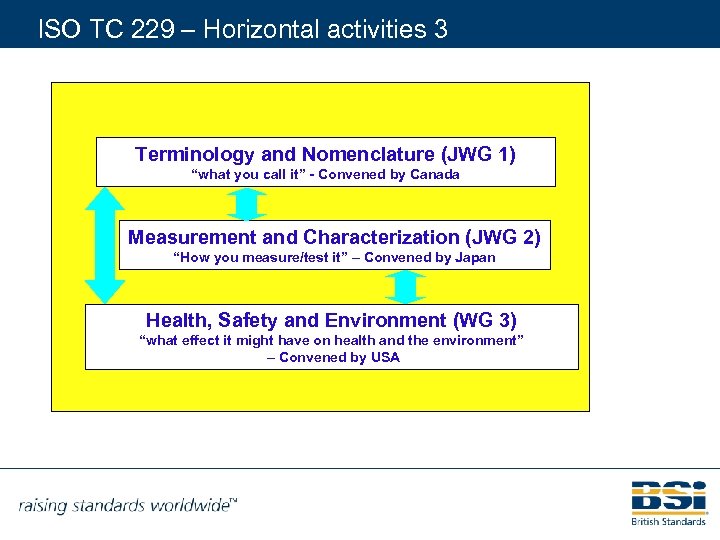 ISO TC 229 – Horizontal activities 3 Terminology and Nomenclature (JWG 1) “what you call it” - Convened by Canada Measurement and Characterization (JWG 2) “How you measure/test it” – Convened by Japan Health, Safety and Environment (WG 3) “what effect it might have on health and the environment” – Convened by USA
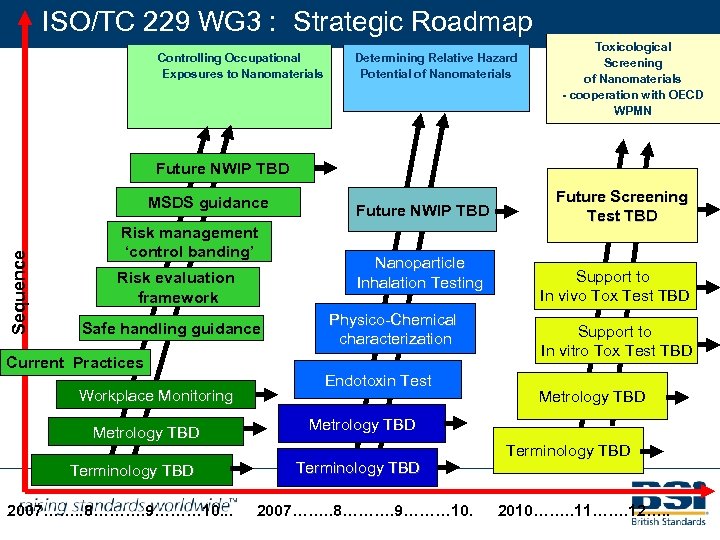 ISO/TC 229 WG 3 : Strategic Roadmap Controlling Occupational Exposures to Nanomaterials Determining Relative Hazard Potential of Nanomaterials Toxicological Screening of Nanomaterials - cooperation with OECD WPMN Future NWIP TBD Sequence MSDS guidance Risk management ‘control banding’ Risk evaluation framework Safe handling guidance Current Practices Workplace Monitoring Metrology TBD Terminology TBD 2007……. . 8………. 9……… 10. . . Future NWIP TBD Nanoparticle Inhalation Testing Physico-Chemical characterization Endotoxin Test Future Screening Test TBD Support to In vivo Tox Test TBD Support to In vitro Tox Test TBD Metrology TBD Terminology TBD 2007……. . 8………. 9……… 10. Terminology TBD 2010……. . 11……. 12…. .
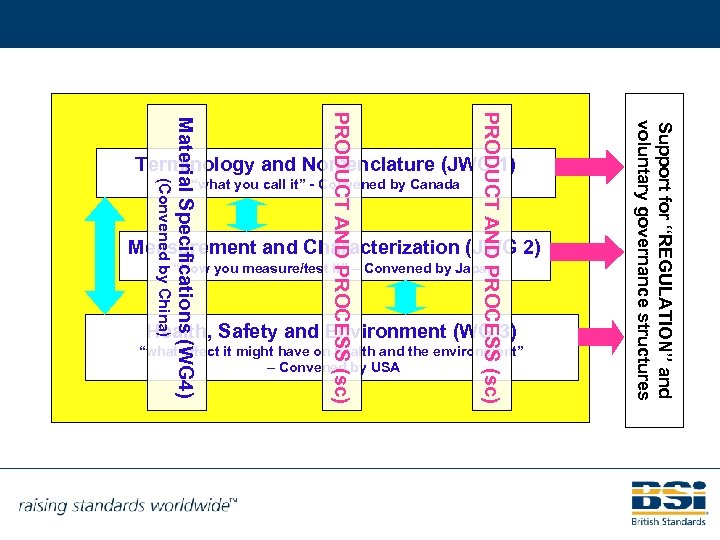 ISO TC 229 – Structure/working areas (Convened by China) “what you call it” - Convened by Canada Measurement and Characterization (JWG 2) “How you measure/test it” – Convened by Japan Health, Safety and Environment (WG 3) “what effect it might have on health and the environment” – Convened by USA Support for “REGULATION” and voluntary governance structures PRODUCT AND PROCESS (sc) Material Specifications (WG 4) Terminology and Nomenclature (JWG 1)
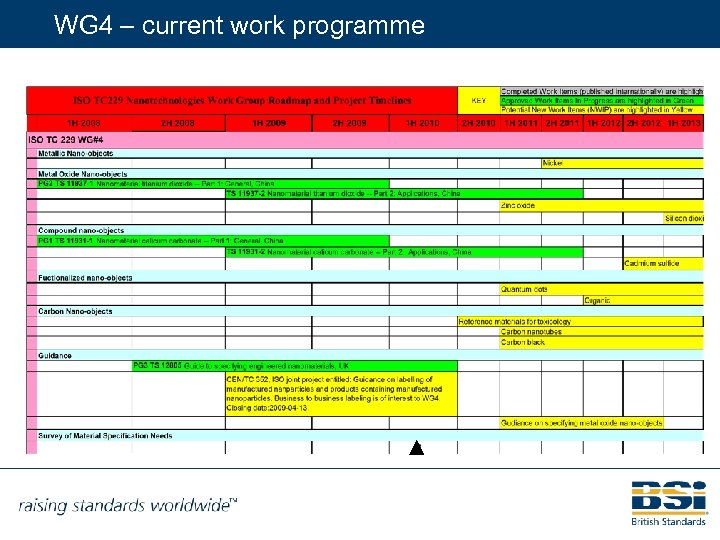 WG 4 – current work programme
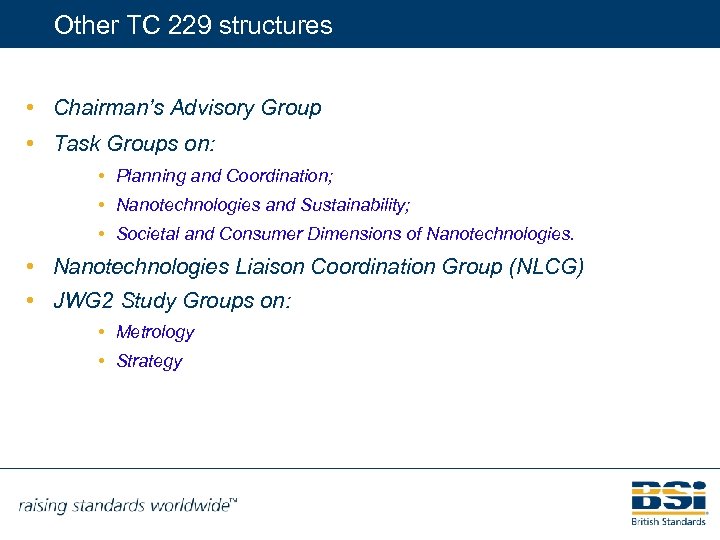 Other TC 229 structures • Chairman’s Advisory Group • Task Groups on: • Planning and Coordination; • Nanotechnologies and Sustainability; • Societal and Consumer Dimensions of Nanotechnologies. • Nanotechnologies Liaison Coordination Group (NLCG) • JWG 2 Study Groups on: • Metrology • Strategy
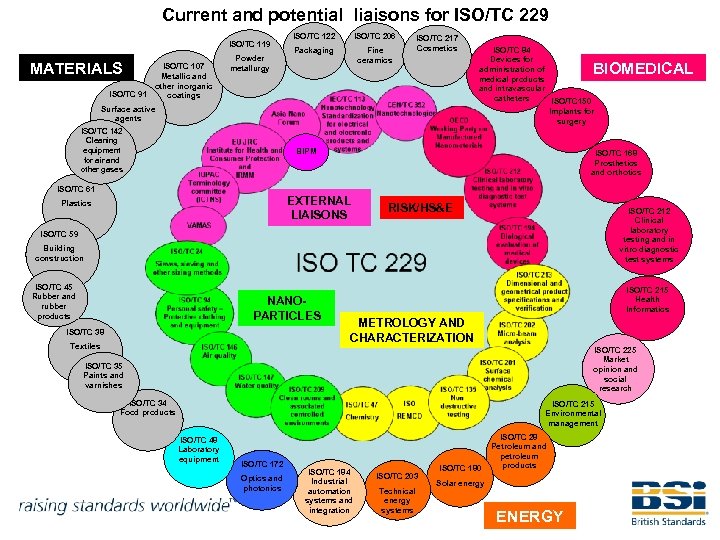 Current and potential liaisons for ISO/TC 229 ISO/TC 119 MATERIALS ISO/TC 107 Metallic and other inorganic ISO/TC 91 coatings Powder metallurgy ISO/TC 122 ISO/TC 206 Packaging Fine ceramics ISO/TC 217 Cosmetics BIOMEDICAL Surface active agents ISO/TC 142 Cleaning equipment for air and other gases ISO/TC 84 Devices for administration of medical products and intravascular catheters ISO/TC 150 Implants for surgery BIPM ISO/TC 168 Prosthetics and orthotics ISO/TC 61 EXTERNAL LIAISONS Plastics RISK/HS&E ISO/TC 212 Clinical laboratory testing and in vitro diagnostic test systems ISO/TC 59 Building construction ISO/TC 45 Rubber and rubber products NANOPARTICLES ISO/TC 38 Textiles ISO/TC 215 Health Informatics METROLOGY AND CHARACTERIZATION ISO/TC 225 Market opinion and social research ISO/TC 35 Paints and varnishes ISO/TC 34 Food products ISO/TC 215 Environmental management ISO/TC 48 Laboratory equipment ISO/TC 172 Optics and photonics ISO/TC 184 Industrial automation systems and integration ISO/TC 203 Technical energy systems ISO/TC 180 ISO/TC 28 Petroleum and petroleum products Solar energy ENERGY
 • The roles of ISO/TC 229, IEC/TC 113 and CEN/ TC 352 will be to identify requirements in cooperation with stakeholders, including industry, governments, regulators, OECD, the European Commission, and the public, to coordinate standards development with relevant TCs, and to develop standards where no TC exists or where the existing TC does not have the necessary resources.
 Why standards for nanotechnologies are important • Standards will help to ensure the open, safe and responsible development of nanotechnologies by supporting: Ø Ø Ø By providing agreed ways of: Ø Ø Ø • safety testing, legislation and regulation worker, public and environmental safety commercialisation and procurement patenting and IPR communication about the benefits, opportunities and potential problems associated with nanotechnologies Naming, describing and specifying things Measuring and testing things Protocols for health and environmental safety testing, risk assessment and risk management Read more at BSI’s nanotechnology website for standards and news www. bsigroup. com/nano